Tag: History of American popular culture

  • A.C. Gunter’s Baron Montez: 13. A Bundle of Letters

    A.C. Gunter’s Baron Montez: 13. A Bundle of Letters

    The nexus of the Louise Minturn and Harry Larchmont characters is reached: their shared connection to Fernando Montez. This is all as the reader might expect from knowledge of Louise’s letters. However, Gunter wants to create a selective perspective of prior events involving Harry that the reader may later share with Louise. Not content with the attributes and qualities he has endowed his characters, Gunter seeks to intrude on the imaginative mental stream of the reader to frame and accentuate the action through his narrator and by other means.

    In Harry’s repartee with Louise in the last chapter, he revealed more of the ‘player’ he is reputed to be. At the close of the chapter, his impetuous act in separating Louise from the presence of Wernig weighs heavy on him, though his thoughts dwell, not on the beautiful Louise, but on his next steps to retrieve his brother’s fortune.

    Though there is no desire to disrupt the reader experience, in order to explore Gunter’s narrative strategy some notes on the content of the chapter ahead is required.

    Harry is on deck smoking cigars again one night, still, one would think, intoxicated with the vision of beauty that was Louise as she left him. Yet it appears in his meditations he has become resolute in a course of action of which some might be critical, perhaps deem dishonorable. Though having access to Harry’s more precise thoughts, Gunter declines to reveal them, and so leaves the reader guessing. Little mysteries add realism to a modern novel as they are part of everyday life, but this has the dramatic touch of deliberate obfuscation.

    At one juncture while informing Louise of the plight of his Francophile brother, Harry bemoans the lack of teaching of American culture in schools. He mentions the nascent sports of baseball and football (we know what becomes of them). But beyond this, one might ask; to what American culture is he referring? The U.S. may boast a number of technical and industrial development achievements, and there are substantial literary best sellers throughout the nineteenth century. Novels such as The Last of the Mohicans by James Fenimore Cooper, Uncle Toms Cabin by abolitionist Harriet Beecher Stowe, Moby Dick by Herman Melville and the very popular Adventures of Huckleberry Finn by Mark Twain which sold in the hundreds of thousands in the U.S. and overseas. And for generations without radio or film or television, and limited access to the theatre or books, entertainment was the circus coming to town. New railways meant the circus could reach many more thousands of people throughout America, and steamships meant many more overseas; Europe and even as far as Australia (Worrall). America’s chief cultural exports of the time were Buffalo Bill’s Wild West Show and P.T. Barnum’s Greatest Show on Earth billed as a circus, museum and menagerie (Watkins).

    This isn’t the first time via Harry this apparent manifestation of inverse cultural cringe (Phillips) has presented with a skew-whiff reasoning. Describing his brother, he equates U.S. disaffiliation with loss of manhood. Gunter is something of a showman himself, and providing entertainment and being sensational is his game. Sensational, to his contemporary audience, is a nineteen-year-old young woman travelling alone without a companion on a steamship to a foreign country, but that is not sufficient. The author wants to provoke emotion-based opinions in his readers where none may have existed. The well-to-do are an easy target for prejudice, and patriotic transgression adds a certain righteousness.

    Woman with a Guitar (n.d.), Julio Romero De Torres (1874-1930)

    Louise has been portrayed as independent, beautiful, at times haughty with strong sense of personal worth, smart, accomplished and not afraid to speak her mind. Shortly after the letters appear, the reader may note an abrupt temporary change in dialogue attributions for our female character. Where before it was ‘Louise’, ‘Miss Minturn’ even ‘the young lady’, now it is ‘the girl’. An apparent attempt through subliminal manipulation to present Louise in an inferior position. So too is the narrator’s suggestion of a tone of proprietorship in Harry’s voice in respect of Louise’s morning agenda, which includes inspecting the letters.

    Louise’s letters are the focus of the chapter, though Harry’s persistence seems a little uncharacteristic, which even Louise remarks upon. On a comment from Harry regarding activities post letter-reading, the narrator cannot resist an amused aside from insider knowledge of what is to come—part of egging the reader on.

    Gunter, through his narrator, is the ringmaster of the various elements of the story that inhabit the reader’s imagination. In a previous intro we covered the paucity of entertainment available to the common man and woman, excluding a possible circus visit. Before the visual artistic forms of film and television, the novel was the chief direct access to the active mental plane of individualsthrough their eyes. Reminders of the narrator’s aural presence as storyteller, of being read to by a third entity have the effect of distracting from the smooth ongoing visual transmission to imagination. There is a shift away from the self-created illusion of reality to acknowledging an amusing fictional entertainment. As the crescendo of the chapter becomes imminent, the narrator cannot resist a snide comment which raises jealousy over integrity as motivation, perhaps to dilute the colour of Louise’s final response, and perhaps also to secure for the author an avenue for later re-engagement.

    And now ladies and gentlemen, without further ado, for your reading pleasure, if you will direct your attention to the centre of the page below. Furin Chime is proud to present, for the first time in a hundred and twenty-five years—the next chapter in the Baron Montez saga! Please enjoy the show!


    CHAPTER 13

    THE BUNDLE OF LETTERS

    The next day Herr Wernig has become again effusively affectionate and thrusts his society upon Mr. Larchmont, though that young gentleman gives him but little chance, as he is again devoting himself to the second cabin passengers.

    This time, he has dropped the society of the man Bastien Lefort for that of one of the second-cabin ladies.

    This lady has a little child of about five. With paternal devotion Harry takes this tot up and carries it about, as he talks to the mother. This attention seems to win the lady’s heart. And he spends a good deal of the morning promenading by her side. By the time he returns to lunch in the first cabin, “his flirtation,” as they express it, has been pretty well discussed by the various ladies and gentlemen of the after part of the ship. Of course it comes to Miss Minturn’s pretty ears, and sets her wondering.

    After an afternoon siesta—for the boat is now well in the tropics, and everybody is drifting with it into the languid manners of the torrid zone—Louise strolls on the deck for a little sea breeze, and chancing to meet the gentleman of her thoughts, puts her reflections into words.

    “Travel views of Cuba and Guatemala” (1899–1926), Genthe photograph collection, Library of Congress, Prints and Photographs Division

    This subject is easily led up to, as Mr. Larchmont even now has in his arms the little girl from the second cabin.

    “Miss Louise,” he says, “this is a new friend of mine. This is pretty little Miss Minnie Winterburn, the daughter of a machinist on one of the Chagres dredgers. Her father has been out there almost since the opening of the railroad. He is by this time used to yellow fever.”

    “And her mother?” suggests the young lady rather pointedly, for Harry’s speech has been made in a rambling, semi-embarrassed manner.

    “Oh, her mother,” returns Mr. Larchmont, “is on board in the second cabin. She is much younger than her husband—third or fourth wife—that sort of thing, you understand. I have brought the little lady aft to get some oranges from the steward.” Which fact is apparent, as the child is playing with two of the bright yellow fruits. “If you will excuse me, I’ll return my little friend to maternal arms, and be with you in a minute. Let me make you comfortable on this camp stool.”

    Arranging the seat for her, Harry strolls off with the little girl. As he walks away the young lady’s eyes carelessly follow him; suddenly they grow tender. She notices the careful way he carries the little tot, and it reminds her of how he had borne her through the snow and ice of that awful New York blizzard.

    Apparently the emotion has not left her eyes when Larchmont returns to her; for he says, his eyes growing tender also: “Tonight we will have another musical evening?”

    “Oh, I’m not going to sing for you this evening,” ejaculates the young lady lightly, for seats beside each other three times a day at the dining table, and the easy intercourse of shipboard life have made her feel quite en camarade with this young gentleman, save when thoughts of her diary bring confusion upon her.

    “Why not?”

    “Oh! Second cabin society in the daytime, second cabin romance at night.”

    “Was there a first cabin romance last night?” asks the gentleman, turning embarrassing eyes upon her.

    “No—of course not—I—I didn’t mean anything of the kind!” stammers Louise.

    “Indeed! What did you mean?”

    “I meant,” says the girl, steadying herself, “that you seem to prefer second cabin society during the daytime—why not enjoy it also in the evening?”

    Whereupon he startles her by saying suddenly: “How a false position makes everything appear false! I presume, Miss Minturn, you imagine I enjoy the patois of Monsieur Bastien Lefort, and the good-hearted but homely remarks of the wife of the machinist—but I don’t!”

    “Then why associate with them?”

    “That for the present must be my secret! Miss Louise, we have been very good friends on shipboard. Don’t go to imagining—don’t go to putting two and two together—simply believe that I am just the same kind of an individual as I was five days ago.” Then he brings curious joy upon her, for he whispers impulsively, a peculiar light coming into his eyes: “No, not the same individual!” and gives the young lady’s tempting hand, that has been carelessly lying upon the arm of her steamer chair, a sudden though deferential squeeze; and with this, leaves her to astonished meditation.

    She does not see him till dinner, which he eats with great attention to detail and dishes. But, though he says very little, every now and then he turns a glance upon her that destroys her appetite.

    At dessert, this is noted by the captain, who in his affable sailor way, with loud voice suggests: “What’s the matter with your appetite, Miss Louise? Has the guitar playing of last night taken it away? Not a decent meal since yesterday.”

    “Oh,” replies the young lady, “the weather is too hot for appetite!”

    “But not for flirtations!” says the awful seadog. Then he turns a winking eye upon Larchmont, and chuckles: “Remember, Harry, kisses stop at the gang plank!”

    “Not with me!” says the young man, determination in his face and significance in his tone: “If I made love to a girl on shipboard, I should make love to her—always: I’m no sailor-lover!” With this parting shot at the skipper he strolls from the table, and goes away to after dinner cigar.

    “By Venus, we’ve a Romeo on board!” cries the captain. “Where’s the Juliet?” and turns remorseless eyes upon Miss Minturn.

    Fortunately this little episode has not been noticed by any of her fellow passengers, nearly all of them having left the table before Mr. Larchmont.

    A moment after, Louise follows the rest on deck, blushes on her cheeks, brightness in her eyes, elasticity in her step. She is thinking: “If he loved me, he would love—always. Did he mean that for—” Here wild hope stops sober thought; but after this there is a curious diffidence in her manner to Mr. Larchmont, though she does not avoid his companionship—in fact, from now on, he can have her society whenever he will, which is very often.

    This evening he asks for more songs, and gets them, perhaps even more soulfully given than the evening before. So the night passes.

    And the next day is another pleasant tropic one, that the two dream out together under the awnings, with bright sunshine overhead, and rippling waves, that each hour grow more blue, running beside them as the great ship draws near the Equator.

    And there is a new something in both their eyes, for the girl has thrown away any defences that her short year’s struggle with the world of business may have put about her, and is simply a woman whom love is making more lovely; and the gentleman has forgotten the conservatism of his conservative class, and is becoming ardent as the sun that puts bronze upon their blushing faces.

    So the second evening comes upon them, and the two are again together on the deck, and the strings of the girl’s guitar seem softer and her voice is lower.

    Then the crowd on deck having melted away, their moonlight téte à téte, as the soft blue ripples of the Caribbean roll past them, grows confidential. Drawn out by the young man, Miss Minturn, gives him her past history, which interests him greatly, especially that portion referring to the disappearance of her mother’s parents on the Isthmus.

    He suggests, “In Panama, perhaps you may learn their fate.”

    “But that was so long ago,” says Louise.

    “Nevertheless—supposing you look through your old letters. It won’t do any harm. Let me help you. It will give us a pleasant morning’s occupation,” goes on Harry, quite eagerly.

    “Don’t you think you could be happy without the letters?” laughs Louise. Then she suddenly whispers: “Oh, they are putting out the lights!” and rises to go.

    “Blow the lights!” answers Larchmont, who is out of his steamer chair, and somehow has got hold of Miss Louise’s pretty hand. “Promise the morning to me.”

    “The whole morning?”

    “Why are you so evasive? Promise—will you?”

    “Yes, if you will stop squeezing my hand. You—you forget you have football fingers!” gasps Louise; for his fervid clasp upon her tender digits is making her writhe.

    “Forgive me!”

    “O-o-oh!”

    He has suddenly kissed the hand, and the girl has flown away from him.

    At the companionway she turns, hesitates, then waves adieu, making a picture that would cause any man’s heart to beat. The moonlight is full upon her, haloing her exquisite figure that is draped in a soft white fluttering robe that clings about it, and would make it ethereal, were not its round contours and charming curves of beauty, those of the very birth of graceful, glorious womanhood. One white hand is upraised, motioning to him; one little slippered foot is placed upon the combing of the hatchway. Her eyes in the moonlight seem like stars. Her lips appear to move as she glides down the companionway. Then the stars disappear, and Harry Larchmont thinks the moon has gone out also.

    He sits there meditating, and after a little, his lips frame the words: “If I did, what would they say?” Then rising, he shakes himself like a Newfoundland dog that is throwing the water from him, tosses his head about, puts his hand through his curly hair, laughs softly, and says to himself: “Hanged if I care what anyone says!”

    Curiously enough, he does not go to the cardroom this evening, for he paces the deck for some two hours more, meditating over three or four cigars that he smokes in a nervous, excitable, fidgety manner.

    The next morning, however, as Miss Louise, a picture of dainty freshness, steps on the deck, he is apparently waiting for her. His looks are eager. There is perchance a tone of proprietorship in his voice as, after bidding her good morning, he says: “A turn or two for exercise first, then breakfast, and then the letters!”

    “Oh, you are beginning business early today,” laughs the young lady, whose eyes seem very bright and happy.

    “Yes. You see I want all your morning.”

    “Then you will have to read very slowly,” suggests Miss Louise, “or the letters will not occupy you till lunch time.”

    “After the letters are finished, there will doubtless be something else,” remarks the young man confidently; and in this prediction he is right, though he would stand aghast if he knew what he prophesied.

    So the two go down to breakfast together, and make a merry meal of it, as the captain, occupied by some ship’s duty, is not there to embarrass them by seadog asides and jovial nautical jokes that bring indignant glances from the young man, and appealing blushes from the young lady.

    They have finished their oranges when Mr. Larchmont says eagerly: “The letters!”

    “They are too numerous for my pocket!” answers the girl.

    “You have not read them?”

    “Not for years. In fact, I’ve forgotten all there is in them, except their general tone; but I fished them out of my trunk last night.”

    “Very well! Run to your cabin, and I’ll have steamer chairs in the coolest place on deck, where the skipper will be least likely to find us,” replies Harry; and the young lady, doing his bidding, shortly returns to find a cosy seat in the shadiest spot under the awnings, and Mr. Larchmont awaiting her.

    “Ah, those are they!” he says, assisting her, with rather more attention than is absolutely necessary, to the steamer chair beside him, and gazing at a little packet of envelopes grown yellow by time, and tied together with a faded blue ribbon. “These look as if they might contain a good deal.”

    “Yes,” replies the girl, “they contain a mother’s heart!”

    Looking over these letters that cover a period of four years, they find that Louise is right. They have been carefully arranged in order. Most of them are simply descriptions of early life in California, and of Alice Ripley’s husband’s efforts for fortune and final success; but every line of them is freighted with a mother’s love.

    The last four bear much more pointedly upon the subject that interests the young man and the young lady The first of these is a letter describing Alice Ripley and her husband’s arrival at San Francisco en route for New York, and mentioning that she encloses to her daughter a tintype taken of her by Mr. Edouart, the Californian daguerreotypist.

    “You have the picture?” asks Mr. Larchmont.

    Vintage photograph (n.a.)

    “Yes,” says the girl. “I brought it with me, thinking you might like to look at it,” and shows him the same beautiful face, the same blue eyes and golden hair that had delighted the gaze of Señor Montez in faraway Toboga in 1856.

    “It is rather like you,” suggests Harry, turning his eyes upon the pretty creature beside him.

    “Only a family likeness, I think,” remarks the young lady.

    “Of course not as beautiful!” asserts the gentleman.

    “I wish I agreed with you,” laughs Louise. Then she suddenly changes her tone and says: “But we came here to discuss letters, not faces,” and devotes herself to the other epistles.

    The second is a letter written by Alice Ripley from Acapulco, telling her child that sickness has come upon her; that she is hardly able to write; still, God willing, that she will live through the voyage to again kiss her daughter.

    The third, in contradistinction to the others, is in masculine handwriting, dated April 1oth, 1856, and signed “George Merritt Ripley.”

    “That is from my grandfather,”says Louise.

    Looking over this letter, Larchmont remarks: “A bold hand and a noble spirit!” for it is a record of a father’s love for his only daughter, and it tells of the mother’s illness and how he had brought his wife to Panama, fearing death was upon her, but that a kind friend, he has made on the Isthmus, has suggested that he take the invalid to Toboga. That on that island, thank God, the sea breezes are bringing health again to her mother’s cheeks.

    There is but one letter more, a long one, but hastily written upon a couple of sheets of note paper. This is inside one of Wells, Fargo & Company’s envelopes, for in 1856 the express company carried from California to the East, nearly as much mail matter as the United States Government.

    It reads as follows:

    “Panama, April 15th, 1856.

    “My Darling Mary:

    “I write this because you will get it one day before your mother’s kisses and embraces. Can you understand it? When you receive this, I shall be but one day behind it—for it will come with me on the same steamer to New York; but there, though I would fly before it, circumstances are such that it will meet you one day before your mother.

    “Tears of joy are in my eyes as I write; for by the blessing of God, once more I am well and happy, and so is your dear father.

    “How happy we both are to think that our darling will be in our arms so soon! We are en route to New York. Think of it, Mary—to you! We left Toboga this morning.

    “I am writing this in the Pacific House where we stay tonight, to take the train for Aspinwall tomorrow morning.

    “The gentleman who has been so kind to your father and me, has come with us from Toboga, to see the last of us. He has just now gone into the main town of Panama, which gives me time to write this, for your father and I have remained here. It is so much more convenient for us to rest near the station, the trunk is so heavy—the trunk your father is bringing filled with California gold dust for his little daughter. I have a string of pearls around my neck, which shall be yours also. Papa bought them today from Senor Montez.”

    At this Harry, who has been reading, stops with a gasp, and Louise cries: “Montez! That’s what made Montez, Aguilla et Cie. so familiar! Montez! It was the name in this old letter!” Then she whispers: “How curious! Can my employer be the man of this letter?”

    “He is!” answers Harry, for while the girl has been whispering, he has been glancing over the last of the manuscript. He now astounds her by muttering: “See, here’s his accursed name!”

    “What do you mean?” stammers Miss Minturn.

    “That afterwards,” goes on Mr. Larchmont; then he hastily reads:

    “This gentleman has been inexpressibly kind to us. George says that he saved me from death by the fever, because he took us to the breezes of Toboga.

    “On parting, my husband offered him any present that he might select, but Senor Fernando Gomez Montez (what a high-sounding name!) said he would only request something my husband had worn—his revolver, for instance—as a souvenir of our visit.

    “I am hastily finishing this, because I am at the end of my paper. There is quite a noise and excitement outside. Papa is going down to see what it is, and will put this letter into Wells, Fargo & Company’s mail sack, so that my little daughter may know that her father and mother are just one day behind it—coming to see her grow up to happy womanhood, and blessing God who has been kind to them and given them fortune, so that they may do so much for their idol.

    “With a hundred kisses, from both father and mother, my darling, I remain, as I ever shall be,

    “Your loving mother,

    “Alice Louise Ripley.

    “P. S. Next time I shall give the kisses in person! Think of it! Lips to lips!”

    “Does not this bear a mother’s heart? “whispers Miss Louise, who has tears in her eyes.

    “Yes, and the record of a villain!” adds Harry impulsively.

    “What do you mean?”

    “I mean this,” says the gentleman. “Last evening you told me that your mother’s parents and treasure disappeared during a negro riot upon the Isthmus on April 15th, 1856, the day this letter was written, Their gold was with them. That was their doom! Had they not carried their California dust under their own eyes, they would have lived to embrace their daughter!”

    “What makes you guess this?” asks the girl, her face becoming agitated and surprised.

    “I not only guess it—I know it!—and that he had something to do with it!”

    “He—who?”

    “Señor Fernando Gomez Montez!”

    “Why, this letter speaks of him as a friend who had saved her life!”

    “That was to gain the confidence of her husband, so he could betray him. Why did he ask for George Ripley’s revolver, so as to leave him unarmed? His nature is the same today! He has also betrayed another bosom friend!” says Harry excitedly.

    “Tell me what you know about him!” whispers the girl eagerly.

    To this, after a momentary pause of thought, Larchmont replies: “I will—I must!” And now astounds her, for he mutters: “I need your aid!”

    “My aid! How?”

    “Listen, and I will tell you all in confidence,” answers the young man. Then he looks upon her and mutters: “You have no interest to betray me?”

    “Betray you?” she cries, “you who saved my life? No, no, no!” and answers his glance.

    “Then,” says the young man, “listen to the story of a Franco American fool!”

    “Oh, don’t speak of yourself so!”

    “No,” he laughs bitterly, chewing the end of his mustache; “I am referring to my brother!”

    “Oh, your French brother!” cries the young lady, “the one your uncle sneered about.”

    “The one I shall sneer about also, and you will by the time you know him!” This explosion over, Mr. Larchmont goes on contemplatively: “My brother is not a bad fellow at heart. Had he been brought up differently, he might have had more force of character, though I don’t think it would have ever been a strong one.”

    Then his voice grows bitter as he continues: “There is a school in New Hampshire, or Vermont, called Saint Regis, the headmaster of which, had he lived in ancient Greece, would have been promptly and justly condemned, by an Athenian jury, to drink the juice of hemlock, and die—for corrupting the youth of the country; because he makes them unpatriotic and un-American. This gentleman is a foreigner—a man of good breeding, but though he educates the youth of this country—some five or six hundred of them—he still despises everything American. He calls his classes ‘Forms,’ after the manner of the English public schools. He frowns upon baseball because it is American, and encourages cricket because it is an English game. He tries to make his pupils foreigners, not Americans. Not that I do not think an English man is better for England, or a Frenchman better for France, but I know that an American is better for America! Therefore he injures the youth of the United States. However, it has become the fashion among certain of our better families in New York to send their boys to his school, to be taught to despise, practically, their own country.

    “Frank was sent to Saint Regis, and swallowed the un-patriotic microbes his tutor stuffed him with. After he left there, Yale, Harvard, or Princeton was not good enough for him. He must go to a foreign university. Which, it did not matter—Oxford, Cambridge, Heidelberg—anything but an American university. His guardians foolishly let him have his way. He took himself to Europe, ultimately settled in Paris, and practically forgot his own country, and became, as he calls himself: Francois Leroy Larchmont, a Franco American.

    “This would not probably have weakened his character altogether, for there are strong men in every country, though when a man becomes unpatriotic, he loses his manhood; but with Frank’s loss of Americanism, came the growth of a pride that is now, I am sorry to say, sometimes seen in our country—the pride of the ‘do nothing’; the feeling that business degrades. With that comes worship of title and an hereditary aristocracy, armorial bearings, and such Old World rubbish.”

    “Why! I—I thought you were one of that class!” ejaculates Miss Minturn, her eyes big with astonishment.

    “Oh! You think this is a curious diatribe from a man who has been called one of the Four Hundred, a good many of whom are devotees of this order,” Mr. Larchmont mutters, a grim smile coming over his features.

    “Yes, I—I thought you were a butterfly of fashion!” stammers the girl.

    “So I was—but of American fashion! Now I am a man who is trying to save his brother!”

    “From what?” asks Louise. “From being a French man?”

    “No, from losing his fortune and his honor!” remarks Harry so gloomily that the young lady looks at him in silence.

    Then he goes on: “My brother’s worship of title, his petty pride to be thought great in a foreign capital, got him into the Panama Canal, and the clutches of Baron Montez—God knows where he picked up the title. This man became my brother’s bosom friend, as he became, twenty odd years before, the bosom friend of the man whose letter I hold in my hand!”
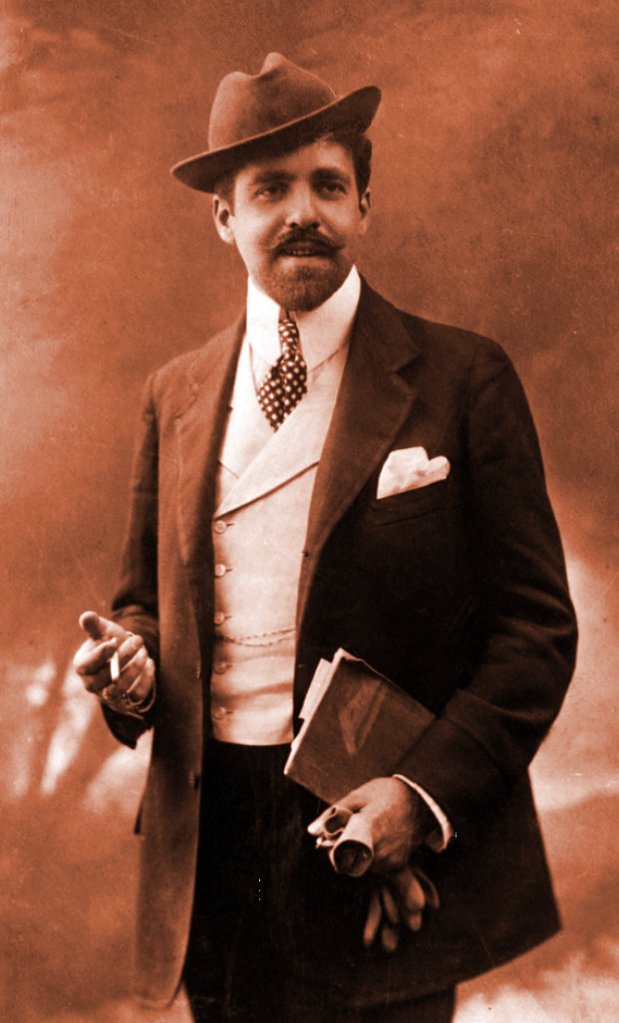
    Press photograph (1906). See note.

    He taps the epistle of George Merritt Ripley, and continues: “This man was a strong man. He had to be killed perchance, to secure his treasure. My brother, being a weak one, needed only flattery and persuasion.” Then looking at the girl, Harry’s tones become persuasive; he says: “I am going to the Isthmus to try and save my brother’s fortune, and that of his ward, Miss Jessie Severn, out of which they have been swindled by this man, who probably ruined your chances in life, and made you struggle for livelihood in the workroom when you should have aired your beauty and graces in a ballroom. Will you aid me to force him to do justice to my brother? Your very position, thank God! will help you to do it!”

    But here surprise and shock come to him. His reference to Miss Severn has been unfortunate.

    Miss Minturn says slowly: “My position?—what do you mean?”

    “You will be the confidential correspondent of his firm. You will perhaps discover the traps by which Montez has purloined my brother’s fortune.”

    “Do you think,” cries the girl, “that I will use my confidential position against my employer?”

    “Why not, if he is a scoundrel?”

    “That is not my code. When I became a stenographer I was taught that the confidential nature of my position in honor forced upon me secrecy and silence!” And growing warm with her subject, Miss Minturn goes on, haughtiness in her voice, and disdain in her eye: “And you made my acquaintance—you tried to gain my friend ship, Mr. Larchmont—to ask me to do this?”

    “Good heavens! I never thought of it before these letters brought home this man’s villany to you, as well as to me!” gasps Harry “I was simply coming to the Isthmus to fight my brother’s battle, to win back for him, if possible, his fortune! To win back for Miss Severn, her fortune!”

    “And for that,” interjects the young lady, “you would make me do a dishonorable—yes, a series of dishonorable acts. You would lure me to act the part of Judas, day by day, to my employer, to bring to you each evening a record of each day’s confidences! How could you think I was base enough for this? How could you?”

    Then seizing the letters that have brought this quarrel upon them, and wiping indignant tears from her eyes, she whispers with pale lips: “Goodby, Mr. Larchmont!”

    “Goodby?”

    “Yes, goodby! I do not care to know a gentleman who thinks I could do what you have asked me!”

    She sweeps away from him to her own stateroom, where she bursts into tears; for, curiously enough, it is not entirely his hurried, perhaps thoughtless proposition, that makes her miserable, and has produced her paroxysm of wrath—it is the idea that he is fighting for Miss Severn’s fortune. “He loves her,” sobs the girl to her self, “and for that reason he would have made me his tool to give her wealth.”

    After she has left him, Mr. Larchmont utters a prolonged but melancholy whistle. Then he suddenly says: “Who can divine a woman? A man, thinking he had lost a fortune through this villain Montez, would have seized my hand, and become my comrade, to compel the scoundrel to do justice to us both! But she—” Then he meditates again, and says slowly: “I wonder—was there any woman’s reason for this? Her eyes—her beautiful eyes—had some subtle emotion in them that was not wholly indignation. They looked wounded—by something more than a business proposition!”

    Then a sudden pallor and fright come upon this young Ajax, as he falters to himself: “Great heavens! if she never forgives me!”


    Notes and References

    • player: A man or woman that has more than one person think that they are the only one. Urban Dictionary.
    • en camarade: in friendship. Cambridge Dictionary.
    • patois: a regional form of a language, especially of French, differing from the standard, literary form of the language.
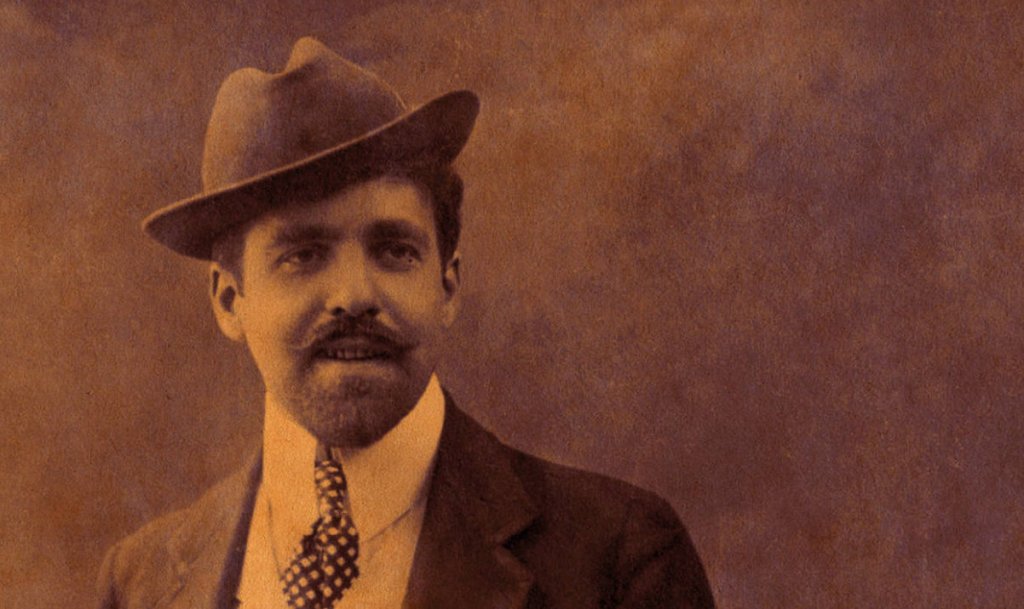
    • Press photograph of male: Reynaldo Hahn (1874-1947): Venezualan singer and under-appreciated composer, conductor and music critic. Hahn was a notable denizen of Belle Époque Paris, and friend and lover of Marcel Proust.

    ‘Books that shaped America 1850-1900’, U.S. Library of Congress.

    Phillips, A.A. -‘The Cultural CringeMeanjin.

    Watkins, H.L. Four Years in Europe – The Barnum & Bailey Circus – The Greatest Show on Earth. 1901. Digital Collections, New York Public Library. Jump to book

    Worrall, H. , Exposing the fallacy of circus ‘showmen’.

    This edition © 2021 Furin Chime, Brian Armour
  • A.C. Gunter’s Baron Montez: 9. The Angel of the Blizzard

    A.C. Gunter’s Baron Montez: 9. The Angel of the Blizzard

    Louise Minturn continues to read past entries in her diary, specifically those of nine days previous, detailing her second encounter with Harry Larchmont. As in the first three chapters Gunter uses an historical event on a particular day to background action. At midnight March 11th, a storm known as the Great Blizzard of 1888, or the White Hurricane, descended on New York City. Being within the living memory of his contemporary readership it adds authenticity to the story. No one who lived through the storm would ever forget it.

    For the first time the metropolis experienced the effects of an oscillation in the polar vortex, which sent a blast of cold air across frozen Canada to meet with a mass of warm air travelling up from the Gulf of Mexico. The previous day had been a moderate 50°F (10°C) with rain in keeping with the close approach of Spring, thus the inhabitants of the city were totally unprepared for what confronted them on the twelfth. Torrential rain had turned to heavy snow, the temperature plunged below zero, snowdrifts reached the second storey of buildings, an estimated 500,000 pounds of horse manure and 60,000 gallons of horse urine froze and along with broken glass and other trash were whipped across the city by 100 mph winds (Mikolay).

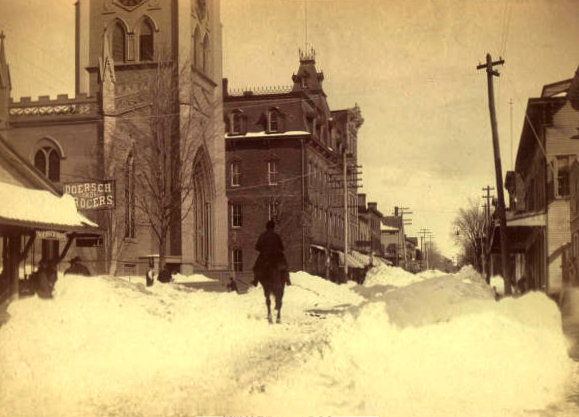
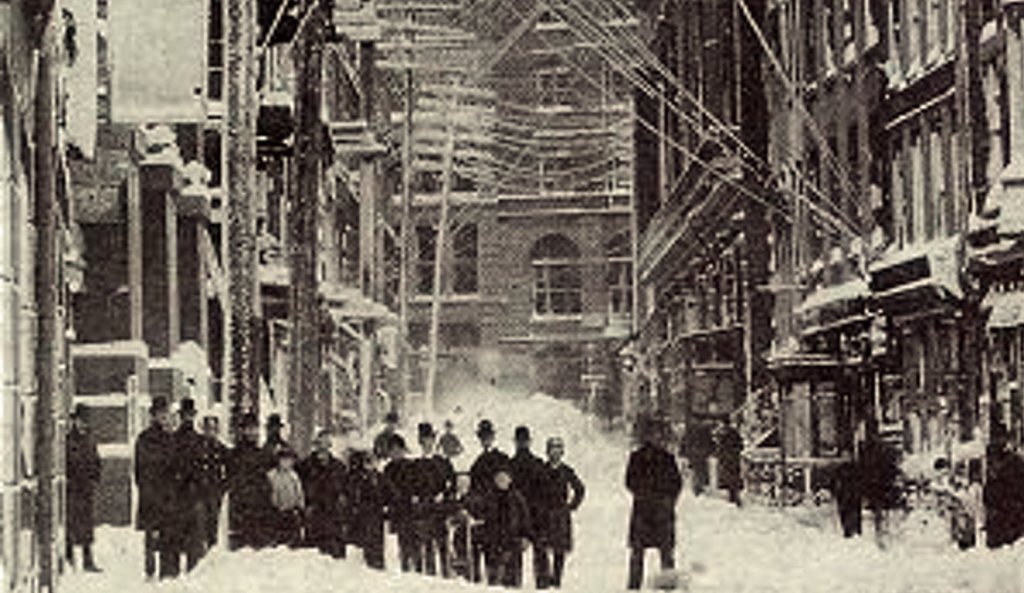
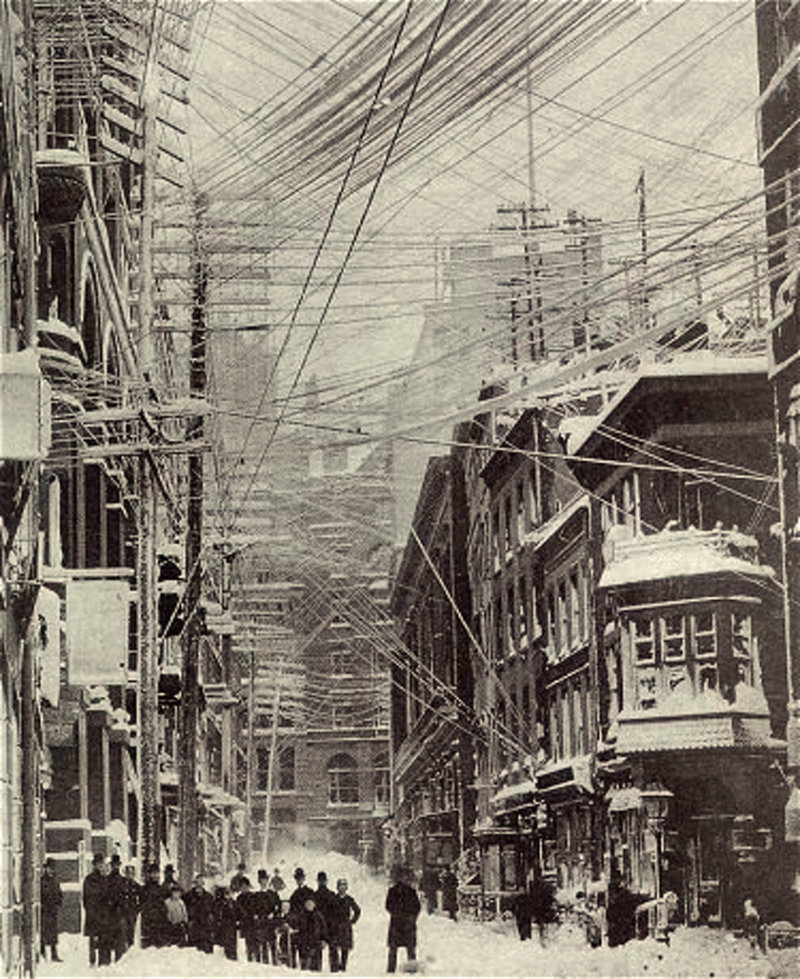
    After the New York Blizzard. New Street, looking toward Wall Street, 1888 (NY Public Library)

    Telegraph, telephone and powerlines came down isolating New York from the rest of the country and live wires buried in the snowdrifts provided a deadly hazard in the streets. Drivers finding the streets impassable unhitched their horses and deserted their carriages, wagons and cars where they stood. Overturned carriages buried in snowdrifts became a feature of the city. Consequently, there were no dairy, bakery, meat or newspaper deliveries upon which the population relied. The elevated rail system froze, trapping thirteen hundred early workers in transit (New York Times).

    Mark Twain was trapped in his hotel room while waiting for his wife, Olivia, and sent her a letter (how it was delivered in the conditions is a mystery):

    A mere simple request to you to stay at home would have been entirely sufficient; but no, that is not big enough, picturesque enough—a blizzard’s the idea; pour down all the snow in stock, turn loose all the winds, bring a whole continent to a stand-still: that is Providence’s idea of the correct way to trump a person’s trick.

    qtd. Clara Clemens, daughter of Mark Twain

    As a result of the blizzard two hundred people died in New York City alone (Schulten). The blizzard was an event of great moment not only because of its ferocity and transfixing power, but because it physically resolved arguments for the future development of the city. As early as the thirteenth of March a New York Times journalist reporting on the effects of the storm stated:

    Probably if it had not been for the blizzard the people of this city might have gone on for an indefinite time enduring the nuisance of electric wires dangling from poles; of slow trains running on trestlework, and slower cars drawn by horses and making the streets dangerous with their centre-bearing rails. Now, two things are tolerably certain—that a system of really rapid transit which cannot be made inoperative by storms must be straightway devised and as speedily as possible constructed, and that all the electrical wires- telegraph, telephone, fire alarms, and illumination—must be put underground without any delay

    New York Times March 13, 1888

    In the same article we see the strange beast of American Exceptionalism raise its head in lamentation:

    …the most amazing thing to the residents of this great city must be the ease with which the elements were able to overcome the boasted triumph of civilization, particularly in those respects which philosophers and statesmen have contended permanently marked our civilization and distinguished it from the civilizations of the old world—our superior means of intercommunication.

    New York Times March 13, 1888

    Louise has already ‘broken the ice’ with Harry Larchmont, indirectly through the desperate state of an old man. For the two to meet again in a population of one and a quarter million other chilly New York souls could only be due to the hand of fate. In this chapter, Gunter was perhaps inspired by an actual rescue that occurred during the storm and reported in the New York Times six months later as ‘Romance of the Blizzard’: George Cozine of Hicksville, Long Island was trudging through the snow when he heard the cries of a woman. Buried beneath the snow he discovered Miss Mary McEwen. Finding that her hands, feet and ears were frozen, he dragged her from the snow and throwing her over his back carried her home. `From that time on, he was a welcome guest, and an intimacy sprang up between him and Miss McEwen that terminated in their marriage on Saturday’ (New York Times Sept. 11, 1888). You read correctly, ‘terminated’.

    As the proverb goes ,‘’tis an ill wind that blows nobody any good’ and in Louise’s case, despite being someone normally possessed of good sense, her foolhardy actions inevitably place her necessarily in deadly peril.


    CHAPTER 9

    THE ANGEL OF THE BLIZZARD

    Two days after, I received a brief note from Mr. Larchmont, which simply stated he was taking care of his uncle’s minor matters of business, during that gentleman’s recovery, and enclosed to me a check for my services as stenographer, the amount of which, though liberal, was not sufficient to make me think it anything more than a simple business transaction.

    Then one week afterwards came the blizzard, that crushed New York with snowflakes, that stopped the elevated railways, and blocked all transportation by surface cars; that confined people in their houses on the great thoroughfares, as completely as if they had been a hundred miles away from other habitations. That dear delightful, fearful blizzard, in which I nearly died.

    On Monday morning, March 12th, I am awakened by Miss Broughton, who is peeping out through the casements. She crys: “’Louise, wake up! This is the greatest storm I have ever seen.”

    “Nonsense! It’s spring now,” I answer sleepily.

    Zeffy in Bed (1906), Lilian Westcott Hale

    “Yes, March spring!—cold spring! Jump out of bed and see if it’s a spring atmosphere,” returns Sally, with a Castanet accompaniment from her white teeth.

    I obey her, and the spring atmosphere arouses me to immediate and vigorous action. In a rush I start the gas stove, and, throwing on a wrap, walk to Sally’s side, and take a look at what is going on in the street.

    “Isn’t it a storm!” suggests Miss Broughton enthusiastically. “A beautiful storm! A storm that will stop work. A storm that will give me a lazy day at home!”

    “You are not going down to the office?” I say.

    “Through those snow banks?” she replies, pointing to six feet of white drift on the opposite side of the street, in which a newsboy has buried himself three times, in an unsuccessful attempt to deliver newspapers at the basement door.

    “Certainly,” I reply.

    “Impossible!” she says. “You will make a nice, lazy day of it, at home with me. We will do plain sewing. You shall help me make my new dress.” Sally always claims me on lazy days. In my idle moments, I think I have constructed four or five costumes for her. This time I rebel.

    “If you are not going to work, I am!” I say decidedly.

    “Through those drifts?”

    “Certainly!” I reflect that I have some documents Miss Work has promised this day. They are legal ones, and admit of no postponement.

    “Well, you may be able to get to the office,” says Sally, “if you are a Norwegian on snowshoes, or an angel on wings.”

    This angel idea is a suggestion to me. “The elevated is running!” I answer, and point to the Third Avenue, down which a train is slowly forcing its way. The station is only a short distance from me. I will take the elevated. Surface cars may be blocked, but the elevated goes through the air.

    Miss Broughton does not reply to this, though I presume she has her doubts about the feasibility of my plan, for the storm is coming thicker and heavier.

    But breakfast over, she steps to the window, looks out, and says disappointedly: “Yes, the Third Avenue trains are still running. I presume you can go, but how about getting back again this evening?”

    “Pshaw!” I reply, “it will be all finished in an hour.”

    North on Third Ave between 67th and 68th streets after the Blizzard of 1888 (New York Public Library)

    A few minutes afterwards, well equipped for Arctic travelling, I, with a desperate effort, get out of the door, and for a moment am blown away by the wind. I had no idea the storm was so severe. But I struggle on, and finally reach the Third Avenue station, to climb up its icy stairs and be nearly blown from them in my ascent to the platform. From this, I finally struggle on board a downtown train, which contains very few people. The guards have lost their usual peremptory tones. They do not cry out in their bullying manner, “All aboard! Step on lively!” as they are prone to do on finer days, but are trying to get warm over the steam pipes in the car. The blizzard has even crushed them!

    We roll off on our journey, amid gusts of wind that nearly blow us off the track, and flurries of snow that make it impossible to see out of the windows. In about quadruple the usual time, however, we creep alongside the City Hall station platform.

    It is now half-past nine. I alight, and am practically blown down the stairs, though a snowdrift at the bottom receives me, and makes my fall a soft one. Then I fight my way along Park Place and into Nassau Street. The storm seems to get stronger and fiercer, as I grow more and more feeble. Midway I would turn back, but back is now as great a distance as forward; and one end of the journey means the comfortless railway station, where perchance no trains are leaving now. The other terminus is Miss Work’s office, where there will certainly be a fire, company, and occupation. By the time I shall be ready to go home, the storm must be over.

    So I struggle on, and fight my way through snowdrifts, to finally arrive, in an almost exhausted condition, at 1351/2 Nassau Street.

    A long climb up the stairs, for the building is not provided with an elevator, and I find myself on the top floor, which is occupied by Miss Work’s establishment. Here, to my astonishment, the door is still locked. Having a pass key, I discover a moment after entering, to my consternation, an empty room, and a cold one. Miss Work, who is punctuality itself, is not here. I reflect, she will undoubtedly arrive in a few minutes. She must come.

    While thinking this, for the atmosphere does not permit of delay, I am hurriedly making a fire in the grate, which has not been attended to overnight, the man in charge of the building apparently not having visited it this morning. Fortunately there is plenty of fuel, and I soon have a roaring fire and comfort.

    Then I move my typewriter where I get the full benefit of the cheery blaze, and sit down to my work.

    Time flies. No one comes. Having nothing to eat, I pass what should be my lunch hour over the keyboard of my Remington, thinking I will have my task finished and go home the earlier. But the papers are long ones, and being legal, require considerable care and accuracy, and as I finish the last of them I look up.

    It is nearly dark. My watch says it is only three o’clock, but the storm, which seems to be even heavier than in the morning, causes early gloom. I look out on the wild prospect. As well as I can determine, in the uncertain light, glancing through flurries of snow, not one person passes along sidewalks that are usually crowded with humanity.

    What am I to do? I am hungry! I am alone! Even in this great building I am the only one, for no sound comes to me from the offices down stairs, that at this time in the day are usually filled by movement, hurry, and activity.

     Sally will be anxious for me. Though, did not my appetite drive me forth, I believe I should attempt to make a night of it in the great deserted building. I should probably be frightened, though I should barricade myself in. I should probably see ghosts of lawyers and legal luminaries who have long since departed, from these their old offices, to plead their own cases before the Court of Highest Appeal. But hunger! I am more afraid of hunger than of ghosts. Besides, it is so lonely.

    I decide to force my path to Broadway. On that great thoroughfare there must be some one! I lock the door, come down the stairs, step out on the street, and give a shiver. During the day it has grown much colder, though in the warm room I had not noticed it.

    My first step is into an immense snowdrift. Through this I struggle, and reaching the corner of the street am literally blown off my feet, fortunately towards Broadway. Thank Heaven! it is a very short block, though it seems to me an eternity before I reach the thoroughfare that yesterday was the great artery of traffic in New York, but now, as I gaze up and down it, seeking some human face, seems as deserted as a Siberian steppe.

     The shops are all closed, even the drug stores. There are no passing vehicles, no struggling pedestrians. The traffic of the great city has been annihilated by this prodigious storm. Telegraph wires, that last night were overhead, have many of them fallen. There is nothing for me but to struggle onward.

    Rider facing north on South Broadway after the Blizzard (NY Heritage digital collection)

    I turn my face to the north—up town—where three miles away Sally is waiting for me, with a warm fire, and I hope a comfortable meal. Towards this I force my way—for a few minutes.

    Then I trip over a broken telegraph wire that lies in the snow. As I stagger up again, for a moment I am not certain which way I am going. Good Heavens! if I should turn back on my tracks?

    The wild snowstorm about me dazes me, confuses me, benumbs me, and makes me stupid. The strength of the wind forces me to hold my head down; I try to see which way I have come by my tracks in the snow—but there are none! The gusts are so violent, my footsteps have been obliterated almost as I made them.

    Desperate, I look around me, and see, through snow flurries, the light in the great tower of the Western Union Telegraph Building. It seems awfully far away, but gives me my direction; and I struggle northward once more, staggering through drifts—sometimes falling into them, no voice coming to me—alone in a living city that is now dead—killed by the snow. Darkness has fallen upon the streets, and enshrouds me. Still I fight on. There are hotels farther up the street. If I could get to one—if I could get anywhere to be warm!

    I have passed the Western Union Building, I think—I am not sure—my faculties are too benumbed for certainty. All I know is, that I am cold— that I am benumbed—that I am hungry—that I am weak—that the snowdrifts grow larger—the snow flurries stronger—the piercing cutting wind more fierce and merciless—and, above all this, that I am unutterably sleepy. I dream even as I struggle, and then I cease to struggle, and only dream—beautiful dreams—dreams of what I long for—dreams of warmth and comfort, of bounteous meals and generous wine.

    And even as this last comes to me, something is poured down my throat—something that burns, but vivifies—something that brings my senses to me with sudden shock. I hear, still in a half dreamy way, a voice that seems familiar, say:

    “Pat, that is the worst whiskey I have ever tasted; but I think it has done me good, as well as saved this young lady’s life.”

    “By me soul, it has saved mine several times today!” is the answer.

    Then the other voice, the familiar one, goes on: “Do you think you can get us up town?”

    “Faith, I’ve been half an hour coming from the Western Union Building. You may bless God if I make the Astor House alive.”

    “Then somewhere, quick! This will keep her warm.”

    I feel the burning stuff pour down my throat once more, and give me renewed life and sentiency. Strong arms lift me into a cab, a rug is wrapped around me. I open my eyes. Beside me sits a man, to whom I falter, my teeth still chattering, “I—I was lost in the snow.”

    Even as I say this, the familiar voice cries: “Your tones are familiar. Who are you?”

    I answer: “Miss Minturn.”

    And the voice cries: “Good heavens! Thank God I saw you from my coupe in time!”

    And I, still dazed, gasp: “It is Mr. Larchmont, is it not?”

    “Yes: don’t exert yourself, you are weak. In a few minutes we will have you at the Astor House, warm and comfortable. Have no fear.”

    And somehow or other, his voice revives me more than the whiskey. I am contented—even happy.

    But the storm is still upon us; and though there are two strong horses attached to the coupe, fighting for their own lives through the deepening drifts, it is nearly an hour before lights flash on the sidewalk, and I am assisted into warmth and comfort and life once more, in the Astor House parlor.

    There I thaw for a few minutes, during which he sits looking at me, though I am dimly conscious he has given some orders. Having entirely regained my senses, I falter: “I must go home! Sally will be anxious about me!”

    “Where do you live?” he inquires shortly “Seventeenth Street.”

    “Then you could not live to walk home tonight, and no carriage could take you there. There is but one thing for you to do. The housekeeper will be here in a moment. She will take you to a room. Go to bed, and take what I have ordered for you.”

    “What is that?”

    “More whiskey—but it is exactly what you want. In two hours they will have dried your clothes, and you can come down to dinner with—with me.” His “with me” is rather embarrassed and diffident.

    I do not reply, and Mr. Larchmont almost immediately continues: “Or, if you prefer it, the dinner can be sent up to your room.”

    I shall feel quite lonely—it will appear ungrateful. “I will be happy to meet you in the dining room,” I answer.

    A moment after, everything he has arranged is done. I go with the housekeeper, a kindly woman of large build and comfortable manner, and find myself excellently taken care of.

    Two hours afterwards, feeling like a new being, I enter the dining room. It is only half-past seven, and Mr. Harry Larchmont is apparently waiting for me. It is a pleasant, though, perhaps, to me, embarrassing meal. The room is crowded with people that the storm has forced to take refuge in the hotel—Brooklyn men, who cannot get across the East River; Jersey men, who are cut off from home; and downtown brokers, who are un able to reach their uptown residences. The place, in contrast to the dreadful dearth of animal movement in the streets outside, is full of life, bustle, and activity.

    “I think I have arranged very well as regards dinner,” remarks Mr. Larchmont. “We’ll have to be contented with condensed milk, but we shall have some Florida strawberries, and Bermuda potatoes and asparagus.” As we sit down, he says suddenly: “Who is Sally?”

    “Sally? Ah, you mean Miss Broughton?”

    “Yes, the young lady you said would be anxious about you.”

    “Oh,” I answer, “Miss Broughton is my chum!” Then we get to chatting together, and I give him a few Sally anecdotes that make him laugh. As the meal goes on I grow more at my ease, and become confidential, and tell him a good deal of my life, my work, and my battle with the world. This seems to interest him, and once, when I am busy with my knife and fork, I catch his eyes resting upon me, and they seem to say: “So young!”

    But I won’t have his sympathy; so I make merry over my business struggles, and tell him what a comfortable little home Sally and I have.

    Altogether, it is a delightful meal for me, and I am not sorry that Mr. Larchmont lingers over it. He grows slightly confidential himself, over his coffee, explaining to me that he has had some very important telegrams to receive from Paris; that the uptown wires were all down, and he had been so anxious about his cables, that he had contrived to get as far as the main office of the Western Union Company; that he thanks God he succeeded in doing so, though no cablegrams had come to him. “Because,” he concludes, looking at me, “if it had not been for the cables, you might have been still outside in the snow!”

    A few minutes after, he startles me by saying, it seems to me with a little sigh, “I must be going!”

    “Where—into the storm?” I gasp, amazed.

    “Only as far as French’s Hotel, just across in Park Place.”

    I know “just across in Park Place” means three long squares—an awful distance, which might kill a strong man in this driving storm.

    “You must not go!” I cry.

    “Under the circumstances, I must,” he replies, and rises, to cut short remonstrance. Then I go out with him from the dining room into the hall, a blush on my cheeks, but a grateful look in my eyes, for I know it is to save me any embarrassment this night that he will make his desperate journey through snowdrifts and pitiless wind.

    We have got to the ladies’ parlor now. He turns and says earnestly, “I have made every arrangement for you, I think, Miss Minturn, not only for this evening, but for tomorrow, in case you should be compelled to remain here. I am more than happy, and bless God that I met you in time.”

    And I whisper: “You have been to me the—the angel of the blizzard!”

    At which he smiles a little, and his grasp upon my hand tightens as he bids me goodnight.

    Then he is gone into the storm.

    I go to my room; a fire is burning brightly there. Sleep comes upon me, and happy dreams—dreams in which I make a fool of myself about “the angel of the blizzard.”

    The next morning everything has been arranged for me. After a comfortable breakfast, I discover that the storm has ceased, but the streets of New York are still impassable. Then I get a newspaper, and learn that the indefatigable reporters have somehow got information of nearly everything. Glancing over its columns, I give a sigh of relief. In the long list of accidents, escapes, and deaths on that twelfth day of March, 1888, I note that my adventure has not been reported, though I read that French’s Hotel had been so crowded that people had slept upon the billiard tables and floors of that hostelry, and one uptown swell had been obliged to content himself with the bar counter. I guess who the uptown swell was who did this to save me any embarrassment or anxiety, and I bless him!

    I bless him again, when, in the afternoon, I find that the streets can with difficulty be navigated, and the porter coming up, informs me that a carriage has been ordered to take me, as soon as possible, to my address in Seventeenth Street.

    At home, I am welcomed by Sally, with happy but anxious eyes. She cries: “Oh, Louise! I thought you were dead!”

    “Oh, no,” I reply nonchalantly, “I did a day’s work.”

    “And then?”

    “Then I went to the Aster House.”

    “Did you have money enough with you for that? I hear they charged ten dollars a room.”

    “That bill is liquidated,” I return in easy prevarication.

    “But you had a carriage! I noticed a carriage drive up with you. How will you ever pay the hackman? They charge twenty-five dollars a trip.”

    “Never mind my finances. I am home safe once more. And you?” I answer, turning the conversation.

    “Oh, I nearly starved! I would have starved entirely, had I not forced my way to the grocery store. I have been living on crackers and cheese, bologna sausage, and tea without milk.”

    “I have been enjoying the ‘fat of the land’. You had better have gone down with me, Sally. You would have had a delightful day,” I continue airily to my pretty chum, who looks at me in partial unbelief.

    Then the next morning comes a joy—a rapture—a surprise! It is a bunch of violets tied with violet ribbon, with the name of a fashionable florist emblazoned on it, and with it this card:

    Message on card: "Compliments of Mr. Harry Sturgis Larchmont who hopes Miss Minturn has thoroughly recovered from the storm. United Club"

    Fortunately, Sally is out when this arrives, so I avoid explanation. When she comes in, the flowers soon catch her bright eyes. She ejaculates, “Violets! Where did you get violets, Miss Millionnaire?” and smells them to be sure they are genuine—not artificial.

    “Why do you call me Miss Millionnaire?”

    “Well, no one but a Miss Millionnaire can live at the Astor House during blizzards, and perambulate in carriages at twenty-five dollars a trip, and have great big bunches of violets at a dollar a blossom! Gracious! They must have cost thirty dollars! Every flower on Long Island was destroyed by snow.” Then Sally’s eyes open very wide with inquiry, and she says coaxingly: “Who sent them?”

    “Oh,” I reply in easy nonchalance, “I gathered them!”

    “Gathered them? Where?” These are screams of unbelief.

    “Off the snowdrifts on Sixth Avenue, over which they have placed a sign ‘Keep off the grass!’”

    “That means you will not tell me,” says Sally, with a pout.

     “Precisely! “

     “What makes you fib so much lately? “she mutters disappointedly.

    “It is not a fib—that I will not tell you.”

    “Very well! I shall inform Mr. Tompkins!” replies Sally spitefully, which threat causes me to burst into hysterical merriment, I am in such good spirits.

    I write to him at his address: “I am quite well. I thank you for the violets, but for the rest—thanks are too feeble. I only hope some day the mouse may aid the lion. L. R. M.”

    I initial this note.

    Somehow I don’t know how to end it. I have grown strangely bashful and diffident lately.

    That was only a week ago. Once since then I have seen him at the theatre, in attendance upon ladies, one of the party being Miss Jessie Severn.

    As I have looked at him I have noticed that a good deal of the lightness has left his face, and a portion of the laughter has departed from his eyes. Has some cloud come over his life?

    As I look over my diary and recall these things, a sudden thought strikes me. I am going away without bidding him good-by. That will be hardly grateful. It is half-past four: he may be walking on Fifth Avenue. It would hardly be wrong to say “farewell” on a crowded street.

    Five minutes, and I have flown over to that fashionable promenade, and am strolling up its thronged sidewalk. I am in luck. Near Thirty-first Street I see him stepping out of a fashionable club. But there is another gentleman with him, almost his counterpart save that he is ten years older, and has a foreign and un-American air and style about him. This must be Harry Larchmont’s French brother—the one Mr. Delafield had sneered at.

    Of course I cannot speak to him now.

    To my passing bow Mr. Larchmont responds with more than politeness. As I pass, I catch four words from the gentleman who is with him. “She is deuced pretty!”

    Fortunately I am beyond them; they cannot see my blushes through the back of my head. What would I not give to have heard Harry Larchmont’s reply!

    As it is, I shall not even bid him good-by. I return curiously disappointed to our rooms on Seventeenth Street.


    References, Links

    Clemens, Clara. My Father, Mark Twain (NY: Harper, 1931) p. 54.

    ‘Great Blizzard of 88 Hits East Coast’. `This Day in History’ – History.com. Jump to article

    ‘In a Blizzard’s Grasp: The Worst Storm the City has Ever Known’, New York Times, 13 March 1888. PDF.

    Mikolay, Anne M. ‘Remembering the Great Blizzard’ The Monmouth Journal, Feb 10, 2011. Jump to Article

    Schulten, Katherine.`Romance of the Blizzard’, Learning Network, New York Times. PDF (NY Times article Sept 11, 1888),

    New York, NY, Population History.

    Eyewitness account of New York’s Great White Hurricane of 1888 (recorded in 1949)

    This edition © 2021 Furin Chime, Brian Armour
  • Cobb’s False Knight: 14. A Scrap of Paper

    Cobb’s False Knight: 14. A Scrap of Paper

    Interesting plot twists and a good knowledge of his foreign settings. Zenzel may sound a bit strange as a choice of name for one of Electra’s new maids these days, but it is a real one and reflects how much serious research Cobb put into his writing.

    More common in southern Germany and particularly Bavaria is “Zenzi“. An interesting name, it sadly has very little to do with any enlightened school of Buddhism however. Nowadays used to name anything from a beach bar in Playa del Carmen to a “real food” fast food chain based in Oslo, to an expensive brand clothing store in Singapore, Bavarian “Zenzis” are usually villager girls, the name being a short form of “Kreszentia” and also “Innozenzia” and “Vincentia“.

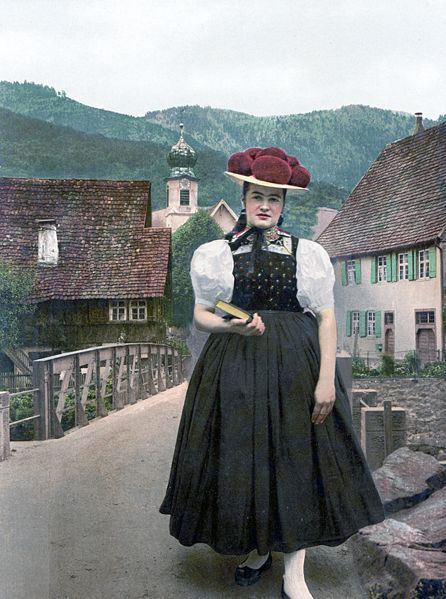
    Black Forest (Gutach) woman in costume, c. 1898, color photo lithograph

    It was particularly popular in Swabia, where the short form “Zenzl” was most commonly used. Nowadays, only about one in 100,000 girls are given the name, in contrast to Bavarian cows, many of which are still named “Zenzi” to this day.

    Carrying our damsels in distress down the mountain on a litter invokes a scene more common in times gone by, even if the one used is a bit makeshift. The German name for a “litter” being “Saenfte“. This word sounds a lot less like anything possibly related to rubbish, as the term comes from the word “Sanft”, which means “Gentle” or “Gently”. Usually, it describes something more like a sedan chair, but it is also used as a name for a simpler construction with poles.

    Just who exactly are these homely-looking replacement maids you will read about? That “Elise”, who sounds more like some sort of nightmare female Swabian prison warder or birthday gift prank masseuse named “Battleship Potemkin” than the beautiful piano piece written for that name. I guess you just couldn’t get the staff, even in those days…


    CHAPTER 14

    A SCRAP OF PAPER

    Half way down the mountain the ruffian band stopped, and having thrown out safe sentinels to give warning of approaching danger, the rest of them went at the work of making a litter upon which to carry their captives. This they did for their own convenience—not for any sentiment of kindness or compassion upon two weak, suffering women. On the contrary, many of them seemed to feel really provoked and indignant because on account of these women they had been forced to expose themselves to such disagreeable weather. A very fair contrivance for the purpose in hand was soon put together, and with the two ladies installed thereon the party once more set forward.

    Finding a mass of fir boughs which she could pull over her head and shoulders, Electra removed the heavy trooper’s coat from that part of her body, as there was an odor coming from it which she could not endure. They made no complaints, as they well knew they would be useless; nor did they ask any favors. The baroness blamed herself for her folly in disobeying her kind protector, whereupon her daughter tried to comfort her.

    “Mamma, let us be brave. You shall not see me surrender. Let us remember what good Martin told us of the robber chief, and of his lieutenant Wolfgang. If they are for us, and mean to put forth a helping hand in earnest, we may surely hope.”

    “Ah! my child, you forget the characters of those men.”

    “Their characters?”

    “Yes. One of them a, chief of robbers!”

    “O, mamma! mamma! you have not seen that chieftain’s face. He is the grandest, noblest, handsomest man that I ever saw.”

    “Handsomer than Ernest?”

    “Yes— because he is more massive, and more muscular—by far a larger and stronger man. You know what I mean.”

    By this time they had reached the foot of the mountain, and as two of the guards came up and walked beside the litter, the captives held their peace.

    Arrived at the castle, they were borne to the foot of the steps leading up to the vestibule, where they were lifted out, and taken at once to the main hall; and here Sir Pascal Dunwolf found them.

    His exclamations of joy and satisfaction upon beholding the rich prize thus returned to him had more gross profanity in them than we care to transcribe. But he settled down into moderation after a time and smiled grimly when the baroness refused him her hand.

    “Well, well,” he said, “I am very glad the castle has its proper mistress once more, and it is not my intention that you shall leave us again. If you give me no more trouble—if you will settle down into two well-behaved, quiet ladies, I will treat you with all respect and kindness. But, mark you, I shall know how to put a stop to any further trouble on your part. You took away a servant with you, I think.”

    “A servant accompanied me, sir,” replied Lady Bertha, proudly.

     She had become calm and dignified, and resolved to quietly submit to what she could not help.

    “Your servant has not returned with you?”

     “Your ruffians did not find her.”

    “Oho! that’s it. Well, I must supply you with another. You may follow me.”

    With this the knight made a sign to a man who stood near at hand—a man in the garb of a mountaineer, whom the baroness had never before seen; and no wonder for it was none other than the brigand, Hildegund. In answer to the sign, he bowed respectfully and went away. Then the master beckoned to another man; and, as he started to lead the way up the great staircase, this last man followed behind.

    The knight bent his course, not towards the apartments which the ladies had formerly occupied, but towards a wing of the keep which had been erected during the time of the two or three generations last past, rightly judging that the new work could have no connection with the secret passes, through which his captives had so unexpectedly escaped him.

    The wing in question, connected with which was a tower with an observatory on its top, had been completed with the late baron’s father. On reaching it, the ladies were ushered into a suite of four small chambers, all connected, three of them being respectably furnished.

    “There,” said the knight, as the countess and her daughter stood and glanced about them; “here you may make yourselves very comfortable if you will. You can, of course, understand why I do not give you back the apartments which you so readily forsook. Yet,” he added, with a malicious twinkle in his deep-set eyes, “if you will promise to show me how you made your escape—if you will point out to me and explain the secret pass, I will allow you to occupy your old rooms.”

    “We shall be as comfortable here, sir, as we can be anywhere under your control. The secret of which you speak is not mine to give.”

    “As you will. I do not suppose I can force you to speak.”

    He then pointed out to them the two apartments which he had supposed they would appropriate to themselves, remarking that the third was for the use of their servants. The room not furnished might be fitted up as they should later suggest.

    “But one small bed has been provided for two servants,” he said, “because only one of them will sleep at the same time.”

    He had just spoken, when Hildegund appeared, accompanied by two females. They were women of middle age; large, coarse looking, with faces hard and uncompromising. One of them, however, was more repelling in appearance than was the other.

    “Ah, here are our helpers!” Dunwolf went on, as the women appeared. “My good Hildegund, will you have the kindness to introduce them to her ladyship.”

    Head of a Peasant with White Cap (1884), Vincent van Gogh

    “This,” said the man thus addressed, answering promptly, “is Elize. She is variously accomplished, and of a most excellent disposition; only she likes to be well treated, as she has always been used to it.”

    This was the harshest and most forbidding of the twain,—a woman of five-and-thirty, or thereabout; tall and heavily framed; low-browed, and sharp-eyed; coarse, unkempt hair, of a reddish brown color; with quite a beard upon her long upper lip and her heavy massive chin.

    “And this,” the robber continued, presenting the other, “is our fair Zenzel. If she is not so accomplished as is the gentle Elize, she at least has the quality of faithfulness. I think they will make madam very comfortable.”

    Zenzel was a few years older than her companion; her face was not so dark; her brow was higher; her eyes were larger, with more of softness in their light; her hair was of a dark brown, and well bestowed; and her face looked as though she could laugh upon occasion, which was more than could be said of the other. But she was far from being happy-looking, and was not by any means such a person as either the baroness or her daughter would have chosen for a servant.

    Further than this Sir Pascal informed the ladies that their meals would be served to them where they now were; that one of the household servants, to be selected by himself, would be permitted to come for orders; and that they should have for food anything they chose to order. He then asked them if they had any request to make.

    “Sir Pascal Dunwolf,” said the baroness, after a moment’s thought, “there are a few things in my old apartments which I would like to obtain; and I must go for them myself. If you will allow me to go, you may send your whole troop to over-look, if you wish. No other person can find them.”

    The knight stood for a few seconds as if in doubt; then his brow unbent, and he told the lady she might go.

    “By and by,” he said, “when you have had your dinner, these two women shall accompany you, and you may get what you like.”

    Then he turned to the woman named Elize, and instructed her in the matter. At any time after the ladies had eaten their dinner, she and her companion might go with them to the apartments which they had formerly occupied, and there allow them to gather up what they pleased, at the same time sternly bidding them to remember that he should look to them for the safety of their charge.

    With this he turned towards the door, motioning for Hildegund to pass out before him; and when the man had gone, and was out of hearing, he once more turned, and bent a keen, significant glance upon the maiden. He started twice to speak, but hesitated. At length with a gleam of triumph in his dark eyes, he said:

    “Young lady,—Once you have escaped me. Had you remained in your castle you would have been my wife ere this. I have no doubt that your flight was for the purpose of avoiding that interesting ceremony. But know ye, my dear girl, that your fate is sealed. I will give you fair warning, that you may be prepared. You shall rest to-day, for on the morrow, before the sun shall have set, you will be a wife. For the purpose of becoming your husband, and lord of Deckendorf, I came hither; that purpose I intend to accomplish; and the sooner it is done the better for all concerned.—Lady Bertha,” to the baroness, “you will be wise if you can help your daughter as she may need. Do not resist the inevitable.”

    He paused a moment, and bent his eyes to the floor. When he next spoke he had assumed what he doubtless thought a frank, generous expression, and his voice was carefully modulated:

    “My dear young lady,—allow me to call you Electra,—l wish you would try to believe that I will make you happy if you will let me. You shall have every privilege you can in honour ask; you shall have state and pomp, if you like it; in short, no lady of the whole Rhine country shall stand above you. Is not your pride something? Would you not like to be worshipped and admired? Think of it; reflect upon it; and be wise in time.”

    And then, without waiting for a response,—perhaps not desiring one, he turned and strode away, leaving one of the new servants to close the door after him.

    For several minutes after the knight had gone not a word was spoken in the chamber where the four women had been left. The baroness and her child sat in deep thought, looking now upon one another, then towards the strange servants, and anon around the bare and cheerless rooms.

    At length Electra bent her head upon her hand, so remaining for a considerable time. When she finally looked up, she turned to the woman called Elize and addressed her quickly, but in an offhand, easy manner, in French, a language with which both she and her mother were entirely familiar.

    The woman stared at her in blank amaze. Our heroine repeated the question, so inclining her glance that either of the servants might consider it as put to herself. But they were both alike. Neither of them understood her.

    “Pardon me, I pray you,” she said, with a pleasant smile. “I did not stop to reflect that you might be ignorant of the language.”

    The twain shook their heads, and Elize responded, gruffly:

    “We know our own language, and that is all; and it is enough for us.”

    “You are not from the village, are you?” Electra pursued, with all the affability she could command.

    “Not from your village, my lady.”

    “I have no desire to pry into your secrets, my good woman; but surely since we are to be together for a time, it would be pleasant for us all if my mother and I knew whence you come.”

    Elize looked first upon the speaker and then upon her companion, and she was evidently upon the point of returning another crisp and unsatisfactory answer, when the other—Zenzel—with a flush upon her face, and a peculiar snapping of the eye, spoke up:

    “Why should we not tell the truth? Lady, we are from the uttermost depths of the Schwarzwald. We are of Thorbrand’s people, and have been reared with the robbers of the Wald from childhood. Our men are brigands, as are the soldiers of our grand duke; only there is this difference: While your soldiers never do good, but kill, kill, kill, the robbers of the Schwarzwald—brave Thorbrand’s men—never kill if they can avoid it; and the cry of distress is never made to them in vain.”

    “Zenzel,  l have not a word to say against Thorbrand. I have heard him spoken very well of. For the good that is in him I honor him.”

    “Ah, lady, I wish you could tell us where he is to be found.”

    “How? Has he gone away?”

    “He left us—now two weeks or more ago—to come to this castle. That, we know, was his purpose when he set forth. There went with him the Paladin of our host—young Wolfgang, the fairest and the bravest, next to the chief himself, of our gallant men. They went from us, those many days ago, and that is the last we know. He has not been here. At least, so the knight says.”

    Old Peasant Woman (c. 1905), Paula Modersohn-Becker

    “I think he speaks truly,” said Electra, as the speaker looked towards her inquiringly. “My mother and I were here several days after Sir Pascal came, and we know that during those days he was anxiously expecting the chieftain, who did not come.”

    Here the conversation ended, and shortly afterwards it was proposed they should think of dinner. It was now well on into the afternoon, and the ladies were hungry. Elize went away to order the meal, having first learned what was wanted, leaving her companion to keep guard. Zenzel was evidently determined to be strict in the performance of her duty; but she was not obtrusive, nor did she make herself unnecessarily attentive in any way. The result was that mother and daughter enjoyed opportunity for private conversation without resorting to a foreign tongue, though they hold that resort in reserve in case of emergency.

    “Electra, what was your object in speaking that woman in French? Was it simply to know if we might safely converse in that tongue?”

    “No, mamma, not wholly that. In fact, I was not thinking of conversing at all. Can you not guess?”

    “No. I fail to think of anything else.”

    “Mamma,” the daughter said with a quick glance towards their guard, “how long do you suppose it will be before Ernest comes to the castle.”

    The baroness started, but did not forget her caution.

    “Of course,” the girl continued, “he will not let the night pass without an effort to learn something of our fate, and of Dunworth’s purpose. He cannot hope to set us free, because the knight will guard against any further use of the secret passage by us. Yet he will do all he can. If he cannot see us, he will contrive to see some one of the old servants who can tell him how we are situated. You understand?”

    “Yes.”

    “And there is one thing more to be remembered: Thorbrand has pledged his word that he will deliver us from the power of that bad man. if you knew this wonderful chieftain as I know him, or if you could have seen him as did I, you would give him your confidence without reserve. And Thorbrand is almost well. Oberwald said yesterday that he was almost as strong as ever, and only waited for the coming of his companion, Wolfgang, to be ready to act.

    “Now, mamma, remembering all this, do you not see how necessary it is that we should let them know at the cot what will happen if we remain here unprotected through another day? for I am sure the wretch means exactly what he says. You follow me so far?”

    “Yes.”

    “Well, we have Dunwolf’s permission to go to our own apartments in quest of whatever we may want; and we must, if possible, persuade our guards to let us go to the old picture gallery, as in the store-room connected with that is one of the most direct and important entrances to the hidden pass, and it is the one I think Ernest will select—either that or the one in your dressing-room. He may think that our captor will not allow those rooms to be occupied, as we have once escaped from them, and consequently come that way. But one or the other of these he will surely use.

    “Now, this is why I wished to know if these women knew anything of French. I will write two brief notes, telling our friends what must be done if I am to be saved—write them in French—which I will drop in the picture gallery, where it cannot fail of being seen by any one who shall come forth from the secret passage. Of course, it is possible that the paper may be detected by one or both of our followers; but they will be none the wiser from seeing it. Something tells me that it will be a success.”

    The baroness was not only favourably impressed, but the details of the scheme had given her new hope and courage.

    Elize had returned while they were talking, being accompanied by one of the servants of the household, who modestly saluted the ladies on entering, but spoke with them no more.

    Lady Bertha chanced to have in her pocket a book of prayer—the last gift of her husband,—and from this, when she found opportunity, she carefully tore out two blank leaves. Electra had a pencil, and while the women were busy preparing the meal she wrote what she could; but though the missives were very brief, it cost her a number of trials before the work was accomplished. This was what she wrote:

    “For E. V. L.—We are in the chambers of the new wing, where we were put this forenoon, on being brought here. The bad knight will, if he is not prevented, make me his wife to-morrow. We are under strict guard. Remember, —IT IS TO-MORROW!”

    Two of these were written and carefully folded and on the outside she found opportunity to write, also, in French, “THIS FROM YOUR CAPTIVE FRIENDS.” She had scarcely completed the work when the woman Elize having seen the table cleared, informed the ladies that she and Zenzel were at liberty to go with them to their apartments. Before setting forth the last-named of the keepers expressed the hope that she and her companion would not be forced to harshness.

    “You know what our duty is,” she said, “and if you make it easy for us it will be better for all concerned.”

    Both the baroness and her daughter gave their word that they would offer no movement to which objection could be made, after which they set forth, Zenzel going in advance, while Elize brought up the rear.

    The old picture gallery was on the same floor of the old keep with the apartments which the baroness had occupied, and not far distant.  She wished to go there, she said, to find a book which she was sure had been left there; and, moreover, it would give them—the guards—an opportunity to see the pictures. Both the women were fond of pictures, though they had seen but very few during their lives; and without opposition, and with but little question, they went first to the gallery, where Electra had no trouble in dropping her folded paper in the little store-closet without being detected.

    She had more trouble in the old dressing-room. By a curious chance Zenzel found the paper after it had been dropped. Electra saw her pick it up, and open it, and examine it; then saw her, with a “Pshaw!” give it a twist and throw it down.

    To our heroine this seemed an augury of good, and she accepted it as such. When she looked back, as she and her mother were being conducted out from the old chambers, and saw the note lying very near the spot where she had dropped it, her heart was filled with thanksgiving. That scrap of paper seemed to her a connecting link between her dear lover and herself.


    Notes

    • Gutach (photo in preface): town in district of Ortenau in Baden-Württemberg; also the name of a river in the area.
    • brigands: ‘a bandit, especially one of a band of robbers in mountain or forest regions’ (dictionary.com).
    • ‘looking […] anon around the bare and cheerless rooms’: in this context, ‘anon’ assumes the sense ‘once in a while’.
    • Paula Modersohn-Becker (illust.): (1876-1907), early German expressionist painter.

  • Cobb’s False Knight: 8. Another Trap

    Cobb’s False Knight: 8. Another Trap

    Confusion in the Castle. The plot thickens, while dastardly villains conspire. Two assassins already dead in the forest, replacements dispatched. Guns that shouldn’t have been working, but which our hero had repaired… History is of course full of foul assassinations. Have you heard of any that occurred in that part of Germany? There were perhaps a few. Not with guns that shouldn’t have been working, but perhaps with guns which should not even have been there

    I don’t mean Stauffenberg’s failed attempt to eliminate Hitler of course, he had tried to do that with a bomb. No, far more recent. In the 1970s, the “Baader Meinhof Gang“, a nasty and extreme bunch of nutcase terrorists that had called themselves the “Red Army Faction” had been causing mayhem. They murdered a Federal Attorney General by the name of Buback and tried to kill an American general by firing a rocket propelled grenade at his car.

    Bomb threats and sightings here and there resulted in trigger happy police with machine guns all over Germany. When many of them had finally been captured, the hard core having been placed in the high security wing of Stuttgart prison, the concern was that those inside had still been orchestrating terror plots via secret messages transported by their legal counsels.

    Red Army Faction leader Ulrike Meinhof (1934-76) when a young journalist, in 1964. Source: Wikimedia Commons

    In the opinion of some in power, they had to go. How do you kill known terrorists in maximum security wings of several prisons? Some say, a “suicide plot” was hatched. On the 18th of October, 1977, gang leaders Andreas Baader, Gudrun Ensslin and Jan-Karl Raspe allegedly shot themselves inside their cells, in different cells, at exactly the same time, with pistols that had allegedly been concealed behind skirting boards.

    A fourth, Irmgard Modeller, survived the attempt. Some say that they had been murdered. How could anyone have got multiple guns past metal detectors and body searches? To hide them in holes dug into concrete walls and behind skirting boards? You can see why some suspected a plot by the authorities to rid themselves of a perceived (and probably quite real) ongoing threat to state security…

    Now what will Cobb’s replacement assassins do? Make it look like Ernest von Linden killed himself? While poisoning is perhaps the preferred method of assassinating any possible threat to today’s Russian Mafia state, it was always seen as the preferred method of killing for females. Kaiser Otto III was possibly poisoned in the year 1002 by a woman whose husband he had put to death. She had allegedly sent him a pair of gloves, the insides of which she had laced with poison, but this was never proven. He died of a sudden fever at the age of just 22.

    Should our hero be careful about what he eats and drinks or wears while inside Electra’s castle?


    CHAPTER 8

    ANOTHER TRAP

    Let us now look back and see what Sir Pascal Dunwolf had been doing the while that we have been with Ernest on his adventurous journey.

    To the very summit of the highest pinnacle of the castle the knight made his way as soon as the youth had departed, and here watched in order to make sure that here had been no deception—that he was really and truly going towards the capital, and not into the opposite mountain. Having satisfied himself that all was right in that direction, he came down and ate his breakfast, after which he took a stroll on the battlements, with his lieutenant for a companion.

    “My dear Franz, you are looking unusually glum this morning. What has happened to give you such a turn?”

    “Pshaw! It’s nothing, Meinherr. I am not feeling just right; that’s all.”

    ”You have not had a bout with Balthazar so early as this, have you?”

    “Eh! Who told you that? Has the little traitor betrayed me?”

    “Easy, easy, Lieutenant. The little rascal has told me nothing. In fact, I have not set eyes on him since I arose.”

    “Then how—”

    “Hold! I’ll make a clean breast of it. I last evening gave Balthazar a piece of work to do for me, promising him, if he was successful, that I would bestow upon him the wherewith to enable him to take revenge on you at dice. He did the work—did it completely—and I gave him the money before I was out of bed this morning. And now, hark ye: If in my present undertaking I succeed as I think I shall, I will give you far more than I gave to him.”

    “Ha! you have the young tiger on the hip [at a disadvantage], eh?”

    “Aye. What did you suppose I sent Roger and Otto in the forest for?”

    “I knew what you sent them for, but I did not know what their chances of success were.”

    “Ha—they have a sure thing. The boy’s wings are clipped entirely—the charges of his pistols withdrawn, and they so left that no human eye can detect the work without trial.”

    “Good! With him out of the way our work is wonderfully simplified. And now for our renowned chieftan—Thorbrand. You have not yet heard from him?”

    “No, and I am a little anxious. He was to have reported to me immediately on my arrival.”

    “Very likely he has been detained away. A man upon whose head is fixed the price of a prince’s ransom cannot go and come at will.”

    “But,” said the knight, with a dubious shake of the head, “the old inn-keeper at Hasslach told me that Thorbrand in company with his chief lieutenant—Wolfgang—stopped with him only two nights before our arrival, and that they were on their way towards this castle. He said, further, that they spoke of me—that is, spoke of an expected arrival from Baden-Baden, about which they were somewhat anxious. So, you see, the chieftain must be somewhere near here.”

    “It cannot be,” ventured Franz, “that— he— would—”

    “What do you mean?” cried Dunwolf, as his subaltern came to a dead stop. “Do you mean to ask if Thorbrand could prove treacherous? By all the bones of all the saints! If I thought he could do that— But, pshaw! Why do I doubt? By our compact he has everything to gain and not a thing to lose; while I— all! it would be a very sore thing for me were I to fail in this.”

    “If Thorbrand is true, and the barons of Wurtemberg keep faith with us, failure is impossible,” said the lieutenant with entire assurance.”

    “You are right. Thorbrand will soon show himself, I have no doubt; and meantime I must think of other matters. The sooner I secure the hand of the heiress the better for me.”

    “And the better for me, I trust, added the other, significantly.

    “Yes, my true heart—I will make it a golden occasion for you, never fear. And with that the twain descended into the court, the knight remarking, on the way down:

    “By the way,— this, I believe, is Sabbath day. Suppose we give Father Alexis an opportunity to manifest himself.”

    The lieutenant thought the plan a good one. They ought, he said, to assume the garb of sanctity once in a while.

    Sir Pascal had brought with him a priest—a man of middle age, reared in camps, who had spent several years of his life in the saddle as a trooper, and who could now lead in a religious service, or in the wassail of high carnival. He was a short, thick necked, rotund specimen of humanity, not absolutely evil at heart, and incapable of a great crime, but ready and willing to serve the master who fed and clothed him, and never curtailed his allowance of wine, even though such service might rend the heart strings of another.

    Towards the middle of the forenoon the herald sounded the call for the assembling of all who heard within the chapel, and the priest in full canonicals, accompanied by a choir he had selected from among the musical ones of the troopers, made his way to the altar, and in due time commenced the service.

    “The devil is selling indulgences” (1490-1510), Jenský kodex. Source: Wikimedia Commons

    The baroness and Electra, when they had been told what was going forward, considered what they had better do. It had been their custom, in pleasant weather, to attend mass in the old church in the village; and when they could not go out, good Father Paul would come up to the castle and perform mass in the chapel. Of course, they could not, with Ernest absent, go to the village; nor would they ask Father Paul to come to them; so, after talking the matter over for a time they concluded that they would call together the female servants, and attend the service of the strange priest. And this they did.

    Sir Pascal received them very politely at the chapel entrance; and, moreover, they became interested, despite their prejudices, in the strange priest’s homily. Yet his fervid speech, his brilliant flights of fancy, and his pleasing pictures of life, did not blind them to his entire lack of true godliness. His discourse was rather flippant than sincere, and strained for effect, and they were glad when it had been brought to an end, and they were permitted to return to their own apartments.

    “Mamma,” said the daughter, “did you mark how Sir Pascal looked at us?”

    “I did, my child; and I thought when marked I the evil glance he gave us, that nothing would induce me to remain here if Ernest were not very soon to return.”

    “But, would the bad man suffer us to leave, do you think?”

    “I should not ask him. There are methods of leaving the castle without disturbing sentinel or warder.”

    “Certainly, l know. Were you ever in the underground passes, mamma?”

    “Once. Shortly before your father went away to his death he took me through them.”

    “Does Ernest know the secret?”

    “Yes. He is thoroughly instructed. There are passages which I do not understand; but I have a key to them all, which your father had prepared on purpose for me. Ernest knows every secret, I believe; and for that reason I have felt no anxiety about instructing you.”

    While the ladies had been making their way back to their apartments Sir Pascal had ascended to the summit of the tower overlooking the path which the young captain had taken, out upon which he now looked for the return of the two bravos. If they had done their work as they ought they should be on their way back by this time. But he saw nothing of them. After remaining until he had become weary, he descended, and sent up a servant, whom he directed to keep strict watch for the return of two messengers he had sent out, and to give him intelligence instantly when they were seen.

    The hours passed; the knight ate his dinner; after which he went up to take a look from the tower. He found the lookout awake and watchful, but with nothing at all to report. Ten minutes or more he stood peering away down the mountain path; and then, nervous and uneasy, he again descended, and considered over the matter.

    It was now past two o’clock in the afternoon. Certainly, his men should have done their work, and returned, long ere this. If they had stopped, and intercepted Von Linden at the point he had laid down for them, they would have met him within two hours after he had set forth. Certainly, they should have had him in their hands by nine o’clock. Then they should have dispatched him at once, and returned before noon.

    While he was thus discussing the matter within himself, his hunchback page came in.

    “Balthazar! Look me in the eye. Now tell me, did you draw the charges from Captain von Linden’s pistols?”

    “Why do you ask me a question like that? I have a mind not to answer you. But, as I see you are in trouble, I will relieve you.”

    And he then went on and told the story of his morning’s adventure. When he had done, his master exclaimed:

    “I believe you, sirrah. But why don’t my men return?”

    “Look ye, brave sir,” the page replied, with a look of keen intelligence, “you should remember that we are dealing with a man who has his wits about him. I can swear that he left this castle this morning without a grain of powder, saving only the priming, and without a bullet in either one of his pistols; for I kept my eye upon him from the time I drew the charges to the moment of his leaping into the saddle; but who shall say how far he rode in ignorance of his defenceless condition? I am told that the old wolves in this forest are bold and fearless, and that often a veteran will sit on his haunches while horse and rider come very near to him. Suppose the captain should have had an experience of that kind—what more likely than that he should have drawn a pistol and thought to fire upon the brute?”

    Dunwolf wanted to hear no more. Bidding the dwarf to hold his peace, he hastened away to the barracks, where he called out two of the most reliable of his sworn men—men sworn to stand by him to the bitter end, let him lead where he would, so that he led them to plunder. These men—Zillern and Walbeck by name—were directed to saddle and bridle their horse immediately, and report to him at the great gate.

    And at the gate he awaited them. When they came he told them what they were to do. Roger Vadas and Otto Orson had been sent out upon the road early that morning, on a particular mission. They should have returned long ago.

    “You know the paths toward Zell?” said the knight.

    Yes, they knew them well.

    “Then ride on till you find those men, or some trace of them. In the deep vale, beyond the first mountain, they were to stop. A small stream of water runs through it. Search well and carefully in that neighborhood.”

    The sun was setting, and Sir Pascal was fairly beside himself with anxiety, when his two messengers last sent out returned. They found him in the apartment which he had appropriated as an office, and his hunchback page was with him.

    “Well,” as he saw one of the men making a search in his pocket, “what have you to tell me?”

    “Meiherr,”answered the man called Zillern—the same who had been searching in his pocket—”we found nothing until we had reached the top of the high ridge that snakes down from the Schwarzwolf Mountains, and there, on the grass, by the wayside, I picked up these bits of paper, which, as you can see, have never been wet by either dew or rain, but which have certainly—”

    Before he could finish the sentence the dwarf had sprung nimbly forward, and taken the crumpled bits of paper from his hand.

    “Oho! D’ye see, my lord and master? The very paper I tore from one of the gallant captain’s—”

    The knight gave him a rap on the side of the head to stop his tongue, and then bade the trooper go on with his story. The truth was already breaking upon him. If the captain had reloaded his pistols the summit of that spur, the end was easy to guess; for not only would he be efficiently armed, but he would have had a warning that would lead him to be on his guard, and give him to know the mission of Vadas and Orson the moment he should see them.

    “Go on,” he said to Zillern, clutching his hands tightly in his effort to hide his deep agitation.

    “Well, Meinherr, after I had picked up the paper we kept on down into the valley, and when we came to the brook, there, by the side of the path, we found the men we were looking for, both of ’em shot through the heart!”

    “Shot?”

    “Aye, Meinherr, by a hand that must have been wonderfully steady, and with a keen pair of eyes behind it. Orson’s pistols had both been fired, but neither of Vadas’s, though he had drawn one from his holster. We put the bodies out of sight, and covered them with leaves and brushwood, leaving them to be got tonight.”

    Dunwolf took a turn across the room, after the story had been told, and when he stopped he had so far regained his composure that he spoke very calmly.

    “Look ye, my men,” he said, with a strong glance in their coarse, brutal faces, “can you hold your tongues?”

    They asserted their undoubted ability in that direction.

    “Because,” the knight continued, “I want you to maintain an utter silence about what you have this day heard and seen in relation to those two men. If you are asked where you have been, simply say that you have been on business for the governor, and suffer them to ask no more questions. We will have the bodies buried where they are. Do you think you can smuggle out a couple of spades without exposing them?”

    “Aye, sir, we can do that; and if you would give us a bottle of good old wine, it would help us. It’s a kind of dubersome work, and a bit of something to shorten the time would make it easier.”

    Without question Sir Pascal turned to the sideboard behind him, and brought forth a bottle that had never been opened. This the men took, and went their way, promising that the bodies should be buried, and that none others should be the wiser.

    “Now, my master, what will you do?” demanded the dwarf, when he and the knight had been left alone.” He exercised a jester’s privilege of freedom when he felt in the mood, and as his wits were keen and his advice often of value, no offence was taken.

    “What can I do?” was the response, spoken half to himself.

    “Of course,” pursued Balthazar, “the youngster will make his way straight to Baden-Baden.”

    “Aye, and there’s the mischief.”

    “The mischief I don’t see, my lord. If you fear he will fill the ears of the grand duke with his complaints, I can inform you that he will not do any such thing.”

    “How? Not do it?” cried the knight, with a violent start.

    “He cannot do it; for his majesty isn’t there. Oho! see what I learned for you by remaining a night behind you when you left the capital! The grand duke has gone to Heidelberg. That I can swear.”

    “Von Linden may keep on after him.”

    “I don’t believe it, sir. He will learn at Baden-Baden that the chances are in favor of his losing the prince, even at Heidelberg, for I don’t think he intended to stop there.”

    “In the name of wonder how did you learn all this?”

    “Why, don’t you know that Leopold’s page is my very dear friend? He told me all about it.”

    “But how could you have seen him if he had gone to—”

    “Pshaw! There it is. He didn’t go, and he was full of wrath. His master wouldn’t take him.”

    “Balthazar, you are a jewel! You have given me great relief.”

    “And now, Meinherr, let me advise you to clip that young gentleman’s wings with your own hands. Don’t trust any more of your troopers.”

    “What!— I—”

    “O! don’t you understand? I do not mean that you are to shed his blood. Are there not strong dungeons somewhere beneath this ancient pile where he can be put behind bolts and bars that will hold him safely?”

    “Balthazar, if ever Franz empties your purse again come to me and I will fill it. I don’t offer it now, because I know you broke him at your last essay.”

    “Oho! he has been complaining to you, then.”

    “No, no; I laughed at his sober face, and he confessed the truth. Ah! who is this?”

    It was Franz himself, come to inform his chief that he had just passed two men out at the smaller postern with spades. He hoped he had done right.

    Sir Pascal relieved his mind at once, after which they sat at the table, and Balthazar waited upon them, filling their glasses as they drank, and at the same time taking his own glass as he liked’.

    Later the knight called his officers, with Father Alexis, to join him at supper, and there he made a night of it.

    * * *

    On the following morning—the morning of Monday—Sir Pascal made arrangement with his lieutenant for the keeping of the men-at-arms who belonged to the castle away from the gates. He wished them during the day and the night, and for another day and another night, to be under the charge of his own men. He was anxious that Von Linden, when he returned, should be brought directly to him, and, if it were possible, he wanted his coming to be kept a secret from the young man’s friends. Franz promised that he would do all that lay in his power.

    Dunwolf gave the youth one day of tarrying in Baden-Baden, and if he should conclude to return speedily to Deckendorf, he would come on Tuesday.

    Twice during the two days—Monday and Tuesday—Sir Pascal saw the baroness, and once he met the daughter. On these occasions he was very polite, and, what was of greater moment to them, he allowed them to pass without forcing upon them his conversation.

    As Tuesday’s sun drew near to its setting the dark-browed knight paced up and down his office in a depth of anxiety that would not let him remain seated. At the very slightest sound he stopped and listened, and as nothing came of it, he uttered an oath and resumed his walk. At length, however, his terrible anxiety was relieved by Balthazar, who came down from the turret with the light of gladness in his wicked eyes.

    “Your man is coming my lord,” said the dwarf.

    “Alone?”

    “Yes.”

    “Where is he now?”

    “He broke cover not five minutes ago, and his horse is walking up the hill. He will be at the gate in ten minutes from the present moment.”

    “Make haste. Send Franz to me; and then call Zillern and Walbeck—the men who went in search—”

    “All right, my lord; I know them. Is that all?”

    “That is all at present. Fly for once, my lad.”

    The dwarf glided out with wonderful agility, and five minutes later the lieutenant was in the room.

    “To the gate, Franz; and when Captain von Linden arrives bring him hither. I leave it to your own wits to invent the best method of bringing him.”

    “I will find a way, sir.”

    “Let half a dozen safe men be on the watch, at a respectful distance, so that if a forcible arrest should become absolutely necessary, it can be done without failure. Mark you: He must not be permitted to see the women.”

    The lieutenant promised that he would look well to it, and then took his leave. As he went out, the men Zillern and Walbeck, came in—the same who had been sent in search of Vadas and Orson, They were armed with short, heavy clubs of ironwood—just the weapon for the work they had to do.

    Dunwolf had not quite the heart to order the youth’s assassination within those walls. He would seize him and lock him up where no human being could find him, after which he could consider at his leisure. Perhaps, when he had made the heiress of Deckendorf his wife, he might set him free.

    The two ruffians had scarcely received their instructions, and effectually concealed themselves, when the jingle of the lieutenant’s spurs was heard in the adjacent hall.


    Notes and Reference

    • on the hip: at a disadvantage (originally a wrestling reference) (Collins Dictionary).
    • bravos: assassins, murderers (New Century Dictionary).
    • Zell: located in the Central Black Forest.
    • dubersome: doubtful, tough, cumbersome.
    • essay: attempt.

    “Who were Germany’s Red Army Faction Militants?” BBC News, 19 Jan, 2016

    This edition © 2020 Furin Chime, Oliver Raven

  • Cobb’s False Knight: 5. Plotting — Deep and Deadly

    Cobb’s False Knight: 5. Plotting — Deep and Deadly

    Inheritances. There’s an old German saying, “Wenn’s ums Erben geht, besser frueh handeln, als zu spaet…” (“When it’s a matter of inheritance, it’s better to act early, than too late …”) There’s a fairytale castle Iocked in a bitter dispute about the matter of who inherited it. A story from the middle ages? No, the dispute erupted in Lower Saxony only last year (Burghardt, “Adel vernichtet,” SZ-Magazin).

    Marienburg Palace is the home castle of the Welf family, the current head of which, Ernest August von Hannover, born on 1954, willed the castle to his son, Ernest August, born in 1983. These days, it’s not threats with soldiers, it’s legal battles.

    Schloss Marienburg bei Pattensen by Raycer (2018). CC BY-SA 4.0, Jump to panorama. Jump to snow covered.

    The head of the Welf family is suing the Prince of Liechtenstein for allegedly conspiring with his son to defraud Ernest August senior of his property, believe it or not. Ernest August Junior has, as opposed to his father, not often appeared in the Boulevarde press, while Ernest August Senior was given the nickname “Priegel Prinz” (The bashing prince) or even “Pinkel Prinz” (The peeing prince, in reference to the result of drinking binges) because of many drunken escapades resulting in court appearances.

    Unfortunately, however, he married a very beautiful Russian “commoner”, Ekaterina Malysheva, in 2017, which, in the eyes of Ernest August Senior, brought about all sorts of complications relating to the future inheritance of the family fortune. In 2005, around 20,000 art objects from the castle’s vast collection were auctioned, for 44 Million Euros.

    I remember seeing the interior decades ago: tapestries, battle standards from the Thirty Years War, Battle drums, knight armour, muskets, pikes… A fairytale hilltop castle balcony overlooking the River Leine below and the distant city of Hannover.

    Ernest August Senior is now trying to sell the castle to the State for a single Euro. A plot to disinherited his son, who married the commoner?? Ah, the problems related to owning castles. The upkeep, well, keeping up the keep. Oiling the drawbridge, that peeling wallpaper in the royal lounge, the rising damp. In the case of this particular castle, all that peeing after too many drinking binges, I wonder? Things might have been more straightforward in the Middle Ages. You marry me, I get your Castle and all the soldiers? Or else? What will the lovely Electra DO?


    CHAPTER 5

    PLOTTING — DEEP AND DEADLY

    While the scene which we have just recorded had been transpiring at the hunter’s cot, Sir Pascal Dunwolf had been making himself known and felt at the castle. During the previous evening he had done nothing more than attend to the quartering of his troop, and to making the acquaintance of the baroness and her fair daughter, with a passing salutation to Ernest von Linden. He had delivered to Lady Bertha his commission from the grand duke, by which he was empowered to possess Deckendorf Castle, and assume entire control of the fortress, together with whatever of military force there might be within its walls. She had received it and read it, and handed it over to Ernest, remarking that he was now her chief reliance, and she must refer to him the surrender of the castle. The young captain had looked the document over; had marked the salient points, and made sure that Leopold’s sign-manual was attached and then, with a low bow, passed it back to its owner, saying that he recognised the authority, and would promptly turn over the command whenever the knight was ready to assume it.

    The knight’s presence was extremely chilling and disagreeable to the ladies, and they could not hide it. Nor could Dunwolf fail to see, and he did not press his company upon them, nor did he at the time manifest to them any ill-feeling on account thereof. They retired to their own apartments, while he gathered together his chief officers in the great banqueting hall, where they held high wassail far into the night. Ernest had been invited to join them, but without hesitation, had respectfully declined.

    It was quite late in the day — past nine o’clock — when Sir Pascal made his appearance from his drunken sleep; so he was not ready for business until near noon. It was very near high twelve when Ernest von Linden, walking with Electra in the little private flower garden beneath the windows of the baroness, was saluted by an orderly, and informed that “the lord of the castle” wished to see him in the armory.

    And who is “the lord of the castle?” asked our Hero, unable to hide his deep indignation.

    “Be careful! O for my sake be careful!” whispered Electra. “That man is terribly vengeful, as his dark and forbidding face plainly shows. Do not anger him.”

    He promised her that he would exercise due caution — that he would not let his passions betray him; and then, having handed her to the foot of the stairs leading to her mother’s apartments, he turned and thanked the orderly for his information — said information being that the noble knight, Sir Pascal Dunwolf, was present lord of the castle — and having thanked him, he signified to him that he was ready to follow his lead.

    Ernest found Sir Pascal in the large armory, with a score or more of the officers and men-at-arms of the castle about him.

    We may state here that the force of the castle, under our youthful captain’s command, consisted of five-and-forty men-at arms, about equally divided into cannoneers, arquebusiers, and pikeman, the latter being trained to the use of the crossbow and the javelin, for, though firearms had come into general use, the modern cross-bow of steel, with short, steel arrows, or bolts, was still held as an effective weapon in the hands of men capable of properly using it. Then there were six corporals, three sergeants, and a lieutenant — forty-five men all told.

    Sir Pascal Dunwolf was evidently feeling far from well. His eyes were bloodshot and inflamed, and he carried his hand over and anon to his forehead, as though he had an ache there.

    “Captain von Linden,” he said, hoarsely and brusquely, “you are ordered to report to me with your command, I think you will remember.”

    “Excuse me, sir. I am ordered to turn over to you my command, which I am ready
    to do.”

    “It is one and the same thing, Captain. When your command is turned over, you will, of course, come with it to me, as you are of the military force of the castle.”

    “Not at all, Meinherr,” said Ernest, respectfully, but with emphasis. I am an officer of the Baroness von Deckendorf, by her appointed and by her commissioned.”

    “By a woman! How can a woman grant a military commission, I would like to know? Whoever heard of such a thing? Franz!” to his lieutenant, “did ever you hear of such a thing as a woman’s giving a military commission?”

    “Never, Meinherr,” was the prompt response, as in duty bound.

    “What do you think now, my youthful Captain? Where do you stand?”

    “I would refer you to Elizabeth of England, Sir Pascal.”

    “Ah!– but — ugh! — she was a queen — a queen, on the throne of a great nation.”

    “Exactly; and the Lady Bertha, was Baroness of this powerful fortress — so recognised by the Archduke Rudolph, father of our present ruler, and by the Emperor Ferdinand. If you wish for further proof, I will refer you to the grand duke himself.”

    “I will be my own judge, young sir,” retorted the knight, angrily; and, mark you; I hold you to service under me. You will disobey me at your peril!”

    Our hero bowed, but held his peace. He was too indignant to trust his tongue with speech. As briefly and quick as possible he gave the knight an inventory of the force and the arms and the ammunition of the castle, together with the horses and the forage; also he gave him the steward’s account of the provisions on hand. His heart ached as he did it — not for himself, but for the baroness. Surely the grand duke could not have known the situation. If he had, he would never have given this man such power, in such a place. And further, his heart was sore when he thought of his journey to the court of the grand duke. How could he got away if Sir Pascal should forbid him? And that thing he was certainly likely to do. He must report to the baroness, and with her confer. She could be strong and resolute upon occasion.

    He had turned to leave, when the knight again addressed him:

    “Captain, you understand that you will report to me for duty.”

    “I will confer with my lady, Meinherr, and by her orders I shall be governed. You are certainly soldier enough to see and acknowledge the propriety of that.”

    Dunwolf was upon the point of making an angry response, when his lieutenant, Franz, plucked him by the sleeve, and whispered into his ear. A little later he swallowed his wrath as best he could, and said to the stubborn youth:

    “Be it as you will for the present, but remember — the means for enforcing obedience are in my hands, and I think you will give me the credit of knowing how to use them.”

    With this Ernest left the armory, and made his way at once to the apartment of the baroness, whom he found anxious to see him.

    In as few words as possible to told the story of his late interview with Sir Pascal, at the same time assuring her that he had been respectful through the whole trial. After a few questions had been asked and answered, the lady gave herself for a little time to thought, neither Ernest not Electra disturbing her. At length she said, in a calm, resolute tone:

    “Ernest, I must send you to Baden-Baden tomorrow. I shall give you no written instructions nor messages. I shall trust you to tell the story to the grand duke, and I have faith to believe that he will do justice. Some time during the day I will see Sir Pascal, and make known my plan. Should he oppose me, I think that I can make him see that it will be for his interest to submit. Further, I shall demand that you be left entirely to me. You can be making your preparations, for I am confident that no opposition will be made to your departure.”

    Later in the day, by the baroness’s request. Sir Pascal met her in one of the salons. He was exceedingly polite, and was inclined to be effusive; but she did not unbend from her true dignity.

    “Sir Pascal,” she said, after she had waved him to a seat, and had seated herself, “it is my purpose to send Captain von Linden, on the morrow, to Baden-Baden. I give you notice of my intent, first, because you are in charge of the fortress, and second, that you may, if you desire, send by his hand any message you may have to transmit.”

    “Dear lady,” said the knight, with a perceptible quiver of the nether lip, “there is no need that you should trouble yourself. I shall be sending messengers of my own almost every day, and any message you have for the capital I will gladly forward for you.”

    “You are very kind, sir but I prefer to select my own courier. I shall despatch Ernest on the morrow. Of course, you will not prevent me from so doing.”

    “I fear I must, madam,” said the knight, with a strong effort to appear calm. “Captain von Linden is an important officer, and I cannot spare him so soon after taking command here.”

    “Whose officer do you consider Captain von Linden?” the baroness asked, with calm, unruffled dignity.

    “Of course, dear lady, we must regard him as subject to my orders. Where would be our military discipline if there could be two commanders in the fortress? He shall be at your service at all proper times, but I must consider him as owing fealty to me.”

    “Very well, sir,” said the lady, rising from her seat as she spoke and standing proudly erect. “We will not argue the matter. I will go myself to Baden-Baden; for most surely you will not claim that I am under your command.”

    “Perhaps not, madam,” the knight returned, plainly showing his temper, “but I fancy I could find means of preventing you from doing so foolish a thing as that. You will remember that the castle is under my command, and those only will pass the gate who have my permission.”

    The eyes of the baroness fairly blazed, yet she did not lose an atom of her dignity. Drawing herself up to her proudest stature she said, with her hand extended, without a finger quivering:

    “Sir Pascal Dunwolf, I shall send a message to Baden-Baden. If Ernest von Linden cannot go, I will go. If you attempt to prevent me, I will call on my tried and trusty retainers to stand by me. Of men-at-arms and officers capable of bearing arms, I have within these walls fifty-six. You will say they are now your men; but let me civil them to my aid and you will see whose men they are. You have, counting yourself, ten men less than that. Then from my battlements I will summon my true henchmen from the town. Beware, sir! If you push me to it, you will find yourself in a sorry plight! I beg you not to forget that I am, in my own right, a baroness of the empire, with all the powers and privileges of a feudal lord. Now, sir, think this matter over. Reflect upon it, and when you are ready to make known your final determination, let me know.”

    She bowed as though to dismiss him; but he did not offer to go. As she started to turn away he put out his hand and begged her to remain.

    “Dear lady,” he said, with a great gulp. “I was wrong. I see it now, and I beg you will overlook my error, an error not of the heart, but of judgment. If you will give your message to Captain von Linden, he will carry it for you. Let me hear that I am forgiven.”

    The baroness ought to have known the man better than she did. She should have known that such a man — a man with that face, and those treacherous eyes — was not to be trusted under any circumstances. But she had strained herself up to so high a pitch, and had endured so much, that the reaction was weakening; and she was so greatly relieved when he had apparently surrendered, that she felt only gratitude.

    “You are forgiven, Sir Pascal, gladly forgiven.” And with that she turned away. She wished to find a purer atmosphere, and regain her breath.

    The dark-visaged knight stood where the baroness had left him until she had disappeared from sight, and when the door had been closed behind her his countenance underwent a wondrous change. It was like the settling of a thunder-cloud over a broken landscape.

    “Aye!” he muttered, between his clenched teeth, and compressed bloodless lips, “you may send your gallant young captain, and he shall freely set forth upon his journey. But — let him look to himself on the road! By my life! I could not ask for a better opportunity to make an end of that impediment!”

    An hour later Sir Pascal was closeted with two of his stoutest and most trusty troopers — most trusty, because they were his tools — both of them culprits whom a word from his lips would consign to the rack and the wheel! — two murderers they were, whom he had saved from exposure on condition that they would give themselves to him, body and soul. And they had done it. And during the night that followed, these two men — Roger Vadas and Otto Orson were their names — fully armed, and well mounted, left the castle by a postern, the knight standing by to watch their departure and give them their final instructions.

    Haying seen his two cut-throats depart — being well-assured that no other eyes had been watching — Sir Pascal re-entered the keep, and having reached his private chamber, he summoned his page.

    The Dwarf, Sebastián de Morra, at the Court of Felipe IV (1644). Diego Velázquez (Museo del Prado)

    And this page is worth an introduction. Balthazar was his name. He was a dwarf, slightly hump-backed, not far from five-and-thirty years of age. He was from the mountains of Tyrol, as swarthy as a Moor; with features sharp and angular; a pair of eyes intensely black, that gleamed like sparks of fire; and his height not quite four feet. He was clad in a quaint garb of velvet and silk, with embroidery of gold and silver; in his bonnet, of bright crimson velvet, was a triple plume of red and white ostrich feathers; and in a crimson girdle, of knitted silk, he wore a silver-hilted dagger. Bodily he was lithe and agile, turning a summersault with entire ease, and performing tricks of legerdemain that might have astonished an Indian juggler.

    “Balthazar,” said the knight, when he had assured himself that no other ears were near, “how do you and Lieutenant Franz stand in the sum and substance of your playing? Didn’t he rather get the best of you at the dice last night?”

    “Look ’e my dear master, much revered,” piped the dwarf, with serio-comic expression, “if you mean to mend my fortunes, I can honestly assure you, there was never a more fitting occasion. My purse is as empty as is your lieutenant’s head.”

    “Well, well, we will try to mend the matter for you. But, really, my noble Festus, you should be more careful in your play with Franz. Did you use your own dice, or his?”

    “We used his, my lord; but, hark ye,” said the page, with a finger laid significantly against the side of his nose, “we will use mine on the next occasion; for he has promised me my revenge. Ho! let the doughty warrior look to himself.”

    “That is right, Balthazar. And now listen; you know the former commander here — Captain von Linden?”

    “Yes.”

    The knight cast a quick glance around the apartment, and then in a low, guarded tone, he said:

    “Captain von Linden proposes that tomorrow morning he will set out for the court of the grand duke. The proud lady of this old pile of granite has a big chapter of complaints made up lo send; and I am not ready, just yet, that our good Leopold — Heaven save him! — should receive them, to which end I have sent Vadus and Orson out upon the road to overhaul the youth and borrow his dispatches.”

    “And you want me to clip his wings,” suggested the dwarf.

    “Exactly. He has three pistols — two large ones, which he carries in his holsters, and a smaller affair, with two barrels, richly mounted with silver, which he carries in his bosom, or in a pocket of the vest. I want the charges of those playthings drawn out. Be sure and leave the priming.”

    “Aye,” cried the little rascal — “I’ll do better than that, Not only will I leave the priming intact, but I will down a charge of paper in each of the three barrels corresponding with the charges withdrawn.”

    “Good! And now for good and sufficient cause for your visit. Here are two letters, for two officers of Leopold’s court. I told the young fellow that I should have one or two messages to send by him, and these will make my promise good. The rest I must leave with you. Let me give you one caution: Von Linden is a man of keen penetration, and quick of wit. You will have to be wary. I would not have him set forth with those pistols fully charged on any account. I am told he is an unerring shot, and wonderfully quick to act.”

    “Let me alone for that, my master. But, look ye: I might work with more spirit if I knew how much you were to give me.”

    “I’ll tell you,” said the knight, after a moment’s thought, — “when you shall come to me, and assure me upon your honour, that the barrels of Captain Von Linden’s pistols are empty of powder and ball, I will give you, in shining gold, a sum just double that which you owe to Franz, let it be more or less.”

    “All right! It is a bargain. Give me the letters, and consider the work done. I shall not fail.” With that Balthazar took the two letters, carefully superscribed, bound, and sealed, and having accepted a draught of wine, he departed.

    On the following morning, while he was dressing, Ernest von Linden was interrupted in his toilet by a rap upon his door, which he had locked upon retiring. He went and opened it and gave entrance to Sir Pascal’s hunchback page.

    The fellow came in without ceremony, with the two letters in his hand.

    “A plague on all early risers, say I!” he exclaimed, rubbing his eyes, as though to get them fairly open. “Here must I, just in the very sweetest chapter of my morning’s nap, be bundled out of bed to bring your honour these two lotters, which old Evil-Eye says you have promised to deliver as directed.” A quick, furtive glance, under shadow of his overhanging brows while he spoke, revealed to him the three pistols lying upon the light stand at the head of the bed.

    Ernest could not repress a smile at the dwarf’s intensely comical and humorous manner. He took the letters, and promised that he would deliver them as addressed, and then asked if the knight had any verbal orders.

    “Nothing of importance. He isn’t out of bed yet. He bade me bring these immediately, as he thought you might be early on the road. Shall I tell him that you will see him before you go?”

    “That depends upon how much longer he remains in his bed. I am very nearly dressed as you see; and I plan to set forth as soon as I have eaten my breakfast.”

    “Then I doubt if you see his bibulous majesty today. However, I guess there’s nothing of importance. He won’t send for orders, — be, sure of that. A pleasant journey to you, fair sir; and give my love to all the pretty frauleins who inquire for me.”

    “I will not fail,” said the captain with a light laugh; and with that the dwarf made a low bow, and departed.

    Ten minutes later Earnest took up his pistols, and examined them critically. Into the pans of the larger pair he put fresh priming, the other having been primed on the previous evening. Then he went out, carefully locking the door behind him, and putting the key into his pocket; and then away to his breakfast.

    Five minutes had elapsed after the young captain’s departure, when the hunchback page glided out from a deep alcove near at hand, and crept to the door. From his pocket he took Several skeleton keys; but only one was needed. At the very first trial the bolt was thrown back, the door was noiselessly opened, and the dwarf glided into the chamber.

    He was there not many minutes; for his fingers were exceedingly nimble, and his manipulations sure. By-and-by he came forth with an evil smile lurking about his lips; he closed and relocked the door behind him; and then away to claim at the hands of his master the golden means whereby he was to be enabled to take his revenge at dice upon Lieutenant Franz.


    Notes and Reference

    • sign-manual: “a personal signature, especially that of a sovereign or official on a public document” (Dictionary.com).
    • high wassail: revelrous drinking.
    • arquebusier: Infantryman armed with an arquebus. “The arquebus (/ˈɑːrk(w)ɪbəs/ AR-k(w)ib-əs) derived from the German word Hakenbüchse (‘hook gun’), was a form of long gun that appeared in Europe and the Ottoman Empire during the 15th century.” (Wikipedia; see illustration,)
    • postern: back or side entrance (lexico.com). Example image of castle postern.
    • keep: fortified tower within a castle.
    • Balthazar: In the Bible, one of the three wise men (gave the gift of myrrh, which evidently prefigures the death of Christ).
    • dwarf: Court dwarfs were employed from early times, as early as the Egyptian empire (See for e.g, Thompson, “Dwarfs in the Old Kingdom in Egypt,” in Bulletin of the Australian Centre for Egyptology, v. 1, 1991). Sebastián de Morra, painted by Velázquez, was one of the most famous in Europe.
    • bibulous: partial to alcohol.
    • legerdemain: (/ˌlɛdʒədɪˈmeɪn/) skilful use of the hands in conjuring.
    • Felix … Festus: names of the successive Roman procurators of Judea from ca 52-58 CE, the latter of whom stands in judgement of Paul (Acts 26).
    • doughty: Brave and persistent (lexico.com).
    • chargespriming: When a flintlock pistol of the time (“first half of the seventeenth century”) is fired, a piece of flint attached to a spring-loaded hammer (or “cock”) strikes a piece of steel causing a spark that ignites an amount of priming or detonating powder, which in turn ignites the main charge of gunpowder. Thus if the charge is removed and the priming left intact, there will be a fizz but no bang.

    Burghardt, Peter. “Adel vernichtet” (“Nobility Destroyed”), SZ-Magazin, 17 Feb 2019.

    Creative Commons License
    This work is licensed under a Creative Commons Attribution-ShareAlike 4.0 International License.