Tag: German Knights

  • Cobb’s False Knight: 15. The Midnight Mission

    Cobb’s False Knight: 15. The Midnight Mission

    Secret passages were one of my favourite elements in spooky old black and white movies. There was one in Ghost Breakers (dir. George Marshall) from1940, in which Paulette Goddard plays a particular combination of keys on the dusty old pipe organ of a very haunted castle in Cuba, and suddenly, in torchlight, a heavy stone column moves, revealing a secret passage to Bob Hope…. Great stuff.

    But are there real secret passages hidden in and around the old castles and churches of Germany and of course many other countries? Yes, there are.
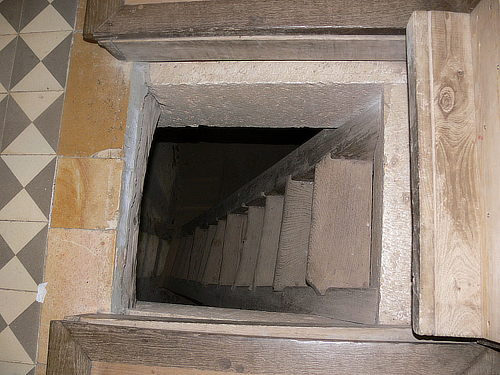
    Passage leading from beneath the altar in the chapel of Wildenstein Castle

    There’s one in the chapel of Wildenstein Castle, near Leibertingen in the Black Forest. Those paying for a guided tour hear stories of the sadistic knight Heinrich von Wildenstein and his squire gruesomely knotting the legs of seditious peasants. But this short stairway down behind the altar probably only leads to a lower storey, that’s all. Those knobbled peasants probably couldn’t have managed any longer distance. But who needs a secret passage anyway if you can tie the peasants’ legs in knots? (‘Auf Burg Wildensteing’, Märchenfreude).

    A hidden passage was found leading out from Liebenburg Castle, about four kilometres north of the Ancient city of Goslar, not far from where I once lived. It was only discovered in the year 2005. You see, that’s the problem. The best hidden passages remained exactly that. Hidden. Often for centuries, until the tunnels collapsed and even if the entrances are ever found, nobody knows exactly where they once led…

    But why did people need secret passages back then? A silly question perhaps: to escape from enemies of course. But the reasons might be more complicated, as perhaps in the case of Liebenburg Castle, which came into the possession of Heinrich the Younger, Duke of Braunschweig-Wolfenbüttel in 1523. From 1541 to 1542, he hid his mistress, Eva von Trott and her three youngest children there, until she gave birth to her ninth child. Of course you would need a secret passage or two to hide a mistress with nine young kids. Even if just to have a place to hang up all the secret nappies to dry?

    There was a lot more to this story than that. Trying to avoid a scandal, Heinrich the Younger, a Catholic, needed some serious secrecy. After having his mistress, with whom he had already had three children, declared dead from the plague, he had a wooden doll put into her coffin and buried after a funeral service at Gandersheim Abbey, only to clandestinely install her and the kids in Liebenburg Castle, where he continued to visit her for a few more years, fathering another six children by her. He probably visited her through that same secret passage discovered in 2005.
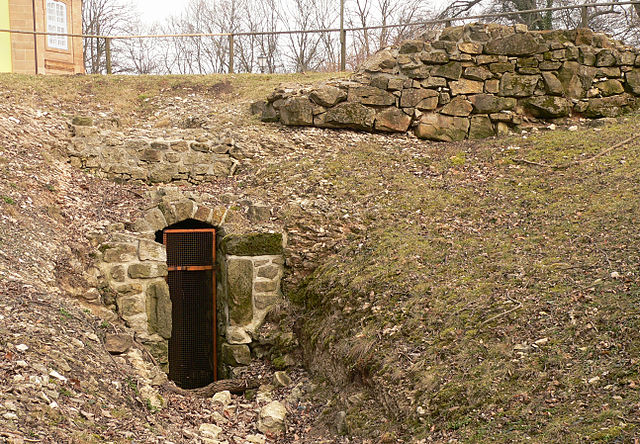
    Underground secret passage of Liebenberg Castle, discovered in 2005

    Why all the fuss? Surely, Kings, Dukes etc., even some rich Archbishops had mistresses all over the place. Yes, maybe. But they didn’t have Martin Luther and the Reformation breathing down their necks. Luther used the affair as propaganda against the Duke in Wider Hans Worst (1541) in the Schmalkaldaic War, the war which caused Eva Von Trott to flee Liebenburg castle. Ah, they don’t quite have love affairs like that any more, secret passages and all….

    There are fine examples of entrances to such passages hidden in bookshelves and behind altars. The famous Admont Abbey in Austria, about forty kilometres east of Salzburg, has one, hidden in the theology section of the stunningly beautiful library. Shades of Harry Potter, the Da Vinci Code and The Name of the Rose perhaps? Not really. All that trouble creating a beautifully concealed entrance was simply to allow library users a discreet access to the upper rows of books. Now stop imagining what kinds of books the naughty monks might have hidden there!

    I really do wonder if Cobb might have heard of that hidden passage at Wildenstein Castle…


    CHAPTER 15

    THE MIDNIGHT MISSION

    The hunter returned alone to the living-room of the cot, but announcing that Wolfgang had departed.

    “But, he added, as our hero’s countenance fell, he will be with us bright and early tomorrow morning. He was obliged to go—called away by business of interest to us all. I may tell you that Thorbrand is so far recovered as to be able to take the saddle, should necessity call.”

    “Then why,” cried Ernest, vehemently, does he not show himself without further delay?”

    The next question was of importance: Had Thorbrand given his consent or countenance to Oberwald’s accompanying him to the castle?

    “Yes,” said Martin, “l am to go with you; and I received from that wonderful man information that may be of value to us. Were you aware that he was, for a considerable time, in the employ of the father of the late baron? He was for several years a boy with the Baron Gregory von Deckendorf, and loved him well and truly; and for that reason is he the more eager to assist the wife and daughter of Sir Gregory. Sir Pascal Dunwolf little dreams of what a rod I have in pickle for his back.”

    During the latter part of the afternoon the hunter made a circuit of the forest near his premises, finding, as he had expected all clear. Evidently Sir Pascal was putting forth no effort towards recapturing the young captain.

    As the sun was setting supper was eaten, after which the two adventurers prepared for their nocturnal visit.

    Pistols were taken, but it was understood that they should not be used except in case of great emergency—it must be a situation where nothing else would serve them. Swords they would not take. They would be awkward weapons at night, in narrow quarters; and, moreover, their clanking might betray them. They took instead short clubs of iron-wood, almost as solid and heavy as iron itself, eighteen inches in length, with a knotted knob on the larger end, and the grip, or handle, so formed that it could not be lost nor slip in the hand. At close quarters it would be a more effective weapon than a blade, and far more readily used. Stout daggers they took and that was all, of the so-called deadly weapons; though, for that matter, the iron-wood club, in the hand of a strong, clear-headed man, might be about as deadly as anything that could be used upon a human skull.

    Two dark lanterns, with lamps well filled, and carefully trimmed, together with flint and steel and tinder, and soft moccasins for the feet, completed their outfit; and as the clock struck ten they were ready to set forth, though they waited a time before starting, it being their plan not to enter the castle until after the sentinels had been relieved at midnight.

    Irene had no fears. She would have the dogs for company, and in case of emergency she could take refuge with the occupant  of the cavern. They had had considerable difficulty with Electra’s stag-hound, having been obliged to keep him fastened most of the time. It was not the care, however that worried them, but the poor dog’s mournful howling—his dismal, heart-rending shrieks were painful to them all. They would have set him free, knowing very well that he would have flown to the castle as swiftly as his fleet feet could have carried him, but they feared that the angry men whom he had bitten—for he had torn the flesh of two or three of them before they had captured him—might intercept and kill him. After it had become dark, however, he had taken food from Irene’s hand, and the combined efforts of the patient girl, and her St. Bernard, at length quieted him and brought him to terms.
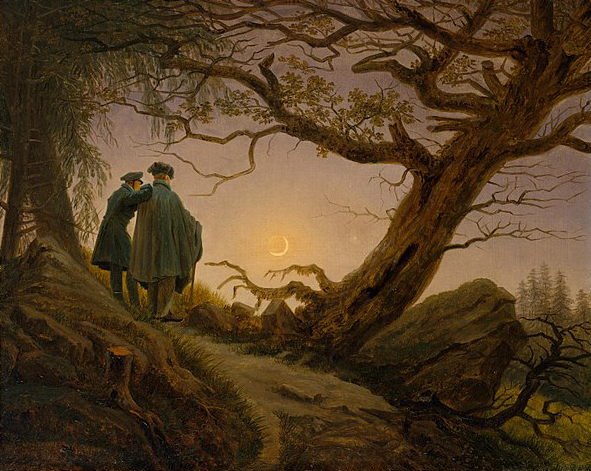
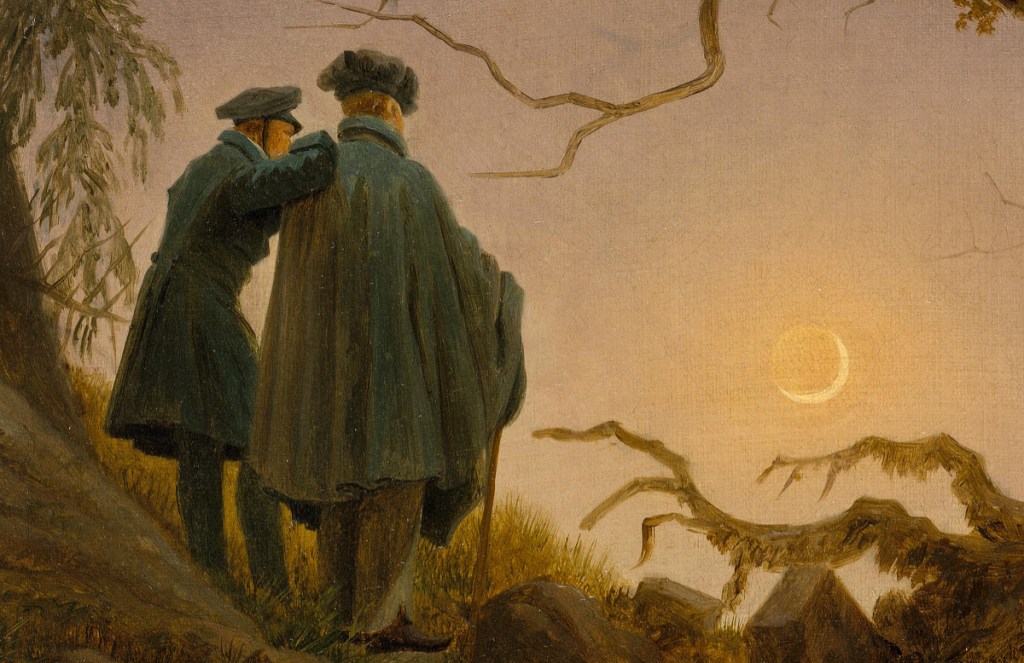
    Two Men Contemplating the Moon (c. 1825-30), Caspar David Friedrich.

    As the clock struck eleven, the two adventurers set forth. The night was clear and pleasant; the moon, a few days past its full, gave a light almost equal to day, which led them to be cautious, and to seek the shadows where they could conveniently find them. In less than half an hour they had reached the deep dell wherein was the entrance to the pass, and here, within the arch of the protecting cave or alcove, they lighted their lanterns. Then Ernest opened the hidden door, and they entered the passage.

    Considering all the circumstances, Ernest felt that he was in honor, not only authorized, but bound to reveal to his companion the secret of the subterranean passage, and he commenced by showing him how to open the way by which they had entered.

    “My dear boy,” said the hunter, gratefully, “it is a thing I would not have asked at your hands: but, believe me, you do no wrong in trusting me; for you do well know that with me the secret is safe, and, further, that I would never make use of the knowledge save for the purpose of good to the lawful inmates of the castle.”

    More than once on the way Oberwald stopped and pointed out to his young companion places in the pass that were like unto his own pass down the mountain.

    “At some time, probably before the advent of animal life upon the earth,” he said, “a mighty convulsion did this work. Who shall say that the same great upheaval which lifted these mountains to their commanding heights did not open these seams in the rock, and form the caverns as we now find them? It is wonderful! Wonderful! What a pigmy is man when compared with the stupendous forces of nature, and the omnipotent power of nature’s God. But only a pigmy in that comparison. As compared with other creatures, or with other creations, man is himself a wonder. Next to the Almighty himself is the good, true man. Made in God’s image, to live beyond the crash of worlds and the bounds of time, the man who strives in his heart to be godlike is surely no contemptible thing.

    “But enough of this. I am not apt to preach, yet I love to think.”

    “And I love to hear you preach, if you will call your grand theme by that name,” said the youth, with enthusiasm. “I have myself often thought in that same strain. I think until I am lost, and then I am forced to acknowledge how little I am. And here you have been giving me a pleasant, healthful thought. After all, our littleness is only in comparison with the infinite. Remembering that, we may take courage, and believe that we can, if we will, so live and act as to be worthy to be called the children of God.”

    “That is true, Ernest. Why haven’t we struck this theme before, during the hours we have spent so near to each other? There’s much of profit—of mental and moral health—in such conversation. Ah! what have we here?”

    “That is the murmuring of the stream above us. Just one half of our journey is done.”

    “Another wonderful thing is this,” said Oberwald, stopping a moment to look up at the dripping roof above his head. “Think how this pass is opened in the solid rock in so strange a manner. A simple fissure or chasm would be easily understood, but this deep rent, roofed as though by the hand of man, is passing strange—it is inexplicable.”

    After this they pushed on, beginning to ascend very shortly after passing under the stream, and so continuing until they stopped before what appeared to be a solid wall of rock, shutting off further advance.

    “We are at length beneath the inner court of the castle,” said Ernest, as he stooped down and pointed out to the hunter a seam in the rock, and in the seam a tiny opening like a key-hole. Into this he bade Oberwald insert the point of his dagger, pressing with a gentle force.

    It was done, and instantly a section of the rock swung inward, creating an aperture through which the pair of them readily passed. A little distance further, and they ascended a flight of stone steps, at the top of which the youth announced that they had reached a point beneath the old keep.

    “And not ten yards away,” he added, is the dungeon into which I was cast.”

    The hunter looked at his watch, and  found it on the stroke of low twelve—midnight.

    “We want the sentinels to be surely exchanged before we enter the keep,” he said; “and I have a great desire to look into that dungeon, which I have doubtless visited from the other side. We shall have plenty of time.”

    So, without further remark, Ernest kept on a few paces, then turned abruptly to the right, at a short distance further reaching the foot of a flight of narrow stone steps cut from the native rock. Up these he led the way, at the top, after listening until assured that all was safe beyond, he lifted the edge of the ponderous slab of stone directly over his head, and stepped up into the dungeon. Oberwald followed and gazed about the place. A swarm of rats scampered away, having been drawn hither by the food which had been left behind when the prisoner went away. Their means of passage was a hole near the door, where, in the course of years, they had succeeded in digging through the thick, hard masonry.

    The adventurers did not tarry long here. The hunter remembered the place, having visited it in other years with Sir Gregory, little thinking then that he should ever come to it through the bowels of the earth.

    “Having reached the main pass, once more they took an upward course, and at the first landing above the level of the dungeon they stopped and exchanged their boots for the soft, noiseless moccasins; and ere long thereafter the guide announced that they had arrived at the second floor of the old keep, and that the closet of the picture-gallery was directly before them.

    They both bent their ears and listened attentively, very soon making sure that no one was at the other side. Then the secret opening was touched, and the panel moved back, revealing an aperture through which they passed without difficulty, finding themselves in a small room half filled with dust-covered pictures and useless lumber. Another season of listening, and they carefully opened the door of the gallery beyond. As the door was opened Oberwald, who was behind, saw a scrap of paper on the floor. He picked it up and held it to his light, it was only an old label that had fallen from one of the pictures. Another scrap was found by Ernest, which proved to be a blank. Another piece, carefully folded and dropped near the door, escaped their observation, though they might have seen it had not their attention been distracted by the others.

    The gallery had a dismal, forsaken look, the sombre portraits on the wall wearing a ghostly aspect, the pictured faces of the dead-and-gone barons frowning down upon them as though in indignant reproof for the sacrilege they had committed.

    Portrait of Pompeius Occo (c. 1531), Dirck Jacobsz.

    “We must reach the apartments of the baroness,” said Von Linden, when they had assured themselves that nobody was moving near the place. “I am confident that the ladies expect my visit, and they will communicate with us if they possibly can.”

    “Then on it is,” answered the hunter, sententiously. “We must find something.”

    “The apartments are on the same floor, and not far away,” the youth explained. And without further question they carefully opened the door communicating with the hall, and stepped out, their moccasined feet falling lightly on the pavement.

    Slowly and carefully they moved on, seeing no light anywhere, and hence judging that no sentinels had been posted in the neighborhood. The door of Lady Bertha’s drawing-room was reached without accident, and it was found unlocked. Ernest opened it and went in. The place was dark and silent; the proper occupants surely not there. Without hesitation they passed on into the sleeping-room, where the great bed was in a sad state of disarray, more than half the clothing having been taken away, probably to make for her ladyship a couch elsewhere.

    Having carefully looked over the room for any scrap of information that might in any manner have been left, Ernest made his way into the room next adjoining—the dressing-room.

    “Here,” he said to his companion, as they closed the door behind them, “is another entrance to the secret pass—the one by which we left the keep when we sought your cot. This is the panel. It is so contrived that—”

    He did not finish the sentence. His eye had caught a carefully folded paper on the floor upon which a bright beam from his lantern had fallen. He picked it up, and a startled exclamation burst from his lips as he saw the superscription—“This from your captive friends.”

    Giving his lantern to his companion, he opened it, and read.

    “Eureka!” he cried, as he caught the meaning of the note. “Here it is, Martin. It is brief, but it is to the point. It is in Electra’s hand. ‘We are in the chambers of the new wing,’ she writes. Ah! Sir Pascal had his wits about him. He judged rightly that there could be no communication with the subterranean pass in that modern structure. They were put there when they were first brought in. Probably they were permitted to come hither under watchful eyes, to  get such articles as they might want for comfort. O! bless the dear girl! how thoughtful she was.

    “Oh! the black-hearted villain! Listen to this: ‘The bad knight will, if he is not prevented, make me his wife to-morrow. To-morrow, Martin! And the day has already commenced. By heavens! We must be moving if we would prevent it.”

    “Easy, my boy. There is time enough Does she say at what hour?”

    “No; she only adds:  ‘We are under strict guard.’ And then she repeats: ‘Remember, it is TO-MORROW!’

    “What shall we do? When will Thorbrand be ready to help us? When will Wolfgang—”

    “Tut! tut! they will be ready whenever we speak the word. We have but to give them information of the need, and you shall find them up and doing on the instant.”

    “But the men! Must they not assemble from the forest some of their band to help them? Think of the host which Dunwolf has at command.”

    “My dear Ernest, you know not yet the power of those two men. Their appearance at the castle will be sufficient. Either one of them would be a host in himself; but let them both appear, and you shall see the stout men-at-arms quail and shrink as from a thunderbolt! Do you borrow no trouble on that score.”

    A little time the youth stood, gazing in speechless amaze into the face of the hunter, and then he turned once more to the paper in his hand.

    “To-morrow!” he repeated, quivering at every joint. “How many hours are there? Think of it! His wife! I would rather see her lovely form torn and rent by the wild beasts of the forest.”

    “Hush! Hush! You shall see neither. We have gained all the information we desired—of course we cannot see the ladies—and we may now return. Let us thank kind Heaven that our effort has been so signally rewarded.”

    “I do! I do—thank Heaven from my heart. But—l wish I could see one of the old servants. If I could but gain speech with one, though but for an instant, I should be glad.”

    “For what, my dear Captain? What can you hope to gain more than we have already accomplished?”

    “Can you not see?” cried the impetuous youth, in surprise. “How will the dear girl live through the coming hours if she knows not that her effort has been effective? Let her remain in ignorance of what we are doing—in ignorance of our knowledge of her situation—and her great anxiety may drive her mad, if it does not kill her. If I can see a servant and leave a sign to be given to Electra by which she may know—”

    “I see,” interrupted Martin, breaking in upon his companion’s eloquent explanation. “I understand you, my dear boy, and I agree with you, too. Let us go back and make the search. Perhaps the servants’ quarters are not under surveillance. But remember this: An accident that should detain us, or, mayhap, do worse for us would be terrible.”

    “We will be very careful,” pleaded Ernest, beseechingly. “O! I must get word to the dear one if I can. Let us make an effort. I will not venture far. You shall say when we must give it up.”

    “Very well. Do you lead the way. Be careful of your light after you strike the open passage.”

    With this they turned back and retraced their steps as far as the passage beyond the drawing-room, where, as the way was clear before them, they closed the slides of their lanterns, and moved slowly forward in the dark. They had reached the end of the passage, and were about to enter the common hall of that floor, from which all the narrower ways diverged, when they were brought to a stand by the glare upon the wall before them of a light; and in a moment more the changing of the shadows told them that the light was in motion. Some one besides themselves was astir.

    Drawing back from the narrow passage pressing close against the wall, they stood and waited.


    Notes

    • Heinrich the Younger: Nicknamed Der Wilde Heinrich, which translates to more like “Randy Heinrich”.
    • Martin Luther, Wider Hans Worst: a propaganda pamphlet satirising Duke Henry. “Wider” means “against”; “Hansworst” was a carnival buffoon character of the time, the name used as an insult.
    • ‘the hunter looked at his watch’: Don’t worry, spring powered clocks originated in the 15th century; pendant-watches were crafted in France and Germany in the 16th century; the pocket watch in the 18th century, when waistcoats became fashionable. See Carlos Perez, “Artifacts of the Golden Age” (2001).
    • ‘I would rather see her lovely form torn and rent…’: Easy for him to say.
    • ‘Do you borrow no trouble on that score’: ‘Don’t let that worry you.”
    • ‘signally rewarded’: conspicuously, eminently, memorably.

    NIGHTSHIFT byTony Reck © 2025
  • Cobb’s False Knight: 1. The Castle and the Cot — An Alarm

    Cobb’s False Knight: 1. The Castle and the Cot — An Alarm


    THE FALSE KNIGHT

    or

    ROBBER OF THE BLACK FOREST

    A Story of Love, Mystery, and Adventure

    by

    SYLVANUS COBB, JR.


    Foreword

    The images the word “knight” conjures up might all be similar for most of us: Shining armour, bravery, jousting, glorious, bloody battles, castles, saving distressed damsels even perhaps. But isn’t it a strange word? In French, it’s “Chevalier”. A man on a horse. In Spanish, “Caballero”, a man on a horse. In German, it’s “Ritter“, derived from “Reiter”, which means “Rider”.

    So where does that rather odd and unhorsely word “Knight” come from? Not from “neigh”, although many a knight’s steed may at the thought. These days, it’s pronounced with a softer beginning, simply the letter “n” with a totally silent “k”.

    Centuries ago however, English people spoke the same word with a hard “kn”. Worse still, they made a retching sort of noise at the end. “Knicht” perhaps. That’s because the word knight wasn’t English. They had, for whatever strange reason, magpied the term from Dutch and German, from “Knecht”, despite the English having had a lot of trouble reproducing that strange retching German and Dutch “ch”.

    Knicht? It sounds more like an insult than title. A word that doesn’t conjure up images of bravery, jousting or shining armour at all. That’s because a Knecht was a mere “boy”, a youth, in the sense of “servant”. A lowly squire in the knightly sense rather than a brave warrior? A lackey? For whatever reason, the English seemed to love the strange and incorrect expression so much that they kept it as their own.

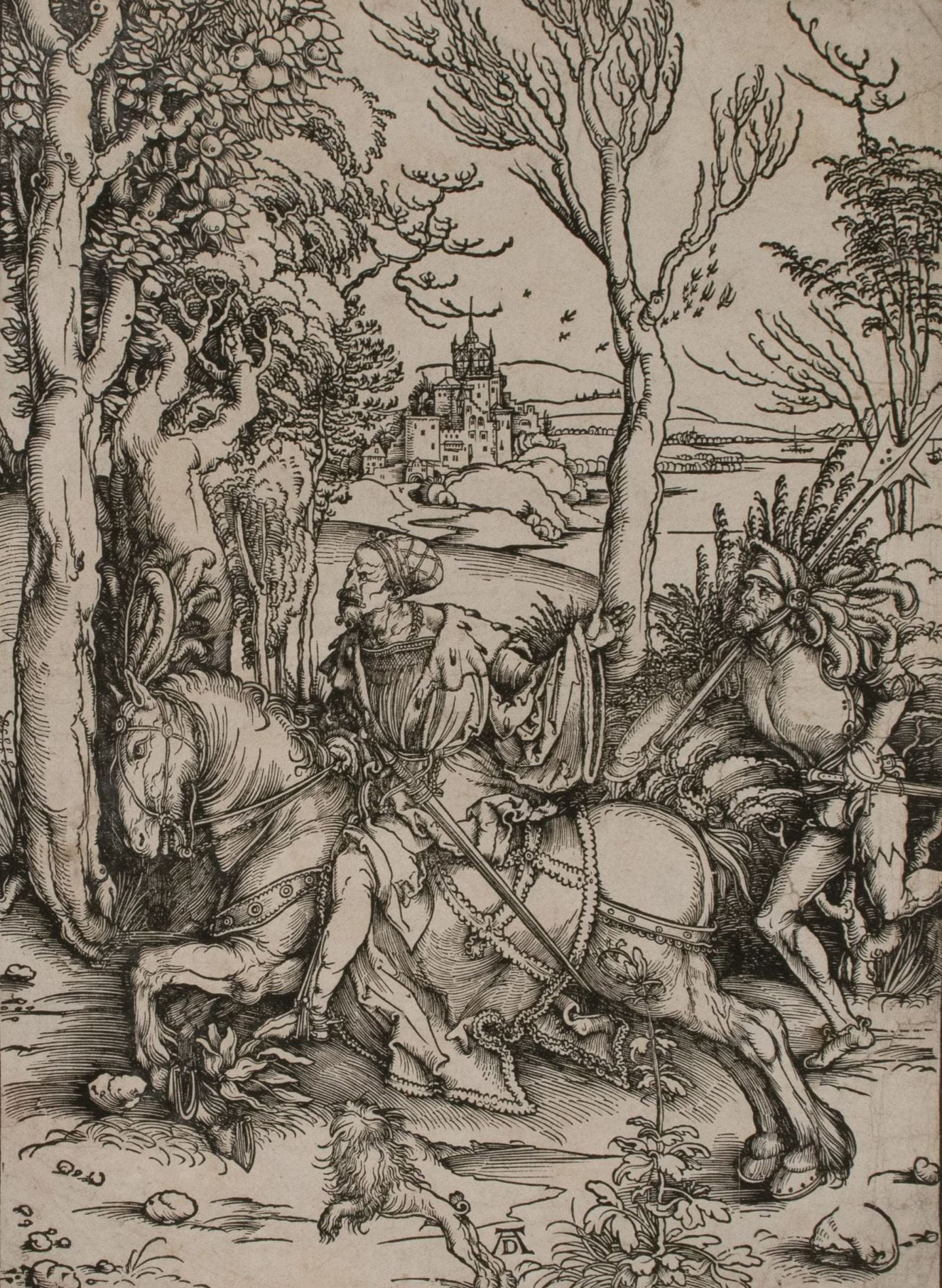
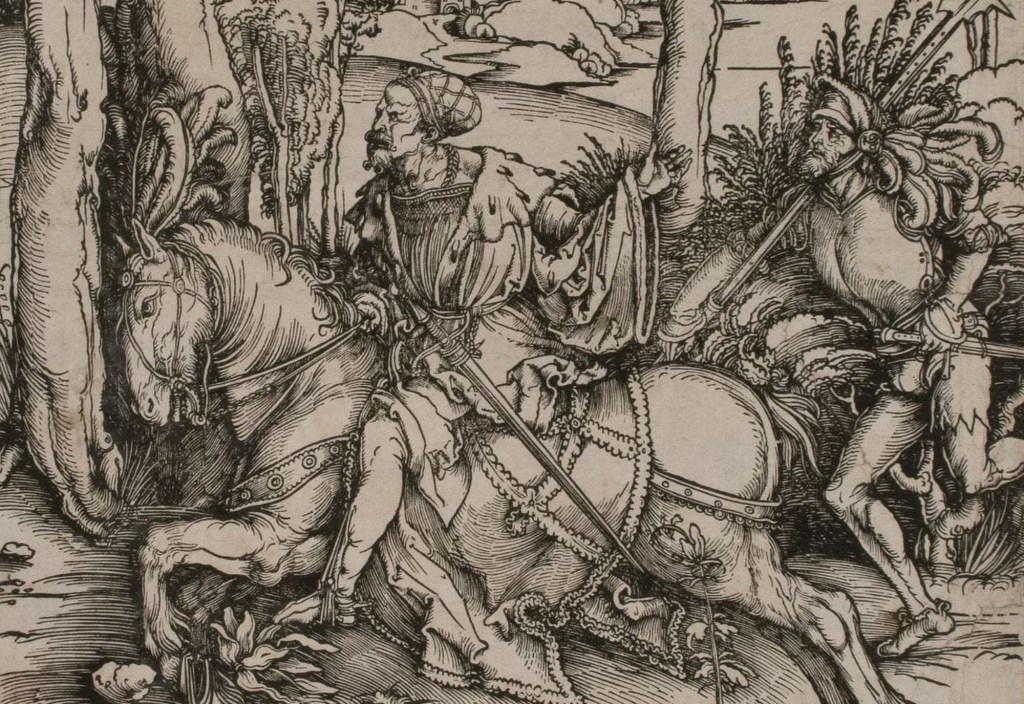
    Albrecht Duerer, Ritter und Landsknecht — the difference to a simple “Knecht” being that a “Landsknecht” was an armed footsoldier. Both far lower in rank however than a knight.

    From around 900 years ago, this anglicised word, in the older pronunciation, described a military follower of a king or duke. Who, similarly to a Caballero, Chevalier or Ritter, used to ride around on a horse, doing his “serving” in that sense. Of course Dutch, French or German knights also usually served kings or dukes, etc., yet the words for “knight” in those languages emphasise the connection to horses, and not to any servile duty to a “superior”.

    Is this why we saw the phenomenon of “Raubritter”, “Robber knights“, more in Germany and at least not linguistically, in England? In England, they call them “robber barons” and not “robber knights”. Perhaps the knights in England were less evil? Not so the Barons apparently.

    Were there any robber knights in the Black Forest? The very name of this area might suggest a darker side, with one famous castle ruin located right in the “Hoellental”, “Hell’s Valley”. Although many robber knights had castles along the Rhine, where they extorted payments from travellers, there are Swabian folk tales about “Hans von Wieladingen”, from the southern end of the Black Forest, who used to lure merchants to his castle by playing his violin, only to throw them in his dungeon, pending the payment of ransoms.

    Knights in the middle ages naturally had something feudal about them, but often more in the sense of “feud”. When they had disagreements with neighbouring “strong men”, this resulted in them attacking and burning down the villages and even destroying the castle of the enemy. Perhaps it’s little wonder, especially after the Thirty Years War, that only ruins of castles in the Black Forest remain…

    A “False Knight”. Is that a double negative then, even after nine hundred years of anglicising the humble “k-nicht” with the retching ending? Hans von Wieladingen may have been a robber, but he really was a knight, title, castle and all. Is there any evidence of there ever having been a real false knight? 

    Back in the year 1284, a humble German peasant decided that it would be a good idea to pretend to be Kaiser Frederick II. The problem was that the real Kaiser had already died in 1250. But he was sorely missed in the decades that became known as the “Kaierlose, die schreckliche Zeit”, the “Kaiserless, the terrible times” because of the political chaos of the interregnum. So Tile Kolup, Dietrich Woodenshoe’s other name, turned up thirty four years later in the city of Cologne claiming to be the dear old Kaiser.

    Whereupon the locals tossed him into a cesspit and dunked him in the Rhine. Undaunted, a perhaps rather smelly Kolup proceeded to the town of Neuss, several miles downstream, where, after he had cleaned himself up, his reception was so much more positive that he used a fake royal seal on documents. He made money by selling fake royal privileges, sealed with wax with his trusty fake seal.

    But what has this got to do with any “false knight”? The following image, from the year 1474, depicts a scene from Tile Kolup’s story in the “Chronicle of the Ninety Five Rulers“, a manuscript kept in the Austrian National Library.

    Clemens Specker, 1479, illustration of the story of Tile Kolup, depicting the “Three Chancellors Paying an Innkeeper”, from the “Chronicle of the Ninety-Five Rulers”, Austrian National Library.

    The text tells us that it shows the fake Kaiser’s three fake “Chancellors” paying an innkeeper in the town of Wetzlar. A chancellor used to be a person who ran a royal household. Usually a knight. The third fake “Chancellor” is even depicted on horseback. He and his co-conspirator “Chancellors” were apparently “moors”.

    Sadly, King Rudolf of Habsburg had Tile Kolup captured and burned at the stake in Wetzlar in 1285. It is only fake news that the exquisite German dish “Kaiserbraten” (“Emperor’s Fry) was so named in honour of this incident. There are no references to the fate of the fake knights, so maybe they managed to get away…

    This story may not quite sound as unlikely as, for example, a resurrected President Kennedy coming back to save America in the year 1997. After all, there were no photos or films back then and because of average mortality, hardly anyone alive in 1284 would ever have laid eyes on good old Kaiser Frederick II.

    The only drawings of him are in old manuscripts only seen by a privileged few. The very most that people would have known was that the dearly departed Kaiser had a big red beard, hence his Italian name Barbarossa. Surprisingly, the only know image of Tile Kolup, his impostor, depicts the wannabe Kaiser without as much as a moustache….


    CHAPTER ONE

    THE CASTLE AND THE COT — AN ALARM

    By far the larger portion of the Grand Duchy of Baden, together with a large part of the territory of Wurtemberg, is covered by that wild and darksome, yet romantic picturesque mountainous region known as the Black Forest (German. Schwarzwald). Near the centre of this forest, on the eastern confine of that district of Baden called the Middle Rhine, nestled away in one of the wildest and most romantic of the Schwarzwald vales, was the small town or hamlet of Deckendorf, taking its name from a strong castle that reared its massive walls and embattled towers upon a rocky eminence close at hand.

    At the time of which we write — during the first half of the seventeenth century — Deckendorf Castle was under the immediate command of a veteran, war-worn knight, Sir Arthur von Morin; but he was not its feudal lord. Ten years previous to the opening of our story, the Baron Gregory von Deckendorf, lord of the domain — then in the early prime of his manhood — in the fullness of his Christian zeal, accompanied John Sigismund in his crusade against the infidel Turks, and in battle with the Moslem he fell, leaving a wife and daughter to mourn his loss.

    On the eve of his departure upon the fatal crusade, the baron had placed his castle and his family under the care of his wife’s uncle, the veteran knight aforesaid, giving him full power, and receiving in return the oath of fealty to himself, and good faith to the baroness and her daughter. And most  loyally had .Sir Arthur kept his oath and his faith. The bereaved ones had come to lean upon him as upon a lord and master, and to love and revere him as a father.

    One of the most beautifully romantic spots in this beautiful and romantic region of which we write, was a small plateau — an elevated bit of table land — on a mountain side, directly opposite to the castle. Imagine twin mountains — one to the east, the other to the west, and between them a crystal stream, leaping from rock to rock in silvery cascades, soon thereafter settling into a sober, placid river, on the fertile intervales of which clustered the dwellings, the shops, the quaint old mill, and the still quainter old church of Deckendorf. On the side of the easterly mountain, not far from its foot, stood Deckendorf Castle; opposite, on the side of the mountain to the westward, and at about the same elevation, was the plateau of which we have spoken, whereon stood the cot of Martin Oberwarld, one of the most accomplished and intrepid of the trained hunters of the Schwarzwald.

    View on the Middle Rhine (1770). Herman Saftleven. Museum Boijmans Van Beuningen.

    The cot covered a broad area; its walls were of gray stone: its small gothic windows, looking not unlike the eyes of some shaggy-headed monster, set so deep in the thick masonry, were artistically glazed; while the widely-spreading roof, steeply sloping — its eaves overhanging so as to afford protection to doors and windows against ordinary storms — was a thatch of fine mountain reeds, made impervious by a liberal application of the balsam of the black fir. A scene it was, take it all in all, that would have happily fixed the gaze of the painter, and made his heart glad.

    Towards the close of a pleasant day of early summer, two girls sat just outside the open doorway of the hunter’s cot. They were very nearly of the same age, one of them having seen eighteen years, the other nineteen, and they were both beautiful, gifted with that beauty of heart and soul of truth and faith — that beauty of loveliness which appeals to the better and nobler instincts, elevating and purifying the love it awakens. They were healthful and vigorous, with forms of sylph-like grace and comeliness; fond of outdoor life and exercise, their forest roaming and mountain climbing having given them unusual strength of limb and powers of endurance.

    The elder of the twain was Electra von Deckendorf, heiress of the grim old castle over the way, and of the greater part of the town and territory in the neighboring valley. She was slightly taller than her companion; her hair was of a dark glossy brown, gathered away from her brow and temples into a heavy braid, which, secured by a bit of silvery ribbon, was suffered to float over her back as it would. Her eyes were of a dark pearly gray, full of mellow, liquid light, with truth and affection in every friendly glance. The younger maiden was Irene Oberwald, daughter of the owner of the cot. She was a laughter-loving, sparkling girl, looking for brightness and goodness wherever they might be found, and never happier than when she could give of her happiness to others. She had a wealth of golden curls, floating over her shoulder in wild but lovely profusion; her eyes, of heaven’s own blue, were large, full and brilliant, rippling with smiles when she was happy, or overflowing with tears when sympathy touched the fount of her tender emotions. Of her it might be truly said: “She was a thing of beauty, and a joy forever.” Electra came to her for comfort always when clouds overhung her path; and to the poor and the suffering of the village of the valley she was an angel of light and goodness. But in this latter respect — in benefactions upon the villagers — be sure Electra bore her part. Little could Irene have done in the way of bestowing creature comforts without the aid of her dear sister of the castle.

    Nothing of raiment, on the present occasion, wore the heiress of Deckendorf to distinguish her from the humble daughter of the poor hunter. Tunics, or short jackets, of velvet — blue for Electra, and crimson for Irene — tastefully embroidered with thread and lace of gold; shirts of fine linen stuff, worn short, so as not to interfere with their mountain climbing; stockings of finely knit silk, with strong leather boots, gave protection to their feet, while for head-covering twin hats of finest Italian straw, fashioned for comfort, but with a true eye to comeliness, lay upon a rough stone bench at their side.

    Such were the principal items of the garb of these two girls, and to be sure nothing more was required nor could anything more have been brought into play to set forth in the rich fullness of perfection their matchless grace and beauty, both of form and feature.

    At Electra’s feet lay a magnificent stag-hound, her constant friend and companion in her forest rambles. He was large and powerful, with a face full of affection and intelligence, and his gentle mistress felt as safe in his companionship as though guarded by a squadron of troopers in full panoply of war.

    On the present occasion, as we thus introduce the two girls and the canine friend and companion, the heiress had just arrived from the castle; and Irene’s first question, after the first impulsive greetings had been exchanged, was of one whom she had hoped to see, but who had not made his appearance.

    “Why didn’t he come?” she asked, with a hand laid affectionately upon her companion’s arm. “I could not have believed you would have come without him.”

    “Ah,” murmured the heiress, with a mournful shake of the head, “my own thoughts and my noble Fritz were all the companionship I wanted. Dear old Fritz!” she cried, throwing her arms round the neck of the dog, who had lifted his muzzle to her knee with a loving light in his brown eyes on hearing his name thus called; “if all could love me with your true heart! Ah!”

    “Electra! What is it! Why do you speak in that manner? Surely, Ernest is not —”

    “Ernest!” broke in the baron’s daughter, quickly and eagerly. “Oh! he is brave and loyal — as true as truth itself. No, no: do you never, never think an evil thing of Ernest. Poor Ernest! He is wandering away somewhere by himself, I have no doubt, dwelling upon his unhappiness, as I have been doing.”

    “Dear sister,” cried Irene, with sympathetic alarm, “you frighten me. — O!” — her memory coming to her aid — “is it something about that dark Sir Pascal?”

    “Yes, Irene — alas! yes.”

    “Electra,” reaching her hand coaxingly to her friend’s shoulders, “I wish you would tell me the story. You have often spoken of Sir Pascal Dunwolf as one of whom you feared. You are not afraid to trust me?”

    “No no, dear sister mine. 0! when I shall have known the fear of trusting you this life will have become bare and barren indeed! — Irene” — after a brief pause — “I will tell you the whole story from beginning to end; and who shall say how much you may be able to help me.”

    “One thing you know, Electra, I will help you if I can.”

    “Yes, my sister, I know it well; and you may be sure I shall not hesitate to ask you for help if I think you are able to give it. Listen, now, and you shall know all about it.”

    After a little thought the baron’s daughter spoke, tremulously at first, as follows:

    “Between Ernest von Linden and myself, though I have always called him, as he has me, cousin, there is no relationship of blood at all. His mother was Uncle Arthur’s youngest sister; and Sir Arthur, you know, is my mother’s uncle by having married with her mother’s sister. Still, both my father and mother loved Ernest from the first as though he had been of their own flesh and blood, and it was always papa’s wish that he should be my husband. He was an only child, left fatherless and motherless when only six years of age, when Sir Arthur took him, and very shortly afterwards, on the death of his wife, placed him where he has since had a home — with us. The estate of Lindenberg is very valuable, and is not only entirely unencumbered, but Uncle Arthur has so managed the property during the twenty years almost of his stewardship that it has fully doubled in value. Knowing that Ernest’s worldly prosperity was assured, my father only asked that he should grow up to be a true and loyal man to claim my hand, always understanding that I should be willing, and that Ernest should truly love and desire me.

    “You know, Irene, how we have loved. It has been a calm, quiet love, but deep, strong, and abiding. Really, we never knew how all-absorbing and powerful our love had become until the bolt came that threatens to smite it.”

    “Electra!”

    “Hush! Do not interrupt me. I will explain. Just before my father went away on that dreadful crusade — O, I cannot bear to think of it! I shall never become reconciled — never! It was ten years ago this very month that he left us — O, so proud and brave, his heart given to the cause of his Lord and Master, Jesus Christ, as he religiously believed. Just before he went away, he spoke with Ernest and myself together. He told us that the Baroness and Sir Arthur both knew his wishes, and it was right that we should know. Never mind the injunctions which he laid upon us; the principal thing was this: Should anything happen to prevent his return to us — should he fall upon the field of battle — it was his desire that we should be married when I should have reached the age of nineteen. He set it first at twenty, but both Ernest and my mother entreated him to cut off a single year: and he did so.

    “Of his death you know. He fell at Novi, in Croatia, struck down by a turbaned Turk at the very end of the battle. He would not flee when the others did. I have been told that Sigismund had ordered a retreat a long time before my father would listen to such a thing; and it was while endeavouring to cut his way out from the midst of the Moslem host that he received his death-blow.”

    At this point the stag-hound lifted his head upon the knee of his mistress, his eloquent eyes looking the sympathy he could not speak. Upon his neck she wept a time in silence, and then resumed her story.

    “In that darksome, mournful time, what should we have done without Ernest? He was our comfort and our joy. Uncle Arthur, with his heart in the war, himself battle-worn and scarred, felt only pride in what he called the baron’s noble sacrifice. Yet, he was sympathetic and kind; but not with the sympathy and the kindness of Ernest. Well, the years passed: Ernest was away much of the time at school, in Heidelberg; and, of late, since Sir Arthur has been so feeble, he has been obliged to be much of the time on his estate, it having come into his full possession three years ago. He has been with us, however, when he could; my mother has regarded him as her son, while I, with my heart given wholly to him, have simply looked upon him as my husband — so in spirit, awaiting only the few; short months that must pass before it can be so indeed.

    “And now comes the storm that threatens to shatter our fabric of bliss and blast our every hope. Ah, how gladly would I exchange places with the lowest peasant girl of Baden! See what it is to be heiress of Deckendorf Castle. By the law of the land I have been, ever since the death of my father, a ward of the reigning grand duke. It has only remained for him to claim his right for me to submit to his authority. It is known at Baden-Baden that Sir Arthur has been stricken with paralysis, and that his days are numbered. Deckendorf Castle, commanding as it does one of the chief passes of the Schwarzwald, between Baden and Wurtemberg, is of so great importance to the State that the grand duke feels that he must have it under his own control, to which end he would place one of his own paladins in full possession, which possession can be gained only by marrying me. Now, do you not understand?”

    “Mercy!” cried the hunter’s daughter, with a frightened look. “Is Sir Pascal Dunwolf the man whom the grand duke would make master of Deckendorf Castle?”

    “Verily, he is the man.”

    “And he would have you become that man’s wife.”

    “So he has said.”‘

    “But, surely, Leopold has a heart. He is himself young, is he not?”

    “I think he is. It is only two years since he succeeded his father on the ducal throne.”

    “What reason does he give? He would not do such a thing without some good and sufficient reason.”

    “His reason, as Sir Arthur has explained it to me, is that there is treason in this section of the Schwarzwald. Some of the powerful barons of Wurtemberg have entered into a league, the object of which is the conquest of a large portion of the district of the Middle Rhine; and it is strongly suspected that a number of the barons of this very district, are ready to join with the enemy as soon as the opportunity is offered. In order to make such a movement a success, the possession of Deckendorf Castle would be indispensable. Thus you can understand why the grand duke should wish to place one of his chief officers in our old fortress.”

    ”Let him place as many officers in your castle as he likes. Do you give to them the room, and betake yourself to this dear old cot. You will never listen to such an outrageous thing. Tell me that you will not.”

    “Ah! my dear sister,”‘ said the heiress, with a lugubrious shake of the head, “it is one of the penalties of rank from which I cannot escape. Although the grand duke has power to give my hand in marriage to whom he will, he cannot make another lord of Deckendorf except my hand goes with the title. He cannot rob me of my heritage.”

    “But he can do what is ten thousand, times worse!” cried the hunter’s daughter, with wrathful emphasis. “He can rob you of your life’s life — of hope and joy — for all time to come!”

    “Alas! yes.”

    “But you will not suffer it. You must not. Why does not Ernest go himself to the ducal court and plead his cause — his cause and yours? As I live, I believe Leopold would listen to him.”

    Still Electra shook her head. “I fear it would be of no use,” she said. “Ernest saw the prince when he was last at Baden-Baden, having been commissioned by my mother to strongly oppose the marriage by him contemplated. Ernest spoke eloquently, as we know he must have done, telling the story of our early betrothal, and of our deep and unwavering love. Leopold listened patiently, and even kindly, but he would not give up his cherished plan. He said the safety of the State must take precedence of everything else. He was sorry to be obliged to make unhappiness for even the very lowest of his subjects; but when the weal of the nation was in the balance the romantic love of a single pair could not be considered. He then told Ernest, to wait. He said he should very soon send Sir Pascal to Deckendorf and he was sure we should like him.”

    “And do you mean to tamely submit? Will you give up your love of a lifetime without an effort?”

    “No! no!’ cried Electra, starting to her feet, with her hands upraised — “not without an effort! O, no! I shall struggle be sure. If Sir Pascal comes, thinking to find in the heiress of Deckendorf a willing victim, he will find instead, I fear, a vixen. I will show him what an injured, indignant maiden can do towards defending herself. If he will take me for his wife as I shall appear to him, he must be something different from the majority of men. No! no, Irene! I shall not surrender without an effort!”

    “Good! Good!” exclaimed the maiden of the cot, with enthusiasm. “You will have time for thought. Of course Sir Arthur will help you all he can.”

    “Yes bless his dear old heart! He will do all that he is able to do: but that, I fear, will not be much. He is very weak, and his mental powers are not what they were. Alas! poor uncle is terribly shattered. Ha! What was that?”

    The girls were at that moment startled by what sounded like a painful moan, or cry of some one in distress. The dog at the same time came to his feet, gave a single sniff in the direction of the point whence the sound had come, and then bounded away.

    “Ah there it. is again!” said Irene, as a low wail of distress was plainly borne to their ears.

    Before Electra could answer the stag-hound came bounding back in quest of help. He stopped before his mistress, gave her a look which she plainly understood, and then turned to lead the way as he desired her to follow.

    “Fritz has found something for us to do,” Electra said, as the dog looked back with an entreating whine. “Let us follow him and see what it is.”

    “Do you feel it safe to do so?”

    “Yes. Fritz would not ask me to go where there was danger — be sure of that. Hark! It is a man in dire distress. Come! Who can tell what the need may be?”

    Irene hesitated no more. “Go on!” Electra said to the dog; and with a glad cry he set forth. They followed him across the open space beside the cot, and into the dark wood of mountain firs beyond followed, both of them, to their fate. What was to come to them of that forest search not the wildest fancy could have pictured to their imagination.


    Notes

    • cot: cottage/hut
    • “a thing of beauty, and a joy forever”: “A thing of beauty is a joy forever,” John Keats, “Endymion”.

    This work CC BY-SA 4.0