Tag: Furin Chime Press

  • The Joss House

    The Joss House

    Hung and festooned as it was with tablets, banners and fans, the joss house at the Chinese camp in Deep Lead was a living bubble of China in the Wimmera. House of deus, so called, from the Portuguese for god. Just inside the doorway, to the left, stood a large iron bell and a tall, barrel-shaped hand drum, with a peacock painted over the pig-skin drumhead. Beside them were glass cases containing sacred candles and five tiers of shelves holding prayers written on paper slips.

    To the unaccustomed eye, the decor was gaudy, with multi-coloured pennants, Chinese characters in purple and gold painted on the walls and roof. Paper and stained-glass lanterns hung from the ceiling; bunches of tinsel in vases were set on stands carved in relief, to depict different epochs. No master craftsman created these, but they proclaim a naïve hand: work executed with painstaking devotion by a jack-of-all-trades, a long-time resident of the Chinese camp.
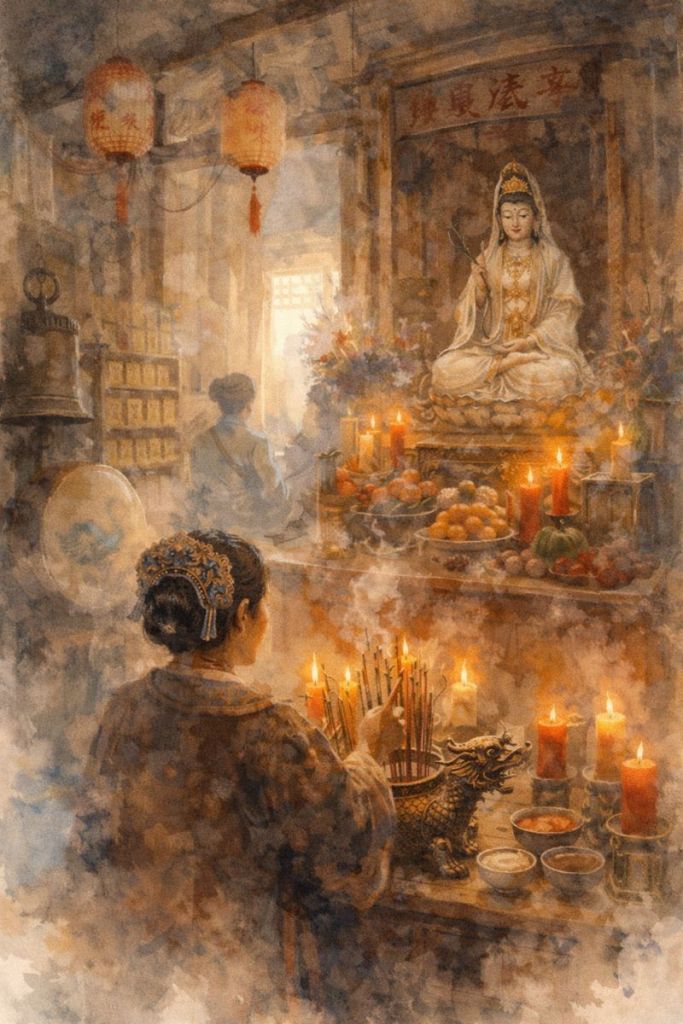
    Watercolour of Joss House interior. A woman tends the altar, on which is seated a carved deity. There are incense, lanterns, a drum, and various other religios artefacts.

    In her ceremonial robe adorned with all the deities of heaven to clothe her in the protection of the universe, Huish-Huish, Mow Fung’s wife, prepared the altar for the ceremony dedicated to making peace with ghosts. At the very back, raised on a pedestal, in the position of greatest honour, stands the immortal Guanyin, provider of good fortune, who is certain to help, for she hears all the cries of the world and is ever willing to offer protection from any kind of threat or attack. She sits placidly upon a lotus, attired pure white, with gold ornaments and crown. In her right palm she holds a golden flask filled with pure water, in her left raised hand, a twig of willow. Water is to ease suffering and purify the body; willow keeps evil and demons at bay. Huish-Huish communes regularly with the bodhisattva, as though she is a dear friend. She regularly brings the statue flowers, food and drink to sustain and empower her. She is no less beautiful for being made out of plaster. The neck of the statue is pierced with a hole, for other spirits to enter and represent her, after the fashion of an avatar; for Guanyin cannot be everywhere at once herself.

    She lit the sacred lamp for the illumination of wisdom, then the two candles, standing for the sun and moon, and for the two eyes of the human being: the light of the Tao and windows to the psyche. These would help her penetrate the dust of the everyday world. In front of them, three cups, one each of tea, rice and water: tea for yin, the female energy; water for yang, the male; and rice the union of both of these, containing yang from the sun and yin from the earth. In front of them in turn, five plates of fruit to represent the five elements: green for wood, red for fire, yellow for earth, white for metal, black for water. These for the liver, heart, spleen, lungs and kidneys – in harmonious cooperation, a cycle of good health. Sour, bitter, sweet, salty, pungent: plum, apricot, dates, peach, chestnut. She placed dried foods on the altar on this occasion, because she wanted to absorb power from it. When she wishes to empower the altar, she gives it fresh food and flowers, from which it draws life energy.

    In front of the five plates stood the incense burner, a bronze dragon turtle, the smoke curling up through the vents in the top of its carapace – vents in the form of the eight trigrams. The joss sticks were Lena’s work: Mongolian incense, pepped up with dubious substances extracted from her beloved maiden wattle. Necessary cleansing rituals completed, Huish-Huish burned the protective talismans and traced their forms in the air.

    Knowing from previous experiences the ceremonial protocols, Chan Lee Lung – known in Deep Lead as Lily Chan, proprietor of the Jade Phoenix – bowed in deference as she entered, then seated herself. Huish-Huish placed a talisman on her head and performed the mudras, the hand gestures used for drawing out spirits. Based on their previous ceremonies, she has come to suspect that urges to self-harm and suicide afflicting the woman are quite possibly the handiwork of a ghost. There are any number of possible reasons why a ghost might wish the subject injury. She is a beautiful woman, and some ghost may want to marry her, particularly if she has said something inadvertently in earshot that put such a nonsense into its mind. On the other hand, it was common for the ghost of someone who died by suicide to become stranded at the gates of hell, compelled to reenact the fatal act for eternity, unless they were able to find someone to replace them, through that person’s own suicide. Or she may have crossed paths with the spirit of a suicide, or tarried at a haunted spot marked by an unnatural death. Such spirits were always in search of a victim.
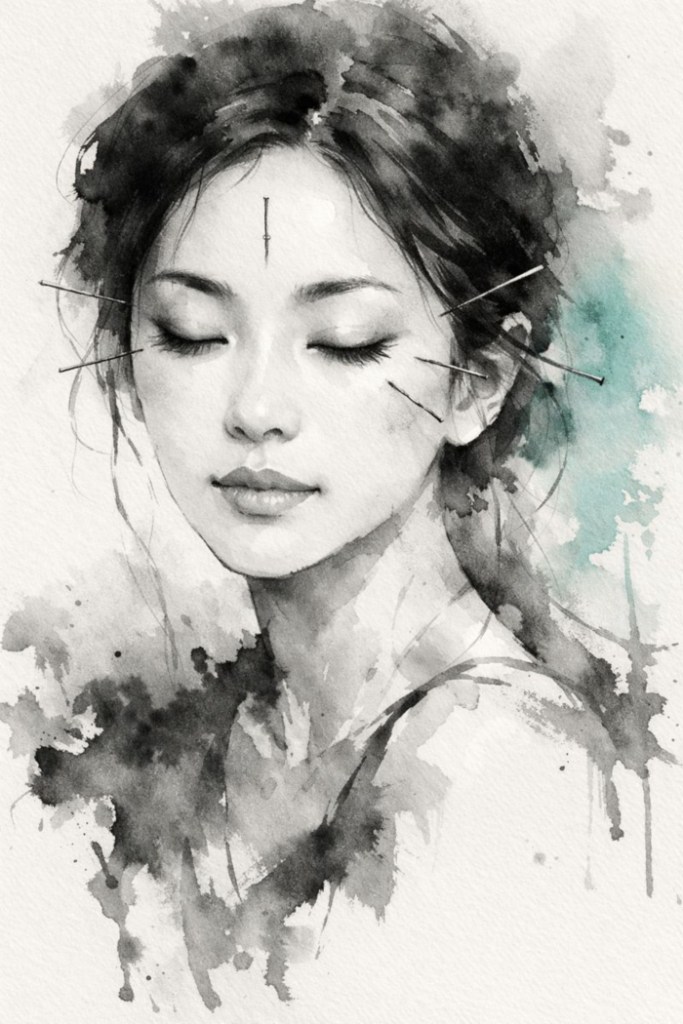
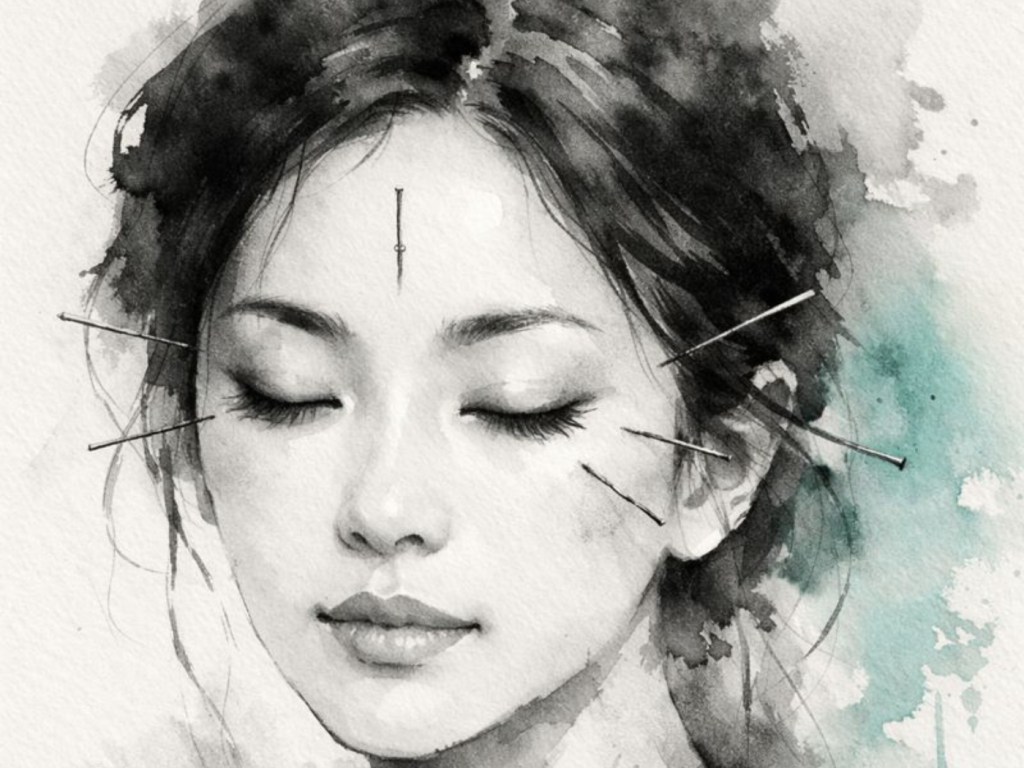
    Watercolour image of a Euro-Asian woman in closeup, with her eyes closed, and acupuncture needles in her face, at a few points around the eyes

    The only way to get some idea is to travel with the woman as she journeys through her psyche via the medium of her speech, her story. In this way Huish-Huish may make the woman aware of the ghost, and encounter its weaker manifestations within the trance; there, the ghost itself may be dissolved or at least dissuaded. At the same time, however, in order to heal, she must make herself whole, cultivate herself, and grow in accord with the principles laid out in the Yi Jing and other Taoist teachings. No quick fix here, no game of fantan, this.

    “Every child loves the pretty fable of Kwang Kau’s dream about the butterfly, which Zhuangzi teaches us,” Huish-Huish says. “When Kau awoke from the dream, he found himself unable to tell whether he was Kau dreaming he was a butterfly or the butterfly dreaming it was Kau.

    “Another tale strikes me as somehow similar, in which Shadow and Penumbra converse – Penumbra wanting to know why Shadow moves as she does, perhaps because Penumbra must follow. So Penumbra says, ‘Before, you were walking, but now you have stopped. You were sitting, but now you stand up. How and why do you do that?’

    “Shadow answers, ‘I have to wait for something else to move, and then I will do the same thing as it, almost as though I am its second skin …’”

    The woman listens, as though to a disembodied voice – fluent, lilting Mandarin. Though her own native tongue was that of the city of Taishan – Taishonese, a dialect of Yue, kin to Cantonese – the music of the hypnotic voice draws her into its discourse, and it seems she leaves the world behind her.

    “‘How on earth would I know?’ says Shadow,” Huish-Huish continued. “‘How could I possibly know what it is, that thing which moves, and which I follow – whether the scales of a snake, or a cicada’s wing? How should I have an idea why I perform one particular act instead of another?’”

    The woman’s eyes are closed, and she is already on the brink of a great descent. She hears the pure tone of a chime, and the jingling of rattles, the sounds suffused with the heavy smoke of the incense.

     “Like Shadow and Penumbra,” the voice continued, “I wonder whether we might allow ourselves to pass through phases of our deeper selves – or our earlier selves, when these are not the same thing – and sink into each other, you and I. Penumbras of the scales of a snake follow the shadows of the scales, which follow the snake; they need not feel the belly of the snake sliding across the sand, which is irrelevant to them and impossible to access. And to whom is visible the penumbra of a shadow of the wing of a cicada? And what does the cicada follow, when it does as it does?”

    Huish-Huish aims to melt away her own ego – to become a nothingness, receptive to the projections of memory – because memory is the essence of the psyche itself.

    She guided Chan Lee Lung to lie back upon a low wooden plinth set before the altar, her head resting upon a rice-husk dragon cushion.

    With an austere calm, she placed fine needles along the woman’s brow, at the temples, beneath the eyes, where the face is thinner and the mind can loosen its hold. Chan Lee Lung felt no pain – only a spreading lightness, as though the weight of her features were being unhooked from memory.

    After a while, Chan Lee Lung could no longer separate her inner dialogue from the sound of the guiding voice, which had transposed itself into a chant, whose symbolic words she was unable to comprehend as words, but which fell into a silence as deep as that of the deepest well. As they penetrated the surface of the ether, or whatever liquid-like substance lay at the bottom of the well, something more pure than water, the pitch darkness ignited: each word flared into a splash of sparkling light, cohering into one image, then another, then the next, setting in play a flickering spectacle. A dream that was not quite a dream; a reality that was somehow greater than her reality of the everyday. As instructed, she began to say whatever went through her mind, as though she were a traveller in a railway carriage, sitting by the window, describing to someone else in the carriage the changing scenes she saw outside.

    Standing on a Canton roadside are a woman and her five children, all dressed in their best holiday black, which is nevertheless patched in some places and threadbare in others. Hardly finery, but the woman does her best under extenuating circumstances, as she repeats often to her neighbours and the grocery vendors. The middle daughter examines her mother’s face and observes a liquid bead run down along her nose and fall to the dust.

    “Mama, do you cry?” she asks.

    “Only sweat. Stand quietly.”

    Their sign leans upright against the trunk of the slender tree under whose branches they have sought shade. The mother pacifies the baby, bounces him gently and reassures him with baby-talk, before binding him again to her back, where he falls asleep immediately. At this sight, the eldest daughter stifles the lump in her throat until the mother notices her quivering jaw and corrects her sternly. In the joss house at the Deep Lead Chinese camp, Chan Lee Lung is once again overcome with a profound sadness. Her mother was a hard woman. Again she tastes the blood in her mouth, where she bit herself on the lip to prevent herself from crying – and bites it once again.

    They met up with the broker, who was carrying their sign, at the appointed spot. She disliked the man’s fat, ugly, greasy face. Even his queue seemed to have lumps of fat in it, and he smelled like rotten pork. He laughed when she pointed out these shortcomings to him. He took a piece of lemon from his pocket and presented it to her. She asked him why he thought she would want a piece of lingmung. He corrected her, with another patronising laugh.
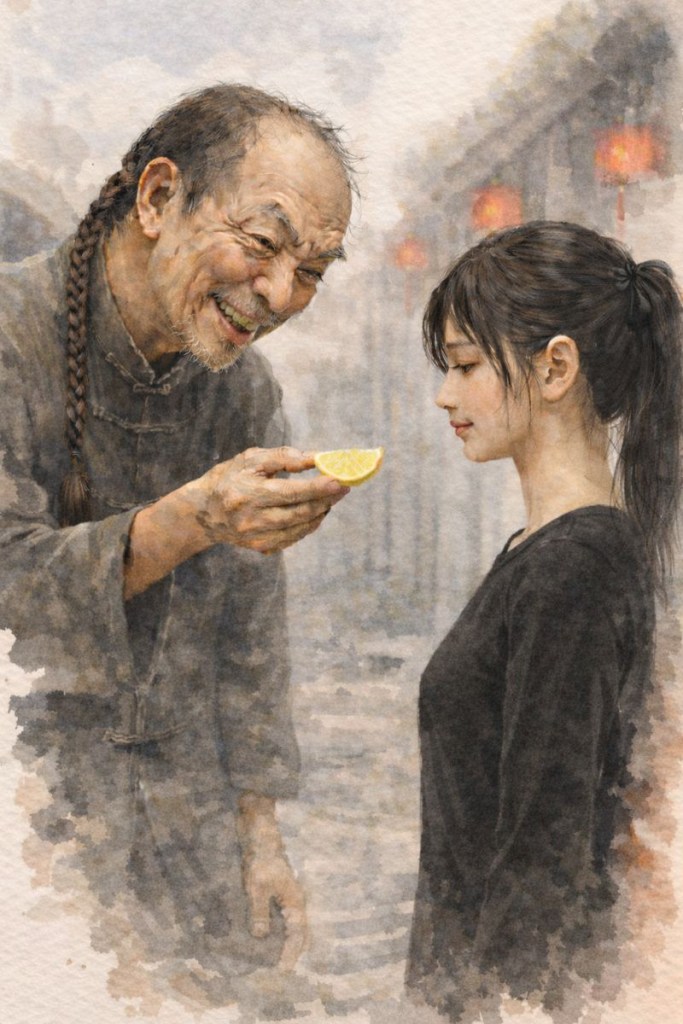
    In a Canton street, an old Chinese man, grinning. offers a young woman a piece of lemon. Watercolour image.

    Ningmeng,” he said, pronouncing the syllables of the Mandarin word. And again, after sucking the lemon, he repeated it, pedantically now, with his bloated, sensual, wet lips, “Ning meng.” Emphasised with two beats of his fat forefinger on her forehead. He told the girls to stand in line, with their bags arranged neatly by their feet.

    She wanted to know what was going to happen to her and he replied that if she was a good girl she would go in a magnificent European ship to a wonderful place called Gold Mountain, an earthly paradise where the streets were paved with gold. There she would find boundless happiness as a wife to many men, have all the food she could eat, wear a cheongsam of the finest silk, and return to China a rich lady.

    She saw the improper look he cast her mother, which he pretended was secret while intending her to notice it, a wink and leer that revealed his green teeth. She complained to the mother, saying she did not want to leave her sisters and little brother, and the mother reassured her that her sisters were leaving as well, to somewhere they would be safe from the fighting here. Her brother was too young to miss her, so she need have no concern for him.

    Another man arrived by rickshaw, perused the sign, and Lemon-man took him aside to discuss a transaction. Her mother told her to take up her bag and walk with dignity to the rickshaw. She was a big girl now, and the world would be her oyster. That is all she remembers of the time her mother sold her, except that as the vehicle moved off, she looked around to farewell her mother and siblings. Her mother had her back turned, remonstrating with the broker, as was her usual way in such pecuniary transactions. Her sisters were waving to her gaily, delighted to see her riding in a rickshaw for the first time.

    Two months later, the Pacific Mail Steamship Company’s China passed through the narrow strait into San Francisco Bay. The voyage seemed far shorter to the girl, who had been pacified with narcotics for much of the time, in order to prevent her from creating any fuss. It was a recurring delirious episode; she was rolled to and fro on her narrow bunk with the tossing of the vessel, nausea melding with visions of her sisters who, in her dreams, were transmogrified into salivating crimson ghouls. They were standing beside the repulsive man, between whose luminous green teeth issued copious streams of blood. In her waking moments, she was indifferent to the crush and squalor around her. 

    “This is the Golden Gate to Gold Mountain, the country of your dreams.”

    The woman assigned to play the role of her mother had, during her lucid intervals, been tutoring her in what she must say in case she was questioned by someone called Customs. The girl learned to utter the English word “seamstress” while performing an appropriate pantomime, smiling with an air of great earnestness.

    If her acting talents were unconvincing and the two apprehended, the White Devil would visit unspeakable torment on her.

    Although the two travelled in a better section of steerage, it was only thanks to the ‘value’ her buyers saw in her looks and talents in song and dance, which they judged superior to those of their former favourite, a Hong Kong girl they subsequently cast aside. Chan Lee Lung was cloistered with a group of a dozen other girls, away from the hundreds of male emigrants and prostitutes also travelling in steerage, shielded from the rapes and bashings by two bodyguards known not for their physiques, but for their ruthless cunning and their expertise with concealed weapons.

    Leaning against the railing on the starboard deck, bracing herself against the jostling crowd, the girl inclined her face to the magnificent morning sun, emerging from wisps of fog that had been thick and opaque only minutes earlier. This was the first time for the duration of the voyage that she had been permitted up on deck. The ship was about to dock when a splash was heard from the port side, followed by distinct female screams and a rising volume of anxious chatter, as a wave of agitation spread through the huddle of disembarkees. Descending the gangplank, shouldering a jute sack containing her meagre belongings, she overheard a high-pitched, trembling mention of the name Lee Sing, which seemed vaguely to resemble that of the girl in Hong Kong whose fate she had supplanted with her own.
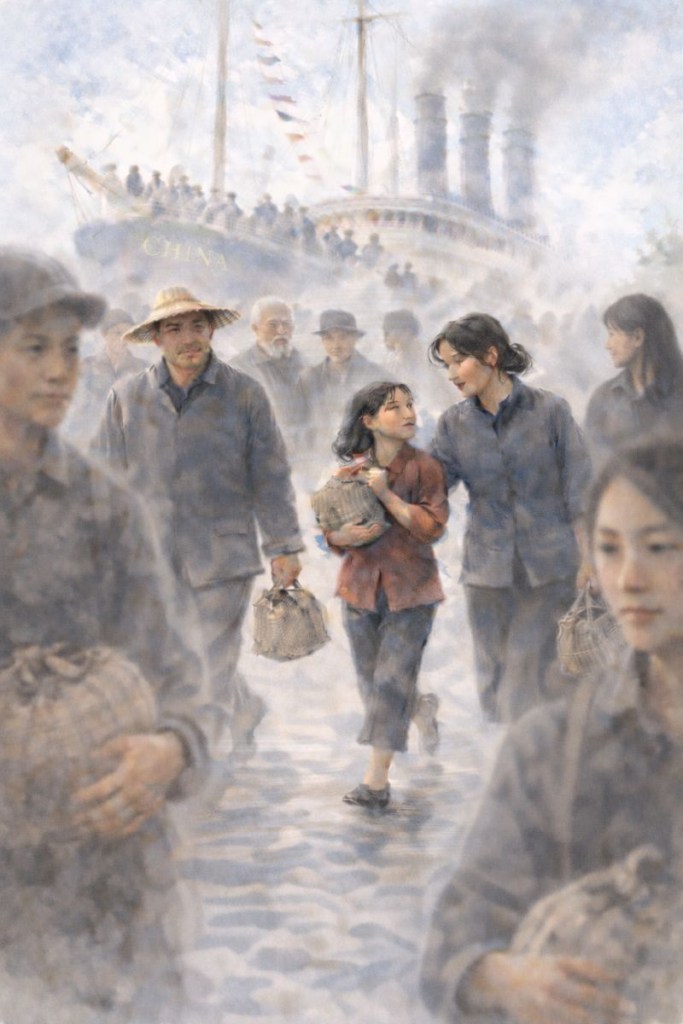
    A girl among a crowd of disembarkees from the steamship China, docked at a San Francisco wharf.

    Bound-footed Madame Ah Toy, the girl’s new owner, immediately warmed to her. When the ageing madam raised the girl’s chin with two fingers to appraise her face more closely, despite the air of sadness that still hung over her, the girl’s eyes reminded her of her own, formerly renowned for their laughing quality. Goldminers “came to gaze upon the countenance of the charming Ah Toy,” the newspaper said once, in poetic, libidinous understatement. And they would come to gaze on the countenance of this girl, her newest attraction, as well. “But only gaze for the time being,” Ah Toy said to herself, in the cold arithmetic of her trade, now satisfied the girl was physically sound, “until you’re growed up good and proper.” There was more in those eyes, however, that drew the woman’s attention: a depth of soul and intelligence; a quiet defiance that she could see would never be crushed. The madam had good reason to identify with the girl’s sterling qualities, having herself wrought a fortune as the first Chinese courtesan and the first Chinese madam of the red-light district, the so-called Barbary Coast.

     Ah Toy oversaw the education of her new protégé as she would that of a cherished daughter, with a loving and stern hand. She declaimed her belief that “son without learning, you have raised an ass; daughter without learning, you have raised a pig,” and over the next few years, the girl flowered under her regime. She soon assumed mastery over the various academic and dance hall pursuits for which her tutelage had been commissioned, guided by professorial clients of Ah Toy’s famous establishment in an alley off Clay Street, under contracts of barter.

    The girl’s getting of wisdom served, as ever, a financial motive, for the ladies of the Chinese establishment trailed those employed in French, Mexican, British and American cat houses, whose popularity ranked roughly in that order. Competition was fierce in the bagnio trade. The French fandango parlour had its les nymphes du pavé, late of the Parisian gutters, who were packing in the patrons to overflowing, gussied up in their red slippers, black stockings, garters and jackets, nothing down below. Stories abounded of outrageous personalities: The Roaring Gimlet, Snakehips Lulu and the rest. Holy Moses! Madame Featherlegs would gallop a horse down the main street wearing nothing but batwing chaps.

    Unfortunately, although a successful entrepreneur, Ah Toy had also become rather a laughing stock, largely because of her Chinese-ness, but also because of the young age and sickly condition of the girls crammed into her shacks, or “cribs,” in Jackson Street, sometimes abused by white boys scarcely older than children themselves.

    These girls she considered, and treated, no better than chattel.

    The girl grew into her role admirably, expressing as though they were natural traits the aristocratic airs she was schooled in; airs that in fact derived from no single country, but from an amalgam of places, real and imaginary. Yet somehow her intrinsic class seemed to imbue these artificial attributes with substance.

    She was not overawed by anyone she met, but treated with due respect and equality all who crossed her path: from city officials who surreptitiously joined the growing flood of patrons paying good money for no more than the pleasure of gazing upon her, to slave girls locked in the cribs like animals. Most of these girls had been smuggled from China, either peddled, like her, or abducted outright. Sufferers of syphilis numbered among them, their short futures preordained: to die disfigured beggars on the streets of Chinatown.

    She felt a compassion for these creatures in the cribs, pleading their cause to Madame Ah Tong and doing her utmost to convince her, in terms she would understand, that acknowledging even minimal duties of care to the crib girls might serve her business-wise – allowing her to be perceived as less of a pariah and blight on society, though she couched that more gently.

    No cribs for her, nor even a residence in one of the sumptuously appointed parlour houses. Ah Tong set her up in a double storey brick house of her own, where she entertained only the most prestigious clientele – exclusively white, expressly no Chinese – when she was not assisting her proprietress to operate the gambling house and manage the business affairs. As well, Ah Tong provided her with a chaperon, a certain Fung Jing Dock, whom she introduced to Chan Lee Lung as an office bearer in a newly formed organisation known as the Society of the Mind Abiding in Tranquility and Freedom. He was, Ah Tong said, a virtuoso on the zither as well as an avid student of the Yi Jing.

    “Regarding my degree of talent with the zither, I must refuse to answer,” Fung Jing Dock pleaded charmingly, “in order to avoid incriminating myself.”

    Nevertheless, he proved to be a surprisingly good amateur zitherist, and Chan Lee Lung and he spent a few minutes at the instrument together now and then during the daylight hours.

    “But there is more to this story,” Lily Chan said as they came out of the joss house and into the dazzling sunlight. “It does not end well, I’m afraid.” She turned towards her establishment.

    Huish-Huish looked at her face, which seemed pallid.

    “As a process, the ceremony may sometimes require any number of iterations,” she said. “Some subjects joke that it will go on forever, and they will never be free of me. Things cannot be rushed, however. We will have plenty of opportunity next time.” She laughed. “There is no cure for the human existence, you know,” she said.

    A horse and trap were drawn up in front of the Jade Phoenix, where a man waited beneath the front awning. Noticing the two women, the detective Forster stepped forward into the sunlight and raised his hand. Huish-Huish briefly squeezed her companion’s arm and went back briskly into the joss house. Lily made her way languidly as ever down the deserted street to Forster.


    From the draft novel Stawell Bardo © Michael Guest 2026

  • Ginseng Poachers

    Ginseng Poachers

    Once the blackened remains of his aerostatic globe were retrieved, Dinwiddie took to his bunk, afflicted with a profound dread usually reserved for the condemned. He shook, perspired, quivered, and palpitated; so much so that Pu-erh, apprehensive of her own fate, having been placed in charge of the Scot by the Qianlong Emperor himself, summoned a team of imperial physicians and acupuncturists. Their examination of his tongue revealed flaws in the state of his kidneys, bladder, intestines, stomach, spleen, lungs, heart, gall bladder, and liver. Moreover, its shape and colour pointed to a severe deficiency in Qi; red dots suggested heat or inflammation in his blood; and the thick coating was indicative of an allergic disorder compounded by digestive imbalance. He was dosed, moxibusted with mugwort, and cupped, scraped, tickled and pricked to the point of tears and bellows.

    He may as well have reclined sunning himself in the Imperial Garden, for Lord Macartney’s overtures to the Emperor had crashed and burned as completely as the globe, with tangible repercussions for the delegation. Macartney, preoccupied with weightier matters, had never much cared for Dinwiddie’s pet project in any case, and failed to notice its absence from the exhibition.

    Dinwiddie resurrected himself and managed to prepare for the official event. The Emperor was contemptuous, tarrying for less than five minutes before repairing to the quarters of his latest concubine. After his disdainful exit, Pu-erh conveyed his comments to the scowling Lord Macartney and deflated Dinwiddie:

    “Your air pump is of little interest, though the telescope might amuse children. He finds your planetarium infantile too – not unlike the sing-song clocks hawked in the Canton marketplaces,” she said. “The Emperor already owns a superior model, anyway, presented as a personal gift by a German delegation. It is true your giant lens can melt a copper coin, but will it melt his enemy’s city? He believes not.”

    The next day, she was summoned to the Dragon Throne. She kowtowed three times as she approached. The imperial ministers, secretaries, and scribes were in attendance, assisting the Emperor draft a reply to King George’s letter. Her attendants delivered the sketches and notes she and her agents had compiled regarding the scientific instruments.

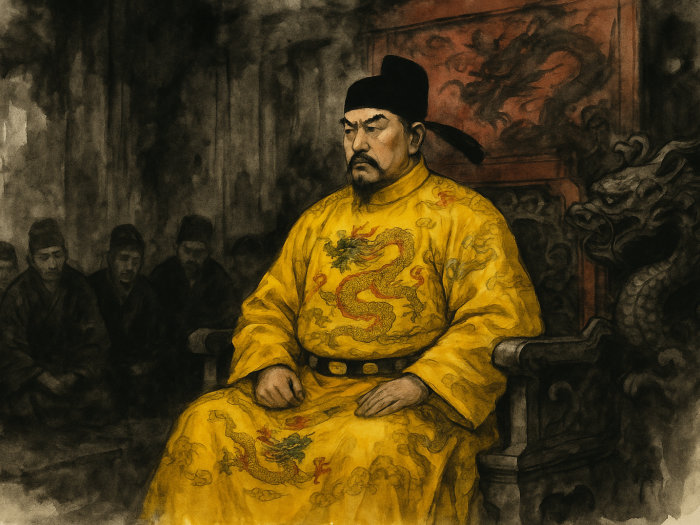
    The Qing Emperor, in his Bright Yellow court robes.

    “You have performed your duties exemplarily, our flower,” the Emperor said. “Our indulgence of the foreign delegation, exasperating though it was, has nonetheless proved edifying in certain significant respects. Their ships are capable and well-armoured, their weapons powerful beyond our anticipation. It is useful to glean these odds and ends regarding the abilities of their scientists and craftsmen. Oh, that fellow, that worm …”

    Lord Macartney,” prompted an advisor at his side.

    “That’s it – Macartney. I will never forget that spotted mulberry suit of his – the enormous diamond star, medals festooning his chest, and that hat – that ridiculous plume of feathers! The very image of presumption and self-importance. What a … peacock! But bumbling as a poacher setting snares in the Imperial Garden!” He let out a hearty laugh, provoking a ripple of hilarity among the ministers.

    “Insufferable dunce and fop. Humming and hawing about the significance of rituals and this and that, how he should bow and the rest of it. Disdains kowtowing to our Throne indeed, but performed some silly sort of jig instead. And they wouldn’t leave! They would like to have remained in Jehol the whole summer long! Those English have incurred my great displeasure – no more favours for them. Mark that, a ministerial edict for you: No more favours. Allow them two days to gather their paraphernalia, then escort them from the capital forthwith. The nonsense of this king, his wild ideas and hopes. Ah, that is apt! make a note. Come, take this down,” he said, flicking his fingers at the nearest scribe. “We shall draft the edict:

    “Your England is not the only nation trading at Canton. If other nations, following your bad example, wrongfully importune my ear with further impossible requests, how will it be possible for me to treat them with easy indulgence? Yes, good, and while I think of it, that point about letting in their proselytizers … Regarding your nation’s worship of the Lord of Heaven … Ever since the beginning of history, sage Emperors and wise rulers have bestowed on China a moral system and inculcated the code of Confucius, which from time immemorial has been religiously observed by the myriads of my subjects. There has been no hankering after heterodox doctrines.

    “Well and good,” he said, looking down at Pu-erh and granting her a broad, warm smile. It was the first smile of any sort, indeed, that she had ever received from him. “Foreign ideas and fancies can breed serious disharmony, can they not, our petal? The last thing we need is exposure to them. What was it that my father used to say? ‘Destroy the seed of evil, or it will grow into your ruin,’ or something to that effect. By the way, how is your beloved Bright Yang? Has he returned with the tiny elephant and soldiers?”

    She averted her eyes and slowly shook her head.

    “You see, I know more than I let on,” he said. “I even heard scraps of a crazy rumour that the barbarians can fly! The nonsense that gets around. Never mind, he was unworthy of you, that Bright Yang. Yet fear not, a woman as intelligent as yourself must be much sought after. Is such a brilliant flower, however plain, worth more than the prettiest concubine? No, she is worth ten of them, and not just for lacking their vacant minds. Stupidity makes a concubine restful. But you, dear petal, you keep us guessing. Oh, that is not quite well put, is it? Naturally a pretty concubine is all the better when graced with an astute mind, is she not? How old are you, our petal? When were you born?”

    She told him, and he slowly shook his head.

    “That is what I have heard tell, but would you truly have me believe in the gold elixir of immortality? Have no qualms, our enlightened one, you need not seduce me with the fairy tales of your sect. Despite my patronage of Tibetan Buddhism and my abiding friendship with the Dalai Lama, I do not entertain the slightest aversion to your affections for the Tao, though its religion and philosophy I neither believe nor understand. Alas, there are far too few of you left in the upper echelons, though I’m told that some of your rural cults are regaining popularity amongst the poorer, lower-class folk. No matter, you have earned our fond indulgence, and may rely upon it to the end of your span under Heaven.”

    Again he shed the glow of his smile upon her, or so it seemed, enhaloed as it was in the golden rays reflected from the Dragon Throne.

    If Pu-erh had never doubted the Emperor’s enduring patronage, she did now. Another warm smile deepened her unease. He dismissed her and returned to work on his epistle to the British.

    “The beginning and middle are good,” he said, “but the end needs attention. Where were we? Ah yes … I do not forget the lonely remoteness of your island, cut off from the world by intervening wastes of sea, nor do I overlook your excusable ignorance of the usages of our Celestial Empire. I have consequently commanded my Ministers to enlighten your Ambassador on the subject, and have ordered the departure of the mission. Etcetera, etcetera, etcetera … Now for a firm conclusion: Should your vessels touch the shore, your merchants will assuredly never be permitted to land or to reside there, but will be subject to instant expulsion. In that event your barbarian merchants will have had a long journey for nothing. Do not say that you were not warned in due time! Tremblingly obey and show no negligence! Yes, that should do it! Inscribe this missive on yellow silk of the finest quality, deliver it to the mulberry peacock and impose my edict upon him to begone in two days’ time, at the risk of your heads!” He uttered the final phrase in an ominous tone that echoed in the hall, then smiled broadly.

    Lord Macartney received the yellow silk epistle, mercifully unreadable to him, and departed China ignominiously, his retinue and exhibition articles hastily boxed. Aboard the Lion as she set sail from Macao, he stood on deck with her captain.

    “Are they ignorant that a couple of our English frigates would outmatch his entire antiquated fleet?” Macartney said bitterly.

    “From what I have seen,” the captain said, “it would take no more than half a summer. Half a dozen broadsides would block the so-called Tiger’s Mouth, which guards the waterway into Canton.”

    “The population would be condemned to starvation. The Empire of China is much overrated. He is a crazy old man of war, kept barely afloat these past hundred and fifty years, which through its impression of bulk has managed to overawe its neighbours. Ah, he’s rotten at the timbers …”

    “Through and through, m’lud. It won’t be long. He’ll drift as a wreck and surely be dashed asunder on the rocky shore.”

    “The tyranny of a handful of Manchu tartars over three hundred millions of Chinese, who will not endure their condition for much longer. Still, we must forbear while a ray of hope remains for the success of gentle measures. At any rate, left to its own devices, I believe the dissolution of this imperial yoke will precede my own.”

    Two British ships, the Lion and another, leaving China under full sail.

    The captain watched the lord’s back as he paced away, then turned discreetly from the breeze, to shake his head, light his pipe, and allow himself a wry face at the tales of his superior’s disastrous mission, which were attaining satirical proportions amongst members of the envoy and crew.

    • • •

    Approaching twilight, two unexceptional sojourners tramped down the dusty track that skirted the flank of Timeless Mount – a poised woman and a mustachioed youth – both clad in plain, weather-worn robes, the modest dress of those who have forsaken rank. Though travel-marked, they bore the composed, abstracted air of those returned from beyond time’s keeping.

    As they neared a fork in the path, one arm climbing higher, the other tracing a ridge eastward before dipping into dense forest, three grizzled bandits in big boots and hats came up behind them.

    “Oi! What’s your hurry, peasants?” one of the bandits growled and the two turned to face them, bowing low and repeatedly, out of old acquaintance with peril.

    The one who had spoken snorted his satisfaction at what he perceived as their humility, blind as he was to the absence of fear in it. “You can chuck down all that stuff,” he said, jerking a thumb, the other hand gripping the hilt of his goose-wing sabre, as he limped toward them. The pilgrims eased their carry-poles from their shoulders to the ground. “Toady, have a look-see what we got ’ere.”

    One of his henchmen, distinguished by the angry boils covering one side of his face, did immediately as ordered, dropping to his knees before the packages and opening them up. Periodically, he scratched at his face, his boils themselves seeming to have boils.

    “Clothes and stuff, pretty nice, silk even!” he said, holding up a deep blue scarf patterned with peonies. “Now, what have we got ’ere in this box? All this writing-stuff and little statues and books and bells and little pots, and all sorts of other useless rubbish.”

    “What about food?” said the third bandit, urgently, his eyes wide.

    “Hold on, Yongyan, give me a minute. We got some carrots, rice, and beans. Not much chop.”

    “Better than nothing,” said the third bandit, a man more corpulent than hardened. “We got more back at camp, anyway.”

    “Pack it all up, you two, and let’s be off.”

    Down from the track they stumbled with their prisoners, pushing through the bamboo until they came to a small cleared area with a fire-pit and the rough wherewithal of a bandit’s trade: a meagre stack of weapons – spear, pike, sword, and a musket – and a dismal pile of loot, which they may as well have obtained by begging: a modest heap of bronze coins, a studded leather belt, an old bamboo flute, an abacus, a compass, a wooden figurine of the Buddha, a drawstring burlap pouch, and other odds and ends.

    Pu-erh and her son sat in silence, loosely restrained by a rope, observing the men as they cooked up the food, ate, and passed around a flagon of rice-whisky. She was adorned with not one extra wrinkle since we last saw her, all that indeterminate period before, though her little boy Mow Fung was matured into an adolescent fellow of lean frame and quiet grace.

    “Better give them a bit,” the leader said through a mouthful. “Might be the last meal they ever have before getting all sliced up into bits and pieces and their heads chopped off.” His guffaws dwindled when she fixed him in her level gaze.

    “Your name, sir?” Pu-erh said politely to the one with boils, who leaned over to them with two wooden plates of beans. She and her son had already freed themselves from their restraints without any fuss. The bandit had removed his headwear, and even in the dim light one could see that the boils continued up from the side of his face and across half his cranium.

    “He’s called Ugly Toad,” the leader said. “The other one goes by Yongyan the Hungry. And me? Wang the Eviscerator.” He lifted his sabre from the ground beside him and waved it in the air. “And this ’ere’s what does the evisceratin’. So you better watch your p’s and q’s, got it? Are you from around hereabouts? We’re new ourselves, lookin’ for a good place to set up a proper hideout and all that. Heard there’s treasure up on that next mountain, Time’s Heavenly Sanctuary Blah-Blah-Something-or-Other, so we figured we might head up there a ways.”

    “That would seem an unfavourable location for those of your profession,” she said.

    “Oh it would, would it?”

    “Certainly, unless you would enter the lair to look for the tiger.”

    “Allow me to be the best judge of that,” he said. “But go on, proceed, tell us a bit about it, since you seem to know so much about everything. What is it you do around this neck of the woods, scratch the dirt, I suppose?”

    “Simple hermits. We study and improve ourselves; distill the gold elixir; wander from village to village; tend the hidden temple; heal boils; make rain; exorcise ghosts; give blessings; heal boils (it’s a recurring problem); prophesy destinies; interpret the countryside; create and burn talismans for good or ill fortune …”

    “Ar, got it,” said the leader and guzzled from the flask. “Quacks. What a coincidence. You know, before this we worked as ginseng poachers in Fusong County up at Changbai Mountain. Not much fun, I can tell you. You get those Manchus after you, because it’s their sacred place, you see; and then you get the black bears too. If it’s the Manchu, you run like the wind, for your head’s at stake. If it’s the bear, you don’t run or fight, whatever you do, but play dead and freeze, and be good at it, too, because they’ll push and prod you around to see if you’re faking, and if you are, they’ll more than likely take your head off before they gobble you up. Here, I’ll show you one of my gut-wounds, still septic it is after all that time. Pretty nice, eh? Well, I never made a peep, you better believe it, though he licked all over my face and blew his rank breath up my nostrils. The ginseng takes a lot of poaching indeed – but if you know what you’re doin’ it’s worth more’n silver. Sometimes, if you’re lucky you’ll hear a special little birdie singing, what’s telling you the ginseng is there; and if it is, it’s so fiddly to get it out you might as well not even try. The root can disappear or run away, too, because it’s magic. It’s just the exact shape of a human and it’s got the mountain spirit in it, so you have to lasso it by the sprouts with red cotton thread with the ends weighed down with two bronze coins. Then you tie it up to a sort of special trap until you dig it out without breaking any of it, which is next to impossible anyways. We’ve saved two in that little sack, which is about all we got out of the exercise. To tell the truth, we haven’t been much chop at working as bandits, either, but that’s another story.”

    “Gold elixir …” said Yongyan the Hungry. “Any alcohol in it?”

    “In the modern day, it’s generally understood as a potion of immortality formed within,” Pu-erh said. “Hence the term inner alchemy. The gold elixir is the innate knowledge and power of the mind – a fusion of vitality, energy, and spirit: the forces of creativity, motion, and consciousness – refined through rigorous observance of the Tao. By contrast, external alchemy follows the example of one of the Eight Immortals, Iron-Crutch Li. Its goal is to concoct a pill of immortality by combining ingredients like lead, mercury, cinnabar, and sulphates, then firing them in a furnace. Unfortunately, the ingestion of such pills often results in death. Some lesser practitioners attempt to raise their consciousness through crude experiments with plant extracts.”

    “Deviant practices,” Mow Fung said, with the shadow of a smile, closing his eyes. The bandits stared, then glanced at one another, slack-jawed.

    “He don’t say too much, do he?” said Wang the Eviscerator at last.

    “Those days are gone,” Pu-erh sighed, “when condemned prisoners were made available as subjects for such experiments. As for these mountains, they are favourable to our alchemical purpose: the pursuit of the elixir. For here, tucked in a valley that time forgot, lies a village where months pass as years and the people scarcely age.”

    “Heal boils, do you say?” said Ugly Toad.

    None of the bandits paid any attention as Mow Fung retrieved the bamboo flute and moved to the edge of the clearing without a word, where he sat down cross-legged again and began to play.

    The campfire crackled. He ad-libbed lento through melodic variations once taught to him by the Imperial Music Master, as a favour to Pu-erh. In theory, they formed a transcendent framework based on the King Wen sequence of I Ching hexagrams from the late Shang Dynasty, embodying a microcosm of the universe.

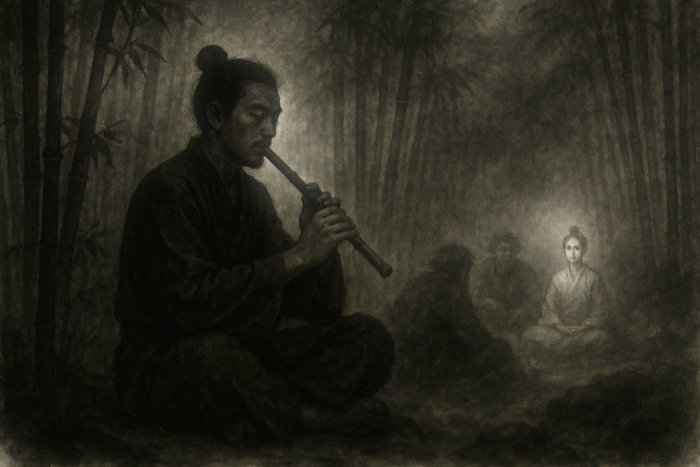
    Mow Fung playing his flute in the dark bamboo grove, with Pu-Erh and the poachers in the background

    Without effort, the young man lent the intrinsically dry exercise a style idiomatic to the flute, evoking in everyone present an impression of a lonely moon suspended in a frosty autumn night sky, though not one of them made mention of it.

    As he played, he reflected on dim memories of his infancy in the Forbidden City, and on the blurry period that followed, living their lives in hiding and reclusion among caves and forests, and in the infinite seclusion of the mountain. How the years had flown since they fled, when one looked back, while seeming, minute to minute, to progress in ordinary time – so that he, an apparent “youth” – had lived the span of perhaps two lifetimes for one of his corporeal age.

    “You might as well keep that thing,” Yongyan said. “None of us could get a note out of it.”

    “What was that you were saying about boils a while earlier?” Ugly Toad asked quietly. “I’ve been having trouble with these for years. Getting worse rather than better, I’m afraid.”

    “Those little blemishes?” Pu-erh said. “Why, you can hardly notice them. They’re really not worth bothering about too much, do you think?”

    He gave her a meek and appreciative grin. “I’ve tried all sorts of remedies from quacks all over the countryside, but they’ve only made things worse.”

    She took a dab of unguent from one of several minuscule clay pots stacked into her carry-sack and told him to apply it. Though scarcely more than a smear, it seemed to warm in his fingers and swell slightly as he rubbed it in – not diminishing, but softly renewing itself. After a long while, she told him to save what remained for daily use. There would always be enough, she said, so long as he didn’t try to measure it.

    “Feels better already,” Ugly Toad said to Wang the Eviscerator. “You should try it, you know, for your belly.”

    “Well, you do realize I was only kidding about cutting you up into bits…” Wang said to her through his toothless grin.

    “I knew your capabilities the moment we met,” she said, “and I was doubtful they include the eviscerating of unarmed victims. Unfortunately, the unguent is only a salve, a stop-gap measure. Cures for both your complaints will require substantial time and involved procedures. Take heed that if you leave your bear-wound as it is to heal, you will assuredly die. Moreover, if you lead your party to seek treasure on the upper mount as you implied was your plan, the three of you will surely perish all the sooner.”

    The following morning the five took the lower path, hiking along the ridge and descending into thick forest. They entered a narrow trail that soon forked into a dozen offshoots, each of which branched again and again into near-identical tracks, until they found themselves in a bewilderment of forks and false turnings. Only Pu-erh and Mow Fung seemed to know the way. At last, near midday, they emerged before a dilapidated temple, half-lost in the undergrowth.

    “Rest now,” said Pu-erh. “We will return before nightfall.”

    The temple and its crumbling attendant building sat on a ledge where the land dropped away into a mist-filled void. Behind it, cliffs fell sheer to silence, visited only by haughty eagles who wheeled and nested in the inaccessible crags.

    The three bandits felt a rush of exhilaration at the sight – a sensation unlike any they had ever known. They settled in to await the return of their two guides or perhaps some wandering monk. An overwhelming solemnity fell over them, as though from this high place one might commune with the Eight Immortals – whoever they were.

    “We were looking for a hideout, and we have found one,” said Wang.

    “Without knowing the way, no one could ever get in,” said Toad.

    The void was an immense auditorium of silence, from whose depths came the thin cry of a hawk.

    “… or out, for that matter, you might say,” said Yongyan.

    “You don’t think …”

    The three cast glances at each other, before settling down for a smoke.

    “How could you suggest such a thing?”


    From the draft novel Stawell Bardo © Michael Guest 2025

  • 7. Document 17 (from the draft novel Stawell Bardo)

    7. Document 17 (from the draft novel Stawell Bardo)

    Document 17: Manifestation Series

    The unicorn is injured, why did it come? My way is finished.

    ⁓ Attributed to the Zuozhuan, on the death of Confucius, 479 BCE (adapted)

    This account, drawn from the lower ledgers in the Registry of Misperceived Wonders (Third Vault), concerns the imperfect ascent of a crown, a sign mistaken for itself, the brief elevation of a foreign scholar, and a haunting sigh. The report commences with an account of the journey of the foreign envoy from the White River, just south of Tongzhou, to the Forbidden City. The route is as well-trodden as the tropes that embellish it, so for present intents, the passage has been elided.

    Lord Macartney received with restrained annoyance the news of the extension of his itinerary a further 160 miles, extending the journey into Tartary. He was already preoccupied with the Chinese administration’s requirement that he perform full-body kowtows to the Emperor, since he was not required to humble himself in this way even before his own monarch, good King George III. He nevertheless resigned himself to attempting an approximation. Bright Yang set him at ease with a broad smile and copious applause, assuring him that his impromptu flourishes, bows and scrapes such as he demonstrated, which were worthy of the most extravagant dandy, would more than satisfy the Qianlong Emperor, who was, in any case, a most amiable fellow once you got to know him.

    Lord Macartney, an Ulster Scot consummately qualified for ambassadorial duty, departed from the capital with the majority of his entourage, leaving behind much of the valuable equipment that he had dragged to the ends of the earth as presents for the Emperor, in the care of his tiring – in both senses – travel companion, another Scot: astronomer, physicist, inventor and philosopher, one dour James Dinwiddie.

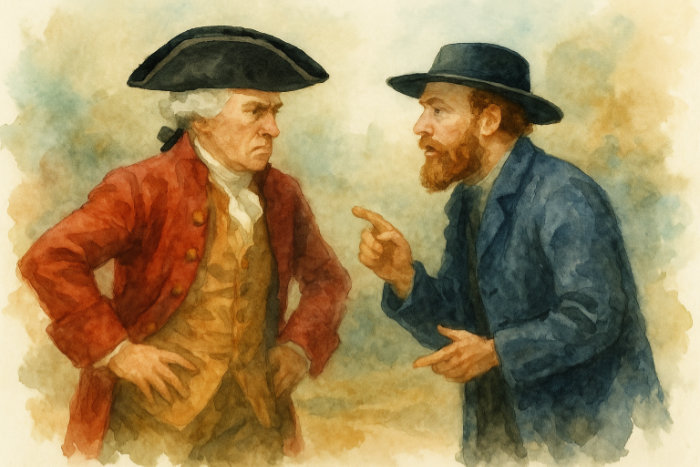
    Two European men in 18th-century dress. Lord Macartney One stands tall and reserved, hands on hips. Dinwiddie leans forward, gesturing animatedly.

    One of the marvels intended to evoke the amazement of the Chinese Emperor was a clockwork planetarium of Dinwiddie’s own devising, which had taken him thirty years to build and was acclaimed “the most wonderful mechanism ever emanating from human hands.” Dinwiddie’s second love among the collection of marvels was a hot air balloon, an “aerostatic globe” of his own design, with room for two aeronauts. Although he had never gone aloft in one before, which had proven to be a perilous feat throughout Europe, he had become obsessed with the idea of becoming the first to do so in China, and to float high above the Emperor, his court, and the citizenry of Peking, who would all be rendered agog in disbelief. Such would be his historical legacy, he foresaw: even above his planetarium and extensive philosophical tracts, it would be foremost amongst his life’s works.

    Other items in the display included reflecting telescopes, burning lenses, electrical machines, air pumps, and clocks; brass artillery, howitzer mortars, muskets, and swords; a diving bell, musical instruments, magnificent chandeliers, and vases; Wedgwood china, paintings of everyday English life, scenes of English military victories by sea and land, and royal family portraits. The cost amounted to fourteen thousand pounds – in those days a formidable sum.

    On the journey to Peking with the envoy, Sun Pu-erh took stock of the information she gathered and started a series of detailed sketches of the devices most relevant to her Emperor’s wishes, in particular the military and scientific machines and artefacts. She employed spies and draftsmen to aid in the task. Bright Yang, on the other hand, was absorbed in tales that had flourished among the populace as the envoy made its way up along the White River – tales in which, perhaps, the twelve-year-old son of Lord Macartney’s secretary had a hand, aided by his smattering of Chinese. From the point of view of the child, similar to that of the rural populace in this regard, the official inventory of planetarium, lenses, lustres and so on, was not overwhelming, hence stories grew up that hidden inside the cargo were the actual marvels to be revealed to the Emperor: an elephant no bigger than a cat; a battalion of miniature, living British grenadiers, each only twelve inches tall but perfect in the most minute detail, down to fingernails, eyelashes, and intelligence; and a magical pillow that transported one to faraway countries while one slept.

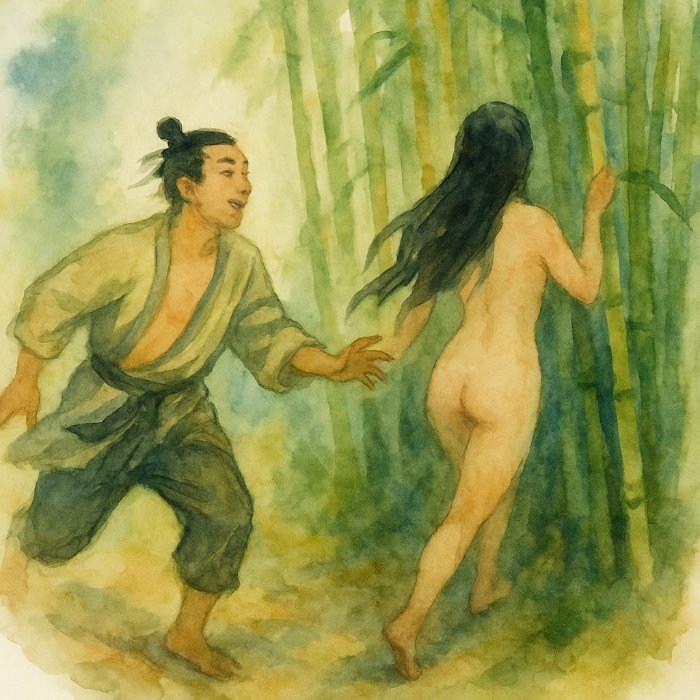
    A sentry reported to Pu-erh that Bright Yang was last observed with one of the lower-ranking concubines, following a narrow path into a bamboo grove, half-clothed and crying out in abandon, in full pursuit of the elephant and grenadiers. She raised an eyebrow expressing initial surprise at the news, then appeared to be none too bothered. Mow Fung, however, observant of such minutiae as only an infant is capable, noticed that, still relatively expressionless, she was now infected with an occasional little sigh, which she would immediately stifle before anyone else but him could notice. He was quite entertaining, she thought.

    A Chinese man in casual robes pursues a nude woman into a bamboo grove, vanishing into shadow and greenery.

    The exaggerated local publicity surrounding the English marvels spread widely among the populace along the way, causing no end of anxiety for both Macartney and Dinwiddie, in fear that their exhibition might fail to meet the Emperor’s expectations. Macartney could do nothing but fret as the journey continued north. Dinwiddie, at least, could busy himself in preparation for the exhibition and his historic balloon flight.

    During his weeks of preparation and waiting in the Forbidden City, he developed an infatuation with the refined, demure, though persistently aloof Sun Pu-erh. She seemed to observe everything through her inscrutable dark eyes, while her long, strategic locks, neither concealing nor clearly inviting access to his imagined fortress of her womanhood, were enough to elicit certain untoward thoughts in his own inflamed mind. He found himself drawn helplessly to the mysterious, dark, exotic femininity he’d read about in travellers’ tales and believed expressed itself in her every word and gesture.

    He took her aside into the corner of a storage room to confess his feelings.

    “D’ye mind I stroke your bonnie raven hair, lassie?”

    She glanced over his large hairy nose, irregular ears, bushy eyebrows, and red whiskers – none of which appealed to her in the slightest – and gave a wry smile. To his mind, it was an encouraging one, so he gave her a wink and proceeded with his whimsy.

    “Looks like silk, but feels a wee bit like the mane o’ a horse,” he confided.

    In an effort to further his suit, such as it was, he professed a warm affection for her young son Chung, our very own Mow Fung of that era, a child blessed with a nature to be seen and not heard, one who would sit and watch him assemble his complex and precious marvels, without ever touching a thing.

    “E’s a fine wee bairn,” he said. “I daresay I got three o’ ma own, and not one o’ em surpasses him in manners, nort be a long short.

    A young Chinese boy gazes intently at a model planetarium; blurred adults adjust the mechanism in the background.

    “Now, the absence of the Emperor, along with almost the entire British delegation, gives us a rare chance to put my aerostatic globe through its paces and to mount a rehearsal that will allow everyone concerned to practise their roles. I’ll hold off, for the moment, from testing the discharge of fireworks from the craft, but will reserve that for the great day itself. We’ll hae nae beasts flung frae the heavens, nor French contraptions named “parachute.” Yon Blanchard – the great pretender tae philosophy, carnival-showman – may cast his ducks at Providence as he pleases! Rather, we shall save such spectacles for the day itself, to maximise the impression upon the Celestial Court that the potentialities – at once military and philosophical – of floating skyward in a silk-lined basket constitute nothing less than the definitive mark of a truly enlightened society.”

    Pu-erh was invested with the imperial power to authorise such a project, and so it was done. The day approached for Dinwiddie to test-fly his globe.

    “I will require a few of my assistants to set up the apparatus,” he said. “Is there a secure location? Best to maintain the highest level of discretion in order to preserve the element of surprise for His Nibs – ahem, His Celestial Majesty the something-or-other Emperor – ahem – when I reveal the aerostatic globe before him in all its magnificent sublimity.”

    “Sire,” said Pu-erh. “I know a perfect place for your preliminary ascent. It is located in the north-west corner of the Imperial Garden of the Forbidden City, close to a Taoist shrine that is under my own humble administration. High walls, a few trees and structures, some open space.”

    “Sounds ideal, my cherub. There we shall discover what shall transpire, according to the scientific method. P’raps a hydrogen one would’ha been better, but a difficulty – not insurmountable, mind ye – to manufacture the hydrogen right here. For all purposes, this beauty should amply suffice.”

    The day before the planned launch, Dinwiddie’s team transported the apparatus from a storage room to the secluded north-west corner of the Imperial Garden. Our young Mow Fung stood apart from the proceedings, contemplating them beside Pu-erh, who observed silently, committing each step to memory in minute detail.

    The envelope was suspended between two masts and tethered by six ropes, each gripped by a man. Dinwiddie ignited a pyre that had been placed beneath it, contained within a structure designed to focus the rising hot air into the mouth of the envelope, which expanded, revealing bright patches of red, blue, white, black, and gold. When fully inflated, the glory of the sphere, suspended in the air by its own force, was manifest: the English coat of arms, with a shield of the Empire and crown of the Monarch supported by a fierce lion and a noble, tethered unicorn. Beneath the arms, the motto Dieu et mon droit shone out in gold, proclaiming the divine majesty of King George III.

    The envelope was detached from the masts and jockeyed into position beside the northernmost gate – the Gate of Divine Might – where the wicker basket stood in readiness. The two were lashed together with ropes, the silk slackening and filling by turns in the uncertain air.

    The basket carried a burner to maintain the heat in the canopy above, with a supply of charred wool for fuel.

    Dinwiddie cleared his throat and hushed his assistants for a spot of oratory. Adjusting his wig with the gravity of a sermon, he murmured, half to the heavens, “If Providence has pit China in the traupic, it’s no but that Britain micht instruct her frae the firmament.”

    The balloon wheezed politely in assent.

    At a shrill blast of Dinwiddie’s whistle, Pu-erh stepped forward as planned and was helped into the wicker-basket.

    “Come along, laddie, dinna dawdle,” said Dinwiddie, lifting the boy in beside his mother, before climbing in himself. “Just a gentle ascent – straight up a wee ways, stay for a few minutes, and straight back doon. Cast off, lads!” he cried.

    The craft began to descend immediately the ropes were loosed, so Dinwiddie struck a spark and stoked the wool-burner. In response, the globe bobbed to a halt.

    “Too muckle ballast!” he cried. “Out wi’ ye, laddie!”

    He took Mow Fung bodily and cast him over the edge into a pair of arms that happened to be there. The craft crawled upwards, reaching a height of about six feet – and there it stayed, hovering, obstinately refusing to rise any further.

    “Ye be-luddy deevil o’ a thang!” he roared. “Off wi’ more ballast! Quick, gi’ out, gi’ out, gi’ off!”

    Fixing him with a cool, level look, Pu-erh climbed out of the basket and took hold of a stay rope, guiding herself roughly to the ground. The craft began to ascend, slowly, and all on the ground dropped their ropes.

    “Na! Dinna do that! Dinna do that!” Dinwiddie called down, but it was too late.

    The balloon rose quickly to a point above the thirty-foot wall and was caught in a stiffening breeze. It took on momentum and, without any stays, sailed over the top of the wall, just beside the Gate of Divine Might.

    As the wind took hold, Dinwiddie realised there was nothing to do but go over the edge himself. He slid down to near the end of a rope, but found himself still too far from the ground to let go.

    Fortunately, as the craft drifted across the broad moat of the Forbidden City, the wind died down just enough for the balloon to descend, dragging his body through the water and giving him a chance to escape into the mud of the opposite bank.

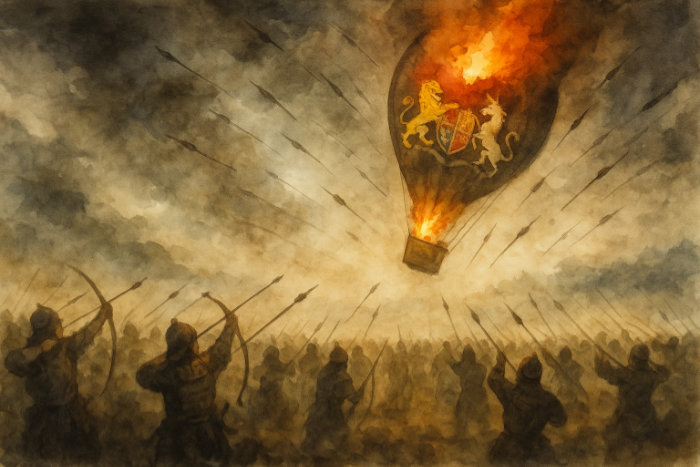
    The balloon gained height again and took off on an unmanned flight for several miles above Peking. The envelope caught fire from the furnace, and many perceived it as a dragon descending from heaven, to wreak havoc on the Manchu Qings.

    Among the populace, alarm spread at the sight of the unicorn, glistening in the evening light – so closely resembling a legendary beast of their own, whose arrival had been anticipated for centuries. Archers fired upon the apparition as it bobbed and limped across the sky, striking sacred spots upon its body.

    Snatches of an ancient song arose amid the cries of terrified onlookers, first muttered, then taken up by others:

    The unicorn’s hooves!
    The duke’s sons assemble,
    Woe for the unicorn!

    The unicorn’s forehead!
    The duke’s cousins gather,
    Woe for the unicorn!

    The unicorn’s horn!
    The duke’s kinsfolk arrive,
    Woe for the unicorn!

    A fire-engulfed hot air balloon, embossed with the British coat of arms featuring a lion and unicorn, plunges from the sky under a gale of arrows, fired upon by amassed warriors.

    When the craft crashed flaming into a field on the outskirts of Peking, it was set upon by peasants wielding spades, shovels, picks, and knives. No one was harmed in the incident, except that during the incineration of the balloon’s remains, all the hair on the head of one of its attackers was entirely burned off.

    Dinwiddie was conveyed back to his quarters, where Pu-erh and her son were waiting. He waved them aside and, devastated and speechless, took to his couch for days, avoiding them both for the remainder of his stay in Peking.

    Mow Fung noticed that from this time on, his mother tacked a tiny new gesture to the end of her occasional, apparently unprovoked sigh: a barely perceptible shake of the head. She would now say just one word to herself:

    “Men.”

    Addendum. Filed: Gate of Divine Might, 1793:
    The foregoing episode is absent from the official papers of the Embassy, and from all Celestial memorials of the same year. No explanation is recorded, nor could one be; the event appears to have been extinguished at the instant of its occurrence. A trace persists only in a marginal entry among provincial gazetteers, describing the sudden descent of a flaming lion beyond the northern wall of Peking: a visitation later interpreted as the passing shadow of an immortal qilin (the “unicorn” of the translated song).

    The entry adds that similar portents were recorded in antiquity, when a qilin was said to have announced the birth of Confucius, the Sage of Lu, and another to have appeared before Emperor Wen of Han. In Han and later commentaries, the song “The Hooves of the Unicorn,” long preserved in classical commentaries, was linked to the death of Confucius himself, for it was said that the capture and wounding of a qilin in Lu marked the end of his era. By analogy, the chronicler proposed that this fiery apparition might signify the renewal of imperial virtue, or else its exhaustion. Whether this was mass illusion, actual omen, or mere transcription error cannot now be determined.


    © Michael Guest 2025