Tag: Fictions and Features

  • Twin Desires: Exploring Mushanokoji’s Humanist Roots

    Twin Desires: Exploring Mushanokoji’s Humanist Roots

    Followed by his colleagues from the Peers’ School, Mushanokoji began publishing Shirakaba in 1910, which was to become the most important literary magazine of early twentieth century Japan. He had graduated from the Peers’ School, then withdrawn from Tokyo Imperial University in 1907. Shirakaba means “White Birch,” in reference to the white birches that appear plentifully in Japan, but are even more overtly symbolic in Russian literature.

    This post in the Exploratory Companion will sketch out elements of the literary and lived forms of Mushanokoji’s evolving humanism, from his Tolstoyan beginnings, through Maeterlinck, and culminating in his literary philosophy and social experiment at Atarashikimura village. I aim to explore the broader global context for his development. It’s not only via his attachment to the metaphysics of Maeterlinck that THE INNOCENT speaks so accessibly to modern readers, nor only through its avant-garde characteristics, but also because of his position in this ongoing historical movement of “East-meets-West” humanism and peace.

    Rousseau – Tolstoy – Gandhi: evolving world vision

    The title Shirakaba resonates with the influence exercised upon the young Meiji intelligentsia by the great Russian author Count Leo Tolstoy (1828 – 1910), through ideas communicated to them by Mushanokoji himself. This influence extended not only to the field of literature but also into social and community idealism, and Mushanokoji’s founding of the village of Atarashikimura, to embody his ideals and teachings. (Rekolektiv, “Atarashikimura in Interwar Japan”).

    To outline the origins of a broader humanistic movement of which Mushanokoji’s work is one manifestation, we would look to Jean-Jacques Rousseau (1712 –78), whose critique of social inequality and ideas about education and the nature of humanity captivated Tolstoy from the age of fifteen. The opening up of a secluded Japan and its potent interaction with Western culture during the Meiji period provided fertile ground in which these ideals could evolve in a fascinating direction.
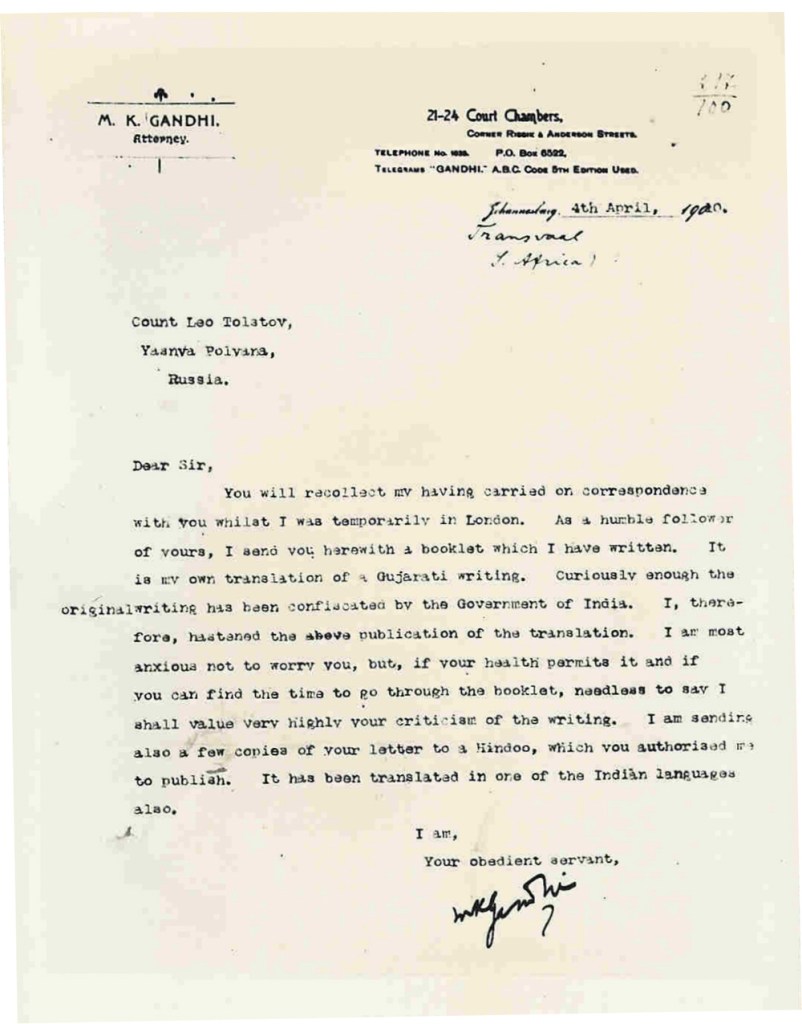
    Facsimile of 1910 letter from Gandji to Tolstoy (UHM Library)
    Facsimile of 1910 letter from Gandhi to Tolstoy (UHM Library)

    Tolstoy’s contribution to the broad politics of peace and non-violence was, of course, immense, and magnified through his relationship with Mahatma Gandhi (1869 –1948). In his autobiography The Story of My Experiments with Truth (1925-29; 161), Gandhi wrote that he was “overwhelmed” by the Russian’s reinterpretation of Christianity, due to its “independent thinking, profound morality and […] truthfulness.”
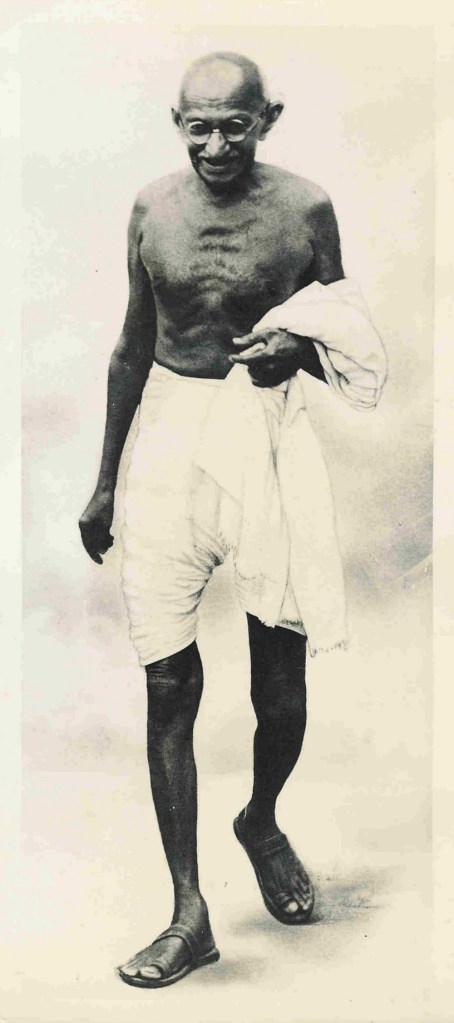
    "The Mahatma" 1945 (UHM Library)
    “The Mahatma” 1945 (UHM Library)

    Tolstoy’s 1908 “A Letter to a Hindu” instigated an ongoing correspondence between the two great luminaries. In 1910, the Mahatma established a cooperative settlement in South Africa, naming it Tolstoy Farm, which was to be a model for self-sufficient, communal living, and training in satyagraha — a commitment to truth, non-violence, self-suffering, courage, conviction, and self-discipline.

    Aristocratic obligation and presumption

    The youngest of eight sons of a Japanese Viscount, Mushanokoji turned to Leo Tolstoy for literary and humanitarian inspiration, fueled by a sense of social obligation that inhered in his aristocratic birthright. During what is sometimes called his “Tolstoy craze” late in his adolescence, Mushanokoji had emulated the ascetic lifestyle that Tolstoy espoused, by living in a small, unheated hut on his family’s estate, “wearing simple clothes and leaving the stove unlit.” Indeed, because of their privileged origins, Mushanokoji and his Peers’ School colleagues received criticism in Japan as being immature and dandyish dilettantes, despite or perhaps even because of the charitable acts that several of them exhibited in response to social inequality, such as Arishima Takeo, who gave his family farm in Hokkaido to its tenants as cooperative owners (Yiu 218).

    Mushanokoji’s uncle provided his nephew with recently translated Japanese editions of Tolstoy’sThe Kingdom of God is Within You (1894) and other works by Tolstoy, and also introduced him to the Bible:

    Mushanokoji’s host – his reclusive uncle Kadenokoji Sukekoto – was far from fashionable. After suffering a series of financial setbacks, Kadenokoji had retired to live alone on his sole remaining estate. He worked in his fields in the daytime and spent the evenings studying sacred texts and discussing them with Christian pastors and Buddhist monks. His eclectic spirituality set an example for his nephew, who would also spend his life gathering ideas from diverse sources.

    Anna Neima, The Utopians: Six Attempts to Build the Perfect Society (118).

    Mushanokoji's uncle Viscount Sukekoto Kadenokoji (1860 –1925) 1913
    Viscount Sukekoto Kadenokoji (1860 –1925), 1913

    Mushanokoji was indeed greatly inspired by Kadenokoji. It is unlikely, however, that the compassionate and amusing portrait of Jibun’s uncle in Chapter 7 of THE INNOCENT is specifically him, since he died from kidney failure at the age of 65, whereas the uncle in the novella dies from cancer at 45 or 46. Recall, however, that Jibun’s father appears in the novella, even though the fact is he died when the author was an infant; so the possibility remains that Jibun’s uncle may be based on Kadenokoji.

    It is perhaps fairly natural to suspect the compassion that privileged individuals extend to those below. For some, the image of Marie Antoinette dressing up as a peasant in her rustic hamlet in the grounds of the Château de Versailles prefigures an inauthentic spectacle of the aristocrat Tolstoy assuming the guise and lifestyle of his peasants, from which he always had the freedom to withdraw.

    Not to be too glib, however: Buddha himself, Siddhartha Gautama, was an aristocrat who, in his “Great Renunciation,” gave up his wealth, family, and social status to become a wandering ascetic.

    Shadow of Buddha: eclectic spiritual roots of a humanistic ideology

    Tolstoy deeply respected Asian culture, and his ideology is redolent with Eastern thought. His interest stemmed from an early experience at age nineteen, when he met a Buddhist monk in a hospital in Kazan, who had been robbed and assaulted violently, but had not fought back, adhering to the principle of non-violence (Kamalakaran).

    The encounter had a profound effect on Tolstoy, fostering his lifelong interest in Buddhism and other Eastern teachings. He experienced an existential crisis in his mid-50s, which he described in his autobiographical A Confession (1880), when, after having achieved wealth and fame, he found life lacking in meaning. Tolstoy became disillusioned with traditional Christian churches, believing they had corrupted Christ’s message. While his resulting “new faith” was not explicitly Buddhist, it marked a significant sympathy with Eastern philosophies. (See Kamalakaran, “The influence of Buddhism and Hinduism on Leo Tolstoy’s life” – Russia Beyond.)

    Tolstoy engaged further with Buddhism in an 1889 essay, “Siddartha, Called the Buddha, That is the Holy One,” and expressed Buddhist ideas in his correspondence, discussing concepts such as karma and reincarnation. Towards the end of his life, he contributed an article on the Buddha to his anthology “The Circle of Reading” (1906) and translated the American Paul Carus’s (1852 – 1919) story “Karma” into Russian.
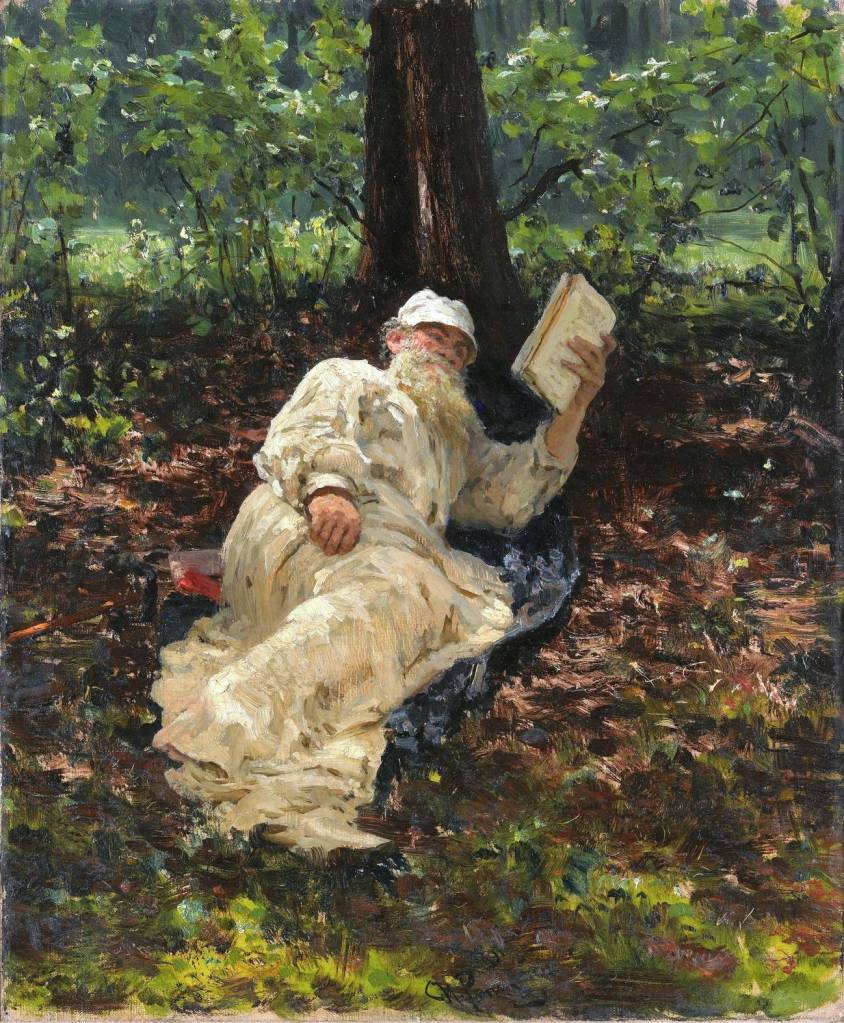
    Tolstoy Resting in the Forest, Ilya Repin, 1891
    Tolstoy Resting in the Forest, Ilya Repin, 1891

    His adoption of vegetarianism, championing of non-violence, and attempts to live a simpler life demonstrate an affinity with Buddhist practice. Ultimately, the philosophy he developed, known as tolstovstvo, containing a core concept of mankind living in peace, harmony, and unity, and which also encompassed his rejection of luxury and opposition to the exploitation of peasants, is in keeping with Buddhist ideals.

    Subsequently Tolstoy engaged in further Japanese projects, particularly in the context of agrarian and utopian movements. He collaborated with Konishi Masutaro, a Japanese Orthodox priest, on a translation of the Daoist text, the Daodejing, which they both saw as “an escape from state authoritarianism” and a step towards a “‘new universal religion’ based on Tolstoyanism” (Johnson, “Displacements: Current Work on Japanese Modernism”). Tolstoy’s concern with the peasantry and agricultural reform became a significant legacy in Japan, influencing movements described as “agrarian-Buddhist utopianism” (see Shields).

    Mushanokoji explored Buddhism explicitly to some extent in later life, presenting the Buddha as a “human” ideal in his popular work Life of Shakyamuni Buddha (1934; ctd. in Shields). Mushanokoji’s explicit intention here was to emphasize the “human” Shakyamuni, portraying him as an ideal figure lauded for his insight and compassion, someone who possessed a natural innocence, described as “the heart of a child” (akago no kokoro). He portrays Buddha as a valuable model for human behavior, one stripped of mystical elements. Mushanokoji included Shakyamuni Buddha in a pantheon of “masters” alongside Jesus Christ (whom he saw as a “man with a pure, pure heart”), philosophers, writers, and even literary characters, all of whom served as models of human “liberation” (Shields).

    …“the Buddha” functions [for Mushanokoji] as a representative of a complex of humanist ideals, including a religious understanding rooted in common sense and compatible with modern science, one that rejects social discrimination and institutional hypocrisy, and looks to nature itself as a source for liberation.

    Shields, “Future Perfect: Tolstoy and the Structures of Agrarian-Buddhist Utopianism in Taisho Japan”

    Mushanokoji’s utopian vision thus blended liberal-humanist ideals evolved from Buddhist, Christian, and Western philosophical traditions. Shirakaba writers compiled a list of idealist “masters” whom they admired, including Christ, Buddha, Confucius, St. Francis, Rousseau, Carlyle, Whitman, and William James. Interestingly, in her book, Meeting the Sensei: The Role of the Masters in Shirakaba Writers, Maya Mortimer asserts that in rejecting all (positivistic) “-isms,” the Shirakaba “masters” embody a “way of unlearning” or a Zen-like methodology (ctd. in Shields).

    Subversive philosophy of self-love

    In an explicit doctrine of egoism (jiko shugi), Mushanokoji advocated one’s complete subordination to the Self:

    Our present generation can no longer be satisfied with what is called “objectivism” in naturalist ideology. We are too individualistic for that . . . I have, therefore, taught myself to place entire trust in the Self. To me, nothing has more authority than the Self. If a thing appears white to me, white it is. If one day I see it as black, black is what it will be. If someone tries to convince me that what I see as white is black, I will just think that person is wrong. Accordingly, if the “self” is white to me, nobody will make me say it is black.

    Mushanokoji, “Art for the Self” (1911), qtd. in Shields

    THE INNOCENT brilliantly embodies such a subjective gesture. In what I have called Jibun’s “spiralling inwards,” he is drawn towards the phantasm of his beloved, the girl Tsuru. That is, she is rendered as a symbol of an ideal love, which is ultimately perceived as his love for himself, which he realizes he is unable to sacrifice for her sake (See previous posts and Translator’s Preface to THE INNOCENT).

    Portrait of Mushanokoji Saneatsu by Tsubaki Sadao (1896 – 1957) 1922
    Portrait of Mushanokoji Saneatsu by Tsubaki Sadao (1896 –1957), 1922

    As discussed in previous posts, Mushanokoji’s humanistic perspectives were greatly influenced as well by the Belgian writer and philosopher Maurice Maeterlinck, with a primary emphasis on self-love and the cultivation of the individual self. Mushanokoji declared in an early issue of the Shirakaba journal, on the struggle of attaining a free individuality:

    I only understand myself. I only do my work; I only love myself. Hated though I am, despised though I am, I go my own way.

    Mushanokoji in Shirakaba (1912), quoted in Gennifer Weisenfeld, MAVO: Japanese Arts and the Avant-Garde, 1905–1931 (Berkeley, CA; Los Angeles, CA; London, 2002), 22

    Thus Mushanokoji’s thought evolved in a direction away from the ideal of self-sacrifice associated with his earlier Tolstoyan influence. Maeterlinck’s metaphysical vision validated an insular, contemplative life. It equipped Mushanokoji to make a literary inward turn to autobiographical fiction and to embody the inner trajectory in literary form.

    A brilliantly original achievement in THE INNOCENT lies in how the author explores multiple implications of such an introjection of objective reality, preserved ironically in an accessible naturalism. In so doing, Mushanokoji adapted Maeterlinck’s philosophy of self-love, encouraging individuals to conduct themselves as individualistic moderns, living for their own pleasure, and writing about the process of exploring their own natures. Mushanokoji came to adopt a pivotal point of opposition between Tolstoy and Maeterlinck: that we must love ourself in order to love others:

    In an essay titled Jiko no tame oyobi hoka ni tsuite (For My Own Sake and Other Things, 1912), [Mushanokoji] paraphrased Maurice Maeterlinck (1862–1949) and wrote, “Even if you were told to love your neighbor, you must first learn to love yourself. Moreover, it is not sufficient to love your neighbor as you love yourself. You must love yourself in oth­ers” 

    Mushanokoji “For my own sake and other things” (1912), qtd in Angela Yiu, “Atarashikimura: The Intellectual and Literary Contexts of a Taishō Utopian Village,” Japan Today

    Mushanokoji’s exploration of identity and self-cultivation in THE INNOCENT and later writings became a key early expression of a cultural phenomenon of the time — a so-called “cult of self-love.” It became a popular mindset among Japanese youth, even prompting government concerns. School texts were rewritten, with the idea of preventing hedonistic individualism from undermining loyalty to the state. Conservatives fumed that Western ideas were destroying Japan’s social cohesion, and that traditional values of piety and loyalty had to be revived (Yiu).

    “Twin Desires”: I-novel and village utopia

    Atarashikimura can be read as the continuous augmentation of an ego that seeks to make its impact felt not only on the pages of a book but literally on earth. The village, like his art, is created “for the sake of the self ” (jiko no tame), and is thus the ultimate act of self-expression.

    Angela Yiu, “Atarashikimura: The Intellectual and Literary Contexts of a Taisho Utopian Village.”

    In 1918, in an effort to embody his ideals and teachings, Mushanokoi established a utopian village community in Japan: Atarashikimura (“New Village”). Mushanokoji’s social project was in the spirit of Tolstoy’s school for peasants at his estate of Yasnaya Polyana (“Bright Meadows”) (Rekolektiv). Atarashikimura can be described not merely as a social experiment but as an instance of an “I-novel” sensibility given physical form: “Atarashikimura is an I-novel written not in the pages of a book but in an actual geographical dimension” (Yiu). Still operating today, though relocated from its original site in Miyazaki prefecture to Saitama prefecture in 1939, the village embodies Mushanokoji’s egoistic and creative vision. It’s about an hour and a half from Tokyo.

    Today, the village continues to operate based on original principles of communal living and the pursuit of art and culture, fulfillment of each individual’s destiny, and the importance of each person’s individuality. Residents, currently numbering around twenty, contribute six hours of compulsory labor per day. (Members living outside the village can contribute funds.) The remaining time is for the free pursuit of truth, virtue, beauty, and personal interests aimed at actualizing one’s authentic self. Villagers receive an allowance from a collective fund for their daily needs (see Yiu).

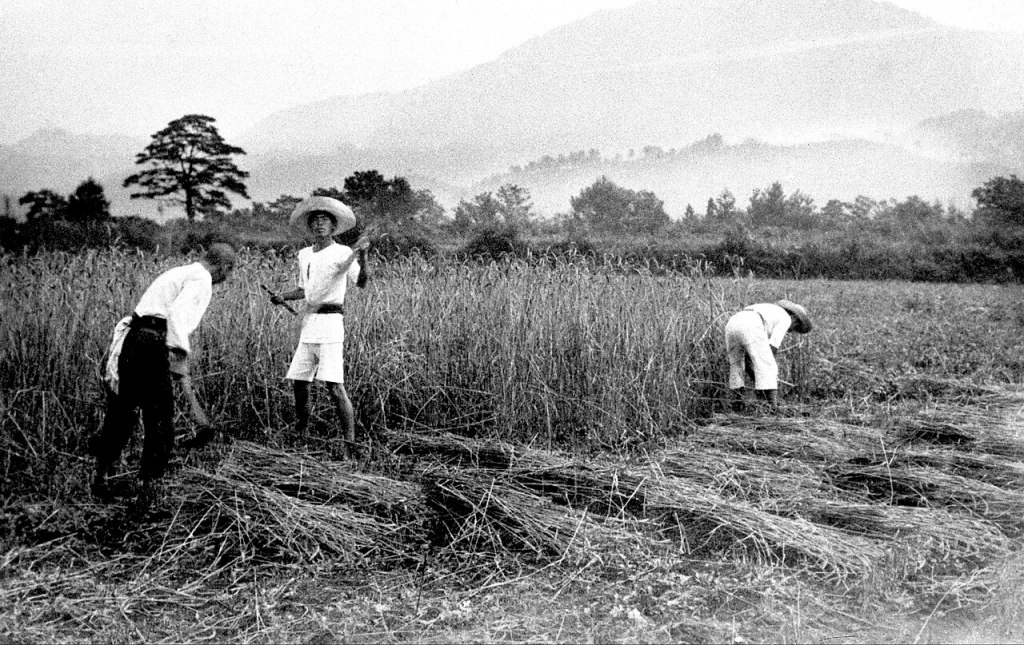
    The harvest wheat in Atarashikimura, 1919. Mushanokoji is facing the camera.
    The harvest wheat in Atarashikimura, 1919. Mushanokoji is facing the camera.

    When Mushanokoji founded Atarashikimura, during the late Meiji and Taisho eras, or from around the end of the nineteenth century to the mid-1920s, a period in Japan saw the rise of kyoyo shugi, an emphasis on holistic personal development, intellectual cultivation, assimilating ideas from Western humanism, which influenced groups such as the Shirakaba-ha. The concept can be translated as “liberal arts” and is linked as well to the German concept of Bildung, which emphasizes intellectual and personal self-cultivation. Alongside this development at the time was a growing exploration of the inner self, as propounded by Mushanokoji.

    The I-Novel and Inner Exploration

    Crucially, this period also witnessed the emergence of the I-novel (shishosetsu), a genre of which Mushanokoji’s THE INNOCENT is a seminal exemplar. The I-novel is characterized by its intensely self-oriented nature and the cultivation and assertion of the ego as the ultimate authority. The I-novel marks a strong focus on interiority in fictional writing, as we see clearly in the case of THE INNOCENT, with the novella’s single-minded exploration of identity and self-cultivation.

    Angela Yiu describes how Mushanokoji’s aspirations in literary art and his wish to create a new world, a utopian community, were his “twin desires,” such as he expressed in his 1921 autobiographical novel Aru otoko (A Certain Man). In an article entitled “Art for Oneself” (1911), at around the same time as THE INNOCENT, he wrote: “I go all the way to create art for the sake of oneself.” The thought process of Jibun in THE INNOCENT demonstrates his arrival at this same conviction of Mushanokoji’s: a sentiment that extended to his village project. Atarashikimura can be viewed as “[Mushanokoji’s] most invested work of art, a sakuhin {work] that is created for the sake of maximum self-expression” (Yiu).

    “Imperialistic Egoism” and the Village

    Saneasu Mushanokoji’s philosophy involves a complex blend of influences, including a tension between his declared admiration for Leo Tolstoy and a contrasting development of what Yiu calls an “imperialistic egoism.” In THE INNOCENT, the ego is clearly presented as undergoing an all-encompassing expansion, to the extent that even the beloved character Tsuru is beyond actual reach, but merely an internal phantasm. In attempting to mitigate such an extreme degree of aggrandizement, we may bear in mind Maeterlinck’s own formulation from his book Wisdom and Destiny (1898):

    Tolstoy’s ideas on humanism, equality, communal living, and labour profoundly influenced Mushanokoji throughout his life, though Mushanokoji selectively adopted or reinterpreted these ideas to accommodate a philosophy centered on the assertion and cultivation of the self, as advanced by Maeterlinck. Mushanokoji’s is a more progressive ideal than Tolstoy’s, validating aspects like

    […] lust, sex and pleasure-seeking as essential, even moral, components of human existence … This new philosophy of hedonistic egotism was the second of the two strands that Mushanokoji would eventually weave together to form his utopian ideology, combining it with the socially minded influence of Tolstoy and Christ.

    Neima, 125

    In Chapter 5 of THE INNOCENT, a still “prudish” Tolstoyan Jibun debates the opposition with his libertine, Maeterlinckian visitor:

    “You speak from the female perspective, as one would expect from a prude,” he said. “But a healthy man has rights as well. Someone who takes pleasure in life is entitled to do so, without having to go around like some kind of sexual invalid. You, as a scholar, should not derive satisfaction from the plight of the weak. I will not accept the idea that healthy people should be condemned for complying with the demands of nature and enjoying themselves.”

    Mushanokoji adapted the philosophy of self-love into a literary philosophy focused on exploring the transcendent extent of one’s own self. His celebration of the self is a crucial element reflecting his philosophical evolution during the period leading up to THE INNOCENT. A model of the Japanese I-novel genre, the novella is marked by an overwhelming emphasis on the subjective perspective and assertion of the ego.

    The concept of what Yiu calls Mushanokoji’s “imperialistic egoism” may be further debated in the context of his utopian commune, Atarashikimura. She argues that the village can be read as a physical manifestation of a creative ego seeking to “make its impact felt not only on the pages of a book but literally on earth.” For Yiu, this strong sense of self implies eliminating the difference between self and others by “subsuming others under an overpowering self”. The observation aligns with Mushanokoji’s assertion that “there is no authority above the self.

    The idea of a central “self” encompassing or projecting onto others within the communal setting resonates with the theme of solipsism found in his literary works. This is particularly so inTHE INNOCENT, in which the narrator reduces the figure of the “other” (his beloved Tsuru in this case) to a mere projection of “projection of fantasies and desires, entirely lacking in agency (Lippit, 14).

    In his Topographies of Japanese Modernism, Lippit considers that Mushanokoji’s “discursive rendering of the relationship between self and other,” where the Other is reduced to a “phantasmal image,” not only provides a framework for Mushanokoji’s fiction, but also his “consciousness of modern culture” (Lippit 14). The village, as Mushanokoji’s “most invested work of art […] created for maximum self-expression” and an I-novel written in a “physical reality,” reflects this same tendency for the individual self to be the ultimate frame of reference, potentially overshadowing the independent reality and experiences of others.

    The concept of “imperialistic egoism” encapsulates a fascinating paradox within Mushanokoji Saneatsu’s work: the transformation of personal idealism into a broader social project. In the I-novel form, this egoism seems not only ideologically tenable but formally generativeTHE INNOCENT thrives on the inward-turning journey of the self, with its solipsistic implications often turning into a source of ironic humor. The exaggerated isolation of the protagonist, driven by self-absorption, becomes a way of exploring human vulnerability, and this humor lends the text a certain playfulness while deepening the existential weight of its themes.

    However, when these same “imperialistic egoism” impulses are extended into the practical framework of Atarashikimura, their implications seem less straightforward. The utopian vision powered by a single, dominant self could, at least hypothetically, run the risk of reproducing some of the hierarchical dynamics it was meant to challenge. The tension between the ideal and the real seems to suggest that what enables the author’s literary world — the expansive self — might not seamlessly translate into a sustainable communal project. It remains uncertain whether this “imperialistic egoism,” when enacted outside the literary realm, would promote true cooperation or potentially veer into paternalism, revealing the complex balancing act between idealism and pragmatism that such a project sets in play.


    Notes and further reading

    Gandhi Image citations:

    Press Information Bureau, “Gandhi (Full Length Portrait),” UHM Library Digital Image Collections, accessed May 11, 2025, https://digital.library.manoa.hawaii.edu/items/show/27516.

    Press Information Bureau, “Letter to Tolstoy,” UHM Library Digital Image Collections, accessed May 11, 2025, https://digital.library.manoa.hawaii.edu/items/show/27528.

  • Razor Viking: With a Twist

    Razor Viking: With a Twist

    • Tony Reck recalls one of many arduous treks. The Razor-Viking wilderness is an isolated and rugged mountainous region in the Alpine National Park, about 380 kilometres northeast of Melbourne. It lacks vehicle access, signposts, and track markers.

    It was November 2024, the Melbourne Cup weekend, and we had four days to complete the Razor Viking circuit. After spending Friday night at Muttonwood camp, twenty kilometres north of Licola, we drove over Mt Tamboritha, along the Snowy Range, and arrived at Howitt car park.

    Having just met the party of nine, I kept my head down and watched for indications of a group dynamic. Our leader, a tall, bearded man of Dutch descent named Jopie, produced a set of scales from his white Subaru Forester, and each member of the group rushed to obtain an accurate reading of the weight of their packs.

    Jopie’s pack weighed 16 kg, John’s 15.5 kg, while Rod’s four-day masterpiece barely recorded a reading at 11 kg.

    There was much conviviality among those with light packs as they struck out at speed through the snowgums on Clover Plain toward Macalister Springs. While the unenlightened, myself included, brought up the rear under a humid sky and wondered what secrets in weight strategy had been denied us during our formative bushwalking years.

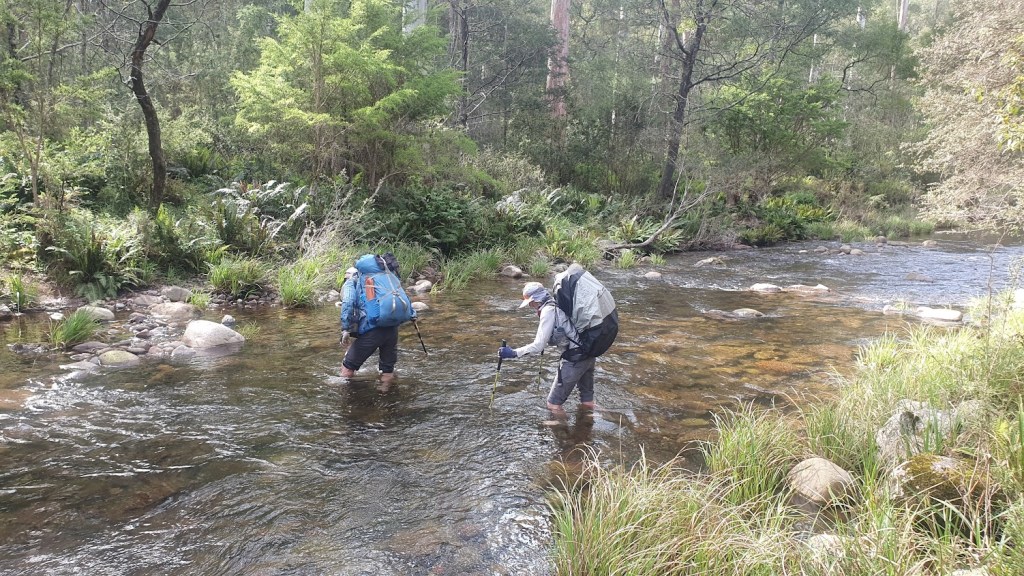
    Two trekkers cross a stream

    Lance, a nuggetty man with a wild afterburn of grey hair, had decided not to chance his hand on the Razor Viking circuit. Instead, he would spend the following four days exploring the Howitt Plains area. We said goodbye at the top of Devil’s Staircase and Lance hot-tailed it along a well-defined track toward a comfortable night in a hut situated at Macalister Springs. For the rest of us the opposite was true. There would be no well-defined track and no hut to retreat to if the weather soured during the following days.

    From the top of Devil’s Staircase, an untracked spur led north-east, then east, during a one thousand metre descent into the valley of the infant Wonnangatta River and our first campsite. We would then cross the river, climb steeply out of the valley, circumnavigate an unnamed 900-metre hill, descend once again, and cross a tributary of the river; then locate a narrow ridge running north-north-east, ending at a 1,300-metre-high point, south-west of the South Viking.

    But first, we had to do battle with three hundred metres of skin-scratching scrub and a stubborn two-metre tiger snake.

    It was past midday, and a significant change in the weather was apparent. Rain was forecast: developing that afternoon, persisting the next day, then clearing the day after. As we scratched our way through corrosive scrub, the cool alpine breeze that had been present above fifteen hundred metres was replaced by a greasy humidity. The scintillating morning sunshine was consumed by a diffuse curtain of grey cloud. Perhaps the sun’s disappearance was a reason why the two-metre tiger snake refused to move. Rod, the man with the unbelievably light 11-kg pack, warned me of the snake’s presence as I stumbled through the scrub.

    A tiger snake disappears into scrubby grass

    “That’s alright,” I said. “It’s probably more frightened of me than I am of it.”

    Rod was not convinced.

    “That might be so, but the snake isn’t moving. So tiptoe around it.”

    And there it was, splayed across a rock, as thick as a sapling. Calm, but possibly dangerous.

    A big snake moves quickly, and I was not about to be bitten. I took Rod’s advice and tiptoed from stone to stone, giving the snake much space. If a wall had been present I would have had my back against it. But the big tiger seemed unconcerned, confirming the maxim that left alone, most snakes are harmless. It was the most impressive tiger snake I had seen in quite a few years.

    That night, camped in light forest with the southern bank of the Wonnangatta River close by, I recorded the day’s events in a notebook. The walk across Clover Plain had been a pleasant jaunt and our thousand-metre descent had come off as planned. We were camped in an isolated spot, and the next morning, we would embark upon an 800-metre ascent that would take us into the heart of a spectacular mountain wilderness. Yet already, something seemed to be missing from this trip. What it was I could not say: the wilderness without is often as intangible as the wilderness within. I was in little doubt that this absence would be filled over the next three days. Not, as often appears to be the case, by a single event. More likely, by an accumulation of experience, one in which the entire trip would coalesce. That moment when the old path on which a walker treads ends, and a new path unfolds.

    It rained all night, and when I woke the next morning it was still coming down. Reluctantly, I emerged from my sleeping bag and pushed my head beyond the vestibule of my tent. A grey sky with an ominous green hue and not a single break between the clouds. It now looked like this rain would continue throughout the day.

    Then the rain stopped. Tents began to quiver and the sound of several pressure stoves blossomed in the gloom. Hans emerged: a Swiss carpenter, his handlebar moustache and superhero emblazoned cap indicated he was ready for action, and it wasn’t long before the group gathered at a site one hundred metres upstream, where we intended to cross the rising Wonnangatta River.

    There Jopie outlined the day’s route. We were aiming for a campsite at Viking Saddle, a small clearing situated between The Viking and The Razor. The distance wasn’t great: approximately seven kilometres. However, it would take a full day to arrive as we climbed eight hundred metres and attained two distinctive summits, before negotiating The Viking’s north-western cliff and descending two hundred metres through uprooted mountain ash in an area decimated by a recent winter storm.

    There are various methods for crossing a fast-flowing, swollen river. Hans, that Man of Action, and being a carpenter, could not contain a biblical impulse. Fully clothed, he entered the river on the south bank and exited via the north like Moses parting the Red Sea.

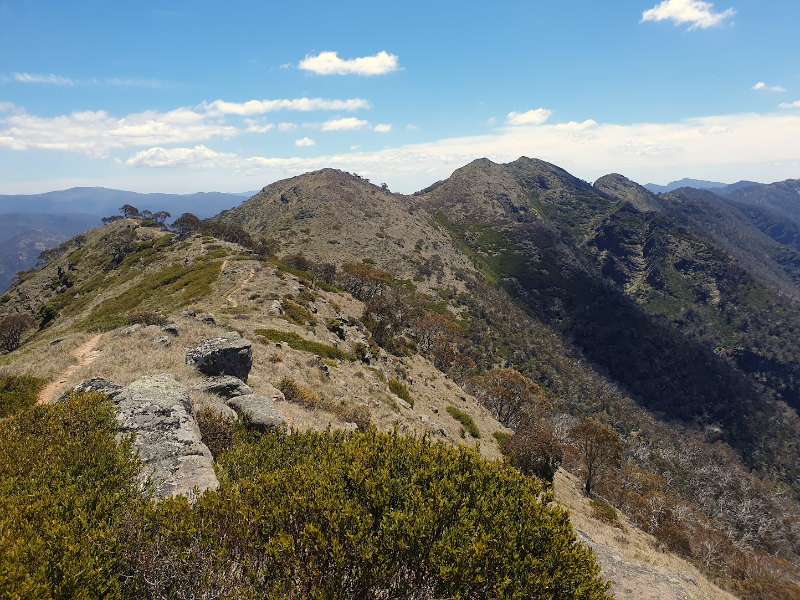
    Majestic scenery of the Australian Alps, with two trekkers showing tiny in the foreground

    Soon, we had all managed to successfully cross the river and regrouped on the north bank, while considering the next — and perhaps most difficult — obstacle of the entire walk: a ‘1 in 2’ climb (one metre ascent for every two metres walked), out of the river valley to a small ridge running east to west and separating the Wonnangatta from one of its myriad tributaries. Steep, but short — yet combined with a 22-kg pack and overbearing humidity… well, I need not say any more.

    Once the tributary was crossed we fought our way through a patch of dense, wet fern and other harsh vegetation, before emerging on a pleasant slope — the beginning of the climb to our first 1,300-metre highpoint, south-west of the South Viking.

    As we followed the spur upward there occurred several changes in the landscape. The spur narrowed and turned to rock. Sub-alpine grasses and mountain ash were replaced by tufts of spinifex and the ubiquitous snowgum. The thick humidity present at seven hundred metres was swept away by the snap of an alpine wind. Cloud coagulated around us, the mist rolled in, and one of our party, Michael, a visitor like myself, disappeared from view.

    The ‘1 in 2′ climb straight after breakfast had curbed the group’s enthusiasm but Michael appeared to have suffered a little more than the rest of us. Having some inclination toward the mysteries of first aid and that almost transparent 11-kg pack, Rod left the leader’s group and joined him at the rear.

    Nobody in the party had traversed, or knew of anyone who had traversed, this route to the South Viking. (I had dropped off the summit once before, opting for the relatively gentle descent of a broad spur further east.) We did not know what to expect as we approached the South Viking in heavy mist until the sight of a perpendicular bluff made its presence felt, appearing to block any further ascent. Momentarily, it looked as if we would be forced to spend excruciating hours battling scrub in hostile country by pushing horizontally east — until Jopie’s navigational skill eased into gear.

    Viewed from a great height, we must have resembled a procession of colourful ants teeming over stonework as we negotiated an interconnected system of channels in the escarpment, soon reaching the summit of the South Viking. The difficult aspect of the ascent was over. The South Viking and The Viking were connected by three low-lying saddles. We hurried through each one and arrived at the summit of The Viking. There we hauled packs through a rock chimney, picked up the track to Viking Saddle, and descended through an apocalypse of trees ripped from the ground by a mini-tornado.

    Rock outcrop in foreground of panoramic view of Australian Alps

    I was thankful not to have been camped in the saddle on the night that monster tore through the bush. Hearing a fully grown tree hit the ground is unnerving enough. To have fifty or so crashing around a tent at night would have been a bushwalker’s nightmare.

    A large group had already arrived at the saddle. With the inclusion of our eight tents, a small colony appeared. The sky cracked open once again — and this time the rain was permanent. Confined to our tents, we were wet, hungry and tired. But we were well and truly alive. Not that there was any question about the safety of the party. It’s just that city life dulls the senses and a sophisticated urbanite soon forgets his primal origins.

    After an hour of heavy rain, the weather shifted. A noticeable breeze blew into the saddle via the headwater of the West Buffalo River. At dusk, a break appeared in the eastern sky. Someone from the other group had persisted in the rain and lit a campfire. A strange shamanic conduit, it drew others to its primal dance. Shadows flickered across faces alive in the darkness, smoke rose into the night air, and I fell asleep and dreamed of prehistoric times.

    As predicted, the rain cleared overnight. We were off early, picking our way through fallen timber as we climbed toward The Razor. To my surprise, there was such a thing as a promising grey sky. But an hour later, as we emerged from the forest and scrambled up the conglomerate slabs of The Razor, low cloud still enveloped the northern face of The Viking.

    Even so, it was the first unrestricted view we’d had of the surrounding area for two days.

    Standing on the crest of one of many conglomerate slabs, we could see the many sloping spurs and interconnecting ridges descending north toward the remote Catherine River. To the west, the Australian Alps Walking Track fractured as it struggled along intractable rock towards Mt Despair. This was to be our intended route for the day, the objective being Mt Speculation. Jopie had other ideas.

    Having walked the circuit several times, I had never reached the summit of The Razor. Once on the summit, after a slow kilometre of rock hopping through trackless terrain, the side-trip proved eminently worthwhile.

    An increase in temperature flushed low-lying cloud from The Viking’s north-eastern flank. The cliffs marking the Australian Alps Walking Track’s easterly descent to Barry Saddle appeared. Vertical, and like the weather-beaten brow of a forlorn, lost explorer, the mid-mountain cloud closed in once again and The Viking disappeared.

    An hour later, after reclaiming our packs, we were back on the walking track leading west toward Mt Despair. Despite slow going along the southern crest of The Razor, the mood of the group had lightened. The most difficult aspect of the walk was behind us. Hans was telling tall stories once again. We would soon be setting the pace along an obstacle-free track over Despair and down to Catherine Saddle, a headwater of the Wonnangatta River. As a gash in the cloud widened and blue sky appeared for the first time in two days, we discovered there was no irony intended in the name ‘Mt Despair’.

    It was a relief to finally see the sun. But why had it chosen to appear, and why had the temperature increased just as the ascent of Mt Despair had begun?

    Rugged rocky ridge with Australian Alps blue in the background

    In the past, a solid rest after considerable physical exertion had always left me ready and willing. However, the cumulative stress produced by carrying a heavy pack through rough country for three days was beginning to tell. And we still had the severe climb from Catherine Saddle to Camp Creek prior to the summit of Mt Speculation to complete.

    It was well past 5.00 pm as we descended the grassy, sun drenched western slope of Mt Despair. After a hard day, this was not a great time for preparing to climb one of the higher mountains (1,630 metres) of the Wonnangatta Moroka sector of The Alpine National Park.

    At Catherine Saddle, two routes presented themselves.

    A foot track headed straight up the northeastern flank of the mountain while the old Wonnangatta Track (ambitiously referred to as Speculation Road) followed the twelve-hundred-metre contour around the same flank, then ascended Camp Creek via a shallow valley.

    Bob and Michael chose to follow the contour. I was tempted, but on a blind impulse followed Jopie, Rod, Tim and Hans over an embankment and up the hill.

    Halfway up, I wished I’d chosen the contour. Without exaggeration, I thought my lungs would pop. But after twenty years of bushwalking, during which I had walked the entire Australian Alps Walking Track and been whacked by second-stage hypothermia on Mt Anne in South West Tasmania, I had integrated into my bushwalking a highly sophisticated technique for dealing with mind-altering pack-carries up the steep flanks of mountains.

    Growling.

    Believe me, growling will get a beaten walker to any summit, any time — although the worried look I received from Hans suggested I had completely lost my marbles. But growl I did, and once again it got me up the mountain. Yet I was grateful that Tim, a trainee nurse, was also present in case my growl became a heart murmur and I collapsed in cardiac arrest.

    Finally, we reached Camp Creek. After some slow tent-erecting, during which I found it difficult to recognise the front end of the tent from its rear, water was obtained from Camp Creek.

    Rugged ridge showing trekking route in the Razor-VIking circuit

    Bob and Michael arrived, a small fire was lit, and once again, cloud descended upon us, dampening everything except our spirits. We settled in for a restful night as the temperature hovered at five degrees.

    We were high in alpine country, directly beneath the summit of a 1,600-metre mountain. We may not have been able to see past our noses, but our bellies were soon full. For the first time during the entire trip, the opportunity presented itself to sit around the fire and share what was already a memorable experience. From intimations of shamanic ritual and prehistoric dreams, to a bushwalker who chose to growl, instead of howl, when confronted by cardiac arrest. But soon, we were all so tired, each one of us silently slipped away, disappeared within a lick of mist, and quietly went to sleep.

    Birdsong broke the silence; what species of bird it might have been, I had no idea. Instead of going back to sleep, I lay on my back in the dark as the bird’s repeated rhythms crystallised thoughts in my sleepy brain. Somewhere in the valley below, a second bird of the same species responded to the first bird’s solo. A fugue ensued; something was afoot in the natural world. I could feel its aura surrounding my tent.

    A high mountain sunrise was one thing, but this show was otherworldly. Tim and I were up and out of our tents, captivated by a violet streak illuminating the tip of a distant mountain. No one else was awake. We were two children watching the birth of a new world. I had seen many a sunrise during my forty years in the mountains, but this was THE sunrise.

    After an hour frolicking in the mellow light of a glorious mountain morning, it was time to get serious. Before us lay the Crosscut Saw: a ten-kilometre rocky spine separating the Wonnangatta and Howqua rivers, leading back to Macalister Springs. Our trip along the Razor Viking circuit was concluding.

    From the summit of Mt Speculation there would be that descent through the bluff at Horrible Gap during which Bob would lose his footing and hang suspended in mid-air from a rickety tree branch. There would also be that climb to Mt Buggery, the name of which would elicit a grim laugh from Tim as he encountered its sharpness. Without doubt, there would be the pain derived from four days of stress upon a body that failed to recover after the climb to Buggery’s summit. Every step, every adjustment of the load upon my back, every swivel of the hips and resulting unobstructed view into valleys east and west would evoke within me an ecstatic sense of the Victorian Alps — their inspiration, my infatuation, and the wonder that makes bushwalking in those alps an exhilarating experience. There would be all this and more as we cracked jokes after meeting up with Lance on the heath at Macalister Springs, before arriving to fresh fruit at Howitt car park.

    But that moment of truth all bushwalkers strive for had passed.

    As we left Camp Creek and climbed toward the summit of Mt Speculation, the old path had ended and a new trip had begun.


    RAZOR VIKING: WITH A TWIST by Tony Reck © 2025
    Photos: John Terrell © 2025

  • The Moral Eye of Meiji: Beauty and Self-Reflection in The Innocent

    The Moral Eye of Meiji: Beauty and Self-Reflection in The Innocent

    In my previous post, I referred to Jibun’s description of two women outside Maruzen bookstore as having “a round face, in a flowery kimono, heavily powdered,” assuming them “naturally” to be geisha. His casual observation raises an intriguing issue about the perception of physical beauty across cultures, which will afford us a diversion touching on some cultural ideas about female beauty.

    The Round Faces of Jibun’s Nihonbashi geisha: changing ideals of female beauty

    Laura Miller’s book Beauty Up: Exploring Contemporary Japanese Body Aesthetics (Berkeley: U of California P, 2006) is a useful place to start. She observes the female aesthetic ideal through history, beginning with Heian era literature (794–1185), primarily Lady Murasaki’s Tale of Genji and Makura no Soshi’s Pillow Book.

    Miller 21. See also her present source, Ivan Morris’s World of the Shining Prince: Court Life in Ancient Japan (NY: Knopf:1964: 202; and Gary Hickey, Beauty and Desire in Edo Period Japan (Thames & Hudson, 1998)

    There are some who argue that at that time teeth were blackened with paint, in order to simulate tooth-decay: this showed that the woman was wealthy enough to afford sweets, in the same way that her plumpness would show that she could afford plenty of food. (See Hiroshi Wagatsuma [1967], “The Social Perception of Skin Color in Japan“. Daedalus. 96 [2]: 407–443.) In later times, a liquid made from iron filings dissolved in vinegar was used. This procedure of ohaguro was considered a dental sealant for preventing tooth decay.

    Female beauty norms of the Edo period (1603–1867) are documented in an ukiyo-e genre called bijin-ga, or “portraits of beautiful women.” These are usually “courtesans with long, thin faces, fair skin, small lips, blackened teeth, thickset necks, and rounded shoulders” (Morris 21; and see Shinji and Newland; and Hickey).

    See also:

    • Hamanaka Shinji and Amie Reigle Newland, The Female Image: Twentieth Century Prints of Japanese Beauties (Leiden: Hotei Publishing: 2000)
    • Gary Hickey, Beauty and Desire in Edo Period Japan (London: Thames & Hudson, 1998)

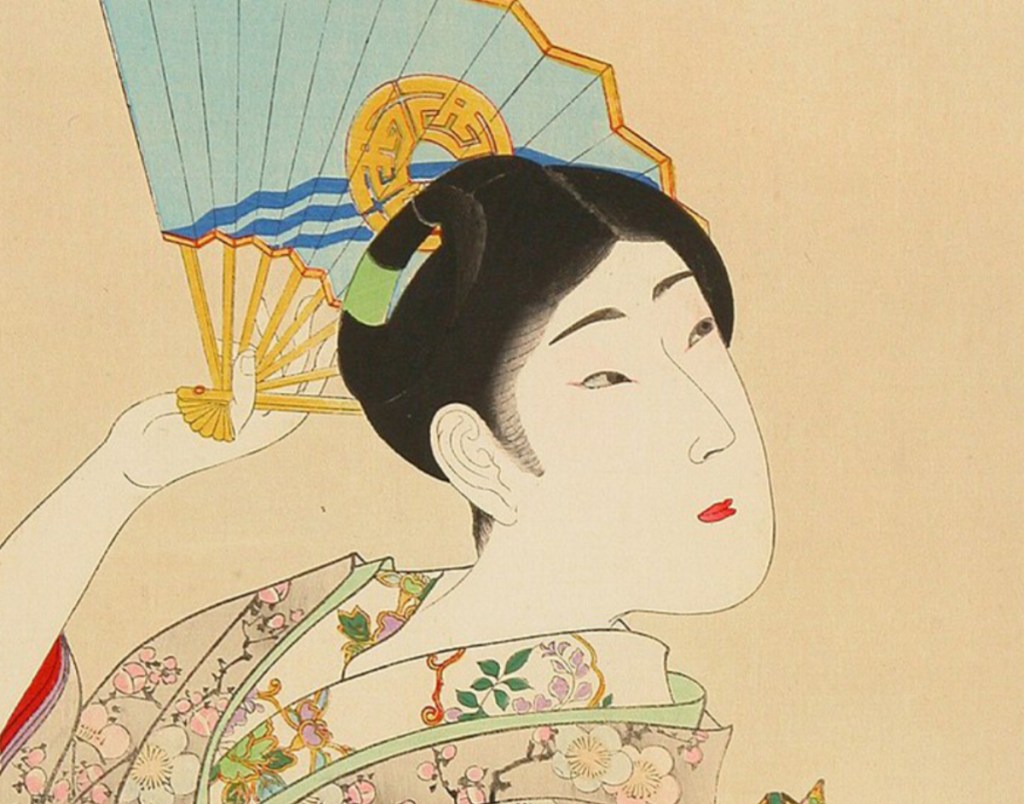
    Actually, it is not so easy to find a “round face” among the bijin-ga. The following, by Yoshu Chikanobu is from 1897, well into the Meiji period (1868-1912), and shows its model holding her fan in a flamenco position, which is an emphatic marker of Westernization:

    Shin Bijin, Shin Bijin series, No. 12 by Yōshū Chikanobu (1838–1912)

    Perhaps part of the problem lies in how to reconcile the naturalistic look of a “round face” with the convention of the bijin-ga to depict its subjects as having long slender faces. There is a gesture made to “round” the face to some extent, about the chin and hairline; but one would have to describe the face more as “oval.” The bijin-ga subjects are sometimes referred to as conventionally having “rectangular” faces. At the same time, the curves in Chikanobu’s Shin Bijin may attempt to convey a degree of plumpness of the face perceived at three-quarter profile.

    Still, Morris maintains that “Later artistic representations of beauties often showed petite women with round faces, straight eyes with flat eyelids, and small receding chins” (21). Furthermore, it seems to me that, in the case of a maiko, or apprentice geisha, the application of thick white makeup over the entire face, does tend to de-accentuate the protrusion of facial features, thus maximizing its perceived roundedness. Fully qualified geisha do not wear the opaque white makeup (once made from toxic lead, which was banned in 1934 and replaced with rice powder.)

    Wagatsuma writes how, during the Edo period, aesthetic norms underwent a transformation: “Gradually, slim and fragile women with slender faces and up-turned eyes began to be preferred to the plump, pear shaped ideal that remained dominant until the middle of the eighteenth century” (15). However, there is a mention in a 1949 novel by Ibara Saikaku, of “A beautiful woman with a round face, skin with a faint pink color, eyes not too narrow, eyebrows thick, the bridge of her nose not too thin, her mouth small, teeth in excellent shape and shining white” (Koshoku Ichidai Onna [The Woman Who Spent Her Life at Love Making], Tokyo, 1949), p. 215.

    In the following passage, the novelist Ishibashi Ningetsu describes a beautiful woman:

    Princess Tsuyuko (“Tsuyukohime,” 1889)

    Indeed, she seems nearly good enough to eat — her skin tones recalling the distinctive spiralling red on white colors of the traditional rolled naruto fish cake!

    Narutomaki — a type of kakoboku, or cured fish surimi (public domain)

    First Miss Japan, 1908

    Traditional influences apparently held sway through Jibun’s time in late Meiji, c. 1908, despite the influence the West had exerted over Japanese values and aesthetics. In 1908, the winner of the first official nationwide beauty contest, Miss Hiroko Suehiro is described as having a “round, pale face, a small mouth, and narrow eyes,” features that “some Japanese scholars cite as […] expressions of the values of submissiveness, gentleness, and modesty” (Miller, 2006, p. 21). We might notice the plumpness of Hiroko’s cheeks, and the relative roundness of her face, particularly as emphasized by the hairstyle. But her nose is quite long. The closer you look, the more relative such measures seem to become; after all, beauty truly is in the eye of the beholder.

    Incidentally, sixteen-year-old Hiroko, the daughter of a city mayor in Fukuoka prefecture, had been a student at the female equivalent of Mushanokoji’s own aristocratic school, attending the elite Gakushuin Girl’s College, or Peeresses’ School in Tokyo. The Chicago Tribune and Jiji Shimpo, an influential Japanese newspaper, co-convened the contest, judging the 7,000 contestants on their submitted photographs. The prize was to be an 18-carat diamond ring worth 300 yen (about 1 million yen today).

    Hiroko’s uncle submitted her photograph unbenownst to her. Thirteen judges included Kabuki actors, “Western-style” painters, and doctors. Unfortunately, the Gakushuin Women’s College took a dim view of her participation in the competition, previous beauty contests having been held only for geisha. The school considered expelling her, harkening to the words of the School President, Baron Nogi Maresuke, a war hero in the Russo-Japanese war (1904-5) and a general in the Japanese Imperial Army, as well as former Governor General of Taiwan. He said of Hiroko’s case:

    Cited in Kusanomido,com

    The school offered Hiroko the option of withdrawing voluntarily, which she did. At any rate, a year and a half later, Hiroko married a twenty-four year old marquis and artillery lieutenant, Shizunosuke Nozu, whose father had fought with General Nogi in the Russo-Japanese war. It was rumoured that the general had mediated the marriage out of regret, but the fact is that the couple’s fathers were old friends, and the marriage had been arranged between the two families over some time.

    As you progress with Mushanokoji’s The Innocent, you will be surprised at some of the parallels between the Hiroko Suehiro matter, and Jibun’s quest to marry his beloved Tsuru, and various other incidents. They are more likely a function of class hierarchies and social customs than any use by Mushanokoji of the case itself. However, there would seem to be little doubt that he would have been extremely aware of the controversy.

    Further reading and reference:

    Tsuru and Jibun: elements of Chapter Two

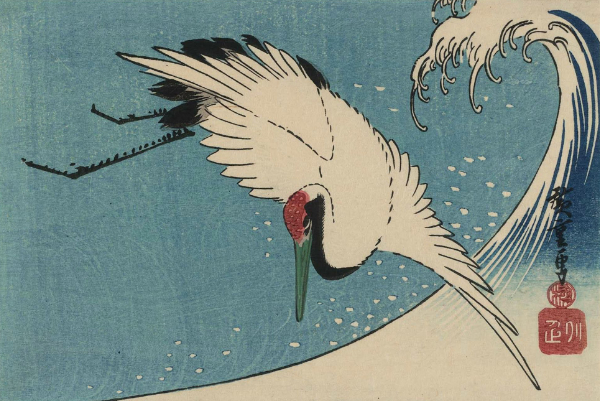
    The wave pictured below recalls Hokusai’s Great Wave off Kanagawa, but this print is by another famous ukiyo-e artist. Here Hiroshige depicts a Japanese crane, the “bird of happiness,” symbol also of good luck, long life, and fidelity. Mushanokoji uses the Japanese word for crane—tsuru—as the name of his “ideal woman,” Tsuru, whom the “I” in the novella obsesses over.

    It is a powerful and economical gesture by Mushanokoji. He invests the young woman’s name with symbolic overtones that encapsulate Jibun’s quest for happiness. Tsuru embodies Jibun’s ideal—or rather, he projects his ideal upon her. In the same action, he internalizes an image of Tsuru, such that she is contained in his psyche.

    Although I refer to the narrator-protagonist as Jibun, this is simply the word for “myself” (reflexive pronoun) that occurs throughout the Japanese text. It is a convenient way to refer to him in the third person—a commonplace in English criticism on the I-novel (shishosetsu) (see, e.g., Fowler).

    Crane flying over wave, ukiyoe woodblock print by Utogawa Hiroshige (1797-1858)

    Mushanokoji’s use of symbolism contributes to the economy of the work as it unfolds before us. This brief Chapter Two is minimalist in the way it develops the outlines of Jibun’s psyche, through his reflecting upon his own peculiar thought processes. Less is more. Bear in mind the autobiographical, confessional nature of the I-novel. We can think of these reflections as sincere observations, not necessarily fictions.

    We like to consider ourselves as rational beings, and to present ourself as such when we express our ideas and opinions to others. But underneath, how much of our inner dialogue is actually obsessive, repetitive, circular, and self-contradictory? We tend not to speak of such thoughts, but prefer to keep them private.

    Jibun Reflects

    Chapter Two continues to develop on the technique of self-examination and self-parody. His continous inner monologue is at once poignant, comic, tasteful, and insightful. A tender yet detached affection—the narrator sees his niece as an embodiment of innocence and familial love, yet she also serves as a quiet reminder of his own solitude, unfulfilled longing, and the uneasy distance between himself and the life he wishes to grasp.

    Anonymous infant girl, ca. 1910

    I love Haru-chan too. She calls me “uncle-chan” and is very fond of me, but I cannot say that I am totally enamored. I live at home without anyone to love but myself.

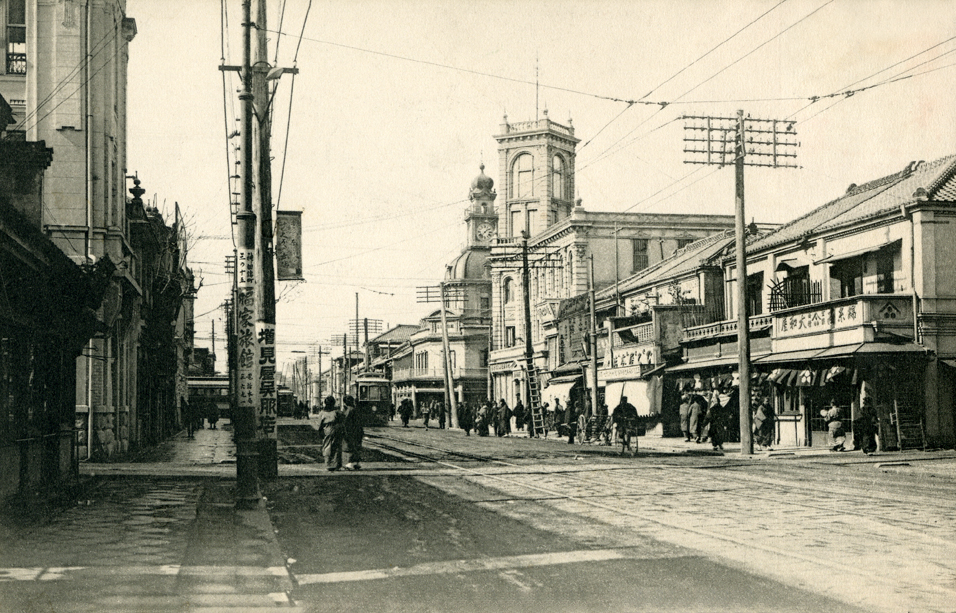
    Ginza, Tokyo, ca, 1910 (Meiji/Taisho)

    I have not been able to taste love, nor do any work I enjoy. I do not know the joy of being a father and cannot help feeling as if I am going to die…

    In the same mood, I walked aimlessly through the colorless town, a solitary feeling in my heart…


    Further Notes and Reference

    Saneatsu Mushanokoji, The Innocent (1911), trans. Michael Guest, Sydney: Furin Chime Press, 2024.

    Bailey Irene Midori Hoy, “Joo wa Dare? Who is the Queen?: Queen Contests during the Wartime Incarceration of Japanese-Americans” (pdf), Winner of Madison Historical Review 2023, U of British Columbia.

    ***Fowler, Edward. The Rhetoric of Confession: Shishosetsu in Early Twentieth-Century Japanese Fiction. Berkeley:  University of California Press, 1988. Full text, html (UC Press E-Books Collection.)

    Fraser, Karen M. in “Beauty Battle: Politics and Portraiture in Late Meiji Japan,” Visualising Beauty and Gender , ed. Ada Yuen Wong, 2012.

    Kamei, Hideo. Transformations of Sensibility: The Phenomenology of Meiji Literature, Trans. Michael Bourdaghs, Michigan Monograph Series in Japanese Studies 40, (Ann Arbor: U Michigan P, 2002).

    Miller, Laura. Beauty Up: Exploring Contemporary Japanese Body Aesthetics (Berkeley: U of California P, 2006)

    Patessio, Mara. Women and Public Life in Early Meiji Japan: The Development of the Feminist Movement. Michigan Monograph Series in Japanese Studies 71 / (Ann Arbor: University of Michigan P, 2011).

    Wagatsuma, Hiroshi [1967]. “The Social Perception of Skin Color in Japan“. Daedalus. 96 [2]

    • I-novel (shishosetsu): Bear in mind that the shishosetsu was not formally theorized until at least ten years after the present novella appeared, when some attributions of “first I-novel” were attempted retrospectively.
    • Haru-chan: The meaning of haru is spring (the season). The ‘diminutive suffix’ -chan attached to a person’s name expresses that the speaker finds them endearing.
    • The first Tokyo Hyakubijin beauty contest, comprising 100 geisha contestants, was conducted in 1891.

    English translation of Saneatsu Mushanokoji’s The Innocent (1911) by Michael Guest © 2024

  • Nightshift

    Nightshift

    Driving through the streets of Fitzroy at night you become obsessed with streetlight and the sound of an imagined disturbance occurring in flat thirteen on the twenty-fifth floor of the Brunswick St. commission flats. In daylight, there is little to see but a urine stain on a tram shelter seat. An old stiff with a grey beard named Jimmy calls to you unintelligibly from the other side of the street. You wish you were somewhere else; perhaps wandering along a path beneath a mountain in the bush…

    But no.


    You are up against a brick wall. Forever waiting to be released from the pain that is synonymous with the stiff named Jimmy who sits the day out on Death Row while trams travel along gentrified Gertrude St.

    Jimmy isn’t a bad man, but he’d snip you for twenty dollars if he could. He sits in his tram shelter, one foot across a thigh, digging splinters of glass out of the soles of his bare feet. The memories emanating from the grey hair covering his scalp are all he has for company. Nobody bothers about old Jimmy, so he creates imaginary friends in order to deflect the pain circulating in his head.

    Jimmy once drove a cab at night. One morning, when the encroaching daylight had washed another junkie’s brains into the gutter, he drove home and had breakfast. While sitting at the kitchen table he saw what he believed was a worm wriggling in his buttered toast. He placed a finger in the marmalade jar and dabbed a touch of ginger in the direction of the worm’s mouth. It promptly slurped the marmalade off his finger, smiled, and in Jimmy’s mind, thanked him for the secretion. The worm then crawled beneath his fingernail and entered his bloodstream through a crack in his skin. Jimmy quietly explained this to his mother; she blessed herself, kissed her son between the eyes, then made him a dish of pear and pineapple pieces hoping that something fruity would prepare her son for the nightshift.

    After breakfast Jimmy read the Neos Kosmos. As the heat of the afternoon drew near he retired to his bedroom and studied an old high school history report. He dropped off to sleep riding the gratification obtained from reading a comment his teacher had made:

    ‘Jimmy is a very bright boy who does no work.’

    As he dozed the worm that he believed had earlier entered his bloodstream fused with the memory of Mrs. Logan’s words until a further sentence was tacked onto the end of the history report:

    ‘Jimmy is a very bright boy who does no work. For punishment, he must clean up the streets.’

    His mother woke him at 4.00 pm. She knocked on his bedroom door then marched into his room and checked him for dysentery. (Her husband had been killed fighting the fascists in the mountains of Northern Greece. He had been a Greek resistance fighter, who, when captured by the Italians, had been forced to sit unchecked in a cell for nine months until an Italian soldier had walked in one morning unannounced and asphyxiated the prisoner using Jimmy’s father’s own excrement. Since the knowledge of that foul act had reached Jimmy’s mother she had remained petrified by the presence of faecal matter. She sensed it everywhere: under the stairs, in the refrigerator, hiding out surreptitiously under the model bridge Jimmy had constructed in the backyard of their home and which acted as a monument over the fish pond he had built in memory of his dead father). Jimmy was free of dysentery, but the worm that he believed had burrowed beneath his fingernail earlier that day had increased in size during the five hours he had been asleep. He now heard and felt Mrs Logan’s command circulating in his arteries and forcing its message through veins, onto blood vessels; which then pumped her command into each muscle of Jimmy’s body until his arms, legs, head, toes and feet were ready to put this command to work and quote:

    ‘…clean up the streets.’ Unquote.

    Later, Jimmy sat at the kitchen table, breadcrumbs clinging to the sleeve of his shirt, gazing at his features in a handheld mirror his menopausal mother had once used when plucking her eyebrows and waxing her bikini line.

    His mother entered the kitchen through a rear door with orange worry beads clasped in her left hand and muttering ‘Hail Mary’ in unorthodox Greek; this was Jimmy’s cue to hit the street. He placed the mirror on the kitchen table and dismissed the furrowed brow that now followed him through the flywire door — Jimmy unaware of its presence between his black Kalamata eyes — and into Vere St.

    Outside, a local street urchin dangled the entrails of a ginger tom cat on a bamboo stick, saw Jimmy, twirled the mess several times, and released it. The entrails slapped on the driver’s side windscreen of Jimmy’s Silver Top Holden Kingswood.

    Jimmy could have murdered the child; indeed, should have murdered the child. This kid, along with all the other kids that played in Jimmy’s region, who refused to play anywhere else, was a constant reminder of his semiconscious desire to kill off ‘The Child’. If Jimmy wanted to achieve this ambition he would have to transcend himself and become a red-eyed battalion of tungsten, human protein, and simple stainless steel, put together and integrated with various weaponry, some obvious, some not so, into a two tone, white hot, come as you are to the party killing machine.

    The sun slithered across the roofs of houses and all its grace and splendour was lost in sawtooth alcoves and sheets of rusty corrugated iron. Jimmy held the ginger tom’s entrails in one hand while its pancreas remained lodged between the taxi’s wiper blade and windscreen. He hurled the entrails after the retreating child then lunged for the pancreas with the intention of removing it. Unluckily for Jim his intellectual faculty kicked in and he was quietly impressed by the proud pancreas’ emanating theoretical value. As the saying goes, and this is not one I would use in any other context I assure you, Jimmy was about to ‘Bust his Pooper’.

    The worm, which that morning had slipped beneath Jimmy’s chipped fingernail and manoeuvred its way into his bloodstream, penetrated his mind. He now believed it had receded, recidivist worm that it was, into the compartment in his brain that contained traces of zinc, iron oxide, lead, sulphur and bauxite, and which had been secreted there by the monumental amount of illicitly made amphetamine Jimmy had injected in a previous attempt at killing off ‘The Child’. With worm and heavy metals in tow — and an undissolved preservative attached to a jelly crystal he had eaten as a child — Jimmy was ready to inflict harm upon the nearest pederast he could find.

    The sun was completely hidden in alcoves and side streets as the nightshift began with ginger tom’s pancreas flapping insistently on the windscreen; a constant reminder to Jimmy of the fun filled days he had been forced to spend with his mother. All of which culminated in a desire to whip the blade of his paint scraper across the carotid artery of ‘The Child’.

    A voice cackled into life on the two-way radio. It was Mary Kyrikilli, the depot manager’s wife. The job involved picking up an elderly couple in Surrey Hills wanting a lift to the over seventy five’s dance in Canterbury. What Jimmy heard was this:

    ‘You have a function to fulfil at 666 Fitzroy St. St. Kilda. Be quick, for the scum is sliding off the street and receding into drains then catching the first train to outer Elsternwick. We applaud your meticulous preparations for performing the task of killing ‘The Child’. We respect your commitment to cleaning up the streets and replacing unredeemed low life with flesh powered by pink spark plugs. We recognise your brain’s ability to assimilate organic material, heavy metal, and static electricity. We admire the organism you have become Jimmy: your quilled fingers, tungsten breastplate, metal teeth, and plumber’s worm for a tongue. We implore you to unleash this flexible spike from your mouth and reach into the decadent minds of the scum who surf Fitzroy St. You are the future Jimmy… Do you read me?’

    Mary’s voice fractured into an orangutan’s outraged scream that pierced Jimmy’s skull, ramming the shears into the soft skin beside his forehead. His eyes crackled with green intensity. He pressed the cab’s accelerator to the floor, picked up the receiver, and responded to Mary’s call:

    ‘Clear as the night sky seen from the planet Venus.’

    
His cab rocketed past a sex shop in Smith St. just as its pot-bellied, red moustached proprietor stepped out for a breather.

    ‘That’s odd.’ The proprietor lit a cigarette and inhaled deeply. ‘There’s a cab without its lights on.’


    Excessive exposure to the Kama Sutra, jet-propelled semen, and pink pelvic interiors pierced by nuts and bolts, wooden pegs, and surgical steel curtain rings eventually overwhelm the most sophisticated thinkers. The proprietor stepped back inside, but not before carelessly flicking his half-finished cigarette into the sky — and there it remained, frozen. The city skyline wheezed while in St. Kilda, Fitzroy St. seethed with discontinuity and shallow breathing as Jimmy’s murderous thoughts sharpened the shears.

    Number six hundred and sixty-six Fitzroy St. was a Malaysian Hawker’s joint. The restaurateur and a Labrador-Deerhound cross he kept in a kennel in the kitchen studied Jimmy with similar expressions when he walked into the restaurant and proclaimed he was on a mission from Mary. The restaurateur shrugged:

    ‘Sorry. Not on the menu here.’

    Then resumed tossing squealing noodles, broccoli, and tofu in a wok. In his left ear Jimmy heard the depot manager’s wife and temporary radio operator Mary Kyrikilli. She sang a song he remembered singing in primary school. The words were unfamiliar: a jumble of disconnected nouns, verbs and present tenses, but Jimmy recognised the tune. His mother had hummed the same tune while sitting in a chair as she tried to conceal from her infant son the homesickness and accompanying despair she felt for the mountains of Northern Greece.

    Jimmy’s vision of the Labrador-Deerhound’s curling upper lip, revealing pink gristle and canines capable of inflicting a serious incision, was blurred by melancholic feelings rising through his gullet and intersecting with Mary Kyrikilli’s pursed lips whispering in his ear. The restauranteur slipped his hand beneath the dog’s frothing muzzle, grabbed its leather collar, and demanded Jimmy exit the premises post haste. Instead of ramming the shears as he had planned, Jimmy turned and stepped onto Fitzroy St.

    Next door, a fight erupted in the bar of the Prince of Wales Hotel, and spilled out over cascading chairs and tables onto the footpath.

    Jimmy became involved in the fracas.

    The bouncer, a bald-headed gorilla, stomped up and down on Jimmy’s head until a member of the Scottish clan celebrating St. Andrew’s Day in the bar intervened, and hit the bouncer with a Bolo combination that cracked the bouncer’s rib and broke his nose.

    The other Jocks drinking portergaffs at the bar broke into a chant for Glasgow singing:

    ‘Here we go… Here we go… Here we go…’

    But their striker’s score on the bouncer was soon equalised by a door bitch well versed in Zen Do Kai, sadism, and the cultivation of azaleas.

    In retaliation, she KO’d Jimmy with a Liverpool Kiss.

    Jimmy sat cross-legged amid the chaos, losing blood from his right ear, and pleading for help to find his glasses. He was unable to do so, and feeling rather discontent, until one of the Scottish revellers finally bought him a beer.

    ‘There you are my good man…’, said Jock to the unremitting Jimmy. ‘Drink up, for you are about to meet your maker.’

    He walked down Fitzroy St. dressed in his stove pipe suit. When he reached The Esplanade the sound of waves breaking on St. Kilda beach accumulated in his mind. He sat down on the dirty sand, stared across Port Phillip Bay, and saw a silhouette of the You Yang Range in the night sky. He pulled his beanie over his eyes and saw an image in his mind of a man not unlike himself. That man wore a tungsten breastplate emblazoned with a moving image of the Serengeti Plain. Jimmy now believed that he was wearing a tungsten breastplate that contained a moving image of the Serengeti Plain. Then, in spite of the worm beneath his fingernail, and the cat entrails on the windscreen, Jimmy murdered ‘The Child’.

    He had wanted to go to the milk bar and buy another ice cream, but his mother had disallowed it, so he had placed a chair beside the window in his bedroom, stood on the chair, and beat his little fists upon the pane of glass until it smashed. He had seen the ice cream stick in his mind, sailing through the sewer beneath the suburb he had grown up in, while hiding under the bed and staring at his mother’s bare legs as she tried to coax him into the open. But Jimmy had refused to come out from under the bed under any circumstance for he knew this meant a beating, so his mother had sent the straw broom under the bed in an attempt to dislodge him. He felt the scratch and tickle, the rip and sickle like feature of sharp straw upon his bare thigh. He squeezed further into a hole between the bed and the wall and slashed his elbow open on a protruding bed spring. He cried and his mother screamed, while the real culprit leant against the wall. The straw broom, diffident, composed, quietly calculating the amount of blood the boy’s wound had sprayed upon its handle.

    On the night of his breakdown, Jimmy struck fourteen people on the head with an engineer’s hammer. When his cab sideswiped a telephone pole in Richmond he ripped a piece of metal from the cab’s rear door and tried to dig that worm out of his ear. A gardener found him in the Botanic Gardens at 8.30 am with the metal shard protruding from the wound in his head. The worm was nowhere to be seen, but Jimmy had mumbled something about a bloated maggot wriggling down Batman Ave. toward Flinders St. According to Jimmy, his extraterrestrial partner had boarded a train, gained six kilograms on the trip by eating leftover packets of potato chips, then got out in Ringwood.

    Jimmy was sentenced to three and a half years in jail, during which he was raped by one inmate, beaten by two, and poleaxed by a screw. Upon his release into the community he lived with a fervour only countered by the ecstasy derived from watching an Old English Sheepdog urinate against a pole. Yet Jimmy did not complain, or if he did, then it was a complaint directed inward — to that black hole he has remained in for the past twenty years.

    Jimmy sucks hard on a cigarette butt. A tram stops alongside his shelter in Gertrude St. He is preoccupied with swatting flies in and around his beard, but the combined stare of the tram cuts him to the quick and he is invigorated.

    ‘Come ’ere…’, Jimmy says.

    He waves an alighting passenger in his direction, hoping to score a fag or some coins for a bottle of turps, but the elderly woman blows disgust at him then disappears into a Voluntary Helpers shop to do her bit for charity. Jimmy’s moment of clarity dissipates in his air of lost connections.

    I watch Jimmy from across the street, sitting in his tram shelter, one foot across a thigh. I am aware of a certain similarity that exists between us.

    Turpentine is not my poison, but living is.

    His mother is asleep in the bedroom of her commission flat. She dreams of water sliding over rocks that cascades into a silent pool. Alongside one another Jimmy and his mother sit waiting for the Achilles Laura to sail back home to Greece. Outside, she can hear Jimmy’s voice, or another voice belonging to one of the hundreds of stiffs on Death Row, sitting in tram shelters on cold nights, sleeping beneath the All Ordinaries Index printed on daily newspapers, or simply fighting off the demon that is Mary Kyrikilli emanating from a microchip Jimmy believes has been implanted in his cerebellum.

    From the twenty-fifth floor of the Brunswick St. commission flats there is only the night sky. The stars try to force the clouds apart, but it is the clouds that contain the pain scintillating in Jimmy’s mother’s mind. She lies on her back in the dark, listening to the tick of an alarm clock, along with her son, sitting in a tram shelter in Gertrude St. He shouts obscenities directed at nobody in particular, yet which she feels are reserved for her. She cannot go out and embrace him or bring him in for moussaka; he is lost to her. He screams:

    ‘Come ’ere gamisou…. La, la, la…’

    His mother takes earplugs from the drawer beside her bed and inserts these into her ears to deaden the obscenities.

    All is quiet at 3.53 am.

    This is the son she was unable to love who has returned to torment her.

    When the early birds rise the squeak they make is an expression of ornithological glee at the penetration of a starling’s beak into the green heart of a cicada. Jimmy’s mother wakes, hurries to the kitchen, and prepares a Turkish coffee.


    NIGHTSHIFT by Tony Reck © 2025

    Selected photographic art is by Jr Korpa, a prominent photographer based in Spain, at Unsplash | @jrkorpa. His surrealistic vision echoes the fractured streets and restless minds within Tony Reck’s narrative. See more of Jr Korpa’s work at jrkorpa.com

  • The Protean Cartoon: Currents of Animation Theory

    The Protean Cartoon: Currents of Animation Theory

    Open Access Review |

    Frame by Frame: A Materialist Aesthetics of Animated Cartoons (2019) by Hannah Frank |

    The truly monumental film director Sergei Eisenstein, pioneer of the “montage of attractions,” creator of the intense Russian masterpieces Battleship Potemkin (1925), Strike (1925) and Ivan the Terrible (1944), loved Mickey Mouse. Pre-colour Mickey exemplifies what Eisenstein termed plasmaticness: the protoplasmic ability of a being who can assume whatever form it likes. Gracefully balletic, virtually omnipotent, simultaneously mouse and man, Mickey tests the “limits of representation” (Eisenstein, “On Disney” 95, qtd. in Frank 98).

    Mickey can do anything, or even become anything. Particularly the early Mickey Mouse is immune to the laws of physics. One tug of his tail makes it a rope, another tug a crank. His shoes grow of their own accord. If you pull his head, his neck elongates, and can be plucked like a guitar string.

    Hannah Frank, Frame by Frame, 100-101
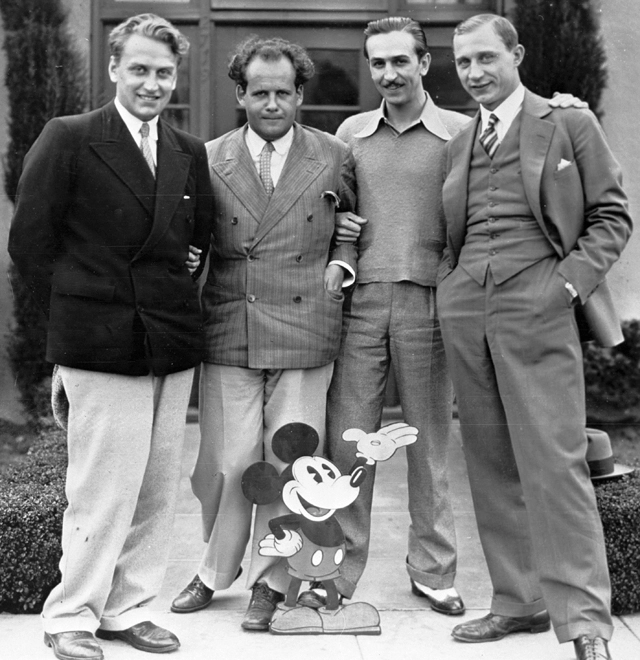
    Sergei Eisenstein and Walt Disney (centre pair) with two other Russian filmakers, Tisse and Aleksandrov (left and right) (1930) (Source: Wikimedia Commons; Public domain)

    An essential mutability is at the core of animation, endowing inanimate lines with apparent life: “We know that these are drawings, and not living beings,” Eisenstein writes of Disney’s characters. “And at the very same time: We sense them as living [….] If it moves, then it’s alive; i.e., moved by an innate, independent, volitional impulse” (Eisenstein, Disney, ed. Bulgakowa, trans. Dustin Condren; see Frank 48).

    The spectacle is perhaps, after all, a certain kind of “magic”: a resonance with the infantile, or even the primal animus, the latter stemming, as Eisenstein asserts, from the prenatal unity of thought and action. Not in the trite sense of “the magic of Disney,” unless this phrase itself conveys a psychoanalytic intuition.

    What a compelling effect produced by a machine.  A series of still images, photographs of drawings, propelled at twenty-four frames per second past a light source, enabling the projection of a single picture that moves.  Perhaps to a degree counterintuitively, Frank undertakes in Frame by Frame to disrupt the “magic” through which inanimate lines are brought to life, and to concentrate on individual frames as though each one is a specific document, a unique artwork. One thinks of the opposition Marx draws between a social system’s “mode of production” and the “ideology” and “false consciousness” that it produces—a mesmerizing form of illusion.

    An aspect of Frank’s analysis is in line with works such as Henry Giroux’s The Mouse that Roared: Disney and the End of Innocence (1999), and Dorfman and Mattelart’s How to Read Donald Duck (1971), both of which reveal an exploitative (colonialist, racist, sexist) predisposition to exist beneath the Disney hegemony of childhood innocence.

    Yet surprisingly, Eisenstein is absolutely smitten. The master’s work, he writes without irony, is “the greatest contribution of the American people to art” (Leyda xiii). Eisenstein swallows the myth of Disney as a single-handed creator, each of his three-hundred workers like “an extension of Walt’s hands and mind” (America Cinematographer, qtd. Frank 84). Surely the Russian couldn’t have realized that, even after being coached by his artists, Disney was unable to draw a single sketch of Mickey Mouse for PR purposes; nor imitate his own famous signature. He was more the entrepreneur.

    Cel Animation, Processes and Glitches

    Now outmoded by computer, the so-called Golden Era for “cel animation” extended from the late 1920s to the late 60s. The major studios like Disney, MGM and Warner Brothers used it to churn out hundreds of seven-minute cartoons each year: alongside Disney’s classics, Otto Messmer’s and Van Beuren’s Felix the Cat, Lantz’s Woody Woodpecker, Warner Brothers’ Loony Tunes and Merrie Melodies (Bugs Bunny, Daffy Duck, Porky Pig, Sylvester the cat and Tweety, etc.), Fleischer’s Popeye the Sailor and Olive Oyl, Hanna-Barbera’s Rocky and Bulwinkle, Tom and Jerry, and many others.

    Cel animation required thousands of images to be transferred from paper onto transparent sheets of celluloid, which were then photographed by a camera, one after the next, frame by frame, to form an individual film. Twenty-four frames per second: that’s a lot of drawing. Which the studios were able to facilitate using an assembly line erected on a Fordist-Taylorist model. (Apparently Disney liked to think of himself as a second Henry Ford.)

    A “head animator” and his “assistant artists”—almost exclusively males—created the main sketches delineating a particular action in a film, and “in-betweeners” filled in the gaps. “Non-creative” workers performed the rest of the tedious, repetitive labour of tracing (inking) and colouring (painting).

    These latter workers were mostly female, low-paid and with no prospects of promotion: the forgotten, invisible hands, the bulk of the labour that made the films. You can almost hear them whistling while they worked. Well, not exactly. Strikes by animators and below-the-line union labour proliferated in the studios. At Disney, much of the talent whom Walt had attracted with talk of art and high ideals abandoned him when his exclusively capitalist motives became apparent.

    From a theoretical point of view, concentrating on the individual, static frame—at the momentary expense of the flow of illusion—produces the grist for understanding the deeper (if less amusing), multifaceted nature of animation, an understanding that at once co-opts and exceeds traditional film studies. The productive forces behind the illusion are foregrounded: the mode of production, the human labour. One becomes aware of the mark of invisible workers, who were absorbed into the illusory identity of a supposed single “artist.”

    To orientate us to the idea of what’s to be found in frame-by-frame analysis, let’s glance at an animator’s pencil test. 

    Snow White and baby bluebird pencil test

    This 46 frame, 4.6 second (i.e., ten frames/sec) design sketch of the heroine of Disney’s film Snow White and the Seven Dwarfs (1937) is a pencil test drawn by a head animator. Notice how it imparts significantly more a sense of the artist’s hand than does the finished film (see, for example, reproductions of finished cels at the Normal Rockwell Museum), in which the material feel of the drawing materials has disappeared, the images have been painstakingly coloured and the lines smoothed. Indeed, the uniformity of the finished art is a target of the mass production assembly line, and informs the idealized “reality” of the film. A social “commodification of desire” is reflected in this ideal of transcendence over human making—the whole world becoming plastic (see for example, Pfifer).

    Paradoxically, the process of tracing the line deadens it, and the pencil test remains more aesthetically pleasing and “alive” than the finished images. Here is a resonance with Walter Benjamin’s 1935 essay, “The Work of Art in the Age of Mechanical Reproduction,” and his discussion of the loss of “aura” suffered by mechanically reproduced works (See Benjamin).

    Technical annotations on the pencil test interrupt the flow of illusion, and at the same time foreground the presence of the maker—any trace of whom needs to be eradicated in the final product, to conform with production values. Directions and corrections are momentarily glimpsed, distracting the eye. These are written and drawn on individual cels, endowing each individual cel with the status of being a form of document. Theoretically, any animation can be treated in this way, as though it is an archive of documents. Doing so is to focus on the animation’s epistemological significance: that is, knowledge of factors bearing upon the means of production (such as issues of race, class, and gender.)

    Information is as likely to have been inputted accidentally as intentionally:

    A cartoon documents and dramatizes India ink, watercolour paints, paper, glass, and stacks of transparent cellulose nitrate or acetate sheets; particles of dust traverse half the screen and fleeting, spectral reflections are cast by the animation stand’s overhead lights; Newton’s rings knit together. And yet animation betrays the graphic of the photographic. A line might be a gesture of ink, a particle of dust on the cel, a hair in the gate of the camera or the contact printer or the projector; the camera lens becomes an element to be photographed, inseparable from the other transparent plates and sheets before it; the image assimilates the various physical and chemical agents that can affect a filmstrip.

    Frank 72-3

    Unintentional factors alter how the cartoon is perceived, as well. Dust particles imprinted on the cels merge with flies swarming around Mickey Mouse; a black, jagged piece of debris appears from nowhere, without reason, to threaten Oswald the Lucky Rabbit. As cartoons recede from the production values of our own era, I might add, they are historicized and humanized in the viewer’s perception, a portion of their lost charm restored.

    Dust and flies swarm about Mickey Mouse (Brave Little Taylor, 1938; Frank 63)

    Located in the dusty archive of cels, precious imperfections are to be discovered, such as erroneous brushstrokes, strands of hair, smudges, and “the literal fingerprints of the workers who handled the image” (Frank 2), preserved for posterity.

    When the film is projected at proper speed, some of the mistakes barely register—blink and you’ll miss them. But even a mistake in a single frame can quake the world of the film.

    Frank 57

    A mistakenly unpainted cel, causing a minute stutter, might stem from the inattention of an in-betweener, inker, painter or camera operator, bored with a repetitious task. For the one-twenty-fourth of a second duration of a single frame, a character’s head is stuck on backwards, an uncoloured foot crossed out, or a single sketch of Woody Woodpecker inserted in a blank cel, in a cartoon where he has no business to be. Most often the precise reasons behind such anomalies won’t be resurrected, any more than we may merely guess at motives behind doodles made by medieval scribes in the margins of their manuscripts— bums, penises and cross-eyed kings. Maybe some of them felt the urge to “fuck it up” (qtd. Frank 80), simply to put their mark on it.

    Cut to Google ScanOps

    An analogue to the idea of the cartoon as an epistemological archive is to be found in a contemporary archive par excellence: Google’s undertaking, begun in 2002, to digitalize every book in the world (known unofficially within the Google organization as “ScanOps”) (Ptak). By 2018 they had succeeded in scanning 40 million volumes, though the status of the project has now become top-secret.

    Now, scanning a book page by page into a long PDF is actually not all that far from the process of shooting and compiling photographs for an animation. Google’s workers, too, leave traces of their presence, commonly in images of errant, “ghostly” fingers captured by the photocopier—the mark of the anonymous drudge. Just like the human glitches and fingerprints uncovered in frame-by-frame analysis of an animation. The artist Andrew Norman Wilson, who used to work for Google, organized and exhibited a series of photographs of these images. The anomalies “index,” so to speak, the elided human element in the scanning process.

    Original found image for The Inland Printer-124 (2012), Andrew Norman Wilson. Source: Buzzfeed News

    As we will see, human fingers do appear occasionally throughout the cartoon corpus, but intentionally, usually within a “how the animation is made” genre.

    Wilson also covertly recorded a 12-minute video entitled Workers Leaving the Googleplex (2011), an insightful pastiche of Louis Lumière’s 46-second film Workers leaving the Factory (1895), the world’s first documentary. Wilson’s Googleplex video is intended to highlight the unequal conditions of the anonymous scanner operators, who were men and women “predominantly of color” (Frank 65).

    Andrew Norman Wilson, Workers Leaving the Googleplex (2011) (11 min)

    Perhaps more than merely being “evocative of” the glitches and disembodied fingers Frank culls in her frame-by-frame viewing of cartoons (Frank 65), Wilson’s project implicates the art of cel animation in the same theoretical schema, one that speaks to the theme of the erasure of human identity in the age of digital reproduction and aesthetic mass production. The animated line already blurs the distinction between image and text, in its mercurial transformation into signifying characters. A digitized book stands at the outer limits of animation; just as a cartoon is a speeded-up archive. If our minds worked fast enough we might directly perceive them as such.

    Or something like—I can’t blame Frank for this notion. Less dramatically, she extends the frame-by-frame context into theory and methodology: the reading of a microform journal; the organization of notes for a novel or thesis into index cards. Avant-garde animators have used index cards to make films; writers such as Dickinson, Melville, Barthes used montage-like methods of composition, assembling fragments often recorded on slips or index cards.

    Dalmations and Xerox

    Disney’s One Hundred and One Dalmatians (1961) marks a decisive moment in the history of animation aesthetics. The first major application of Xerox technology, the film heralded the end of classical animation, which was already suffering the repercussions of unionization, high salaries, the rise of television, and the legal blow to the Big Five studios dealt by the Hollywood Antitrust Case of 1948 (aka the Paramount Case).

    By integrating xerography into the system, the Ink Department (women), could be largely dispensed with because it now became possible for the artist’s original drawing to be directly transferred and fused onto the cells. Spectators of the time were struck by a particular quality of line in the film, which was sketchy, imperfect, artisanal—”loose and scratchy and spontaneous” (Frank 113).

    Cruella de Vil in One Hundred and One Dalmations (Disney, 1961). Reprinted in Frank, 119. Observe the aesthetic “scratchiness” of line.

    The line was brought back to life by the technology, in an enhanced, sophisticated style. Walt Peregoy, the background artist and colour stylist for the film, came up with an innovative style to complement the new technique, in which patches of colour could overlap the outlines, after the fashion of the Fauvist artist Raoul Dufy. (See too the UPA short animation The Invisible Mustache of Raoul Dufy [1995].)

    The central theme of One Hundred and One Dalmatians, which resonates in the title itself, is reproducibility—the very reproducibility inherent in the mode of its production. Dalmatians themselves happen to be black and white—a perfect match for Xerox capabilities. A limitless number of images of Dalmatians could be Xeroxed, easily producing masses of them on screen. All that was needed was to animate:

    Opening titles of Disney’s One Hundred and One Dalmations (1961)

    …eight or nine cycles of action, of dogs running in different ways, then [make] them larger or smaller, using Xerox, knowing that if there are a hundred and one dogs, and if there are eight or nine distinct cycles, and they’re placed at random in this rabble of dogs, no one will know that they all haven’t been animated individually.

    Frank 135, and see Barrier

    It’s reasonable to claim, therefore, that One Hundred and One Dalmatians is in a certain sense “a film about xerography” (113), absorbed as the makers were in the possibilities of the technology. The medium is the message. A self-reflexive trope is found in animation since the early days. Films such as Edison’s The Enchanted Drawing (1900) and Winsor McCay’s Little Nemo (1911), showed still drawings “coming to life,” an ostensive aim being to demonstrate the method of animation itself. (When fingers sometimes appear in these—though intentionally—they seem prescient of ScanOps.)

    Still from Winsor McaCay’s Little Nemo (1911)

    Characters such as Felix the Cat and Oswald the Lucky Rabbit are self-reflexive in their very ability to create objects out of their own bodies. Familiar to the millions of us brought up on Golden Era television cartoons, Bugs Bunny, in Chuck Jones’s Duck Amuck (1953, Merry Melodies), possesses the power of the animator, which he uses to harass Daffy Duck, drawing and erasing him, as well as objects and scenes around him (“Ain’t I a stinker?”)

    Animation and the Avant-garde

    The art of animation informs as well as deconstructs cinema, and has currently taken a central position in film studies. Hollywood needed to trivialize and thus “tame the technology” (qtd. Frank 7) because of its inherent potential to disrupt cinematic narrative codes. While emulating photographic cinema, Warner Brothers’ Sniffles Bells the Cat (1941) and Disney’s Cinderella (1950) already managed to exploit narrative effects of deep-focus, in colour, when film directors were limited to black and white (for example, Orson Welles with Citizen Kane [1941]), because of the slowness of Technicolor film stock. Alfred Hitchcock co-opted the animators’ use of Xerography for scenes in The Birds (1963). Ingmar Bergman may be indebted to Chuck Jones’ Duck Amuck for the moment when, in Persona (1966), the film itself jams in the projector and burns: a materially embodied spectacle—pyschic trauma manifesting itself in visceral shock.

    From the early 1920s, Otto Messmer used stroboscopic effects in his Felix the Cat cartoons, alternating positive and negative images or black and white frames, in sequences simulating phenomena like lightning or shock. Numerous cartoons followed suit: Hanna-Barbara uses a similar idea to electrocute Tom the cat by a string of Christmas lights in The Night Before Christmas (Hanna-Barbera, “Tom and Jerry,” 1941); as does Disney in The Golden Touch (Silly Symphony, 1935) in order to mark the entrances of a leprechaun who grants King Midas’ wishes, and for the climactic collapse of his castle.

    Stroboscopic effect in The Night Before Christmas (Hanna-Barbera, 1941)

    Subsequently, avant-gardists such as Peter Kubelka (Arnulf Rainer [1960]) and Tony Conrad (The Flicker (1965) unleashed techniques of “retinal bombardment” (Frank 24) in concentrated form, producing a genre of “flicker films,” causing headaches and eyestrain for some. In his Epileptic Seizure Comparison (1976) Paul Sharits aimed

    to orchestrate sound and light rhythms in an intimate and proportional space, an ongoing location wherein non-epileptic persons may begin to experience, under ‘controlled conditions’ the majestic potentials of convulsive seizure.

    Sharits, Light Cone

    The New Zealand artist Len Lye was an early experimenter with the potentials of cel animation for abstract art. For A Colour Box (1930) Lye painted directly onto the film (“direct animation”), using a camera only for the titles; he was paid ₤30 to make it as an advertisement for the British General Post Office. Avant-gardists of the 60s and 70s, such as Kubelka, Werner Nekes (e.g., Hynningen [1973]), Robert Breer (Eyewash [1959], Blazes [1961]), Hollis Frampton (Palindrome [1969]) and Ken Jacobs (Tom, Tom the Piper’s Son [1969]) followed with experiments; along with Stan Brakhage (Glaze of Cathexis [1990], Peter Tscherkassky (Outer Space [2019]) and any number of others.

    A Colour Box (1930), Len Lye

    I hope it is not too simplistic to suggest that the avant-garde overlaps traditional animation in terms of elemental techniques and a shared antagonism toward the conventions of cinematic realism—toward André Bazin’s notion of film as “a window to the world.” Frank lays down an aspect of the overlap in broad strokes: one relation moves from animation into the avant-garde; another into microfilm photography (Frank 58). Google ScanOps triangulates the two, in a complex theoretical scenario.

    There is nothing so suigeneris as an avant-garde film, but some key works by Robert Breer are close to conventional narrative animation. Breer made a hundred drawings on index cards for A Man and His Dog Out for Air (1957), shuffling them into various orders to produce the 4,000 pencil line images in the two and a half minute film, dramatizing Paul Klee’s famous saying: “a drawing is simply a line going out for a walk.”  It is as though the film progresses through abstract perceptions (infant-like? canine?), before coalescing in an eponymous scene.

    To make Fuji (1974), Breer shot a Super-8 film while travelling on the Japanese bullet train that goes past Mount Fuji. He traced selected images onto index cards by hand and rephotographed them as cels. The result is a film that shifts between photographic and animated modes, a further memorable pastiche of a logocentric narrative.

    As the footage unfolds, the film tests the iconicity of Mount Fuji: what does it take for it to be identifiable? As it turns out, just a tiny black triangle can be enough, or even an upside-down V.

    Frank 53-4
    Still from Fuji (1974), Reprinted in Frank, 54. (Note the artist’s fingers.)

    But for a sheer reductio ad absurdum of the classical cartoon to its most iconic, aesthetic and perhaps most annoying features, one can’t go past Martin Arnold’s Whistle Stop (2014). A re-envisioning of Duck Amuck, combined with a deconstruction of Draftee Daffy (Loony Tunes, Warner Bros., 1945), in which Daffy ends up in hell, as just deserts for trying to dodge the draft. In contrast, Arnold isolates and incarcerates Daffy Duck throughout, in a repetitious, narrative-less purgatory.

    The cartoon is Beckettian in its angst-ridden minimalism, with an unmistakable debt to the play Not I (Samuel Beckett, 1973), where the only character is a frantic, isolated Mouth. Arnold’s deconstructed protagonist is also somehow reminiscent of Pirandello, its fractured elements in a state of perpetual anticipation of some—any—coherent scenario.


    References

    Barrier, Michael and Bill Spicer (1971). “An Interview with Chuck Jones,” Reprinted from Funnyworld 13.

    Benjamin, Walter (1935). “The Work of Art in the Age of Mechanical Reproduction.” In Arendt, H. ed., Illuminations (New York: Schocken Books, 1969). PDF (MIT).

    Betancourt, Michael (2011). “On Len Lye’s Kinetic Film Theory.” Cinegraphic.

    Burges, Anika (2017). “The Strange and Grotesque Doodles in the Margins of Medieval Books.” Atlas Obscura.

    Eisenstein, Sergei (2010). Disney, ed. Oksana Bulgakowa, trans. Dustin Condren (Berlin: Potemkin Press). PDF excerpts.

    Harmanci, Reyhan (2012). “The Hidden Hands Scanning The World’s Knowledge For Google.” Buzzfeed News: Tech.

    Leyda, J. ed. (1986). Eisenstein on Disney (Calcutta: Seagull Books). PDF excerpts available for download.

    McCay, Winsor (1912). How a Mosquito Operates. Short film.

    Pfifer, Geoff (2017). “The Question of Capitalist Desire: Deleuze and Guattari with Marx Geoff Pfeifer, Continental Thought and Theory: a Journal of Intellectual Freedom 1.4 (Oct). PDF.

    Ptak, Laurel (2013). Interview with Andrew Norman Wilson. Aperture Magazine (Feb 26).

    Somers, James (2017). “Torching the Modern-Day Library of Alexandria,The Atlantic.

    Creative Commons License
    This work is licensed under a Creative Commons Attribution-ShareAlike 4.0 International License.


    Frame by Frame

    A Materialist Aesthetics of Animated Cartoons

    by HANNAH FRANK

    May 2019 | First Edition

    UNIVERSITY OF CALIFORNIA PRESS | OPEN ACCESS | Free from Luminos (EPUB, Mobi, PDF, HTML)

    Paperback: US$34.95, £27.00
    256 pages