Tag: Ferdinand de Lesseps

  • A.C. Gunter’s Baron Montez: 25. The Preferred Creditor

    A.C. Gunter’s Baron Montez: 25. The Preferred Creditor

    Welcome to the final dramatic chapter of Baron Montez of Panama and Paris. We witness the culmination of Louise and Harry’s romance and the end of Fernando Montez. Readers have been eagerly anticipating the final revenge against Montez, for every time they pick up the yellow-back novel to read, the cover screams of the lustful, violent crimes he committed.

    Be prepared to be confronted by how the romance of Louise and Harry is treated. For the purposes of securing the desired outcome, Louise must be transformed to meet current societal standards. First, she is coerced, softened by the presentation of three dresses, and as the evening progresses the reader will observe her become increasingly objectified. The narrator is literally lost for words in describing her appearance. Louise is for the most part quiet and acquiescent during the chapter though she strives to maintain her integrity and independence.

    Harry recalls the Roman writer, Livy’s depiction of the rape/abduction of the Sabine women by Romulus to satisfy Rome’s need for females, as if this is a historical precedent for his forceful behaviour towards Louise. Readers of today will be familiar with the scene, it having been re-enacted in various forms in films, for expressing a man’s power over a woman. Louise can’t get a word in, and so far as Harry’s ‘proposal’—he even has the hide to accept it on her behalf.

    The mention of ‘marriage settlements’ may recall from my introduction to Chapter 7 (“NO! BY ETERNAL JUSTICE!” ) the definition of ‘coverture’: the legal doctrine that treated a married woman’s possessions, wages, body and children as property of her husband, available for him to use as he pleased. Coverture gave husbands total control. The use of the word ‘guide’ by both Jessie and Louise is an attempt to mollify the true master/subordinate relationship. After their marriage, Louise asks Harry for permission to spend her money.

    However, though cast through a male point of view, there is an alternative reading mired in the eternal struggle of relations between men and women. Post proposal, Louise says: ‘I shall give you even more trouble than Jessie’, and prior to the evening’s events stated that she would ‘put her best foot forward’. It is not beyond imagination to suggest that Louise has done exactly that, and her show of independence, her steadfastness, is a deliberate move to force the dunderhead Harry to act.

    The pre-marriage arrangements and indeed the marriage itself are treated summarily and finish with a honeymoon in Italy.

    The second part of the chapter dealing with the last moments of Fernando Montez is done in retrospect, similar to the previous chapter, only with the return of Frank to the door of the apartments late at night, having previously escaped his bodyguards. Two other enemies of Montez are present in the final moments. It would be a shame to reveal too much detail—suffice to say that Gunter handles the last moments of our protagonist, at the hands of his former prey, in an imaginative and efficient way.

    The novel has used the French attempt at the construction of the Panama Canal as a background to the adventures within, but the timeline of the story, unfortunately, cannot contain the full extent of real events. Before his demise, Montez assumes that, with the Lottery Bill having passed the Senate, outstanding debts to him for contracts associated with the Canal will be paid. In truth though, this is unlikely. It will take two months of preparation before the Lottery shares are put to the public for sale. On the 11th December, a day before the last day of the sale, Ferdinand De Lesseps himself takes the stage in the hall of his company, which is packed full of desperate investors and declares:

    ‘My friends, the subscription is safe! Our adversaries are confounded! We have no need for the help of financiers! You have saved yourselves by your own exertion! The canal is made!’

    Ferdinand De Lesseps, qtd. in Parker, p183

    De Lesseps leaves the stage in tears and embraces the cheering crowd. The following day Charles De Lesseps, his son, fronted a similar crowd. He informed them that of the 800,000 bonds on offer only 180,000 had been sold, and this being under the minimum requirement, all deposits collected would be returned. This led to the eventual liquidation of the company (Parker, p. 184)

    At the close of the novel is a small epilogue, more an aspirational scene for readers, for the fulfilment of the American Dream. The three major characters stand on a hill looking towards an optimistic future. Louise now has the fortune she should have had all along, and this together with her marriage to man-about-town Harry, has placed her in the social position where she felt she always belonged. The last words are spoken by Frank, who in his derangement mistakes a naval parade on New York’s Hudson River for the opening of the French Panama Canal—of course, an event that in reality never occurs.

    Gunter’s career as a dramatist is reflected in the style of the novel. The previously mentioned objects, such as the enamelled box or the black pocketbook might be props, and Gunter is excellent at staging interactions between characters, and of course, his facility with dialogue is the mainstay of the novel. Consistent with this, perhaps because it would be right before the eyes of an audience watching it on stage, are minimal physical description and use of colour. Apart from descriptions of the flowers of Tabogo Island and the sunset over the rail of the SS Colon earlier in the novel, and Jesse’s blue eyes, the use of colour is limited. The reader may have noticed an absence of descriptions of interiors, the colours of dresses, how Louise wears her hair, what colour it is, or her eyes—all are missing. Also, there is little incidental interaction of characters with their environment. In a sense, Gunter’s work can be viewed as a precursor to film scriptwriting.

    In closing, I would like to thank all the readers who have joined me on this journey through this work of Archibald Clavering Gunter—through the time and world his characters inhabited a hundred and thirty years ago. I would also like to thank Michael Guest for giving me the opportunity to write for Furin Chime and for assisting me edit the text and select images.


    CHAPTER 25

    THE PREFERRED CREDITOR

    Then Mr. Larchmont looks at his watch. He has just time. He springs upstairs to the door of Louise’s room, raps on it, and would shout: “Victory!” but the girl knows his step, and is before him. His face tells its own tale.

    She cries: “You’ve won! Thank Heaven! I—I am so happy for you.”

    “Yes, we’ve won!” answers Harry—“won in full! But to nail our flag over his—I must go at once—I have just time to do it! Goodby—our interview this evening!” His voice grows very tender, and wringing her hand, he mutters: “God bless you! It was all you!”
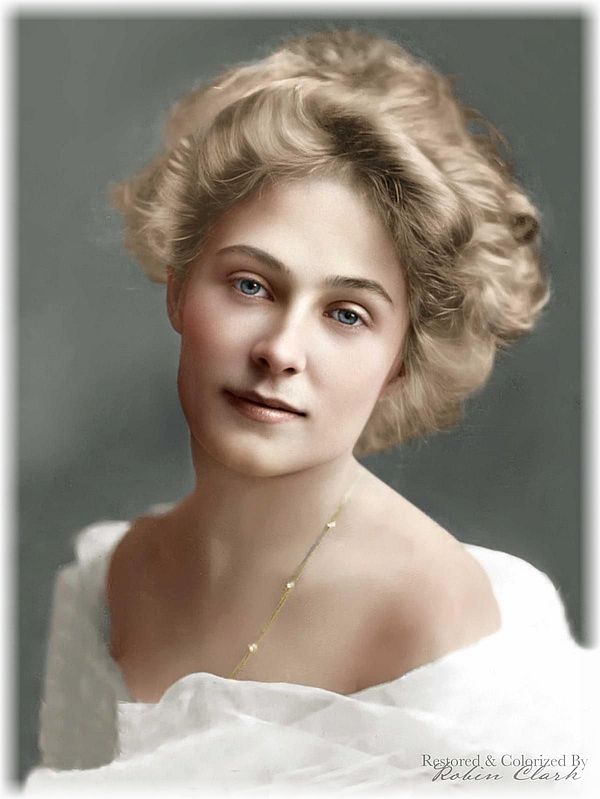
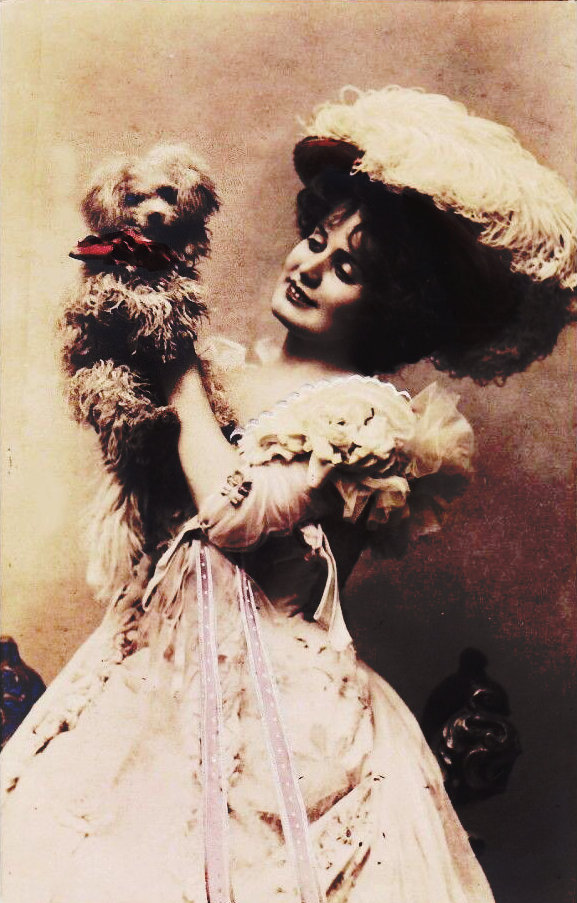
    Vintage anonymous portrait (ack. Memory Lane)

    By this time he is down the stairs, but at the foot of them he turns and cries: “I’ll attend to your dress!” then opens the front door, springs down the steps, and gets into his brother’s carriage, which has been waiting for him for the last hour.

    In it he drives, with even more than Parisian recklessness, to his American lawyer, Mr. Evarts Barlow, and getting him into his carriage, the two post off to the Paris agents of the New York bankers who hold the American securities of Fernando Montez. At their suggestion, the agency cables their home house, that all the stocks, bonds, and investments of Baron Montez in their hands have been transferred and made over to Harry Sturgis Larchmont, by personal deed of their former owner, properly acknowledged and registered, which they (the agency) now hold; that all further dividends upon said securities, earned now or in future, are to be paid in to Mr. Larchmont’s account, at his bankers in New York.

    This being done, Harry remembers he has another errand, and telling it to his lawyer, the latter laughs: “What?—Parisian modiste, so soon!”

    “Certainly! She’s worn one dress three days running!” replies Harry. Then he says, in a voice that makes Barlow glance very sharply at him: “She’s like a dream in muslin! What will she be under the genius of a Worth or a Felix? You’ve a treat before you tonight!”

    So it comes to pass that, about four o’clock this afternoon, a forewoman of a great Parisian dressmaker calls upon Louise, and presents a note which reads:

    My Dear Miss Minturn:

    With this I send you some robes to choose from. You need not fear the expense. If you take them all, they are easily within your income. I’ll explain the financial part of it this evening. I’ve nailed everything—by your aid.

    “Yours most sincerely,

    HARRY LARCHMONT.

    P. S. Please, for my sake, put on the prettiest tonight. The great lawyer I told you of will call with me—upon your business.”

    This kind of a note dazes the girl. The dresses displayed to her delight but astound her. In her present state of mind, she would send the woman away and tell her: “Tomorrow—any other time!” But Harry’s note says: “For my sake!”

    So Louise looks over the robes, and now the legacy left her by Mother Eve comes into play. The dresses fight their own battle; for they are exquisite conglomerations of tulle and gauze—the tissues and webs of Lyons thrown together by a genius for such effects.

    Just at this moment Jessie adds her efforts to this scene. She comes in and chirps: “My! How lovely!” and looks over the gowns with exclamations of delight, but not of envy. For she cries: “How beautiful you will be this evening!”

    “This evening! Mr. Larchmont has written you?”

    “Yes—this unsatisfactory note, half an hour ago,” pouts Jessie. It only says: ‘Have a nice dinner for four this evening at eight sharp. I shall bring Mr. Evarts Barlow with me.’ Evarts Barlow?—he is one of the great lawyers of Manhattan. I saw him last season. He’s not so old, either,” goes on Jessie, contemplatively. “I think I’ll put my best foot forward. I’ve got some dresses of the Montez trousseau that are rather comme il faut, I imagine. I’ll go at that trousseau and wear it out quick, before I’m promised again. It shan’t do double duty!”

    She goes away, and Louise, thinking of Miss Severn’s remarks about putting her best foot forward, says to her self: “Why should not I do the same? My foot is also a pretty one, I believe!” Then she laughs, for there is something in all these remarks of Mr. Larchmont’s and Jessie’s, that brings a sudden spasm of doubt to an idea that had burned itself into her brain in those hot days on the Isthmus, when Harry had raved in the delirium of the fever.

    Then Mother Eve flying up in this lovely creature, with the assistance of the forewoman, who is very expert in such matters, Louise finds herself in such a toilette by dinnertime, that, looking on herself, she is amazed, per chance a little awed, by her own image; for she is a dream of fairy beauty.

    So Miss Minturn coming down into the great parlor of Franc̗ois Larchmont, with its wealth of bric-a-brac, statues, and paintings, Jessie runs to her and says: “Don’t we contrast just right!—only you overpower me—you have so much esprit!” for Jessie has a dear, generous heart, and there is a great soul in Louise’s eyes this night.

    As they stand together, two gentlemen in evening dress enter and gaze upon them amazed.

    “Great heavens, Larchmont!” whispers the lawyer to Harry. “Why didn’t you tell me I had such pretty clients? I would have worked for them as if inspired.”

    “I—I didn’t know she was quite so pretty, myself!” mutters Harry, who has eyes for only one of them.

    A moment after, the introductions are made, and Barlow and Jessie, followed by Louise and Larchmont, go in to one of those pretty little dinners, that are all the more pleasing because they are not quite banquets.

    As they sit down, Miss Minturn’s thoughts give a jump to the time she first saw the gentleman beside her in evening costume—to the night of the dinner party at Larchmont Delafield’s, when she was not guest, but stenographer. Then recollections bring blushes. It is her pretty shoulders Mr. Larchmont is now looking at, not Miss Severn’s.

    Into this reminiscence Jessie breaks: “Guardy Harry, have you got me into your clutches thoroughly? Are you legally my guardian now?”

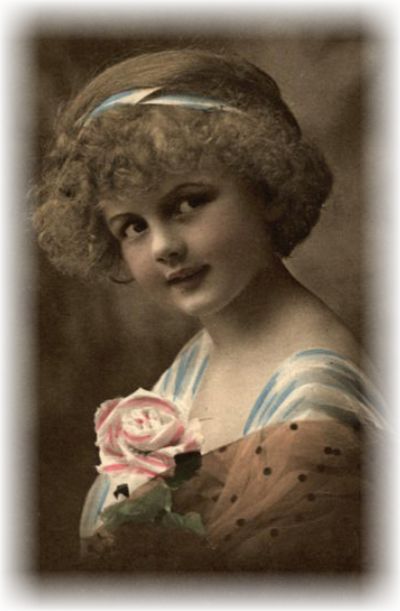
    Vintage anonymous portrait (Ack. Memory Lane)

    “Yes!” replies Larchmont. Then he looks curiously but anxiously at Louise, and says: “I am also the guardian of another young lady!”

    “Another ward? You wholesale guardian; who is she?” laughs Jessie.

    “Miss Minturn!”

    “I!” gasps Louise, her eyes growing astonished and almost affrighted.

    “Why, certainly!” remarks Barlow. “I had the order of court made today. You’re only nineteen?”

    “Y-e-s!”

    “Then not of age in Paris, though you may be in America. It was necessary for the proper protection of your interests and property, that a guardian should be appointed. Heiresses must be looked after.”

    “Heiress!—I—?” stammers Louise.

    “Of course,” interjects Harry, “if you don’t like it, you can have someone else appointed tomorrow—Mr. Barlow, for instance—but for tonight,” he rises and bows profoundly to her, “I believe I have the honor of being your guardian and your trustee.”

    Here Jessie suddenly exclaims: “Both Harry’s wards! Delightful! Louise, we can do our lessons together and have the same governess. Half of the present one will be enough for me!”

    “Jessie!” cries Larchmont, sternly, for Louise’s eyes have looked rebellious at the mention of lessons and a governess. “Miss Minturn is a little older than you. This appointment is more form than otherwise.”

    “Oh!—Well, it don’t matter being Harry’s ward,” giggles Miss Severn. “He is a good, indulgent guardian. He lets you do as you like. But if it was Frank!—Whew!—Louise, he might decree that you were only eleven or twelve years old tomorrow morning!”

    “And if you were sullen, kodak you,” interjects Harry, grimly.

    But a scream from Jessie interrupts him. “Oh, goodness!” she ejaculates. “He didn’t get a picture of me!”

    “Yes—a very charming one. It is labelled, ‘L’enfant gâté’. You look as if you were springing at the camera.”

    “And so I was!” mutters poor Jessie. “I thought he had not snapped it in time. Did he really get one?” The tears come into her eyes, and she begs: “Please don’t show it—Please——.”

    “Not if you’re a good, obedient little girl!” says Harry, with great magnanimity.

    As for Louise, she has been silent during this. The word “heiress” has put her into a kind of coma; the term “guardian” has given her a fearful start, and sometimes her eyes look at Harry Larchmont in a half-bashful, half-frightened sort of way.

    Then the conversation runs pleasantly on, Harry telling Barlow of his Isthmus adventures; some of his stories making Miss Minturn, who has gradually been regaining her intellect, blush, though they make her more tender to the man relating them, for they bring back the days she had struggled for his life by his bedside in the room of young George Bovee.

    This talk of the Isthmus leads to talk of the Panama Canal, Barlow remarking: “The Senate will probably pass the Lottery Bill tonight.”

    “That will give the enterprise six months longer to exist, I imagine; but more empty pocketbooks and more bankrupt stockholders, when the inevitable crash comes,” rejoins Larchmont. “By the by, I wonder if the Baron is looking after it this evening! Eh, Jessie? What would you have said to journeying to Italy about now, with his chocolate face beside you?”

    At this Miss Severn shudders, grows pale, but says firmly: “He has kinks in his hair. I would have said, ‘No!’ right in his face, to both notary and priest.”

    With this, as the dinner is over, Miss Jessie rises, and going to the door, turns, and lifting her skirts a little, courtesies, after manner of dancing school children, and says: “I bid you adieu till après le cigar, my guardian!”

    And Louise, who has risen also, a kind of reckless mirth coming to her, follows Jessie’s example, and, courtesying to the floor, murmurs: “Your obedient ward, Monsieur Larchmont!”

    Then the two go off laughing towards the parlor, leaving the gentlemen to cigars and coffee. But they don’t take very long over these, for Barlow says: “We owe a little explanation to Miss Minturn about her affairs.”

    To this Harry replies: “Very well! Let’s get it over!” a curiously anxious look passing over his face.

    Then the two coming into the parlor, Mr. Larchmont takes Jessie aside, and whispers: “Would you mind running upstairs for a little? Mr. Barlow and I have some business with Louise—Miss Minturn.”

    “Shall I not come down again?” falters Jessie.

    “No, perhaps you had better not. Perhaps it would be well to bid Mr. Barlow good evening now! I imagine you have lessons to learn!”

    At which Miss Jessie astonishes him. She says: “Yes, and you have something to say to Louise. But—I’ll be down to congratulate!” and so with a bow to Barlow moves out of the room.

    Then Harry and Mr. Barlow go into a business conversation with Miss Minturn.

    Mr. Larchmont says: “I have received a number of millions of francs in trust for three creditors of Baron Montez. You, Miss Minturn, are the preferred creditor. Your dividend first!”

    “My dividend on what?”

    Here the lawyer remarks: “You are the sole heir to your mother, and she was the sole heir of her parents. They were robbed, I understand from Mr. Larchmont, of sixty thousand dollars on the Isthmus, in 1856. This at interest at six per cent., for thirty-two years, compounded yearly, amounts to nearly four hundred thousand dollars—two millions of francs.”

    “Oh, goodness!—So much?”

    “Certainly!” answers Harry, “I’ve computed it!” and he bows before her, and says: “Behold another American heiress!”

    Here Louise astounds the lawyer and stabs Harry to the heart. She says in broken voice: “You, Mr. Barlow, take it for me—you be my guardian. You can be appointed tomorrow!”

    “Good heavens!” cries Larchmont. “What have I done? Can’t you trust me?”

    “Trust you? Of course I can!” murmurs Louise; “but two wards will be too much for you to guide.” Then she says faintly: “Yes, let Mr. Barlow be my guardian—take care of my money—I’ll leave it to his judgment!”

    “Of course, if you ask it I can hardly refuse,” returns the lawyer; “but you had better think over it till tomorrow.”

    And noting that the girl is strangely agitated, Evarts Barlow remarks: “I will go now, and see you in the morning. Your interests this evening are thoroughly safe in the hands of Mr. Larchmont!”

    So this diplomat makes his bow, and taking Larchmont with him to the hall door, he whispers: “This . strain has been too much for your pretty ward. If you’re not careful, she’ll require the doctor, not the lawyer! I’m afraid she has wounded your feelings.”

    “My heart!” replies Harry, with a sigh. And Barlow bidding him adieu, Larchmont marches in to his fate, and goes into the great parlor where Miss Minturn stands, more beautiful than ever before this evening.

    It is the beauty of resolution.

    As he looks at her, the laces and tissues clinging about her exquisite figure are so still, she would seem a statue, were it not for the quick heaving of a maiden bosom that throbs up white and round and trembling beneath its laces, and a little nervous twitching of lips that should be red, but are now pale. There is a fear in her eye She uplifts a dainty hand almost in warning, for he has come up to her, pride upon his face, agony in his heart, and anguish in his eyes, and said sternly: “How dare you do it?”

    “Do what?”

    “Refuse to accept me as your guardian! Imply I was not worthy of the trust—I, who think more of it than any man upon earth!”

    “Oh,” says the girl, “I presume I can choose my mentor—I have arrived at years of discretion enough for that!” Then she falters: “Let me go away! I—I have saved your bride for you!”

    “Have you?” mutters Harry, surlily. “That’s some little blessing!”

    “Yes—let me go away.”

    “Not out of this house tonight!”

    “Why not?”

    “Because I forbid you! “answers Harry. “Tomorrow you may have Barlow—or anyone else you like—but today the courts of France made me your guardian—and tonight you obey me!

    “You forget—tomorrow—you are not my guardian then! Let me go! May you be happy!” And, fearing for herself, Louise glides towards the door. But his hand is upon her white arm, and his voice whispers: “Not without me!”

    On this the girl pulls herself away, faces him with eyes that blaze like stars, and stabs him with these cutting words: “Do you want to compel me to run away from you as I did from Montez that awful night?”

    “Why won’t you have me for your guardian?”

    One ward is enough!”

    “Ah! You are jealous of Jessie!”

    “Pish! Of that child?”

    “Yes—jealous of her!” answers Harry, who has discovered that the Roman way is the only true method of winning this Sabine virgin. Then he astounds and petrifies her, for he murmurs: “You love me!”

    “I? My Heaven! How dare you?” And the girl is before him with flaming eyes.

    But he smites her with: “Because I have your DIARY!”

    “Impossible!”

    “Yes, from Mrs. Winterburn in Panama!”

    “Ah! the traitress!” Louise’s hands fly to her affrighted face; she bows her drooping head, tell-tale blushes cover her face, her neck, and even her snowy shoulders, making what had been glistening white, gleaming pink. But she forces herself to again look at this man, and her eyes seem to be scornful, and disdain is on her lips, as she mutters: “And you dared to read it?”

    “No!”

    “Then how did you discover——?”

    “Ah! I have you—ah!”

    “O Heaven!”

    “A bunch of violets and a card dropped out of it—my tokens of the blizzard. They were mine before—they are mine now!” cries Harry, and pulls them out of his breast and kisses them. Then he says tenderly: “I stole your confession—I give you mine! I love you with my soul! good angel of my life—whose scorn kept me from making a fool of myself in Panama—whose kind nursing saved me from the fever! I love you! Without you for my wife, life has but little for me—what does the kind nurse—who saved it in faraway Panama:—say?”

    And Louise stands fluttering before him—loveliness personified—loveliness astounded—loveliness in doubt—loveliness blushing—loveliness that is about to be happy; for a sturdy arm that has played in many a football game is round her waist, and is giving her such a grip as never Princeton man received in college jouissance.
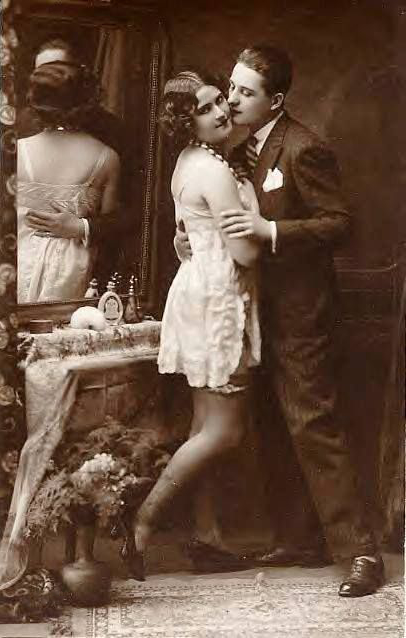
    Vintage postcard

    The girl gives no answer save a little sigh; she has almost fainted in his arms. But a moment after, her happy eyes seek his, and she falters: “Was it only to save your brother? Was it only to save your fortune you went to Panama?”

    “That at first,” answers Harry, stoutly. “But afterwards I fought to be rich enough to put you in the place in society that you will adorn!” Then he queries: “Shall I continue to be your guardian? Shall I tell Barlow he need not oust me in court tomorrow?”

    “Since you are going to be my permanent guide,” returns the young lady with a piquant moue, “I suppose you might as well get into practice as my guardian.”

    “Then may God treat me as I treat you!”

    There are tears in her beautiful eyes, there are kisses on her cherry lips, as Louise says playfully: “Dear Guardy! I shall give you even more trouble than Jessie!”

    “Then I will cut my guardianship very short!” cries Larchmont, a gleam of joy flying into his face as he walks up to the girl, who can’t now meet his eyes, as his arm goes around her waist again. For he says: “I, Harry Sturgis Larchmont of New York, demand of you, Harry Sturgis Larchmont, at present of Paris, the hand of your ward, Miss Louise Ripley Minturn, in marriage! And I, Harry Sturgis Larchmont, guardian of said young lady, accept your proposition, my worthy young man, for I have a deuced good opinion of you, and solemnly betroth her to you, and announce that the nuptials shall take place WITHIN THE MONTH.”

    “Within the month!” falters Louise. “But I have only known you four!”

    “Yes, but guardians must be obeyed!”

    Then there are more kisses, and Mr. Larchmont walks out, and mutters to himself: “By Jove! that was a harder battle than I had with the Baron this morning!”

    About half an hour afterward, meeting his friend Barlow at the Café de la Paix, he says: “You need not make any motion about that guardianship business! The young lady has had the good taste to accept me, after all!”

    “As a guardian?” asks Barlow, in tones of cross examination.

    “As a husband as well!” remarks Larchmont, “and the sooner you get to work at the wedding settlements, the better it will please both the guardian and ward.”

    The next morning Mr. Larchmont, coming from his apartments on the Boulevard Haussmann, takes Louise, and says to Jessie quite solemnly: “This young lady is to be my wife. As the wife of your guardian you will obey her, eh, rebellious one?”

    But Jessie gives a mocking bow, and laughs: “Oh, I know all about it! She told me last night! We have been talking about you most of the time since. I have promised to be obedient, if she asks me to do just what I want to!”

    “Ah!” replies Harry, “then I shall exhibit the kodak.”

    And Jessie cries: “No! no!”

    But he is in a merry mood, and shows the picture of l’enfant gâté’. to Louise, and they all laugh over it.

    But though Jessie giggles, she also begs; so piteously he gives it to her. Then she tears it into a hundred pieces, and tossing them over her head, dances on them, crying: “That’s how I leave my childhood behind me!” next says: “No more governesses! Eh, Guardy?” with a pleading look.

    “AFTER the wedding!” remarks Mr. Larchmont, for he has thought upon this subject, and he has concluded that a governess for Jessie will be very convenient during the honeymoon.

    But the next morning he is relieved to find Mrs. Dewitt has returned from Switzerland. He introduces her to his coming bride, and this lady is most happy to take charge of Miss Jessie during his wedding tour.

    In one of their numerous communings, within the next day or two, Louise says to Harry: “We are so happy! Can’t we do a little to make others happy?”

    “To whom do you refer?”

    “To a dear little friend of mine in New York, who is going to be married also, Miss Sally Broughton,” answers Louise. “Could I send her a thousand dollars?”

    “Of course! ten thousand if you like. It’s your money, dearest,” answers Harry, cheerfully.

    “Oh, thank you!” replies Louise. “A thousand is enough. It will mean a great deal to Mrs. Alfred Tompkins.”

    “So Sally is going to marry Tompkins!” remarks Larchmont, grimly. Then he suddenly continues: “Tompkins was the man who shook his fist at me when he saw me sail away on the Colon with you? Eh?” and his eyes ask awful questions.

    “Y-e-s!”

    “Ho-oh!” Then Larchmont smiles a little and says: “Any other gentleman you want to do a good turn?”

    “Yes, to George Bovee, who nursed you on the Isthmus so tenderly—who was such a good chum to you out there. He is growing pale also—someday he may have the fever, and there will be no one to nurse him. Could not you?—you need someone to manage your affairs—” For Harry had been complaining about the amount of business that had suddenly come upon him, from his brother’s incapacity.

    “Oh, I cabled George yesterday; he is now on his way to Paris!”

    “On his way already?”

    “Yes, so as to be my best man.”

    “Oh,” cries Louise, “you are always talking of the wedding!”

    “Of course! I am always thinking of it!”

    Probably Louise is too, for she and Jessie are driving about town, from milliner to dressmaker, and dressmaker to jeweller; and all the gorgeous paraphernalia of a mighty trousseau is being manufactured in this the town of trousseaux, as fast as nimble fingers of French working women can put together things worthy of the beauty of the bride.

    So one morning, at the American Legation, Louise Minturn is married to Harry Larchmont, and Evarts Barlow, who has stayed over for the ceremony, gives the bride away. George Bovee stands behind his old chum of the Isthmus, with Miss Jessie, the only bridesmaid, but with the concentrated beauty of six average ones in her pretty self.

    Then bride and bridegroom go to Italy—southern Italy and the isles of the Mediterranean—where they see palms and orange trees, and dream they are in Panama—but there is no fever! And coming back from this trip, they linger out the happy autumn time in Paris.

    But one evening Francois Leroy Larchmont, in a careless moment of his keepers, escapes from them, and is out all night. The next morning, he comes back with a sleepy look upon his face.

    But Harry Larchmont, reading the morning journals, gives an awful start! Two days after, the whole party are en route for America, taking the brother, whose mind is now permanently gone, with them.

    * * *

    Crushed, defeated, but not altogether subdued and dismayed, Baron Montez staggered down the steps of the Larchmont mansion.

    The next day he calls at the American embassy, and delivering up his order, receives, after identification, a sealed envelope, which he tears open, and finds his pocketbook—not one memorandum gone, and his eyes glisten.

    He thinks: “With this I have enough to feed upon the vitals of this republic. Some of their public men are in my power!” Besides, his fortune, outside of his American investments, is large, and the Lottery Bill almost immediately passes the Senate of France and becomes a law. He receives large sums of money, delinquent payments due from the Canal Company, and though he is forced, by the record of the ledgers Louise has taken, to make some restitution to Aguilla, still, as he does not make restitution to anyone else, his fortune is enormous.

    Though the shares of the Canal go down and down, he has no interest in them, and lives the life of a gay bachelor in Paris.

    In the course of time, the deluded investors will take no more lottery bonds, and in December an assignment is made to a receiver, and the work practically stops on the Canal Interoceanic.

    As this happens, Fernando Montez becomes possessed of a shadow. Though he does not know it, as he walks along the boulevards, a shabby creature slinks along behind him. When he goes to the opera or theatre, the creature is waiting for him as he comes out. This unfortunate one evening stands outside the gay Café de la Paix, with its flashing lights, and sees Montez eating the meal of Lucullus. As Fernando comes out, well fed, contented, even happy, this shabby creature mutters to himself: “Nom de Dieu! for his dinner he paid more money than I saved in my whole first year of deprivation!”
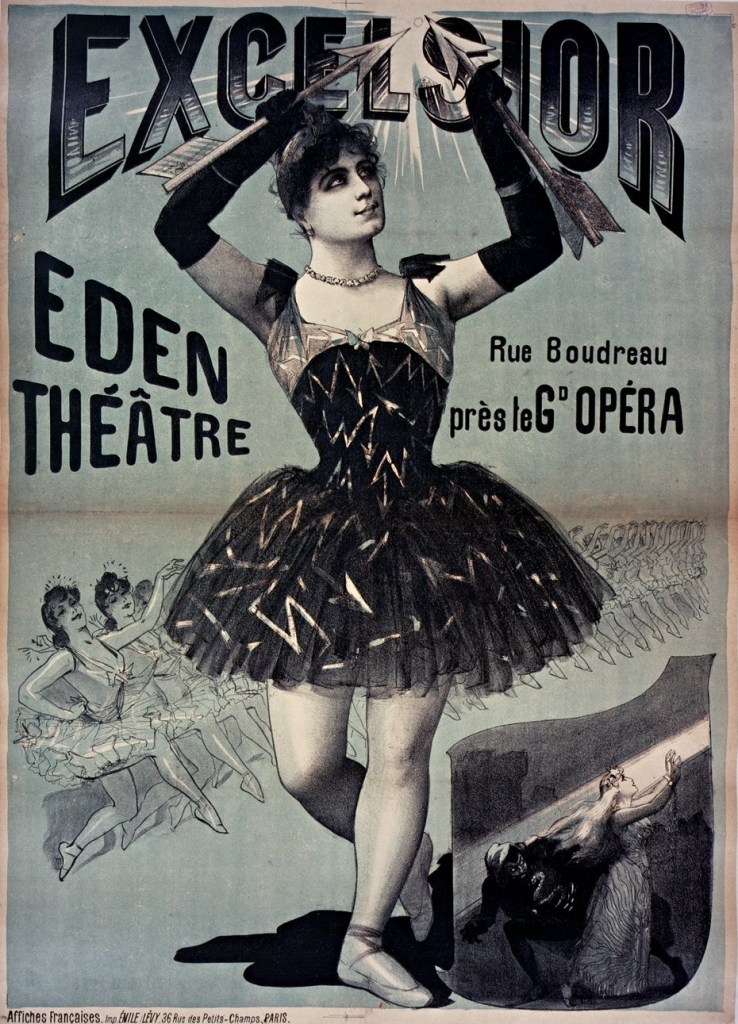
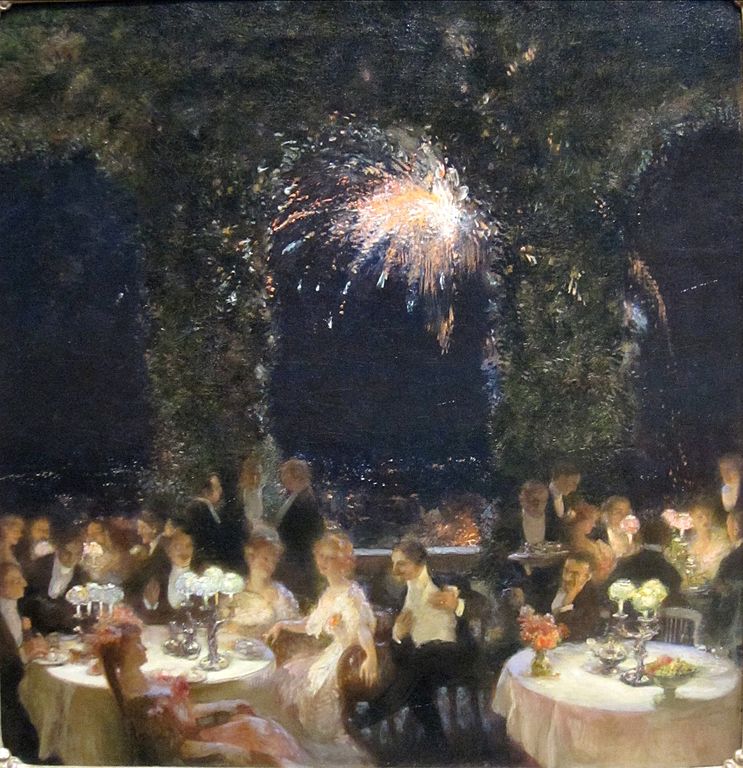
    Excelsior. Eden-Théâtre, c. 1890

    And Bastien Lefort, the miser, who has been sold out of his glove store on the Rue Rivoli, utterly ruined by his grand investment in the Canal Interoceanic, follows, shivering with cold, and brushing the snow off his rags, the steps of the well-dressed, debonnair, and happy Baron Montez.

    But there is another—a black man with snowy wool, and two great red gashes upon his cheeks, and a form bent by age, but strong with hate. He comes alongside Lefort and whispers: “How now, miser! Are you on the track of your enemy? I, Domingo of Porto Bello, have come a long way to see him, also!”

    And the two become bloodhounds, and follow the Baron Montez of Panama all that evening to the haunts of gay bachelors in Paris: to the Eden Theatre, where there is a ballet; to the Palais Royal, where he laughs at a suggestive farce. But whenever he comes to the streets—these two dog his footsteps.

    So it comes to pass, late that night, returning from a petit souper with some fair sirens of the gay world of Paris, who are very kind to rich men, Montez enters his apartments, to find his valet is not in them, and mutters to himself:

    “The worthless beast! I will discharge him tomorrow!”

    Then Fernando sits down to await the coming of Herr Wernig; for these two are hunting in couples again.

    So Montez meditates and is happy; but, chancing to think of his lost American securities, he utters a snort of savage remembrance, and taking the poker in his hands breaks up the coals burning in his porcelain ornamental stove—and as the blaze flickers up, thinks he sees a face. He starts and gazes round, and sees three faces—the faces of the wronged, the faces of the past—Domingo’s pirate head, the miser’s wistful face, and the pallid cheeks and big eyes of the lunatic, Franc̗ois Larchmont.

    Fernando thinks it a dream. The lunatic says with cunning chuckle: “I enticed your valet away, my dear Baron—ha, ha!—and let myself in with my old passkey—you forgot the passkey—ha, ha! I was coming in here to do your business myself—but these two gentlemen joined me—ho! ho! ho!”

    THEN MONTEZ’ DREAM BECOMES REAL!

    He springs up to cry out and defend himself—but the lunatic’s hands close round his throat, and the voice of a madman cries: “Oh, ho! my friend! Baron Montez of Panama and Paris!”

    And though Montez struggles he cannot say anything, and his eyes have despair in them, for three men have surrounded him. He sees, half in a dream, the form of Domingo, the ex-pirate, whom he has robbed, who whispers in hoarse voice: “Ah, ha!—the punishment of the buccaneer—who steals from his fellows!”

    And the miser cries: “For the gold of my ruined life!”

    Then a surging is in his ears; there is the report of a pistol, and three forms glide out into the darkness; and on the floor, his own revolver in his hand, lies the form that was once—Baron Montez of Panama and Paris!

    A few minutes after, his old chum, Alsatius Wernig, comes in with laughing voice and merry mood, crying: “Oh, ho! my dear Fernando! you leave your door open. You should be careful! You might be robbed!” then utters a horrified “Mein Gott!” and staggers from the prostrate form before him. Next he says slowly, with pale lips: “Murder! If they have stolen the pocketbook!” With this his hand, trembling, goes deep into the bosom of the dead man, and he gives a gasp of joy as it draws forth the black pocketbook of Montez.

    Then Wernig mutters: “In other hands, this would have been my ruin! But now!” and the German’s form becomes larger, and his eyes grow luminous with coming potency, as he jeers: “I own the secrets of many Deputies and some Ministers! I will bleed them till they die! I will be rich forever. I hold the politics—perhaps the destinies—of France!”

    Then he cautiously leaves the room, and none see him come down the stairs.

    The next morning it is reported that Montez of Panama must have committed suicide—though it is hinted to the police not to make too thorough an investigation of the affair—some of the powers that be seeming to fear Baron Montez, dead as he is, will rise up like Banquo’s ghost.

    But Herr Wernig lives on the fat of the land, and bleeds some of the potentates of France, right and left. He spares not Ministers nor Deputies who have been bribed, and would keep on so forever; but one day, years afterward, scandal comes, and investigation follows, and he flies from France, fearing that more than any other country upon earth—the country he has debauched and plundered. For the foreign adventurers who came to Paris, lured by the millions spent or squandered upon the Canal, were the greediest, the most devouring—the Swiss, the German, the man of all nations.

    * * *

    One afternoon in 1892, in the autumn, there is a great naval parade upon the Hudson River, and the flags of all nations are thrown into the air from vessels belonging to the great countries of the world.

    And from a private retreat, situated on the Palisades overlooking the river, kept by a doctor well known for his skill in treating diseases of the mind, a gentleman comes forth onto the lawn. He is very elaborately dressed in the latest fashion, and seems happy, as he should be, for a beautiful woman and handsome man walk by his side, and he calls them sister and brother. He looks over the great river, and jabbers, “Ha!” to the guns.

    Then, seeing the flag of France, he cries: “It is the opening of the Panama Canal! Montez was right! My dividends! My dividends!” And gazing over the beautiful Hudson he chuckles: “Mon Dieu! What a glorious canal this is at my feet! What dividends we’ll make! Hurrah for De Lesseps, Franc̗ois Leroy Larchmont, and Baron Montez of Panama and Paris!”


    Notes and References

    • modiste: a fashionable milliner or dressmaker
    • comme il faut: behaving or dressing in the right way in public according to formal rules of social behaviour
    • Lucullus: Lucius Licinius (ˈluːsɪəs lɪˈsɪnɪəs). 110–56 BC, Roman general and consul, famous for his luxurious banquets.
    • petit souper: French – a little supper
    • Banquo’s ghost: Shakespear’s Macbeth Act 3, Scene 4: During a banquet, Macbeth is horrified to see the ghost of Banquo sitting in his place at the table.

    Parker, M. Hell’s Gorge: The Battle to Build the Panama Canal (London: Arrow Books, 2008).

    This edition © 2021 Furin Chime, Brian Armour

  • A.C. Gunter’s Baron Montez: 21. After Her!

    A.C. Gunter’s Baron Montez: 21. After Her!

    As the title suggests, this chapter, the last in Book Three has a sense of haste and urgency about it. Louise has to navigate a series of diverse interactions and does so skillfully and with a will, including another encounter with Domingo in which she deftly uses his own vernacular to deflect him from the truth. The previous night’s episode with a drunk Domingo has wrought a profound change in Louise. She appears now as self-realized, confident and independent in her thought and actions, acting some contemporary female readers might say, like a driven man.

    Harry is recovering and is well enough to read the cable he has received. The situation is becoming desperate for young Jessie as Harry’s brother has started wedding arrangements. We come to appreciate that Harry is thicker than we thought when it comes to Louise’s feelings toward him, and is only enlightened by his friend Bovee’s observations. Despite Louise’s explanations as to what has occurred and that she has to act immediately, Harry is still too ill to do anything and seeks her promise to wait until he is well. This is expressed in dialogue that is attributed, not to Harry, but to ‘the man’, the intimation being that this is ‘what a typical male might say’. Louise has other ideas. Louise has been put in an invidious situation but she responds well, with new adventurous vigor invested with her desire for vengeance. Louise has a mission.

    In an ‘impressive’ meeting with Aguilla, Louise is informed that Montez and himself sold their shares in the Canal Interoceanic in the first four months of 1881. This is when the shares would have been at their most inflated value. December 7th, the previous year having seen the first share offering of the company. The stock issue of 600,000 shares at 500 francs each had been heavily promoted—there were picnics and conferences hosted by De Lesseps, hot-air balloons streaming advertisements, handbills issued with grocery purchases, offers of a silver medal to those who were assigned five shares or more.

    The Panama Canal: having fled France to escape the results of his mismanagement of the canal’s financing, Dr Cornelius Herz escapes extradition on the ground that he has a terminal illness, and lives happily in Bournemouth for fifteen years. Satirical watercolour drawing by H.S. Robert, ca. 1897. See n. Chapter 18.

    In addition, the press had been bribed with a million and a half francs, so that all the leading journals lauded the project. The enterprise took hold in the hearts of the French people and 100,000 citizens subscribed for the 1,206,609 shares on offer, 80,000 of these being small investors. As the share issue was seriously oversubscribed, many people were left still hungry to be a part of the great French enterprise (Parker, p. 97-98). Such a person was Gunter’s character Sebastien LeFort, the Parisian glovemaker, who was desperate not to miss out on the once in a lifetime opportunity. This saw enormous speculation on the Bourse for shares, of which obviously, Montez has taken full advantage. Though it is difficult to determine what exactly the functions of Montez, Aguilla et Cie have been since that time, requiring an office in Panama and the employment of three clerks, Aguilla is seriously rattled at the prospect of Montez getting his hands on the company books.

    The chapter is designed to initialize action that will stimulate the reader to anticipate Book 4. With Louise’s departure, Gunter has spawned a parallel narrative stream, which he will utilize in a future chapter. This method permits the author to condense time, skip unnecessary description, and instill curiosity in the reader afresh as the story progresses. Gunter concentrates on only one long sea voyage, and return to Paris, aptly filled with Harry’s convalescence. Once more our narrator cannot contain his excitement and uses upper-case letters to entice readers onward with great expectations.


    CHAPTER 21

    AFTER HER!

    Some little time after this, the girl lying half swooning over her typewriter, by an effort, forces her mind to its work once more, and taking the awful dictation with her, goes tremblingly out of the building, and is happy to find herself in the streets, with people moving about.

    This terrible tale has affected her nerves, and she shudders, turning corners, even on the open streets of Panama, for she sees the Macagua snake in her imagination, and a woman crazy with despair holding it on high, pursuing the shrieking Montez in the hut, careless as to which one it gives death. But the very horror of the tragedy ultimately gives her strength. She thinks of the cruel fate of Alice Ripley, and determines to avenge it, and this nerves her to do things Louise Minturn could hardly have brought herself to do, until Domingo the ex-pirate had told his awful story to her shuddering ears.

    Young Fer-de-lance (Bothrops Asper), Photo by Hugo Brightling on Unsplash

    She is so excited, that she fears her agitation may communicate itself to the invalid. She knows this night she is no fit nurse for anyone.

    So she sends a message to the young American, Bovee, in whose room Harry Larchmont still lies; and, receiving word that the invalid is doing very well, remains at home and goes to bed herself.

    The next morning she awakes her usual self; for youth and hope give brightness to the eyes and elasticity to the step of this fair young maiden—even in this sickly town of Panama—now that Harry Larchmont is getting well.

    She comes into the sickroom quite cheerily this morning, and is very happy, for the patient is much better. A moment after, the doctor, who is present also, says to her inquiring glance: “Yes, you can give him the cablegram now.”

    This she does, and is sorry for it.

    Glancing at it, the sick man utters a faint cry, and tries to struggle up in his bed.

    “What’s the matter?” whispers the doctor, seizing him.

    “My brother!” shouts Larchmont, agitation giving him for a moment strength. “My heaven! He is wax in Montez’ hands! I must go to Paris at once, or he will marry her to that villain before I get there! It’s—it’s a cable from Jessie.”

    These words put a knife in Louise Minturn’s heart.

    After a little, when the doctor has quieted the patient, telling him he will soon be able to travel, she mutters: “I must go!” And despite Harry’s pleadings for more of her society, falters from the room to her office labors at Montez, Aguilla et Cie., murmuring to herself in broken voice: “How anxious he is to get back to theside of his love—the girl in Paris! All he fears is that he will lose her!”

    At the office she contrives to get through her work, which is very little just now, though Aguilla says : “In a few minutes I will have something to say to you!”

    She is at her typewriter. Suddenly she shudders; Domingo stands before her.

    The wine has left him now, and he says insinuatingly, a cunning gleam in his eyes: “What did I do last night? Did you see me? Did the old drunkard swear to any wild tale, eh, muchacha bonita?”

    The girl, steadying herself, replies: “No, though you might have—you had a letter to write, old Domingo—only you were a little overcome with wine—too much to speak it to the air. If you will tell it to me now, I will put it down for you.”

    “Oh, I told you nothing—that was well! Never believe the stories of the drunkard!” he chuckles. “But I have a letter to write to mi amigo, Baron Montez—one he will not bless you for sending.”

    And he dictates one to her, of a threatening kind, in case he shall lose his gold that he has saved during his many years, and be left in his old age without money to buy for him the pleasures of life. This finished, he snarls: “Send that to Montez with the compliments of Domingo of Porto Bello!” and goes off to the wine shop, for there is still some money in his pockets.

    Thinking over the matter, Louise is glad she has given him no hint of his revelation. Domingo drunk, and Domingo sober, are two different creatures. Domingo drunk will babble his awful tale into her pretty ears: Domingo sober will cut her white throat for telling it.

    A moment after, she hears something from Aguilla that expels for the moment all thought of the ex-pirate from her mind.

    He leads her cautiously into his private office, and says: “This that I tell you is a secret. I have been kind to you, while you have been here, have I not?” and pats her hand as if to beg a favor.

    “Yes,” answers Louise, “very kind and considerate, and I thank you for it.”

    “Then in my extremity, remember it! You are the only one I can trust to do this thing. My clerks here are either those who might betray me, or have not that certainty of character that is necessary in this delicate mission.”

    “What do you wish?” asks the girl, nervously; for his manner is impressive.

    “This! and remember—I am placing my fortune in your hands—the fortune of my family that I have worked all these years to gain! I want you to prevent my partner, Baron Montez”—here his voice grows very low—“from ruining me!

    “Ruining you?”

    “Sh—sh! Not so loud! Yes. What he has done here, to those about him, makes me know I am not safe in his hands. I fear he will destroy the ledgers of our firm in Paris, because those ledgers show that I am rich—not as he is—but still enough. There is but one chance for me. You must go to Paris!”

    “To Paris!” gasps Louise, then thinking of the invalid still pale and weak and needing her nursing, she mutters, “Impossible!”

    “Imperative!” answers Aguilla. “You must leave tonight!”

    “But my patient?”

    “Leave him here. He is out of danger, I am not. My salvation depends on your acting for me—in time! I shall give you tickets for the fast steamer leaving Colon tomorrow morning, to connect at St. Thomas with the English line for Southampton. The British ship calls at Cherbourg. From there go to Paris, immediately! At the office of Montez, Aguilla et Cie., deliver to the gentleman in charge, Monsieur Gascoigne, my written order for you to examine the ledgers of the firm, and take off certain reports therefrom.”

    “But,” stammers Louise, “Montez is there. If he means to do what you fear, he will refuse!”

    “Montez is not in Paris! He did not go there direct. He will stop two weeks in New York—that is our chance! You will get there, probably, a week before him! In that time you must take a record of the ledgers for the first four months of 1881. That was the time when we sold out most of our stock and got clear of Canal Interoceanic. Have your excerpts attested by Monsieur Gascoigne before a notary. Then if Montez destroys the books or loses the books—or they fly away into the air, I am safe—I have the records!—he cannot rob me!”

    “But why not go yourself?”

    “At this moment it is impossible! My wife and child are sick—perhaps dying—I cannot leave them! There is no time but now! I must trust to you! Will you do it?”

    “Yes, if possible!” cries Louise, a sudden wild thought in her brain. “I will tell you in an hour!”

    “Very well! If you will not go, I must try and get someone else, though I know of none who would do as well!” murmurs Aguilla.

    Then the girl flies off to the bedside of Harry Larchmont.

    “What does the doctor say about your going to Paris?” she asks hurriedly.

    “Not for a week yet—at best!”

    “Then I will go to Paris for you!”

    “You? How will you prevent Baron Montez marrying Jessie Severn?” and the invalid stabs his nurse again.

    “Do you suppose you could control my brother?” he goes on reflectively, “who is now either fool or imbecile, in Paris?”

    “No, but I can do something else for you!” murmurs the girl, whose lips tremble at the mention of Miss Severn’s name. “You told me once, you wanted the secrets of Baron Montez. What secret do you want most?”

    “The most important to me,” murmurs Larchmont, “would be the real or true record of his transactions with my brother. The statements he has furnished Frank, I have looked over; they are incomprehensible, involved, vague. I do not believe them true!”

    “I will betray them to you!”

    “Impossible!”

    “I will betray Baron Montez to you! I will use my confidential position to destroy him!” cries Louise, her face excited.

    “Oh, no!” answers the man. “You told me your business honor would prevent your doing that!” Then he falters: “Not even to save me a fortune or my brother his honor, will I permit you to do what you may one day blush for!”

    “My business honor is to business men—not monsters, murderers, and bandits!” answers the girl, the light of passion coming into her eyes. “I will destroy this man as he has destroyed those of my blood—remorselessly as he did them!” and she tells him the story of Domingo, the ex-pirate, and the mission that Aguilla would give her in Paris.

    But he whispers: “No! no! Montez would kill you, if you brought danger upon him! For my sake, do not go!” and kisses his nurse’s hand, murmuring “Promise!”

    “I must go!”

    “Not till I go with you. Promise!”

    But she does not understand, and breaks away from him; but lingers at the door and kisses her hand to him, though her face says farewell.

    From Harry’s side she flies back to Aguilla and says: “I accept. I will do what you wish, faithfully and truly!”

    “Then I have hope!” answers the Frenchman, and chuckles in his bourgeois way “I knew you would! You are a true girl! I have had everything prepared! Here are your tickets to Paris, complete in every particular. Here is money for your expenses!” And he gives her more gold than she has ever had in one lump in her life before. “Spare no expense. This letter to the firm will give you the opportunities you want, if you get to Paris before Montez—that is the vital point!”

    Then she suddenly says: “Where shall I stay in Paris? A young lady alone, I am told, is very unpleasantly situated.”

    “I will give you a letter to a friend of mine, a man of family,” answers Aguilla. Writing this last and handing it to her, he gives her another thrill—for he says: “You must leave this afternoon!”

    “This afternoon?” ejaculates Louise.

    “In two hours! The steamer leaves Colon tomorrow morning, and time is vital!”

    “Then get a carriage for me,” answers Miss Minturn, who having once made decision carries it to the end. This being done she flies to the house of Martinez the notary, and astonishes them all. She says she is going away.

     “Next month?”

    “No, now!”

    “Now? Sanctus Dominus!” And the Spanish family, not accustomed to haste, jabber excitedly about her as she packs her trunk. Feeling she has not strength to say good-by to the man for whose sake she is really going, Louise scribbles a hasty note of farewell to Harry Larchmont; and even while writing it, Aguilla has come for her with a carriage—he is in such a hurry.

    The two drive down to the railroad, the Frenchman repeating his instructions as he puts her on the train.

    Then Louise Minturn, as the cars run out of Panama, the excitement of departure leaving her, falters: “Who would have thought it this morning? I am going to Paris to fight Harry’s battle—to win his love for him—to win her fortune back!”

    Her lovely eyes cannot see for the tears, and she murmurs: “God help me! The happier I make him, the more unhappy I make myself! I wonder if he will ever know?” Then determination coming to her, she cries: “I pray God not!”

    Vampire (orig. Love and Pain), 1893, Edvard Munch

    That evening a little note is brought to Harry Larchmont, as he lies in his cot, in the town of Panama, and he mutters: “Louise has broken her promise! She has left me! She has gone where danger and death may come upon her!”

    “Calm yourself, Harry!” says his friend Bovee; “she has only gone to Paris, and Paris is not fatal to all pretty women.”

    “But you don’t know—he may kill her!”

    “He—who?”

    “Baron Montez!”

    At this his friend looks curiously at him, and thinks he is raving again; so curiously that Harry says: “You need not fear. My head is as sane as yours, only—God help me! She has left me!”

    “Oh, you’re convalescent now—you can get along without your nurse!” laughs Bovee.

    Not when I love her!” answers Larchmont. “Love her with my heart and my soul!”

    “Then,” says Bovee, after a pause of astonishment: “I can give you better medicine than the doctor—the best medicine in the world!”

    “What’s that?”

    “She loves you!”

    “My God! What makes you think?”

    “She’s awfully jealous of that little girl in Paris—and between ourselves you’ve given her very good reason in your delirium ravings.”

    “Jealous of Jessie? Ha! ha! Ho! ho! The darling!—jealous of my brother’s little ward! This is lovely; this is funny! This is delightful,” laughs the invalid.

    “You wouldn’t laugh if you’d seen her look at you when you were raving about the other girl,” mutters Bovee who is an observer.

    “I brought tears to her?” murmurs Harry.

    “Yes!”

    “Then as God’s above me, those tears shall be her last!”

    “All right! To keep your oath pull yourself together, get well, and we’ll ship you off to Paris after her!” answers his friend.

    Which Mr. Larchmont does, and a week after Miss Minturn has sailed from Colon, Harry reaches that place, to follow her to Paris. He is much stronger now, and the sea-breeze adds to his strength, day by day, as he sails to cooler climes.

    He carries with him something that keeps his mind occupied during the voyage.

    As he is leaving Panama, right at the depot, Mrs. Winterburn catches him. She cries eagerly, for the locomotive has already whistled: “Here’s something my husband says belongs to Louise;” and gives him the beautiful string of pearls found in the powder canister. “And here’s something Miss Minturn left in the hurry of bolting. It’s a book of writing: she had only an hour to pack, and forgot it.” With this Susie presses into Larchmont’s hand a large manuscript volume.

    “Great goodness! It’s her diary!” he gasps, gazing at the outside of it, and would give it back to Mrs. Winterburn, but the train is already moving, for a curiosity has come upon him of which he is afraid.

    But he locks the book up in his trunk, and fights with himself, saying: “No, no. I’ll not—read this—if I die of wanting.” But one day as he moves it, gazing at it with longing eyes, some things fall out of it.

    With a cry of love and joy he picks them up and look ing on them mutters: “These are mine—they were mine before they were hers.” And goes about happy but expectant. They are his bunch of violets and card of the blizzard.

    And so, coming into Paris, about six o’clock in the evening, of an early June day, Harry Larchmont is pretty much his old self again, though his face is still pale, and there is a very anxious expression in his eyes.

    Driving up to the hotel of his brother in the Boulevard Malesherbes, near the Park Monceau, he is let in by Robert the old-time servitor, with exclamations of delight and welcome, and finds something that astounds him—that something that often comes to us—the great—the UNEXPECTED!


    Notes and Reference

    • muchacha bonita: pretty girl

    Parker, M. Hell’s Gorge: The Battle to Build the Panama Canal (London: Arrow Books, 2007).

    This edition © 2021 Furin Chime, Brian Armour

  • A.C. Gunter’s Baron Montez: 16. The Duplicate Tintype

    A.C. Gunter’s Baron Montez: 16. The Duplicate Tintype

    Settling into life in ‘Little Paris’, Louise is about to embark on another journey: one of discovery. Whereas Harry will struggle to gain any ground through his dedicated efforts, evidence of Montez’s treachery will almost fall into her lap.

    Readers will remember, in Chapter Three, George Ripley proudly showing Fernando Montez a tintype image of his wife taken in Sans Francisco, and Alice Ripley remarking that a copy had been sent to her daughter, Mary. Old objects pass through time in a way that human beings may not. Wayward, long-forgotten, they may gather dust, wear, tarnish, but still exist as an embodiment of a particular time. So it is with the tintype.

    It is well to consider how Louise Minturn, granddaughter of George and Alice Ripley, came to be placed where she is. Miss Work, her former employer, who learning of a stenographer’s position for which she thinks Louise suitable above all others, arranges an interview. Louise, with only a stray thought of her missing grandparents lost those decades ago in Panama, and none of the deadly threat of yellow fever, accepts the job and its outstanding salary of sixty dollars a week. Then her multiple coincidental meetings and ongoing involvement with Harry Larchmont lead to the chance revelation that they share, not only a destination, but a common foe in Baron Montez, her new employer.

    And it is Harry, not Louise herself, who arranges her accommodation with Silas Winterburn and his portentous ‘collection of curiosities’. Such coincidences might strain credulity unless one were to believe in the strength of subconscious intuition, of a cosmic consciousness capable of leading a trusting soul where they need to go. Or otherwise, the careful planning of an author wanting to surprise his reader with a familiar found object and create degrees of pathos at the same time. Significantly, revelation of the contents of the powder case glimpsed in the previous chapter, has been delayed.

    Bastien Lefort resurfaces, virtually apoplectic at the extravagances he has witnessed in the building of the Canal Interoceanic. It does not seem to me extraordinary, however, that the Director-General’s house is luxurious, nor indeed that he is paid a startling salary—such incentives are required to entice someone of sufficient experience to risk their lives in the disease-ridden Panama. Were Lefort to look about some more, he would find examples of extreme waste: tons and tons of unsuitable equipment, never used, rusting by the canal (Parker, p.140). The narrator has already alluded to some surface indicators of corruption.

    ‘Boneyard of the Old French Machinery’ (McKinlay, 1912)

    Describing the failure of the French attempt, United States Member of Congress Duncan E. McKinlay wrote:

    … of the enormous sum of money raised by the French Canal Company, one-third was wasted, one-third grafted and one-third probably used in actual work.

    It seemed as if anyone who had any sort of influence might sell that influence to the Panama company for some kind of a consideration. On the Isthmus today they will show you a storehouse containing about half a ship’s cargo of snow shovels which a manufacturing company in France succeeded in selling to the French Panama Company, no doubt in return for the influence they might be able to give in assisting in the sale of the French Panama Company’s stocks. Of course, one can easily see the ridiculous side of the purchase of half a cargo of snow shovels to be used in the tropics.

    The Panama Canal (1912)

    At the lowest level, pilfering was rife and the bribing of inspectors charged with estimating excavation costs common. Countless avenues existed for defrauding company funds, right up to the French banks and financial institutions who took generous cuts for processing the funding (Parker, p.140). Lefort would have been only one of eight hundred thousand investors. Thus far US$280 million dollars had been spent, and the French Panama Canal Company (Universelle du Canal Interocéanique) had liabilities many times that again (Parker, p.185). At the time, not only is the Panama Canal the largest engineering project ever undertaken on Earth, but also the greatest financial investment in human history.

    Up to this point the novel has been aggregating material, essential background data for the reader on characters and events. From here on, the story cascades, uncovering and re-animating relics from the past. The chapter concludes once again in a conflict between Louise’s jealous desire for Harry versus the easy charm he wields over other females, this time in pursuit of the information he needs to nail Montez.


    CHAPTER 16

    THE DUPLICATE TINTYPE

    The next morning Miss Minturn, having American business methods in her mind, makes her appearance, after an early breakfast, at the office of Montez, Aguilla et Cie., on the Calle de Paez, but finds that it is not open, and is told by a negro boy who is in charge of it, that if she will call at eleven o’clock, they will be ready for business.

    Consequently, though somewhat astonished, the young lady takes a walk about town, and going towards the bay, finds herself in the market of Panama, where a number of negro women and mulattoes are doing a thriving business in yuccas, frijolis, beef cut in long strips (tassajo), fruits, and fish.

    Tempted by some of the beautiful fruit of the Isthmus, Louise buys an orange, and walks nonchalantly, eating it, towards the end of the railroad track which runs out on the wharf into the bay. Nearing this, she sees a building that is now almost in ruins, carelessly deciphers on it the words “Pacific House,” and suddenly gives a start. This is the place from which the last letter of Alice Ripley had been written to her daughter in the far away United States.

    It brings the epistle home to her; Montez comes into her mind she wonders, and: “Can it be true—the wild accusations that the American has made against him? If he has ruined one friend in Paris, may he not have destroyed another frank, trusting soul upon the Isthmus?”

    Filled with these thoughts, the girl strolls slowly down the wharf, to see a figure that appears familiar to her. It is that of the second-cabin passenger on board the Colon, Bastien Lefort.

    The old man is sitting looking over the beautiful waters of the bay, which, as the tide is in, are now rippling at his feet. His eyes have a dreamy, far off expression, and he is muttering as if brokenhearted, words that come to Miss Minturn something like this:

    “Five hundred thousand francs! Sapriste!—for the residence of the Director General! Seven hundred and fifty thousand francs! Mon Dieu!—for his country palace! Millions for luxury, the pigs—the swine—but little for work!”

    Then to her astonishment, the man suddenly becomes very animated, for he utters a snarling, shrieking “Sacré! What shall I do? The savings of a life!” and goes dancing and muttering up the wharf in a semi-demented, semi-paralyzed manner.fc

    But the beauties of the scene bring back her thoughts to it. It is fairyland!—and a fairyland she had never seen before, for no stage picture was ever so beautiful. The dainty islands of Flamenco, Perico, Tobaguilla, and in the distance faraway Toboga, rise before her from blue water, green—eternal green!

    To the south, blue water;—though this seems to her west, for the points of the compass are wondrously changed here, to those not knowing them.

    Panama City, View Taken from Mount Ancon (1885), wood engraved print, anon.

    To the east, the coast running away to the far-off tower of deserted old Panama, and back of it green savannas and mountains that rise from it, islands in an emerald sea. To the north, the old gray ramparts of the city. But the sun is coming up upon this scene of beauty, and warned by its heat, the girl leaves the wharf and returns to the town of Panama, to make her appearance at the office of Montez, Aguilla et Cie.

    Here she is received by the junior partner Aguilla, who is an old, pleasant, round-faced, honest-mannered Frenchman, one of the bourgeois class, who had been taught in his youth to save pennies, but now, in this era of extravagance, runs his business quite liberally.

    “Ah,” he says, “Miss Minturn!” speaking to her in French, to which she replies in the same language. “I had received advices of your leaving New York from our correspondents, Flandreau & Company, who have forwarded to me your contract. Your duties here will not be difficult, nor unpleasant, I hope. You will chiefly take my dictation, and forward my letters, doing any other correspondence that may be entrusted to you. An American stenographer was engaged, at the suggestion of my partner, the Baron Fernando Montez.” The old gentleman speaks with great reverence of his titled associate. “He thought an American would have less interest in discovering any of our confidential transactions, and would be more difficult of approach than any one we could employ here. Your engagement, Miss Minturn, is a tribute to the respect my partner and I feel for the business honor of the United States.”

    Then the old gentleman chuckles in a theatrical way: “Voilà Remington!” and shows her, in an adjoining office, a newly imported typewriter.

    “It came with you, on the same steamer,” he laughs.

    “Oh, I brought mine with me also!” says the girl.

    “Ah, that will be convenient, if one gets out of order. Besides,” here a sudden idea strikes this gentleman, “I occupy a villa belonging to Baron Montez, on the Island of Toboga. We will have this sent there. I have often correspondence that requires attention on Sundays. Sometimes I will ask you to make a picnic to Toboga, on a bright day, where you will be pleasantly received by my wife who lives there. Thus we can save a delay of twenty four hours in our correspondence.”

    A few minutes afterwards, Miss Minturn’s own machine, which has been sent from his house by the notary, arrives, and the young lady finds herself at her old occupation again, and playing upon the well-remembered but perhaps not well-beloved keys.

    She is delighted to find she has a room to herself. It is immediately behind the private office of Monsieur Aguilla. The large general offices, three or four of them, are occupied by numerous clerks who go about business in a French way, with a good deal of excited jabber and volubility.

    Miss Minturn’s first day’s correspondence is chiefly with the Panama Canal Co. Everything with that institution is done by letter. However, there are some outside epistles, one to the agent of the railroad at Colon, and another addressed to Domingo Florez, Porto Bello, State of Panama, enclosing a draft upon the Railroad Company at Colon, for the sum of fifty dollars.

    “You can keep that form of letter,” remarks Aguilla, after dictating it, “as you will have to send a similar one every month to the old man, as it contains his remittance—his dividend on his Panama stock.”

    Then the old gentleman looks with quick, eager eyes at the deft hands of the young lady, as they fly over the keyboard.

    He laughs as he goes away, and says:

    “You are like an artist on the piano. I feel quite proud of our firm! We have the only stenographer and typewriter on the Isthmus!”

    Antique postcard showing a Smith Premier No. 4

    This sets the girl to thinking. She the only stenographer in Panama—what could have put it into their heads? But the remark of Aguilla satisfies her on this point. They fear that their affairs would not be as private in the hands of someone who knew more about the state of business on the Isthmus—someone who perhaps might find it to his interest to disclose some of their contracts with the Panama Canal Company—one or two of the letters to that concern having made Miss Minturn open her bright American eyes, and wonder with her bright American mind, if there is not jobbery and rascality contained between their rather ambiguous lines.

    But this is none of her business, and getting through with her work, Louise soon becomes interested in the movements of her fellow clerks, a few of whom are now introduced to her by the head of the house.

    Most of these are young Frenchmen; although there are a few Spaniards and Chilians, there are no Americans among them. But, curiously enough, there is a Chinaman! He has charge of the accounts of the various laborers hired upon certain excavation contracts that the firm is engaged upon, and also carries accounts with several Chinese stores and booths scattered along the works of the Canal, between here and Colon.

    Two of the clerks, however, interest her. They are both great dandies, one of them a young Parisian named Massol, and the other a Marseillais named D’Albert. These two young gentlemen are apparently well up in the office and have good salaries, as they stroll off to the Bethancourt for lunch, while the bulk of the employees are perfectly content with the more democratic and less expensive La Cascada, which is more convenient to the Calle de Paez.

    Noting the employees going away, the young lady steps into Monsieur Aguilla’s private room, and says: “What must I do now?”

    “Why, do what the rest of them have done. Run away to your breakfast!”

    “Will I have time?” asks the girl, astonished, recollections of the rush of Nassau Street coming to her.

    “Oh, certainly! There will be nothing for you to do till half-past two—say three o’clock. I will be here at three. Perhaps I may have a few letters.”

    So the girl trips away quite lightly, though the sun is warm, wondering to herself: “Sixty dollars a week for this! At this rate I would have earned six hundred dollars a week at Miss Work’s.”

    But she soon discovers that the heat is such that one cannot labor as vigorously in Panama as in New York.

    When she gets home and has a déjeuner a la fourchette, she is very glad to escape from the sun, and under the cool veranda lounge out a couple of hours in a hammock siesta. It does not take long for old Sol to destroy even Anglo-Saxon activity in this land of the Equator.

    So the week runs along, and grows heavy to her, for by this time she has become very anxious to see the bright face of Harry Larchmont. She has, however, heard about him several times from the loquacious clerks, D’Albert and Massol, the former of whom questions her regarding the young American. He remarks one day: “Mademoiselle, you came by the same steamer with Monsieur Larchmont, the new clerk of the Pacific Mail Company?”

    “Yes,” replies the girl, “why do you ask?”

    “Why? Because he is the most wonderful clerk in the world. His salary, I have inquired and discovered, is one hundred and fifty dollars a month. He spends one hundred and fifty dollars in a night. Now, if he were rich, he might be a clerk in other lands, but nobody who is rich would ever come down here to slave.”

    Then he suddenly strikes his head, and says: “Mon Dieu! perhaps he is an embezzler! Perhaps he has fled from the United States!” for there are several of these gentry upon the Isthmus.

    The girl answers, with indignant eyes: “Embezzler! What do you mean? Mr. Larchmont is a member of one of the richest families of the United States!”

    “Oh, indeed! And mademoiselle is angry!” replies the young man. Then he bows to her mockingly, and remarks suggestively: “Monsieur Larchmont is also one of the handsomest men in the United States!”

    Watching them as they go to breakfast, Louise notes with flaming eyes and indignant face D’Albert and Massol emit sly giggles, and indulge in shrugs of shoulders, and slight pokes in each other’s Gallic ribs.

    Going off to her own afternoon intermission she smites her pretty hands together nervously, once or twice, and murmurs: “Yes, handsome! God help me! Too handsome for my happiness!” Then she says suddenly: “What a fool he is! Could he not have seen it was Miss Severn made me angry?”

    So the time is heavy on her fair hands. Silas Winterburn has already gone back to his dredger on the Chagres, and Mrs. Winterburn devotes herself chiefly to her child and rummaging in her husband’s museum in the daytime, and listening to the music of the young ladies at night; for this is almost the only recreation that Louise has found.

    According to Spanish custom, young ladies cannot go out by themselves, and old Martinez does not seem to ever think of taking his daughters to evening amusements.

    “If they would only go to the theatre,” thinks Miss Minturn, “I could perhaps invite myself to go with them. There I might see him! What shall I do to pass the coming nights that are even now so long?”

    And she has thoughts of writing a novel, or poetry, or some other wild literary thing that young ladies when driven by ennui, resort to, to bring despair upon publishers.

    So Saturday arrives, and Louise imagines she will have a Sunday holiday, and thinks of doing the Cathedral. But before leaving the office for the afternoon, a large mail comes in, and Aguilla taking it in his hands says:

    “Behold our Sunday work! Make up a little picnic. Ask one of your young lady friends, the Martinez, I believe you live with, or someone else, to come with you to Toboga. Run down tomorrow. I have had the new typewriter sent there. You will have a little office all to yourself in my villa. Come and pass the day with us, and take a two hours’ dictation from me. The Ancon goes down every morning, and you will enjoy the trip, I think. The expense, of course, will be mine.”

    “Thank you,” replies the young lady, “I shall be delighted to come,” as in truth she is; for she knows it will be a pleasant excursion, having heard of the beauties of Toboga Island from other people besides her employer.

    So she asks Mrs. Winterburn if she will not go with her, thinking she will be more protection, and perchance needs more recreation than the voluble Spanish girls, who seem to find their life in Panama a pleasant one, notwithstanding there is a dearth of suitors, as old Martinez has no great dot to bestow upon his numerous progeny.

    Thus it comes to pass that Miss Minturn and the wife of the engineer, one bright Sunday morning, run down through the limpid waters of the bay, upon the steamboat which lands them amid the palms, plantains, and cocoanuts of Toboga Island, which is very fair—fair as when George Ripley looked upon it in 1856, though now slightly more modern.

    They tramp up the little hill, and over the same walk that Fernando had skipped down that 15th day of April, and come to the villa of Baron Montez of Panama, which has been greatly enlarged from the bamboo and palm-thatched cottage of its early days.

     Seated on a veranda overlooking the bay. Louise finds the genial Frenchman and his family, and they make her at home, and treat her very kindly; and after a pleasant lunch, she takes half an hour’s dictation from the business man.

    “Now,” he says, “I think you can write all these letters and have time to return to Panama this afternoon!”

    He leads her into quite a large room which had once been used as a bedchamber, but which has been made into a temporary office, for there is a bureau, chest of drawers, and washstand in it. In this has been set up the typewriter.

    Working rapidly, Louise finishes the letters in less time than she had expected.

    As she hands them to Aguilla, he remarks: “Have this paper put away in the bureau. Make everything permanent for yourself. This dictation has been a great success! I am a day ahead in my week’s work. We will have more of these Sunday dictations.”

    “Very well,” answers the young lady, “I will put the paper and envelopes in the drawers of the bureau.”

    “Yes, I believe it is empty,” he replies. “I don’t think the room has been occupied for a long time, though my partner slept in it years ago, before even the Canal.”

    So he leaves Mrs. Winterburn and Miss Minturn together, for the girl is putting on her wraps.

    Susie says suddenly: “I will put away the paper for you, so we will have more time to catch the boat.”

    “Thank you, I think the top drawer will be all I want,” answers Louise, by this time engaged with her hat strings.

    “What a pretty picture!” suddenly exclaims the matron, from the depths of the bureau.

    “Indeed?” says the young lady nonchalantly.

    “Yes, I reckon she must have been some sweetheart of the Baron’s,” laughs the lady. “It’s quite your facial expression. Look!” and she thrusts the picture under the girl’s vision.

    And suddenly Louise’s eyes grow great with startled surprise, and stare at a portrait! For it is the counterpart of the one she showed Harry Larchmont that day upon the Colon—the one even now she is carrying in her pocketbook.

    She gasps—she almost staggers!

    “Why, what’s the matter, dearie?” cries Mrs. Winterburn.

    “Nothing, but a great surprise! Something that I may want,” says the girl suddenly, a kind of horror coming into her eyes,—“want you to bear witness to. See!” She has opened the pocketbook. “Compare these two—the one found in this deserted room—in the unused bureau—it is the duplicate! It is the picture of Alice Ripley, who disappeared on the Isthmus over thirty years ago!”

    And she holding them before the astonished woman’s face, Mrs. Winterburn says, also growing pale: “Oh, goodness gracious! They are just the same! She was a relative of yours?”

    ”Yes, she was my mother’s mother,” whispers Louise. “She and her husband were robbed here of a fortune which should have been mine—at all events, it disappeared. This picture I am justified in keeping! But say nothing of it—not even to your husband.”

    “Why, Silas can help you in the matter! He knows everything about the old Isthmus in those days!” gasps Mrs. Winterburn.

    “Until I tell you—not a word to him! I must consider.”

    The girl’s hand is laid warningly upon the woman’s arm, as Aguilla coming in, says: “Hurry, my dear young lady, or you will miss the boat!”

    “Yes,” answers Louise. “Thank you for your hospitality!” and goes down the path falteringly, leaning upon Mrs. Winterburn’s arm.

    So falteringly that Aguilla remarks to his wife: “Is sickness coming upon that poor child so soon? See, even now she looks pale—her limbs tremble. Can the yellow fever have found even her youth and beauty?” and sighs, turning away his face, for he has seen many a young face go down before Yellow Jack in this town of Panama.

    But as they approach the landing, Louise starts and gives a jeering laugh, for Mrs. Winterburn has whispered to her: “Do you think he is the murderer?”

    “He? Who?”

    “Why, Aguilla, the man in the house.”

    “No!” cries the girl. “He is as kind-hearted a Frenchman as the sun ever shone on! He has an honest heart! Though I think there is another who is not so scrupulous! But for God’s sake, keep silent! My future depends upon your promise!”

    “Very well!” says the lady, “though I’d like to have told my husband!”

    “I’ll tell him if necessary,” answers Louise.

    Then they board the steamer, which ploughs its way back over the blue water to Panama, making the trip in about an hour; and all this time Miss Minturn is in a brown study no flight of flying fish attracts her, no big shark draws her gaze—her eyes look out on the blue water but see it not.

    She is thinking: “He divined! He knew! I’ll tell Harry Larchmont! I’ll beg his pardon! I’ll tell him what a fool I was! I’ll ask his aid, and if Montez is guilty, I’ll help him throw the villain down!”

    Now she becomes desperately anxious to see this man she has turned her back upon. She throws away mock modesty. Excitement gives force to her character.

    Soon after they reach her home in Panama, Martinez says: “You are not tired; your eyes are very bright; your face has plenty of color, Señorita Luisa; why not take a walk with me and my daughters, on the Battery? Everybody goes there on Sunday afternoons, to hear the band play. It costs nothing.”

    “Willingly!” cries the girl, for sudden thought has come to her: “If everybody goes to hear the band play, Harry Larchmont will be there!” She can speak to him. She can apologize and ask his advice and aid.

    So they all stroll off to the Battery, which is but a step for them, and climbing up on the old ramparts, that have the city prison beneath them, they see the town in its glory—the white dresses of the ladies, the gay colors of the negroes, the fashions of Paris displayed in ancient setting of rare beauty; blue water on one side, the old town on the other; underneath, prisoners wearing out their lives in sepulchral heat; and overhead, gay Panama.

    The crowd is brilliant as a butterfly and light and airy as the blowing breeze. The military band is playing, and the scene is radiant with French color and French vivacity, but it has tender Spanish music, for the band is South American, and Spanish music always brings love to young girls’ hearts.

    Postcard, 1900

    So there are tears in Louise’s brown eyes, and she is looking anxiously for Harry Larchmont, when suddenly there is even more than the usual French buzz about her, and she sees a beautiful woman in the latest mode of Paris, sweeping with bold eyes and flaunting step, and brazen look through the assemblage. The eyes of all are turned upon her, and she is laughing and flirting her parasol about her, and crying: “Bichon! Viens ici! Bichon! Vite!” to a French poodle that has been shaved in artistic manner, and is led by a maid beside her. She is talking to a gentleman whose form the girl recognizes and starts as she sees his face, for it is Harry Larchmont, and he has shut off all admirers from this lady’s side, and is talking to her, making play with his eyes, as if he loved her.

    Then there is a whisper in the girl’s ears. It is that of old Martinez the notary, who knows everybody and says: “Turn away your heads, girls! It is that awful French actress—that fearful Mademoiselle Bébé de Champs Élysées, the heroine of a hundred loves, the chère amie of Baron Montez, the financier.”

    But Miss Minturn does not turn away her head! She looks straight at the gentleman, who on seeing her is about to speak, but as her eyes gaze at him, his eyes droop, abashed, a flush of shame runs over his cheeks, that for one moment have become pale, and his lips tremble a little, though they force themselves to try to speak, as Louise Ripley Minturn, the stenographer of Seventeenth Street, New York, cuts Harry Sturgis Larchmont, of fashion and Fifth Avenue, dead—dead as the yellow fever!


    Notes and References

    • frijolis: Mexican cooking bean.
    • Sapriste: ‘heavens’, ‘by Jove’.
    • déjeuner a la fourchette: luncheon or light meal.
    • Viens ici: come here.
    • Viens vite: come quick.

    McKinnlay, D.E., The Panama Canal (San Francisco: Whitaker & Ray-Wiggin Co., 1912). gutenburg.org copy.

    Mills, J. Saxon, The Panama Canal: A history and description of the enterprise (London & NY: T. Nelson and Sons, 1913). gutenburg.org copy.

    Parker, M. Hell’s Gorge: The Battle to Build the Panama Canal (London: Arrow Books, 2007).

    This edition © 2021 Furin Chime, Brian Armour

  • A.C. Gunter’s Baron Montez: 5. Black Blood Changes to Blue

    A.C. Gunter’s Baron Montez: 5. Black Blood Changes to Blue

    Twenty-five years after the closing events of the last chapter, Panama is still our setting, though the focus has shifted from the Panama Railroad to a new major engineering challenge: The Panama Canal. The year is 1880 and Ferdinand de Lesseps, French diplomat and developer of the Suez Canal and his entourage, are in Panama to celebrate commencement of the French undertaking to link the Pacific and Atlantic Oceans.

    Ferdinand de Lesseps (1805-1894)

    A New York reporter tries to obtain engineering information from the official party, and amid an ensuing scuffle, mention is made of the Monroe Doctrine. Instigated by John Quincy Adams, then US Secretary of State, and first delivered in a speech by President James Monroe in 1823, this policy became a formative statement in the international presence of the United States. It fundamentally and unilaterally opposed European colonialism in the Americas, or meddling “into any portion of this hemisphere” (Monroe). Most of the Latin American colonies had either gained independence from Portugal or Spain, or were on the point of doing so. Monroe stated that any European efforts to reestablish control would be seen as unfriendly toward the United States. The United States would, however, recognize existing European colonies.

    The attitude of the United States towards France was quite positive at this time. France had helped America substantially in the Revolutionary War (1775–1783). A swathe of public opinion decried the “virulence” of the Paris Commune of 1871 (Bernstein); but a good relationship ensued with the Third Republic. The Louisiana Purchase of 1803 massively increased the size of the United States, and enabled its continental completion. The Statue of Liberty, a gift from France, will be inaugurated in New York in 1886.

    The narrator, we know, finds it difficult to keep a secret. If his insider knowledge of Montez, and his ‘book cover’ assessments of other characters are correct, we as readers have an idea what is going to happen, if all goes according to fomenting plan. Our narrator also, you will find, is not backward in coming forward over the plight of shareholder’s interests being neglected in the expensive promotions taking place—to the extent of shouting at the reader. The French attempt to create a canal was abandoned in 1887, a mere five years before this novel was published, and given the strident voice, it may not be far-fetched to suggest the author personally knew shareholders, or was one himself.

    Not only did shareholders lose greatly in the $287M venture. As noted on the first page of the chapter, yellow fever is still prevalent, and over twenty thousand will die before it is over. One such sad case is the Director General of Works and Chief Engineer, Jules A. Dingler. He arrived in Panama in 1883, and spent $100,000 building a mansion, only to lose his wife, son and daughter to the disease.

    The fate of his prize stallions is one of the heart-wrenching episodes of his tragedy:

    His wife had frequently gone riding on one of two magnificent horses worth 25,000 francs, which had been a gift from Gadpaille [a labour recruiter] in Jamaica. After her death, the director did not wish to encounter anyone else on the streets of Panama riding these horses, so he ordered the beasts to be killed. The staff refused to carry out the command. Finally they found a poor fellow who was given the role of executioner, but at the last moment his hand trembled and he could not finish the job. For hours the horses were heard, partially disembowelled, screaming in agony. In the end they were shot dead.

    Parker, p. 123

    Dingler returned to France in 1885 a broken man and died within six months.

    Under our narrator’s guidance, readers continue to follow the nefarious career of Fernando Gomez Montez, which is interlinked with the Panama Canal project. We hear no more, for the time being, of the fate of sweet Alice Ripley, or her daughter left alone in the United States. However, not content with the elevated position he has achieved, our conniving Montez has two new victims in his sights.


    BOOK 2

    The Franco American

    CHAPTER 5

    Black Blood Changes to Blue

    It had been a day of triumph for Panama and le grand Français Ferdinand de Lesseps, this first day of January, 1880—this day that inaugurated the opening work of the Canal Transatlantique; that was to make the commerce of all oceans one; that was to wipe out from the sailor’s log the tempestuous icy hurricanes of Cape Horn, and the more languid but equally retarding calms of the Cape of Good Hope. By it France was to become richer, the world happier, and Ferdinand de Lesseps doubly immortal—this man of Suez and of Panama.

    The Ball (n.d.), Gaston La Touche (1854-1913)

    Five o’clock on the previous afternoon, welcomed by the braying of the one military band, and addresses from the Committee, and President of the State of Panama at the railway station, he had descended from the train bringing him from Aspinwall, soon to be rechristened Colon.

    The bridge over the track of the Panama Railroad, from which the speeches were made, had been adorned with the flags of France and Colombia.

    In carriages, the finest in the city, though not of the latest style, and the worse for twenty years’ wear, Comte de Lesseps and his attendant party of engineers, politicians and fortune seekers, had been driven through streets, that for once in the history of Panama, and only once in its past, present, or to come, were clean. They had been swept by municipal order, that their foul odors might not affront the delicate nostrils of the great Frenchman. Along the road from the railway station, leading up to the old Gargona road, and thence into the Plaza and the Grand Hotel, the huts and houses were especially white washed for the occasion, to destroy germs of yellow fever, or cholera Asiaticus that had convenient resting place upon their palm-thatched roofs and mouldy beams.

    This had been the suggestion of Don Fernando Gomez Montez, by this time one of the leading dignitaries of the city, banker, rich man, and general swell, who had impressed his views upon his confrères, by this pertinent remark: “Caramba! If all those delicate Europeans encounter Yellow Jack and el vomito negro before they commence operations, good-by to our canal which is to make us rich.”

    So the French party came with prancing of horses and shoutings from the crowd of creoles, negroes, and the general populace, between two battalions of native troops drawn up along the road, as ragged, as barefooted and as badly armed as in the days of ’49; for this man and his nation were to bring wealth, commerce, and enterprise to this city deserted since the days of the early Californian travel; and Panama was to become even greater, richer, and more populous and important than the old town whose deserted tower stands in tropical jungle five miles to the south—the one that Morgan’s buccaneers destroyed two hundred years before—the richest city of its size on earth.

    Among the élite gathered to meet the great French man had stood Fernando Gomez Montez, apparently not much older than when he had made his first great coup in life from the returning Californian, since which time he has devoted the plundered gold dust of that night to commercial pursuits, and has built up for himself a fortune, large for a Colombian city, but not great for Paris or New York.

    His poverty he has learned by travel, for he has been both to France and America; and his intellect, bright, wicked, and unscrupulous as ever, has been made subtile, cautious, and wary by experience. At twenty he was a great villain, at forty-four he is a great man, and therefore greater villain. To the audacity of the bandit he has added the finesse of the diplomat.

    During the preceding day he has made his address at the railway station and at the banquet of the evening, and has been embraced by le grand Franc̗ais, and petted with diplomatic tact, and called the hero local of the canal—for he had greatly assisted in obtaining from the Colombian Government the concession about to be sold to French stockholders for ten million francs.

    On this day he has, with the inaugural party, sailed in the Tobaguilla around the bay, into La Boca of the Rio Grande, where young Mademoiselle Fernanda de Lesseps was to have inaugurated the work of the canal, by digging with childish shovel the first little sod of all the earth that separated the Atlantic and Pacific. But, as it had grown late, in this land where darkness comes on with sudden rush, they agreed to consider the entrance of the steamer into the river as the opening of the work of the canal—and omitted the shovelful of Isthmus swamp; thus beginning the gigantic enterprise by a makeshift—one of the many that they made—till makeshifts were of use no more.

    Gaston La Touche

    Returned from this excursion, tonight Fernando Montez is at one of the minor banquets that take place before the ball.

    It is in one of the smaller rooms of the Grand Hotel. Several of the attachés of De Lesseps are at the table—a Paralta, a Diaz, and one or two others of the leading families of the Isthmus. It is a gentlemen’s dinner party; and though the great Frenchman is not there in person, all are enthusiastic about the canal which is to give every one a chance to grab a fortune.

    Among them sits one Anglo-Saxon—a man of about twenty-eight years, who has a pleasant though weak face, surmounted by light hair, and adorned by a moustache and goatee, the cut of which are French. His costume is rather that of Paris than America, as far as a dress suit permits.

    “The stock must be subscribed for at once!” cries Montez. “The fever must not be let grow cold in France.”

    “Oh, trust De Lesseps for that!” answers one of his satellites, Monsieur Dirks, Dutch engineer, who has dug canals in level Holland.

    “Let me be the first to subscribe!” says the Franco American. Here he whispers to one of the French attachés: “Please hand my name for the first one thousand shares to your chief, the Comte de Lesseps!”

    “The first one thousand shares subscribed for by an American!” There is a buzz of excitement around the table. The champagne glasses clink.

    “A health,” cries Montez, “to the great Republic and the American, Mr. Frank Leroy Larchmont!”

    “I beg your pardon!” says the gentleman he toasts.

    “Don’t put me down as an American. Register me as a Franco American—Franc̗ois Leroy Larchmont.”

    “But you live in the United States?” says Jose Peralta who sits next to him.

    “I did once. Now I consider myself a Parisian!” Which in truth he does.

    “This gentleman who takes one thousand shares so eagerly—I know his name—but what is he?” whispers Montez to the Frenchman sitting next to him.

    “Oh, he is very rich, I believe! That is all I know about him. He lives in Paris, has the good taste to like France, and very seldom visits his native land.”

    Then the banquet goes on, but during its conversation, buzz and excitement, Montez’ eye, sleepless and relentless, never leaves the face of the Franco-American who has taken the one thousand shares.

    Fernando Gomez Montez has determined to make himself one of the rich men of the world by this canal; as many more did about that time, some of whom succeeded. He is shrewd enough to foresee, this cannot be by the dividends it will pay to its investors, but in the immense amount of money that must be handled, and rolled about, and circulated from hand to hand and check book to check book during its construction.

    His subtle mind can easily grasp the idea that in this great “grab game” some of it must come into his clutches. This gentleman, who rushes so eagerly into a scheme just set on foot, whose face has a peculiar weakness not often seen in men of the United States, may possibly be a very good chicken to pick in the great pluckings and pickings that will take place during all the financial evolutions of this great enterprise.

    As soon as cigars pass about, and the formality of the dinner becomes somewhat relaxed, he contrives to get his chair beside that of Mr. Larchmont, and their conversation, from being that of first introduction, becomes freighted with some of the confidences of friends.

    Mr. Larchmont, to Fernando’s deft questioning, informs him that though educated partly in America, and his family entirely American, he has lived from his seventeenth year mainly in Europe and Paris. “Paris,” he says, “I regard as my home. I have a young brother in the United States, who is only twenty now. I am afraid he is too American to ever become a Parisian like myself.” But here their conversation is disturbed.

    A dapper young man, with the quick address of one to whom time is money, and the manner of “no time like the present,” enters the room, and says: “Pardon my stopping the champagne, Monsieur Dirks. I believe you are one of the engineers in control of the preliminary surveys of the canal?”

    “I have that honor,” says the Hollander.

    “Then, between drinks, permit me to ask you four questions. First, when do you expect to open the Panama Canal that has been inaugurated today?”

    “Certainly,” replies the Dutch engineer, astonished at the abruptness of the address. “In five years at the latest. In 1885.”

    “You are sure?”

    “So confident that I would write it in letters twenty-four feet high!”

    “Then can you tell me how you are going to provide for the tremendous floods in the Chagres River that wash down, each rainy season, dirt enough to fill up the whole canal?”

    “That will be by means of a large dam and reservoir sufficient to hold the average rainfall of a week.”

    “But when the rainfall is more than the average, what will you do with it?”

    To this, the Hollander replies evasively: “Are you an engineer?”

    “No!”

    “Then why do you ask engineering questions?” he replies sternly.

    “It is because I am not an engineer that I ask engineering questions. If I were an engineer, I could determine things for myself.”

    “Ah, then I will tell you. The floods in the Chagres will be provided for—later.”

    “Then, the floods being provided for, what will you do with the higher rise of tide in the Pacific than the Atlantic?”

    “That will be provided for later also!” returns the Dutch engineer savagely. And others of the Latin races at the banquet look with angry eyes upon this young man who stays their festival. Who is this creature that dares interrupt their night of triumph by impertinent queries that tend to throw doubt upon their grand scheme?

    “Then, all this being settled, will you tell me how you are going to build the canal if you don’t get the permission of the Panama Railroad, which by its concession from the Colombian government must give its consent before you can dig a barrelful of dirt out of your gigantic ditch?”

    At this question, the guests rise with foreign indignation and South American swagger.

    “That,” shouts Dirks, wildly, “will be provided for by Monsieur le Comte de Lesseps. When he visits the United States, he will obtain from the Panama Railroad the requisite consent.”

    “Not unless he pays Trainor W. Park pretty well, if I know him,” replies the young man. “I have just got time to telegraph your answer.”

    “Ah, you are an emissary!” cries a French attaché. “An emissary of the United States, that is now making such a shriek about the accursed Monroe doctrine!”

    “I am no emissary!” the intruder gasps, dismayed, for two or three Latins have gathered about him threateningly, and one, a young Chiliano, is handling a carving knife as if it were a cuchillo. “I am merely a reporter for the New York―” He can say no more, for at this instant he is rushed from the room and hurled down stairs, which perchance saves his life, as the Chiliano does not reach him in time.

    Looking on this, the Franco-American says disgustedly: “You see the crude manners of my country men. No wonder I fly from them! You will appreciate my embarrassment, Señor Montez, at this uncouth scene. I have been lately to New York, to try to induce my brother Henri to live with me in Paris, but he declines. Over his actions I have no control; but my ward, Mademoiselle Jessie Severn, as her guardian and trustee, I am taking with me to Paris. I made a short tour in America, and while in San Francisco, thought I would come to Panama, to see the opening of this great French enterprise, and from here take passage in the Transatlantique line from Colon to France.”

    “The young lady, your ward, is with you;” remarks Montez indifferently.

    “Oh, yes; she and her governess and nurse.”

    “Ah, she is not a young lady?”

    “Not yet. She is but ten. I am taking her to Europe, to educate her in the manner of my adopted country. I do not approve of the way in which girls are brought up in the United States. Heiresses in America become so bold and self-reliant. They even assert their independence to the extent of selecting their own husbands.”

    “Ah, an heiress!” thinks Fernando, his eyes opening a little wider at the news, for here may be two fortunes to play with; not only that of this rich gentleman, but also that of his ward.

    So he proceeds to weave the first meshes in the web of the spider around this Franco-American fly. His conversation grows jovial, and full of anecdote, repartee, and wit. Incidentally, by adroit questions that seem more suggestions than queries, he learns what he wishes to know of the other’s character and life; and, though it is conveyed to him with reluctance, discovers that Mr. Larchmont’s father had been at one time a tailor in New York, and turning the money he had received for dress suits, overcoats, and trousers into city real estate, had become one of the magnates of Manhattan, though his elder son was almost ashamed to own him, notwithstanding the very handsome estates he had left behind him to his two sons and co-heirs.

    “Ah!” remarks Montez, to this revelation, “no one can avoid bourgeois ancestors in the United States; it is land of trade and money.” And he sneers at the tradesmen in his mind, as the robber always does at the merchant.

    Then noting that the gentleman sitting opposite him seems somewhat ashamed of his commercial American ancestors, and drags into his conversation every one he knows of title or rank in the Old World, Montez’ occult mind divines that to thoroughly and easily trap this man who is ashamed of his commercial country and tailor birth, he his captor must be of the nobility.

    Then he mentions parenthetically: “Though you of North America have no aristocracy, South America still clings to hers. The Hidalgos of Spain never forget that they are grandees. As such I remember my ancestors!” and a drop of the blood of one of the Spanish Conquistadores coming into his eyes, this gentleman looks very haughty and exclusive to his Franco-American acquaintance.

    Shortly after, they stroll from the apartment in which the little banquet has taken place, towards the ballroom. As they pass through the corridor of the hotel, which is brilliantly lighted, a charming figure trips toward them. It is that of a beautiful little girl, who is dressed like a sylph in gauze and fancy flowers and whitest muslin.

    She is attended by a French bonne, trying in vain to restrain her charge, who comes eagerly towards the gentlemen, exclaiming, “Mr. Larchmont—Frank—Guardy! Look what the count has given me.”

    She exhibits one of the beautiful decorations the charming gentleman had had made for distribution among the ladies of Panama—a mass of colored enamel and solid gold, and bearing the Colombian coat of arms, and an inscription in Spanish announcing the inauguration of Del Canal Interoceanic by Count Ferdinand de Lesseps.

    These exquisite badges had been scattered broadcast among the youth and beauty of Panama, little drops in the ocean of expense that was to come, but bearing promise of the lavish manner in which gold would be thrown broadcast over promoters, jobbers, contractors and employees—in short, on everyone engaged in this gigantic enterprise—SAVE THE SHAREHOLDERS.

    Delighted with her present, the child stands poised on tiptoe, one hand held upwards towards her guardian, one little foot advanced. With bare white arms and graceful pose, the short skirts of childhood displaying fairy limbs, she looks to Montez like a ballerina idealized. For she has the blonde hair and blue eyes that dark nations love so well; and her figure, draped in the light dress of that warm climate, gives promise of faultless development in an early future.

    “This is my little ward,” says Larchmont, examining the pretty bauble she holds up to him. “Miss Jessie Severn, permit me to present Señor Montez.”

    Baron Montez.”

    “Ah!” is the little surprised exclamation from the American.

    “Yes, we are old Castilians, we Montez, and like all Spanish Hidalgos, punctilio itself about our name and our titles. You will excuse my mentioning it to you,” says Fernando, with a pleased smile at his own inspiration. “Baron Fernando Montez.”

    English postcard, c.1919

    But here the little girl breaks in upon them, and says: “How curious, Mademoiselle Fernanda de Lesseps was to open the canal today, and you are called Fernando! Fernando Montez—that’s a pretty name! I call little Fernanda, Tototé; must I call you Tototo?” Then she looks at the little figure of the ennobled gentleman, and gazes curiously at his jetty hair that is just beginning to show a little silver on the temples, and notes his mobile mouth play under his waxed moustachios, and his very white shirt, which has a decoration upon it—some old Spanish order he had picked up in some Peruvian cathedral. Next the blue eyes of happy childhood glance up fearlessly at the bright orbs of the newmade noble that have opal flashes in the gaslight; and, somehow, though this child had never felt fear before, her eyes droop before those of the all-nation gentleman, and she is happy when her guardian says: “Jessie, it is time for little girls to be in bed.” So mademoiselle trips hurriedly off to her governess, followed by the sleepless eyes of Montez.

    “You have made quite an impression on my little ward,” whispers the guardian.

    “Ah, you ravish me with delight!” cries Fernando.

    And so he has; for the little girl is murmuring to her elf: “Bluebeard, Bluebeard—naughty Bluebeard!” and trembles as she runs along.

    The Hidalgo is pleased to see that his title has made an impression upon the Franco-American. He remarks, for the beauty of the child still lingers in his senses, “Miss Jessie will soon be ready to bless some happy man with her hand—this little beauty!”

    “Pooh! She is only ten. That will be years from now!” says Larchmont easily. Then he goes on: “But I see in this tropic land the ladies develop early,” and casts his eyes over the bronze shouldered Inezes and Doloreses, as they are trooping into the ballroom.

    “Yes, we would marry her at fourteen here!” laughs Montez. “But even in France, in a few years she will be ready for her trousseau—about the time the canal will be open. You might celebrate both fêtes together, when you have selected the husband.”

    Then the buzz of excitement coming in through windows that are always open, save during thunder storms, in this torrid city, attracts the gentlemen. They step out to catch the night breeze that comes refreshingly to their cheeks, and look down upon the great Plaza of Panama, with its green plants and paved walks, in which the crowd are promenading, the great cathedral standing at their left. For this is the old Grand Hotel—the one that afterwards became the offices of the Panama Canal—which is decked to-night for gayety.

    Looking at the cathedral, a grim smile comes over the face of Montez, and he sees in his vivid imagination a bridal procession going up its great aisles to music of the organ and chant of dusky altar-boys, and picturing the bride with blue eyes and blonde tresses, thinks to himself: “Why not I for the bridegroom? I am not old! She is rich. The man beside me is weak. Perhaps with another fortune may come to me another beauty.”

    The noise of the moving crowds below breaks in upon his reverie, and Larchmont suggests:  “Suppose we see the ball.”

    They go in to the dance where Spanish beauties, in the ball-dresses of Europe, jostle French and Colombian uniforms and black dress coats; and the grand old man dances quadrilles with lovely Inezes, Marias, and Manuelas, to have his agility telegraphed all over the world, so that doubting French peasants may invest their stocking hoards in his newest and grandest enterprise, still thinking him the man of Suez, when Ferdinand de Lesseps is in reality beginning a dotage, awful in its consequences, to his friends, his government and his country—because it is unsuspected.

    So the ball goes on to its climax, amid the strains of the latest waltzes, and the clinking of champagne glasses in the supper room, and the laughing eyes of Spanish beauties, and the babbling tongues of sycophants and hangers-on.

    And on this night of triumph, when De Lesseps inaugurates the work on the Panama Canal, this night Fernando Montez gives to himself nobility and a title that will give him weight in Europe and influence over weaklings like the one he has set his eyes upon this evening. So the black drops in his veins become blue, azure, and noble; even the little Congo negro he has in him changes to old Castilian, as he exclaims: “Fernando Gomez Montez, I ennoble thee! Mule-boy of Cruces, I introduce you to Baron Montez!”

    Full of his project, this very night he obtains a printer, who, under great promise of secrecy, for which he is heavily paid, furnishes early the next morning the following striking carte de visite.

    Visiting card is decorated with a coronet. Embossed flowing script reads, "Baron Montez, Panama and Paris".

    This looks so beautiful to him that he cannot refrain from trying its effect early next morning.

    Old Domingo, who is older by twenty-four years since the night he assisted to make Montez rich, lives with him, not as servant, but as kind of halfway guest, for the old man is well-to-do. The old pirate knows the buccaneer maxim: “Every man his share!” And he had had pirate enough in him to compel the moiety of the American’s gold due him from Montez.

    On this he has lived and prospered, and though well over seventy, is still as hale and hearty and old a sinner as can be found in South America—which furnishes as fine a sample of ruffians as Hades itself.

    “How now, Señor? You seem happy!” is Domingo’s greeting, as his mentor saunters on to his portico, having finished his alligator pear, sucked his orange, and drank his cup of coffee. “How now, Señor Montez?”

    Baron Montez!” corrects the gentleman addressed, severely.

    “Caramba!”

    “After this, Baron Montez! I have been ennobled,” remarks Fernando, shoving his ornamental pasteboard beneath Domingo’s rolling orbs.

    “Ho oh! By the great fat Frenchman who is here?”

    “Yes, the great Frenchman, who will make us all rich.”

    “Sant Jago! Another massacre! There are lots of them here now! Beauties, too! Would I were younger!” mutters the ex-pirate, his eyes glowing with pirate gleam.

    “No, not this time. They have more to give us if we let them live!” returns Montez in grim significance.

    But the remembrance brought to his mind of that night in 1856, does not seem to please him. He looks curiously at Domingo, then gives a little sigh of relief; the appearance of his co-laborer indicates he will be forever close-mouthed. Time has made the rest safe. They are dead; even the beautiful Indian girl, Anita of Toboga, had become a hag at twenty-five, and died at thirty. Beauty that the sun nourishes most fondly, it soon scorches to death in these tropic climes.

    So, with a contented smile, Fernando strolls off, to put his new nobility to use.

    He sends up his card, with its coronet, to the Franco-American, and very shortly following it to that gentleman’s parlor in the Grand Hotel, is greeted by a “Good morning, Baron!” and an effusive grasp of the hand.

    For one second he starts, thinking some one else is addressed—it is not easy to get accustomed to nobility overnight—then, with a smile, the “new creation” replies with affable hauteur.

    Soon after, all others address him as Baron; none seeming to doubt his title, for these curious reasons: The French, knowing but little about him, think he is a true Spanish Hidalgo. His Colombian confrères, some of whom have known him even when he was an altar boy in the Cruces chapel, think Fernando has received his patent of nobility in some peculiar manner from le grand Francais De Lesseps. Besides this, they are very much occupied about a revolution that they have been intending to put in progress, but have postponed, fearing their political shooting and slaying might delay the opening of this canal. They will, however, go at this quite merrily, as soon as Monsieur de Lesseps leaves Panama. So it comes to pass that the ex-muleboy of the Gargona trail, el muchacho diablo, becomes accepted by men as Ferando Gomez, Baron Montez, and prepares to air his title in the salons of Europe and the Parisian Bourse.


    Notes and References:

    • Le Grand Franc̗ais: a title bestowed on Ferdinand de Lesseps by Léon Gambetta, a French statesman, a revolutionary Republican known for his brilliant oratory. De Lesseps withdrew from the election in the District of Marseille in order that Gambetta might win it, and Paris District.
    • Comte de: count, earl.
    • cholera Asiaticus: Asiatic cholera pandemic (1826-1837), was “a cholera pandemic that reached from India across western Asia to Europe, Great Britain, and the Americas, as well as east to China and Japan.”
    • el vomito negro: alternative name for acute viral yellow fever.
    • la boca: French—the mouth.
    • confrères: a fellow member of a profession, fraternity, colleague.
    • Chiliano: Chilian.
    • cuchillo: knife.
    • carte de visite: visiting card, i.e. a calling card. Notably a type of small photograph which was patented in Paris by photographer André Adolphe Eugène Disdéri in 1854.
    • bourgeois: member of middle class.
    • sylph: “a slender, graceful woman or girl. (In folklore) one of a race of supernatural beings supposed to inhabit the air” (dictionary.com).
    • bonne: French—a child’s nurse.
    • punctilio: a fine point, particular, or detail, as of conduct, ceremony, or procedure.
    • moiety: a half, or an indefinite portion, part, or share.
    • hauteur: haughty manner or spirit; arrogance.
    • Bourse: stockmarket—the Paris Stock Exchange


    Bernstein, S. “The Impact of the Paris Commune in the United States,” The Massachusetts Review
    Vol. 12, No. 3 (Summer, 1971), pp. 435-446.

    Monroe Doctrine; December 2, 1823“. Yale Avalon Project: Documents in law, history and diplomacy.

    Parker, M. Hell’s Gorge: The Battle to Build the Panama Canal (London: Arrow Books, 2007).

    This edition © 2021 Furin Chime, Brian Armour

  • A.C. Gunter’s Baron Montez of Panama and Paris

    A.C. Gunter’s Baron Montez of Panama and Paris

    Prepare to embark on an idiosyncratic taste thrill, another foray into the paradoxically expanding universe of vanishing literature. This bestselling author-playwright, said to have been better known in his day than his contemporary, Mark Twain (1835-1910), is now reduced to fragments, trivial contributions to popular culture: Played middle-man in the rise of the great American baseball poem “Casey at the Bat” – sometimes referred to as the best known poem in the United States. Authored a novel on which A Florida Enchantment (1914) was based, ancestor of lesbian-transgender films.

    Archibald Clavering Gunter (1847-1907) was born in Liverpool, England, taken by his parents to San Francisco when he was six, and grew up there, before moving to New York to become a playwright, after building careers in rail and mining engineering, chemistry and stockbroking. Something of the thrill and spectacle of that six-year-old Liverpudlian’s trans-Atlantic voyage surely took permanent root in his imagination, given the extensive output he managed to generate even after such patently anti-literary occupations. Actually, he wrote his first play, Found a True Vein (1872), about life in a mining camp, while still working as an engineer.

    Baron Montez of Panama and Paris (1893) is a rags-to-riches story, like other of Gunter’s novels propelled by a dynamic of character and place. We can compare with titles of his such as  Mr. Barnes of New York (1888), Mr. Potter of Texas (1891), Don Balasco of Key West (1897), and the intriguing Miss Nobody of Nowhere (1890). Intriguing indeed, as Harlequin Romance author Elizabeth Ashton must have thought in 1933 when writing her novel Miss Nobody from Nowhere.

    But where are places as plentiful in such possibilities of drama and exotica as Panama and Paris – especially in that exciting era of massive change and aspiration, of explorers, prospectors, swindlers and tycoons? We wonder already about Gunter’s representation of the burgeoning Americas and Americana upon a global stage.

    Panama Dancers (1910-11), Ernst Ludwig Kirchner. (North Carolina Musuem of Art)

    Shady Señor Fernando Montez starts out as a seedy muchacho in a bamboo shack on Toboga Island. These are portentous times, however, preceding the building of a great canal to link the Atlantic and Pacific Oceans, and hence the two hemispheres of the globe, a dream only intensified by the discovery of Californian gold. Montez’ ascent can be limited only by his own hubris, and Gunter’s imagination.

    The French diplomat Ferdinand de Lesseps, who had developed the Suez Canal in 1869, attempted a repeat performance in Panama during the years 1881-89 but went bankrupt. The Compagnie Nouvelle du Canal de Panama again tried unsuccessfully in 1894. Gunter’s novel is, therefore, quite contemporaneous with the world depicted in it. One anticipates a taste of the authentic flavour of the times—the authentic zeitgeist, good and ill.

    In Gunter’s own estimation, his were “the most successful novels ever published” (Hart 189). Well, we’ve heard that sort of thing before, and it depends which way you’re looking at it. Nevertheless, if not for literary brilliance or a polished style, he is acknowledged for bringing American and European attitudes into a comparative focus and for the immense popularity of his

    …long line of yellow-backed novels, soon to be seen in innumerable hammocks, summer resorts, excursion boats, Pullman Palace cars, or wherever else Americans moved for dreams and escape.

    Hart 188

    Brian Armour will edit the chapters and provide reflective, contextual prefaces. Brian is the author of a stunningly good science fiction novel, Future Crime (2015), with a further brilliant novel and book of short stories coming out soon.


    Reference

    Hart, J.D.,The Popular Book: a History of America’s Literary Taste (NY: OUP, 1950).