Tag: Early German popular literature

  • A.C. Gunter’s Baron Montez: 9. The Angel of the Blizzard

    A.C. Gunter’s Baron Montez: 9. The Angel of the Blizzard

    Louise Minturn continues to read past entries in her diary, specifically those of nine days previous, detailing her second encounter with Harry Larchmont. As in the first three chapters Gunter uses an historical event on a particular day to background action. At midnight March 11th, a storm known as the Great Blizzard of 1888, or the White Hurricane, descended on New York City. Being within the living memory of his contemporary readership it adds authenticity to the story. No one who lived through the storm would ever forget it.

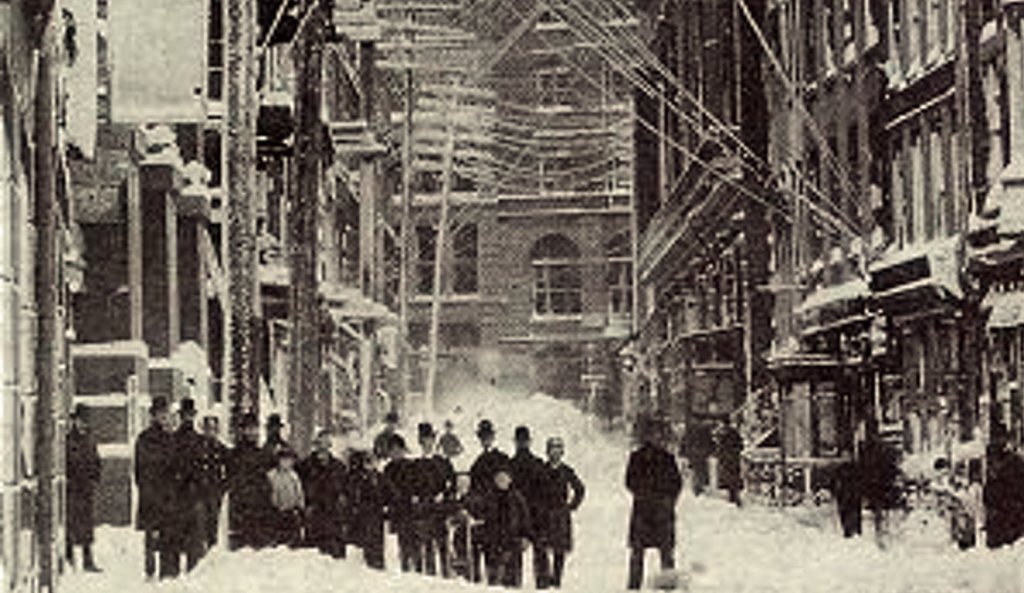
    For the first time the metropolis experienced the effects of an oscillation in the polar vortex, which sent a blast of cold air across frozen Canada to meet with a mass of warm air travelling up from the Gulf of Mexico. The previous day had been a moderate 50°F (10°C) with rain in keeping with the close approach of Spring, thus the inhabitants of the city were totally unprepared for what confronted them on the twelfth. Torrential rain had turned to heavy snow, the temperature plunged below zero, snowdrifts reached the second storey of buildings, an estimated 500,000 pounds of horse manure and 60,000 gallons of horse urine froze and along with broken glass and other trash were whipped across the city by 100 mph winds (Mikolay).
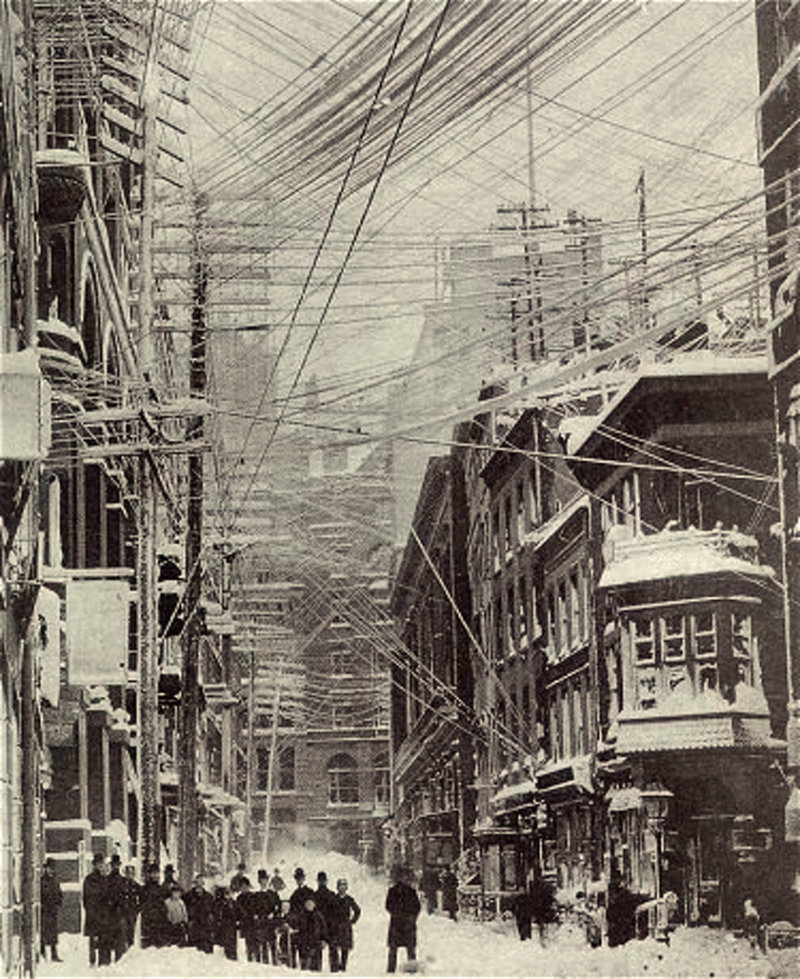
    After the New York Blizzard. New Street, looking toward Wall Street, 1888 (NY Public Library)

    Telegraph, telephone and powerlines came down isolating New York from the rest of the country and live wires buried in the snowdrifts provided a deadly hazard in the streets. Drivers finding the streets impassable unhitched their horses and deserted their carriages, wagons and cars where they stood. Overturned carriages buried in snowdrifts became a feature of the city. Consequently, there were no dairy, bakery, meat or newspaper deliveries upon which the population relied. The elevated rail system froze, trapping thirteen hundred early workers in transit (New York Times).

    Mark Twain was trapped in his hotel room while waiting for his wife, Olivia, and sent her a letter (how it was delivered in the conditions is a mystery):

    A mere simple request to you to stay at home would have been entirely sufficient; but no, that is not big enough, picturesque enough—a blizzard’s the idea; pour down all the snow in stock, turn loose all the winds, bring a whole continent to a stand-still: that is Providence’s idea of the correct way to trump a person’s trick.

    qtd. Clara Clemens, daughter of Mark Twain

    As a result of the blizzard two hundred people died in New York City alone (Schulten). The blizzard was an event of great moment not only because of its ferocity and transfixing power, but because it physically resolved arguments for the future development of the city. As early as the thirteenth of March a New York Times journalist reporting on the effects of the storm stated:

    Probably if it had not been for the blizzard the people of this city might have gone on for an indefinite time enduring the nuisance of electric wires dangling from poles; of slow trains running on trestlework, and slower cars drawn by horses and making the streets dangerous with their centre-bearing rails. Now, two things are tolerably certain—that a system of really rapid transit which cannot be made inoperative by storms must be straightway devised and as speedily as possible constructed, and that all the electrical wires- telegraph, telephone, fire alarms, and illumination—must be put underground without any delay

    New York Times March 13, 1888

    In the same article we see the strange beast of American Exceptionalism raise its head in lamentation:

    …the most amazing thing to the residents of this great city must be the ease with which the elements were able to overcome the boasted triumph of civilization, particularly in those respects which philosophers and statesmen have contended permanently marked our civilization and distinguished it from the civilizations of the old world—our superior means of intercommunication.

    New York Times March 13, 1888

    Louise has already ‘broken the ice’ with Harry Larchmont, indirectly through the desperate state of an old man. For the two to meet again in a population of one and a quarter million other chilly New York souls could only be due to the hand of fate. In this chapter, Gunter was perhaps inspired by an actual rescue that occurred during the storm and reported in the New York Times six months later as ‘Romance of the Blizzard’: George Cozine of Hicksville, Long Island was trudging through the snow when he heard the cries of a woman. Buried beneath the snow he discovered Miss Mary McEwen. Finding that her hands, feet and ears were frozen, he dragged her from the snow and throwing her over his back carried her home. `From that time on, he was a welcome guest, and an intimacy sprang up between him and Miss McEwen that terminated in their marriage on Saturday’ (New York Times Sept. 11, 1888). You read correctly, ‘terminated’.

    As the proverb goes ,‘’tis an ill wind that blows nobody any good’ and in Louise’s case, despite being someone normally possessed of good sense, her foolhardy actions inevitably place her necessarily in deadly peril.


    CHAPTER 9

    THE ANGEL OF THE BLIZZARD

    Two days after, I received a brief note from Mr. Larchmont, which simply stated he was taking care of his uncle’s minor matters of business, during that gentleman’s recovery, and enclosed to me a check for my services as stenographer, the amount of which, though liberal, was not sufficient to make me think it anything more than a simple business transaction.

    Then one week afterwards came the blizzard, that crushed New York with snowflakes, that stopped the elevated railways, and blocked all transportation by surface cars; that confined people in their houses on the great thoroughfares, as completely as if they had been a hundred miles away from other habitations. That dear delightful, fearful blizzard, in which I nearly died.

    On Monday morning, March 12th, I am awakened by Miss Broughton, who is peeping out through the casements. She crys: “’Louise, wake up! This is the greatest storm I have ever seen.”

    “Nonsense! It’s spring now,” I answer sleepily.

    Zeffy in Bed (1906), Lilian Westcott Hale

    “Yes, March spring!—cold spring! Jump out of bed and see if it’s a spring atmosphere,” returns Sally, with a Castanet accompaniment from her white teeth.

    I obey her, and the spring atmosphere arouses me to immediate and vigorous action. In a rush I start the gas stove, and, throwing on a wrap, walk to Sally’s side, and take a look at what is going on in the street.

    “Isn’t it a storm!” suggests Miss Broughton enthusiastically. “A beautiful storm! A storm that will stop work. A storm that will give me a lazy day at home!”

    “You are not going down to the office?” I say.

    “Through those snow banks?” she replies, pointing to six feet of white drift on the opposite side of the street, in which a newsboy has buried himself three times, in an unsuccessful attempt to deliver newspapers at the basement door.

    “Certainly,” I reply.

    “Impossible!” she says. “You will make a nice, lazy day of it, at home with me. We will do plain sewing. You shall help me make my new dress.” Sally always claims me on lazy days. In my idle moments, I think I have constructed four or five costumes for her. This time I rebel.

    “If you are not going to work, I am!” I say decidedly.

    “Through those drifts?”

    “Certainly!” I reflect that I have some documents Miss Work has promised this day. They are legal ones, and admit of no postponement.

    “Well, you may be able to get to the office,” says Sally, “if you are a Norwegian on snowshoes, or an angel on wings.”

    This angel idea is a suggestion to me. “The elevated is running!” I answer, and point to the Third Avenue, down which a train is slowly forcing its way. The station is only a short distance from me. I will take the elevated. Surface cars may be blocked, but the elevated goes through the air.

    Miss Broughton does not reply to this, though I presume she has her doubts about the feasibility of my plan, for the storm is coming thicker and heavier.

    But breakfast over, she steps to the window, looks out, and says disappointedly: “Yes, the Third Avenue trains are still running. I presume you can go, but how about getting back again this evening?”

    “Pshaw!” I reply, “it will be all finished in an hour.”

    North on Third Ave between 67th and 68th streets after the Blizzard of 1888 (New York Public Library)

    A few minutes afterwards, well equipped for Arctic travelling, I, with a desperate effort, get out of the door, and for a moment am blown away by the wind. I had no idea the storm was so severe. But I struggle on, and finally reach the Third Avenue station, to climb up its icy stairs and be nearly blown from them in my ascent to the platform. From this, I finally struggle on board a downtown train, which contains very few people. The guards have lost their usual peremptory tones. They do not cry out in their bullying manner, “All aboard! Step on lively!” as they are prone to do on finer days, but are trying to get warm over the steam pipes in the car. The blizzard has even crushed them!

    We roll off on our journey, amid gusts of wind that nearly blow us off the track, and flurries of snow that make it impossible to see out of the windows. In about quadruple the usual time, however, we creep alongside the City Hall station platform.

    It is now half-past nine. I alight, and am practically blown down the stairs, though a snowdrift at the bottom receives me, and makes my fall a soft one. Then I fight my way along Park Place and into Nassau Street. The storm seems to get stronger and fiercer, as I grow more and more feeble. Midway I would turn back, but back is now as great a distance as forward; and one end of the journey means the comfortless railway station, where perchance no trains are leaving now. The other terminus is Miss Work’s office, where there will certainly be a fire, company, and occupation. By the time I shall be ready to go home, the storm must be over.

    So I struggle on, and fight my way through snowdrifts, to finally arrive, in an almost exhausted condition, at 1351/2 Nassau Street.

    A long climb up the stairs, for the building is not provided with an elevator, and I find myself on the top floor, which is occupied by Miss Work’s establishment. Here, to my astonishment, the door is still locked. Having a pass key, I discover a moment after entering, to my consternation, an empty room, and a cold one. Miss Work, who is punctuality itself, is not here. I reflect, she will undoubtedly arrive in a few minutes. She must come.

    While thinking this, for the atmosphere does not permit of delay, I am hurriedly making a fire in the grate, which has not been attended to overnight, the man in charge of the building apparently not having visited it this morning. Fortunately there is plenty of fuel, and I soon have a roaring fire and comfort.

    Then I move my typewriter where I get the full benefit of the cheery blaze, and sit down to my work.

    Time flies. No one comes. Having nothing to eat, I pass what should be my lunch hour over the keyboard of my Remington, thinking I will have my task finished and go home the earlier. But the papers are long ones, and being legal, require considerable care and accuracy, and as I finish the last of them I look up.

    It is nearly dark. My watch says it is only three o’clock, but the storm, which seems to be even heavier than in the morning, causes early gloom. I look out on the wild prospect. As well as I can determine, in the uncertain light, glancing through flurries of snow, not one person passes along sidewalks that are usually crowded with humanity.

    What am I to do? I am hungry! I am alone! Even in this great building I am the only one, for no sound comes to me from the offices down stairs, that at this time in the day are usually filled by movement, hurry, and activity.

     Sally will be anxious for me. Though, did not my appetite drive me forth, I believe I should attempt to make a night of it in the great deserted building. I should probably be frightened, though I should barricade myself in. I should probably see ghosts of lawyers and legal luminaries who have long since departed, from these their old offices, to plead their own cases before the Court of Highest Appeal. But hunger! I am more afraid of hunger than of ghosts. Besides, it is so lonely.

    I decide to force my path to Broadway. On that great thoroughfare there must be some one! I lock the door, come down the stairs, step out on the street, and give a shiver. During the day it has grown much colder, though in the warm room I had not noticed it.

    My first step is into an immense snowdrift. Through this I struggle, and reaching the corner of the street am literally blown off my feet, fortunately towards Broadway. Thank Heaven! it is a very short block, though it seems to me an eternity before I reach the thoroughfare that yesterday was the great artery of traffic in New York, but now, as I gaze up and down it, seeking some human face, seems as deserted as a Siberian steppe.

     The shops are all closed, even the drug stores. There are no passing vehicles, no struggling pedestrians. The traffic of the great city has been annihilated by this prodigious storm. Telegraph wires, that last night were overhead, have many of them fallen. There is nothing for me but to struggle onward.
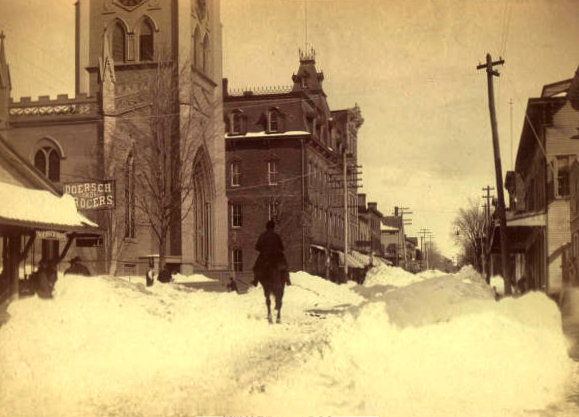
    Rider facing north on South Broadway after the Blizzard (NY Heritage digital collection)

    I turn my face to the north—up town—where three miles away Sally is waiting for me, with a warm fire, and I hope a comfortable meal. Towards this I force my way—for a few minutes.

    Then I trip over a broken telegraph wire that lies in the snow. As I stagger up again, for a moment I am not certain which way I am going. Good Heavens! if I should turn back on my tracks?

    The wild snowstorm about me dazes me, confuses me, benumbs me, and makes me stupid. The strength of the wind forces me to hold my head down; I try to see which way I have come by my tracks in the snow—but there are none! The gusts are so violent, my footsteps have been obliterated almost as I made them.

    Desperate, I look around me, and see, through snow flurries, the light in the great tower of the Western Union Telegraph Building. It seems awfully far away, but gives me my direction; and I struggle northward once more, staggering through drifts—sometimes falling into them, no voice coming to me—alone in a living city that is now dead—killed by the snow. Darkness has fallen upon the streets, and enshrouds me. Still I fight on. There are hotels farther up the street. If I could get to one—if I could get anywhere to be warm!

    I have passed the Western Union Building, I think—I am not sure—my faculties are too benumbed for certainty. All I know is, that I am cold— that I am benumbed—that I am hungry—that I am weak—that the snowdrifts grow larger—the snow flurries stronger—the piercing cutting wind more fierce and merciless—and, above all this, that I am unutterably sleepy. I dream even as I struggle, and then I cease to struggle, and only dream—beautiful dreams—dreams of what I long for—dreams of warmth and comfort, of bounteous meals and generous wine.

    And even as this last comes to me, something is poured down my throat—something that burns, but vivifies—something that brings my senses to me with sudden shock. I hear, still in a half dreamy way, a voice that seems familiar, say:

    “Pat, that is the worst whiskey I have ever tasted; but I think it has done me good, as well as saved this young lady’s life.”

    “By me soul, it has saved mine several times today!” is the answer.

    Then the other voice, the familiar one, goes on: “Do you think you can get us up town?”

    “Faith, I’ve been half an hour coming from the Western Union Building. You may bless God if I make the Astor House alive.”

    “Then somewhere, quick! This will keep her warm.”

    I feel the burning stuff pour down my throat once more, and give me renewed life and sentiency. Strong arms lift me into a cab, a rug is wrapped around me. I open my eyes. Beside me sits a man, to whom I falter, my teeth still chattering, “I—I was lost in the snow.”

    Even as I say this, the familiar voice cries: “Your tones are familiar. Who are you?”

    I answer: “Miss Minturn.”

    And the voice cries: “Good heavens! Thank God I saw you from my coupe in time!”

    And I, still dazed, gasp: “It is Mr. Larchmont, is it not?”

    “Yes: don’t exert yourself, you are weak. In a few minutes we will have you at the Astor House, warm and comfortable. Have no fear.”

    And somehow or other, his voice revives me more than the whiskey. I am contented—even happy.

    But the storm is still upon us; and though there are two strong horses attached to the coupe, fighting for their own lives through the deepening drifts, it is nearly an hour before lights flash on the sidewalk, and I am assisted into warmth and comfort and life once more, in the Astor House parlor.

    There I thaw for a few minutes, during which he sits looking at me, though I am dimly conscious he has given some orders. Having entirely regained my senses, I falter: “I must go home! Sally will be anxious about me!”

    “Where do you live?” he inquires shortly “Seventeenth Street.”

    “Then you could not live to walk home tonight, and no carriage could take you there. There is but one thing for you to do. The housekeeper will be here in a moment. She will take you to a room. Go to bed, and take what I have ordered for you.”

    “What is that?”

    “More whiskey—but it is exactly what you want. In two hours they will have dried your clothes, and you can come down to dinner with—with me.” His “with me” is rather embarrassed and diffident.

    I do not reply, and Mr. Larchmont almost immediately continues: “Or, if you prefer it, the dinner can be sent up to your room.”

    I shall feel quite lonely—it will appear ungrateful. “I will be happy to meet you in the dining room,” I answer.

    A moment after, everything he has arranged is done. I go with the housekeeper, a kindly woman of large build and comfortable manner, and find myself excellently taken care of.

    Two hours afterwards, feeling like a new being, I enter the dining room. It is only half-past seven, and Mr. Harry Larchmont is apparently waiting for me. It is a pleasant, though, perhaps, to me, embarrassing meal. The room is crowded with people that the storm has forced to take refuge in the hotel—Brooklyn men, who cannot get across the East River; Jersey men, who are cut off from home; and downtown brokers, who are un able to reach their uptown residences. The place, in contrast to the dreadful dearth of animal movement in the streets outside, is full of life, bustle, and activity.

    “I think I have arranged very well as regards dinner,” remarks Mr. Larchmont. “We’ll have to be contented with condensed milk, but we shall have some Florida strawberries, and Bermuda potatoes and asparagus.” As we sit down, he says suddenly: “Who is Sally?”

    “Sally? Ah, you mean Miss Broughton?”

    “Yes, the young lady you said would be anxious about you.”

    “Oh,” I answer, “Miss Broughton is my chum!” Then we get to chatting together, and I give him a few Sally anecdotes that make him laugh. As the meal goes on I grow more at my ease, and become confidential, and tell him a good deal of my life, my work, and my battle with the world. This seems to interest him, and once, when I am busy with my knife and fork, I catch his eyes resting upon me, and they seem to say: “So young!”

    But I won’t have his sympathy; so I make merry over my business struggles, and tell him what a comfortable little home Sally and I have.

    Altogether, it is a delightful meal for me, and I am not sorry that Mr. Larchmont lingers over it. He grows slightly confidential himself, over his coffee, explaining to me that he has had some very important telegrams to receive from Paris; that the uptown wires were all down, and he had been so anxious about his cables, that he had contrived to get as far as the main office of the Western Union Company; that he thanks God he succeeded in doing so, though no cablegrams had come to him. “Because,” he concludes, looking at me, “if it had not been for the cables, you might have been still outside in the snow!”

    A few minutes after, he startles me by saying, it seems to me with a little sigh, “I must be going!”

    “Where—into the storm?” I gasp, amazed.

    “Only as far as French’s Hotel, just across in Park Place.”

    I know “just across in Park Place” means three long squares—an awful distance, which might kill a strong man in this driving storm.

    “You must not go!” I cry.

    “Under the circumstances, I must,” he replies, and rises, to cut short remonstrance. Then I go out with him from the dining room into the hall, a blush on my cheeks, but a grateful look in my eyes, for I know it is to save me any embarrassment this night that he will make his desperate journey through snowdrifts and pitiless wind.

    We have got to the ladies’ parlor now. He turns and says earnestly, “I have made every arrangement for you, I think, Miss Minturn, not only for this evening, but for tomorrow, in case you should be compelled to remain here. I am more than happy, and bless God that I met you in time.”

    And I whisper: “You have been to me the—the angel of the blizzard!”

    At which he smiles a little, and his grasp upon my hand tightens as he bids me goodnight.

    Then he is gone into the storm.

    I go to my room; a fire is burning brightly there. Sleep comes upon me, and happy dreams—dreams in which I make a fool of myself about “the angel of the blizzard.”

    The next morning everything has been arranged for me. After a comfortable breakfast, I discover that the storm has ceased, but the streets of New York are still impassable. Then I get a newspaper, and learn that the indefatigable reporters have somehow got information of nearly everything. Glancing over its columns, I give a sigh of relief. In the long list of accidents, escapes, and deaths on that twelfth day of March, 1888, I note that my adventure has not been reported, though I read that French’s Hotel had been so crowded that people had slept upon the billiard tables and floors of that hostelry, and one uptown swell had been obliged to content himself with the bar counter. I guess who the uptown swell was who did this to save me any embarrassment or anxiety, and I bless him!

    I bless him again, when, in the afternoon, I find that the streets can with difficulty be navigated, and the porter coming up, informs me that a carriage has been ordered to take me, as soon as possible, to my address in Seventeenth Street.

    At home, I am welcomed by Sally, with happy but anxious eyes. She cries: “Oh, Louise! I thought you were dead!”

    “Oh, no,” I reply nonchalantly, “I did a day’s work.”

    “And then?”

    “Then I went to the Aster House.”

    “Did you have money enough with you for that? I hear they charged ten dollars a room.”

    “That bill is liquidated,” I return in easy prevarication.

    “But you had a carriage! I noticed a carriage drive up with you. How will you ever pay the hackman? They charge twenty-five dollars a trip.”

    “Never mind my finances. I am home safe once more. And you?” I answer, turning the conversation.

    “Oh, I nearly starved! I would have starved entirely, had I not forced my way to the grocery store. I have been living on crackers and cheese, bologna sausage, and tea without milk.”

    “I have been enjoying the ‘fat of the land’. You had better have gone down with me, Sally. You would have had a delightful day,” I continue airily to my pretty chum, who looks at me in partial unbelief.

    Then the next morning comes a joy—a rapture—a surprise! It is a bunch of violets tied with violet ribbon, with the name of a fashionable florist emblazoned on it, and with it this card:

    Message on card: "Compliments of Mr. Harry Sturgis Larchmont who hopes Miss Minturn has thoroughly recovered from the storm. United Club"

    Fortunately, Sally is out when this arrives, so I avoid explanation. When she comes in, the flowers soon catch her bright eyes. She ejaculates, “Violets! Where did you get violets, Miss Millionnaire?” and smells them to be sure they are genuine—not artificial.

    “Why do you call me Miss Millionnaire?”

    “Well, no one but a Miss Millionnaire can live at the Astor House during blizzards, and perambulate in carriages at twenty-five dollars a trip, and have great big bunches of violets at a dollar a blossom! Gracious! They must have cost thirty dollars! Every flower on Long Island was destroyed by snow.” Then Sally’s eyes open very wide with inquiry, and she says coaxingly: “Who sent them?”

    “Oh,” I reply in easy nonchalance, “I gathered them!”

    “Gathered them? Where?” These are screams of unbelief.

    “Off the snowdrifts on Sixth Avenue, over which they have placed a sign ‘Keep off the grass!’”

    “That means you will not tell me,” says Sally, with a pout.

     “Precisely! “

     “What makes you fib so much lately? “she mutters disappointedly.

    “It is not a fib—that I will not tell you.”

    “Very well! I shall inform Mr. Tompkins!” replies Sally spitefully, which threat causes me to burst into hysterical merriment, I am in such good spirits.

    I write to him at his address: “I am quite well. I thank you for the violets, but for the rest—thanks are too feeble. I only hope some day the mouse may aid the lion. L. R. M.”

    I initial this note.

    Somehow I don’t know how to end it. I have grown strangely bashful and diffident lately.

    That was only a week ago. Once since then I have seen him at the theatre, in attendance upon ladies, one of the party being Miss Jessie Severn.

    As I have looked at him I have noticed that a good deal of the lightness has left his face, and a portion of the laughter has departed from his eyes. Has some cloud come over his life?

    As I look over my diary and recall these things, a sudden thought strikes me. I am going away without bidding him good-by. That will be hardly grateful. It is half-past four: he may be walking on Fifth Avenue. It would hardly be wrong to say “farewell” on a crowded street.

    Five minutes, and I have flown over to that fashionable promenade, and am strolling up its thronged sidewalk. I am in luck. Near Thirty-first Street I see him stepping out of a fashionable club. But there is another gentleman with him, almost his counterpart save that he is ten years older, and has a foreign and un-American air and style about him. This must be Harry Larchmont’s French brother—the one Mr. Delafield had sneered at.

    Of course I cannot speak to him now.

    To my passing bow Mr. Larchmont responds with more than politeness. As I pass, I catch four words from the gentleman who is with him. “She is deuced pretty!”

    Fortunately I am beyond them; they cannot see my blushes through the back of my head. What would I not give to have heard Harry Larchmont’s reply!

    As it is, I shall not even bid him good-by. I return curiously disappointed to our rooms on Seventeenth Street.


    References, Links

    Clemens, Clara. My Father, Mark Twain (NY: Harper, 1931) p. 54.

    ‘Great Blizzard of 88 Hits East Coast’. `This Day in History’ – History.com. Jump to article

    ‘In a Blizzard’s Grasp: The Worst Storm the City has Ever Known’, New York Times, 13 March 1888. PDF.

    Mikolay, Anne M. ‘Remembering the Great Blizzard’ The Monmouth Journal, Feb 10, 2011. Jump to Article

    Schulten, Katherine.`Romance of the Blizzard’, Learning Network, New York Times. PDF (NY Times article Sept 11, 1888),

    New York, NY, Population History.

    Eyewitness account of New York’s Great White Hurricane of 1888 (recorded in 1949)

    This edition © 2021 Furin Chime, Brian Armour

  • A.C. Gunter’s Baron Montez: 3. The Railroad Station At Panama

    A.C. Gunter’s Baron Montez: 3. The Railroad Station At Panama

    As we begin this chapter, Fernando Gomez Montez, having tampered with George Ripley’s revolver, has new confidence, and commences putting in place other components in his plan to relieve the American of his gold-filled chest, and fair-skinned wife. Montez arranges boat transport for himself and the Ripleys to Panama where they find it crowded with travellers recently offloaded from steamers awaiting the train across the Isthmus and also those joining vessels to travel up the West Coast of the United States. Panama has become a busy hub for trans-continental travellers.

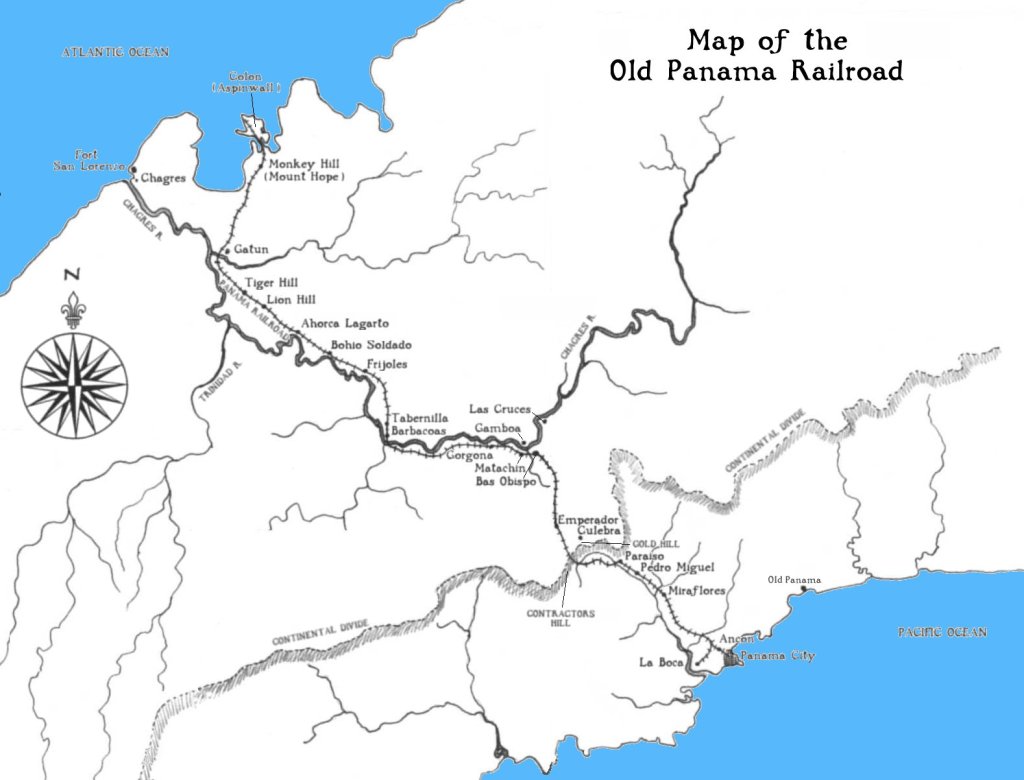
    Even before the railroad was completed, Americans eager to join the gold rush in California were paying to have themselves and their luggage transported across the extent of the completed track. The Californian Goldfields would generate nearly twelve million ounces of gold, most of which would pass through Panama on the way to the Eastern United States. George and Alice can expect to pay a hefty twenty-five dollars each to travel on the recently completed railway to Aspinwall.

    Old rail route across the Isthmus of Panama (panamarailroad.org)

    Seven years earlier, in 1848, the United States signed the Guadalupe Hidalgo Treaty, ending the long running Mexican War. The treaty gave the U.S. undisputed control of Texas, established the U.S.-Mexican border of the Rio Grande, and ceded to the United States the present-day states of California, Nevada, and Utah, most of New Mexico, Arizona and Colorado, and parts of Texas, Oklahoma, Kansas, and Wyoming. This expansion completed control of continental United States complementing central lands transferred through the Louisiana Purchase of 1803. The removal of the threat of warring Mexican forces, and mitigation of dangerous Native Indian tribes encouraged settlers like those awaiting the steamships to venture to the Western States.

    During the construction of the railroad, the Americans used workers who had come from the United States, Europe, Columbia, China, the Caribbean islands, and also African Slaves, a great many of them who died of Cholera, Malaria and Yellow Fever. Once the Railway was completed the majority of these remaining poorly paid workers were dumped and left to their own devices for survival. The US used troops to suppress separatist uprisings and social disturbances on many occasions. The first time will occur on the fifteenth of April, 1856.

    Unlike the narrator, who reminds the reader of the date, Fernando is unaware of any significance attached to it and goes about his connivances, which remarkably are designed to precipitate an historical event.


    CHAPTER 3

    THE RAILROAD STATION AT PANAMA

    On the veranda once more, George Ripley suggests: “Would you mind showing us your pearls? My wife is anxious to see your jewels, and we must be soon getting under way for the mainland.”

    “Yes, the Illinois arrived this morning at Aspinwall,” returns Montez. “Her passengers will soon reach Panama. Soon there will be a Pacific Mail steamship in the bay. The Golden Age from San Francisco is one day overdue. When she comes in, her passengers will be moved eastward rapidly. If you are not at the railway station you may be left to spend ten days more with us. That would please me, mi amigo; but you—you are an American, and in a hurry. You do not enjoy life. You fly through it.”

    “And you dream through it, I imagine, Señor Montez,” laughs Alice, coming on the veranda to meet the returning bathers. Then she says archly, “Dream no more; show us your pearls, and become a man of business.”

    “That I will!” cries Montez, as he displays his jewels, and descants on the beauties of the large pink pearl he has, and the perfection of the white ones he holds caressingly in his hands, with the vehemence and volubility of an Armenian in the bazaar at Constantinople, and the shrewdness of a Hebrew pawnbroker in Seven Dials.

    Fernando’s trading powers, however, are thrown away; for the American takes all the pearls at the seller’s own prices, which though exorbitant for Panama, are cheap for New York.

    “Come in and get our business over,” says George; and Montez following him and Alice into the bamboo cottage, the affair is completed. Opening a large buckskin bag, that is part of his belt, after the manner of early Californians, Ripley makes payment in gold dust; for at that time gold was plenty, though coin was scarce, in the Western world.

    Upon this yellow dross, Fernando’s eyes linger lovingly, and from it roam gloatingly to the heavy ironbound trunk of the Californian, and turning from this to the beautiful Americana, who had thrown her pearls in a string of white radiance around her fair white neck, his glance becomes more longing than ever.

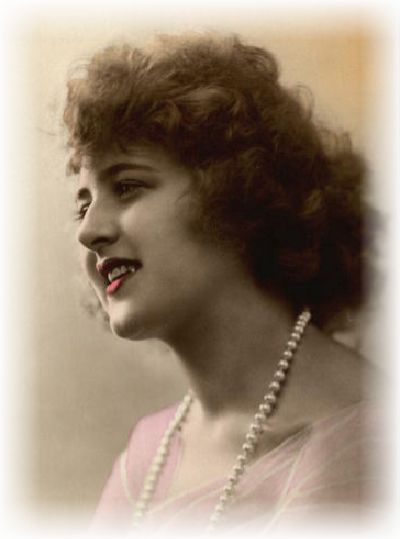
    Antique French postcard (n.d.)

    Here George laughingly suggests: “Montez, you think jewels become her? Alice should have had these pearls when she stood in Edouart’s gallery in Washington Street, San Francisco, and had this taken,” producing from his pocket a tintype of his wife, a style of picture just come into fashion.

    “Yes, I had two of them taken; one for my husband, the other for my daughter; Mary’s was sent to her two months ago. It will remind her of my coming,” replies the lady; then blushes a little, for Montez, in his native way, has cried out: “Ah, Dios! It is celestial—but the sun has not done you justice, Señora Ripley!”

    The sun, however, has done very well, and the tintype has the blue eyes and fair hair of this charming American.

    So charming, Montez fears to stay; his passion may betray itself. He mutters, “I will go and engage your boat, Señor Ripley.”

    “Yes! Get a safe one, I don’t care for speed. Something there is no chance of capsizing,” calls the Californian after him.

    “I will be sure of that for my own sake, as well as yours,” cries back the little gentleman, as he glides down the pathway, brushing with a bamboo switch the dust from his patent leather boots.

    At the white glistening beach he selects carefully a boat, and is delighted to find among its crew a swarthy boatman, who is called Domingo.

    Addressing him familiarly, and slapping him on the back, Montez says in his ear: “Old bravo, are you still up to banditti work as in ’52, on the Cruces roads?”

    To this, Domingo, a gentleman with a pirate countenance adorned by two fearful scars, with a stalwart black frame, and a stout black heart beating in his black body, replies: “Si, Señor, mouches dinero, mouches sangui, mouches Domingo.”

    So Fernando knows he has at his hand, for this night’s work, a man who will not be turned back for pity, nor blood, nor danger, from doing any wickedness that may come to his hand.

    While this has been taking place on the beach, Ripley and his wife, during hurried preparations for their departure, are holding a conversation that makes the Californian open his honest eyes in astonishment.

    His wife says to him, under her breath: “Now that Montez is away, I wish to tell you something: I am glad we are going!”

    “Of course! Tomorrow we will be one day nearer our daughter.”

    “It is not entirely that,” whispers the lady, nervously, “but I fear to stay here.”

    “Why?”

    “Anita hates me.”

    “Impossible! No one could have nursed you more faithfully during the fever, than the bright-eyed Indian girl.”

    “It is her bright eyes that make me fear her. Something new has come into them. Besides that, while you were taking your bath she told me that we had better go away as soon as possible. She told me.”

    “Well, what?” says the American impatiently.

    “Only—that—if the fever returned to me here—I would not throw it off again. Toboga breezes are good for the first attack,—but after that,—like other medicines,—they lose their value.”

    While she says this in a hesitating, disjointed manner, a bright red flush has come over the features of the beautiful American lady, for Alice Ripley is telling her husband her first falsehood.

    Anita’s words had been to her: “Beware of Montez! Montez loves you!” and suspicion coming to her quick feminine mind at these words, Alice had noted some of the uncanny glances the polyhæma gentleman at times could not restrain himself from indulging in. But at the last moment, even when warning was on her lips, she has hesitated to tell her husband what she has heard and suspects—because the very thought of the thing brings blushing shame upon her.

    So the modesty of this beautiful woman takes from her husband one of his ropes of safety this day—his one chance of suspecting the man he thinks his friend, but who is even now bent upon his robbery and ruin.

    “Well, let us give Anita her pearl—perhaps that will reconcile her to our going away,” laughs the Californian.

    This being done, they leave the palm-thatched bamboo villa, and come down the little rocky pathway to the beach at Toboga, to take departure for Panama.

    Three stalwart natives carry the ironbound trunk, and find it all they can handle; another swings easily the lighter one that contains the wardrobe of George Ripley and his wife.

    Looking around, Montez is happy; for there is only a steamer of the English Steam Navigation Company in the harbor, one or two trading brigs and schooners, and the Columbus just returned from her voyage to the Islas de las Perles, and no vessels of war of any nation. No blue jackets can be landed to interfere with a plan that he has already set on foot among the desperate native classes of the town of Panama this fifteenth day of April, 1856.

    Toboga is slumbering in the midday sun, as they stand upon the sandy beach. A lazy steward from the English steamer is buying fish and fruit from a big Indian bongo that has come from a neighboring island. There is a drowsy hum from a few bamboo huts, and pine board edifices that do duty as shops, and ship chandlers’ stores, for this Island of Toboga is really the port of Panama, as the depth of water permits vessels to lie there at all times; while off the mainland, the tremendous rise and fall of the ocean compels ships of burden to keep three or four miles out in the bay.

    “I am glad you got a good, big, safe boat,” remarks the Californian, “and I hope competent boatmen.”

    “Yes, that is all arranged. On board, mi amigo,” cries Montez, offering a gallant hand to assist the pretty Americana.

    But what the Indian girl has said to her makes this lady blind to his attentions, and she carelessly and lightly steps over the gunwale of the boat, and tripping to its stern, takes seat under its awning of many colors, ignoring the gentleman whose eyes follow her, an unknown suspicion in them.

    A moment after, they are under way, black Domingo pulling a strong stroke oar, and three lithe natives keeping time with him, and dashing foam that looks like pearls and diamonds from the water, as they glide over this aquarium, in which Alice looking down sees countless fish.

    As they move, she carelessly drops a dainty hand into the cool water, playing with its ripples. The next instant Montez quietly takes it in his and replaces it in the boat.

    Perchance, unable to control himself, he has given its delicate fingers a tender pressure, for the lady’s face grows angry.

    “Would you like to leave your arm in that fellow’s maw?” is Fernando’s reply to her indignant glance, and he points to a huge white shark that is lazily patrolling the water a cable’s length or so from the English steamer’s stern.

    Following his gesture with their eyes, the crew start and Domingo mutters: “Diablo! Toboga Bill!”

    “Yes, that is the gentleman!” laughs Montez. “This desperado has just come up after the Peruvian steamer from a trip down the coast to Callao.”

    “So that is the terror of Panama Bay?” queries George, turning his eyes upon the great fish, who is as long as a ship’s cutter, and whose dorsal fin makes a big swash of foam with every movement.

    Bay of Panama, lantern slide c. 1900–20 (cropped), Art Gallery of South Australia

    “Yes! There will be one or two less native boatmen, perhaps, before he leaves harbor!” returns Montez. Then he suddenly cries: “For your life, No!” and places a deterring hand upon the Californian’s pistol, for Ripley is about to draw it.

    “There is no danger in this big boat. Let me have a pop at the desperado,” says George, still fingering his ready revolver.

    “No, no! Your wife is here. He might charge the boat. He has upset canoes! Don’t use your pistol!” murmurs the little every-nation rascal, his lips trembling and growing white.

    “If he is so awful—don’t shoot at him!” gasps Alice to her husband.

    “If you tremble, of course not!” says the American, returning his revolver to his belt. “Though I had imagined Montez had better nerves.”

    This idea is that of the boatmen; for one of them says in Spanish to his fellow: “Caramba! I never saw the muchacho diablo tremble before—at a shark, too!”

    But Domingo knows his old master better, and chuckles to himself: “What was there about that pistol of the Americano that Fernando did not wish him to use it? Ah! It has been tampered with. This man and this woman are to be our prey.” And from now on, the whites of his eyes grow bloodshot when they look on the Californian and his fair-haired wife.

    As they leave “Toboga Bill” behind them, fear seems to depart from Montez; he regains his spirits, but whenever a stray gull offers a tempting shot he looks nervous; perchance Ripley will test his pistol.

    Three hours after, they make the landing at Panama, having been assisted by the incoming tide, which has just turned, and is here tremendous.

    They come to the end of the long wharf of the railroad, finding there a little light-draft iron steamboat—the Toboga—used in transferring passengers and mail to the great Pacific steamers that cannot come nearer than three miles of the town. Not six inches of water is under the Toboga’s keel. It must wait for the incoming tide to free it, and make it float again, which will be somewhere about ten or eleven o’clock this evening.

    Clambering upon this wharf, which rises at this stage of the tide quite high above the boat, Montez and Ripley assist the American lady, who soon stands beside them.

    “There will probably be no train for Aspinwall before tomorrow morning. I think we had better go to one of the hotels in the main town. It will be more comfortable,” remarks Ripley.

    “Very well,” answers Montez, a shade of disappointment crossing his face, “the Hotel Francais. But what will you do with your trunk—the heavy fellow? It seems all that the three boatmen can manage.”

    “Of course, George, they can never carry it into the town in this hot sun,” remarks Alice, who, having hoisted a dainty parasol over her head, stands watching the men.

    “Let me suggest the Pacific House,” returns Fernando, pointing to a white board hotel just across the road from the station. “It is but a step for your wife—and your trunk.”

    To this proposition George assents, and they walk up the wharf, followed by three of the boatmen, who struggle under the heavy ironbound chest, upon which the Californian, turning ever and anon, casts a wary glance. Behind them tramps old Domingo, slinging easily upon his stalwart shoulder the light trunk containing the wardrobe of the Californian, which does not seem to interest Ripley at all.

    Walking along the tracks of the Panama road, which run upon this wharf, they soon come to dusty terra firma, and find themselves in quite a crowd of passengers from the Illinois, which has landed them at Aspinwall, on the Atlantic side of the Isthmus, some few hours before. These are making their preparations for departure, some of them checking their baggage, and others having their tickets examined; a few, even now (fortunately for themselves), are taking their families on board the Toboga, as the Golden Age, the incoming Pacific Mail steamer, has been sighted.

    Hearing this, Montez whispers to the Californian: “The train for Aspinwall will be sure to leave early in the morning. The Pacific House is the one for you, it is so near the railroad depot.”

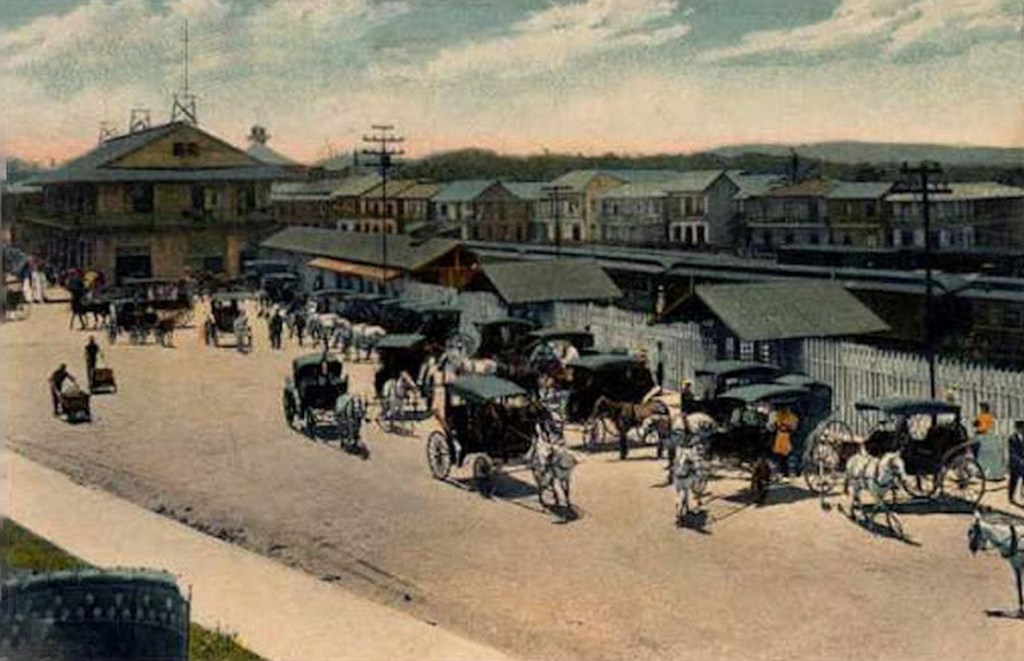
    Railroad Station at Panama, antique postcard (n.d.) (panamarailroad.org)

    So they pass in, and registering their names with McFarlane, the proprietor, soon find themselves in a little room on the eastern, and now shady, side of the house, for the sun is already declining in the heavens. This chamber is one flight up, retired and quiet as any room can be in a house made of thin boards with partitions of canvas and paper. To this the three natives stagger with the heavy trunk, Domingo accompanying them with the lighter one.

    Here Montez says to the American, “Au revoir!” but while doing this, suggests: “Won’t you take a stroll with me into the town? You will find lots of the passengers who are bound for California, seeing the sights. Why not make an evening of it with me? Dinner at the Cafe Victor, and then, I believe, we have a circus in town tonight.”

    “That would be delightful!” cries Alice. A moment after, she says thoughtfully, “but I am afraid I am too fatigued for it.”

    “No thank you, Montez, old boy,” answers George. “I think I’ll stay here with my baggage and my tired wife.”

    “Then au revoir again!” murmurs Fernando, and turns to go, but the Californian comes after him, and seizing his little fingers in his stalwart grip, says gratefully; “This must not be the last we shall see of you! Promise to come back here this evening. My wife and I must thank you again for your hospitality, and what you have done for us. I’ll not forget to express the revolver to you from New York.”

    “Oh, do not fear—I’ll return to you!” answers Montez, the Armenian drop in his blood coming to the fore, and giving his eyes a farseeing, peculiar, subtle look. “Until this evening!” and whispering these words, he skips down the steps, giving one last longing parting glance at the fair American lady, who makes a pretty picture, her bright beauty being in strong contrast to the bareness of the room, as she carelessly sits upon the ironbound trunk. Thus grouped these two treasures of the American look very beautiful to Señor Montez—they are now, he thinks, so nearly his.

    As he reaches the doorway of the hotel he suddenly starts and says: “But I have much to do!” and so passes rapidly out of the Pacific House, where there is a good deal of drinking going on, and many glasses are being emptied to the first sight of the Pacific, by passengers eager to reach the land of gold.

    Left together Ripley turns to Alice, saying: “It looks as if you would have a dull time, little woman, till tomorrow morning when we get upon the railroad for Aspinwall.”

    “Oh, I’ll pass a little of it writing to Mary.”

    “Why, the child’ll see us as soon as the letter!”

    “Not quite. We’ll have to remain a day in New York probably. The letter will go right on. I’ll tell her of our week in Toboga,” returns the lady, taking from her trunk the articles for a hasty epistle. “Had you not better see about our tickets?”

    “They’ll do in the morning,” replies the gentleman who is looking out of the hotel window. “Besides, the crowd bound for California are giving the railroad officials all they want to attend to just now.” And George amuses himself inspecting the movements of the throng outside as the sun goes down upon Panama.

    After a little, his wife closes an epistle full of a mother’s love to her absent dear one, telling her the day after she receives it she will be in her arms, and says, “George, just step down and put this in the mail at the railroad depot, before you forget as usual.”

    “Then the usual bribe,” laughs her husband.

    “Two, if you like,” and the lady’s lips receive his kisses, for these two are as much lovers as when they first became man and wife.

    “Now hurry. For Mr. McFarlane’s gong is going to sound for dinner soon,” cries Alice.

    So George Ripley goes down and posts the letter to Mary, his daughter, putting it in the strong grip of Wells, Fargo & Co., but does not come back to dinner with his wife—for this is the night of the fifteenth day of April, 1856—a night that at Panama severed husbands from wives and parted children from parents’ love.


    Notes, References, Further Reading

    • Aspinwall: City founded in 1850 on the northern shoulder of the Isthmus. Named after co-founder of the Panama Railroad, American businessman William Henry Aspinwall (1807–1875), it was the Atlantic terminal of the railroad. The name was changed to Colón, after Christopher Columbus, whose Spanish name was Cristóbal Colón. See “How Did Colón Become Columbus?: Explorer’s name varies from country to country” (thoughtco.com).
    • dross: “waste product taken off molten metal during smelting, essentially metallic in character” (wordreference.com).
    • descants: to comment or discourse at great length.
    • tintype: Photographic image produced on a thin metal plate. See “Tintype Photographs” at phototree.com.
    • mouches dinero, mouches sangui: much money, much blood.
    • set on foot: to initiate, start something.
    • polyhæma: many bloods.
    • bongo: “[T]he small schooner-rigged market craft of Panama are […] called bongos.” Man, Vol. 28 (1928), p. 122, at Internet Archive.
    • Caramba!: good heavens.

    Bishop, F., Panama Past and Present (NY: Century, 1916). wikisource.org .

    Daley, M.C., “The Watermelon Riot: Cultural Encounters in Panama City, April 15, 1856,” Hispanic American Historical Review 70:1, Feb 1990. Available Duke U Press.

    Haskin, F.J., The Panama Canal (NY: Doubleday, Page and Co., 1913) Project Gutenberg eBook.

    Musicant, I., The Banana Wars (New York: Macmillan, 1990).

    Schott, Joseph L., Rails across Panama; the story of the building of the Panama Railroad, 1849-1855 (Indianapolis, Bobbs-Merrill, 1967. Borrow from Internet Archive.

    This edition © 2021 Furin Chime, Brian Armour
  • Cobb’s False Knight: 17. Beginning of the End

    Cobb’s False Knight: 17. Beginning of the End

    As the story hurtles towards what appears to be a bloody climax, our heroine and her mother, the baroness, seem like bait in a trap, a trap set to kill the only threat to Pascal Dunwolf’s dastardly plan to force Electra to marry him so he can inherit the castle.

    Luring the good guy into a trap so the bad guy can get the loot was also part of the plot of the German movie The Oil Prince from 1965. Never heard of it? Why mention it? Well, 19th century American writer Cobb set The False Knight in Germany, while The Oil Prince was written by 19th century German writer Karl May, but set in the United States. Same sort of thing, just the other way around.

    Karl May books and movies were unbelievably popular in Germany. Every year, the town of Bad Segeberg still hosts the Karl May Festival, in an open air theatre in September. To non-Germans, it seems rather weird to see Germans, dressed up as cowboys and Indians with heavy German accents, re-enacting bits from films and novels involving Winnetou (the noble Indian chief), Old Surehand and Old Shatterhand (the good white guy), among the buildings of a fake western town. Yet Germans still seem to love it, although the movies are long past their heyday in the sixties. Is Ernest von Linden just as doomed as Old Shatterhand (Lex Barker), tied to a post in the old movie poster? You’ll have to read on to find out.

    Portrait of Karl May himself dressed as Old Shatterhand. Photograph by Alois Schiesser, 1896.

    Cobb’s writings were just as popular in the English speaking world; his novel The Gunmaker of Moscow, a huge hit of the 1850s, had made it onto the film screen in 1913, via Edison Studios in Manhattan. A common thread between his work and that of Karl May seems to be the fascination of people of one culture or continent with stories about the people of far away places. Knights and damsels in distress versus Indians, settlers and western bad guys.

    Nineteenth century opera composers and librettists wrote about Egyptian Princesses, French bohemians, and Japanese geisha girls too, and I love their works because of the music; yet I never really warmed to May’s western novels or the movies based on them. I’m sure it wasn’t because of Lex Barker or Stewart Grainger as Old Surehand, even if the actors may have resented being typecast as “old”. I guess it’s more of matter of too many blows by the heavy German accents of other actors, wielded as laughter inducing weapons of involuntary humor that might have done it for me. While we luckily never had some unfortunate German actor cast as Sir Pascal Dunwolf having to put on a terribly fake American accent.

    Just as well perhaps. May’s books and films had females in supporting roles, for example Karin Dor as Ribanna, the daughter of an Indian chief, in the Winnetou series of novels (1892/1910), but he never wrote a novel with women as the main characters. Cobb way ahead of his time? All the more reason to enjoy this episode.


    CHAPTER SEVENTEEN

    BEGINNING OF THE END

    The man now brought before the troubled knight for examination was in a pitiable plight. He was the first who had felt the weight of our hero’s iron-wood club. If his skull had been fractured, which was probably the case, the excessive flow of blood from a long, ugly wound of the scalp had served to lessen the pressure upon the brain and to restore him to consciousness. The cut, though thickly bandaged, was still bleeding, and his face was hideously begrimed with the ghastly exudation. His name was Brandt.

    He thought there were at least a dozen of his assailants. They had come upon him just as he had ascended the stairs at the rear of the lower hall. He and his companions had been standing at the far end of the hall when they were startled by the shrieks of the women, one of whom simply screamed with all her might, while the other yelled Murder! As quickly as possible they had rushed up the stairs, to meet the fate of which his lordship had been already informed.

    “Did you see the faces of any of the men?” Dunwolf asked.

    “No, sir,” was the answer. He said, further, that he thought their faces were covered. It had been a gigantic fellow who had given him the blow that overcame him—a man of prodigious strength and ferocity.

    Sir Pascal asked several more questions, after which the man was led away, it being very evident that nothing more could be gained from him.

    “Franz,” said the chief, when he and his lieutenant had been left alone together, “what do you make of this?”

    “I think,” replied the other, “that somebody from outside has been in the castle.”

    “Aye, that is very evident. But who were they?”

    “Captain von Linden was one of them. Who the other was I am unable to say.”

    “Then you think there were but two of them?”

    “It so appears to me, sir.”

    “I think you are right. And yet, our men—three of them—ought to have done better work.”

    “As for that, Sir Pascal, you will remember that the young captain has proved himself, ere this, a dangerous customer. Remember, also, that he had our men at a disadvantage.”

    Dunwolf arose from his seat and took several turns across the room. Then he pulled out his watch and looked at the time. He found it to be a few minutes past three.

    “Franz, it is very evident—in fact, we know—that these interlopers came in by way of the secret pass, the same through which Von Linden and the ladies left the castle; and from the account of Elize and Theresa, as well as from the manner in which the baroness and her daughter left us, it is equally evident that there is a hidden means of entrance to that pass somewhere in the apartments which the ladies were wont to occupy. Do you not think so yourself?”

    “I am sure of it, sir.”

    “Then I wish you to see to it that those apartments are strictly guarded. In every room where such an entrance could possibly be hidden have two good men stationed, with fire-arms carefully loaded, instructed to shoot any person—any man—who may appear in any such manner. Next, I wish you to look well to the known places of entrance. I know, as well as I can know anything of which my senses have not directly informed me, that Ernest von Linden was in the castle this night. He knows that I intend to make the daughter of the baroness my wife, and he means to prevent it if he can. To that end he may raise men enough in the village to give us trouble, provided they could gain entrance.

    “So, Franz, you will keep the great gate fast; keep the bridge up, and the portcullis down; and also look to the smaller gate, and the posterns. At the break of day have every man of our host under arms, and ready for service at a moment’s call. Will you do this?”

    The subaltern promised that he would not fail.

    “Then,” said the knight, “I will seek my pillow, and try to sleep for a little time. If I am not up by six o’clock, you may call me.”

    With that the aspiring chief went to the sideboard and swallowed a generous draught of strong spirit, after which he went to his sleeping-room.

    While the examination of the man Brandt had been going on before Sir Pascal, the housekeeper’s assistant, Theresa, was giving to Electra details of the night’s alarm that differed somewhat from those she had given to the knight.

    Our heroine knew that something unusual had happened. When the two servants had returned empty-handed from the expedition in quest of her mother’s resting-drops, Elize had declared that sentinels had been posted in the passage, and that they had not been allowed to proceed; but Electra had not believed her. The face of Theresa betrayed something startling and mysterious; but she could find no opportunity to question her until after a time the two women of the Schwarzwald fell asleep, leaving her to do the watching.

    While Elize had been away, in the presence of Sir Pascal, Zenzel had been awake and watchful; but, after Theresa had been out, and had returned, both of the women of the forest surrendered themselves to their craving for sleep, giving to the anxious girl the opportunity she so much desired.

    “Now, Theresa, what is it? What has happened?”

    And Theresa told her the story as we know it, saving only that she knew it was the handsome young captain who had so frightened her.

    “At the moment,” she explained, “I did not know him; but as soon as I had started to run his face came back to me, and then I knew.”

    She said, further, that there was another with him, not quite so tall as the captain, but stouter. She thought it was Martin Oberwald.

    When asked if she had told the wicked knight of this, she answered that she had not. She said she would have died first. “He tried to make me speak, but I would not.”

    “My dear Theresa,” said her young mistress, in a guarded whisper, “when I was in mamma’s dressing-room—when we went to get our clothing—I dropped a little note for Ernest. 0, if I could be sure he had found it I should be very happy. Don’t you think you could go and look, and see if it has been taken away?”

    The true-hearted girl said she would do all she could. Nothing but absolute force should hold her back.

    “I dropped it,” explained Electra, “close to the partition between that room and the room in which I used to sleep. As you stand looking straight into mamma’s great looking-glass, it should be on the floor, at your left hand, within a foot of the wall. You understand— about halfway between the looking-glass and the door to the clothes-press. You understand?”

    “Yes.”

    “And you will be sure and look for it?”

    “Yes. But you hope I shall not find it?”

    “Of course I do. If you do not find it I shall think Ernest has it in his dear hands. 0, if he knows—if the good hunter knows—be sure help will come.”

    Theresa promised once more she would do all that lay in her power to do, after which the heiress sought her pillow, and finally sleep came to her relief.

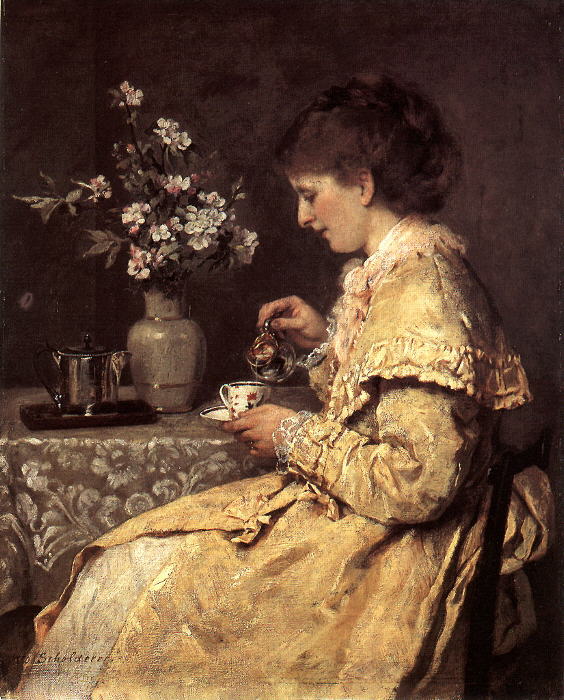
    Frau Scholderer am Frühstückstisch (c. 1872), Otto Scholderer

    When the new day had dawned, and while the women of the forest were thinking of breakfast, Theresa said she would go, now that it was daylight, and see if she could find her lady’s drops. No objection was made, and she departed on her errand.

    She was gone but a little while; and when she returned her face, full of disappointment and chagrin, told to the anxious maiden that her effort had resulted in failure. She said to Elize, who was the first to question her, that sentinels had been posted in all the rooms in that wing and that no one was allowed to enter.

    And she could tell to Electra but little more. An officer whom she had met had informed her that the orders of Sir Pascal had been peremptory. No person could be allowed in any of the rooms which either the baroness or her daughter had occupied.

    “But do not give up tall hope,” whispered the faithful servitor, as her mistress groaned in the bitterness of her disappointment. “I am as sure that Captain von Linden was in that room last night as I am that I am alive. And if he was there, he must have seen the paper; for, surely, no one else had been there before him.”

    Electra thanked the girl for her kindness, and said she would hope if she could.

    Later, when she saw her mother suffering on her account, she took it upon herself to whisper of hope; and in seeking to strengthen another, she found her own strength revived.

    They had eaten breakfast, and the table had been cleared and set aside, when Sir Pascal made his appearance. His first movement on entering was to signal to the guard-women that they might retire. At first Theresa, who was waiting upon the baroness, did not offer to move, but the knight caught her eye, and pointed to the door with a look which she dared not disregard. She had crossed the threshold, and was drawing the door to after her, when it was wrenched from her hand, and in a moment more the dark-browed knight was before her.

    “Look ye, woman!” he said, in a harsh, grating whisper, eyeing her as though he would look her through if he could—”I want you to call back the events of the past few hours and try to think if there was not something forgotten in your story of the fright you received, and of the men who caused it. Your companion was not more than three or four paces in advance of you, carrying a light that illumined the way so that you saw plainly. Of course, the very first thing you did, when you felt the touch of that hand, was to look up at the face. You could not have helped it. Now I know there was light enough to reveal to you the features—or, at least, their outlines. I ask you once more—and, mark me—if I can find that you have lied to me, I will put you to the rack!—I will, as sure as fate! Now,—once more I ask you,— Did you not see the face of Captain von Linden?”

    If there had been a quivering of the poor girl’s nerves when the man began to speak, it had all gone when he had concluded. She looked him straight in the eye, with a glance in which there was no sign of quailing, and stoutly answered:

    “You might put me to all the racks in the world, Meinherr, and I could tell you nothing different from what I have told you. Suppose, to save myself from torture I should speak a lie, and tell you ‘Yes,’ when the truth would be ‘No,’ would it help you any?”

    This simple argument fairly nonplussed the man, and having bidden the girl to hold her tongue and say nothing of that interview, he sent her away and returned to the chamber, carefully closing the door behind him.

    The baroness was sitting in a large easy-chair, near one of the windows, and did not offer to rise. Electra, however, had arisen as the knight entered, and when he had turned towards her, after having closed the door, she politely pointed to a seat. He bade her to be seated first, and when she had obeyed, he moved his chair so that he might face her, and then, with a low bow, sat down.

    He was arrayed in the full uniform of his rank as Colonel of the Imperial Hussars, graceful and elegant, even in that early day. It was new, and very likely donned for the first time. He had thoroughly soaked his head and laved his face, until a look of something like freshness had replaced the bloated, haggard look with which he had arisen. He had drank what would have been deeply for most men, but which, with him, had been only sufficient to steady his nerves, and give borrowed vigor to his system.

    After taking his seat he recognized the baroness with a slight inclination of the head; then he fixed his gaze upon the daughter, so regarding her for a time in silence. When he at length spoke, his voice was deep and low, with a sound that might be truly termed sepulchral.

    “Lady, you know what was the object of my coming to the castle. It had been for a considerable time the desire of your royal guardian, the grand duke, that I should be lord and master of Deckendorf. He had many reasons for that wish, chief of which was this: that he might have a true and reliable friend in this fortress, which, as you are aware, holds a commanding position in one of the most important passes of the Schwarzwald. At first my only desire was to please my sovereign; but since I have come hither, and have been permitted to gaze upon the face of the lady selected by him to be my bride, I have found my heart gone from me, and my duty has become my fondest hope.

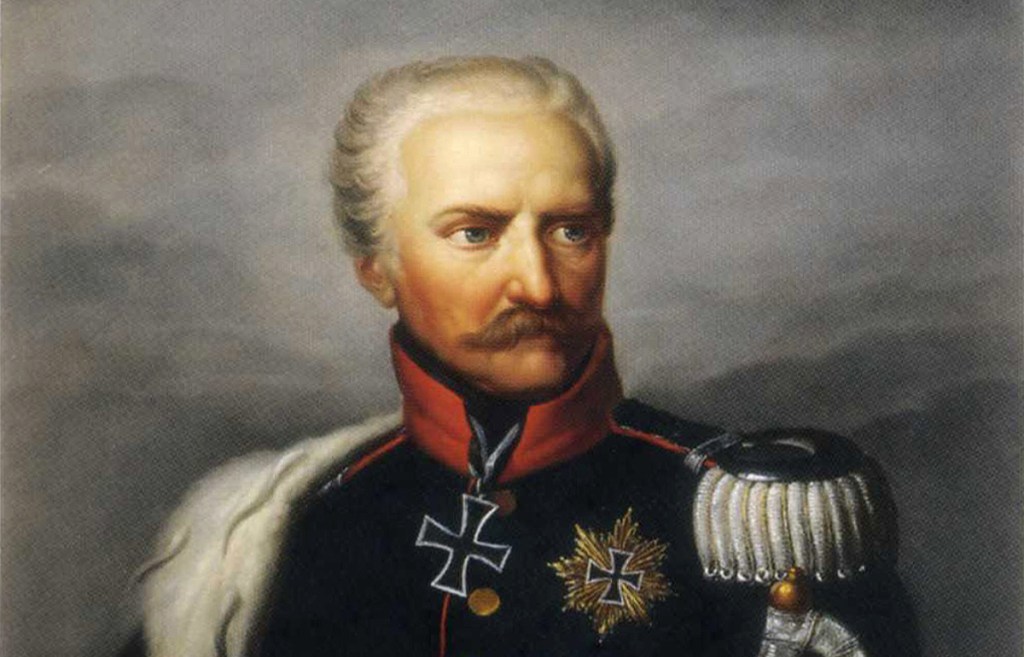
    Gebhard Leberecht von Blücher (c. 1815-19). Artist unknown, copying Paul Ernst Gebauer.

    “Of the little accidents that have happened since I came, we will not speak. I shall think of them no more; yet, you will allow me to tell you that I thank Heaven from the very depths of my heart that the bond between us has not been irreparably broken.”

    At this point, while the maiden sat like one turned stone, her only signs of sense of feeling being the changing light of her staring eyes, and the occasional twitching of the muscles of the compressed lips and the tightly-clenched hands, the speaker took his watch from his fob and consulted it. Then he put it slowly back, and changed his position in his chair. When he next raised his eyes to the maiden’s face, they had assumed a fateful glare—a wicked threatening look—and his lips were compressed until well nigh bloodless.

    “Electra!” She started when he spoke that name, as though a serpent had suddenly darted up and stung her. “Electra, it is now almost nine o’clock Before this day has seen its noon-tide you will be my wife. I know not what hopes have been held out to you of an avoidance of the union, for I will not pretend ignorance of the fact that your wish lies in that direction. I know that you have friends—they call themselves friends—who would aid you in resisting me if they could. Perhaps,” he went on, with a keener glance into the “windows of her soul,” “you have been led to think that those people can reach you here, but do you put away all such thought. My precautions are taken, and from this moment until I have held you by the hand as my wife, no human being from beyond these walls will come within the castle limits.

    “It may seem foolish for me to tell you this; but I wish to satisfy you that those so-called friends who would make you discontented with the inevitable are no friends at all. It is not impossible that your wild fancy, or your wilder hope, leads you to think that your sympathizers outside will come to you through the mysterious passage by means of which you managed once to slip away from me; but, I beg you, do not cherish any such delusion. I know every place—every nook and corner—where an entrance can possibly exist; and you may be sure I shall see that they are sufficiently guarded. Further, on that point, I have only this to say: If powder and leaden ball have any power over life and death, then, woe betide the unfortunate wight who shall attempt to introduce himself into this castle through any one of those hidden ways.”

    For the life of her, Electra could not repress the shudder that shook her frame as these words fell upon her ear. On the instant this picture was present before her eyes: Her dear lover, his heart bounding with eagerness to save her,—no matter who followed to assist, he would be surely in the lead,—his would be the post of danger,—she saw him, thus eager, behind the secret panel—saw him, moving quickly now that he was so near—touch the hidden spring—saw the panel slide noiselessly away into the adjacent wall—saw him, with the fire of ardor in his handsome face, start to enter the room thinking only of her and her weal, when— 0! taken suddenly, unaware of the danger, and shot through the heart on threshold of the pass.

    “Does it frighten you?” the knight said with a gleam of diabolical malevolence in his wicked eyes. “Let us hope none will be so foolish as to make the venture; for, I do assure you, if they come, they will come only to their death.”

    “And now,’ he added, rising as he spoke, “I give you one hour for preparation. At the end of that time I shall come for you, and you will accompany me to the place where the marriage ceremony will be performed. It will please me if I find you ready. If you wish for anything from your old apartments, you may send your maid, Theresa, who will go with Elize and get what you want. Remember—this is final.”

    And without waiting for reply he turned and left the room, passing out by the way which the servants had taken on their exit. For a little time after he had gone the stricken twain sat speechless. Then Electra started up and threw herself upon her mother’s bosom, and the loving arms were clasped tightly around her. At that moment how willingly would the widowed parent have given her life to save her child.

    “0, mamma! will they come? Will they be killed? 0, mamma! mamma! will they shoot my dear Ernest?” wailed poor Electra.

    “Hush! hush, my child! You should know Ernest better. Be sure he will not come by a way which they can suspect. If he comes at all, as I believe he will, he will be accompanied by others—by those of whom we have been told—and when he enters the keep it will be from the vault. My word for it, this wicked man—false knight—will never think of the chapel; and if he did, it would not matter, for upon entering there our dear boy would discover his enemies before they could discover him. Think of the situation of the altar, behind which is the hidden door, and you will see and understand.”

    The words were of simple fact, and they had a wonderful effect upon the hearer. In her fears for her dear lover, she had for the time forgotten herself, and now that his safety was well nigh assured, she was glad. In this spirit she resumed her seat, and shortly after Elize and Zenzel entered, behind them, a little later, coming Theresa.

    Electra was asked if she would require anything from the chambers in the old wing. She shook her head, and answered, “No.”

    The woman Elize said his lordship would be better pleased if she should put on wedding garments. A look was the maiden’s only reply, but it was a reply before which the bandit’s mate quailed and held her peace.

    Then Theresa, with a world of love and devotion in the warm clasp of her hand, ventured forward and to help her young mistress.

    “0! sweet lady,” said she, ” tell me what I can do, and I will do it if it is in my power.”

    “Nothing, Theresa, only this: stay by me if you can. Help my dear mamma if she shall need.”

    And then she drew close to her mother’s side, and took one of her dear hands in her own; and so she sat, and waited for what should come, her heart the while raised in earnest prayer for release from her deadly peril.


    Notes

    NIGHTSHIFT byTony Reck © 2025