Tag: Early American Pulp Fiction

  • A.C. Gunter’s Baron Montez: 7. “NO! BY ETERNAL JUSTICE!”

    A.C. Gunter’s Baron Montez: 7. “NO! BY ETERNAL JUSTICE!”

    In her letter Jesse does not describe or elaborate on her dire predicament. It is only following the arrival of Larchmont’s brother, Harry, back in Paris for all to be revealed in personal dialogue between the two. Given the generous insights of our narrator, our good readers may hazard a guess at what has occurred to precipitate this action on Jesse’s part. After all she is the seventeen-year-old ward of Frank Larchmont, she and her fortune under his guardianship as according to her late father’s will.

    Today, given the wealth Jessie is due to inherit on coming of age, in the absence of finaglers like Montez, one might expect her to live a relatively charmed life, however in her time there was what was known as coverture. Although Jessie’s life has been one of privilege, in terms of education and living conditions compared to the oppressive circumstances surrounding most women of the period (see Johnson, Edwards), she cannot remove herself from the legal constraints placed upon the rights of all women.

    At the Women’s Rights Convention in Senneca Falls, New York in 1848, Elizabeth Cady Stanton (1815-1902) delivered her Declaration of Sentiments, a large part of which protested against coverture, the legal doctrine that treated a married woman’s possessions, wages, body and children as property of her husband, available for him to use as he pleased. Coverture gave husbands total control—from finances and place of residency to wife-beating and marital rape (Edwards).
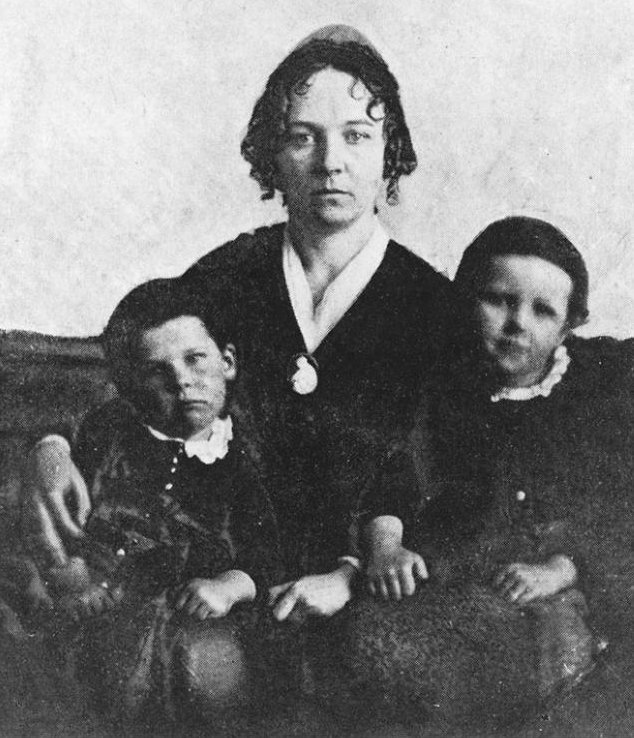
    Elizabeth Cady Stanton with her sons (1848)

    Having deprived her of this first right of a citizen, the elective franchise, thereby leaving her without representation in the halls of legislation, he has oppressed her on all sides. He has made her, if married, in the eye of the law, civilly dead. He has taken from her all right in property, even to the wages she earns.

    Excerpt from “Declaration of Sentiments” —Stanton

    Conflicts, and obstacles to be overcome, are requisites of any good story. Gunter has been working toward the end of this story arc, engineering through character definition, and events related for the reader, the abrasive, but decisive interaction that is to occur between the brothers, Larchmont. As a playwright, dialogue is Gunter’s stock in trade, and the spoken word, over an author’s exposition, communicates a direct, if sometimes false, truth, for the reader’s evaluation. Although the words exchanged are personal, the author’s intention to implement a theme of American vs European is transparent.

    The question a reader of our time might ask is why has he been setting up this nationalistic clash of cultures via two brothers, why should this appeal to the readers of his time? It is 1887, over a hundred years since the US gained independence, yet it appears the people are still defensive enough in regard to their global identity to appreciate jingoistic expression. Or perhaps, as today with extensive American coverage of the travails of Prince Harry and Megan Markle’s romance, Prince Charles and the terrible plight of Princess Diana, or the delightful children of Prince William and Duchess Catherine, there is a proportion of the American public that continue to be so enamored and fascinated with European culture and royalty to warrant chastisement.

    Ironically, using Jesse’s ‘chevalier’, as she has called Harry, or knight, fashioned to ennoble and set right American values, Gunter relies on a trope of European origin.


    CHAPTER 7

    “NO! BY ETERNAL JUSTICE!”

    The words are blotted with tears, and the whole appearance of the epistle is such as to give the young man a shock. He throws this off, however, remarking to himself, “Pshaw! She’s only a child in short dresses yet! I presume she must have been naughty. Even if she has been disobedient she needn’t fear Frank, he is gentleness itself to her.” But this evasive kind of reasoning does not suit him. After communing with himself fifteen minutes the action of the man comes into play. He was dawdling by the Rhine. He dawdles no more. And in one hour afterwards he is en route to Paris, as fast as an express train can take him.

    Arriving there next day, he goes over from the Gare du Nord, as fast as a fiacre can take him, to the pretty little villa on the Boulevard Malesherbes.

    “Ah, Monsieur Henri, you have come back from Germany,” says the footman, opening the door, a grin of welcome upon his Breton face, for this young gentleman has endeared himself to the servitor by many fees.

    “Yes, you need not mention the matter to my brother, if he’s at home,” says Mr. Larchmont, “but I presume he is out?”

    “I think he is at the Bourse.”

    “At the Bourse? That is rather astonishing.”
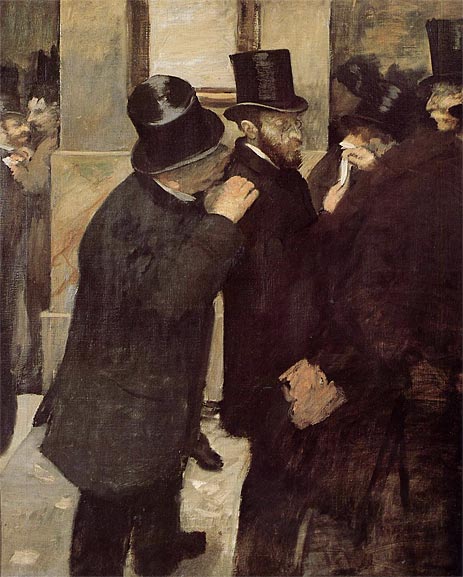
    At the Stock Exchange, Edgar Degas (1878)

    “Oh, he goes there every day, now,” answers the man.

    “The dickens!” ejaculates Mr. Harry, and this information would set him wondering, did not another idea fill his mind. He says: “Step upstairs, please, Robert, and tell Miss Jessie that I am here, and would like to see her.”

    “Mademoiselle Jessie is at her lessons,” replies the footman, “and I don’t think the governess cares to have her disturbed.”

    “Never mind about the studies, Robert, I have only a few hours to stay in Paris. Just show me up to the school room, and I will break in upon the lessons, and help her with them,” returns Mr. Harry, and walks up to find Miss Jessie and get a surprise.

    As he opens the schoolroom door and looks in upon her she is prettier than ever, but not wearing out her blue eyes over books, though there is a troubled look in them. She springs up with a cry of joy, and, as he gazes at her, he notes that during his few days’ absence an occult change seems to have come over the girl. Her short skirts had seemed to him her proper costume; now as she glides toward him they appear too juvenile.

    She utters a warning “Sh-h-h!” and puts a taper finger to her lips, then whispers: “My governess is in the next room. She thinks I am studying, but I was thinking—thinking;” next gasps, “Harry! Dear good Harry! God bless you for coming to me!” and the pathos in her manner, and look in her eye, tell him that a great trouble has come into this child’s life.

    “I am here,” he says, astonished at the girl’s manner, “to do anything you wish, Jessie; but it seems to me you should have applied to my brother, who is your guardian, before coming to me.”

    “It is he who makes me come to you!”

    “My brother?”

    “Yes! Your awful brother is using his authority as my guardian. After the horrid manner of the French, he has betrothed me.”

    “Be—betrothed you?” stammers the young man shortly in intense surprise.

    “Yes, to that odious Baron Montez!”

    “What, that old stockjobber? He’s twice your age! You are but a child.”

    “I am seventeen, and, in spite of training, an American seventeen; and that is old enough to know that I never will marry Baron Montez!” cries Miss Jessie, angry at the suggestion of youth, more angry at the thought of Montez.

    “Oh, ho, you love another!” laughs the young man, who tries to take this matter quite easily before the ward, though great indignation has come to him against the guardian.

    “No, I love no one! I hate everyone. Rather than marry Fernando Montez,” falters the girl, her lips growing pouting and trembling, “I’d sooner go into a convent.”

    Whereupon the gentleman says, in offhand manner: “Pooh! Pooh! No convent for such a beauty as yours.”

    “And you will save me, even though your brother uses his authority as my guardian?”

    “Certainly!” says the young man.

    “Swear it!”

    “Very well, you have my promise,” returns Harry who is loath to take the affair seriously; “but I don’t think you need have troubled me. Had you spoken to my brother, he would have most assuredly not tried to coerce your inclination in such a matter.”

    But here Jessie’s words bring astonishment, disgust, and displeasure against the man he calls brother, to the gentleman facing the excited girl. She whispers: “I have told your brother! I have told him that I loathed, I detested, I hated the man he wished me to marry!”

    “And he did not listen to you?”

    “No! He said it was absurd for me to rebel against his lawful authority. That I must, and I should, do what he told me.”

    “He did, did he? Then hang him! I swear you shall not!” cries the young man, for something in Jessie’s manner tells him she is speaking from her heart. “You shall only marry the man you want to!”

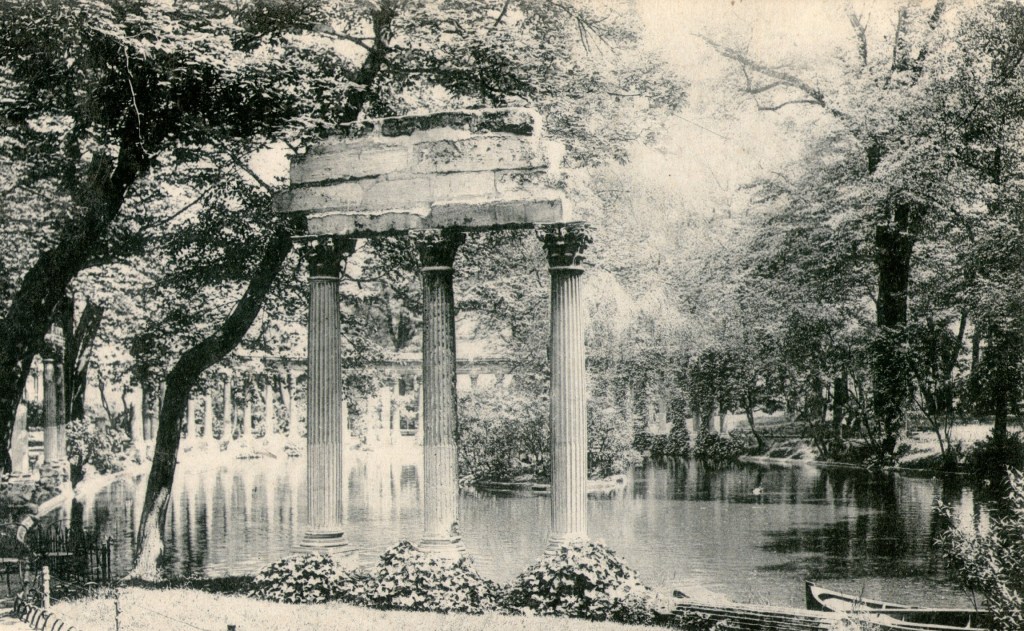
    So he leaves the young lady reassured, and strolls over into the Parc Monceau (his brother not having returned from the Bourse), and communes with himself in the exquisite little pleasure ground, looking at the beautiful naumachie and rock grotto, and would reflectively toss stones into the lake, did not a gend’arme restrain him.

    La Naumachie, Parc Monceau (postcard, n.d.)

    And all the time his eyes grow more determined, and the indignation in his heart against his brother increases.

    Then he strolls back to the house, and Mr. Francois Larchmont being at home, walks into that gentleman’s library, with a very nasty look upon his countenance.

    “You here?” says Frank, starting up with unnerved face. “This is a surprise!”

    “Yes,” says the other nonchalantly. “In Cologne I received a letter from Miss Severn—I suppose we must call her Miss Severn, since you consider her old enough to marry. By the by, I think you had better have her governess put her in long skirts; she’s been growing lately.”

    While he has said this, notwithstanding Harry’s manner, Frank’s face has become white. He suddenly asks: “Did that stop your journey?”

    “Certainly! An appeal from a woman would stop any man’s journey. I have seen your ward. She tells me what I find it very hard to believe—that you wish to exercise your authority as her guardian, to coerce her into marrying this South-American stock-jobber, and gambler—Baron Fernando Montez. Is it true?”

    “It is,” falters the other. “I wish her to marry him!” Then he goes on suddenly, noting the look of disgust upon his brother’s face, “Don’t misunderstand me, Henri, it is necessary. She has now arrived at the age when it is best for her—for any young woman—to enter the world; and to do that in France, it is necessary for her to take a husband.”

    “But not such a husband.”

    “He will give her title.”

    “Pooh! titles are common here.”

    “He will accept her—and this is the important part of the matter—without a dot.”

    Without a dot? Why, she is worth a million dollars in her own right.”

    “Nevertheless she will have no dot!

    “What do you mean?” gasps the other.

    Then Frank bursts out hurriedly: “Don’t look at me so. I have lost Jessie’s money in speculation.”

    “Then you must make it up out of your own fortune. You are a very rich man!”

    “I was.”

    “Good heavens! have you lost that also?”

    “Yes, it is involved. At present I could not, if called upon, hand over Miss Severn’s fortune, which was entrusted to me by her father’s will, when I gave her to her husband. In France it would be demanded at once, if anyone else except Baron Montez married her.”

    “And you have lost all this money—in what?”

    “In the shares of the Panama Canal, I think.”

    “In the Panama Canal, you think?” sneers Harry. Then he scoffs: “You—you are the only American who has not made money out of that giant fraud? You are so afraid of being thought a man of business, that you have let that swindling South American make you bankrupt?”

    “I—I do not know—my affairs are involved. I have entered into so many speculations with Baron Montez.”

    “Ah, he has your money!” cries the New Yorker.” He has Miss Severn’s money. He has got the dot before. Now he will take the bride, generous man, without it, but she shall not marry him! I have sworn it!”

    “Great heavens! You would ruin me!”

    “I would ruin everyone to save this girl’s happiness!”

    “You—you love Jessie?” gasps Frank with twitching lips.

    “As a brother! That is all. But it is well enough to see she is not wronged by you!”

    “You forget I am her guardian!”

    “And I am her protector! She shall not marry Baron Montez! I’ll prevent it with my fortune—with my life! Do you suppose I will stand by and see a lovely, beautiful, young American girl sacrificed on the altar of your speculations? No! By eternal justice!”

    “You will save her?” asks Francois Leroy Larchmont, a curious wistful look coming into his uncertain eyes.

    “Yes!”

    “God bless you!” cries the man, and sinks down into a chair, sobs in his voice, but no tears in his eyes.

    “Why do you thank me for saving her from your friend?”

    “He is not my friend! I hate him! I fear him! I loathe him now, but I am in his power! But thank God! Henri,” and the weak man has seized his brother’s hand and wrung it, and is muttering to him: “Thank God! you will save her—save her from marrying him—save her for me—for me—I love her!”

    “Not for you!” cries the other, breaking away from his brother’s grasp, and an awful contempt coming into his soul. “You are not worthy of her. You love no one but yourself, and that not well enough to fight for your own hopes, desires or loves! When you renounced your country, you gave up manhood! But I’ll save her for some good American!”

    With that he leaves his brother, who has sunk down, and is cowering away from Harry Larchmont’s indignant eyes, and goes up to again see the lovely girl her guardian’s weakness would have sacrificed, and tells her to be of good cheer, that he will save her. “Only one thing—procrastinate this matter,” he adds. Then he queries wistfully, “Can you be woman enough to procrastinate? Are you still a child?”

    “Why not defy him? With you by my side I’ll snap my fingers in Montez’ face.”

    “That,” says the young man, wincing a little, “will require a sacrifice from me.” For he knows, if matters come to a climax now, to give this girl her fortune and keep his brother’s name in honor before the world, will sadly cripple his means and make him comparatively poor.

    Looking in his face the girl says suddenly: “No, I see it is important. I am not child enough to ask too much. I will do as you say.”

    “In every way?”

    “In every way.”

    “Then procrastinate. Get my brother to bring you over to New York for this winter; put off the wedding till the spring—till the autumn. If Frank demurs, tell him you will write to me, and that will settle the affair, I think.”

    “You—you are going away?” falters the child, growing pale at the thought of his desertion.

    “Yes, I am going away.”

    “Why?”

    “To save you.”

    “How?”

    “To find out more about this man, who has my brother in his powerthis Baron Montez of Panama and Paris. Here he is surrounded by all the Panama clique; there is no rent in his armor that I, an American, unaccustomed to the ways of Paris, can pierce. If he has a flaw in his cuirass, it is at the other end of the route. I am going to Panama. Please God, I’ll nail him there! I leave this evening for England. Then to New York, to arrange several matters of business, for if the worst comes to the worst—”

    “You will permit me to be sacrificed?”

    “Never! It is for that I go to New York.”

    “But if the worst comes to the worst, you—”

    “It is for that reason that I go to New York. Don’t ask me questions. Only know that I am forever your protector. What my brother has forgotten, I will do; his dishonor shall be effaced by me.”

    “His dishonor!” cries the girl. “What do you mean?”

    “Nothing that I can tell you; but good-by, Jessie. Be sure of one thing—that you need never marry Baron Montez of Panama!”

    “God bless you!” cries the girl, and gives him the first kiss she has ever given him in her life. But it is the kiss of the child, not of the woman. The kiss of gratitude—the kiss that beauty gives to the knight that risks his life to save her from the giant Despair.

    Twenty-four hours after, Harry Larchmont sailed for New York on the Etruria, and a month later his brother brought his ward to America upon the Gallia; but Baron Montez said to him, “Remember, mon ami, you must bring her back by Easter. Springtime in France will suit Mademoiselle Jessie’s beauty.”

    Four weeks after the Larchmonts arrive in New York a letter comes to Fernando, from a co-laborer of his in the Panama scheme, one Herr Alsatius Wernig, who is in America on some joint business, and will shortly proceed to the Isthmus.

    This epistle contains some curious news about the Larchmonts.

    After reading it the Baron’s face grows grave for a moment, then it suddenly lights up. Montez, with a jeering smile, exclaims: “What? That idiot who plays football and takes the chance of being killed for fun!” A moment later he remarks meditatively: “There is always danger in a lunatic!” and an hour afterwards sends a carefully prepared cablegram to Herr Alsatius Wernig in New York.


    Notes and References

    • trope: “a recurring theme or motif, as in literature or art: e.g. the trope of motherhood; the heroic trope. A convention or device that establishes a predictable or stereotypical representation of a character, setting, or scenario in a creative work” (dictionary.com).
    • fiacre: “a small four-wheeled carriage for public hire” (lexico.com).
    • stockjobber: “a stockbroker, esp one dealing in worthless securities” (Collins).
    • naumachie: an artificial lake, orig. used for mock sea battles for entertainment.
    • without a dot: colloquial—less than nothing—zilch, nada.
    • cuirass: “a piece of armour consisting of breastplate and backplate fastened together” (OED).

    Accampo, E.A., Rachel G. Fuchs and Mary Lynn Stewart (eds.), Gender and Politics of Social Reform in France (Baltimore: Johns Hopkins University Press, 1995).

    Edwards, Rebecca: Early Women’s Rights Activists Wanted Much More than Suffrage. history.com, 2028. Jump to Article

    Johnson, Julie Anne: Conflicted Selves: Women, Art & Paris 1880-1914. PhD Thesis, Queen’s University
    Kingston, Ontario, Canada, 2008. Jump to file

    Stanton, Elizabeth Cady, “Declaration of Sentiments” address, Seneca Falls, New York, 1848. Jump to Transcript

    Tilly, Louise and Joan Scott, Women, Women, Work, and Family (New York: Holt, Rinehart, and Winston, 1978)

    This edition © 2021 Furin Chime, Brian Armour

  • A.C. Gunter’s Baron Montez: 6. Jesse’s Letter

    A.C. Gunter’s Baron Montez: 6. Jesse’s Letter

    Although this chapter begins in 1880, it spans the years to 1887. The Baron Montez, Larchmont and his ward, Jessie, arrive in Paris at the centre of a glorious time which in the future will be known as the ‘Belle Epoque’. Imagine wide boulevards where bunches of flowers spill from vendors’ baskets onto the pavement before you, ladies in colorful flowing dresses with ornamented bustles parading, carrying equally beautiful parasols, gentlemen in tailored suits and top hats, the fragrance of coffee from the many cafes, the boulangerie and the sweet smell of fresh bread filling the air, artisan shops and vendors of all types, salons with art covering every inch of their walls. There is sunshine, fresh air and walks in the numerous squares and parks to be enjoyed, but these are only relatively recent additions to life in Paris.

    Boulevard des Capucines (1873), Claude Monet

    In 1853, the Emperor Napoleon III decided to continue the civil works of his uncle, Napoleon Bonaparte. Many plans and attempts in the past to improve and modernize Paris had failed. Paris had been closed up and congested with numerous tenements and slums in which pestilence and disease prevailed. The average life expectancy of a Parisian was forty-six years versus a rural life expectancy of fifty-years (Kesztenbaum & Rosenthal). Louis Napoleon engaged Georges-Eugène Haussmann to carry out massive civil works while renovating and repairing landmark buildings and facilities damaged during the reign of the Commune. One of the first works completed is the restoration and extension of the Rue Rivoli where a special character in Gunter’s novel, Bastien Lefort, has his glove shop.

    Napoleon III instructed Haussman to aérer, unifier, et embellir’ (ventilate, unify and beautify) Paris. Haussmann’s plan constructed boulevards and avenues, squares, and parks; theatres, markets, schools; new railway stations, a sewerage system and freshwater aqueduct. The projects employed thousands of workers.

    Immigrants flooded Paris, as did art students, including those from the United States, who made up the largest foreign contingent, to study in the numerous art schools (Weinberg). Not just art students but sculptors, architects, writers, academics and wealthy American collectors. The whole city was brimming with culture as its population boomed. The construction of the Eiffel Tower would soon commence. The construction of sewers beneath the city had begun and the delivery of fresh water to parts of Paris; this as well as the introduction of trashcans, known as poubelle after their instigator, would lead to a rise in life expectancy. During the Exposition internationale d’électricitė in 1881, the Grands Boulevards were illuminated with electric lights. The hill overlooking Paris, Montmartre, once a rural district, was brought into Paris proper, and its cheap accommodation became a haven for artists of the like of Van Gogh, Renoir, Monet, Degas and many others. It was an exciting time to be in Paris. At the bottom of the hill, in 1882 the city’s first modern cabaret, Le Chat Noir, opened.

    La danse au Moulin Rouge (1890), Henri de Toulouse-Lautrec

    Rather than the beauty that is vibrant Paris, which someone such as young Jessie might enjoy, our narrator is more concerned with the speculative financial skullduggery of Baron Montez, who is growing in influence and wealth, naturally to the detriment of others. As anticipated by the Baron, the doomed French Panama Canal project is coming to an end and investors in the enterprise will see their shares become valueless. If this weren’t enough, in January 1882 the Paris Bourse crashes due to the failing of the Union Générale bank, which causes ten years of recession (White). Our narrator doesn’t mention this, and the financial dealings of the Baron Montez are dealt with summarily, for it is all background noise to his major play for the lovely seventeen-year old Jessie.

    It is not by accident that a young Jessie expresses a fervent pride in being American, nor is the arrival of Larchmont’s all-American brother, Harry to set up a dynamic with his opposite, the weak-chinned, sedentary Francophile, Francis. Defense of American values abroad our Author knows will appeal to his readers; and isn’t it only right that it should be the wholesome, strong, patriotic Harry and his remarkable elbow that intercedes for our Goddess of Liberty?


    CHAPTER 6

    JESSIE’S LETTER

    After this, the time passes pleasantly for the great Frenchman and his party at Panama in picnics, sight-seeing, and excursions around the beautiful bay. They run down to the Pearl Islands, and visit Montez’ villa at Toboga. They view the ruins of the old city, and finally, the preliminary reports from the engineers being received, they one day put a little dynamite cartridge into the great mountain of Culebra, which will be the deepest cut on the whole line, and blow out an infinitesimal portion of its great side, little Mademoiselle Fernanda de Lesseps touching off the giant powder fuse, and announcing that work has really commenced on the great canal.

    Then they depart, Monsieur de Lesseps taking steamer from Colon to the United States to obtain the proper concessions from the Panama Railroad Company necessary to his legally carrying out his project. Baron Montez and his Franco-American friend, however, leave the Isthmus direct for France, via Martinique and St. Lucia.

    At Martinique they stop a day or two, and chance in a local museum to see one of the deadly snakes of that Island, the fer-de-lance, at which they all shudder, but Fernando turns very white and trembles; so much so, that little Jessie, holding her governess’ arm, says: “Mademoiselle, why is Baron Montez so afraid of a snake?”

    Mon Dieu! my dear, replies the Frenchwoman, “everybody trembles at such hideous, crawling, deadly things. You did—so did I!”

    “But I didn’t nearly faint—and he is a man, and I am only a little girl!” And she looks with wondering, childish eyes after Montez, who has moved away from the sight.

    But they soon leave this island. Two weeks later finds them at that centre of the French universe—the great city on the Seine—where Francis Leroy Larchmont settles down in a beautiful villa on the residential part of the Boulevard Malesherbes near the pretty little Parc Monceau with his little ward and attendants, and Baron Montez engages fine apartments just off the Boulevard de Capucines, where he can be near the Press Club and baccarat, an amusement in which he takes great delight.

    He soon has hosts of friends, for he spends his money freely, hoping to get return from the same in the near future, with usurer’s interest.

    In this capital of France, De Lesseps, soon after returning from the United States, inaugurates his great scheme. The shares are taken by the peasants of France, every village has its subscriber, work is begun in reality upon the canal.

    Then comes the time of harvest for Montez. He founds the firm of Montez, Aguilla et Cie.—Aguilla being practically a clerk, with a nominal interest—and for it obtains a contract for a portion of the work, at great figures. He circulates between Paris and Panama, dabbling in contracts, dabbling in shares, and making money in everything, for he knows what takes place on the Isthmus, as well as what goes on in Paris.

    All the time he is doing this, investors’ money is being squandered like water, and the shares of the Canal Company go lower and lower. But Montez loses not. He has ecome too near the Board of Directors to suffer; he knows too much of the inside politics of the scheme to permit its magnates to let him lose a single franc in this Canal Interoceanic.

    Besides, he, by the diplomatic arts of entertaining and open pocket book, is now a boon companion with many a space-writer for the press—a class vigorously strong in shrieking their incorruptibility, and very pliable to the persuasive check book and bank bill, as impecunious classes generally are. Again, he has a few easy deputies of the Corps Législatifs under his thumb, owing to postponed debts at baccarat and many little suppers at Des Ambassadeurs and le Madrid and the Alcazar. In fact, he is a power at which the directors of the canal stand aghast, and would strike down were their enterprise upon a basis sufficiently solid for them not to fear what Fernando Baron Montez’ ready tongue might hint to stock holders already becoming suspicious.

    But stock and preferences in a losing concern, to make their owner rich must be converted into money of the realm and more substantial securities. To do this it was necessary to find purchasers; and to beguile, allure and dazzle investors to transfer their gold to his pockets; for shares in the Canal Interoceanic had been Montez’ first, great and continuous effort ever since he had determined the enterprise must fall, even of its own weight.

    His ready tongue, unscrupulous assertion, and, if necessary, direct and brilliant lies, had gained many listeners and some believers, notably among them one Bastien Lefort. This person, curiously enough, was a noted miser, who had lived to sixty, saving his accumulations, adding to them franc by franc the product of not only a life of toil, but a life of absolute deprivation. Beginning as a clerk in a small booth, he had saved and pinched till he had become a shopkeeper himself. Then he had squeezed and accumulated till he was worth nigh on to a million francs, each one of which meant not so much profit, but so much stint and discomfort and privation—even to lack of fire in winter and lack of food in summer. This hoarded treasure he did not dare invest in real estate—even city property sometimes depreciates. He did not dare deposit in a bank—banks fail—but kept his gold in safes of his own and the strong box of the miser.

    All his life Bastien Lefort had said he was looking for an investment—one that would be sure as the Bank of France but would return large usury—such an investment he had been seeking for forty years. Within three months after Baron Montez strolled into his little magasin de gants, on the Rue Rivoli, to buy a pair of gloves, the Panama philanthropist found it for him.

    Among those gathered into these Panama ventures is François Leroy Larchmont. From the year 1880 to 1887 Fernando has been gradually involving the wealth of the Franco-American, who has become his bosom friend; and not content with this, has succeeded in drawing into the financial maelstrom that is now running over Paris, the fortune of the orphan, the little girl, that her weak guardian had in his charge, and which should have been secured in consols and collaterals undoubted.

    So one day, towards the close of the year 1887, Montez thinks it time to speak, for all these years the loveliness of this graceful girl—this American beauty—this fairy beauty, who is still in the schoolroom, but nearly a woman, has appealed more and more to him. He has looked upon it, and says it shall be his. He has whispered to himself: “These people are in the toils. I am wealthy as a New York nabob! I will marry this beautiful creature. The loveliness of the Baroness Montez shall make her a queen in the fashionable circles of this gay capital, and I shall be one of its princes—I, Fernando Gomez Montez, once mule-boy on the Cruces trail!”

    Thinking this, he one day calls upon his bosom friend, François Leroy Larchmont, who is just admiring a newly purchased picture, for this gentleman is a dilettante in everything artificial, and dabbles in paintings, scores of unproduced operas, and manuscript verses and novels; dealing with the prodigality of a connoisseur, and the lack of knowledge of an amateur.

    “I want to speak to you, Larchmont, mi amigo, on a particular subject.”

    “Yes, but first admire the beauty of this picture, Montez. The head is that of a newly discovered Madonna!”

    “Ah, but not as beautiful as Mademoiselle Jessie, your ward.”

    “Why, Montez, she is but a child!”

    “Nevertheless it is time she should marry, I wish to speak to you of her!”

    Turning from his painting, in his nonchalant way, François Leroy Larchmont hears words that give him a fearful shock.

    He remonstrates.

    Then the easy tone of the friend changes to the voice of the master; and before the interview is over, this weak and untrustworthy creature has given such hostage to his enslaver that makes him ashamed to look his lovely charge in the face; for he knows in his feeble heart he has done the act of the dastard and the coward.

    Now while this has been going on, several times in the years between 1880 and 1887, François Leroy Larchmont has received visits from his younger brother Harry Sturgis Larchmont, who has come over from the United States when his collegiate course has been finished, and has assumed, in his offhand, American style, the rôle of a relative, and the good comradeship of a friend, to his brother’s pretty ward.

    This has been done in the easy manner of youth.

    Young American, postcard, Atlantic City (n.d.)

    Once, on his visit after his college days at Yale, he had upheld her against guardian and governess in a way that had endeared him greatly to Miss Rebel.

    It was one Fourth of July. Harry had come in the dusk of the day to dress for the banquet in honor of the United States at the American Minister’s.

    He is talking to his brother in the salon which looks out upon a little courtyard made pretty by flower beds, and a graceful kiosk in which the gentlemen sometimes take their breakfasts.

    Harry has just remarked, “Frank, I’m sorry you sent a regret to Mr. Washburn’s invitation. It looks as if you had forgotten George Washington and fire crackers.”

    “My dear Henri,” lisps the elder brother, “I have promised to listen to a new manuscript comedy. Farandol, le jeune, its author, thinks I have influence with the management of the Palais Royal, and may get it produced. As for firecrackers and such juvenile nuisances—” Here he gives a great start, and cries, “Mon Dieu! What is that? Dynamite?”

    For a loud explosion has just come from the garden, and Parisians, in grateful memory of the Commune, always fear dynamite and Anarchists.

    “I rather imagine that is a little piece of the Fourth of July,” laughs Harry, who has made Miss Severn a patriotic present of fireworks and firecrackers this very morning.

    A moment after, Jessie, with defiant face that is slightly grimed with gunpowder and burning punk, and a bunch of firecrackers in her hand, is dragged into the room by her governess and an attendant maid.

    “In spite of my protestations and commands she has exploded them in the bed of daisies, Monsieur Larchmont,” says the duenna, looking with reproving eyes upon her charge who stands pouting but unrepentant.

    Mon Dieu! My white daisies! “cries Mr. François; then he remarks sternly: “This is most unseemly! Jessie, don’t you know it is wrong to disobey your governess—wrong to make a noise, and disturb me with explosions?”

    “Not on the Fourth of July!” mutters the child. Then her eyes flash, and she cries, “I will fire them! I’m American! I ain’t French, and I will fire them!” and emphasizes her declaration by defiant eyes and stamping feet.

    “Oh, this is terrible!” murmurs Mr. Larchmont.

    “If you would permit me,” suggests the instructress, “I think Miss Jessie should be put to bed.”

    “What! for being a patriot?” cries Harry, intruding on the scene. Then the young man goes on firmly, “Jessie shall celebrate the Fourth, and I’ll help her.”

    “But, Henri,” expostulates his brother, “the gensd’armes will arrest me. It is violating a municipal ordinance.”

    “Then you pay the fine, or I’ll do it for you,” returns the younger man. “You go off to your comedy reading, and Miss Jessie and I’ll make a patriotic night of it.”

    “Will you?” cries the girl; then she comes to him and puts her arms about him, after the manner of trusting childhood, and whispers, “I knew you would. You’re a Yankee, so am I.”

    “You bet!” says Harry, giving way to slang in this moment of patriotic enthusiasm. “You and I, Jessie, are the only Americans in this house.”

    “Well, have your will!” replies the older brother. “I’ll go off to the reading and get away from the noise.Jessie, come and kiss me goodnight.”

    “I won’t,” returns Miss Jessie. “You would have let Mademoiselle put me to bed if it hadn’t been for Harry—Harry’s my chevalier.”

    “You won’t kiss me,” mutters the child’s guardian.

    Then he astonishes his brother, for he goes to his pouting charge, and says: “I beg your pardon, little one. Won’t that get a kiss?”

    “Yes, two!” answers Jessie, and gives him three very sweet ones, for her guardian is very kind to her, and generally lets her do her will except when it disturbs his ease or puts him to trouble.

    So Harry and Jessie go off to their fireworks, where, amid revolving pinwheels and colored lights, the little lady in her dainty Parisian dress looks like a miniature Goddess of Liberty, though Mademoiselle, her governess, shakes her head; and the maid, whose white apron has been soiled and her cap put awry, and her skin somewhat bruised by the struggles of Miss Rebel when she had been dragged in, mutters: “If I had my way with Miss Vixen, I’d smack her good.”

    After this Miss Jessie looks upon Harry Larchmont as her Court of Appeals from all decisions against her childish whims. And when, sometime after, a pretty trinket of gold and jewels, commemorative of this event, comes to her from New York, it does not tend to make her forget her Fourth of July champion.

    Young woman of La Belle Epoch (Fr. postcard, n.d.)

    This very year, when he is making a little tour of Europe, Miss Severn has renewed her trust in him, and they have grown greater friends. The exquisite beauty and grace of the girl have appealed to him, as they would to any man, though she has seen but few, being still kept at her studies much closer than Mr. Harry Larchmont thinks is necessary. For, on leaving for his German trip he has remarked to his brother; “Why not bring Jessie over to America, put her in society, and marry her to an American?”

    “She is too young for society.”

    “She is not too young to have a good time. Give her a chance at a beau anyway. Whether she marries or does not, just at present is of no particular moment; but her enjoyment is!”

    “I will consider your suggestion, Henri,” says the brother, a wistful expression coming over his face, but his answer is cut short.

    “Confound it! Don’t call me Henri. Do you suppose I would ever call you François?” bursts in the younger brother. Then he goes on quite dictatorially, “Frank, be an American, and a man. Leave this foreign place where you are dawdling away your existence!”

    “And what are you doing in America?”

    “Nothing!”

    “Am I not doing the same in Paris?” says the other, with an attempt at a laugh, which changes into a sigh as he continues, “I wish I could leave Paris!”

    “What keeps you?”

    “My interests.”

    “Pooh! your fortune is well invested, and you can sell this pretty little villa at a profit, even now, notwithstanding Panama shares have gone down!” answers the younger brother. So, departing upon his journey, he thinks he will have an hour in Dresden, a week in Vienna, three days in Berlin, and get home for the first Patriarchs’ ball of the season in New York.

    Curiously enough, this young gentleman, though a man of fashion, has a good deal of action in him; though nominally he does nothing, he is energy itself, killing time by athletics, hunting, pigeon shooting. He is very good at some of these sports, which, if they do not exactly elevate a man, at least keep his muscles in condition, and his mind active. He has been a great football player, and is still remembered in his college as a wonderful half back. He leads the German at Delmonico balls, with a vigor that startles the languid youths who perform in the cotillon; and young ladies are very happy to have his strong arm as a guide, and his potent elbow as a guard from collisions in the dance, for he has not yet forgotten an old football trick.

    His innocent looking elbow has many times caused young Johnnie Ballet, who dances so recklessly, and Von Duzen Van Bobbins, who prances about so carelessly, to wonder why they so suddenly get extremely faint and out of breath, when they come in contact with his deft elbow. But they have not played on college campi, and do not know how effective this elbow has been in putting many a Princeton rusher out of play, and many a Harvard slugger on the ground, in the desperate scrimmages of the football field.

    It is late in 1887 when Harry Larchmont goes away for his German tour, in the careless, easy frame of mind that he has been wont so far to run through life. Three days afterwards, at Cologne, he receives an agitated letter from Miss Jessie Severn, praying him to come to her for heaven’s sake, before he leaves for America. Its end gives this easygoing young athlete a start, for it closes:

    Dear good Harry, as you love the memory of your mother, don’t let your brother know I wrote this.

    Your frightened to death

    Jessie.”


    Notes, References, Further Reading

    • poubelle: common Parisian term for trashcan named after Eugène-René Poubelle (15 April 1831 – 15 July 1907)  a French lawyer and diplomat who introduced waste containers to Paris.
    • Culebra: “the name of the mountain ridge the canal cuts through and also originally applied to the cut itself. The cut forms part of the Panama Canal, linking Gatun Lake, and thereby the Atlantic Ocean, to the Gulf of Panama and hence the Pacific Ocean. Digging at Culebra began on January 22, 1881. A combination of disease, underestimation of the problem, and financial difficulties led to the collapse of the French effort. The French had excavated some 14,256,000 cubic metres (18,646,000 cu yd) of material from the cut, and had lowered the summit from 64 meters (210 ft) above sea level[4] to 59 meters (193 ft),[5] over a relatively narrow width.”
    • fer-de-lance: “Bothrops asper (common names Terciopelo [English], Cuatro Narices [Spanish], and often called the fer-de-lance (French – ‘spearhead’). It is a highly venomous pit viper species, ranging in distribution from southern Mexico to northern South America. It is found in a wide range of lowland habitats, often near human habitations. Because of its proximity to human habitations and its defensive temperament.”
    • magasin de gants: store of gloves.
    • consols: form of government issued perpetual bond, i.e. irredeemable.
    • dilettante: “a person who cultivates an area of interest, such as the arts, without real commitment or knowledge” (lexico.com).
    • dastard: someone wicked and cruel.
    • le jeune: the young
    • the Commune: “a radical socialist, anti-religious, and revolutionary government that ruled Paris from 18 March to 28 May 1871.”
    • duenna: from Spanish—”older woman acting as a governess and companion in charge of girls” (lexico.com).
    • gensd’armes: ‘men at arms’, armed police,
    • chevalier: a knight of prestigious order such as French Legion of Honour.
    • Goddess of Liberty: an atemporal comment, likely referring to the Statue of Liberty, which at the time of the story has yet to be built. Throughout history there have been many goddesses of Liberty—the Roman goddess Libertas is one, Marianne who wore the cap of Liberty in 1792 another—though it is unlikely he means any of these.
    • cotillon: “French country dance, a social dance, popular in 18th-century Europe and America. Originally for four couples in square formation.”
    • Corps Legislatif:  “a part of the French legislature during the French Revolution and beyond. It is also the generic French term used to refer to any legislative body.”

    Calavita, Nico. ‘Haussman, Baron George-Eugene’, in Caves (333-4) .

    Caves, Roger R, ed. Encyclopedia of the City. (London: Routledge, 2005). Re. Haussman.

    Glancey, Jonathan. ‘The Man who Created Paris‘, BBC Culture / Architecture.

    Kesztenbaum, Lionel & Jean-Laurent Rosenthal, “Public goods and health inequality; Lessons from Paris, 1880-1914”, IAST General Seminar, Toulouse: IAST, October 11, 2012. PDF here.

    Papayanis, Nicholas. Planning Paris Before Haussmann (Baltimore: Johns Hopkins, 2004).

    ‘The Making of Paris: The Grands Travaux of Napoleon III and Baron Haussmann (1848-71).’ Alliance Française of Boston. Video URL.

    Weinberg, Barbara H. ‘Americans in Paris, 1860–1900‘, Metropolitan Museum of Art, New York. Oct. 2006.

    White, E. (2007), “The Krach of 1882 and the Bailout of the Paris Bourse”, Cliometrica, 1.2, pp. 115–144. PDF, Rutgers.

    This edition © 2021 Furin Chime, Brian Armour

  • A.C. Gunter’s Baron Montez: 5. Black Blood Changes to Blue

    A.C. Gunter’s Baron Montez: 5. Black Blood Changes to Blue

    Twenty-five years after the closing events of the last chapter, Panama is still our setting, though the focus has shifted from the Panama Railroad to a new major engineering challenge: The Panama Canal. The year is 1880 and Ferdinand de Lesseps, French diplomat and developer of the Suez Canal and his entourage, are in Panama to celebrate commencement of the French undertaking to link the Pacific and Atlantic Oceans.

    Ferdinand de Lesseps (1805-1894)

    A New York reporter tries to obtain engineering information from the official party, and amid an ensuing scuffle, mention is made of the Monroe Doctrine. Instigated by John Quincy Adams, then US Secretary of State, and first delivered in a speech by President James Monroe in 1823, this policy became a formative statement in the international presence of the United States. It fundamentally and unilaterally opposed European colonialism in the Americas, or meddling “into any portion of this hemisphere” (Monroe). Most of the Latin American colonies had either gained independence from Portugal or Spain, or were on the point of doing so. Monroe stated that any European efforts to reestablish control would be seen as unfriendly toward the United States. The United States would, however, recognize existing European colonies.

    The attitude of the United States towards France was quite positive at this time. France had helped America substantially in the Revolutionary War (1775–1783). A swathe of public opinion decried the “virulence” of the Paris Commune of 1871 (Bernstein); but a good relationship ensued with the Third Republic. The Louisiana Purchase of 1803 massively increased the size of the United States, and enabled its continental completion. The Statue of Liberty, a gift from France, will be inaugurated in New York in 1886.

    The narrator, we know, finds it difficult to keep a secret. If his insider knowledge of Montez, and his ‘book cover’ assessments of other characters are correct, we as readers have an idea what is going to happen, if all goes according to fomenting plan. Our narrator also, you will find, is not backward in coming forward over the plight of shareholder’s interests being neglected in the expensive promotions taking place—to the extent of shouting at the reader. The French attempt to create a canal was abandoned in 1887, a mere five years before this novel was published, and given the strident voice, it may not be far-fetched to suggest the author personally knew shareholders, or was one himself.

    Not only did shareholders lose greatly in the $287M venture. As noted on the first page of the chapter, yellow fever is still prevalent, and over twenty thousand will die before it is over. One such sad case is the Director General of Works and Chief Engineer, Jules A. Dingler. He arrived in Panama in 1883, and spent $100,000 building a mansion, only to lose his wife, son and daughter to the disease.

    The fate of his prize stallions is one of the heart-wrenching episodes of his tragedy:

    His wife had frequently gone riding on one of two magnificent horses worth 25,000 francs, which had been a gift from Gadpaille [a labour recruiter] in Jamaica. After her death, the director did not wish to encounter anyone else on the streets of Panama riding these horses, so he ordered the beasts to be killed. The staff refused to carry out the command. Finally they found a poor fellow who was given the role of executioner, but at the last moment his hand trembled and he could not finish the job. For hours the horses were heard, partially disembowelled, screaming in agony. In the end they were shot dead.

    Parker, p. 123

    Dingler returned to France in 1885 a broken man and died within six months.

    Under our narrator’s guidance, readers continue to follow the nefarious career of Fernando Gomez Montez, which is interlinked with the Panama Canal project. We hear no more, for the time being, of the fate of sweet Alice Ripley, or her daughter left alone in the United States. However, not content with the elevated position he has achieved, our conniving Montez has two new victims in his sights.


    BOOK 2

    The Franco American

    CHAPTER 5

    Black Blood Changes to Blue

    It had been a day of triumph for Panama and le grand Français Ferdinand de Lesseps, this first day of January, 1880—this day that inaugurated the opening work of the Canal Transatlantique; that was to make the commerce of all oceans one; that was to wipe out from the sailor’s log the tempestuous icy hurricanes of Cape Horn, and the more languid but equally retarding calms of the Cape of Good Hope. By it France was to become richer, the world happier, and Ferdinand de Lesseps doubly immortal—this man of Suez and of Panama.

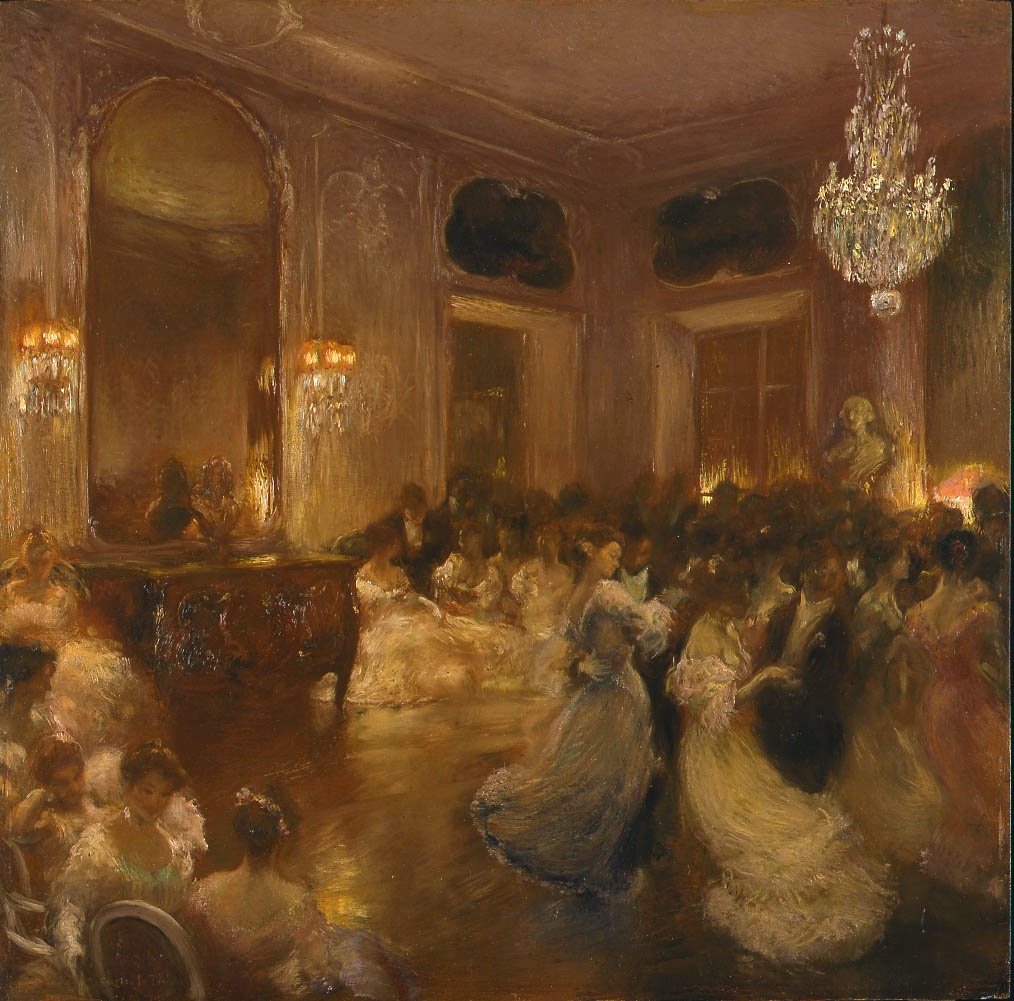
    The Ball (n.d.), Gaston La Touche (1854-1913)

    Five o’clock on the previous afternoon, welcomed by the braying of the one military band, and addresses from the Committee, and President of the State of Panama at the railway station, he had descended from the train bringing him from Aspinwall, soon to be rechristened Colon.

    The bridge over the track of the Panama Railroad, from which the speeches were made, had been adorned with the flags of France and Colombia.

    In carriages, the finest in the city, though not of the latest style, and the worse for twenty years’ wear, Comte de Lesseps and his attendant party of engineers, politicians and fortune seekers, had been driven through streets, that for once in the history of Panama, and only once in its past, present, or to come, were clean. They had been swept by municipal order, that their foul odors might not affront the delicate nostrils of the great Frenchman. Along the road from the railway station, leading up to the old Gargona road, and thence into the Plaza and the Grand Hotel, the huts and houses were especially white washed for the occasion, to destroy germs of yellow fever, or cholera Asiaticus that had convenient resting place upon their palm-thatched roofs and mouldy beams.

    This had been the suggestion of Don Fernando Gomez Montez, by this time one of the leading dignitaries of the city, banker, rich man, and general swell, who had impressed his views upon his confrères, by this pertinent remark: “Caramba! If all those delicate Europeans encounter Yellow Jack and el vomito negro before they commence operations, good-by to our canal which is to make us rich.”

    So the French party came with prancing of horses and shoutings from the crowd of creoles, negroes, and the general populace, between two battalions of native troops drawn up along the road, as ragged, as barefooted and as badly armed as in the days of ’49; for this man and his nation were to bring wealth, commerce, and enterprise to this city deserted since the days of the early Californian travel; and Panama was to become even greater, richer, and more populous and important than the old town whose deserted tower stands in tropical jungle five miles to the south—the one that Morgan’s buccaneers destroyed two hundred years before—the richest city of its size on earth.

    Among the élite gathered to meet the great French man had stood Fernando Gomez Montez, apparently not much older than when he had made his first great coup in life from the returning Californian, since which time he has devoted the plundered gold dust of that night to commercial pursuits, and has built up for himself a fortune, large for a Colombian city, but not great for Paris or New York.

    His poverty he has learned by travel, for he has been both to France and America; and his intellect, bright, wicked, and unscrupulous as ever, has been made subtile, cautious, and wary by experience. At twenty he was a great villain, at forty-four he is a great man, and therefore greater villain. To the audacity of the bandit he has added the finesse of the diplomat.

    During the preceding day he has made his address at the railway station and at the banquet of the evening, and has been embraced by le grand Franc̗ais, and petted with diplomatic tact, and called the hero local of the canal—for he had greatly assisted in obtaining from the Colombian Government the concession about to be sold to French stockholders for ten million francs.

    On this day he has, with the inaugural party, sailed in the Tobaguilla around the bay, into La Boca of the Rio Grande, where young Mademoiselle Fernanda de Lesseps was to have inaugurated the work of the canal, by digging with childish shovel the first little sod of all the earth that separated the Atlantic and Pacific. But, as it had grown late, in this land where darkness comes on with sudden rush, they agreed to consider the entrance of the steamer into the river as the opening of the work of the canal—and omitted the shovelful of Isthmus swamp; thus beginning the gigantic enterprise by a makeshift—one of the many that they made—till makeshifts were of use no more.

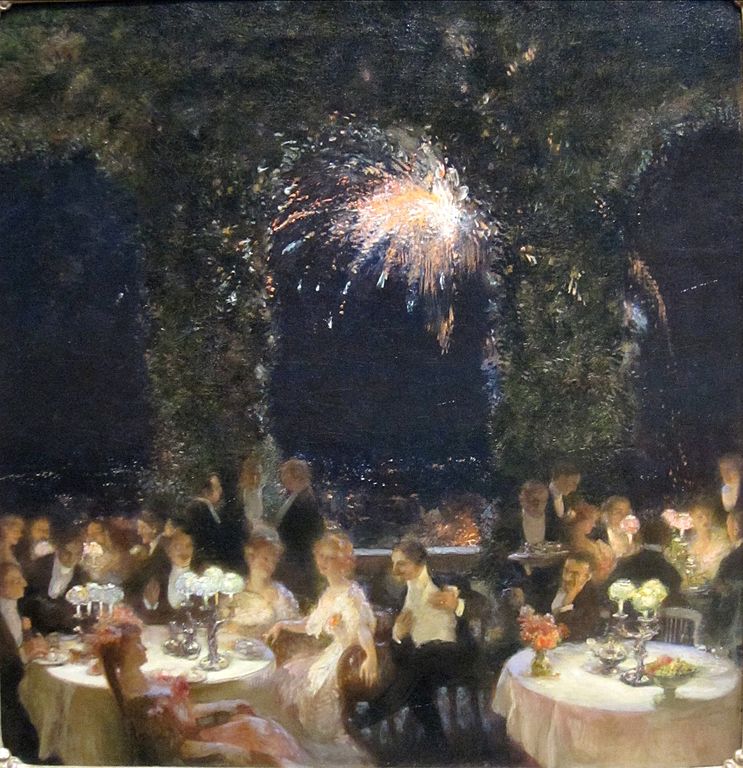
    Gaston La Touche

    Returned from this excursion, tonight Fernando Montez is at one of the minor banquets that take place before the ball.

    It is in one of the smaller rooms of the Grand Hotel. Several of the attachés of De Lesseps are at the table—a Paralta, a Diaz, and one or two others of the leading families of the Isthmus. It is a gentlemen’s dinner party; and though the great Frenchman is not there in person, all are enthusiastic about the canal which is to give every one a chance to grab a fortune.

    Among them sits one Anglo-Saxon—a man of about twenty-eight years, who has a pleasant though weak face, surmounted by light hair, and adorned by a moustache and goatee, the cut of which are French. His costume is rather that of Paris than America, as far as a dress suit permits.

    “The stock must be subscribed for at once!” cries Montez. “The fever must not be let grow cold in France.”

    “Oh, trust De Lesseps for that!” answers one of his satellites, Monsieur Dirks, Dutch engineer, who has dug canals in level Holland.

    “Let me be the first to subscribe!” says the Franco American. Here he whispers to one of the French attachés: “Please hand my name for the first one thousand shares to your chief, the Comte de Lesseps!”

    “The first one thousand shares subscribed for by an American!” There is a buzz of excitement around the table. The champagne glasses clink.

    “A health,” cries Montez, “to the great Republic and the American, Mr. Frank Leroy Larchmont!”

    “I beg your pardon!” says the gentleman he toasts.

    “Don’t put me down as an American. Register me as a Franco American—Franc̗ois Leroy Larchmont.”

    “But you live in the United States?” says Jose Peralta who sits next to him.

    “I did once. Now I consider myself a Parisian!” Which in truth he does.

    “This gentleman who takes one thousand shares so eagerly—I know his name—but what is he?” whispers Montez to the Frenchman sitting next to him.

    “Oh, he is very rich, I believe! That is all I know about him. He lives in Paris, has the good taste to like France, and very seldom visits his native land.”

    Then the banquet goes on, but during its conversation, buzz and excitement, Montez’ eye, sleepless and relentless, never leaves the face of the Franco-American who has taken the one thousand shares.

    Fernando Gomez Montez has determined to make himself one of the rich men of the world by this canal; as many more did about that time, some of whom succeeded. He is shrewd enough to foresee, this cannot be by the dividends it will pay to its investors, but in the immense amount of money that must be handled, and rolled about, and circulated from hand to hand and check book to check book during its construction.

    His subtle mind can easily grasp the idea that in this great “grab game” some of it must come into his clutches. This gentleman, who rushes so eagerly into a scheme just set on foot, whose face has a peculiar weakness not often seen in men of the United States, may possibly be a very good chicken to pick in the great pluckings and pickings that will take place during all the financial evolutions of this great enterprise.

    As soon as cigars pass about, and the formality of the dinner becomes somewhat relaxed, he contrives to get his chair beside that of Mr. Larchmont, and their conversation, from being that of first introduction, becomes freighted with some of the confidences of friends.

    Mr. Larchmont, to Fernando’s deft questioning, informs him that though educated partly in America, and his family entirely American, he has lived from his seventeenth year mainly in Europe and Paris. “Paris,” he says, “I regard as my home. I have a young brother in the United States, who is only twenty now. I am afraid he is too American to ever become a Parisian like myself.” But here their conversation is disturbed.

    A dapper young man, with the quick address of one to whom time is money, and the manner of “no time like the present,” enters the room, and says: “Pardon my stopping the champagne, Monsieur Dirks. I believe you are one of the engineers in control of the preliminary surveys of the canal?”

    “I have that honor,” says the Hollander.

    “Then, between drinks, permit me to ask you four questions. First, when do you expect to open the Panama Canal that has been inaugurated today?”

    “Certainly,” replies the Dutch engineer, astonished at the abruptness of the address. “In five years at the latest. In 1885.”

    “You are sure?”

    “So confident that I would write it in letters twenty-four feet high!”

    “Then can you tell me how you are going to provide for the tremendous floods in the Chagres River that wash down, each rainy season, dirt enough to fill up the whole canal?”

    “That will be by means of a large dam and reservoir sufficient to hold the average rainfall of a week.”

    “But when the rainfall is more than the average, what will you do with it?”

    To this, the Hollander replies evasively: “Are you an engineer?”

    “No!”

    “Then why do you ask engineering questions?” he replies sternly.

    “It is because I am not an engineer that I ask engineering questions. If I were an engineer, I could determine things for myself.”

    “Ah, then I will tell you. The floods in the Chagres will be provided for—later.”

    “Then, the floods being provided for, what will you do with the higher rise of tide in the Pacific than the Atlantic?”

    “That will be provided for later also!” returns the Dutch engineer savagely. And others of the Latin races at the banquet look with angry eyes upon this young man who stays their festival. Who is this creature that dares interrupt their night of triumph by impertinent queries that tend to throw doubt upon their grand scheme?

    “Then, all this being settled, will you tell me how you are going to build the canal if you don’t get the permission of the Panama Railroad, which by its concession from the Colombian government must give its consent before you can dig a barrelful of dirt out of your gigantic ditch?”

    At this question, the guests rise with foreign indignation and South American swagger.

    “That,” shouts Dirks, wildly, “will be provided for by Monsieur le Comte de Lesseps. When he visits the United States, he will obtain from the Panama Railroad the requisite consent.”

    “Not unless he pays Trainor W. Park pretty well, if I know him,” replies the young man. “I have just got time to telegraph your answer.”

    “Ah, you are an emissary!” cries a French attaché. “An emissary of the United States, that is now making such a shriek about the accursed Monroe doctrine!”

    “I am no emissary!” the intruder gasps, dismayed, for two or three Latins have gathered about him threateningly, and one, a young Chiliano, is handling a carving knife as if it were a cuchillo. “I am merely a reporter for the New York―” He can say no more, for at this instant he is rushed from the room and hurled down stairs, which perchance saves his life, as the Chiliano does not reach him in time.

    Looking on this, the Franco-American says disgustedly: “You see the crude manners of my country men. No wonder I fly from them! You will appreciate my embarrassment, Señor Montez, at this uncouth scene. I have been lately to New York, to try to induce my brother Henri to live with me in Paris, but he declines. Over his actions I have no control; but my ward, Mademoiselle Jessie Severn, as her guardian and trustee, I am taking with me to Paris. I made a short tour in America, and while in San Francisco, thought I would come to Panama, to see the opening of this great French enterprise, and from here take passage in the Transatlantique line from Colon to France.”

    “The young lady, your ward, is with you;” remarks Montez indifferently.

    “Oh, yes; she and her governess and nurse.”

    “Ah, she is not a young lady?”

    “Not yet. She is but ten. I am taking her to Europe, to educate her in the manner of my adopted country. I do not approve of the way in which girls are brought up in the United States. Heiresses in America become so bold and self-reliant. They even assert their independence to the extent of selecting their own husbands.”

    “Ah, an heiress!” thinks Fernando, his eyes opening a little wider at the news, for here may be two fortunes to play with; not only that of this rich gentleman, but also that of his ward.

    So he proceeds to weave the first meshes in the web of the spider around this Franco-American fly. His conversation grows jovial, and full of anecdote, repartee, and wit. Incidentally, by adroit questions that seem more suggestions than queries, he learns what he wishes to know of the other’s character and life; and, though it is conveyed to him with reluctance, discovers that Mr. Larchmont’s father had been at one time a tailor in New York, and turning the money he had received for dress suits, overcoats, and trousers into city real estate, had become one of the magnates of Manhattan, though his elder son was almost ashamed to own him, notwithstanding the very handsome estates he had left behind him to his two sons and co-heirs.

    “Ah!” remarks Montez, to this revelation, “no one can avoid bourgeois ancestors in the United States; it is land of trade and money.” And he sneers at the tradesmen in his mind, as the robber always does at the merchant.

    Then noting that the gentleman sitting opposite him seems somewhat ashamed of his commercial American ancestors, and drags into his conversation every one he knows of title or rank in the Old World, Montez’ occult mind divines that to thoroughly and easily trap this man who is ashamed of his commercial country and tailor birth, he his captor must be of the nobility.

    Then he mentions parenthetically: “Though you of North America have no aristocracy, South America still clings to hers. The Hidalgos of Spain never forget that they are grandees. As such I remember my ancestors!” and a drop of the blood of one of the Spanish Conquistadores coming into his eyes, this gentleman looks very haughty and exclusive to his Franco-American acquaintance.

    Shortly after, they stroll from the apartment in which the little banquet has taken place, towards the ballroom. As they pass through the corridor of the hotel, which is brilliantly lighted, a charming figure trips toward them. It is that of a beautiful little girl, who is dressed like a sylph in gauze and fancy flowers and whitest muslin.

    She is attended by a French bonne, trying in vain to restrain her charge, who comes eagerly towards the gentlemen, exclaiming, “Mr. Larchmont—Frank—Guardy! Look what the count has given me.”

    She exhibits one of the beautiful decorations the charming gentleman had had made for distribution among the ladies of Panama—a mass of colored enamel and solid gold, and bearing the Colombian coat of arms, and an inscription in Spanish announcing the inauguration of Del Canal Interoceanic by Count Ferdinand de Lesseps.

    These exquisite badges had been scattered broadcast among the youth and beauty of Panama, little drops in the ocean of expense that was to come, but bearing promise of the lavish manner in which gold would be thrown broadcast over promoters, jobbers, contractors and employees—in short, on everyone engaged in this gigantic enterprise—SAVE THE SHAREHOLDERS.

    Delighted with her present, the child stands poised on tiptoe, one hand held upwards towards her guardian, one little foot advanced. With bare white arms and graceful pose, the short skirts of childhood displaying fairy limbs, she looks to Montez like a ballerina idealized. For she has the blonde hair and blue eyes that dark nations love so well; and her figure, draped in the light dress of that warm climate, gives promise of faultless development in an early future.

    “This is my little ward,” says Larchmont, examining the pretty bauble she holds up to him. “Miss Jessie Severn, permit me to present Señor Montez.”

    Baron Montez.”

    “Ah!” is the little surprised exclamation from the American.

    “Yes, we are old Castilians, we Montez, and like all Spanish Hidalgos, punctilio itself about our name and our titles. You will excuse my mentioning it to you,” says Fernando, with a pleased smile at his own inspiration. “Baron Fernando Montez.”

    English postcard, c.1919

    But here the little girl breaks in upon them, and says: “How curious, Mademoiselle Fernanda de Lesseps was to open the canal today, and you are called Fernando! Fernando Montez—that’s a pretty name! I call little Fernanda, Tototé; must I call you Tototo?” Then she looks at the little figure of the ennobled gentleman, and gazes curiously at his jetty hair that is just beginning to show a little silver on the temples, and notes his mobile mouth play under his waxed moustachios, and his very white shirt, which has a decoration upon it—some old Spanish order he had picked up in some Peruvian cathedral. Next the blue eyes of happy childhood glance up fearlessly at the bright orbs of the newmade noble that have opal flashes in the gaslight; and, somehow, though this child had never felt fear before, her eyes droop before those of the all-nation gentleman, and she is happy when her guardian says: “Jessie, it is time for little girls to be in bed.” So mademoiselle trips hurriedly off to her governess, followed by the sleepless eyes of Montez.

    “You have made quite an impression on my little ward,” whispers the guardian.

    “Ah, you ravish me with delight!” cries Fernando.

    And so he has; for the little girl is murmuring to her elf: “Bluebeard, Bluebeard—naughty Bluebeard!” and trembles as she runs along.

    The Hidalgo is pleased to see that his title has made an impression upon the Franco-American. He remarks, for the beauty of the child still lingers in his senses, “Miss Jessie will soon be ready to bless some happy man with her hand—this little beauty!”

    “Pooh! She is only ten. That will be years from now!” says Larchmont easily. Then he goes on: “But I see in this tropic land the ladies develop early,” and casts his eyes over the bronze shouldered Inezes and Doloreses, as they are trooping into the ballroom.

    “Yes, we would marry her at fourteen here!” laughs Montez. “But even in France, in a few years she will be ready for her trousseau—about the time the canal will be open. You might celebrate both fêtes together, when you have selected the husband.”

    Then the buzz of excitement coming in through windows that are always open, save during thunder storms, in this torrid city, attracts the gentlemen. They step out to catch the night breeze that comes refreshingly to their cheeks, and look down upon the great Plaza of Panama, with its green plants and paved walks, in which the crowd are promenading, the great cathedral standing at their left. For this is the old Grand Hotel—the one that afterwards became the offices of the Panama Canal—which is decked to-night for gayety.

    Looking at the cathedral, a grim smile comes over the face of Montez, and he sees in his vivid imagination a bridal procession going up its great aisles to music of the organ and chant of dusky altar-boys, and picturing the bride with blue eyes and blonde tresses, thinks to himself: “Why not I for the bridegroom? I am not old! She is rich. The man beside me is weak. Perhaps with another fortune may come to me another beauty.”

    The noise of the moving crowds below breaks in upon his reverie, and Larchmont suggests:  “Suppose we see the ball.”

    They go in to the dance where Spanish beauties, in the ball-dresses of Europe, jostle French and Colombian uniforms and black dress coats; and the grand old man dances quadrilles with lovely Inezes, Marias, and Manuelas, to have his agility telegraphed all over the world, so that doubting French peasants may invest their stocking hoards in his newest and grandest enterprise, still thinking him the man of Suez, when Ferdinand de Lesseps is in reality beginning a dotage, awful in its consequences, to his friends, his government and his country—because it is unsuspected.

    So the ball goes on to its climax, amid the strains of the latest waltzes, and the clinking of champagne glasses in the supper room, and the laughing eyes of Spanish beauties, and the babbling tongues of sycophants and hangers-on.

    And on this night of triumph, when De Lesseps inaugurates the work on the Panama Canal, this night Fernando Montez gives to himself nobility and a title that will give him weight in Europe and influence over weaklings like the one he has set his eyes upon this evening. So the black drops in his veins become blue, azure, and noble; even the little Congo negro he has in him changes to old Castilian, as he exclaims: “Fernando Gomez Montez, I ennoble thee! Mule-boy of Cruces, I introduce you to Baron Montez!”

    Full of his project, this very night he obtains a printer, who, under great promise of secrecy, for which he is heavily paid, furnishes early the next morning the following striking carte de visite.

    Visiting card is decorated with a coronet. Embossed flowing script reads, "Baron Montez, Panama and Paris".

    This looks so beautiful to him that he cannot refrain from trying its effect early next morning.

    Old Domingo, who is older by twenty-four years since the night he assisted to make Montez rich, lives with him, not as servant, but as kind of halfway guest, for the old man is well-to-do. The old pirate knows the buccaneer maxim: “Every man his share!” And he had had pirate enough in him to compel the moiety of the American’s gold due him from Montez.

    On this he has lived and prospered, and though well over seventy, is still as hale and hearty and old a sinner as can be found in South America—which furnishes as fine a sample of ruffians as Hades itself.

    “How now, Señor? You seem happy!” is Domingo’s greeting, as his mentor saunters on to his portico, having finished his alligator pear, sucked his orange, and drank his cup of coffee. “How now, Señor Montez?”

    Baron Montez!” corrects the gentleman addressed, severely.

    “Caramba!”

    “After this, Baron Montez! I have been ennobled,” remarks Fernando, shoving his ornamental pasteboard beneath Domingo’s rolling orbs.

    “Ho oh! By the great fat Frenchman who is here?”

    “Yes, the great Frenchman, who will make us all rich.”

    “Sant Jago! Another massacre! There are lots of them here now! Beauties, too! Would I were younger!” mutters the ex-pirate, his eyes glowing with pirate gleam.

    “No, not this time. They have more to give us if we let them live!” returns Montez in grim significance.

    But the remembrance brought to his mind of that night in 1856, does not seem to please him. He looks curiously at Domingo, then gives a little sigh of relief; the appearance of his co-laborer indicates he will be forever close-mouthed. Time has made the rest safe. They are dead; even the beautiful Indian girl, Anita of Toboga, had become a hag at twenty-five, and died at thirty. Beauty that the sun nourishes most fondly, it soon scorches to death in these tropic climes.

    So, with a contented smile, Fernando strolls off, to put his new nobility to use.

    He sends up his card, with its coronet, to the Franco-American, and very shortly following it to that gentleman’s parlor in the Grand Hotel, is greeted by a “Good morning, Baron!” and an effusive grasp of the hand.

    For one second he starts, thinking some one else is addressed—it is not easy to get accustomed to nobility overnight—then, with a smile, the “new creation” replies with affable hauteur.

    Soon after, all others address him as Baron; none seeming to doubt his title, for these curious reasons: The French, knowing but little about him, think he is a true Spanish Hidalgo. His Colombian confrères, some of whom have known him even when he was an altar boy in the Cruces chapel, think Fernando has received his patent of nobility in some peculiar manner from le grand Francais De Lesseps. Besides this, they are very much occupied about a revolution that they have been intending to put in progress, but have postponed, fearing their political shooting and slaying might delay the opening of this canal. They will, however, go at this quite merrily, as soon as Monsieur de Lesseps leaves Panama. So it comes to pass that the ex-muleboy of the Gargona trail, el muchacho diablo, becomes accepted by men as Ferando Gomez, Baron Montez, and prepares to air his title in the salons of Europe and the Parisian Bourse.


    Notes and References:

    • Le Grand Franc̗ais: a title bestowed on Ferdinand de Lesseps by Léon Gambetta, a French statesman, a revolutionary Republican known for his brilliant oratory. De Lesseps withdrew from the election in the District of Marseille in order that Gambetta might win it, and Paris District.
    • Comte de: count, earl.
    • cholera Asiaticus: Asiatic cholera pandemic (1826-1837), was “a cholera pandemic that reached from India across western Asia to Europe, Great Britain, and the Americas, as well as east to China and Japan.”
    • el vomito negro: alternative name for acute viral yellow fever.
    • la boca: French—the mouth.
    • confrères: a fellow member of a profession, fraternity, colleague.
    • Chiliano: Chilian.
    • cuchillo: knife.
    • carte de visite: visiting card, i.e. a calling card. Notably a type of small photograph which was patented in Paris by photographer André Adolphe Eugène Disdéri in 1854.
    • bourgeois: member of middle class.
    • sylph: “a slender, graceful woman or girl. (In folklore) one of a race of supernatural beings supposed to inhabit the air” (dictionary.com).
    • bonne: French—a child’s nurse.
    • punctilio: a fine point, particular, or detail, as of conduct, ceremony, or procedure.
    • moiety: a half, or an indefinite portion, part, or share.
    • hauteur: haughty manner or spirit; arrogance.
    • Bourse: stockmarket—the Paris Stock Exchange


    Bernstein, S. “The Impact of the Paris Commune in the United States,” The Massachusetts Review
    Vol. 12, No. 3 (Summer, 1971), pp. 435-446.

    Monroe Doctrine; December 2, 1823“. Yale Avalon Project: Documents in law, history and diplomacy.

    Parker, M. Hell’s Gorge: The Battle to Build the Panama Canal (London: Arrow Books, 2007).

    This edition © 2021 Furin Chime, Brian Armour

  • A.C. Gunter’s Baron Montez: 4. What The Moon Saw In Panama

    A.C. Gunter’s Baron Montez: 4. What The Moon Saw In Panama

    This is the last chapter of Book One, dealing with the climax of events on the evening 15th April, 1856, for which the narrator has been preparing the reader. There is a thin line between author and narrator, and in some novels the narrator is distinct, is known, has a name: ‘Call me Ishmael’, so says the narrator in Moby Dick. In such cases the author’s sympathies, concerns, failings, desires and knowledge are limited to the age and experience of the character. Then again, the author may design a character to express their own attitudes and opinions, if ever so discreetly, or the reverse, as with the multi-blood Fernando, a collection of all the author’s antipathies, to act as a prime example of the dissolution of civilization without American standards and values, law and order.

    Fernando’s preparations appear haphazard, as he is actually selecting a boat when he happens upon Domingo, his major confederate, who has a crucial part to play in immediate and future events. He is relying on his influence in various quarters, yet this would be insufficient motivation for the action of others, were it not for his knowledge of American behaviour and the underlying resentment for the American presence in Panama. Although the narrator desires the reader to view Fernando Montez as a major instigator, he is only a bit-player in historical events.

    ‘American exceptionalism’

    The United States, of course, has performed exceptionally in fields such as space exploration, scientific research, pharmaceuticals, mass production, education, sport, and many others, but that is only part of the whole.

    Exceptionalism requires something far more: a belief that the U.S. follows a path of history different from the laws or norms that govern other countries. That’s the essence of American exceptionalism: The U.S. is not just a bigger and more powerful country—but an exception.

    Ian Tyrrell, The Week

    The term was first used in English many years after the events of this book, when in 1920 an American Communist, Jay Lovestone, proclaimed that conditions were still more unfavourable for Communism in America in comparison with other countries. Needless to say, he was ejected from the party. It was Abraham Lincoln who first espoused the national principle at the close of his 1864 Gettysburg Address:

    …we here highly resolve that these dead shall not have died in vain—that this nation, under God, shall have a new birth of freedomand that government of the people, by the people, for the people, shall not perish from the earth.

    November 9, 1863

    It is all very well for one president to say such words, but how does this reflect in the general population? Many foreign visitors commented on American exceptionalism, including Karl Marx, Francis Lieber, Hermann Eduard von Holst, James Bryce, H. G. Wells, G. K. Chesterton, and Hilaire Belloc; and they did so in complimentary terms. The theme became common, especially in textbooks. From the 1840s to the late 19th century, the McGuffey Readers, primary school texts, sold 120 million copies and were studied by most American students. The Readers “hailed American exceptionalism, manifest destiny, and America as God’s country. McGuffey saw America as having a future mission to bring liberty and democracy to the world” (Skrabec, p. 223)

    Amongst the population of the time there is a growing sense of what it means to be an American, and with increasing influence and power comes a form of self-righteous arrogance when abroad and engaging with different native cultures and lifestyles. This cultural anomaly was put centre stage with the 1963 film, The Ugly American, starring Marlon Brando. Though set in a fictional country, Sarkhan, and shot in Thailand, it was based on a factual study of American diplomatic behavior in South East Asia by Eugene Burdick and William Lederer, for their novel of the same title. They observe how Americans typically failed to engage the concerns of the native populations or learn their languages, which gave Communist regimes who did, a head start in influence and control (‘A Factual Epilogue’.)  President J. F. Kennedy was so impressed with the book he sent a copy to every one of his senate colleagues and took out a full page add in the New York Times to advise the public (Curtis, ‘How to Kill a Rational Peasant”). As a Burmese journalist in the book puts it:

    For some reason, the [American] people I meet in my country are not the same as the ones I knew in the United States. A mysterious change seems to come over Americans when they go to a foreign land. They isolate themselves socially. They live pretentiously. They are loud and ostentatious.

    Lederer and Burdick, The Ugly American, 122-3

    The narrator of Baron Montez is an American exceptionalist, and though the moon may be watching, it is he who is everywhere directing the action, coloring the readers reception of participants and escalation of events. In this he seeks to alter the reader’s impression of an historical event: The Watermelon Riot of 1856, (which actually began in the morning, not the evening).

    American press depiction of the “Watermelon Riot” in Panama City, April 1856. From ”Frank Leslie’s Illustrated”, May 1856.

    As you read, note the words the narrator uses to describe the native populations and wonder what makes someone unknown ‘vile’, and although the melon vendor is described as a ‘black savage’ his name was José Manuel Luna, and he runs off after the pistol is drawn. Historically, the police only joined the riot once an officer was shot in the arm. And while our narrator exhorts the absence of U.S. troops to defend the American population in Panama, it was actually US troops firing on the native population that caused the riot in which twenty-six Americans and two Panamanians were killed (Daley). US Marines then arrived to attempt to quell the violence. Following the riot, Panama was forced to pay substantial restitution to the US, Britain and France, and the incident was used as leverage to exert more control by the US over Panama.

    The next chapter commences twenty-five years after the events in these pages, with the advent of a new American interest: The Panama Canal.


    Warning: The following text contains words considered racially insensitive and offensive.


    CHAPTER 4

    WHAT THE MOON SAW IN PANAMA

    Montez, after gliding through the crowd about the railroad station, joins Domingo, who has been waiting for him, and the two stroll together along the dusty lane leading to the Cuinago, a quarter of the city composed of vermin, filth and native huts, in which the lower orders of this town of Panama make their habitat.

    “You half understand my design, my worthy old desperado,” murmurs Montez.

    Si, Capitano mio,” returns the swarthier and more stalwart bandit.

    “Then I will explain the rest to you. Listen!” and Fernando hastily outlines a plan, which makes the other grind his teeth together in a wild kind of unholy chuckle. “Diablo! This will be a better night than any one of the wild days of my youth!” and Domingo had once been a ship’s boy with Lafitte, the last pirate of the Gulf of Mexico.

    “Yes—it will be—fine!” laughs the other. “There are women and children among this crowd of passengers. These people are not like the adventurers of ’49. They are going to be California farmers, not miners. Few of them carry a revolver; fewer still know how to use it.”

    “But your American friend bears a very large one.”

    “Yes, and is a dead shot; but that is arranged,” says Montez.

    “Ah, trust el muchacho diablo!” laughs Domingo, looking in admiration at his little mentor. Then he says suddenly: “But the plan you have mentioned, will take much time. The natives must be aroused.”

    “It is almost arranged now. You have but very little to do. The keg of powder I have ordered is already in those huts. You see our savage boatmen and muleteers are prepared to use it,” and Montez points to the crowd of excited Indians, sambos, mulattos, negros, Spanish gypsies, and every other vile race of the Isthmus, who are stimulating themselves in the streets of the native quarter with aguardiente for some work they have on hand, and are even now nearly all armed with old muskets, machetes, or pistols.

    Looking upon this, Domingo says: “That little steamer,” pointing to the Toboga, whose smokestack is still visible at the end of the wharf, “has taken away their livelihood from the honest barqueros here, by transferring the passengers that were their customers. Their hatred will be an assistance to us. Besides, the railroad has ruined our mulateros—they will not be backward.”

    “Not with American plunder in sight,” laughs Montez. “But they will need a leader—Domingo, you are the man for that kind of thing: you like blood!”

    “Ah, but, demonios! we have forgotten the police!”

    “We have not forgotten anything!” replies the brighter scoundrel. “The police are arranged for; the governor, I think, is arranged for also. A Dios till six o’clock! Do your work here; I will do mine in the town! Remember at six—the railroad station. There Montez will make his start in life.”

    Tertulia de Pulquería (1851), by Agustín Arrieta. Scene inside a Mexican pulqueria (pulque bar)

    Leaving Domingo surrounded by a crowd of his old cronies and chums, whom he will excite with strong pulque and bad aguardiente, Montez, turning away from the native quarter, strolls through the Gargona gate, along the Calle de la Merced, into the middle of the old town of Panama.

    Here he sees many of the passengers of the Illinois, who are buying jewelry of Choco gold and Panama pearls, sombreros de Guayaquil, and bright-hued stuffs, to take with them to California.

    The sun is going down rapidly, flaming lanterns are beginning to appear in the shops; a few Spanish ladies, in short white petticoats and light chemises, scarcely concealed by graceful mantillas and nelosos floating from their dark hair, and draping their bare and gleaming necks and arms, are tripping with slippered feet hurriedly homeward.

    The lights are twinkling in the Cafe Victor and the Hotel Francais. The tingling of bells announces mules, ridden by dashing caballeros adorned with all the splendor of Spanish horse trappings. Still the streets seem curiously deserted; the lower classes have left them; few mulateros, boatmen, or ladrones are here; they are nearly all in the Cuinago, and those that are not yet there are hurrying towards the native quarter, as if going to a rendezvous.

    Looking on this, Montez thinks: “This will be a glorious evening! But to make sure, I must see His Excellency.”

    He passes rapidly to the street San Juan de Dios, and stops before a low stone building, in front of which a negro sentry is parading, with dirty gun and bare feet. He says to him: “Colonel Garrido is here?”

    “Yes, Señor, inside.”

    “I must see him.”

    And word being sent in, Garrido, Commander of Police, makes his appearance. He is half negro, quarter Spanish, quarter cur—all devil. Adorned with great tawdry epaulettes, and buttons and sashes, and a big sword, he wears long dark oily mustachios, which he strokes in an affected and military way.

    “Ah, Señor Montez, mio!” he laughs, looking at the little man who has already placed his hand in his pocket and is chinking doubloons together.

     “You have come at last. I have been waiting for you!”

    “Yes, I represent the law,” says Montez. “There is going to be an outbreak. The Americanos, the passengers at the railway depot, will attack tonight our poor fruit pedlers.”

    “You told me of that yesterday.”

    “Yes! I am a prophet! Are the police prepared?”

    “The police will do their duty. They are now ready,” and Garrido chuckles and points into the patio where he has already mustered and armed the hundred vagabonds he calls the police of Panama.

    “Then the Americanos will bully us no longer,” rejoins Montez. “I thought that would be your decision. The Americanos have women and children with them, also considerable sums of money with which they are going to buy ranchos in California.”

    “But the men—those awful Yankee fighters,” stammers the police colonel, growing nervous; “I remember them in ’49 and ’50. How they handled their revolvers!”

    “Now—they do not carry many, besides—” Here Fernando’s hand chinks a roll of doubloons into the out-stretched palm of the officer of the law. “Besides—they are unprepared to fight—these rioters.”

    “Aah, that settles los Americanos” laughs Garrido. “But the governor—” suggests the other.

    “Ah, the governor,” mutters the colonel of police. “He is wavering.”

    “Wavering? Diablo! Caramba!” moans Montez. Then the drop of Morgan’s buccaneer’s blood coming to the front in this little man, he becomes tremendous. He cries out: “I’ll see him at once! He shall waver no longer!”

    So he directs his way to His Excellency’s house, and begs that he may see the Governor of the town of Panama, but word is brought him that His Excellency is engaged.

    At this Mr. Fra Diavolo grinds his teeth, writes four words on a slip of paper, and says: “Give that to His Excellency, curse him, and see if he dares to be engaged.”

    A moment after, the answer comes that he can see the potentate of Panama.

    Young Fernando is received by this functionary, with a suggestive snarl. He says to this little every-nation gentleman: “What mean your threats, Señor Montez?”

    “Nothing, only if the President at Bogota knows what I know, the Governor of Panama will occupy six feet of our quiet little cemetery within the month, though he will not die of yellow fever. Shall I tell him?”

    “Certainly not!”

    “Not if you do as you promised. There is no danger! The American Consul is a nothing! If it were Englishmen we were killing—Santos! that would be different.”

    “Very well, then! Garrido is arranged for?”

    “Perfectly! Besides, these people are mostly unarmed; they have women and children with them. They will be easy. Likewise, the plunder will be great!”

    “And my share?”

    “Will be great also, as I promised.”

    “Ah! then I will know nothing about it! I shall go to sleep! I will not be awakened. Buenas noches, Señor Montez! Tell my people that I must be disturbed on no account—not for an earthquake—not even if a riot—nothing till tomorrow morning!”

    “Very well, I will give your orders!” laughs Fernando. He is about to depart, when suddenly the governor queries: “How will the riot commence?”

    “The Americanos shall do that!”

    “The Americanos—how?”

    “There are nine hundred and forty passengers; some one of them is sure to be drunk. Drunken men are quarrelsome!”

    With these words Montez departs, whistling to himself a jaunty air from one of Verdi’s first operas—the ones with melody divine in them—for this little gentleman has a drop or two of Italian blood, that make him a devotee to the Muses.

    So passing along, he joins the stream of passengers bound for the railway depot.

    Arriving there, the scene is much the same as when he left it, only there is a greater throng of passengers checking their baggage and seeing about their tickets. More ladies and children are going on board the Toboga, and the laughter coming from the saloons of McFarlane’s hotel and the Ocean House (a rival hostelry) is louder. One or two drunken Americans are strolling about in front of the depot, and bantering in an alcoholic way some negro fruit hucksters, who are plying their trade with a defiant bloodthirsty vim, for they are waving the knives by which they cut up watermelons and pineapples, in a threatening and ferocious manner.

    Just back of these stands Domingo and fifty or sixty of his cronies, and perhaps a hundred more are scattered from the depot, along the lane leading to the Cuinago.

    Several American ladies, and their husbands and children, together with one or two Spanish señoras of the better class, from the town, are looking at the scene, which is made picturesque by torches, as darkness is coming down.

    It is a peculiar contrast of civilization and barbarism.

    On one side, the long train of yellow railway passenger cars; the giant locomotive, that is powerless now because it has lost its steam; the railroad track; the puffing steamer at the end of the pier; ladies and gentlemen of Anglo-Saxon race, in the costumes of Paris and New York, for some of the ladies wear little crinolines, that are just now commencing to make their appearance on the Boulevards and Broadway.

    On the other side, the flaming torches of the negros; their black, swarthy faces; the waving palms and bamboos and cocoanuts of the tropics; the wild gesticulations and jargons of the savage races who are half clothed, and seem to excite themselves not only with pulque and aguardiente, but with some more subtle yet potent stimulant, for their eyes blaze under the torch glow with some unholy fire.

    Between these aggregations—one white and civilized, one black and barbarous—stands one man—drunk and disorderly—and he, alas! of the Anglo-Saxon race. He is bargaining with a negro huckster for a slice of watermelon. He takes the watermelon, the watermelon disappears; the negro holds out his hand, demanding a real.

    “Go to the—the—d—devil!” hiccups the drunken American.

    “A real, or your life’s blood, Gringo!” screams the negro savage, waving his machete in threatening gestures about the American’s head.

    “Here’s your ten-cent piece, Blackey! Don’t make a muss,” cries another Anglo-Saxon, stepping alongside his compatriot, and tossing the negro the demanded coin.

    “Curse it! He—he was trying to b—b—bully me!” gulps the drunken American, trying to draw a revolver.

    A second later, there is a sound of a pistol shot, and riot and plunder, arson and murder, are let loose upon the defenceless Americans, who, in a foreign land, burdened with their women and children, are almost helpless, in the presence of a debased and armed mob.

    The bell of the old church of Santa Anna, in the native quarter, near the Gargona trail, is pealing an alarm. Hundreds of blacks are running up the road from the Cuinago, with wild cries and waving of muskets, machetes, and pistols.

    On this Montez looks and smiles, and as he does so, a hand is laid upon his shoulder, and a voice cries in his ear: “Stand the brutes off till the women and children get on board the steamer!” Then George Ripley, drawing his revolver from his belt, runs down the steps of the hotel, and steps in front of the coming negros.

    A moment after, McLean of the Pacific Mail Company, and Nelson of the railroad, stand beside him.

    “Get the women on board the boat, quick! If they come another step, I shoot!” cries the Californian. “And I shoot to kill!”

    A moment more and he would try his pistol, and find it useless, and thus perchance save his own life, did not Montez hurriedly whisper to him: “Hold! the police are coming! Hear their bugle!”

    At this moment its clear notes sound over the road running from the town.

    “Ah! then all is well!” mutters George, and puts up his revolver.

    Then a man named Willis, who has hastily rolled a six pounder out of the railroad depot, and trained it loaded to the muzzle down the lane running towards the Cuinago, which is crowded with coming blacks, turns it away, crying: “Law and order! we’re all right now,” and runs it back down the wharf, as headed, by Garrido, the native police come marching with unsoldierly bare feet, and carelessly carried muskets, to the front of the hotel.

    As they see the police, a cry of joy comes from the American ladies and children, who have not as yet escaped to the steamboat.

    The bugle sounds again. A crashing volley from the police.

    “My God!” cries George. “They have made a mistake! They are shooting at us! They have killed the child beside me! There’s its mother screaming over it.”

    Another crashing volley!

    Mistake no more! It is no riot. It is a massacre!

    Attacking negros rush upon the railway station, butchering those they come upon, and plundering all. Trunks are broken open and looted; and a little baby, torn from its mother, is tossed about by the savage men and more savage women of the mob, till it becomes a clot of gore.

    Again the police fire!

    Le Désespéré (1843), Gustave Courbet

    More Anglo-Saxon blood!

    A delicate American lady staggers to Ripley and gasps, “Tell my husband I—I was going to join—Harry Nesmith of Colusa—how I—died,” then falls at his feet, a Minié bullet through her breast.

    This sight brings recollection to the Californian.

    With a muttered “My God! my wife!” George Ripley rushes back into the hotel to find and save, if possible, his wife and treasure. If not both, the woman he adores.

    Montez, Domingo and three blacks glide after him. The register of the hotel lies open in the deserted office. Tearing it to pieces, Fernando says: “There is now no record of the American on the Isthmus! His fate will be unknown. To business!”

    A second later, amid crashing volleys. George Ripley, one arm around the slight waist of his wife, who is sobbing on his shoulder, one foot upon the trunk that contains the fortune he has risked his life to gain amid the Sierras of California, stands confronting the negros; foremost of whom, his eyes all blood-red now, is Domingo, a vermilion glow upon his black cheeks and white eye balls, as if they were painted.

    The ex-pirate cries: “Death to the Americano! Save the lady! Her beauty gives her life!”

    To this Ripley’s revolver makes reply; the lock clicks, but no cartridge explodes. With a muttered curse he turns the cylinder.

    They are springing towards him. Again the pistol, that has never failed him till now, when all depends upon it, gives no report to his clicking trigger.

    “My heaven! Someone has tampered with my weapon!” he gasps; and taking his wife’s hand, turns to fly, but at the door stands the man he thinks his friend, and he cries: “Thank God! In time. Montez!”

    And Alice joins his shout: “Dear Señor Montez, God bless you for coming!”

    But tired of diplomacy, the savage drop coming upper most in him, this little every-nation fiend cannot for the life of him keep down a smile of triumph and a mocking laugh, as Domingo cries: “Fear not his pistol! It will not shoot.”

    Then suddenly the American knows!

    He gasps: “My ruined weapon!—that bath at Toboga—it was you! you! YOU! But, Judas, you go first!

    Reversing the revolver, with its butt end the Anglo-Saxon strikes down two negros who spring upon him, and seizing Montez by the throat, is strangling him over the trunk of his desires.

    But at this moment there is a flash; and, with a shriek, such as comes only when hope has gone, Alice Ripley sinks fainting on the dead body of her husband. For as he has forced the every-nation traitor down, the back of the Californian’s head has come within two inches of the pistol of Domingo, the ex-pirate; and to the flash of its explosion, George Ripley dies.

    Looking on the scene, Fernando, rising, gasps—for the breath has nearly left his body—to Domingo: “Quick! the mules—before the massacre is over! This treasure is mine—all mine! This beauty is mine—all mine! Montez has made his first great start in life!”

    As he speaks, more volleys from the murderous police outside tell of more bloodshed in the railway station, and more cruel massacre of unarmed men and helpless women and shrieking children, that, were they English, would have been atoned for by the blood of the Governor of Panama and his satellites and police; but being American, is left to the shallying procrastination of a languid consul, and forgotten soon in the rush of the great Republic towards what it loves best—gold.

    Will the United States of America never learn to protect its absent citizens, and make its banner, like the Union Jack of England, a bulwark of defence to its wanderers on the earth and on the sea?

    Some two hours afterwards, the moon rising high above the Cordilleras of the Isthmus, lights up the Gargona trail leading into the mountains, where, on the back of a mule, is a defenceless woman insensible, in the arms of Montez, who rides hurriedly along, bearing her farther from any aid that civilized man can give, into the recesses of the upper valley of the Chagres. Domingo, ex-pirate, striding sturdily along in front of his master, mutters: “This has been a pleasant evening!”

    The glancing fireflies light up the lianas, parasites and creeping plants that hang from the great trees of the dense torrid forest. The silence is unbroken save by the tramp of the mule’s hoofs as they scatter the decaying leaves, or the rustle of a serpent seeking his nightly prey—when, as he holds the fair victim to his heart, Montez starts.

    Her lips are moving—sentiency is coming to her. She is shuddering, and murmuring: “My husband—killed at my side!”

    And under that same tropic moon, far out in the waters of the Bay of Panama, “Toboga Bill” and two other tiger-sharks, are munching over and playing with a something that was once George Ripley.

    And, in a school dormitory, in faraway America, a child in the white dress of night is kneeling by her little bed, and praying, with happy eyes and expectant lips: “God bless papa and mamma, who are coming home to me again!”


    Notes, References, Further Reading

    • Jay Lovestone: ‘In 1929, Communist leader Jay Lovestone informed Stalin in Moscow that the American proletariat wasn’t interested in revolution. Stalin responded by demanding that he end this “heresy of American exceptionalism.” And just like that, this expression was born’ (McCoy).
    • Si, Capitano mio: `Yes, my captain’
    • Pulque: an alcoholic beverage made from the fermented sap of the maguey (agave) plant.
    • Aguardiente: mash-up of the words agua, meaning water, and ardiente, meaning burning, aguardiente is direct translation of the English term, firewater (or vice-versa). Based on sugar-water. a generic term for alcoholic beverages that contain between 29% and 60% ABV (alcohol by volume)
    • barqueros: boatmen
    • mulateros: mule drivers
    • Demonios!: Damn it!
    • Calle de la Merced: Spanish – Street of the Mercy (i.e. leading to the Iglesia (church) of the Mercy.
    • doubloons: a former gold coin of Spain and Spanish America
    • choco gold: gold from the mines of Choco, whose river sands are also auriferous (gold-bearing)
    • sombreros de Guayaquil: A port city in Equador known for somberos and panama hat making
    • mantillas: scarves, shawls
    • caballeros: gentlemen
    • ladrones: thieves
    • los Americanos: the Americans
    • Buenas noches: good night
    • Santos!: Saint, Holy
    • crinolines: ladies stiff petticoats made of horsehair and linen.
    • real: coin – originating Brazil.
    • Minié bullet: “The Minié ball, or Minni ball, is a type of muzzle-loading spin-stabilized bullet for rifled muskets named after its developer, Claude-Étienne Minié, inventor of the French Minié rifle.” simple.wikipedia.org.
    • the lianas: climbing vine found in tropical rainforests.

    Ceaser, J. ‘The Origins and Character of American Exceptionalism,’ American Political Thought: A Journal of Ideas, Institutions, and Culture, vol. 1 (Spring 2012). Available in PDF at time.com

    Curtis, A, ‘How to Kill a Rational Peasant‘, ‘The Medium and the Message,’ BBC blogs.

    Daley, M.C. ‘The Watermelon Riot: Cultural Encounters in Panama City, April 15, 1856‘. Hispanic American Historical Review (1990) 70 (1): 85–108.

    “History of Panama”. World Heritage Encyclopedia, available here at Project Gutenberg.

    Ignatieff, M., ed. American Exceptionalism and Human Rights. Princeton: Princeton UP, 2005

    Lederer, William J. and Eugene Burdick. The Ugly American. NY: Fawcett Crest, 1983. Available on loan from Internet Archive.

    McCoy, T. ‘How Joseph Stalin Invented “American Exceptionalism’”. The Atlantic, Mar 15, 2012.

    Skrabec, Q.R. William McGuffey: Mentor to American Industry. NY: Algora Publishing, 2009.

    Tyrrell, I. ‘What Exactly is “American Exceptionalism”?‘ theweek.com.

    Watermelon Riot“. Wikipedia.

    Westerhoff, J. H. McGuffey and his readers : piety, morality, and education in nineteenth-century America. Nashville: Abingdon, 1978. Available on loan from Internet Archive.

    This edition © 2021 Furin Chime, Brian Armour