Tag: Early American Popular Literature

  • Cobb’s False Knight: 17. Beginning of the End

    Cobb’s False Knight: 17. Beginning of the End

    As the story hurtles towards what appears to be a bloody climax, our heroine and her mother, the baroness, seem like bait in a trap, a trap set to kill the only threat to Pascal Dunwolf’s dastardly plan to force Electra to marry him so he can inherit the castle.

    Luring the good guy into a trap so the bad guy can get the loot was also part of the plot of the German movie The Oil Prince from 1965. Never heard of it? Why mention it? Well, 19th century American writer Cobb set The False Knight in Germany, while The Oil Prince was written by 19th century German writer Karl May, but set in the United States. Same sort of thing, just the other way around.

    Karl May books and movies were unbelievably popular in Germany. Every year, the town of Bad Segeberg still hosts the Karl May Festival, in an open air theatre in September. To non-Germans, it seems rather weird to see Germans, dressed up as cowboys and Indians with heavy German accents, re-enacting bits from films and novels involving Winnetou (the noble Indian chief), Old Surehand and Old Shatterhand (the good white guy), among the buildings of a fake western town. Yet Germans still seem to love it, although the movies are long past their heyday in the sixties. Is Ernest von Linden just as doomed as Old Shatterhand (Lex Barker), tied to a post in the old movie poster? You’ll have to read on to find out.

    Portrait of Karl May himself dressed as Old Shatterhand. Photograph by Alois Schiesser, 1896.

    Cobb’s writings were just as popular in the English speaking world; his novel The Gunmaker of Moscow, a huge hit of the 1850s, had made it onto the film screen in 1913, via Edison Studios in Manhattan. A common thread between his work and that of Karl May seems to be the fascination of people of one culture or continent with stories about the people of far away places. Knights and damsels in distress versus Indians, settlers and western bad guys.

    Nineteenth century opera composers and librettists wrote about Egyptian Princesses, French bohemians, and Japanese geisha girls too, and I love their works because of the music; yet I never really warmed to May’s western novels or the movies based on them. I’m sure it wasn’t because of Lex Barker or Stewart Grainger as Old Surehand, even if the actors may have resented being typecast as “old”. I guess it’s more of matter of too many blows by the heavy German accents of other actors, wielded as laughter inducing weapons of involuntary humor that might have done it for me. While we luckily never had some unfortunate German actor cast as Sir Pascal Dunwolf having to put on a terribly fake American accent.

    Just as well perhaps. May’s books and films had females in supporting roles, for example Karin Dor as Ribanna, the daughter of an Indian chief, in the Winnetou series of novels (1892/1910), but he never wrote a novel with women as the main characters. Cobb way ahead of his time? All the more reason to enjoy this episode.


    CHAPTER SEVENTEEN

    BEGINNING OF THE END

    The man now brought before the troubled knight for examination was in a pitiable plight. He was the first who had felt the weight of our hero’s iron-wood club. If his skull had been fractured, which was probably the case, the excessive flow of blood from a long, ugly wound of the scalp had served to lessen the pressure upon the brain and to restore him to consciousness. The cut, though thickly bandaged, was still bleeding, and his face was hideously begrimed with the ghastly exudation. His name was Brandt.

    He thought there were at least a dozen of his assailants. They had come upon him just as he had ascended the stairs at the rear of the lower hall. He and his companions had been standing at the far end of the hall when they were startled by the shrieks of the women, one of whom simply screamed with all her might, while the other yelled Murder! As quickly as possible they had rushed up the stairs, to meet the fate of which his lordship had been already informed.

    “Did you see the faces of any of the men?” Dunwolf asked.

    “No, sir,” was the answer. He said, further, that he thought their faces were covered. It had been a gigantic fellow who had given him the blow that overcame him—a man of prodigious strength and ferocity.

    Sir Pascal asked several more questions, after which the man was led away, it being very evident that nothing more could be gained from him.

    “Franz,” said the chief, when he and his lieutenant had been left alone together, “what do you make of this?”

    “I think,” replied the other, “that somebody from outside has been in the castle.”

    “Aye, that is very evident. But who were they?”

    “Captain von Linden was one of them. Who the other was I am unable to say.”

    “Then you think there were but two of them?”

    “It so appears to me, sir.”

    “I think you are right. And yet, our men—three of them—ought to have done better work.”

    “As for that, Sir Pascal, you will remember that the young captain has proved himself, ere this, a dangerous customer. Remember, also, that he had our men at a disadvantage.”

    Dunwolf arose from his seat and took several turns across the room. Then he pulled out his watch and looked at the time. He found it to be a few minutes past three.

    “Franz, it is very evident—in fact, we know—that these interlopers came in by way of the secret pass, the same through which Von Linden and the ladies left the castle; and from the account of Elize and Theresa, as well as from the manner in which the baroness and her daughter left us, it is equally evident that there is a hidden means of entrance to that pass somewhere in the apartments which the ladies were wont to occupy. Do you not think so yourself?”

    “I am sure of it, sir.”

    “Then I wish you to see to it that those apartments are strictly guarded. In every room where such an entrance could possibly be hidden have two good men stationed, with fire-arms carefully loaded, instructed to shoot any person—any man—who may appear in any such manner. Next, I wish you to look well to the known places of entrance. I know, as well as I can know anything of which my senses have not directly informed me, that Ernest von Linden was in the castle this night. He knows that I intend to make the daughter of the baroness my wife, and he means to prevent it if he can. To that end he may raise men enough in the village to give us trouble, provided they could gain entrance.

    “So, Franz, you will keep the great gate fast; keep the bridge up, and the portcullis down; and also look to the smaller gate, and the posterns. At the break of day have every man of our host under arms, and ready for service at a moment’s call. Will you do this?”

    The subaltern promised that he would not fail.

    “Then,” said the knight, “I will seek my pillow, and try to sleep for a little time. If I am not up by six o’clock, you may call me.”

    With that the aspiring chief went to the sideboard and swallowed a generous draught of strong spirit, after which he went to his sleeping-room.

    While the examination of the man Brandt had been going on before Sir Pascal, the housekeeper’s assistant, Theresa, was giving to Electra details of the night’s alarm that differed somewhat from those she had given to the knight.

    Our heroine knew that something unusual had happened. When the two servants had returned empty-handed from the expedition in quest of her mother’s resting-drops, Elize had declared that sentinels had been posted in the passage, and that they had not been allowed to proceed; but Electra had not believed her. The face of Theresa betrayed something startling and mysterious; but she could find no opportunity to question her until after a time the two women of the Schwarzwald fell asleep, leaving her to do the watching.

    While Elize had been away, in the presence of Sir Pascal, Zenzel had been awake and watchful; but, after Theresa had been out, and had returned, both of the women of the forest surrendered themselves to their craving for sleep, giving to the anxious girl the opportunity she so much desired.

    “Now, Theresa, what is it? What has happened?”

    And Theresa told her the story as we know it, saving only that she knew it was the handsome young captain who had so frightened her.

    “At the moment,” she explained, “I did not know him; but as soon as I had started to run his face came back to me, and then I knew.”

    She said, further, that there was another with him, not quite so tall as the captain, but stouter. She thought it was Martin Oberwald.

    When asked if she had told the wicked knight of this, she answered that she had not. She said she would have died first. “He tried to make me speak, but I would not.”

    “My dear Theresa,” said her young mistress, in a guarded whisper, “when I was in mamma’s dressing-room—when we went to get our clothing—I dropped a little note for Ernest. 0, if I could be sure he had found it I should be very happy. Don’t you think you could go and look, and see if it has been taken away?”

    The true-hearted girl said she would do all she could. Nothing but absolute force should hold her back.

    “I dropped it,” explained Electra, “close to the partition between that room and the room in which I used to sleep. As you stand looking straight into mamma’s great looking-glass, it should be on the floor, at your left hand, within a foot of the wall. You understand— about halfway between the looking-glass and the door to the clothes-press. You understand?”

    “Yes.”

    “And you will be sure and look for it?”

    “Yes. But you hope I shall not find it?”

    “Of course I do. If you do not find it I shall think Ernest has it in his dear hands. 0, if he knows—if the good hunter knows—be sure help will come.”

    Theresa promised once more she would do all that lay in her power to do, after which the heiress sought her pillow, and finally sleep came to her relief.
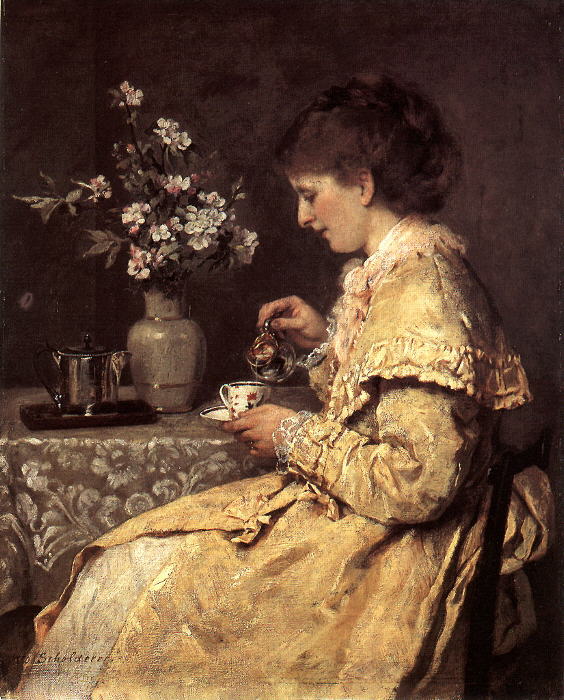
    Frau Scholderer am Frühstückstisch (c. 1872), Otto Scholderer

    When the new day had dawned, and while the women of the forest were thinking of breakfast, Theresa said she would go, now that it was daylight, and see if she could find her lady’s drops. No objection was made, and she departed on her errand.

    She was gone but a little while; and when she returned her face, full of disappointment and chagrin, told to the anxious maiden that her effort had resulted in failure. She said to Elize, who was the first to question her, that sentinels had been posted in all the rooms in that wing and that no one was allowed to enter.

    And she could tell to Electra but little more. An officer whom she had met had informed her that the orders of Sir Pascal had been peremptory. No person could be allowed in any of the rooms which either the baroness or her daughter had occupied.

    “But do not give up tall hope,” whispered the faithful servitor, as her mistress groaned in the bitterness of her disappointment. “I am as sure that Captain von Linden was in that room last night as I am that I am alive. And if he was there, he must have seen the paper; for, surely, no one else had been there before him.”

    Electra thanked the girl for her kindness, and said she would hope if she could.

    Later, when she saw her mother suffering on her account, she took it upon herself to whisper of hope; and in seeking to strengthen another, she found her own strength revived.

    They had eaten breakfast, and the table had been cleared and set aside, when Sir Pascal made his appearance. His first movement on entering was to signal to the guard-women that they might retire. At first Theresa, who was waiting upon the baroness, did not offer to move, but the knight caught her eye, and pointed to the door with a look which she dared not disregard. She had crossed the threshold, and was drawing the door to after her, when it was wrenched from her hand, and in a moment more the dark-browed knight was before her.

    “Look ye, woman!” he said, in a harsh, grating whisper, eyeing her as though he would look her through if he could—”I want you to call back the events of the past few hours and try to think if there was not something forgotten in your story of the fright you received, and of the men who caused it. Your companion was not more than three or four paces in advance of you, carrying a light that illumined the way so that you saw plainly. Of course, the very first thing you did, when you felt the touch of that hand, was to look up at the face. You could not have helped it. Now I know there was light enough to reveal to you the features—or, at least, their outlines. I ask you once more—and, mark me—if I can find that you have lied to me, I will put you to the rack!—I will, as sure as fate! Now,—once more I ask you,— Did you not see the face of Captain von Linden?”

    If there had been a quivering of the poor girl’s nerves when the man began to speak, it had all gone when he had concluded. She looked him straight in the eye, with a glance in which there was no sign of quailing, and stoutly answered:

    “You might put me to all the racks in the world, Meinherr, and I could tell you nothing different from what I have told you. Suppose, to save myself from torture I should speak a lie, and tell you ‘Yes,’ when the truth would be ‘No,’ would it help you any?”

    This simple argument fairly nonplussed the man, and having bidden the girl to hold her tongue and say nothing of that interview, he sent her away and returned to the chamber, carefully closing the door behind him.

    The baroness was sitting in a large easy-chair, near one of the windows, and did not offer to rise. Electra, however, had arisen as the knight entered, and when he had turned towards her, after having closed the door, she politely pointed to a seat. He bade her to be seated first, and when she had obeyed, he moved his chair so that he might face her, and then, with a low bow, sat down.

    He was arrayed in the full uniform of his rank as Colonel of the Imperial Hussars, graceful and elegant, even in that early day. It was new, and very likely donned for the first time. He had thoroughly soaked his head and laved his face, until a look of something like freshness had replaced the bloated, haggard look with which he had arisen. He had drank what would have been deeply for most men, but which, with him, had been only sufficient to steady his nerves, and give borrowed vigor to his system.

    After taking his seat he recognized the baroness with a slight inclination of the head; then he fixed his gaze upon the daughter, so regarding her for a time in silence. When he at length spoke, his voice was deep and low, with a sound that might be truly termed sepulchral.

    “Lady, you know what was the object of my coming to the castle. It had been for a considerable time the desire of your royal guardian, the grand duke, that I should be lord and master of Deckendorf. He had many reasons for that wish, chief of which was this: that he might have a true and reliable friend in this fortress, which, as you are aware, holds a commanding position in one of the most important passes of the Schwarzwald. At first my only desire was to please my sovereign; but since I have come hither, and have been permitted to gaze upon the face of the lady selected by him to be my bride, I have found my heart gone from me, and my duty has become my fondest hope.

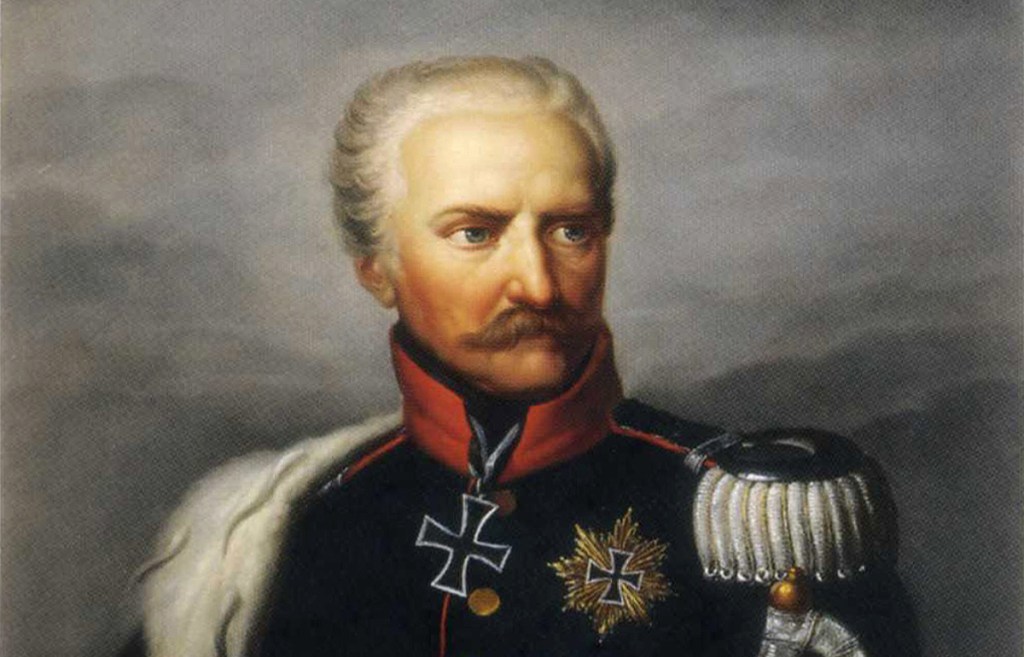
    Gebhard Leberecht von Blücher (c. 1815-19). Artist unknown, copying Paul Ernst Gebauer.

    “Of the little accidents that have happened since I came, we will not speak. I shall think of them no more; yet, you will allow me to tell you that I thank Heaven from the very depths of my heart that the bond between us has not been irreparably broken.”

    At this point, while the maiden sat like one turned stone, her only signs of sense of feeling being the changing light of her staring eyes, and the occasional twitching of the muscles of the compressed lips and the tightly-clenched hands, the speaker took his watch from his fob and consulted it. Then he put it slowly back, and changed his position in his chair. When he next raised his eyes to the maiden’s face, they had assumed a fateful glare—a wicked threatening look—and his lips were compressed until well nigh bloodless.

    “Electra!” She started when he spoke that name, as though a serpent had suddenly darted up and stung her. “Electra, it is now almost nine o’clock Before this day has seen its noon-tide you will be my wife. I know not what hopes have been held out to you of an avoidance of the union, for I will not pretend ignorance of the fact that your wish lies in that direction. I know that you have friends—they call themselves friends—who would aid you in resisting me if they could. Perhaps,” he went on, with a keener glance into the “windows of her soul,” “you have been led to think that those people can reach you here, but do you put away all such thought. My precautions are taken, and from this moment until I have held you by the hand as my wife, no human being from beyond these walls will come within the castle limits.

    “It may seem foolish for me to tell you this; but I wish to satisfy you that those so-called friends who would make you discontented with the inevitable are no friends at all. It is not impossible that your wild fancy, or your wilder hope, leads you to think that your sympathizers outside will come to you through the mysterious passage by means of which you managed once to slip away from me; but, I beg you, do not cherish any such delusion. I know every place—every nook and corner—where an entrance can possibly exist; and you may be sure I shall see that they are sufficiently guarded. Further, on that point, I have only this to say: If powder and leaden ball have any power over life and death, then, woe betide the unfortunate wight who shall attempt to introduce himself into this castle through any one of those hidden ways.”

    For the life of her, Electra could not repress the shudder that shook her frame as these words fell upon her ear. On the instant this picture was present before her eyes: Her dear lover, his heart bounding with eagerness to save her,—no matter who followed to assist, he would be surely in the lead,—his would be the post of danger,—she saw him, thus eager, behind the secret panel—saw him, moving quickly now that he was so near—touch the hidden spring—saw the panel slide noiselessly away into the adjacent wall—saw him, with the fire of ardor in his handsome face, start to enter the room thinking only of her and her weal, when— 0! taken suddenly, unaware of the danger, and shot through the heart on threshold of the pass.

    “Does it frighten you?” the knight said with a gleam of diabolical malevolence in his wicked eyes. “Let us hope none will be so foolish as to make the venture; for, I do assure you, if they come, they will come only to their death.”

    “And now,’ he added, rising as he spoke, “I give you one hour for preparation. At the end of that time I shall come for you, and you will accompany me to the place where the marriage ceremony will be performed. It will please me if I find you ready. If you wish for anything from your old apartments, you may send your maid, Theresa, who will go with Elize and get what you want. Remember—this is final.”

    And without waiting for reply he turned and left the room, passing out by the way which the servants had taken on their exit. For a little time after he had gone the stricken twain sat speechless. Then Electra started up and threw herself upon her mother’s bosom, and the loving arms were clasped tightly around her. At that moment how willingly would the widowed parent have given her life to save her child.

    “0, mamma! will they come? Will they be killed? 0, mamma! mamma! will they shoot my dear Ernest?” wailed poor Electra.

    “Hush! hush, my child! You should know Ernest better. Be sure he will not come by a way which they can suspect. If he comes at all, as I believe he will, he will be accompanied by others—by those of whom we have been told—and when he enters the keep it will be from the vault. My word for it, this wicked man—false knight—will never think of the chapel; and if he did, it would not matter, for upon entering there our dear boy would discover his enemies before they could discover him. Think of the situation of the altar, behind which is the hidden door, and you will see and understand.”

    The words were of simple fact, and they had a wonderful effect upon the hearer. In her fears for her dear lover, she had for the time forgotten herself, and now that his safety was well nigh assured, she was glad. In this spirit she resumed her seat, and shortly after Elize and Zenzel entered, behind them, a little later, coming Theresa.

    Electra was asked if she would require anything from the chambers in the old wing. She shook her head, and answered, “No.”

    The woman Elize said his lordship would be better pleased if she should put on wedding garments. A look was the maiden’s only reply, but it was a reply before which the bandit’s mate quailed and held her peace.

    Then Theresa, with a world of love and devotion in the warm clasp of her hand, ventured forward and to help her young mistress.

    “0! sweet lady,” said she, ” tell me what I can do, and I will do it if it is in my power.”

    “Nothing, Theresa, only this: stay by me if you can. Help my dear mamma if she shall need.”

    And then she drew close to her mother’s side, and took one of her dear hands in her own; and so she sat, and waited for what should come, her heart the while raised in earnest prayer for release from her deadly peril.


    Notes

    NIGHTSHIFT byTony Reck © 2025

  • Cobb’s False Knight: 16. An Adventure

    Cobb’s False Knight: 16. An Adventure

    Odd, that the simple maid should cry “murder, murder!” Or is it? I mean, long before anyone had been done in yet—without giving too much away. Now, any simple English maid who happened to be skulking around in any old dark secret passage and suddenly feeling a hand against her and somebody whispering might have yelled something else. Just a shriek perhaps? Or an extremely panicked sounding “help!”?

    What about an American maid? Probably likewise, even in the late 1800s, I’d guess, although nowadays she’d be more likely to yell “pervert” and spray him with mace. So I wonder if Cobb using the words “murder, murder” for the poor young lady to yell really was merely a coincidence?

    You see there is a common term that any Swabian or German maid might have yelled, in any play or novel of that time, and that’s “Zeter und Mordio”, “Zetermordio” or just “Mordio”. Not that anyone would yell that these days, but back then, a writer would commonly have stated that the poor young lady had yelled exactly those words. Sounds intriguingly Italian or maybe even Spanish, doesn’t it? But it’s German, from the Middle Ages. In the law courts of the time, as the Sachsenspiegel (“Saxon Mirror”) states, prosecutors would yell “Zeter und Mordio!” to signify that they wish to lay charges. (“so fure en vor den richter und schry obit den schuldigen zcether obir minen morder” , “so lead him before the judge and yell over the guilty Zeter over mine murder”)

    Nobody knows for sure any more what Zeter actually meant. Today, the verb Zetern means to scold or clamor. It is assumed, because of the context, that it derives from ze aechte her, which is Middle Ages German and means “come to the punishment”, while mordio was a cry for help, derived from the German word mord, which still means murder today. These days, to yell “Zeter und Mordio” means “to scream blue murder”.

    The Seven Swabians and the hare (Brothers Grimm)

    An example of the use of this term in an older text isperhaps appropriate to the Black Forest settingin the Fairytale of the Seven Swabians, collected by the Brothers Grimm.

    This tale, well worth reading, tells of seven timid men who go off to find adventure, carrying a huge pike which they can only lug around together. “All for seven, seven for one”, although their greater number hardly makes them Musketeers. They come across a bear on the way to Lake Constance, where they intend to kill a fabled monster. Luckily, the bear is already dead, so they pull its fur over it’s ears, hence the modern German saying “das Fell ueber die Ohren ziehen”, which means “to fleece someone” in English.

    Wonderfully colloquially described by the Grimms, they are even more easily scared than the hare they mistake for the Lake Constance monster. In their final tale, they are brought down by their unintelligible Swabian dialect, yelling to a person on the other side of the Mosel how they might get across. He only calls back “Wat? Wat? Wat?”, meaning “what” of course, which the heroes mistake for “Wade, Wade, Wade”. This they also do, when they hear the order apparently mimicked by the croaking of a frog inside the washed up hat of their first and bravest, who had already waded into the river only to drown. None are ever to be seen or heard of again…

    Knowing how well researched Cobb’s writings were, I really do wonder if he might have been aware of the use of Mordio“. If not, then please feel free to cry blue murder at my assumption.


    CHAPTER SIXTEEN

    AN ADVENTURE

    As the light came nearer our adventurers saw that it was borne by a woman, the position which they occupied enabling them to see so much without being themselves seen. Ernest’s heart bounded gratefully, for the garb of the woman bespoke her a servant, and he had no doubt she was of the household. Several of the female helpers in the departments of the cook and housekeeper he did not know—some of them not even by sight.

    “Who is she?” asked Oberwald”, in a low whisper.

    “Wait a moment. I think she is one of the cooks. If she is, she is sure to be friendly to Electra, for the dear girl had been very kind, and even loving, to them. Ah!”

    “What is it?”

    “Another is coming, this one has stopped. Wait a moment.”

    At this time the woman who bore the light—a lighted lamp—had reached to within two or three steps of the top of the stairway, where she had stopped to await the arrival of her companion. Presently the second woman came in sight, and our hero’s heart bounded anew as he recognised the well-remembered features of a girl who had been always friendly and pleasantly familiar with the baroness and her daughter. It was Theresa, belonging to the housekeeper’s force, a girl who had often worked in his own apartment, and whom he knew he could trust.

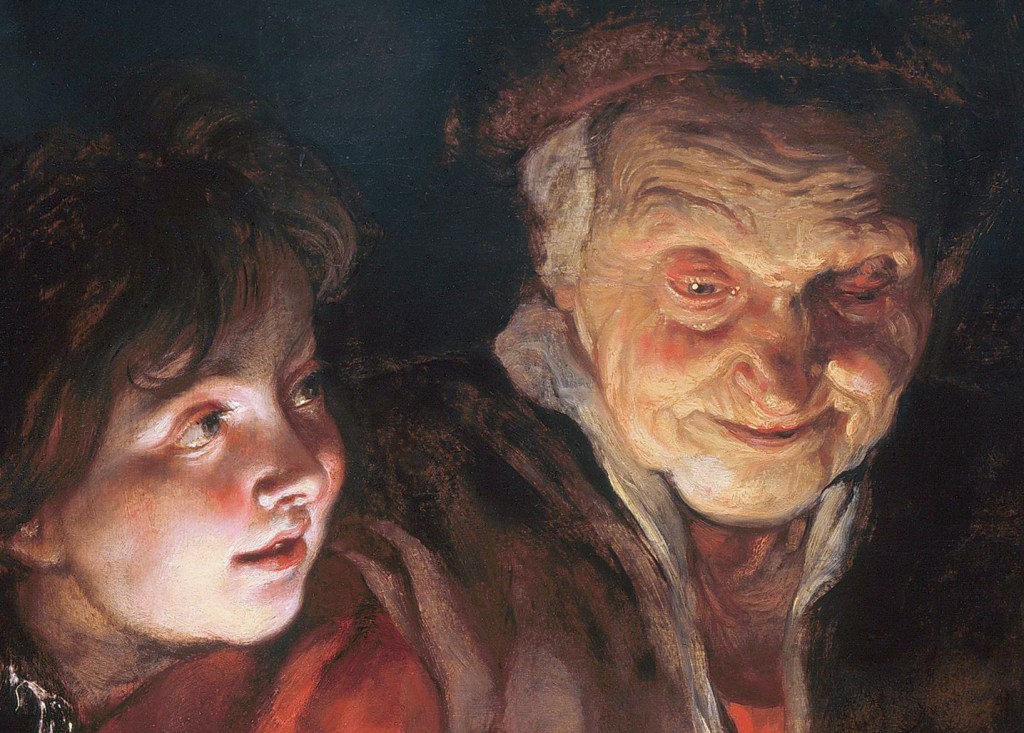
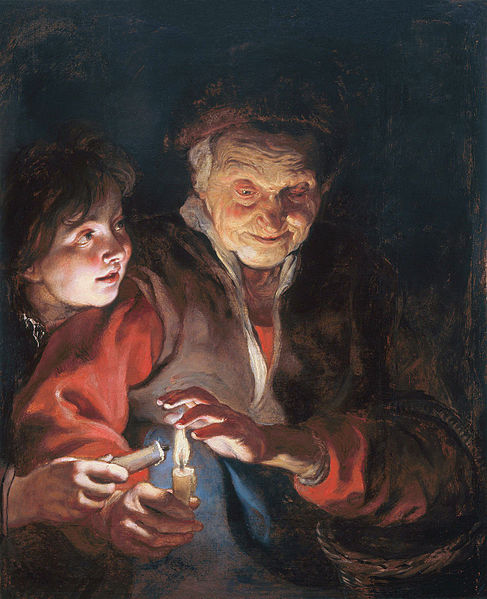
    Night Scene (1616-7), Peter Paul Rubens

    “Be very careful,” whispered Martin Oberwald. “Do not run a risk that may be fatal to the very purpose we have in view.”

    The youth assured him that there could be no danger. He knew the girl very well and he would run no risk in speaking with her.

    The cautious hunter understood his companion to mean that he knew both the females, and that he could personally vouch for both. Had he understood otherwise he would have held him back without hesitation.

    The twain were now approaching again, evidently bent upon entering the very passage in which the two intruders were ensconced, probably, thought Ernest, on their way to the apartments of the ladies in quest of something for their use and comfort.

    There was a door close by where our friends stood, and into the shallow place between the posts they drew themselves. The woman with the light, who was none other than Elize, one of the keepers of the captive ladies, passed without discovering them; but Martin Oberwald obtained a fair view of her face, and it struck him as sinister and dangerous. He grasped his companion’s arm, meaning to hold him back from betraying himself, but he was too late.

    Already had Ernest put forth his hand, and before he could fully realise what the hunter meant by his sudden movement, he had softly whispered the girl’s name, and at the same tune touched her on the shoulder.

    No sooner had he done so than he regretted it, for it flashed upon him instantly that he had done a very foolish thing. Nothing that could have happened could have more terribly frightened the simpleminded, timid girl. She was on a midnight errand, in a forsaken part of a castle given up to all sorts of wickedness and misrule, her dear mistress a prisoner in her own home; and she, at this ghostly hour, forced to accompany a woman who, she was very sure, was a companion of the dreadful robbers of the Black Forest—to accompany her to these dark, deserted halls in order to show her where she could find certain necessaries she must get for her prisoners.

    Under these circumstances was poor Theresa creeping unwillingly along behind the ogress when, from a dark corner, came a man’s hand in contact with her person, and a man’s voice in her ear! She did just what our hero ought to have known she would do. She screamed for mercy!—mercy!—a scream that broke upon the midnight air with frightful force. The woman with the lamp—the ogress—heard, and turned quickly, and as she did so the two adventurers stood revealed before her, the bright rays of her lamp falling full upon them; and she, with the voice of a Stentor, shouted:

    “Murder! Murder!”

    And straightway the pair of them fled back to the hall and down the stairs up which they had come.

    There was nothing left now for Oberwald and Ernest but instant retreat, and that of a most rapid character. The dressing room of the baroness was the nearest point whence they could gain the secret pass, and in that direction they bent their steps.

    Had the youth thought of a flight of stairs at the far end of that same passage, leading up from the rear hall below, he might have taken his way towards the old picture gallery; but he did not think of it until, just as he drew near to the door of the drawing-room, a bright light flashed up that same stairway, and immediately after came two men, evidently soldiers on duty, who were upon him before he could open the door and pass in—that is, he saw that, should he succeed in gaining entrance to the drawing-room, his companion would be inevitably cut off; so he turned to face the danger.

    If the headstrong youth had blundered when danger was to be only apprehended and guarded against, he made no blunder now that it had come upon him. No sooner had he seen that the escape of the hunter was a thing impossible, than he thrust his lantern into the bosom of his frock and grasped his club, his hand steady and his brain clear.

    The foremost swordsman came on with his sword raised for a blow, shouting loudly: “Surrender or die!” The man behind him carried the torch. “Who are you?” added the first, as he came almost within reach of the intruder.

    Quick as lightening Ernest stepped forward and dealt a blow with his iron-wood club upon the side of the trooper’s head that felled him like a dead man.

    In a moment more it was discovered that two other men had come upon the scene, but they were disposed of very quickly. They had not thought of drawing their pistols, if they had them, but depended wholly on their swords. The second sentinel, upon seeing his comrade fall, sprang quickly forward, not having seen how the work had been done; but his torch was an encumbrance, and before he had fairly seen where he must strike the unerring chip fell upon his head, and he went down to keep company with the first.

    Had the troopers worn their iron morions upon their heads, our friends might not have disposed of them so easily; but for duty at night, within doors, they had worn only their leathern skull caps, which afforded not a particle of protection against the blows of those marvellous clubs.

    The torch borne by the last man who had fallen was not extinguished, and by it’s light, as it flared and sputtered on the pavement, the stout hunter sprang upon the remaining trooper, and before the poor fellow had fairly seen with what he had to contend he was sent to join his unfortunate companions.

    By this time the first man whom Ernest had felled was beginning to move and to moan, but the adventurers did not stop to see more. They assured themselves that no more of the enemy were at hand, and then, by the light of the sputtering torch, they found the drawing-room, and entered, Oberwald passing in first, as he chanced to be nearest. As our hero started, to follow—just as his foot was raised over the threshold—he saw the glare of a light away at the far end of the passage where the two women had been first seen. Either the women were returning, or someone whom they had alarmed, but he did not stop to solve the mystery. Quickly following his companion, he closed and locked the door behind him; then drew his lantern from his bosom and opened the slide; and then away to the dressing-room, where he quickly set free and slid back the moveable panel, and in a few moments more the pair of them were beyond the possible reach of pursuers.

    Down a flight of narrow steps; thence through a winding way between flanking walls, and ere long they struck the main pass. To the right would take them to the picture-gallery. They turned to the left, and followed back the path by which they had come. They were fatigued and, in a measure, out of breath; but not until they had reached the point where they had left their heavy boots did they stop to rest for a second.

    “Do not scold me,” begged the youth, with sincere earnestness, after they had exchanged the covering of their feet, and had breathed awhile. ” I will acknowledge that I was foolish—stupidly foolish. I should have known better than to speak to that simple-hearted, timid girl as I did.”

    “I thought you knew both the females,” said Oberwald, pleasantly. “Had you told me that one of them was a stranger to you as she proved to be, I should have advised you not to make any sign. The moment I saw that foremost woman’s face, I knew she was dangerous. I am very sure that she is the wife of one of the Schwarzwald robbers—one whom Dunwolf has brought in to keep guard over his captives, as he dares not trust any of the women of the castle.”

    “Yes, I see it now; and I saw it the moment I had committed the blunder. Scarcely had the girl’s name passed my lips when I would have given much to recall it. But I was so anxious to get word to Electra.”

    “Well, well, never mind now. It is too late to mend it; and, after all, no damage is done. I think we may take it for granted that your lady-love will hear of your presence in the castle. If I know anything of womankind, that Jezebel is not going to keep her adventure to herself. Even if the girl Theresa does not see the baroness, this woman will be very sure to tell her of the two interlopers whom she frightened half out of their wits. That is the way she will picture it. Naturally, the ladies will ask for a description of the wretches, and it will be given; and the narrator’s instinctive exaggeration will not fail to convey to her hearers an inkling of the truth. They will recognize you; and will be very likely to recognize me as well.”

    “I hope it will be so.”

    “You may not only hope, my dear boy, but you may be sure of it. Take my word for it, before the morrow is an hour old, your darling will know that you have been in the castle during the night; and she will have strong faith that you have seen and read the missive she prepared for you. Upon my word, Ernest, that girl is one of a thousand. Not many would, under such circumstances, have thought of that method of communication.”

    The young lover expressed his pleasure at hearing his companion’s warm eulogium, after which the twain arose, and having trimmed their lamps, they set forth upon their homeward way, arriving at the cottage, without further hindrance, between two and three hours after midnight, where they found Irene and the dogs awake, and ready to receive them.

    After they had made a simple repast, which the thoughtful girl had ready for them, the hunter took his young friend by the hand, and said to him, in a tone of mild, paternal authority:

    “Now, my dear Ernest, I desire that you will attend to what I say. Put away all anxious imagining and vain surmising, and seek your rest. Accept from me the solemn assurance that all shall be well. If you would be fresh and vigorous on the morrow, you must give the few hours remaining of the night to sleep. Do you borrow no anxiety about awaking. I am older, and sleep lightly. I will see that you are called in season. If it will make you easier, I will whisper in your ear that Wolfgang is here, and is now with Thorbrand. They will be with us when we want them, be sure. Will you do as I tell you?”

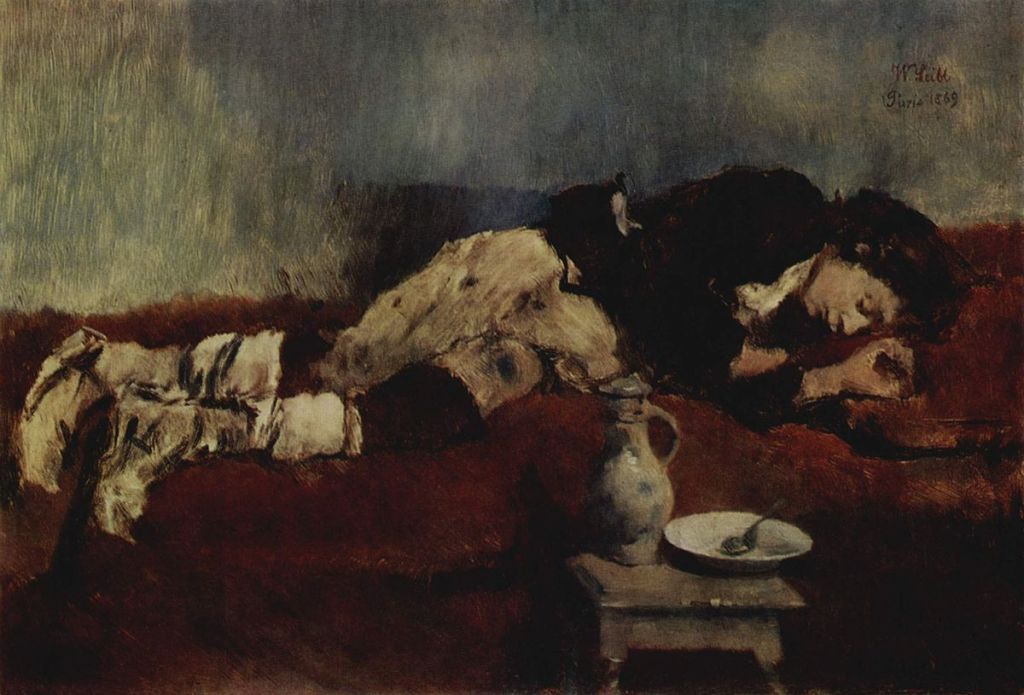
    Sleeping Savoyard Boy (1869), Wilhelm Leible

    The youth, with more gratitude in his eloquent look than tongue could have told, answered that he would do his best. And with that he bade his kind host and gentle Irene a cheerful good night, with a God’s blessing, and then sought his rest, As he reached the door he felt a warm touch upon the back of his hand, and on looking down he found the bereaved stag-hound at his side, his great brown eyes beseechingly upraised.

    “Come, Fritz! Come with me.”

    No human being could have expressed more gratitude, nor expressed it more plainly. The faithful animal clung close to Ernest’s side; and almost spoke his joy in words when he was invited to make his bed upon the sofa clothing at his feet.

    * * *

    At the castle there was uproar and confusion. An hour after midnight, or little later, Sir Pascal was aroused by his hunchback page, who scorned to take delight in tormenting him when the opportunity offered. The page himself had been awakened by an officer of the guard, who wished to know if the master had retired, he not daring to intrude upon his sleep.

    But Master Balthazar had no such fear. Having learned what was the nature of the business, he made his way to the knight’s bedside with a noisy stamping, and yelled “Murder!” into his ear. Dunwolf had gone to bed more than half drunk, as usual, and it was a considerable time before he could open his eyes, and a longer time still before he could arouse his wits. His first sensible motion was to seize the imp by the collar, and half strangle him while he shook him.

    “Now, you miserable ape, what is all this racket about? Why have you awakened me at this hour?”

    “O! mercy, good lord. If you knew what had happened, you wouldn’t spend your strength in shaking a fool’s ape.”

    “Ha! What now? What is it, boy Speak!”

    “It’s a murder, my lord!—murder mos’ foul and bloody. I don’t know how many of your best men have been killed, but the castle has been invaded, and dreadful things have been done.”

    By this time, the knight had got out bed, and as he had retired with his top-boots and small-clothes on, it required but a few moments for his toilet. Moreover he had heard all that he cared to hear from Balthazar. Knowing so well the rascal’s inability to tell a straight story, he would not waste more time with him. So he hastened out, and in his office he found the officer of the guard, who told him, in few words, and as nearly as he could what had happened.

    A number of men had been in the castle, one of whom had been recognized to be the young captain of the original guard of the castle. Who the others were could not be told. The intruders had first been seen by two women, whom they had tried to seize. The cries of these women had brought three men of the guard to the rescue. A conflict had followed, in which one of the guardsmen had been killed.

    “And how many of the intruders were killed?”

    “We do not know, my lord.”

    Already his followers had begun to give him the lordly title he coveted, They saw that it flattered him and made him proud, and as it cost them nothing they did it cheerfully.

    “Do not know?” thundered the chief angrily. What do you know about it? Where is the man who can speak? Where are the women? Who were they?”

    Of these questions the trembling officer answered half the last. He said that the woman Elize had been one of them.

    The woman was brought before him after a time, and in answer to the general question of what she knew of the affair, she said that as it was found hard for her and Zenzel to keep watch alone through the night, they had called in one of the women of the household, named Theresa. Some time after midnight the baroness had asked for a bottle of medicine that was in her old chamber, and as she had been ordered to do what she could for the lady’s comfort, she concluded that she would go and get it; and, as Zenzel chanced to wake up while they were talking, she took Theresa with her to find the thing wanted, as she knew just where to put her hand on it, while she herself might have spent half the night in the search.

    She then reminded the knight that the only door, on that floor, communicating with the old keep, was locked, and that he had the key; so they had been obliged to go down stairs, into the main hall, and thence up the great staircase, to the floor they wished to reach. She then told how, in passing a corner, just off the main hall, she had heard her companion cry out, ”in a manner fit to wake the dead.” She had turned quickly, when two men were revealed to her sight.

    “I went towards them, and demanded to know who they were; but instead of answering, one of them pushed me out of the way, and the pair of them made off as swiftly as their legs would carry them.” And this was all she knew.

    Next, the knight sent for the girl Theresa. She came reluctantly, and with her mouth tightly closed. Elize had not been able to describe either of the men she had seen, as she had gained but a single glance, and that not entirely clear. She only knew that they had been very tall men, and very large.

    Theresa declared that she did not know the men. There was but two of them, so far as she saw; but, as for that matter, there might have been a score of them beyond. Elize had carried the light, and was ahead of her at the time, so that the faces of the men were not to be seen; furthermore, she was so scared that she had no thought of trying to make out the persons. One of the men had put out his hand and touched her arm; that was the first intimation she had of their presence, and his excellency could judge how it must have frightened her.

    At this point the knight put the question direct:

    “Did not one of those men look to you like Captain von Linden?”

    “Mercy on me!—no, your honor; no more like him than a bear looks like a young antelope.”

    “If it had been the young captain, would you have recognised him, do you think?”

    The girl was not to be caught. If she was prevaricating, she did it very shrewdly; and it is more than possible she was doing so. To expose the presence of Ernest might result in ill to her young mistress, which she would not have done to save her own life. Yet she told the truth so far as this: She had not recognized a friend when she screamed. Not until after she had started upon her flight had her wits returned with an inkling of the truth.

    At length, in disgust, Sir Pascal sent the woman away, and caused the wounded man to be brought before him.

    Meantime he ordered that the guard should be doubled throughout the castle, and that no gate or postern should be opened under any circumstances whatever, without orders from him.

    “Franz!” he said to his lieutenant, “up with the bridge, and down with the portcullis! The gate shall not be opened again until I am Lord of Deckendorf.”


    Notes

    • Sachsenspiegel: See Oliver Raven, Introduction to Chapter 3 (and n.) See Heidelberger Sachsenspiegel (Heidelberg U).
    • Seven Swabians: English text / The original German text, with the word yelled “Zetermordio” when one of the seven Swabians imagines the monster of Lake Constance.
    • morion: type of round helmet; cf. Spanish conquistador style. Jump to image of 17th c. German example.
    • Stentor: Mythological Greek herald during the Trojan war, with a voice as loud as that of fifty men.
    • eulogium: eulogy (praiseful speech).
    • in season: in time
    • top-boots / small clothes: “Top boots, or hunting boots (for riding, and fox hunts), during most of the 19th century usually meant knee-high leather boots of black with the top portion of the the shaft a natural brown, emulating the look of previous centuries when thigh-high boots were folded down.” / “Small clothes referred to men’s undergarments, usually of silk, linen, or cotton, but also sometimes shirts and breeches.” From R.S. Fleming’s Kate Tatersall Adventures, “Victorian fashion terms“.

    NIGHTSHIFT byTony Reck © 2025

  • Cobb’s False Knight: 15. The Midnight Mission

    Cobb’s False Knight: 15. The Midnight Mission

    Secret passages were one of my favourite elements in spooky old black and white movies. There was one in Ghost Breakers (dir. George Marshall) from1940, in which Paulette Goddard plays a particular combination of keys on the dusty old pipe organ of a very haunted castle in Cuba, and suddenly, in torchlight, a heavy stone column moves, revealing a secret passage to Bob Hope…. Great stuff.

    But are there real secret passages hidden in and around the old castles and churches of Germany and of course many other countries? Yes, there are.

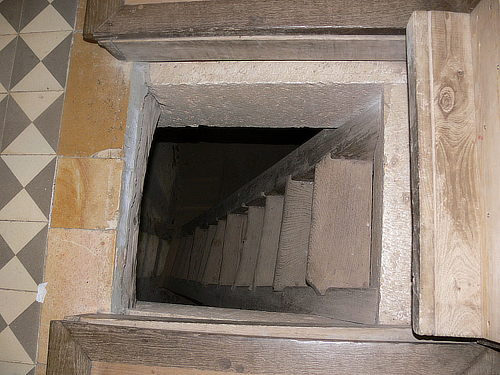
    Passage leading from beneath the altar in the chapel of Wildenstein Castle

    There’s one in the chapel of Wildenstein Castle, near Leibertingen in the Black Forest. Those paying for a guided tour hear stories of the sadistic knight Heinrich von Wildenstein and his squire gruesomely knotting the legs of seditious peasants. But this short stairway down behind the altar probably only leads to a lower storey, that’s all. Those knobbled peasants probably couldn’t have managed any longer distance. But who needs a secret passage anyway if you can tie the peasants’ legs in knots? (‘Auf Burg Wildensteing’, Märchenfreude).

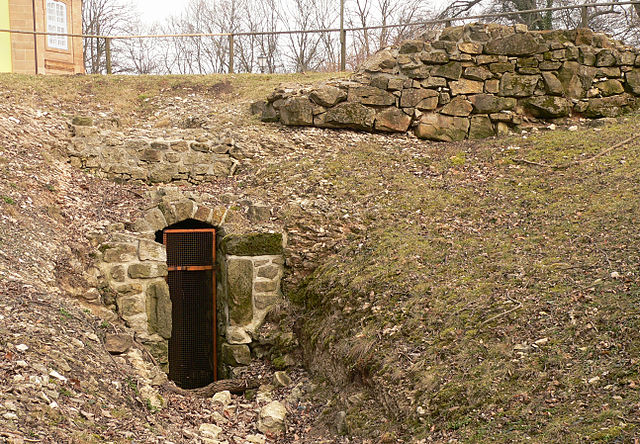
    A hidden passage was found leading out from Liebenburg Castle, about four kilometres north of the Ancient city of Goslar, not far from where I once lived. It was only discovered in the year 2005. You see, that’s the problem. The best hidden passages remained exactly that. Hidden. Often for centuries, until the tunnels collapsed and even if the entrances are ever found, nobody knows exactly where they once led…

    But why did people need secret passages back then? A silly question perhaps: to escape from enemies of course. But the reasons might be more complicated, as perhaps in the case of Liebenburg Castle, which came into the possession of Heinrich the Younger, Duke of Braunschweig-Wolfenbüttel in 1523. From 1541 to 1542, he hid his mistress, Eva von Trott and her three youngest children there, until she gave birth to her ninth child. Of course you would need a secret passage or two to hide a mistress with nine young kids. Even if just to have a place to hang up all the secret nappies to dry?

    There was a lot more to this story than that. Trying to avoid a scandal, Heinrich the Younger, a Catholic, needed some serious secrecy. After having his mistress, with whom he had already had three children, declared dead from the plague, he had a wooden doll put into her coffin and buried after a funeral service at Gandersheim Abbey, only to clandestinely install her and the kids in Liebenburg Castle, where he continued to visit her for a few more years, fathering another six children by her. He probably visited her through that same secret passage discovered in 2005.

    Underground secret passage of Liebenberg Castle, discovered in 2005

    Why all the fuss? Surely, Kings, Dukes etc., even some rich Archbishops had mistresses all over the place. Yes, maybe. But they didn’t have Martin Luther and the Reformation breathing down their necks. Luther used the affair as propaganda against the Duke in Wider Hans Worst (1541) in the Schmalkaldaic War, the war which caused Eva Von Trott to flee Liebenburg castle. Ah, they don’t quite have love affairs like that any more, secret passages and all….

    There are fine examples of entrances to such passages hidden in bookshelves and behind altars. The famous Admont Abbey in Austria, about forty kilometres east of Salzburg, has one, hidden in the theology section of the stunningly beautiful library. Shades of Harry Potter, the Da Vinci Code and The Name of the Rose perhaps? Not really. All that trouble creating a beautifully concealed entrance was simply to allow library users a discreet access to the upper rows of books. Now stop imagining what kinds of books the naughty monks might have hidden there!

    I really do wonder if Cobb might have heard of that hidden passage at Wildenstein Castle…


    CHAPTER 15

    THE MIDNIGHT MISSION

    The hunter returned alone to the living-room of the cot, but announcing that Wolfgang had departed.

    “But, he added, as our hero’s countenance fell, he will be with us bright and early tomorrow morning. He was obliged to go—called away by business of interest to us all. I may tell you that Thorbrand is so far recovered as to be able to take the saddle, should necessity call.”

    “Then why,” cried Ernest, vehemently, does he not show himself without further delay?”

    The next question was of importance: Had Thorbrand given his consent or countenance to Oberwald’s accompanying him to the castle?

    “Yes,” said Martin, “l am to go with you; and I received from that wonderful man information that may be of value to us. Were you aware that he was, for a considerable time, in the employ of the father of the late baron? He was for several years a boy with the Baron Gregory von Deckendorf, and loved him well and truly; and for that reason is he the more eager to assist the wife and daughter of Sir Gregory. Sir Pascal Dunwolf little dreams of what a rod I have in pickle for his back.”

    During the latter part of the afternoon the hunter made a circuit of the forest near his premises, finding, as he had expected all clear. Evidently Sir Pascal was putting forth no effort towards recapturing the young captain.

    As the sun was setting supper was eaten, after which the two adventurers prepared for their nocturnal visit.

    Pistols were taken, but it was understood that they should not be used except in case of great emergency—it must be a situation where nothing else would serve them. Swords they would not take. They would be awkward weapons at night, in narrow quarters; and, moreover, their clanking might betray them. They took instead short clubs of iron-wood, almost as solid and heavy as iron itself, eighteen inches in length, with a knotted knob on the larger end, and the grip, or handle, so formed that it could not be lost nor slip in the hand. At close quarters it would be a more effective weapon than a blade, and far more readily used. Stout daggers they took and that was all, of the so-called deadly weapons; though, for that matter, the iron-wood club, in the hand of a strong, clear-headed man, might be about as deadly as anything that could be used upon a human skull.

    Two dark lanterns, with lamps well filled, and carefully trimmed, together with flint and steel and tinder, and soft moccasins for the feet, completed their outfit; and as the clock struck ten they were ready to set forth, though they waited a time before starting, it being their plan not to enter the castle until after the sentinels had been relieved at midnight.

    Irene had no fears. She would have the dogs for company, and in case of emergency she could take refuge with the occupant  of the cavern. They had had considerable difficulty with Electra’s stag-hound, having been obliged to keep him fastened most of the time. It was not the care, however that worried them, but the poor dog’s mournful howling—his dismal, heart-rending shrieks were painful to them all. They would have set him free, knowing very well that he would have flown to the castle as swiftly as his fleet feet could have carried him, but they feared that the angry men whom he had bitten—for he had torn the flesh of two or three of them before they had captured him—might intercept and kill him. After it had become dark, however, he had taken food from Irene’s hand, and the combined efforts of the patient girl, and her St. Bernard, at length quieted him and brought him to terms.

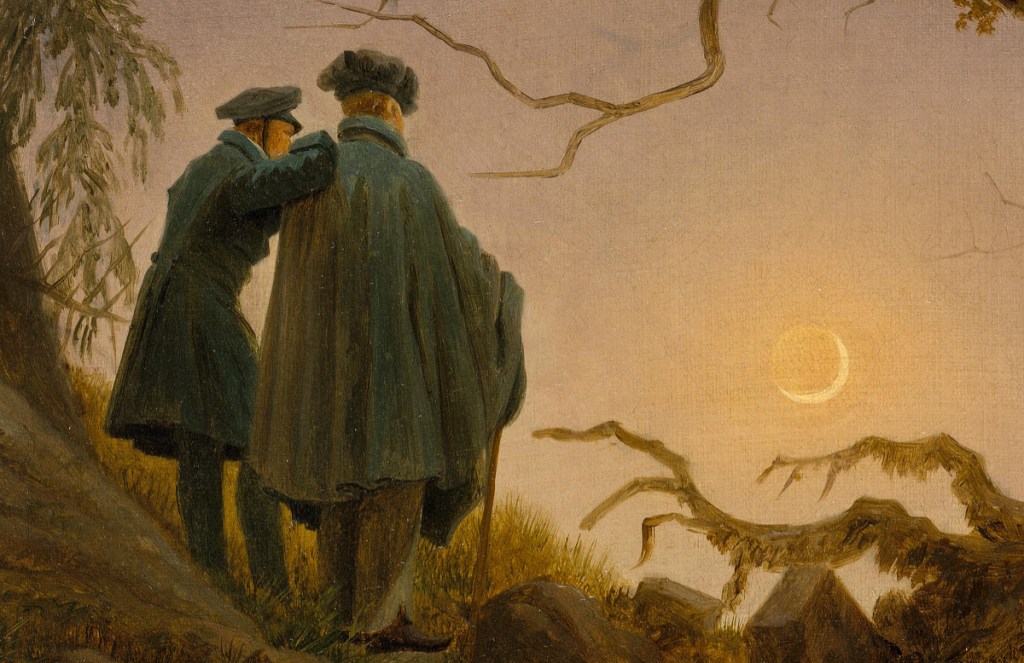
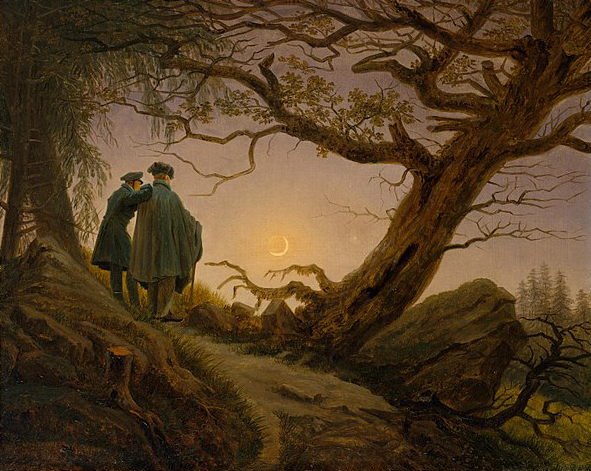
    Two Men Contemplating the Moon (c. 1825-30), Caspar David Friedrich.

    As the clock struck eleven, the two adventurers set forth. The night was clear and pleasant; the moon, a few days past its full, gave a light almost equal to day, which led them to be cautious, and to seek the shadows where they could conveniently find them. In less than half an hour they had reached the deep dell wherein was the entrance to the pass, and here, within the arch of the protecting cave or alcove, they lighted their lanterns. Then Ernest opened the hidden door, and they entered the passage.

    Considering all the circumstances, Ernest felt that he was in honor, not only authorized, but bound to reveal to his companion the secret of the subterranean passage, and he commenced by showing him how to open the way by which they had entered.

    “My dear boy,” said the hunter, gratefully, “it is a thing I would not have asked at your hands: but, believe me, you do no wrong in trusting me; for you do well know that with me the secret is safe, and, further, that I would never make use of the knowledge save for the purpose of good to the lawful inmates of the castle.”

    More than once on the way Oberwald stopped and pointed out to his young companion places in the pass that were like unto his own pass down the mountain.

    “At some time, probably before the advent of animal life upon the earth,” he said, “a mighty convulsion did this work. Who shall say that the same great upheaval which lifted these mountains to their commanding heights did not open these seams in the rock, and form the caverns as we now find them? It is wonderful! Wonderful! What a pigmy is man when compared with the stupendous forces of nature, and the omnipotent power of nature’s God. But only a pigmy in that comparison. As compared with other creatures, or with other creations, man is himself a wonder. Next to the Almighty himself is the good, true man. Made in God’s image, to live beyond the crash of worlds and the bounds of time, the man who strives in his heart to be godlike is surely no contemptible thing.

    “But enough of this. I am not apt to preach, yet I love to think.”

    “And I love to hear you preach, if you will call your grand theme by that name,” said the youth, with enthusiasm. “I have myself often thought in that same strain. I think until I am lost, and then I am forced to acknowledge how little I am. And here you have been giving me a pleasant, healthful thought. After all, our littleness is only in comparison with the infinite. Remembering that, we may take courage, and believe that we can, if we will, so live and act as to be worthy to be called the children of God.”

    “That is true, Ernest. Why haven’t we struck this theme before, during the hours we have spent so near to each other? There’s much of profit—of mental and moral health—in such conversation. Ah! what have we here?”

    “That is the murmuring of the stream above us. Just one half of our journey is done.”

    “Another wonderful thing is this,” said Oberwald, stopping a moment to look up at the dripping roof above his head. “Think how this pass is opened in the solid rock in so strange a manner. A simple fissure or chasm would be easily understood, but this deep rent, roofed as though by the hand of man, is passing strange—it is inexplicable.”

    After this they pushed on, beginning to ascend very shortly after passing under the stream, and so continuing until they stopped before what appeared to be a solid wall of rock, shutting off further advance.

    “We are at length beneath the inner court of the castle,” said Ernest, as he stooped down and pointed out to the hunter a seam in the rock, and in the seam a tiny opening like a key-hole. Into this he bade Oberwald insert the point of his dagger, pressing with a gentle force.

    It was done, and instantly a section of the rock swung inward, creating an aperture through which the pair of them readily passed. A little distance further, and they ascended a flight of stone steps, at the top of which the youth announced that they had reached a point beneath the old keep.

    “And not ten yards away,” he added, is the dungeon into which I was cast.”

    The hunter looked at his watch, and  found it on the stroke of low twelve—midnight.

    “We want the sentinels to be surely exchanged before we enter the keep,” he said; “and I have a great desire to look into that dungeon, which I have doubtless visited from the other side. We shall have plenty of time.”

    So, without further remark, Ernest kept on a few paces, then turned abruptly to the right, at a short distance further reaching the foot of a flight of narrow stone steps cut from the native rock. Up these he led the way, at the top, after listening until assured that all was safe beyond, he lifted the edge of the ponderous slab of stone directly over his head, and stepped up into the dungeon. Oberwald followed and gazed about the place. A swarm of rats scampered away, having been drawn hither by the food which had been left behind when the prisoner went away. Their means of passage was a hole near the door, where, in the course of years, they had succeeded in digging through the thick, hard masonry.

    The adventurers did not tarry long here. The hunter remembered the place, having visited it in other years with Sir Gregory, little thinking then that he should ever come to it through the bowels of the earth.

    “Having reached the main pass, once more they took an upward course, and at the first landing above the level of the dungeon they stopped and exchanged their boots for the soft, noiseless moccasins; and ere long thereafter the guide announced that they had arrived at the second floor of the old keep, and that the closet of the picture-gallery was directly before them.

    They both bent their ears and listened attentively, very soon making sure that no one was at the other side. Then the secret opening was touched, and the panel moved back, revealing an aperture through which they passed without difficulty, finding themselves in a small room half filled with dust-covered pictures and useless lumber. Another season of listening, and they carefully opened the door of the gallery beyond. As the door was opened Oberwald, who was behind, saw a scrap of paper on the floor. He picked it up and held it to his light, it was only an old label that had fallen from one of the pictures. Another scrap was found by Ernest, which proved to be a blank. Another piece, carefully folded and dropped near the door, escaped their observation, though they might have seen it had not their attention been distracted by the others.

    The gallery had a dismal, forsaken look, the sombre portraits on the wall wearing a ghostly aspect, the pictured faces of the dead-and-gone barons frowning down upon them as though in indignant reproof for the sacrilege they had committed.

    Portrait of Pompeius Occo (c. 1531), Dirck Jacobsz.

    “We must reach the apartments of the baroness,” said Von Linden, when they had assured themselves that nobody was moving near the place. “I am confident that the ladies expect my visit, and they will communicate with us if they possibly can.”

    “Then on it is,” answered the hunter, sententiously. “We must find something.”

    “The apartments are on the same floor, and not far away,” the youth explained. And without further question they carefully opened the door communicating with the hall, and stepped out, their moccasined feet falling lightly on the pavement.

    Slowly and carefully they moved on, seeing no light anywhere, and hence judging that no sentinels had been posted in the neighborhood. The door of Lady Bertha’s drawing-room was reached without accident, and it was found unlocked. Ernest opened it and went in. The place was dark and silent; the proper occupants surely not there. Without hesitation they passed on into the sleeping-room, where the great bed was in a sad state of disarray, more than half the clothing having been taken away, probably to make for her ladyship a couch elsewhere.

    Having carefully looked over the room for any scrap of information that might in any manner have been left, Ernest made his way into the room next adjoining—the dressing-room.

    “Here,” he said to his companion, as they closed the door behind them, “is another entrance to the secret pass—the one by which we left the keep when we sought your cot. This is the panel. It is so contrived that—”

    He did not finish the sentence. His eye had caught a carefully folded paper on the floor upon which a bright beam from his lantern had fallen. He picked it up, and a startled exclamation burst from his lips as he saw the superscription—“This from your captive friends.”

    Giving his lantern to his companion, he opened it, and read.

    “Eureka!” he cried, as he caught the meaning of the note. “Here it is, Martin. It is brief, but it is to the point. It is in Electra’s hand. ‘We are in the chambers of the new wing,’ she writes. Ah! Sir Pascal had his wits about him. He judged rightly that there could be no communication with the subterranean pass in that modern structure. They were put there when they were first brought in. Probably they were permitted to come hither under watchful eyes, to  get such articles as they might want for comfort. O! bless the dear girl! how thoughtful she was.

    “Oh! the black-hearted villain! Listen to this: ‘The bad knight will, if he is not prevented, make me his wife to-morrow. To-morrow, Martin! And the day has already commenced. By heavens! We must be moving if we would prevent it.”

    “Easy, my boy. There is time enough Does she say at what hour?”

    “No; she only adds:  ‘We are under strict guard.’ And then she repeats: ‘Remember, it is TO-MORROW!’

    “What shall we do? When will Thorbrand be ready to help us? When will Wolfgang—”

    “Tut! tut! they will be ready whenever we speak the word. We have but to give them information of the need, and you shall find them up and doing on the instant.”

    “But the men! Must they not assemble from the forest some of their band to help them? Think of the host which Dunwolf has at command.”

    “My dear Ernest, you know not yet the power of those two men. Their appearance at the castle will be sufficient. Either one of them would be a host in himself; but let them both appear, and you shall see the stout men-at-arms quail and shrink as from a thunderbolt! Do you borrow no trouble on that score.”

    A little time the youth stood, gazing in speechless amaze into the face of the hunter, and then he turned once more to the paper in his hand.

    “To-morrow!” he repeated, quivering at every joint. “How many hours are there? Think of it! His wife! I would rather see her lovely form torn and rent by the wild beasts of the forest.”

    “Hush! Hush! You shall see neither. We have gained all the information we desired—of course we cannot see the ladies—and we may now return. Let us thank kind Heaven that our effort has been so signally rewarded.”

    “I do! I do—thank Heaven from my heart. But—l wish I could see one of the old servants. If I could but gain speech with one, though but for an instant, I should be glad.”

    “For what, my dear Captain? What can you hope to gain more than we have already accomplished?”

    “Can you not see?” cried the impetuous youth, in surprise. “How will the dear girl live through the coming hours if she knows not that her effort has been effective? Let her remain in ignorance of what we are doing—in ignorance of our knowledge of her situation—and her great anxiety may drive her mad, if it does not kill her. If I can see a servant and leave a sign to be given to Electra by which she may know—”

    “I see,” interrupted Martin, breaking in upon his companion’s eloquent explanation. “I understand you, my dear boy, and I agree with you, too. Let us go back and make the search. Perhaps the servants’ quarters are not under surveillance. But remember this: An accident that should detain us, or, mayhap, do worse for us would be terrible.”

    “We will be very careful,” pleaded Ernest, beseechingly. “O! I must get word to the dear one if I can. Let us make an effort. I will not venture far. You shall say when we must give it up.”

    “Very well. Do you lead the way. Be careful of your light after you strike the open passage.”

    With this they turned back and retraced their steps as far as the passage beyond the drawing-room, where, as the way was clear before them, they closed the slides of their lanterns, and moved slowly forward in the dark. They had reached the end of the passage, and were about to enter the common hall of that floor, from which all the narrower ways diverged, when they were brought to a stand by the glare upon the wall before them of a light; and in a moment more the changing of the shadows told them that the light was in motion. Some one besides themselves was astir.

    Drawing back from the narrow passage pressing close against the wall, they stood and waited.


    Notes

    • Heinrich the Younger: Nicknamed Der Wilde Heinrich, which translates to more like “Randy Heinrich”.
    • Martin Luther, Wider Hans Worst: a propaganda pamphlet satirising Duke Henry. “Wider” means “against”; “Hansworst” was a carnival buffoon character of the time, the name used as an insult.
    • ‘the hunter looked at his watch’: Don’t worry, spring powered clocks originated in the 15th century; pendant-watches were crafted in France and Germany in the 16th century; the pocket watch in the 18th century, when waistcoats became fashionable. See Carlos Perez, “Artifacts of the Golden Age” (2001).
    • ‘I would rather see her lovely form torn and rent…’: Easy for him to say.
    • ‘Do you borrow no trouble on that score’: ‘Don’t let that worry you.”
    • ‘signally rewarded’: conspicuously, eminently, memorably.

    NIGHTSHIFT byTony Reck © 2025