Tag: Early American Popular Literature

  • A.C. Gunter’s Baron Montez: 2. A Toboga Breakfast in ’56

    A.C. Gunter’s Baron Montez: 2. A Toboga Breakfast in ’56

    Our narrator is at it again, delighting us with wonderful descriptions of island scenery and life, while never missing an opportunity to take a swipe at Montez. Fernando is now increasingly referred to as ‘little’. When a Narrator becomes a character in a story, as I explored in the previous introduction, expressing opinions, deriding or debasing characters, a question arises: can he be trusted? Were it not for the intimations of the Narrator, the previous chapter would seem idyllic. Hasn’t our kind host, Fernando rescued the ill Alice and her husband George from the pestilence of Panama, for the sweet aromatic breezes of his island retreat, treated them to excellent care and wonderful cuisine, travelled to the Isle of Pearls for them, at all times been a perfect gentleman? Yet our American Narrator’s insights into Montez’s character are ringing true, and his credibility appears intact for the time being.

    Village on Taboga Island, Republic of Panama, from postcard c. 1927

    While providing an unsympathetic history of young Fernando, at the same time the Narrator covers some of the history of the Isthmus and the crossing before the railway. Prior to this, for three hundred years the Isthmus was a possession of the Spanish. They first sought to improve the way across it for the passage of South American gold and treasure back to Spain.

    Through Fernando’s memory, his first engagement with the Americans, George Ripley and his wife, is related. It is clear he holds some disdain for Americanos, apart from their potential as marks in a confidence trick, which is likely shared amongst the local population. American presence and involvement in the Isthmus had been going on for some time. In 1846, the United States and The Republic of New Granada negotiated a treaty of “peace, amity, navigation and commerce” that included a guarantee of the US right of way across the Isthmus of Panama. The country of New Granada consisted mostly of present-day Colombia, and also Panama, Ecuador and Venezuela (Encycl. Britannica).

    Background is provided on George Riley, and his wife, Alice’s, contraction of yellow fever. Yellow fever, malaria and other mosquito borne diseases were rife in Panama due to the port being surrounded by swamp. Direct off-loading of passengers by steam ships was not possible which is why they disembarked at Taboga Island and later transferred to Panama by smaller boat or canoe.

    Most infections of yellow fever lead to serious illness. At first the sufferer experiences a high temperature, a slow pulse, muscle pain, nausea, shivers and vomiting. About 15 percent of people progress to a toxic stage, with life threatening symptoms such as bleeding, jaundice and liver and kidney failure. Half of these sufferers die within two weeks of onset. In 1887, the artist Paul Gauguin contracted yellow fever and malaria after working on the Panama Canal and spent time on Taboga Island recovering, as does Alice Ripley.

    Fernando‘s aspirations for Alice Ripley have grown, though his vision varies not, and she remains a beautiful object to him, second only to the old chest of George Ripley. In this chapter, Fernando’s disarming ways take on a new definition, and he moves one step closer to achieving his goal.


    CHAPTER 2

    A TOBOGA BREAKFAST IN ‘56

    Then this little disciple of Satan runs over what has brought him this great chance of good luck. He thinks of his earlier days.

    He is scarce twenty now, but people develop rapidly under the hot sun of the Equator. He remembers the quiet little town of Cruces, in the mountains—at the head of navigation of the Chagres, where the good priest taught him his Paternosters, and where he chanted them each day in his class, mingling his Latin with howls produced by blows of a cutting rawhide in the hands of the padre’s athletic and vigilant assistant.

    This mixture of penance and prayer pleased the young Montez but little. His mother, who lived in a palm hut by the rapids of the Chagres, did the padre’s washing; his father was—Heaven knows where or who. There seemed no way of escape. They were about to make him an altar boy, and rebellious little Fernando cursed as he chanted and saw no prospect save of a life of prayer and penance, and candle carrying behind a decorated image of the Virgin, in its daily religious procession through the lanes of the little town. But just at this moment Cruces—buried from the world in the hills of the Cordilleras in the deadly slumber that had fallen upon the Isthmus when the route to Chili and Peru round Cape Horn succeeded the route via Panama, and the jingling bells of its mule trains were no longer heard crossing the mountain paths between Panama and Porta Bella—awoke and lived again.

    The first rush of the gold seekers for California in ’49 crossed the Isthmus.

    Flying from church and prayer and penance, young Montez dodged fasting and discipline in the hurly-burly of that early Isthmus excitement.

    At thirteen he peddled water, for ten cents a glass, to thirsty Gringos. A year after he did a thriving business in unripe bananas, oranges, and pineapples in the streets of Chagres. Next taking up with a monte shop, became “muchacho diablo” in a gambling establishment at Gargona, where he learned card sharping and thimble rigging. In the years 1851, 1852, and 1853 he was a handler of bad mules, which he leased out at exorbitant prices to the embryo pioneers and argonauts of California to cross worse roads from Gargona in the dry season, and from Cruces in the wet time, to Panama.

    Spanish muchacho. Anonymous photo c. 1920

    Perchance, he took a flyer or two, with one or two successful bandits, and some looted treasure came to him.

    He had a knack of recovering lost children who disappeared together with their native carriers in this rush across the Isthmus, and restoring them to fond parents for large sums of money.

    And during this time he learned one great principle that has been of much use to Napoleons of finance both in America and Europe—that is, not to steal often, but to steal much. The first invariably leads to disgrace and a prison—the second often to honor and a palace.

    While doing all this, his facile mind became educated. He picked up French, from some Parisians crossing the Isthmus. Spanish was his native tongue. A smattering of Latin he had from the priest. English came to him from his vocation with the Californian adventurers; and by devoting himself to one or two Portuguese, who travelled tremblingly across the Isthmus in those days, he stole from them a smattering of their language and any doubloons and Spanish dollars they might leave within reach of his grasping paws.

    At length, the railroad completed in 1855 destroyed young Montez’s means of livelihood; but by this time he had sufficient to engage in other occupations, and turned his attention to dealing in pearls, precious stones, and other valuables he could pick up about the Isthmus, sometimes making trips to the Pearl Islands, and once or twice going as far as Ecuador and Peru, upon the English steamers that were now running down the coast of South America, and to Acapulco to the north, on the Pacific Mail boats, trading always with a rare facility and shrewdness that had come to him in a drop of Yankee blood left by a New Bedford whaler at Darien some hundred years before, and by a globule of the vital fluid of Israel, that had entered his poly-nation veins from an unfortunate Jewish pedler the Inquisition had burned, before the time of Morgan.

    He was even now considered well to do, and his orders were good in the Hotel Francais in Panama, or in the restaurant of Monsieur Victor, the Isthmus Delmonico those days, but still as yet no grand coup had come to him.

    Some ten days before the time he sits upon the veranda of the villa on the Island of Toboga, the steamer John L. Stevens, from San Francisco, brought its lot of passengers from California, to take route across the Isthmus by railway to Aspinwall, and so on to New York; among them this American gentleman and his wife, who are occupying the pretty palm cottage this morning—Ripley ruddy in health, Alice beautiful as a pale lily, stricken with the fever picked up during a six hours’ stay in Acapulco, and too ill to proceed on her journey. But for this, the American would have been the happiest of men, for he was a successful pioneer to California.

    George Merritt Ripley had left a clerkship in Baltimore, and taken his wife with him, leaving his little daughter of twelve at school in the East, and had gone to California in 1852. He had made his first start in gold mining in Calaveras County, at Mokelumne Hill, and being sensible enough to see that placer digging was uncertain, and that trade in California at that time was a sure road to wealth, had taken his few thousand dollars, and entered into business in the thriving town of Stockton on the San Joaquin. In three years he had accumulated some sixty thousand dollars, which, in those days of cheap prices, large interest, and small capital, was the equivalent to half a million at the present.

    Having enough to live upon in the East, his money properly invested in the growing towns of New York or Boston would in time make him even wealthy.

    His wife, anxious to see her child (for four years is a long time to a mother’s heart), had implored him to return to the Eastern States, which in those days all Californians called “home.”

    So, though his life on the plains of the San Joaquin had been a pleasant one, Ripley was delighted to turn his face from the crudities of the early California, to the more civilized existence of the Eastern world.

    He had come on his way rejoicing, until the fever struck the woman he loved, so he had brought her to Panama to rest there—perchance to die there.

    His trunks, checked through to the East, had gone on, all save one that contained their immediate necessities of apparel, and the other one; the one that never left his eye—the heavy one—the one that took three natives to handle. These, together with his wife, were in Panama, when he chanced to meet Montez, who, having many arts and graces of a gentleman, had soon made George Ripley think him his friend.

    Montez had recommended the change from the pestilent miasma of the mainland to the breezes that came fresh up the Gulf to the Island of Toboga, and in these zephyrs, health had come to George’s wife, and despair had left the heart of the strong man who loved her.

    During these days of his wife’s convalescence, in one of his conversations with Montez, Ripley had mentioned a desire to invest a little of the gold he was bringing with him in the pearls of the Isthmus—which were cheap at Panama compared to New York. This treasure was all in his own care, for Wells Fargo’s charges in these days, for the transmission of specie, were very high, and George Ripley thought himself strong enough to take care of his own money, having stood off bandits from his Mokelumne Hill mine and possessing that peculiar self-confidence that seemed to come with the air of the Sierras to all Californians in those early days. Therefore this foolish Ripley had evaded Wells, Fargo & Co.’s charges, and had everything he held valuable in this world with him in Toboga this sunny day—save his daughter in her Eastern school.

    Musing over this, Fernando chuckles to himself: “Brave Americano—fool Americano!

    Just here he is awakened from his reverie by the brave Americano’s voice in his ear, and the hearty grasp of the fool Americano’s hand upon his shoulder. The voice says: “Come along, Don Fernando Montez! We are hungry. The odor of the breakfast is delicious—but my wife insists upon our waiting for our kind host.” The hand drags in friendly play the petite carcass of Fernando Gomez Montez to see the prettiest sight his sparkling, all nation eyes have ever gazed upon—the blonde beauty of the temperate zone contrasted with the dark loveliness of the Equator, surrounded by a tropic breakfast al fresco.

    It is under the shade of the tamarind trees, the perfume from which is mingled with the odors of a feast for the gods!

    The aroma of Costa Rica coffee just burnt and ground comes from a steaming urn that stands on the ground near the fire of perfumed orange wood, upon which turtle steaks are broiling, and luscious plantains and mealy yams are cooking in its ashes. A stew of rice and freshly killed Iguano lizard, made hot with Chili Colorado, and a slight suspicion of garlic—for Anita is an artist in the cooking line—stands ready to their hands; and fruits, gorgeous as the sun that gave them their ripe beauty, lie about them everywhere.

    The American lady, lazily seated in a hammock, looks coolly beautiful under the leaves that shade her—the abandon of careless ease shows her still girlish figure in graceful motion. Her blue eyes would be very bright this morning, were they not wistful at times when gazing towards the East. Anita posed like a bronze statue stands near the fire, her orbs sparkling also, save when looking at la Americana they glow with soma unknown passion like those of a Voodoo priestess!

    So breakfast passes, Anita the presiding goddess of the feast; for to this Indian girl all the beauty of the tropics has come in the fifteen years of her life. She is robed in white—some soft clinging Isthmus stuff, which drapes her lithe figure, and displays the beauties of her graceful limbs at every motion—and her little feet, bare as when she was born, step so lightly they hardly rustle the leaves under them.

    The girl flits about, ministering to the appetites of Señor Montez and his guests, which seem to be very good, Montez apparently being happy, and a great joy beaming in the eyes of the American. His beautiful wife has roses on her fair cheeks, and in ten days they will be in their Eastern home; with them the one child of their love. Health and appetite are theirs, and their breakfast is almost like that of Arcady.

    The coffee is of the sweetest aroma, the Iguano is done to a nicety, and the turtle steaks are juicy as those from a two-year old buffalo cow. These being finished, they revel in the fruits of the tropics—oranges green as an olive, thin-skinned as a lady’s glove, with one blood red shot upon each, to prove that it has ripened; melons, sweet limes, Avigado pears, and the mangoes for which Toboga is famous.

    As appetite is appeased, conversation becomes easy.

    “Why did you not ask Anita to tell me that I was keeping you from breakfast? It is such a good one,” laughs the every-nation gentleman.

    “Anita did not seem to care for your coming.” returns the American lady. “Perhaps she did not think her breakfast was as perfect as it is.”

    “Ah, Anita was sulky, eh?” says Fernando, a little mocking snarl curling over his white teeth. “Anita has an Indian temper and Indian moods.” He regards the girl with a sneer, and she returns him several flashes from her eyes, that would be reproachful, were they not almost vindictive.

    “A little sullen, Anita—eh?” jeers the host.

    His tone would drive the girl to frenzy, did not the American lady suddenly say, “Please don’t be cross with her. You do not know how kind she has been to me during your absence and my sickness!” Then she turns to her husband and suggests: “We must not forget Anita’s services when we leave her.”

    “No,” cries the jovial Californian. “Anita shall have the biggest pearl that Montez has brought from the Islands.”

    At this mention of personal adornment, a smile runs over the volatile features of the Indian girl.

    Fernando smiles also. What is Anita’s is his. And everything is fish that comes to his net.

    A second after, he gives a start. The American lady is remarking in grateful tones: “And what shall our offering be to you, Señor Montez, whose hospitality has given me health?”

    “A present for me? Mia madre! you are too kind.”

    “Yes, mention what you like and you have it,” interjects the Californian.

    “Oh, if you wish me to say what I should regard with the greatest favor, it would be your—your beautiful revolver. There is none like it on the Isthmus,—none that shoots so truly, for I have seen your skill with it,” answers Fernando, looking with longing eyes upon the fatal weapon of the American.

    “My revolver,” echoes the Californian with a start. Then he says, after a pause of consideration: “I will send it to you by express from New York. Until this journey is over, I cannot part with it. It has guarded my life and my property before. I feel safer with it by my side.”

    “Yes,” returns Alice, “at his side by day, near his hand at night. George is superstitious, I think, with regard to it.”

    This conversation apparently does not please Señor Montez very greatly. The revolver has seemed to fascinate him. All through the meal his glances have sought the long Colt’s pistol that carries six lives in its six loaded chambers as it hangs in the Californian’s belt. A little spheroid of timid Cingales blood, poured into his veins from some East Indian ancestor, now brings a coward faltering into his bright eyes. He does not seem to enjoy the Avigado pear that he was eating with a good appetite a second before. Throwing it away with a “pish” of disgust, he cries: “Anita, quick, a cigar!” for nicotine soothes this gentleman’s excitable nerves.

    The Indian girl, at his command, draws out from a bundle of fragrant Toboga tobacco a fresh leaf, and rolling it in her deft and agile fingers, in half a minute it becomes a cigar. Thirty seconds more, a second leaf becomes another cigar. This she offers to the American, who follows his host’s example. So lighting up, the two men puff away contentedly.

    A moment after, Alice gives a start of amazement, for a third cigar has been tendered to her. and to her astonished refusal, Anita laughs: “You are not well enough yet to smoke. I had supposed now you are ill no longer you would enjoy it as I do.” Then throwing herself into a hammock, this lazy bird of the tropic surrounds herself with wreaths of smoke, puffing them out between her white teeth, and playing with them as a juggler does with his baubles.

    The sensuous scene appeals to even the energetic Californian’s senses. He mutters: “This week at Toboga has seemed like a week ofof—”

    “Of paradise! “interjects his wife. “Since I have become well again, we have made a fairy land of it. Daytime in the hammock, sipping coccanut milk and chicha under the tamarind leaves; dinners at Jacques’ petite restaurant in the cocoanut trees, and moonlight in a canoe on the water. George said,” here the lady blushes slightly, gazing at her husband with bride’s eyes, “that it was more romantic than our wedding tour.”

    “A-ah, a—new honeymoon!” sighs Montez. Looking at the beauty of this Northern violet, as she sits before him in the ease of this tropic Arcady—for Alice Ripley has imitated Señorita Anita in the hammock business, and sits lazily under the green leaves, one perfect foot and one delicate ankle carelessly swinging from under her white laces and muslin and ribbons—this gentleman’s face suddenly flushes with a great delight, as he thinks: “A new honeymoon!—Yes—for me!” Then visions come to him, entrancing as the dreams of opium sleep, as he gazes at Alice Ripley through the clouds of his cigar smoke.

    Woman in white. Anon., antique French postcard (n.d.)

    Mingled with the rustling breezes in the tamarind groves, as they sit there, the “silence—of—the—smoker” coming on them, is heard the voice of a rushing stream, which issues gurgling and foaming from the hillside, and splashes into a little basin, a short hundred yards away, suggesting coolness.

    The day is already burning, and the noise of this foaming stream apparently puts an idea into the fertile mind of little Montez, as he sits looking with sleepless eyes at the big Californian, through his wreaths of smoke.

    He says: “How is a cool plunge this hot morning? Why not a bath, Señor Georgio Ripley?”

    “A bath—delicious!” ejaculates the American. Then looking over the green water of the bay, he suggests, “But the sharks!”

    “No sharks here,” and Fernando points with a little finger, adorned with some diamonds and a very delicately trimmed almond-shaped nail, to the cool, limpid basin worn in the rock by the unceasing flow of the living stream for centuries. “That is nature’s bathing place.”

    So the two go off together, through the thickets to the shady pool, bearing with them handfuls of javoncilla leaves, that will act as vegetable soap and make their skins soft as those of children.

    Looking on its limpid waters, dark under the palms and only golden where the sun steals in upon it through little breaks in the leaves, the American mutters: “This is perfection.”

    Then Montez cries, “Quick, I’ll beat you into the water. You need not fear to undress here. Toboga has no deadly lance-vipers or coral snakes like the mainland.”

    So undressing himself in the little thicket of broad leaved palms and feathery bamboos, George Merritt Ripley, as he takes his plunge into nature’s bathtub, for the first time in his journey really parts himself from his revolver.

    It is but for a short fifteen minutes, and Montez bathes with him ten of them, but leaves the water first.

    But in that five minutes, that one last plunge for Ripley, something has happened to his weapon of trust that had saved his life and his treasure from the bandits of the Sierras and the highwaymen of the Californian trails.

    Not knowing this, George comes laughingly up the bank, crying, “That last plunge was the most refreshing of my life! I hope you enjoyed your bath as well as I did, Señor Montez.”

    “Perhaps better,” returns his companion, who has as yet hardly begun to dress. Fernando is apparently a lazy man, and he has had something to occupy him, and a little file that he has brought with him, during the five minutes of Ripley’s last plunge.

    From now on, a confident air seems to come over this every nation gentleman; and when his eyes look at the revolver which the American is strapping around him again, they no longer shrink from it, but gaze at it in confident triumph. So, walking up the path to the tamarind grove and bamboo cottage, Fernando chuckles to himself: “I am sure now—treasure and beauty.”


    Notes, References, Further Reading

    • Cover feauture image is a painting by Edward Gennys Fanshawe, ‘From a back window in Panama, March 10th 1850’.
    • Toboga: Taboga, volcanic island in the Gulf of Panama, known also as ‘the Island of Flowers’. See “Some History of Isla Taboga” at taboga.panamanow.com.
    • treaty: known as New Granada Treaty, Bidlack Treaty, or Bidlack Mallarino Treaty (see Dennis).
    • yellow fever: See “What’s to know about Yellow Fever”, medicalnewstoday.com
    • Chili: early variant spelling ‘Chile’.
    • monte shop:  monte is a gambling game played with a 40 card deck.
    • muchacho diablo:  Spanish ‘man-devil’
    • specie: coin, or money in kind.
    • Paternosters: in the Roman Catholic Church, The Lord’s Prayer usually in Latin.
    • Padre: Spanish ‘father’, ‘a priest’.
    • Delmonico: Opened 1837. “New York’s first a la carte restaurant on 2 South William Street, favored French cuisine, cloth-covered tables and a printed menu designed by the first “star chef,” Charles Ranhofer” (A Brief History of Delmonico’s)
    • Placer digging: “placer derives from the Spanish placer, meaning shoal or alluvial/sand deposit, from Catalan placer (shoal), from plassa (place) from Medieval Latin placea (place) the origin word for “place” and “plaza” in English. The word in Spanish is thus derived from placea and refers directly to an alluvial or glacial deposit of sand or gravel” (“Placer Mining” — Wikipedia).
    • Darien: Darién, province in eastern Panama. The Scots failed in an attempt to colonize it in the 17th century. (See Ben Johnson, “The Darien Scheme.”)
    • Arcady: Arcadia, a region of Greece, known through the ages as a beautiful, unspoiled wilderness.
    • Mia madre: Spanish `my mother’
    • Isle of Pearls: a group of islands in the Gulf of Panama, Isle del Rey being the largest.
    • Avigado pear: Avocados are widely cultivated in Panama.
    • Javoncilla: Luffa operculata.
    • John L. Stephens: “The [SS John L. Stephens] is 2500 tons register, 280 feet keel, 66-1/2 feet breadth of beam amidships, and 285 feet over all. Her engine was built in the Novelty Works, and is on the oscillating principle. It is suspended from a framing of wood similar to the frames usually employed in the construction of beam-engines, and is the first application of the kind ever introduced. She is built on the clipper model, and is believed to be the sharpest American steamer ever constructed. Her accommodations are for twelve hundred passengers and the ventilation throughout every part is believed to be superior to any steamship ever built. Her buoyancy is also very great, and with 650 tons of coal and 20,000 gallons of water, she draws less than 12 feet of water” (excerpt from March 25, 1853, Sacramento Daily Union, Sacramento, California). See maritimeheritage.org .
    • lance-viper: Fer-de-lance, venomous pit viper.

    Anderson, Charles L.D., Old Panama and Castilla del Oro (np: Sudwarth, 1911 at Smithsonian Institute. “Narrative history of the discovery, conquest and settlement by the Spaniards.”

    Dennis, William Cullen. “The Panama Situation in the Light of International Law. The Treaty of 1846 between
    the United States and New Granada” The American Law Register (1898-1907) , May, 1904, Vol. 52, No. 5, Volume 43
    New Series (May, 1904), pp. 265-306. Available at Jstor.

    “América Central. Tierra Firme. Mapas generales. 1785” Historical Spanish maritime map of Central America. España en el Mundo.

    Samuels, A.J., “Gauguin in Panama: A Forgotten Journey”. Culturetrip.com

    This edition © 2021 Furin Chime, Brian Armour
  • Gunter Biosnip: Curse of Popularity

    Gunter Biosnip: Curse of Popularity

    The word “unenthusiastic” well encapsulates Gunter’s critical reception. Observe his appearance in a number of overviews of the history of American letters and theatre. In his Dictionary of American Authors (1899), Adams pronounces Gunter’s “popular sensational romances” as “quite destitute of literary merit” (161). In American Authors, 1600-1900 a Biographical Dictionary of American Literature; complete in one volume with 1300 biographies and 400 portraits (1938) Kunitz grudgingly acknowledges Gunter as the “most widely read American novelist” for a few years, before concluding that “[h]is work had little merit and is almost completely forgotten today” (323).

    We find with Gunter the same theme that comes up with J.F. Smith and Sylvanus Cobb, Jr.: how often preeminently successful writers in their own day – when viewed through the lens of their popularity – were pilloried critically. Indeed, specifically for an author to make a considerable income from his or her work, generally attracted derisive opinions about their literary value. In the shorter term, they were prejudged (as Emerson prejudged Cobb, Jr., without having read him.) In the longer, their perceived shortcomings magnified, they were no longer read, for their unjustly disvalued reputations preceded them.

    This effect is particularly pronounced in encyclopedic coverages of the kind I mentioned in opening, because the compilers and editors have no opportunity to read the corpora of every single author they cover. Rather, they must distil the critical accounts of popular authors such as Gunter. Even though literally masses of readers celebrated him, what mostly remains is the critical taint.

    Hence, far more recently than the overviews I mentioned, in their Oxford Companion to American Theatre (2004), Bordman and Hischak find that

    [Gunter‘s] two dozen produced plays were generally perceived as lacking in real merit, but theatrically effective.

    p. 280

    Traditionally – and to some extent in the present day –theatre was considered a “lower” artistic form than literature. Only by extracting the words from the dramatic context, the theatrical occasion, can they attain to transcendence and timelessness. One truly appreciates Shakespeare, not by seeing a play, but by reading him on the page. Gunter’s play is merely “theatrically effective.” I don’t know quite how, but somehow Gunter must produce his play’s theatrical effectiveness from out of thin air rather than from his writing, which is obviously very poor, according to the remnants of critical account.

    Consider Bordman and Hischak’s verdict on Gunter’s early box office success, Fresh, the American (1881): a “loosely contrived farce” that nevertheless “provided [its leading man] with a major hit for two years” (245). And again, their description of another of Gunter’s successful plays, Two Nights in Rome (1872), as “a crude but powerful drama” (280). Note yet again the persistence of the dual description, and how “crude” tends to outweigh “powerful” in the impression it leaves regarding his literary talent — and a reader’s orientation towards his books..

    Their ambivalence betrays their instinct to avoid the taint of a literary elitism that bolsters the structures of the traditional canon. One mainstay is a perceived opposition between “merit” and “popularity.” Hence this “crude but powerful” each-way bet. The play lacks some ephemeral quality that marks true literature, despite, or because of its “vulgar” mass appeal. On the other hand, Adams, writing more than a century before them viewed a “popular sensational romance” as crossing a line drawn in filth.

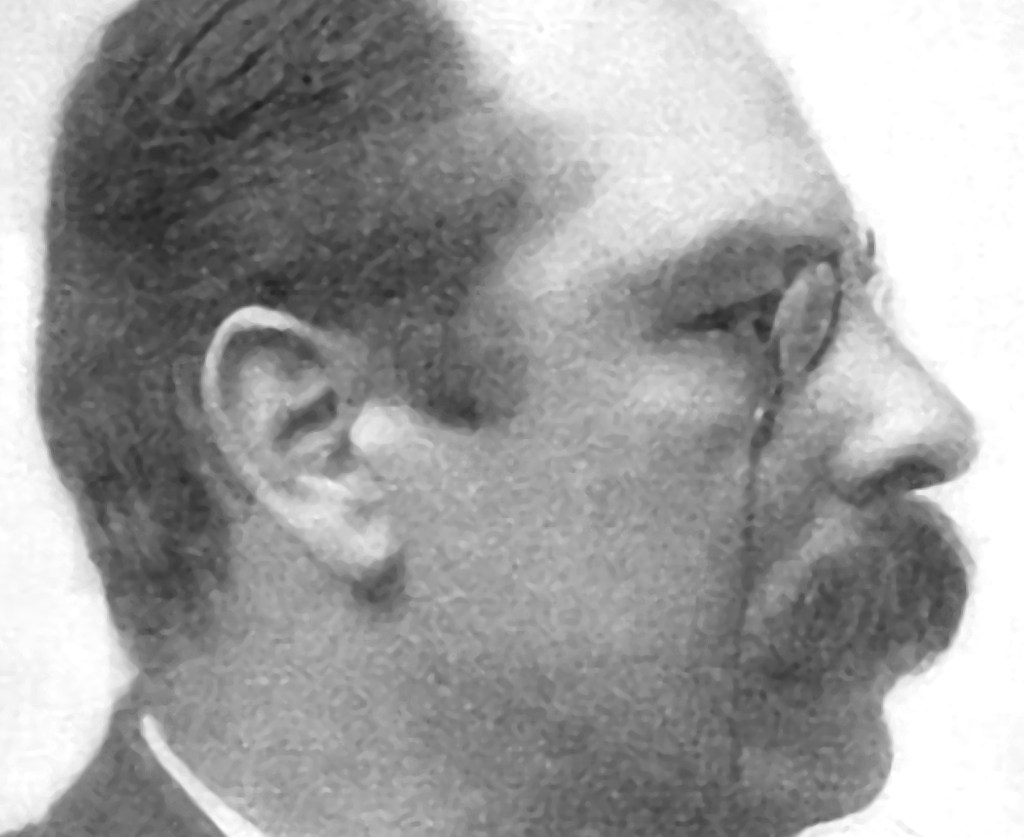
    Archibald Clavering Gunter, in King, Notable New Yorkers of 1896–1899

    Understandably, canonical-critical preconceptions pervade the institution of publishing. Gunter wrote his first novel, Mr. Barnes of New York (1887), in response to a dare by a friend: “I bet you couldn’t put me into a book and make me interesting” (San Francisco Call, Volume 101, Number 90, 28 February 1907). Hart, in his The Popular Book: a History of America’s Literary Taste (1950), describes the novel as “awkwardly written.” This implies he has read it; but of course, it could only have been awkwardly written to have been so roundly rejected for publication.

    I don’t mean to suggest that the book may not in one way or another be considered awkwardly written—many are. Its awkwardness was clearly not, however, a defining characteristic that prevented the novel from providing immense pleasure for millions of people who actually did read it.

    According to a celebratory account in the San Franciso Call, written the week after Gunter died in Chicago in 1907:

    [Mr. Barnes of New York] was offered to most of the publishers in the country, and not one would consider it, so the author finally decided to publish it himself. It came out in 1886, and was not a best seller at once. Indeed, it fell as flat as the proverbial pancake, but one copy being sold on the first day of publication. Within seven months, however, it was selling at the rate of nearly 3500 a day,

    … ultimately to the tune of three million copies (Burt, p. 271).

    The astute obituarist views the issue of Gunter’s “literary merit”:

    Archibald Clavering Gunter’s works will never be considered literature. He lived a generation too soon; he never became one of the “six best sellers” because his books always sold in greater numbers than the “Six Best” ever dared to.

    It would have been laughable for Gunter’s cheap yellowbacks ever to make it into the Bookman’s bestseller list. The “Six Best” would have found it equally ludicrous to leap from literary grace in pursuit of such spectacular popular acclaim, even if they were able to.


    Notes and References

    Adams, Oscar F. A Dictionary of American Authors (Boston: Houghton & MIfflin, 1899).

    Burt, Daniel S (ed.) The Chronology of American Literature: America’s Literary Achievements from the Colonial Era to Modern Times (Boston: Houghton Mifflin, 2004).

    Bordman, G. and Hischak, T.S, Oxford Companion to American Theatre (2004). 3d ed. (NY: OUP, 2004)

    Hart, J.D, The Popular Book: a History of America’s Literary Taste (NY: OUP, 1950).

    King, Moses. Notable New Yorkers of 1896–1899, NY: King, 1899.

    Kunitz, American Authors, 1600-1900: A Biographical Dictionary of American Literature; complete in one volume with 1300 biographies and 400 portraits (1938).

    Sorenson, Alan T., “Bestseller Lists and Product Variety,” Journal of Industrial Economics, 55.4, Dec. 2007 (pp. 715–38).

    “The Insider”, San Francisco Call, Volume 101, Number 90, 28 February 1907.

    © 2020 Furin Chime, Michael Guest

  • A.C. Gunter’s Baron Montez: 1. The Returning Californians

    A.C. Gunter’s Baron Montez: 1. The Returning Californians

    Welcome to the first instalment of Achibald Clavering Gunter’s 1893 novel Baron Montez of Panama and Paris. The story is integrated with historical events which provide a background for the introduction of the main character, Fernando Gomez Montez. The first chapters take place on a particular day, the fifteenth day of April, 1856, a date that has a significant part to play both in history and future plot.

    Panama

    Panama was always of vital interest to the United States. President Andrew Jackson as early as 1836 had commissioned a study of proposed routes for a railroad across the Isthmus to protect the interests of Americans travelling to and from the Eastern and Western states by ocean, and the developing Oregon County in the Pacific Northwest. Two years before gold was discovered in California in 1848, which made safe transit across the Isthmus even more crucial, William H. Aspinall, who ran the Pacific mail steamships conceived of a railroad. He and his partners formed a New York company and raised a million dollars to conduct engineering and route studies. The Panama Railroad was completed on January 27, 1855, at a cost of eight million and an estimated five to ten thousand lives to malaria, yellow fever and cholera.

    The ‘science’ of blood and race

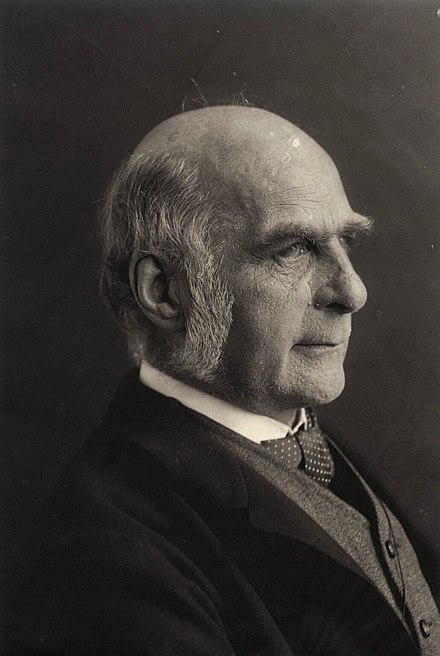
    There is a great dollop of blood ahead and smatterings throughout these first chapters, with racial connotations. Not to alarm our readers, it is best to put this in context with the time of A.C. Gunter’s writing, 1893. Ten years before, Sir Francis Galton, a cousin of Charles Darwin, defined Eugenics as ‘the study of agencies under social control that may improve or impair the racial quality of future generations’ (Memories… p. 321). As Darwin’s evolutionary ‘survival of the fittest’ made universal sense and was applied widely beyond its scientific origins, so Galton’s determination took on a life of its own in the US. Pseudo-eugenics prospered. Galton proposed that, where possible, breeding should be encouraged from good stock, and discouraged in bad. He saw the English upper classes as good stock with good qualities.

    Sir Francis Galton (1822–1911). Platinum print by Eveleen Myers (née Tennant). Source: Wikimedia Commons

    It’s all very well to establish a scientific principle, but left in the hands of the unscientific to ascribe subjective values on who or what is desirable, is another thing, particularly if based simply on race. It becomes a basis and validation for prejudice. None-the-less a movement began to grow to embrace the principles for the betterment of society through inherited blood. As Nancy Ordover puts it:

    U.S. eugenicists tended to believe in the genetic superiority of Nordic, Germanic and Anglo-Saxon peoples, supported strict immigration and anti-miscegenation laws, and supported the forcible sterilization of the poor, disabled and “immoral.”

    Ordover, American Eugenics (2003) xii

    Today, the narrator’s stereotypical presumptions would be considered racist, but these were, not to judge or justify, the emerging values of the society within which he lived. With financial support from the likes of John D. Rockefeller, and the Carnegie Institution, and aided by influential scientists like Charles B. Davenport and Alexander Graham Bell, the formation of organizations such as The Eugenics Record Office and the American Breeders Association, ensured the movement continued to grow and expand its demands until the commencement of the First World War (Ordover).

    Style and technique of the storyteller

    Contemporary writing has been greatly influenced by the visual mediums of television and film. ‘Show don’t tell’ is the admonition given new writers. This is a distinct departure from previous writing styles where the narrator plays a more visible, involved role of story-teller. However, even in Gunter’s period narrators were generally unobtrusive entities largely prepared to let their characters’ actions and words speak for qualities and nature.

    The narrator of Baron Montez, has a prominent all-seeing, all-knowing presence, to the extent of almost becoming a character of the story himself—as a US basketball coach is considered part of the team or an off-stage voice one of the cast. But this is purposeful. A.C. Gunter is a successful New York playwright, and this dramatic influence is evident in this work, in staging, character design and the transparency of his dialogue which truly provides an insight into character.

    In this first chapter, A.C. Gunter has several revelations to impart which have a bearing on the larger plot: the new Panama Railroad and its effect on the native population, and transiting Americans such as Alice and George Ripley; and while alternatively mollifying the reader with exquisite descriptions of the paradise that is Toboga Island, the sand, jewel waters and flowers, the vehement narrator carries out a relentless character assassination of Fernando Gomez Montez, who no doubt is up to no good. He is the quintessential bad boy, a charming rogue without soul, capable of anything, and his irresistible potential for evil-doing draws the reader on.


    BARON MONTEZ

    OF

    PANAMA AND PARIS

    A NOVEL

    BY

    ARCHIBALD CLAVERING GUNTER


    BOOK 1

    A TRAGEDY OF THE EARLY ISTHMUS

    CHAPTER 1

    THE RETURNING CALIFORNIANS

    “ANITA!”

    “Fernando, light of my heart! Returned from the Pearl Islands!” cries the beautiful Indian girl rushing to his arms and covering Mr. Fernando’s olive face with the kisses of youth and love. Anita is but fifteen, and the heart grows fast under the sun of the Equator.

    Fernando himself is scarce twenty, but he does not seem so ardent. He replies carelessly, “Yes, last night, by the Columbus,” pointing to that little unseaworthy steamer as she lies languidly upon the blue waters of the Bay of Panama, about three miles from the town, and seven from the lovely Island of Toboga, from which these two are gazing at it.

    “Last night, and you did not come to me? you—away five days!” answers the girl, tears coming into her eyes that flash through mists of passion like topaz stones.

    “Last night I had business in Panama—great business.”

    Then the young man says anxiously, “Is the Americano well?”

    Photo of indigenous Panamanian woman by Ayaita (detail, adjusted) CC BY-SA 3.0 Source: Wikimedia Commons

    “Yes.”

    “And here?”

    “Still here.”

    “He has not gone yet! Blessings on God! And his wife—the beautiful Senora Alicia, the lady with the white skin? She has recovered from her touch of the fever Panama?”

    “She is better. They go to the mainland this after noon.”

    “Ho-oh!”

    “To-morrow morning they take passage on the railway, to Aspinwall, and then go on the big vessel with the smoke to the great America beyond the sea.”

    “A-ah. she is well enough to travel?”

    “Yes, she is yellow no more; her cheeks are red as the blossoms of the manzanilla.”

    Por Dios! She must be lovely as a mermaid of Las Islas de las Perles!” murmurs Fernando half to himself, but still not sufficiently low to miss the sharp ear of an Indian; for at his words the dark eyes of Anita flash ominously, her full, round bosom pants under its white semitransparent cotton drapery, and she mutters savagely to herself.

    “What are you saying under your breath, Anita?” cries the young man.

    “Nothing! I—I was only whispering a prayer to the Virgin for the young American lady’s recovery, in the language of my tribe,” answers the girl hesitatingly.

    Diablo! No more of the language of your tribe! I don’t understand the language of your tribe!” sneers Señor Fernando, giving the girl a little slap on her shapely brown shoulder and a nasty glance out of his bright eyes. To this she does not reply, as she passes round the corner of the bamboo cottage, apparently overcome by some emotion she would sooner the gentleman who has been speaking to her would not discern in her face.

    “By all the saints of the cathedral, I believe the fool is jealous of my passion for the beautiful Americana! Anita jealous! Did she but know there is an Anita at Cruces, another at the Island del Rey, and half a dozen more scattered between Aspinwall and Panama, little Anita of Toboga would have fine cause for jealousy,” chuckles the young gentleman, smoothing his elaborate and spotlessly white shirt front, and settling the bright red sash around his hips, in the conceited way peculiar to South American dandies.

    A moment after, he thinks: “What matters one Indian girl, more or less? Besides, today I have other things—they are going away today. How lucky I returned from the Pearl Islands in time! But now, Por Dios!—everything is arranged for the departure tonight of the American, his treasure, and his—beautiful—wife.” He lisps this through his white teeth, as he looks lazily out over the Bay of Panama, and dreams a daydream which seems to be a pleasant one.

    It is shortly interrupted by a hearty American voice saying: “Back at last, Señor Montez. I hope you have brought the pearls. I was afraid we would not be able to wait for you. A gleaming necklace would be a very pretty present for my little girl in the United States.”

    With these words, a brown-faced, hardy and stalwart American, George Merritt Ripley, steps upon the bamboo portico and gives the man he addresses a hearty grasp of the hand. Ripley’s manners are those of one who has been educated as a gentleman, but has to a limited extent thrown off the veneer of society among the rough and ready companions of Alta California.

    This is apparent as he continues. “Light a cigar, my Spanish friend, and enjoy the view with me, this beautiful morning;” and, taking a camp chair, places his feet lazily upon the bamboo railing of the veranda, making a fine picture of a returning Californian of the fifties in his light woollen turn-away shirt, Panama hat, black trousers, high boots and belted revolver.

    “Gracias!” The Spaniard accepts the offered weed and then suggests: “Your wife, I understand, is now sufficiently recovered, to continue her journey to the United States.”

    “Yes, thank God!” answers the American. Then his lip trembles a little, as he says: “Though our first day in Panama, I was afraid my Alice would leave me forever;” and sighs: “That would have been the saddest parting on earth. My wife going to the embraces of our daughter she has not seen for four years—since we left her to journey to California.”

    “Why did you not take her with you to the land of gold?”

    “What! take a child of twelve across the Isthmus in 1852? With its boat travel on the Chagres—its night at Gargona, amid the clicking of dice and the curses of the gamblers—its morning of miasma, going up the river to Cruces, and its mule ride through tropical forests infested by thieves and banditti? That would have been too great a risk; but now, with the railroad, our return is different and safe.”

    At the American’s mention of gamblers at Gargona, and bandits on the Cruces road in 1852, a slight smile has rippled the olive features of the young man to whom he is talking.

    As the returning Californian speaks of the railroad, the smile on the Spaniard’s features changes to a scowl, but a moment after he assents laughingly: “Yes, it is different.” Then a gleam of diabolical hope comes into his face, as he says: “I am glad the Señora is well enough to travel.”

    “Yes, we leave here this afternoon. That reminds me I must thank you for your kindness of the week. Had it not been for you, Alice would have remained in Panama, and perhaps have succumbed to the fever; but here on this beautiful island, the sea breezes and the perfume of the tamarind groves have been better for her than all the quinine in the universe, and all the doctors on earth. So I shall take her back to the East to meet our child, and a reunited family will settle down to a life of civilization, blessing God for the gold placers of the Sierras, for I have been very fortunate in California. My wife will be dressed very shortly, Señor Montez. Would you mind suggesting to the kind Anita that sea breezes bring appetite for breakfast?”

    With this the gentleman returns into the little cottage of bamboo walls and palm-thatched roof, and Fernando Gomez Montez, looking after him, murmurs: “He has been very fortunate!” and thinks covetously of a strong ironbound chest the returning Californian carries with him, whose weight indicates that it contains the gold of the Sierras.

    Then his agile though sensuous mind wanders to the beauty that he knows the slight bamboo walls keep from his prying, inquisitive, hungering eyes—the beauty of the American lady—the white lady whose loveliness he has longed for since he has seen it—more than for the biggest pearl ever fished up from the blue waters of the Gulf of Panama.

    So he chuckles, looking over his own personal charms which he thinks are great, for he has very nice regular white teeth and sparkling dark eyes; his skin is a very mild chocolate color, and his slight, wiry, petite figure is clothed in immaculate white linen save where his bright red sash circles his dapper waist and falls down his right leg almost to his highly polished patent leather Wellington boots.

    Then hearing a woman’s soft voice within the bamboo walls, he mutters: “The Californian is bigger than I; but she will forget him for me—the prettiest boy in Panama!” and, gazing over the bay, sees in the distance, on the shore, the ramparts of the town, the white walls of its houses, and the glittering domes of its cathedrals.

    Back of it are the savannas, green as emeralds, that glisten in the rising sun; beyond, the Cordilleras droop to the lowest gap of that great ridge that divides the Atlantic and Pacific—so low here that twenty-five years after, they will draw all the gold from the stockings of the saving peasants of Brittany and Normandy, in the vain attempt to make the waters of the Pacific and Atlantic meet.

    Behind the South American town rise two green hills—the nearest, called Ancon; the other, farther back, an advance peak of the Sierras, is the Cerro de Filibusteres—thus ominously named because Morgan, the buccaneer, first gazed upon the old Panama that he and his two thousand miscreants (gathered from all quarters of the earth) three days afterwards destroyed with lust and pillage and rapine and fire and blood.

    Looking on this, Montez murmurs: “How peaceful! how beautiful!” Even his soul is struck by the lovely view before him, though he has seen it a hundred times, for to devils’ eyes, heaven is sometimes lovely: and this looks like heaven—though it is not.

    The sea breezes bring to him the scent of the tamarind, lime and orange groves. Around him is a mass of green—feathery green—of palms and bamboos, brightened here and there by red and yellow blossoms, that are strung, as if on florist’s wreaths, from tree to tree, and often dangle and droop into the limpid waters that lave the shore of fair Toboga Island.

    In front of him, and round to right and left, are waves clear as blue diamonds, in which the fish are seen as in some gigantic aquarium: the white shark, mixing with shoals of baracuta, and now and then a shiver of pearly water thrown into the air by flights of flying fish, that glisten in the sun.

    A little to his right, concealing a portion of the modern town of Panama, are three or four islands—green to the water’s edge. Were he nearer to them, they would also be brightened by the colors of innumerable tropical flowers, and made joyous by the songs of tropic birds. Beyond these, on the mainland to the south, lie the ruins of the old town of Panama—the one that Morgan made no more. Farther towards the Equator, the mountain range, growing higher, disappears in the blue sky.

    To the southeast, but beyond his eye, lie the beautiful Islas de las Perles. Around him it is all green and golden yellow and brilliant red—the foliage, fruits, and flowers of the tropics; about him blue; at his feet the waters of the Gulf; above him the ether of a fairy atmosphere. Its dreamy effect appeals to his sensuous soul. He gazes entranced.

    Panama, showing Archipiélago de las Perlas and Isla del Rey. (By Zakuragi; released by copyright holder)

    But as he looks his restless eyes catch, just on the right of the new town of Panama, a little smoke that goes peacefully into the air above it, and mingles with it. It comes from one of the locomotives of the Panama Railway, completed but eighteen months before, and a gleaming smile, as bright and sunny as the day he looks on, comes into the eyes of Fernando Gomez Montez, as he thinks: “Our mulateros and the Chagres boatmen hate this railroad that has taken from them the just dues they filched from the stupid Gringos who travel across our land. This iron track robs our honest banditti of their chances of spoil and plunder on the Cruces mule trail. To-night this helps me! To-night I have both the American’s treasure and his wife!”

    Then he giggles and chuckles to himself, emotions running over his mobile countenance, as fantastic, bizarre, and changing as the many drops of the blood of the various human races who in two centuries have passed across this highway of the world; and Montez of Panama has a drop of nearly all the races of the earth within his despicable carcass, and each drop—the basest.

    He has the drop that gives the cunning of the Spaniard; the drop that holds the bourgeois greed of the Frenchman; the drop that makes the watchful stealth of the Indian; the drop that contains the savage cruelty of the Zulu warrior; the drop that gives the finesse of the Italian; the drop that comes from the Corsican and makes undying hate; and, above all, one drop left by one of Morgan’s buccaneers, that makes him more dangerous than all the other drops of wickedness in his blood, for it gives to him the determination and the bulldog pluck of the Anglo-Saxon.

    Brute and bully as this buccaneer had been, he left his drop of blood to flow in the veins of this fantastic creature of all nations, to make him dangerous; because it gave him that unflinching determination that has carried the Anglo-Saxon race to all quarters of the world, and made it dominant in every one of them.

    But Montez awakes with a start. A merry voice is in his ear, a white, aristocratic hand is held toward him in friendly greeting. These belong to Alice Ripley, who with joy, hope, and happiness on her fair American face, is saying: “Señor Montez, our kind friend, you have been to the Pearl Islands for us—another favor for which to thank you!”

    “You are now quite well?” he stammers, a little confused, though his eyes are bold enough to linger over the beautiful woman, as she stands before him, a white muslin dress floating about her graceful form, and some ribbons in her golden hair, giving color to a fair Saxon face, that is lighted up by radiant, happy violet eyes.

    “Yes—quite well!” she laughs. “So well, appetite has returned to me. I am impatient for breakfast, which kind Anita says is ready in the tamarind grove.”

    “You are—quite changed—you are more beautiful—”

    “No,” she laughs, “more happy. I am well once more—my husband is by my side. In ten days I shall kiss my daughter. Am I not a fortunate woman? But breakfast. En avant, George, and forward Montez!” and Alice Ripley flits over the veranda towards the breakfast bower, made girlish by joy, and stands beside the green palms and red flowers, a picture that makes Señor Montez’s eyes grow tender, and he would pity this lovely American lady he hopes this night to cut off from husband and friends, and home and child—but in all the polyhæma drops that run in his vile veins, there is no drop of pity.

    But there are in his body, drops of blood that carry unbounded passion and intense desire, and gazing on this fair woman’s blue eyes, and white skin, and graceful mobile figure, his eyes grow misty, as he mutters: “A rare flower for Fernando Gomez Montez of Panama to pluck—Ah! This is a lucky day for the naughty boy of the Isthmus!”


    Notes and References

    • Francis Galton (quotation): The version above is taken from Galton’s book Memories of My Life (1908), where he refers to the quoted definition appearing in the ‘minutes of the University of London’, presumably based on his work. (See Field, p.23 for clarification.)
    • Por Dios: Spanish, ‘For God’s sake'.
    • quinine: anti-malaria treatment. Made from bark of a tree from Peru. It gives Tonic Water its bitter taste.
    • rapine: origin 1375–1425; late Middle English – robbery, pillage.
    • mulateros: Spanish, mule driver, mule boy.
    • Gringos: Spanish foreigners, pejorative: Yanks, Yankees, North Americans, light hair/complexion.
    • banditti: Spanish, el bandido; bandit (plural, el bandolero).
    • Cerro de Filibusteres: Cerro, hill. The literal meaning of ‘filibustero‘/’filibuster’ is ‘obstruction’; hence in the text, ‘thus ominously named…’.
    • lave: before 900; Middle English, laven < Old French, laver < Latin, lavāre, to wash. Partly representing Old English, lafian, to pour water on, wash, itself perhaps < Latin, lavāre (same Latin root as ‘lavatory’).
    • polyhæma: ‘many’ + ‘blood’; in the context, perhaps referring derogatively to his ‘mixed blood’?

    Field, James A. ‘The Progress of Eugenics’, Quarterly Journal of Economics, 1911, 26.1, 1-67. Jump to file (OUP) at JSTOR.

    Galton, Francis.Memories of My Life (London: Methuen, 1908). Jump to quotation at Internet Archive.

    ——. Hereditary Genius: An Enquiry into its Laws and Consequences (London:Macmillan, 1802). Jump to file at Internet Archive.

    ——. Inquiries into Human Faculty and its Development. (London: Macmillan, 1883). Jump to file at Internet Archive.

    Otis, Fessendon Not. Isthmus of Panama: History of the Panama Railroad; and of the Pacific Mail Steamship Company (NY: Harpers Brothers, 1867). Available free: Google Books. Internet Archive.

    Ordover, Nancy. American Eugenics: Race, Queer Anatomy, and the Science of Nationalism (Minneapolis: University of Minnesota Press, 2003).

    This edition © 2021 Furin Chime, Brian Armour

  • A.C. Gunter’s Baron Montez of Panama and Paris

    A.C. Gunter’s Baron Montez of Panama and Paris

    Prepare to embark on an idiosyncratic taste thrill, another foray into the paradoxically expanding universe of vanishing literature. This bestselling author-playwright, said to have been better known in his day than his contemporary, Mark Twain (1835-1910), is now reduced to fragments, trivial contributions to popular culture: Played middle-man in the rise of the great American baseball poem “Casey at the Bat” – sometimes referred to as the best known poem in the United States. Authored a novel on which A Florida Enchantment (1914) was based, ancestor of lesbian-transgender films.

    Archibald Clavering Gunter (1847-1907) was born in Liverpool, England, taken by his parents to San Francisco when he was six, and grew up there, before moving to New York to become a playwright, after building careers in rail and mining engineering, chemistry and stockbroking. Something of the thrill and spectacle of that six-year-old Liverpudlian’s trans-Atlantic voyage surely took permanent root in his imagination, given the extensive output he managed to generate even after such patently anti-literary occupations. Actually, he wrote his first play, Found a True Vein (1872), about life in a mining camp, while still working as an engineer.

    Baron Montez of Panama and Paris (1893) is a rags-to-riches story, like other of Gunter’s novels propelled by a dynamic of character and place. We can compare with titles of his such as  Mr. Barnes of New York (1888), Mr. Potter of Texas (1891), Don Balasco of Key West (1897), and the intriguing Miss Nobody of Nowhere (1890). Intriguing indeed, as Harlequin Romance author Elizabeth Ashton must have thought in 1933 when writing her novel Miss Nobody from Nowhere.

    But where are places as plentiful in such possibilities of drama and exotica as Panama and Paris – especially in that exciting era of massive change and aspiration, of explorers, prospectors, swindlers and tycoons? We wonder already about Gunter’s representation of the burgeoning Americas and Americana upon a global stage.

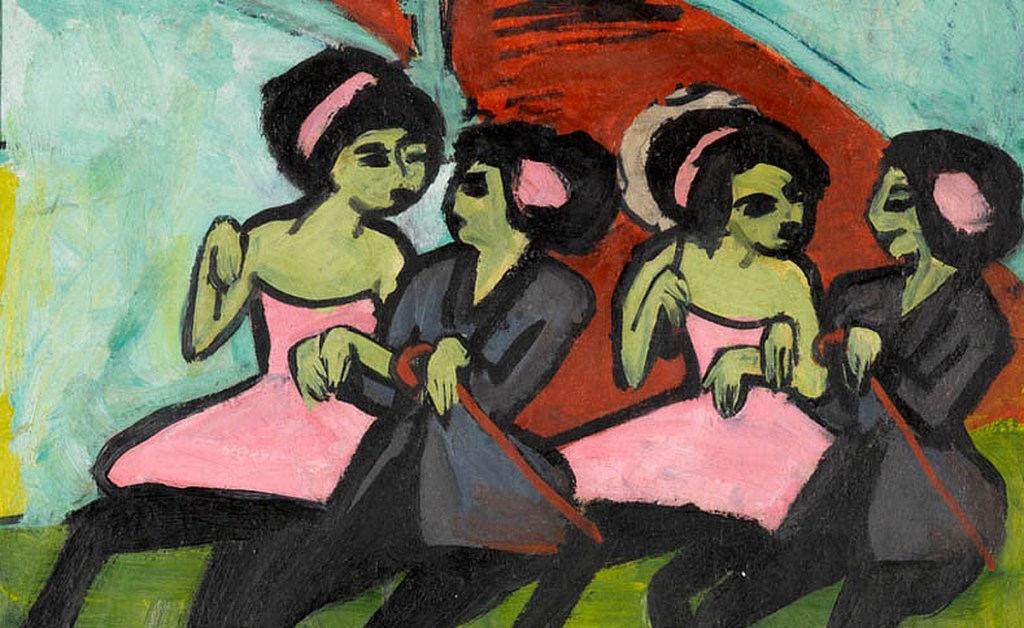
    Panama Dancers (1910-11), Ernst Ludwig Kirchner. (North Carolina Musuem of Art)

    Shady Señor Fernando Montez starts out as a seedy muchacho in a bamboo shack on Toboga Island. These are portentous times, however, preceding the building of a great canal to link the Atlantic and Pacific Oceans, and hence the two hemispheres of the globe, a dream only intensified by the discovery of Californian gold. Montez’ ascent can be limited only by his own hubris, and Gunter’s imagination.

    The French diplomat Ferdinand de Lesseps, who had developed the Suez Canal in 1869, attempted a repeat performance in Panama during the years 1881-89 but went bankrupt. The Compagnie Nouvelle du Canal de Panama again tried unsuccessfully in 1894. Gunter’s novel is, therefore, quite contemporaneous with the world depicted in it. One anticipates a taste of the authentic flavour of the times—the authentic zeitgeist, good and ill.

    In Gunter’s own estimation, his were “the most successful novels ever published” (Hart 189). Well, we’ve heard that sort of thing before, and it depends which way you’re looking at it. Nevertheless, if not for literary brilliance or a polished style, he is acknowledged for bringing American and European attitudes into a comparative focus and for the immense popularity of his

    …long line of yellow-backed novels, soon to be seen in innumerable hammocks, summer resorts, excursion boats, Pullman Palace cars, or wherever else Americans moved for dreams and escape.

    Hart 188

    Brian Armour will edit the chapters and provide reflective, contextual prefaces. Brian is the author of a stunningly good science fiction novel, Future Crime (2015), with a further brilliant novel and book of short stories coming out soon.


    Reference

    Hart, J.D.,The Popular Book: a History of America’s Literary Taste (NY: OUP, 1950).

  • Cobb’s False Knight: 18. A Revelation—Conclusion

    Cobb’s False Knight: 18. A Revelation—Conclusion

    The term “shotgun wedding”, which most English speaking people are familiar with, loses all its descriptive impact in German. “Mussehe” doesn’t sound as dramatic at all. It means “have-to wedding”. The first word, muss, meaning “have to”, also means “mash” or “sauce”, although that word is pronounced with a soft “s”. It sounds a bit ho-hum or mundane, totally unlike what awaits you in the final chapter.

    There’s actually a German website that helps get rid of some of the ho-hum at weddings, at least for any kids attending. Sort of for when the shotgun has been implied or threatened many times before perhaps. They offer a service where you can choose your favourite fairy princess to turn up, singing songs, doing face-painting and so on. Ghastly. Probably slightly better than a circus clown, I suppose. But, as I said, the final chapter has no need for any such boredom relief.

    In the English speaking world, royal weddings are all too well documented in publications that do that sort of thing (e.g., Royalty Magazine, Royal Life, New Idea). We hear little about the same sort of thing in Germany however. Of course the sorts of Germans who are into royal weddings can read all about British royal “tie the knot shindigs” too in the Bunte Illustrierte, in “Heim und Welt” or whatever hair salon magazine they read, but there still are German royal weddings too, long after royal titles and privileges were done away with in the Weimar constitution of 1919.

    When the Hohenzollern heir weds, or the Prince of Hannover, Frau Schulz or Mueller can still see all the details of whatever wedding dress was chosen, etc, at least in those sorts of magazines. Because the old royal families and suburban housewife interest in them still do exist. Somewhat diminished perhaps, but some former royals still own vast swathes of land, royal jewels and so on.

    I remember a popular family TV show in the eighties, “The Rudi Carrell Show”. Perhaps because there were only two channels at the time. They did a skit involving an expensive jewel necklace. Quite bizarrely, there, in the front row of the audience, was Krupp family heir Arndt von Bohlen-Halbach, famously and obviously very gay, but who had married some Princess Henrietta von somethingorother, “graciously” nodding, almost royally waving and smiling at Rudi Carrell for his grovelling acknowledgement in allowing the use of his probably well insured, glittering and sparkling family heirloom for the show, which Carrell handed back to him. As I said, truly bizarre, but it illustrates that Germans are still just as much “royal watchers” as the Brits or Americans.

    Part of the Landshut Wedding of 2005 (source: de.wikipedia.org) CC BY-SA 3.0

    In the town of Landshut, the wedding of Duke George of Bavaria in the year 1474 is still re-enacted every year, with thousands of people watching knights and participants dressed in mediaeval costumes parading through the streets in this amazing pageant. I’m sure you will enjoy the wedding in this final chapter. With a happy end? Who knows? I wouldn’t want to be a spoiler…


    CHAPTER EIGHTEEN

    A REVELATION—CONCLUSION

    Sir Pascal had caused a clock to be set up in the sitting-room occupied by the ladies, towards the face of which our heroine glanced over and anon, to note the passing of the lime—the passing of the brief hour that had been given her in which to prepare for her nuptials. As the fateful moments drew near she caught her mother’s hand, and asked her, with a world of earnest entreaty in her gaze,—Did she really think they would come? The simplest word of hope would give her comfort.

    “Let us hope. They have promised; and we know they will keep the promise if they can.”

    At the same time, in the great audience chamber, or hall of state, of the castle—sometimes the banqueting hall—Sir Pascal Dunwolf had assembled his chief officers, together with a number of men-at-arms, who were stationed at the doors as sentinels and ushers. He was determined that his marriage should not lack publicity. These men-at-arms, it is worthwhile stating, were all of the original garrison-men, who had willingly sworn fealty to the new chief.

    In a far corner, at the head of the hall, where over the permanent dais a canopy of silk had been suspended from the vaulted roof, stood the knight in company with good father Alexis. The priest was in full canonicals, and was comparatively sober. His patron had drunk with him several times, and had caused his lieutenant to do the same, well knowing that a certain quantity of wine would inspire the priest with a daring obliviousness to consequences which might not otherwise possess him. And success had crowned his efforts. The ecclesiastic had reached that happy state between inebriety and soberness which, without seriously clouding his mental faculties, yet blunted every moral sense, rendering him fit and ready for any work not terribly wicked or fraught with mortal danger.

    “Produce the lovely bride,” he said, heroically. “There shall be no delay on my part.”

    “You will allow nothing to stop you. As soon as I give the word you will proceed with the service.”

    “Yes, my lord, and I will finish it right speedily.”

    “All right, remain you here, do not leave until I am done with you.”

    The priest promised, and the knight went away. He touched his lieutenant on the arm as he passed him, whispering in his ear a caution to look to the good father, and see that he drank no more wine until after the marriage service had been performed.

    In her prison chamber Electra still watched the passing of the minutes, pale and prayerful. At the stroke of ten, as she had expected, Sir Pascal appeared. As he approached her and extended his hand she arose. She had resolved that she would offer no senseless opposition—no opposition which could only serve to render her treatment at the bad man’s hands more harsh and painful.

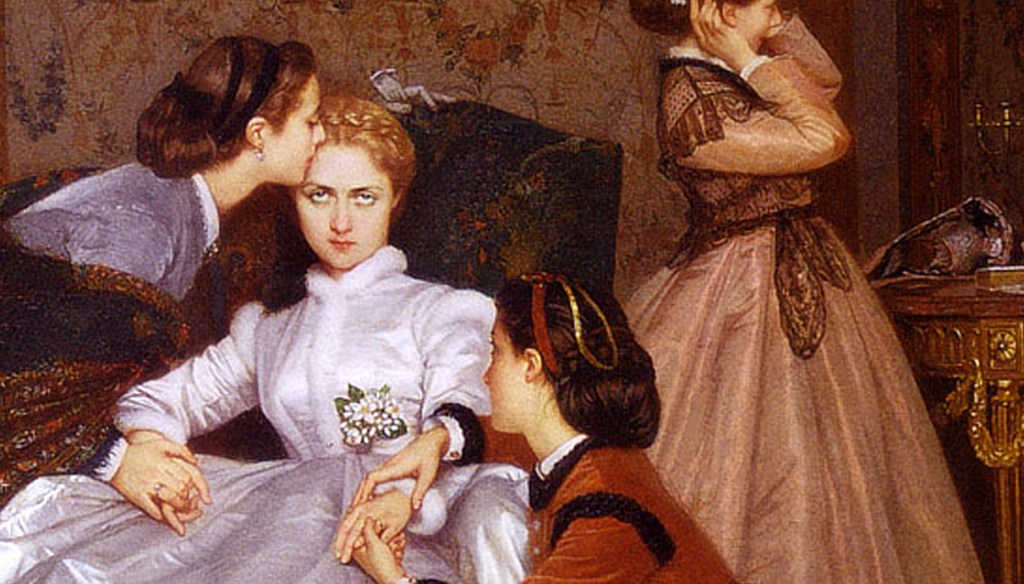
    The Reluctant Bride (1866), Auguste Toulmouche (Source: Wikimedia Commons)

    “Dear lady—Electra—the hour is up, and all is ready for the brief ceremony that is to make us one. I had hoped that you would have felt like arraying yourself in a more befitting costume than that is you now wear. You might, at least, have put on a few jewels.”

    She did not tell him that her jewels were all in a place far from the castle, because, if she had had them near her, she would not have worn them.

    “Never mind,” he added, trying to smile. “If you are satisfied, I will be. After all, it is Electra I want, and not her finery. Come.—Good mother, you may walk by your, daughter’s side, or follow us, as you please.”

    For a single instant the sorely tried maiden came near fainting. Her limbs weakened, and her brain reeled; but with a mighty effort she recovered herself and moved on by the knight’s side. Her mother came close behind her, walking with Theresa, the two women of the forest bringing up the rear.

    So the procession moved on, down the great stairway, into the main hall of the keep, and thence to the broad doorway of the chamber of audience, which was open for their reception. At the arch of the vestibule Electra saw, as she passed, a squad of men-at-arms, who seemed to be stationed there for guard duty; a little further on, at the opening of a passage which led to a side porch, other sentinels were posted, and at the door of the audience chamber itself armed men were stationed.

    Her heart throbbed painfully as she entered the old hall of state. The first thing upon which her eyes fell, as she crossed the threshold, was the silken canopy at the far end. O! what a mockery it seemed! And then she saw the full-robed priest standing on the dais! When she saw this she came near stopping. It was an instinctive movement, without premeditation; the pressure of her companion’s hand, however, drew her on, and she hesitated no more.

    Half way up the long room the knight stopped to speak with his lieutenant, and he appeared to desire that the ladies should hear.

    “Franz, has there been any sign of interruption yet?”

    “None, my lord.”

    “Are the guards thoroughly instructed?”

    “They are.”

    “And every avenue efficiently guarded?”

    “Everything has been done, my lord, as you commanded.”

    “It is well.”

    And then, with head erect, and a proud step, Sir Pascal moved on to the dais; assisted his fair companion to ascend; stopped at the proper place, and turned, bringing the prospective bride upon his right hand.

    “Now, good father, you may proceed at once.”

    The priest had stepped to the front, and made ready to commence the service, when the baroness, with a sudden movement, dashed him aside, and turned to the men who had assembled there, many of whom she recognised as having belonged to her own guard.

     “O! in Heaven’s name! are you men, to stand and see this thing? Is there not—”

    At this point the lieutenant, at a sign from his chief, laid his hand upon the lady’s arm, and drew her aside. She started to struggle; but when she found that among those who stood before her she had not a friend who would, or who dared, to move in her behalf, she gave up, and resisted no more; but she turned upon the false knight, with flaming eyes, and with her hand extended, exclaiming, in a voice that rang like the blast of a cornet:

    “Base, wicked man! thou shalt not succeed! High Heaven will not permit it! O! for one brave, true heart to stand by me now! Cowards! cowards, all!”

    So far had she gone when Franz, with evident reluctance, placed a strong hand over her lips, thus stopping her impassioned appeal.

    Twice the daughter tried to break away to go to her mother’s assistance; but the man at her side, now beside himself with anger and chagrin, had held her back; and when he had seen the baroness under control, he turned again to the priest.

    “Now, Sir Priest, should the very walls come crashing down about us, do you proceed. Not a word more than is necessary; and speak the words you must speak quickly. Up, up, my sweet wife that is to be! No fainting now. By Heaven! this fair hand’s mine at length!”

    “Not quite yet!” spoke a voice close beside him.

    At the sound of that voice the drooping maiden started out from her half swooning state into which she had sank, and found no difficulty in breaking away from the hand that had held her. It was the rich, deep voice heard once before—the voice of him whose life she had saved in the forest. Her heart bounded with rapture unspeakable, for it was to her a note of redemption.

    Sir Pascal turned, and beheld, just stepped from behind the old tapestry that hung against the wall, a man in whose majestic presence he quailed instinctively—a man but little past the middle-age; of powerful frame, his lower features covered by a full beard, his brow full and expansive, with a pair of dark gray eyes, that seemed to look him through and through.

    “No quite yet, Pascal Dunwolf. There are others who have an interest in this matter.”

    “What ho, Franz! Bring up your guard!” So shouted the knight, as soon as he could command his speech; and when he had seen his lieutenant start to obey, he laid his hand upon his sword, and drew it half way from its scabbard.

    But he drew it no further, for at that moment his attention was called to a newcomer upon the scene.

    Following close upon the steps of him who has surely been recognized as our friend of the mountain-side, known to us thus far as Thorbrand, came that other friend—the blue-eyed, fair-haired Wolfgang. But now, in place of the leathern doublet of the forester, he wore a coat of purple velvet richly embroidered, and upon his breast a golden star blazing with diamonds.

    The effect upon Dunwolf was terrible. He gasped for breath; turned pale as death; his legs quivered and grew limp beneath him; and his sword dropped back into its scabbard, and his hand fell powerless at his side, a deep groan escaped his bloodless lips.

    A squad of the headstrong men-at-arms, made pot-valiant by numerous potations of strong- drink, eager to obey the command of their chief, and indignant at seeing the exhibition thus interfered with, had hastened forward, and would have rushed upon the dais, had not Franz, aroused from his stupor by the impending calamity, put himself quickly in their way.

    “Back! Back!” he cried, vehemently.

    “No, no!” vociferated a stout trooper. ”Who dares come hither to interfere with our master?”

    “Fool! It is the grand duke!”

    The effect was electrical; not only upon the rough soldiers, who fell back like so many frightened animals, but upon others as well. Electra, as she heard, gazed upon the transformed man in utter amazement as did her mother; and the thought came to them both at the same moment,—”If Wolfgang is the grand duke, who is Thorbrand?”

    But their thoughts were soon called in a new direction by the appearance of Martin Oberwald and Ernest von Linden. Our hero flew to the side of his darling and caught her hand.

    “Saved! Saved! O! thank Heaven!” So ejaculated Electra, in answer to her lover’s eager look of inquiry; and on the next instant she was clasped closely to his bosom.

    Sir Pascal saw it all, but could utter not a word nor a movement in opposition. Still pale and trembling he stood before the sovereign whom he had betrayed, knowing full well that his race was run—his short-lived power at an end.

     Ernest, when he had seen Electra’s sweet face once more beaming with happy smiles, called to still another new-comer to advance and take his place; and in a moment more the dear girl found herself in the loving embrace of Irene Oberwald, with her faithful stag-hound, mad with joy, leaping and frisking about her.

    Once more our hero was captain in the castle. Stepping to the rear of the dais he lifted aside the tapestry, and spoke a wore of command, and directly an armed man appeared, wearing the uniform of the ducal guard; then two more abreast, and another, until a score of them had entered the chamber, and formed in order upon the grand duke’s left hand.

     “Sir Pascal Dunwolf!” said Leopold, “I trust you will offer no word in justification of your conduct. I know the whole story of your treachery against this house, and of your treason against me. Aye, well may you tremble. O! Sir Pascal! I  had not thought it! In memory of the great kindness you once did me—the saving of my life—I would have done much for you. When you told me that the heiress of Deckendorf loved you devotedly, and that her mother desired nothing so much as the union of her daughter with yourself; when, beyond that, I was told that this important fortress was without a commander, Sir Arthur von Morin being near his death, I sent you hither, with full powers of command, and with my consent to the marriage.”

    At this point the duke took a step forward and bent upon the miserable culprit a look beneath which he seemed to wither and collapse.

    “O! false knight that you are! you had not been three days in this castle before I knew that you were the leading spirit on this side of the border of the treasonable insurrection I had been fearing—that you had entered into a league with the Robber Chief, Thorbrand, and that he was to meet you here, with his chief lieutenant, for the purpose of arranging your plans for the overthrow of all healthful government in the realm. Here, in fact, were to be the headquarters of the conspirators. Can you deny it?”

    “Why should I?” sulkily returned the scoundrel, struggling hard to hold up his head. “If Thorbrand—may the fiends seize him—has turned traitor to me—”

    “Hold!” commanded a deep, solemn voice. “Curse not the dead!” And he whom we have known as the brigand chieftain stepped forth from where he had seemed to be in hiding, and confronted the false knight.

    “Sir Pascal Dunwolf,” he went on, as the grand duke moved back to give him place, “would you have me to tell you why you did not meet the Robber of the Schwarzwald as you had expected?”

    “Who—who are you?” the quivering culprit gasped, something in those solemn eyes and in the towering form striking him with awe.

    “Who am I? I will tell you that anon. For the present I will tell you that both Thorbrand and his lieutenant, Wolfgang, fell by my hand, though the strife cost me dear; and would have cost me my life but for the providential appearance and ministrations of two angels who found me, dying, in the deep forest. Would you like to hear my story? Would it please you to know how it came to pass that I slew those two men? For, let me add, it will tell you how your treason came to be known.”

    Sir Pascal started and caught his breath. He did not speak, but his looks plainly signified that he would be only too glad to hear.

     So others seemed eager to hear. The women, Elize and Zenzel, with dark, lowering brows and compressed lips, listened eagerly; and Franz was eager; and so were all of them, for that matter.

    “Pascal Dunwolf, you behold in me one raised from the dead more than once. Years ago, upon a hard fought field, when you might have won glory had you fought for your country and your religion as you fought for plunder. Aye, you were there Dunwolf; and you, with others, thought me dead. But I was not. The spear of a turbaned Moslem had stricken me down and when my consciousness returned I found myself a prisoner in Moslem hands. Those same Moslem hands nursed me back to health and strength, and then put me into the slave market in Constantinople, when I was sold to a merchant of Bagdad. And to Bagdad I was carried; and there I remained, a bondman and a slave, for ten long years.

    “At length my master died, and in dying gave me my freedom. Do you ask why I had not escaped? I tell you—I could not. Many times I tried, but the thing was not to be done. But the blessed boon was mine, as I have said, on my owner’s death, and the widow, when she had heard my story, not only kept the faith her dying husband had pledged, but gave me money for my journey home—more than enough, by far.

    “Thank the Good Father of us all! nothing occurred to interrupt my homeward voyage. I arrived in my native country well and strong. At Baden-Baden I stopped co see the grand duke; but he whom I had expected to meet was dead, and his son, Leopold, was on the throne. But Leopold received me kindly and affectionately; and when I had told him my story, he embraced me as a son might have done.

    “When he learned that I was going to Deckendorf, a curious plan formed itself in his mind. He told me of the contemplated insurrection in that region, and how necessary it was that he should discover who were the chief conspirators. I told him I would help him in any way within my power. It was then arranged that we should come hither incog., letting no one know of our intention. I was in haste, and started on in advance, arranging to meet him at the cot of the hunter of the Schwarzwolf Mountain, Martin Oberwald. He knew how to find the village of Deckendorf, and I told him the people there would inform him how to find the hunter’s cot.

    “Then I set forth, intending first to call upon good old Martin, who had been my dear and loving friend from boyhood, and enlist him in our enterprise; for I had great confidence in his judgment and shrewdness. On the way up the mountain I fell in with two men. They asked me certain questions about the castle over the way. I told them I knew the place well. From the first I guessed their true characters, and led them on for the purpose of gettinq them to commit themselves, and I succeeded. They believed me to be the very man of whom they were in search—Sir Pascal Dunwolf.

    “After that the rest was easy—easy until they had discovered their error—and then it became rather difficult. I learned from them all their secrets—learned the whole scheme and scope of the insurrection—learned the names of the chief conspirators; and learned that for giving Deckendorf Castle to be the stronghold of the Grand Brigand Confederacy, Sir Pascal Dunwolf was to be general-in-chief of the Free-Riders.

    “At length an unlucky word betrayed me, and I was foolish enough, in the instinct of self-preservation, to lay my hand upon the hilt of my sword. Their eyes followed in that direction, and they saw that he weapon at my side was the double-handed sword of a Knight of the Temple. That was sufficient information for them. No man honestly bearing the knightly accolade would dare to assume a sign of rank or station not his own. Enough to say beyond that,—we were quickly engaged, and I slew then both, though the younger of the twain wounded me so severely that my life would have soon left me had not kind Heaven sent me help.

    “The place where we had held our conference had been a deep, hidden nook, shut in by tangled vines and brushwood; and there we had fought. As the two robbers had fallen side by side, I was able to pull a few branches over their dead bodies before I left. A considerable distance I managed to crawl, then I fainted. I think I called for help. A dog came first,—then—Ah! how hard it was to refrain from taking the administering angel to my bosom!—but, believing that the mortal remains of those two robbers would not be found, I had resolved that the duke and I would assume their names, thus “enjoying a freedom in our movements which could not otherwise be ours. So I held my peace, and gave out that I was the terrible Thorbrand.

    “O! it was hard—very—very hard! But—but—”

    He could hold himself from his loved ones no longer. From the very first the baroness had suspected, and very shortly thereafter she had known. So, too, had the truth burst upon Electra. As the speaker now turned, the flowing beard no longer concealed the well-remembered features. With a quick step he left the dais, and in a moment more wife and daughter were clasped in his loving embrace.

    “Gregory! My husband! O! thank God!”

    Portrait of a Nobleman (1610), Guilliam van Deynum (Source: Wikipedia Commons)

    “Papa! Papa!”

    “My blessed child! Your father’s life is yours from this time; for surely he holds it as your gift.”

    “And Irene’s, papa. What could I have done without her?”

    Already have I thanked that dear girl, my darling, though she knew not until now that her grateful debtor was the Baron von Deckendorf.”

    While this latter scene had been going on with the re-united ones, the grand duke had given Sir Pascal Dunwolf into the hands of a double file of his guard, with direction that he should be taken away, and held in strict and sure confinement until further orders. To others of his guard he gave direction that they should clear the chamber of all, saving his true and loyal friends. One man, however, he was inclined to favor. He had marked with what entire revulsion of feeling Lieutenant Franz had recognised him and how luckily he had held back the would-be assailants. Him he called aside as the others were being sent away, and kindly said:

    “Franz, I know that you have been played upon by a wicked, designing man, who has taken advantage of your little weaknesses to bend you to his own purpose. I will not lose your love and loyalty if I can help it. Will you take command of the men who came hither with you, and march them back to Baden-Baden? I care not to know who have offered to desert me, provided they will be true in the time to come.”

    Utterly crushed, and seemingly heart-broken, the conscience-stricken man sank upon his knees, and implored forgiveness, pledging himself, while life should be his, to be honest and true.

    So Franz was forgiven; and, for the first time in many days, he was able to think of the present with satisfaction, and look to the future with hope. In the time to come, when he had proved himself worthy, he was to be given Sir Pascal’s old command, that recreant knight having been banished forever from the land he had dishonored.

    Ordinarily, the traitor and conspirator should have suffered death; but Leopold could not find it in his heart to take the life of the man who had once saved his own.

    And now, back to the old chamber of audience. As soon as the company not wanted had been sent away, Leopold stepped down from the dais and looked about him. He saw the baron, with his wife and daughter in his arms, and Ernest with them, their tears of joy still coursing down their cheeks, their voices mingling in praise and thanksgiving. And presently he saw two others—the hunter and his child. They stood against the tapestry, near to the secret pass, the child held close to the bosom of the father, who appeared to be trying to comfort and console her.

    He looked upon them for a little time; then moved quickly forward and captured one of Irene’s hands. She turned, with a wild frightened look upon her beautiful face, a low, startled cry bursting from her lips; but when she saw the loving light of those wondrous eyes, and marked the infinite tenderness of the gaze that was bent upon her, her heart bounded with a renewal of hope, and the light of a great joy chased away the cloud from her face.

    “Irene,” he said, with a smile that seemed to her celestial, “do you remember the question I once asked you in your mountain home? I can repeat it, word for word. I asked you if you thought—if you believed—you could make me a good and happy man—a man who could be of use to his fellows and of value to his country—would you give yourself to the work? Would you be willing to place your hand in mine, and go with me to the end? So I asked you, and then gave you time for thought. Dear girl—my love, my life—l repeat the question now. Shall this dear hand be mine?”

    Again something of the old frightened look came back.

    “You!!—you!—the grand duke! O! it cannot be! Your people would never look upon me—”

    “Pshaw!” broke in Leopold, laughingly. “Dear girl, I tell you truly, were you the poorest of the poor, and plebeian to the core, loving you as I do, so you were honest and pure, I would make you my wife. But— My lord,” he continued, turning to Oberwald, “you must tell her who she is.”

    “Irene, the story of my life I must tell you at another time. For the present suffice it for me to say, I have promised our duke that I will, for his sake resume the title and station once cast off, and give to him my poor services in the time to come. For yourself, you must answer according to the dictates of your own heart; but, if it will help you any, I will inform you that you are the daughter of a baron of the empire. Something of this you have heard before, but I now give it to you plainly, that you may know your true rank and station.”

    “Sweet love, again I ask the question,” said Leopold, taking her hand once more.

    Her answer was given upon his bosom. Held close in his strong embrace—a happy, joyous answer, never to be regretted while life should endure.

    By-and-by Electra and Irene found themselves together, talking of the wonderful things that had happened, while the grand duke and Ernest, with the two barons and the Lady Bertha, were arranging for the double wedding, which they had planned should come off at the Ducal Palace of Baden-Baden.

    And the noble stag-hound went from one to another of his true friends, looking up happily from his great brown eyes, and wagging his tail with infinite satisfaction.

    THE END


    Notes

    • pot-valiant: cf. “Dutch courage”.
    • dark, lowering brows: “looking sullen: appearing dark and threatening” (Chambers Twentieth Century Dictionary).
    • Knight of the Temple: Templar. See Furinchime, “Cobb Biosnip: Laborare est orare” on Cobb’s connection with Freemasonry.
    • recreant knight: (cowardly, unfaithful)
    • Arndt von Bohlen-Halbach: Heir to the 400-year-old Krupp dynasty, producers of steel and armaments. See Time magazine, “West Germany: Who Should Pay the Playboy?” (Aug 15, 1969).

    NIGHTSHIFT byTony Reck © 2025