Tag: Dime novels

  • Cobb’s False Knight: 13. A Terrible Blow

    Cobb’s False Knight: 13. A Terrible Blow

    For some people living in western democracies, reading Cobb’s story with spies lurking in the woods may almost seem a bit too fictional to be taken seriously. Yes, some of us remember all the “reds under the beds” hysteria from not so long ago, but wasn’t that a bit different?

    Perhaps we are entering times of spies galore once again, but only a few years ago, all you had to do was get a day pass to visit East Berlin from West Berlin, and suddenly you entered something like a huge walk-through movie set from what could have been a James Bond spy film. Except, it was real.

    Maybe it was because the drab border checkpoints and East Berlin streets seemed familiar from such movies? Or maybe it was because you knew a bit more about Stasi, the East German security service, that was reputed to have up to ten percent of the population working for it as informants? They even had one in West German Chancellor Willy Brandt’s office, happily passing on NATO secrets (Guenther Guillaume).

    Still, imagining “spies lurking in the woods” is something quite different, isn’t it? I guess it might not seem so unusual for those of us who might be a bit more prone to paranoia than others when it comes to feeling observed to accept such a notion. But for the others? Is Frau Schmidt from the apartment building next door hoping to see what kind of furniture is being delivered from the van parked below? Perhaps, in the Middle Ages, “spies” may have been little more than inbred villagers paid to hang around an area and hope to get a reward for reporting something suspicious. Calling them “spies” may be all that had irked me at first. I really wondered exactly why Cobb’s mentioning of them at first seemed a bit too contrived for me.

    Mata Hari in 1906, photographer unknown. Source: Wiki Commons

    We have all heard of Mata Hari and those famous British traitors from Cambridge, like Philby. Less well known is Rudolf Roessler, an extremely successful anti-Nazi Soviet spy. But do we know the name of even a single spy from several hundred years ago? Hmmmm… There you go. Not one, I bet. Perhaps they were just too good at keeping a low profile back then? I’m just kidding. Or could it be that in an age of chivalry, when concepts such as “honour” and “fairness” still meant something, anyone lacking enough in either to become a spy in such times was soon best forgotten?

    An example of this could be Christian Andreas Kaesebier (the surname translates as “Cheesebeer”). Known as a thief and a scoundrel, Prussian King Frederick II had him released from prison in Stettin during the siege of Prague in 1757, on the condition that he should of enter the city and spy for Frederick. He did so on two consecutive nights, not returning from a third however. He disappeared and was never heard of again. It’s amazing we even still know of him.

    So of course Kings, Emperors and all sorts of nobles had spies, maybe even knights from smaller castles, surely also in the Middle Ages. Perhaps my reason for at first wanting to think of them as being too fictional was simply because I had never heard of any from that era. Tinker, tailor, soldier, spy? Forgotten bit part players in the intrigues of long ago, mere village inbreds, standing around suspiciously in the woods? Fitting then, that Cobb didn’t even name them.

    Just kidding. It seems that our perception of spies may have changed since a century or so, except those we revile for having worked for the other side. Too many Bond films?


    CHAPTER 13

    A TERRIBLE BLOW

    An hour and more Oberwald and his young friend spent with Thorbrand, finding him more easy and comfortable than he had been at any time since his sanguinary ordeal. For one thing, they found him up and partly dressed, sitting in a softly-cushioned chair, with a sword in his hand— a sword which his host had kindly lent him to hang up on the wall of his abode. He said he had been simply trying the strength and endurance of his arm. His nurse did not scold him, as he believed the exercise would be of benefit.

    As we have said, his visitors remained with him an hour and more, and when they left him he seemed better and stronger than when they had found him. They had told him all they thought it best to tell him, giving him to understand that the baroness and her daughter were for the present safe, but withholding the fact that they were so near him.

    When evening had come, Lady Bertha and Electra, with Captain von Linden, joined the hunter and his child in their comfortable living room. The heavy inside shutters had been put up against the windows, and there firmly bolted, and the doors carefully closed and secured.

    “Dear sister,” said the heiress of Deckendorf, looking suspiciously into Irene’s face, “what has happened to you? What is that wondrous light in your eyes? And why does your heart beat so strangely? I can hear its throbbing when I lay my head against your bosom. Ah! you have seen—”

    “Hush! No more now, if you love me!” And as Irene thus exclaimed in a tremulous whisper, she caught her companion’s hands and looked into her face imploringly. “At some other time I will tell you all about it. Don’t ask me any more now.”

    Electra gave her a curious glance, then a meaning smile broke over her beautiful features, and she turned the conversation upon another topic.

    Wolfgang had gone as he had come, promising that with the expiration of another week, if not before, he would come again, by which time he felt assured his chief would be entirely recovered; or, should an alarm of impending danger reach him, they might see him at any moment thereafter.

    The fourth day from the visit of Wolfgang was dull and drizzly—really stormy. The wind moaned through the sombre firs and around the broken faces of the mountain, and the driving moisture was penetrating. Early in the morning the hunter had been obliged to go to the village, taking the secret way. It was a business he dared not neglect. Before he went he looked in upon the baroness, to see if she had any orders or errands for him, at the same time being very particular to enjoin upon her the utmost caution during his absence. She promised him that both she and her daughter would be very, very careful and circumspect; and he went away content.

    Alas! Why did the woman break her promise? Was it that perversity of her kind that makes forbidden fruit so attractive? At any rate, good Martin Oberwald had not been gone an hour when the fancy seized the baroness that it was very gloomy and lonesome in that dismal cavern, and she tried to make herself believe that the rain was coming down through the roof. A full hour she dwelt upon the subject, telling herself repeatedly that she would certainly stay where she was, and then—then she persuaded Electra that they might, on such a wretched day, with entire safety spend a little time with Irene before her great fire. The girl, unfortunately, needed no urging. So many days of quiet rest without any alarm had made them bold.

    At the same time that Lady Bertha and her daughter were making their way out into the living-room of the cottage, something happened outside that is worthy of note.

    Two of Dunwolf’s spies, posted near the main path from the hunter’s cot, were surprised by the appearance of another of their squad, who had just come up the mountain. He had been climbing rapidly, and was breathing hard.

    “Martin Oberwald is in the village!” was the report. “I saw him at the foot: of the mountain, just striking into the path from a dense jungle of rock and tangled wildwood. Now let us strike at the game. We know where it is, and we may capture it if we are prompt and wary. What say you ?”

    They were both of his way of thinking, and they at once went to work to gather together sufficient of their comrades to strike a decisive blow.

    * * *

    “O! Irene, how comfortable you are here!”

    The words were spoken by the Baroness Deckendorf, as she and Electra came forth from their hiding place.

    The hunter’s daughter started so suddenly that she dropped a part of the work from her hands.

    “Now, don’t scold us. I cannot tell you how lonesome and cheerless it had become in that dark and dismal place,” said the baroness.

    “I could not scold you if I would, dear lady; yet I must tell you that you are running a risk. I know the cavern is chill and cheerless on such a day; but it is safe, nevertheless.”

    “And why shall we not be safe here?” asked the baroness, as she spread her hands over the blazing fire. “The shutters are all up at the lower windows, and if strangers should approach the dogs would give us warning.”

    “What makes your father so particularly anxious?” asked Electra, not offering to sit. ” I thought this morning, when he came to speak to us, that some new cause of alarm had arisen.”

    Young Couple (1850), Carl Wilhelm Hübner. Source: invaluable.com

    “You know, dear sister, that your staghound got out on the day before yesterday, and was away for a considerable time. Some of the spies must have seen him, and if they recognised him as yours, of course they would be certain that you are not far away.”

    “Really, mamma,” the daughter said, “I think we had better return to our safe retreat. We can have a good fire there, and be as comfortable as we please. Let us call Ernest to sit with us, and I am sure we shall pass the time away very pleasantly.”

    “Well, well,” the baroness returned, as she arose from her chair with a seeming effort, ” I will go back. But, certainly, I do not see how anybody can come upon us in here. How could they, with the lower shutters up, and everything so snug and close?”

    As she spoke, and before lrene could reply, the staghound, who had followed his mistress from the cave, gave a sudden start; then a low, sharp cry; and then away to the door, where he pressed his muzzle against the cracks, sniffing and growling with wonderful persistence.

    “Mamma! mamma! come! let us make haste. There is something at the door I am sure.”

    Electra had taken her mother’s hand, and had turned towards the place of exit, when a sound, as of a thunderclap, smote their ears, and on the next instant the outer door was burst from its fastenings, and flew wide open, a huge battering-ram—a log of wood as heavy as ten men could lift—being at the same time projected into the room; and in a moment more the place was filled with armed men!

    While the women screamed the staghound flew at the foremost of the intruders ferociously; but one of the men, with his wits about him, and evidently prepared for the work, adroitly slipped a noose over his head, and very quickly had him secured and placed beyond the power to do more harm.

    The baroness and her daughter were then seized, their arms bound behind them, their heads and shoulders protected from the weather by heavy coats which two of the soldiers threw off; and then, without further ceremony—without waiting for further raiment, they started off upon the run, the half paralyzed women being borne roughly along, a strong man at each arm, almost lifting them from their feet as they sped on their way. In their paroxysm of terror, the stricken captives could neither struggle nor cry out; one word, and one alone, fell from the lips of Electra—the name of her dear lover—”ERNEST!”

    So quickly had the whole thing been done, so prompt and sure had been every moment without mistake or mishap, that not more than one poor minute had elapsed after the invaders had burst open the door of the cot before they were out again, with their prisoners in charge,

    Upon Irene they had scarcely looked. Her great St. Bernard, accidently left shut up in another room, had been struggling for admittance, but she felt that in opening the way to him she would but admit him to his death. And further, he could have done no good. As for herself, she had not lost her presence of mind at any time during the startling scene. She had seen on the instant that anything like resistance would be worse than useless. As for help, there was none to call. If, for a single moment, she had allowed Electra’s pathetic call to lead her to think of arousing Ernest, the thought was quickly put away. She would have simply called him to share the fate of the others. There had been at least a full score of the ruffians, and they had been determined and desperate. Against them, the arm of the young captain, strong as it was, would have been but as an arm of straw. He would have been instantly captured, if not killed, and thus the loved ones would have been robbed of a valuable helper in the future. Aye, Ernest von Linden left behind in his safe retreat, could be of vastly more service to them than he could have been had he kept them company in captivity.

    The girl stood where she had stood from the first, and watched the departing troopers—saw them half carrying their captives in their arms—forcing them onward in brutal haste—watched them until they had gone from sight, and then went to close the door; but this she was unable to do. The heavy log, which had been used as a battering-ram, had been left across the threshold, and she had not the strength to lift it. With a strong lever, however, she at length succeeded in working it out of her way, after which she shut to the door, and secured it as best she could.

    Her next movement was to loosen poor Fritz, who was jumping against his leash, and howling most dismally. When the dog was free, he sprang to the door and tried to open it. Then he came back to Irene, and begged most piteously, fawning upon her and whining, his great brown eyes fairly brimming with tears. The agony of that poor, dumb friend made her heart ache more than had all that had gone before; and by and by the intelligent animal seemed to understand that he had her sympathy, and that that was all she could give him. He finally returned to the door, and there lay down, moaning in bitter grief and distress.

    The getting of the log from the threshold and disposing of the dog had consumed considerable time; so much, that Irene judged that the marauders had, reached the foot of the mountain, at least, and she would be safe in letting Ernest know what had happened. She had hesitated until now, because she had felt sure that he would, if he thought the ruffians within reach, dash madly after them; and she did not care to be a party to his self-destruction. But she was speedily saved further anxiety in the matter by the appearance of the man himself.

    She was standing looking at the dog, but thinking of Ernest, when she heard her name called, and on turning, she saw the face of the captain just peering through a narrow opening he had made by partially pulling back the door.

    “Irene, What was the noise I heard? Where are the baroness and Electra?” he asked, hurriedly and eagerly, as the girl came towards him. “How? Has anything happened?” he exclaimed, catching the scared look upon her face; and, at the same time forgetting the precautions of the hunter, he threw open the door and came out.

    But Irene pushed him back, herself following; and as she started to close the door behind her, the stag-hound came bounding through, and at once began to fawn upon the youth, and to implore him as he had to the maiden.

    By this time our hero knew that all was not right. He caught the girl by the wrist and besought her to speak.

    “Alas, dear sir, the worst— No, no not the worst,” she cried, correcting herself, “but something very painful has happened.”

    And then, as best she could, with his frequent and frantic interruptions, she went on and told the story.

    It was terrible—and for a little time the frenzied youth strode to and fro, wringing his hands in speechless agony. His first thought, when he could think at all, was of instant pursuit. He would arm himself with sword and pistols, and overtake the villains if he could.

    Fortunately for Irene, and, perhaps, fortunately for the young man himself, at that moment the hunter made his appearance. In the two faces before him he saw the indications of terrible news, for never was more terror depicted in a human countenance. Before a word had been spoken he opened the door and looked into the front room. He saw the ponderous log of wood upon the floor, its smaller end just clear of the outer door, and his quick eye detected that the fastening had been broken away, in a moment he knew what had happened.

    “Irene! how came it to pass?”

    “Dear papa! It was all done in a moment, without warning of any kind.” And she went on, and told the story as it was; and this time she was permitted to tell it without interruption.

    When it was done, the strong man bowed his head upon his hand, and so remained for several seconds.

    “Alas! Alas!” he moaned, on looking up. “l ought not to blame her. Poor lady! she was very sad and lonesome, I have no doubt; and she did not think. Yet, if she had obeyed me— if she had kept the spirit of her promise to me—this would not have happened.”

    “But how did they happen to strike at the very time when you were away, dear papa?”

    “There was no happening in that. As I emerged from the cover of the far end of the mountain pass, I saw one of Dunwolf’s men not ten yards away; and I know that he saw and recognised me. But I feared nothing. Even should the rascals pluck up courage enough to break into my dwelling in my absence, they could find nothing, for my caverns are beyond human skill to discover. Had I thought that Bertha could have been so careless, after the caution I had given her, I should have come back at once. You remember the circumstance of the dog’s getting loose and wandering into the forest? The spies knew that the [check typo in copy] mistress must be hidden not far away.”

    To a question from Ernest, Oberwald explained that he had several times detected spies in the tall grass near the cot, from which position they could look into the sitting-room through the upper windows. In all probability enough had been seen to warrant them in making a bold dash. They made it, and the result we have now before us.

    Ernest groaned in bitterness of spirit. By-and-by, when he could speak coherently, he laid a hand upon the hunter’s shoulder and asked him what could be done.

    “If I thought I could find the grand duke,” he said, “I would take horse for Baden-Baden at once. He, l am sure, would set this matter right.”

    “There is the trouble,” returned Oberwald. “You are not sure of finding Leopold, if you go. I have not heard of his return to his palace since he went away. We must look to Thorbrand. Upon him our hopes must now rest.”

    “Let me see him,” pleaded the eager youth. “I can so set before him the character of Pascal Dunwolf—”

    The hunter put out his hand and commanded silence.

    “Thorbrand will not be seen until he is ready to act. Be sure, my dear Ernest, you can tell him nothing which he does not know. As for the character of Dunwolf he knows it thoroughly; and I may assure you that he can, when he will, strike him to the earth. There is one other, however, for whose coming we must wait. I think he will be here before this day’s light is gone.

    Irene looked up quickly, with a flush upon her face, and a wondrous sparkle in her eye.

    Her father nodded pleasantly. “Yes, dear child, it is he. With his arrival we shall be prepared to lay out the work. Meantime, you Ernest, must run a little risk. You must visit the castle—”

    “O!” the latter exclaimed, impetuously, “did you think I needed to be told that? Did you imagine that I would allow a night to pass with us in uncertainty regarding the fate of our beloved friends?”

    “Ah, my dear boy,” the hunter said, with a significant shake of the head, ” I think you need a little caution before you venture. You may be sure that Dunwolf will have an eye upon his fair captives, that they do not escape him again by any secret pass; for, of course, he must know that in that way alone could you have given him the slip, and taken the ladies with you. Now, mark me, Ernest, your only object in going to the castle must be to learn what is going on, and, if possible, what the rascal’s plans are. Evidently, he intends to force a marriage ceremony upon the heiress, and that we must prevent.”

    “Prevent it! By the heavens above me I would—”

    “Tut! tut! What would you do, singlehanded, against the host that man has at command? Be rational, boy, and listen. You will learn all you can learn, and bring back word as speedily as possible. And do you not, for a single moment, lose sight of this important fact: The power to overcome Pascal Dunwolf is here—at present within these walls.”

    “O! dear Oberwald, if I could know—”

    “Pshaw! Can you not believe me? Do you fear to trust me?”

    “Papa,” interposed Irene, with pleading look and tone, “remember how he has been tried. Think how his heart is aching.”

    “And I would heal it for him.—Dear boy,” the hunter added, with a kindly smile, laying a hand upon his shoulder, “there is no need of haste in this matter. You will not think of going to the castle until evening; so we have plenty of time for consideration. I might ask you, however, whom you will seek? To which part of the keep will you direct your steps?”

    The young man reflected for a brief space, and finally said that he should go to the old picture-gallery.

    “Leading out from that,” he explained, “is a small closet, for the stowing away of pictures not hung, in one of the walls of which is a sliding panel that opens the way into a branch of the secret pass. None of Dunwolf’s people will be in that neighbourhood. From that point I can direct my steps as I will. I must run some risk. I will see the baroness if I can. But, good Martin, I will be careful. I shall be cool and collected. Know that clanger, however great or sudden, never weakens or confuses me. I am never so strong, never so cool and calm as when in the face of mortal peril. I shall go well armed, and woe betide the man who shall place himself in my way.”

    Oberwald gazed upon the youth with a beaming look—a look of admiration and respect.

    “Ernest,” he said, extending his hand as he spoke, ” I did you wrong a little while ago. I failed to think how sorely you had been stricken, how your heart must have been wrung. I will trust you, dear boy. Aye, more, if Thorbrand thinks well of it, I will go with you. The pair of us might present a strong front in case of discovery and attack.”

    Von Linden uttered an exclamation of gladness.

    “O! that would be a joy for me,” he cried. “As we should go we could meet nothing that we could not overcome on the instant. Say you will go.”

    “I will speak with him I told you of, and by his judgment must I abide. You shall know in good time.”

    Just then poor old Gretchen came crying upon the scene. She had just missed her dear mistress, and feared some accident had befallen her.

    To Irene was left the work of comforting the faithful old servitor. She did it after a time, though she found it difficult to do.

    After this Martin put on his cloak and went out to take an observation. For half an hour he scoured the forest in every direction, over the ground, lately occupied by the spies from the castle, without finding one of them left behind. The capture of the two ladies had been all that had been particularly desired by their chief; for, though he had set a price upon Von
    Linden’s head, he was not at all anxious that he should be brought back to him.

    Having satisfied himself upon this point the hunter returned to his cot, where, for the next hour, with Ernest’s help, he worked on his front door. Luckily the door itself had been stronger than had been its fastening, in consequence of which only the latter had suffered.

    House in the Middle Black Forest (1910-11 autochrome, cropped). (Emmendingen district of Baden-Württemberg). Public Domain. Source: Wiki Commons

    Irene was just preparing the evening meal when a step was heard in the rear porch of the cot, and shortly afterwards the door of the living-room was unceremoniously opened, and the golden-haired, blue-eyed hero of our mountain maid’s love-dream appeared. He shook the dripping moisture from his plumed cap, and threw off his cloak before he spoke.

    Oberwald started to his feet, and took his hand.

    “Just in season, my dear Wolfgang—in season for supper, and for news,” said the hunter.

    Our hero gazed in speechless wonder upon this man, with the name of the most notorious of the famed robbers of the Schwarzwald, and whom yet the honest hunter took by the hand and addressed as a dear friend. But a greater surprise was in store. He saw the man turn from the father to the daughter, and never before had he seen that beautiful maiden look so charmingly beautiful as she did at that moment.

    Her azure eyes beamed and glowed with the light of a gladness that was of the heart; and when the man lifted her hand to his lips she did not quail, and if she trembled at all, it was not with either fear or offence.

    And for the man himself—Ernest was obliged to confess that he had never seen a handsomer— never a man whose face at sight he would sooner trust. This had he seen and thought when he stood with him face to face.

    “Captain von Linden, this is the Herr Wolfgang of whom you have heard. I present him to you as my very dear friend. And to you, my dear sir, I will say, Von Linden is worthy of your confidence and esteem.”

    It was all very strange to our hero, but he had no time then for speculation. He gave the man his hand, and in the grasp which he received there was a warmth and spirit that went to his heart. He met the earnest, honest gaze of those deep blue eyes—eyes that appeared a heavenly blue to Irene—and he was captive from that moment.

    After a time the men resumed their seats, and Irene, assisted by her maid, with good old Gretchen making herself as useful as she could, resumed her work of preparing supper.

    Then Oberwald told the new-comer the story of the abduction of the baroness and her daughter; and if Ernest had honored and respected Wolfgang before, he fairly loved him now; for the words which he spoke, the spirit which he manifested, and the power which he seemed to possess, gave him more of hope and courage than had come to him from any other source.

    When supper was ready, they all sat round the table, for the time putting off every anxious care, and turning their conversation upon subjects of interest and instruction.

    Later in the evening the hunter drew Ernest aside, and said :

    “Now, my dear boy, you must make yourself comfortable and sociable, if you can, for a time with Irene. Wolfgang and I are going to confer with him whom we both acknowledge our chief at present. I would ask you to go with us if I dared, but our master has forbidden it. Be not uneasy. The time is not far distant when we shall have no secrets from you.”

    In speechless amaze Ernest stood gazing in to the vacant space which the hunter had left, until the sweet voice of Irene recalled him to himself.


    Notes & FYI

  • Cobb’s False Knight: 12. In the Hunter’s Cot

    Cobb’s False Knight: 12. In the Hunter’s Cot

    The Swabian Alb is indeed the area of Germany with more caves than anywhere else. Around 2000 of them, apparently. That’s because it’s a karst area: a landscape in which limestone is constantly being hollowed out by erosion. Cobb knew his geography well. Hiding in caves is a theme that has left traces in the German language that still endure.

     “Siebenschlaefer”, the “Seven Sleepers”, is what every German knows as a particular date. The 27th of June in every year. That’s because legend has it that the weather on this date predicts the weather for the following seven weeks. If it rains on the 27th of June, that means it will be rainy until mid to late August. Farmers still recite the old rhyme, “ist der Siebenschlaefer nass, regnet’s ohne Unterlass” (If the Seven Sleepers is wet, lots of rain is what you’ll get). Yikes! A “Siebenschlaefer” is also a species of fat, edible dormouse found in Western Europe. One whose burrows might be flooded if it rains on that particular day? Why on Earth would Germans, and who knows, fat dormice, believe in something like that?

    It’s perhaps the most enduring example of weather lore in Europe. Quite surprising how often it can be relatively accurate. You seem to forget the years where it may have been wrong. What many Germans don’t realise is that the date is actually that of an old religious feast, meant to commemorate the “Seven Sleepers“, seven youths in antiquity who hid in a cave outside the Greek city of Ephesus to escape religious persecution. They apparently emerged again three hundred years later. The seven youths are also known in the Islamic faith, as the “Cave people”.

    Seven sleepers, Anon. from Menologion of Basil II* (c.985).

    Well, if anyone decided to hide in a cave these days, the Atta Cave in Westphalia might be a good choice. Because, if they ended up staying a bit longer, at least they wouldn’t starve. This one is more than seven kilometers long and is used to store thousands and thousands of tons of cheese. Bored cave hiders who might lack a bit of entertainment however would have to burrow through to another cave, the “Ruebelaender Tropfsteinhoehlen” (the “Turnip Country Dripping Stone Caves” if translated word for word) (I simply couldn’t deprive you of this gem by putting in a normal translation) in Saxony Anhalt. Even Goethe is said to have visited this particular hole in the ground, which has been used for theatre performances for a long time (Is there anywhere that Goethe didn’t visit?) There’s even a “Goethe Chamber” in one of them.

    Anyone for Mervyn Peake’s “Cave”, performed in a real cave? Then head for Turnip Country. But don’t forget to take lots of hard cheese with you. To stick in your ears perhaps: performances there can be a bit grating because they are often in the somewhat heavy Saxon dialect.


    CHAPTER 12

    IN THE HUNTER’S COT 

    Forty years, or thereabout, previous to the time of which we write, Sir Arthur von Morin, then a gallant hunter when not in the field, had accidentally discovered a wonderful cavern on the side of the Schwarzwolf Mountain; or it was rather a series of caverns, with a common entrance. Beneath an overhanging shelf of rock, completely hidden by tangled wildwood, was a broad alcove, within which were three different openings into as many large and convenient caves. They were very high, with arched roofs, and with fissures in the walls and tops, through which air could pass, and light enter, but proof against the incoming of rain. This secret the knight had kept to himself, only imparting it, after a time, to Baron Deckendorf, until Martin Oberwald chanced to come that way in search of a refuge from the world. He had known and loved Martin’s father, and Martin himself had served under him in more than one campaign.

    Portrait of a Hunter, Max Kuglmayer (1863-1930). Source: invaluable.com

    To Martin Oberwald, Sir Arthur imparted the secret of the cavern, and the baron gave him a deed of that side of the Mountain. His infant daughter had a home at the castle until he could prepare for her a fitting dwelling of his own. The fancy seized him to erect a substantial stone cottage so situated that its rear wall should cover the entrance to the caves; and in this covering wall, with his own hands, assisted only by a competent builder whom he could trust, he fixed a secret door, so arranged that a child might work it, but which no stranger could discover.

    And here the recluse had lived, and reared his beautiful child. To more than one poor, hunted fugitive, flying from oppression and injustice, had he given safe asylum, and none to whom he had thus given his secret had betrayed it.

    In one of these caves the wounded man whom Electra and Irene had succoured had been placed, and there the hunter cared for him. In all the land not a better physician than was Oberwald could have been found, and under his skilful treatment and tender nursing the patient was gaining strength fast. But very little fever had resulted from his hurts, and that was entirely gone. All he had now to do was, to make good blood and plenty of it. That would heal his wounds, and give him back the strength he had lost.

    On the other two caves, one of them—that on the extreme left—was double. Opening from it, was a narrow, beautifully arched passage, leading to another chamber of good size, but so far into the mountain that no light of day could reach it. Yet the air circulated freely through it, and it was very comfortable. This double cave was given to the baroness and her daughter and good Gretchen, while Ernest von Linden took the other.

    Since there was no likelihood of the baroness coming in contact with the occupant of the first-mentioned cave, the hunter did not think it best to inform her of the presence of the dreaded robber chieftain so near to her; but she was not long in discovering it. That some one was there whom Oberwald was tenderly nursing, she knew on her first visit to the sitting-room of the cottage; and finally her daughter told her who it was. At first she was inclined to be alarmed, believing, as she did, that Thorbrand was a friend and co-worker with her worst enemy.

    “O! mamma,” said her daughter, “if you could see the man as I saw him, you would not fear him.” And then, for the first time, came out the story, new and wonderful to Lady Bertha and Ernest, of the heroic work of Electra in saving the robber’s life; for that she had done so was a fact not to be disputed.

    “And now,” said the hunter, when Electra’s story had been sufficiently discussed, “I will make a disclosure which has been given to me as a trust; but I think that I have a right to impart it to you. This man—Thorbrand—is so far from being a friend of Dunwolf, that he will expose and punish him as soon as he is strong enough. I tell you my lady, and von Ernest, in that man rests the sole power to give you ample justice. He loved the late baron as he never loved another living being. It would be a long story to tell, and I feel that I have not the right to tell it. I have nursed him, and helped him on the road to health and strength, as much for your sakes as for his own. So, dear lady, put away your fears, and pray, if your conscience will let you, for the speedy recovery of the robber chief.”

    Both the baroness and von Linden were greatly surprised by this information. They had many questions to ask, some of which their host promptly answered, while to others he only shook his head and closed his lips. But the lady put away her fears from that moment, and soon came to think o£ the terrible Thorbrand kindly, and with good wishes.

    Oberwald was not long in discovering that his cot was under surveillance, and before night of the second day of the appearance of the spies he had counted a full score of them, and he knew there were more,

    He had one secret more which, up to the present time, had been given to only two men beside himself. That was a covered way—a deep, narrow gorge in the mountain, caused by some great convulsion that had upheaved and rent asunder—completely hidden at both ends. At the upper extremity a porch of the cot covered it; and half a mile away, toward the village, at the extreme foot of the mountain, it was hidden by a combination of broken rocks and tangled vine and brushwood.

    The second man to whom he had given the secret had been none other than Wolfgang. When that man had called to see his wounded comrade, and had expressed a desire to feel free to come when he would, Oberwald had been so wonderfully impressed in his favor that he had not only suffered him to depart by the secret pass but had bidden him come when he would by the same way.

    So the good hunter borrowed no present trouble on account of this espionage. Had it been necessary for Wolfgang to come up the mountain openly, he would have felt it his duty to hasten down to the village and instruct the inn-keeper there to warn him when he came; but, as it was, if he should chance to visit the wounded chief again, he could do so safely,

    Four days had passed since the spies had made their appearance in the forest; the baroness had been a full week a guest of the hunter; and, thus far, all had gone well with the indwellers of the cot and its mountain chambers.

    Towards the middle of the forenoon, Irene Oberwald sat in the kitchen, having just finished a grand baking of pies and meats, and while her only servant had gone out to look to the poultry and hunt for eggs, she had laved her face and hands in fresh water, and sat down to rest. Her father had taken his gun and gone forth to hunt for game— partly that, and partly to observe the disposition of the spies, who still occupied their old places in the surrounding forest. He had not been far away from his dwelling since they made their appearance, and he would not probably go far now.

    Very seldom did the people from the castle leave their cavern during the day. The hunter had striven to impress it upon them that they could be safe only while out of sight. There was no telling at what moment the eyes of one of the numerous spies might peer into the cot. As for himself, they dared not molest him without cause. Sir Pascal knew that he enjoyed a pledge of personal security from both the grand duke and the emperor. Why those magnates had thus honored him he did not know; he only knew it was so.

    So Irene sat, in her high-backed chair, her eyes half closed, thinking of something that had often occupied her thoughts of late, one hand resting upon her lap, while the other stole unconsciously up until it pressed her bosom, when she was aroused from her reverie by the sound of a footfall behind her, coming from the direction of the rear of the cot. She quickly turned, and started to her feet. Her breath came and went, her face grew suddenly pale, and then the rich colour mounted to cheek and temple, while she caught the back of her chair for support.

    He of whom she had been thinking, looking handsomer, she thought, than ever, his clear, honest eyes smiling upon her, with a gaze earnest and sincere, stood before her.

     “Wolfgang!” she whispered, before she thought.

     “Dear lady—lrene!—let me believe that I am welcome.”

     “But, sir, how did you come? I saw you not.”

     “No. I am a favored one. Your father, when I was here once before,—it has seemed an age to me—initiated me into the mystery of the secret pass.”

    Why did her heart bound so happily at that? Why did it give her such quick, thrilling joy to know that her father had so trusted this man? Ah, poor heart! poor heart! It had become captive, and she knew it. She realized now, if never before, that she loved this man. And yet she scarcely knew him. How strange it was. How had it come to pass?

    But she had no time now for further speculation or philosophising. The newcomer took her hand as a brother might have done, and asked for her father—or rather, where he was. He did not appear to be in a hurry to see him.

    She told him that he had gone out to shoot some game and— She had got so far when she stopped.

    “Ah, I see,” he said. ” Let us converse for a few moments. I want information which you can give me.”

    He pointed her to a chair, and then sat near her.

    “Now, dear lady, I want to know what is going on here. As I told you once before, I will help your friends if I can; and that the ability will be mine I have not the least particle of doubt. Trust me. You will trust a true heart, be sure.”

    Her tongue was loosened as though by the touch of a magician’s wand. She could not have felt more confidence in her beloved father than she felt at that moment in the man before her. She asked him of what she should tell him.

     “Of everything,” he answered. “I want to know what Dunwolf is doing at the castle.”

    Then she went on and told him the story. She told first of Dunwolf ‘s arrival at the castle immediately after the funeral of old Sir Arthur; then of the adventure of Ernest von Linden on the road; then of his being entrapped and cast into the dungeon; then of the escape and flight to the cot; and, finally, of the precautions they had been obliged to take on account of the spies that Sir Pascal had posted in the forest. She said her father had counted more than twenty of them.

    It would be impossible to describe the various emotions which had been manifest in her listener during her recital.

    “Ah!” he ejaculated, “and this villain thinks we will give him our help! I will help him! But it shall be to—what he little dreams of. And the ladies of the castle are still here?”

    “Yes, yes.”

    “Well, well,—let them remain for a time longer, but it shall not be for long. We must wait until our very dear friend in yonder chamber of the mountain is able to be up and doing. He is the man upon whom the final solution depends. We will not call his name, but, my dear girl, do not you think badly of him. Be sure he is not so black as he is painted.”

    With this the young man rose quickly from his chair, and took two or three turns to and fro across the room. Once he stopped near Irene, and gazed into her face. Then he walked to and fro once more, and finally, with slow and thoughtful step, he returned to his seat, which he moved nearer to the maiden before he sat down.

    “Irene,” he said, speaking with solemn earnestness, “I wish you to answer me a question—to answer it from your heart. I would have you look to your own good; but, if you can, give a little thought to me and my weal. If you thought—if you believed—that you could make of me a good and happy man—a man who should be of some use to his fellows and of value to his country—would you give yourself to the work? Would you be willing to place your hand in mine, and go with me to the end?”

    His eyes of celestial blue were brimming and beaming with a light that was infinitely tender and true. The quivering maiden felt her own eyes fill; her bosom heaved tumultuously; and she could no more have spoken at the moment than she could have flown.

    Wolfgang took her unresisting hand, and repeated the question. He spoke very softly, and with an earnestness that was of the heart. A little time he waited, and then said:

     “Irene,—you do not refuse me? You do not say me nay? Then, dear girl, will you by and by, when you have consulted your own heart, and reflected more deeply, give me an answer?”

    “Yes, yes,” she cried, and she would have buried her face in her hands, but he gently held them fast, while he presently whispered:

    “I wish you would tell me that I may hope. Irene, I have not told you how beautiful you are, nor have I told you how deeply and ardently I have learned in this brief time to love you. I would not have asked you that question if my love—the deepest, purest love my heart can know had not been all your own. And now—give me a sign, that I may live in hope of a happier, better life than I have ever yet known.”

    She looked up, and met his ardent gaze, and its wondrous wistfulness conquered. A sweet, loving smile broke through the gathering moisture of her eloquent eyes as she softly whispered:

     “If it can make you happier—if it can make you—O! I dare not say, better—but if it can give you help for the coming time, I would not refuse you the hope you ask.”

    “Ten thousand blessings for that word!” and he lifted her hand to his lips, and imprinted upon it a kiss.

    He had just risen from his seat and was upon the point of speaking further, when the hunter entered. He started on beholding the visitor, and a cry of surprise broke from his lips.

    Biondina (1879), Frederick Leighton. Source: Wikicommons

    Irene arose, trembling with an apprehension she could not define. How would her father receive the man who had gained from her more than an implied pledge of love— had gained love itself? If she had fears, they were quickly set at rest. She was watching eagerly, anxiously, and this was what she saw:

    With an exclamation of gladness, following close upon that of surprise, her father grasped the visitor by the hand, holding it with a fervent grip; and she saw in his face the warmth and fervor of genuine affection.

    “Good old Martin,” said Wolfgang, after having quieted the hunter’s fears by informing him that he had come by way of the secret pass, “your daughter, God bless her for an angel of love and mercy, has told me of all that has transpired at the castle, and of the exodus of its mistress and her fair daughter.”

    As the young man thus bestowed his heart’s blessing upon his fair informant, the hunter gazed first upon the speaker and then upon his daughter; and one who watched narrowly would have seen an expression of infinite joy and satisfaction upon his honest face. Irene saw it, and from that moment the die was cast.

    The two men conversed a little further, after which the hunter cautioned his daughter to keep the visit of Wolfgang to herself, then took his visitor by the arm and led him towards the asylum of the wounded chieftain.


    Notes

    • * Menologion of Basil II: The most lavishly illuminated of extant Byzantine liturgical manuscripts. Housed in Vatican Library. Jump to beautiful digitalized facsimile at Digivatlib.

  • Cobb’s False Knight: 11. Sir Pascal in Trouble

    Cobb’s False Knight: 11. Sir Pascal in Trouble

    What would they call a villain or “badguy” in German? An older term was “Boesewicht“, “Boese” meaning bad or naughty, “wicht” being a derogatory term meaning something like “blackguard”, but also a toddler, a naughty child . It is still in use today, along with “Schurke“, which means villain. Can you think of any typical villain in German literature or music?

    Unless you count the witch in Hansel and Gretel, it is not that easy to think of one. Mephistopheles in Goethe’s Faust? Mack the Knife in Brecht’s Threepenny Opera? When you think about it, from Dracula to Batman’s Joker to Darth Vader, there seem to be countless villains in English literature and movies, but it is quite difficult to think of any German counterparts. Unless you count books or movies about Hitler of course. It’s almost as if any evil, against which heroes and heroines fought, was not that commonly personified as just a single “badguy”.

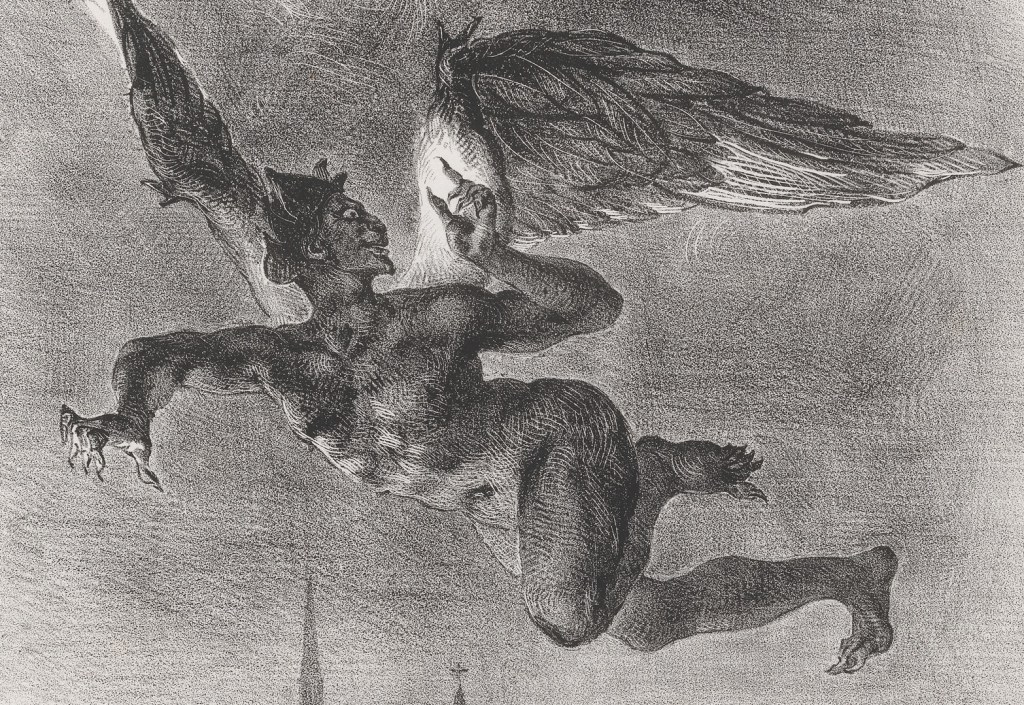
    Mephistopheles in the air (1828). Lithograph by Eugène Delacroix, appeared in Goethe’s Faust, publ. Charles Motte, Paris 1828. NGV online collection.

    There was a 1995 German movie, Der Totmacher (“The Deadmaker”) in which Goetz George starred as the famous mass murderer Fritz Haarmann. The “Butcher of Hannover” murdered at least 24 young men and boys between 1918 and 1924. And then there was the unscrupulous reporter Tötges in Heinrich Boell’s novel The Lost Honour of Katharina Blum (1974) and Volker Schloendorff’s 1975 film version. That seems about it offhand, apart from more common portrayals of “evil women” in the German literature of the Middle Ages.

    Cobb’s use of the Pascal Dunwolf character therefore seems to be much more typically American. Had it, at the time, fulfilled a need for English readers to personify evil? Don’t Germans want to read about or see movies with “badguys” in them? I wonder. There were none to mention in the works of Hermann Hesse or Thomas Mann, only minor role baddies invented by Goethe or Schiller. Do Germans somehow seem to more often prefer to see or read about “evil” as being much less personified? Any thoughts on this?

    Now I think of it, I do remember a local villain from a forested range of hills called the “Elm”, which was near my home. Johannes Tetzel was an infamous “Indulgences Preacher“, a Catholic Priest who roamed the countryside selling indulgences. Apparently, he had sold one such piece of paper absolving a certain nobleman from Kueblingen of the sin of murder, only to be shot dead and robbed by the same nobleman in 1518. The stone marking the grave of the villainous priest who possibly got what was coming to him is known as the Tetzelstein (“Tetzel Stone”).

    The name of the even more villainous nobleman has been forgotten, written out of history in the1800s. The odd thing about this stone and the even more elaborate monument to Tetzel, which is located in the town of Koenigslutter, his supposed destination at the time of his murder, is the apparent fact that Tetzel actually died in prison in Leipzig in the year 1519. Most locals believe that the 19th century monument is the real Tetzelstein, when in fact the real one is the much older stone, located about 100m away in the forest. Under which, according to local legend, an “Indulgences Preacher” lies buried. An impostor? Tetzel has been portrayed in various films on the subject of Martin Luther.


    CHAPTER 11

    SIR PASCAL IN TROUBLE

    On the morning next following the events last recorded, Sir Pascal Dunwolf was up and moving earlier than was his wont. He had much on his mind—much that was weighty and of the utmost importance to himself. First, he was in doubt as to the course he should pursue in regard to his youthful prisoner. He feared Captain von Linden more than he liked to acknowledge, even to himself. Were that man to gain his freedom before he had made the heiress of Deckendorf his wife, he would find it difficult to accomplish the cherished purpose. The thought had occurred to him of having the youth put to death, but he was not quite prepared for that. He was safe where he was for the present, so there let him remain.

    Next,—What should he do about his marriage? That was the main question. After he had eaten of his breakfast, he sent for the priest, for the purpose of conferring with him on the subject. The good father came, fresh from his hot meats and hot wines, ready and willing for anything that would not pull too hard on his conscience.

    The knight put the question to him squarely: Would he perform the marriage ceremony, no matter what opposition might be made to it by others than himself?

    Portrait of a Woman (1464). Rogier van der Weyden. Nat. Gallery London

    “Suppose,” said the recreant scoundrel, “that the girl should declare that she would not be my wife, and should persist in it to the end.”

    “You have the grand duke’s consent?” said the priest.

    “Yes, I have it in his own hand, and over his own signature.”

    “Then what care you for the girl’s consent? She is merely an infant; the grand duke is her legal guardian; and only the formal ceremony is required to make her your wife.”

    “And you are willing to perform that ceremony?”

    “Most assuredly I will.”

    “Good. I shall give you the opportunity very soon.”

    When, the priest had gone Sir Pascal summoned Balthazar and bade him, go and see the baroness, and ask her how soon she could be prepared to receive him. He wished to confer with her upon a matter of great importance.

    The dwarf departed, and was gone so long that his master became uneasy and suspicious of evil. He had twice framed the opening speech with which he would salute her ladyship, and had twice forgotten it; and by the time the hunchback finally returned he had forgotten much more.”

    “Well, rascal? What says her august ladyship? Have you been making love to the fair daughter?”

    “No, your lordship. I will leave that delectable pastime to you, when—you find her.”

    “Ha! What does that mean?” cried the knight, seizing the pigmy by the collar of his doublet and giving him a shake. “Did you see the baroness?”

    “No sir. Not a door could I open beyond the archway at the entrance to the ladies’ apartments. After I had knocked, and kicked, and called at as many doors as I have fingers, I found a servant, who told me that she had been doing the same thing for more than an hour; and the black-eyed wench had the audacity to spit at me—not on me, mark you—and tell me that I and others like me—meaning your excellency—had driven the poor woman to seeking safety in death, to which end she had drank poison.”

    “Hark ye, sirrah! Speak ye now soberly and to the point, or I’ll—I’ll cut your wine for a week. I mean it. Now, tell me what you found.”

    “I told you as nearly as I knew how. I went to the chamber of the lady as you bade me; and I tried the doors of all the rooms on that floor, in that wing; and not a door could I start, nor a word of response to my calls could I hear; and the girl said she’d been an hour trying to raise somebody without avail.”

    Twice the startled knight strode across the room, and then, seizing his cap, he went out—went to the forge of the armorer, and selecting a heavy sledge—a two headed tool—with which he returned to the keep, he ascended to the apartments of the ladies, his dwarf page bearing him company. In the first passage on the second floor they met the servant whom Balthazar had questioned, and her Sir Pascal told to show him which was the sleeping-chamber of the baroness. The door was pointed out, and a single blow of the heavy sledge beat it open.

    The girl rushed in, and presently set up a frantic outcry. Her dear mistress was dead she knew. That was her bed, out of which she never slept, and it had not been touched during the night.

    Other doors were broken open, and other chambers looked into; but no trace of mother or daughter could be found. It was Balthazar who thought of asking the servant if she ever waited upon the baroness, and helped her to dress.

    Yes, that was a part of her duty. She and Gretchen always waited upon the good lady and her daughter, and nobody else. And Gretchen, too, was gone. She was directed to see if the ladies had carried anything away with them; and upon search it was found that both of them had taken clothing and all their jewelry.

    In a state of frenzy the knight hastened down, and summoned to his presence all the officers and soldiers who had been on guard duty during the night. There were a full score of them in all. They were questioned sharply, but nothing could be learned from them. None of them had seen either of the missing females. Each and every one most solemnly swore that not a soul had passed him during his watch.

    “Where is the wonder?” suggested Lieutenant Franz, when the chief had reached the point of declaring that somebody had lied. “Do you not know that these old castles are riddled, through and through, with all sorts of secret passages?”

    “Simple as was the revelation, Dunwolf had not thought of it. But he saw it now, and admitted the probability of its correctness.

    He had just bowed his acknowledgment to Franz when the door of the apartment was opened, and the two ruffians, Zillern and Walbeck, came in, looking like men who had just seen a veritable ghost, each trying to push the other on ahead.

    “How now?” cried the knight, with a new terror before him. “Why are you here? Speak!—Zounds! I’ll—”

    “Mercy, Meinherr!” And it came out, with much stumbling, that they had gone down to carry their prisoner his breakfast; had found the door of the dungeon bolted and barred and locked, just as they had left it; but the place was empty. The straw had not been laid upon, and two of the candles and the candlestick had been taken away.

    This was too much. Sir Pascal was stricken dumb. He gasped and choked, but for a considerable time was unable to speak. And when, at length, his power of speech came to him, he was so deeply moved that he spoke without an oath; no oath that he could frame being adequate to the occasion.

    “Franz! What do you make of this?”

    “It must be, sir, that some of the men of the castle discovered that the captain had been locked up in that, place, and they contrived, during the night, to set him free.”

    “But how could they have got there if our sentinels were awake?”

    “By means of passes of which we are ignorant. If you will reflect, you will call to mind that the subterranean passes of these old piles always connect with the lower crypts and dungeons.”

    Again the knight was forced to admit the plausibility of his lieutenant’s solution; and, having questioned the jailers somewhat further, he resolved to go down and investigate for himself. He had brought with him the sledge with which he had opened the chamber doors; that he gave to Zillern, and directed Walbeck to go to the armorer’s forge and get another just like it, and to bring, also, a common hammer of goodly size.

    When all was ready, lights were taken and the party set forth. The first point for examination was the dungeon from which the prisoner had been set free. Was there any secret pass there? They hammered and pounded everywhere, but only the dull, massy sound of solid rock was returned. The walls on three sides were absolutely native rock, and, of course, there could be nothing of the kind in the front wall. As for the floor, it was of flags of such size, and so firmly laid, that no human power could move them. It never occurred to them that the floor of a square recess cut from the native ledge ought itself—or, at least, the inner portion of it—to be solid like the walls that arose from it. They might have seen, too, that the floor of the passage outside, on a level with that of the dungeon, was simply a surface of natural rock. Also, they might have discovered that the floor of the very next dungeon was of nature’s own make.

    But they saw nothing of this. It was evident that the prisoner had been set free by somebody from the outside; and as for finding the secret in that maze of cells and crypts and vaulted passages, the thing was not to be thought of. They hammered and banged upon a few suspicious-looking places, but in the end returned no wiser than they went.

    On reaching daylight again, Sir Pascal thought of mustering the force of the castle—those men who had been under Capt. von Linden’s command—and demanding of them information upon the subject of what he was pleased to term the recent outrage; but Franz quickly argued him away from it. Said he, after his chief had given up the objectionable plan:

    “The prisoner is gone, of course, beyond the confines of the castle, and I doubt if there is a soul here present who knows where he is. Further, the ladies are surely with him; and we may judge, from the fact that no horses have been taken, that they have not gone far. Now, my dear master,” continued the trusty henchman, laying the dexter finger of the right hand into the palm of the left, as he went on, speaking slowly and earnestly, “our first object is to make ourselves secure in our position, and know who are our friends. Of the five-and-forty men-at-arms whom we found in the garrison here when we came, the larger portion of them are soldiers who have been drawn from other sources within a few months. The old knight, whose funeral had just taken place when we arrived, had enlisted them by order of the grand duke, after intelligence had been received of the anticipated insurrection. More than half of those men, to my certain knowledge, are already heart and soul with us; and I have no doubt that we might, by proper management, gain very nearly the whole of them.

    “Let us first do that, sir; and then let us find Thorbrand. If we do not find him readily, we must find some of his men and confer with them. That they are in this neighborhood there can be no doubt. Meantime we will throw our guards upon all the avenues of the surrounding forest, to make sure that the fugitives do not escape us. This is the plan I would suggest.” And the chief had resolved to adopt it before Franz had done speaking.

    Accordingly, after one more thorough search over the castle for the missing ones, Sir Pascal caused the original force of the castle to be mustered on the parade ground, and when they were together, he stated to them plainly his object. He wanted to know how many of them he could depend upon to follow him without question; how many would take the oath of fealty to himself. He used no honeyed words, but he did this: He made them understand that those who should refuse him allegiance might look for hard times; while on the other hand, for those who should prove true to him, there would be the best of treatment, and there might be considerable booty.

    The result had not been looked for. Only ten men of the five-and-forty privates and nine non-commissioned officers—ten of the whole number—stood firm and true to the old duty; and they, when they saw and understood the situation, believing that their young captain and the ladies of the castle had got safely away, asked that they might be discharged from the service. They had taken the oath of fealty to the baroness, and only she herself could absolve them.

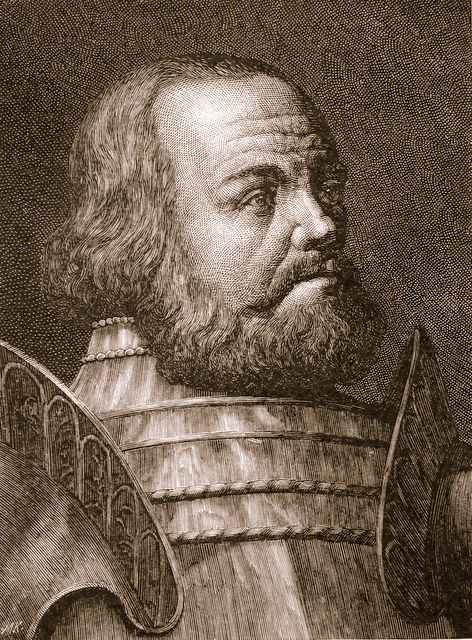
    Portrait of Götz von Berlichingen. 1651/1700. Copper engraving, artist unknown. City Museum of Cologne. See note.

    For a wonder Dunwolf permitted them to go. He felt that they could do him more harm if they remained than they could in being outside. And thus was he completely master of the castle. Saving the few household servants, for whom he did not care, all within the walls were his sworn supporters. Before the sun of that day had set he had sent swift couriers out upon all the roads—upon every path where a woman could make her way—and made sure that no persons had gone forth since the previous evening. Also, he had posted sentinels at the various passes, to prevent the outgoing of anyone without question.

    During the evening of that day, for the first time he was told of the cot of the old hunter on the opposite mountainside. Could it be possible that the fugitives had found sheltered hiding there? He would very soon know.

    On the next morning, bright and early, accompanied by a guide from the men of the castle, Sir Pascal and his lieutenant, with the dwarf page, who had begged hard that he might be permitted to go, set forth for the hunter’s cot. They reached it without adventure worthy of note, and found the hunter himself standing in his open doorway. Evidently he had been on the watch for them, having been very sure that they would come.

    Pascal Dunwolf stood fairly abashed before the man he had come to see. He had been prepared to find a rough, ignorant mountaineer, who would instinctively quail and cower before him; but, instead of that, he gazed upon a man noble and grand in form and feature—a man who looked upon him as a monarch might look upon his meanest subject.

    Never mind the details of the interview. The visitor, as soon as he could present his business, stated why he had come. He was very anxious concerning the ladies, who were so far under his care that he felt responsible for their safety. Had the hunter seen anything of them? Could he give any information at all?

    “Sir,” said Oberwald with a stately bow, “I might answer you that I had not seen them—that I knew nothing of them; but that would presuppose my readiness to betray them if they were here, or to tell a falsehood. The lady Bertha and her daughter are my dear friends, and if I knew where they had found refuge I certainly should refuse to tell you. O! do not look so glum! I only do what you would do if you be a man of honor. But, sir, my humble abode is before you; no doors are locked. You can look through it if you will; also, you may search the forest round about. I certainly hope you may not find them, because I know they would not have left you without good and sufficient reason.”

    The spurred and belted knight was for a little time fairly beside himself with contending emotions. Once he seemed more than half inclined to draw his sword, and again a torrent of curses was upon his lips ready to burst forth; but his better judgment finally prevailed, and in moderate tones he told the hunter that he should like to view the internal arrangements of his dwelling.

    Without a word Oberwald admitted him and his lieutenant. The obtrusive hunchback started to go in, but his master put him back.

    Upon entering the living-room the hunter’s daughter was discovered sitting by the great fire-place, and Franz who had an eye for a pretty face, started to address her. At that moment up rose the great St. Bernard, with a growl like far-off thunder, and the gallant drew back, leaving the damsel to herself.

    Every part of the cot was visited; every hole and corner was peered into; but nothing was found that looked like a fugitive baroness, and in the end the party of observation left the cot no wiser than they were on their arrival.

    Sore at heart, and in deeper trouble than he would acknowledge, Sir Pascal Dunwolf returned to the castle. Thus far he had been baffled at every step; still he did not give up. Fresh riders were sent out to scour the forest, and every means he could think of taken to find the missing ones.

    And now for the robber chief. While the search was going on for the fugitives he must find Thorbrand, and with him come to an understanding. Why the man had not called upon him he could not conceive.

    He had promised that he would be very punctual.

    It was on the third day after the disappearance of Captain von Linden and the ladies, while scouts were scouring in every direction for the robber chieftain, or for any of his band, that one of the famed bandit’s followers was brought before him. He gave his name as Hildegund, and he was one of Thorbrand’s chief lieutenants. He had been on his way to the castle when the outriders had met him, and he was anxious to find his master as was any one.

    “More than a hundred men of our band,” he said, “are now encamped in the Arnberg Valley waiting for an order from their chief. Thorbrand left us little more than a week ago, in company with his chief officer, young Wolfgang—young he is, sir, but a thunderbolt in battle—they left us for the express purpose of coming to this very castle to report to yourself. All is ready with us, and the barons of Wurtemburg are ready to move as soon as they know that Deckendorf Castle is open to them in case of need. We have waited till now for our chief’s return, and when the full week had gone I started out in quest of him. The last words he spoke before leaving us were spoken to me.

    “‘Hildegund,’ he said, ‘I go to confer with the knight who has been sent to command Deckendorf Castle. When I have arranged satisfactorily with him I will let you know.’

    “He promised that if he did not come himself he would send Wolfgang. That, as I have said, was more than a week ago, and from that time, we have heard not a word, nor have we received a sign. What can it mean?”

    Dunwolf was confounded. Was it possible that Thorbrand had made his appearance at the castle before his arrival while von Linden was in command—and had the fiery youth put him out of the way?

    He summoned two of the assistant warders, who had taken the oath of fealty to him, and questioned them closely. They declared unhesitatingly that it would have been impossible for any man to have visited the castle during the week previous to Sir Arthur’s’ death without either one or the other of them being witness.

    After this there was a silence, broken at length by the robber.

    “Have you made search at the cot of Martin Oberwald?”

    ”What?—the hunter on the opposite mountains?”

    “The same.”

    “Not for Thorbrand; but I have been there, and have looked into every hole and
    corner after others.”

    Hildegund shrugged his shoulders significantly.

    “That man,” he said, “is deeper than you think. If anyone can give us information, it is he. But we must be wary. Let us think the matter over, and fix upon a plan of action. He has holes and corners at command that you did not dream of, I’ll be bound.”

    Hildegund was of middle age; tall and sinewy, and strong of limb. He was a handsome man, too, with a face remarkably keen and intelligent. That he was an experienced forester and mountaineer was evident from the outset, and to him Sir Pascal tendered the office of guide in the present emergency.

    The brigand readily accepted the position and straightway proceeded to action, his movements indicating very plainly that he knew what he was about. Before that day’s sun had set he had organized a force of little less than two-score men—all more or less versed in the mysteries of mountain life—and the dwelling of Martin Oberwald was completely environed; so that no person could enter in or go away without being discovered.


    Notes

    • various films on the subject of Martin Luthor: E,g. Luthor (2003), dir. Eric Till & Marc Canosa.
    • doublet: “A close-fitting garment for men, covering the body from the neck to the waist or a little below. It was worn in Western Europe from the 15th to the 17th century.” Webster’s, cited in finedictionary.
    • she had drank poison: Sic erat scriptum. Merriam-Webster discusses some confusion over the usage of drank/drunk. Drunk is, of course, the past participle according to the present rules of grammar. However, instances date from the 17th century, and commonly throughout the 19th, when drank was also so used.
    • Zounds!: Expression of anger, wonder, astonishment. Contraction of “God’s wounds.”
    • Portrait of Götz von Berlichingen: Aka Götz of the Iron Hand. German (Franconian) Imperial Knight (Reichsritter), mercenary, and poet. Robber knight and all-round tough guy. Distinguishing physical feature: iron prosthesis. Subject of a play by Goethe, Götz von Berlichingen (1773), well-known for Götz’s line: “Me, surrender! At mercy! Whom do you speak with? Am I a robber! Tell your captain that for His Imperial Majesty, I have, as always, due respect. But he, tell him that, he can lick me in the arse!”; embroidering Götz’s self-attributed: “He can lick me on the behind.” Inspired Mozart’s canon in B-flat for six voices, “Leck mich im Arsch” K. 231 (K. 382c)(1872). See Götz entry at Wikipedia.
    • Hildegund: A man herein; but seems exclusively a female name.
    • environed: Encircled, encompassed.

    NIGHTSHIFT byTony Reck © 2025

  • Cobb’s False Knight: 10. Flight

    Cobb’s False Knight: 10. Flight

    The first impression of a flight from danger I can remember was that of the Von Trapp family. Good heavens, no, I’m not one of those people that would mar an otherwise perfectly enchanting visit to a beautiful city like Salzburg by insisting on trying to sing songs from The Sound of Music at every turn when a possibly familiar backdrop comes into sight. Remind me to take earplugs with me, however, when I do next visit.

    Peggy Wood as Mother Abbess in Sound of Music (1965; dir/prod Robert Wise). (Dubbed vocals by Margery MacKay.)

    At the time, the family escaping over the Swiss Alps to the tune of “Climb Every Mountain” might have seemed a tad less corny before the fifty millionth re-run. There actually are countless tours of Salzburg and ferry rides across Lake Wolfgang where costume wearing “entertainers” endlessly yodel to visitors or sing “Doe, a deer” and so on.

    On the subject of such fiendish and dastardly torture: Will Ernest von Linden and Electra make it to safety? Or will a fake Mother Superior belting out “How do you solve a problem like Electra” in the guise of Sir Pascal Dunwolf thwart their plan? That haunting image must be something acquired from TV news coverage of the Sydney Gay and Lesbian Mardi Gras or something. Not that I have any problem at all with that event, no, it’s the evil nuns that get me. Is there a known phobia of nuns by the way? I looked it up. There is! It’s called sphenisciphobia. Oh well, I guess there had to be. If there’s one of clowns, then evil nuns surely must be right up there with them when it comes to having a phobia attributed to them. Let alone fake ones with beards…

    What will happen at Martin Oberwald’s? Will our heroes find safety and protection? Or could a seemingly far too easy escape from a dark dungeon be an overture to doing away with a problem? “How do you solve a problem like Von Linden”? Oh no, not one of those ghastly songs stuck in my ear now, I hope. Worse still, I could have made it stick in your ear!


    CHAPTER 10

    Flight

    The baroness and her daughter were in an agony of unrest and disquiet. They had been told that Ernest had returned, and they had not seen him. More than an hour had elapsed since the word of his arrival had been brought to them. A servant had seen him ascending the hill. She knew it was Ernest von Linden, and no one else. Then Electra had bethought her of the horse, and she sent a boy—one whom she could trust—to the stable to see if the captain’s horse was there. He had been upon the mission, and had returned with word that the horse was there. He knew the animal, and could not be mistaken. Then mother and daughter had sought Sir Pascal, but had not been able to find him. At length they came across the dwarf, Balthazar, who had informed them that his master was lying down. He had not felt well, and had sought recovery in sleep, which he often found efficacious. He promised them, however, that he would come to them, if they would permit him, and inform them when the knight had risen.

    Before giving him this permission, they asked him concerning the young captain. He was simply surprised. He had not seen the man, nor had he left the castle on his journey to Baden-Baden, The ladies then told him that he might come to them when his master was astir.

    And for this they were now waiting. Meantime, however, they had made other enquiries, but without avail. At length, when their patience had become well nigh exhausted, the dwarf appeared, and directly behind him came Sir Pascal. Lady Bertha arose quickly to her feet and took a stop forward.

    “Sir Pascal! you find me in great distress of mind. Can you tell me where Captain von Linden is?”

    She spoke eagerly and impulsively, with her whole heart in her face. The knight was not prompt in his answer. He seemed to be gloating over the unrest he had been able to give these proud suppliants. So long did he hesitate that the widow spoke again:

    “Sir Pascal Dunwolf! You heard my question. Will you tell me if you know what has become of the young man? Where has he gone? He returned here more than an hour ago, and I have had no sign of him I cannot understand it.”

    “My dear, dear Baroness!” exclaimed the false knight, with fulsome effusiveness, “the absence of the young captain is very simple. He returned, as you say, an hour or more ago, arriving fresh and well, and in the best of spirits. He found here a messenger who had just arrived in hot haste from the village in quest of him. What was wanted I do not know, for I was not informed. I can only tell you that the young man turned him about instantly and went with the courier. This, you will understand, was told to me by the sentinel at the gate. I did not see the captain myself.”

    “It is very strange that a messenger should have come from the village and not inquired for me,” the baroness said, looking the knight straight in the eye.

    “I thought so myself, madam; but I had no opportunity to investigate. However, I can see no occasion for alarm. Doubtless our young friend will pretty soon return; and then we shall know all about it.”

    Something in the man’s manner—something in his look, in his averted eye—an unmistakable malevolence of expression—impressed her ladyship with distrust. She did not tell herself that the man was flatly lying, but he was not telling the whole truth. At all events, she would not question him further. She thanked him for his trouble in waiting upon her, and then dismissed him. He would have offered further help, but the lady would not listen. His presence was painfully disagreeable to her, and she could not wholly hide it. This he saw, and without further remark he turned away, his mutterings of wrath breaking the air as he went.

    “O! mamma! mamma! what can we do? Where do you think dear Ernest is? Has that bad man done him harm?”

    “Hush! my child. Let us wait for a little time. It may be that he has been called to the village, as Sir Pascal says. If he has, he will surely be with us before we retire. Put away your fears, and let us give our thoughts to pleasant subjects.”

    It was easily said, but it was hard to do. Pleasant subjects were not readily found. At length, however, the baroness spoke of Ernest’s brave and noble qualities, and of the assurance she felt that the grand duke would unhesitatingly befriend him when he came to know him, thus bringing her daughter to a theme that for a time led her thoughts away from the dark fears of the hour.

    Thus passed the time until the little Strasburg clock on the mantel struck the hour of nine. As the silvery chime broke the air Electra sprang to her feet with her hands clasped, exclaiming:

    “Have you been uneasy?” was Ernest’s first speech, after he had seen who were present, and had succeeded in freeing himself from the attentions of the happy staghound.

    “Mamma! mamma! I cannot endure it. I must go down to the village and make inquiries. Don’t say me nay. My noble Fritz will give me safe conduct. I can go out by the private postern, which Dunwolf knows nothing about.”

    Before her mother could reply, the staghound, who had been crouched away in a corner ever since Dunwolf had made his appearance in the chamber, sprung up with a sharp sniff and rushed to the door and tried to open it, which he would have done had not the baroness turned the key after the dark-visaged knight had gone out. Presently, above the dog’s eager whining, was heard a rap.

    ”It is a friend—I know it is a friend!” Electra cried, starting forward. “O, mamma!— don’t stop me. Don’t you know dear old Fritz’s meaning when he acts like that? It is my darling—my darling!”

    Staghound and Hind (1868); Richard Ansdell. Lytham Art Collection of Fylde Borough Council .

    She turned the key and lifted the latch, and in another moment was in the arms of her dear lover. Without a word, he lifted her from her feet and bore her back into the room; then closed and locked the door behind him.

    “O! Ernest! we cannot tell you how uneasy. Where have you been? Did that bad man tell us the truth?”

    “What did he tell you?”

    Electra told him the whole story from beginning to end, but in a very few words and disconnectedly.

    He shook his head very slowly and significantly, and with a very significant smile as he replied:

    “I will tell you all about it in a very few moments. But, first, dear lady,” to the baroness, “you and Electra must prepare at once to leave the castle.  If I can convince you that your safety and well-being demand it, will you go with me?”

    “Let me hear what you have to say, dear boy. You know that I will do what is right.”

    Ernest made sure that all was safe—that the doors were fast, and that no eavesdroppers were near,—and then he sat down and told his story. He told, first, of the coming of the dwarf, Balthazar, to his chamber, on the morning of his departure, with letters from his master to be delivered in Baden Baden. Then of his meeting with the wolf, and his discovery of the trick that had been played with his pistols. When he came to tell of his being waylaid by the two assassins, and of the scene that followed, his hearers were excited indeed.

    Of his meeting with his old tutor, and of their conversation, he told minutely. And then came his return. He told how he had been met by the lieutenant, at the gate, and how he had suffered himself to be led into the trap that had been set for him, and how that trap had been sprung upon him. Many times he was stopped, and forced to go over certain parts of his story; and more than once he had been called upon to assure Electra that he had not suffered harm.

    “When I had been thus bound and gagged,” he went on, “the two burly ruffians took me by the arms, and led me away, Sir Pascal going on in advance with a lighted candle. Then came the torch, and the descent into the dungeons.

    “Here,” he said, “I became anxious. Down in those dismal depths are three entrances to the secret subterranean passes to and from the castle. The main shaft connects the dungeon at the extreme corner towards the east. I asked myself, would they carry me thither? I thought they would, for two reasons. First,—that cell is the farthest removed from any possible point of hearing by those in the apartments above; and, second, it is in the best order and apparently the most secure. If they should take me to that place, I need have nothing to fear.

    “And thither I was led. Perhaps you can imagine how I had to struggle to hide my emotions of satisfaction; but I fancy I did it. I asked but one favor—a candle— which was granted. My bond and my gag were removed, and the door shut upon me. An hour later food and drink were brought, with straw for a bed, and some candles. When I had been left for the night I ate a hearty meal; for I was hungry; and then turned my attention to the opening of the secret pass. It was very familiar to me, and without the slightest difficulty I tipped up the broad flag, and found the stairs clear.

    “You are aware, dear lady, that there are several entrance to the pass in the upper apartments of the keep. There is one in the upper wall of the great library; one in the baron’s sleeping-room; one in the extreme rear of the banqueting-room, and one in your own dressing-room. It was by way of the latter that I just came.”

    It would be impossible to tell the variety of emotions that had been called up in the bosoms of the listeners while Ernest had been telling his story. Electra’s chief thought was of what the wicked man’s final plan had been. What had he meant to do with her dear lover in the end?

    “What he would have done with me,” said the captain, “did not give me so much concern as did the thought of what he certainly would have done with you, my beloved. Remembering what good old Arnbeck told me, of the power which the grand duke’s commission had placed in the villain’s hands, I could see his plan was to make you his wife, and himself lord of this castle, as quickly as possible. Did you understand, my darling,—and do you, dear lady,—that by the will of the grand duke, the man marrying with the heiress of Deckendorf may take her name, and become feudal lord of the domain?”

    “I supposed it was so,” the baroness replied.

    “Yes—so it is. Pascal Dunwolf is very eager to become baron Deckendorf; and to that end he knows he must get rid of me. I think, had he succeeded in this bold scheme—had he managed to seal me up in a dungeon from which there was no escape, save at his own will and pleasure—he would not have delayed a great while the marriage ceremony. He has his own priest with him—a man ready to do his bidding. The consent of the bride would not have been asked, nor would it have been needful, so far as the black-visaged and black-hearted man cared. And now, dear lady,—knowing what you do, are you ready to go with me, and seek safety elsewhere?”

    “Yes, yes, yes!” was Electra’s response, quickly and earnestly.

    But the older lady was more thoughtful. She would know first whither they were to go.

    “To the cot of good Martin Oberwald,” was Ernest’s answer. “He has secrets about his dwelling that are more wonderful than anything connected with the castle. He can give us a safe and comfortable place of hiding, where no enemy can find us. And, moreover, he is himself a true and noble man.”

    “Noble in more ways than you think, perhaps,” said Lady Bertha, with a curious smile.

    ”Eh!” cried the youth, quickly, at  the same time laying a hand upon her arm. ”What mean you by that? I have heard something—I remember once hearing the baron make an allusion to the hunter that puzzled me. Is he—”

    “Hush! Oberwald’s secrets are his own.”

    “O, but, mamma, you can tell us!” pleaded Electra. I have been puzzled more than once by remarks I have heard him drop. Is he—”

    “There. No more. I cannot—”

    “But, mamma, you have made us both so anxious.”

    The baroness smiled, and finally said:

    “Well, well, if you will promise to keep what I now tell you to yourselves, as I have never been bound to silence,—I will tell you this: Martin Oberwald was a baron of the empire. In his younger days he was gay and reckless. He married a lovely wife, whom he well nigh worshipped. She was taken from him by a cruel death—killed by an accident—shot by a bullet intended for himself; and in the depth of his despair he surrendered his barony, together with his estate, to a cousin—he had no brother—and, with an infant daughter, retired from the world. He came to this place, and here he has been ever since. Electra, I charge you, never a word of this to Irene. I have told you the truth, that you may know better how to value that beautiful girl’s friendship.”

    “Ah, mamma, it needed not that to make me appreciate Irene. She is an angel. I love her.”

    “And now, Ernest, which way do you propose to go?”

    “There is but one. We must, of course, go by way of the secret passage, through a part of which I have just come. We will enter from your apartment, and go the course towards the Schwarzwolf. It is very nearly in the direction of the hunter’s cot.”

    The baroness required no further urging. Ernest’s plan was that she and her daughter should remain in hiding until he could see the grand duke, being well assured that the true-hearted prince, when he should have been made to understand the situation, and to know the true character of Dunwolf, would do them ample justice.

    Only one other person would they call to bear them company. Lady Bertha’s faithful maid, Gretchen, who had nursed Electra, and who was at heart one of themselves, must go. Not only did they need her services, but the devoted creature would go fairly frantic were they to leave her behind.

    Mistress and Maid (1666-7), Johanness Vermeer. Frick Collection, NY.

    So Gretchen was summoned—a hearty, buxom woman of five-and-forty, or thereabouts, whose chief beauty was in her goodness, and who had been an inmate of the castle long before the baroness ever entered it. She required but little instruction. She had already conceived an utter horror of Sir Pascal, and was rejoiced when she know they were to leave the place, made dark and dangerous by his presence.

    With her aid the necessary preparations wore soon made. Her jewels and her money, the baroness collected, having no confidence in their safety if left behind. Ernest gave to Gretchen particular directions with regard to the things he would have brought from his room, and told her where she would find the key. She was quick and prompt in her movements, and in less than an hour from the time of beginning the preparations they were complete, and the party ready to set forth.

    It was close upon eleven o’clock when Ernest placed his hand upon the secret spring which set free the sliding panel that closed the entrance to the passage they were to enter. They were careful to lock all the doors behind them, so that their absence might not be accidently discovered. First beyond the panel was a broad step, and then a flight of narrow steps descending. When all had entered, the Captain closed the panel, which locked itself, and then, went on in advance with a convenient lantern, Gretchen bringing up the rear with another light—also a lantern, as they were liable to strong currents of air which might extinguish the flame of a candle.

    For a considerable distance the way for the most part was descending. They passed quite near the dungeons, but did not care to look into them. Beyond this point, a natural fissure, made easily passable by the hand of man, served them until they had reached the top of an abrupt descent, down which they went over a flight of rough stone stops, cut in the native rock. At the foot of this they were at their lowest point, the guide informing them that the rumbling noise they heard overhead was the brook that flowed through the valley between the castle and the Schwarzwolf Mountain.

    Beyond this they began to ascend. The way was somewhat tedious and toilsome, all having more or less of luggage to carry; but they pushed on bravely, glad at heart that they were leaving the castle under its present control, farther and farther behind them. At the end of twenty minutes after commencing the ascent, and more than an hour from the point of starting, the guide stopped before what appeared to be the solid face of rock, cutting all further progress; but he very soon found a way through it. A concealed door was opened—a door formed by a rock that turned on a central pivot—and upon passing through the aperture thus afforded the party found themselves in a deep mountain cavern—a cavern which Electra knew very well; and here for the first time the staghound was inclined to be frisky and obtrusive; but a persuasive word from his mistress quickly calmed him.

    Though we have not before spoken of the dog as one of the journeying party, he had been with it, and had been an important and useful member. Upon his strong back he bore a goodly store of Electra’s raiment; and more than that, on the dark and dubious way he had gone far enough in advance to give timely warning had there been danger ahead.

    Our heroine recognized the cave as one in which she and Irene had often stopped, about half way from the foot of the mountain to the hunter’s abode.

    As soon as Ernest had been assured that Fritz would not bark, he went out and took a survey of the surroundings. It was now not far from midnight; the heavens were clear; and the moon, within an hour of setting, gave plenty of light to guide them on their way up the mountains; so the lights were extinguished, and as soon as the baroness had signified her readiness to proceed they moved on. They very soon struck the main path, and in less than half an hour more, without accident of any kind, they stopped before the door of Oberwald’s cot, where Fritz, with a desire to make himself useful, with a loud voice demanded admission.

    Irene’s St. Bernard was the first to make answer from within, but the hunter himself appeared shortly after, with a lighted flambeau in his hand, not a little surprised at the sight of his midnight visitors. His first movement, without question, was to step back, and allow the women to enter; and after he had closed the door behind Ernest and Fritz, he found voice to ask what had happened.


    Notes

    • Sydney Gay and Lesbian Mardi Gras…: Popular annual LGBT pride festival and parade. The Sisters and Brothers of the Order of Perpetual Indulgence, Sydney, are prominent regular participants.
    • flag: (n) or flagstone. “A grit or sandstone naturally separating in layers of suitable thickness for flagging; any rock which splits or is capable of being readily split into tabular plates or flags. Usually the layers are parallel to the bedding or stratification of the rock; but there are cases in which the lamination of the material available for flagging is the result of cleavage or jointing” (finedictionary.com; New Century Dictionary). Hence, as here, an individual flat piece of paving, having been split from such stratified rock.

    NIGHTSHIFT byTony Reck © 2025

  • Cobb’s False Knight: 7. Cause for Alarm

    Cobb’s False Knight: 7. Cause for Alarm

    Baden Baden. The German Wagga Wagga? For the non-Australians among you, the latter is a town in western New South Wales which does not derive its name from “the Aboriginal word for Italians” (an old joke based on the no longer so insulting term “wog”). But what of Baden Baden? A city in the state of Baden, which is famous for being a health spa, where, in Cobb’s time, upper class Germans used to “take the waters”.

    Poster (1924): Water-fountains, the Black Forest, and a red sunset, representing the health resort Wildbad im Schwarzwald (Baden-Württemberg). Colour lithograph after A. Fischinger. CC by 4.0. Wellcome Images

    In the Middle Ages, it was also a spa town, and had been since the times of Roman emperor Caracalla, as excavated ruins below the New Castle have proven. The German word for taking a bath is “baden”; so does the funny sounding double name simply refer to the town in Baden where people take baths? With such a history, one could be forgiving for thinking it did, but it’s just an older plural form for “the city of Baden in the state of Baden”. Whether you go for one in mud, water, or in the casino, the name of the town has nothing to do with taking a bath.

    Casino? Yes, there’s also been a casino there since the 1830s, so Cobb would have heard of it. Surely you can’t go for a bath in the casino. Well, perhaps not, except for diving into roulette, baccarat or blackjack, but the word “baden” also has another meaning in German, “baden gehen“: not only to go for a bath or to go swimming, but “to go under“, in the sense of losing everything, which one often does in a casino.

    Hopefully, our hero’s hopes won’t “go swimming” in this German sense in Baden Baden because of the recipient of his letter, the Grand Duke, being away in Heidelberg. Oh, by the way, there’s an old German schlock of a song called “Du hast Dein Herz in Heidelberg verloren” (“You lost your heart in Heidelberg”, meaning not that you went there for a transplant of this vital organ, but that you fell in love there). Will our hero get shot through the heart in this supposedly most romantic German town? Surely, not, but this terribly sentimental old tune reminded me of another when there was mention of the Grand Duke being saved from drowning off the Island of Capri.

    Rudi Schuricke – Capri Fischer 1943

    I’ve added a link to this cheesier song about the island: “Wenn bei Capri die rote Sonne im Meer versinkt” (“When the red sun sinks into the sea near Capri”), which a German comedian turned into “Wenn bei Capri die rote Nonne im Meer versinkt“, which, sung to the same tune, translates to, “When the Red Nun sinks into the sea near Capri”. Perhaps you could change it to a Grand Duke almost sinking beneath the waves near Capri, instead of a suicidal or perhaps tipsy, drowning communist nun? — the former, however, being allegedly saved by none other than Sir Pascal Dunwolf?

    Is it just me, but after remembering two terrible tunes, do things not bode well for the desperate mission of Ernest von Linden?


    CHAPTER 7

    CAUSE FOR ALARM

    As Captain von Linden came near to the crystal stream the two ruffians pulled up the heads of their horses, and faced them about to the northward towards their objective point; but the youth clearly detected some signal and a response pass between them, and he was sure they loosened their pistols in the holsters at the same time.

    Ernest’s only trouble was this: He could not, in good conscience, fire a deadly shot upon one who had not made a demonstration of the same character against himself; and yet, if he waited for that, he was liable to he shot down like a dog before he could make preparations for his defence. He thus felt it to be a critical moment, knowing, as he did, that his life hung by a thread.

    Once more, as the two men turned their horses as though to ride forward, he recalled all the circumstances to mind. He passed them critically in review, from the beginning to the end from Sir Pascal’s prompt refusal, when his journey to the court of the grand duke had been first proposed, to the present time. He could now understand why the knight had so readily and with such apparent cheerfulness withdrawn his opposition to the visit. He had allowed him to set out upon his journey for the very purpose of leading him into this trap. In every way he stood dangerously in Dunwolf’s path of greed and ambition; and, if he could be stricken down in the wild depths of the dark forest, none save himself and his sworn tools would be the wiser.

    There could be no mistaking the signs as he had thus passed them in review, and his resolution was quickly taken.

    Even at a little risk he must make the rascals avow themselves, to which end he rode on a few paces beyond the brook, and there ordered them to halt. They obeyed instantly, and, without further orders, turned about and faced him.

    “Roger Vadas, answer me. Wherefore have you hung upon my steps? why thus waylaid me? Seek not to deceive me, for I know more than you think. Will you speak?”

    The man thus addressed glanced towards his companion, but gained no help from the stolid look he there met. Then he looked towards the young officer, and, with a grin almost idiotic in its utter brutishness, he said:

    “Look ye, Meinherr, I s’pose w’eve a right to travel this path, haven’t we? If you don’t like to see us ahead, just go on yourself, and we will follow.”

    “That does not happen to suit me,” said Ernest, “and,” he added, drawing a pistol from his right-hand hoister, and cocking it, “you will answer my question, or I will put you beyond the power of answering forever-more.”

    “Oho! That’s the business, is it? I rather think I can take a hand of the same kind.”

    Then, to his companion, as he drew a pistol from its case, he said:

    “Now’s our time Otto! Let’s finish it quickly!”

    To hesitate longer would have been simply suicidal.

    “Hold!” thundered the youth, rising in his stirrups, and taking a sure aim. “Mark me. If you raise that pistol I shall fire, and I am not apt to miss my mark.”

    “Fire away, Captain. Such things as those you’ve got won’t hurt.” And he raised
    his weapon to take aim.

    That was enough for our hero. It told him that he had not been mistaken in his judgment, and that his life was aimed at. With a quick, sure aim, his finger pressed the trigger, and this time the faithful weapon did not fail him. A sharp report broke upon the air, and the ruffian reeled, and fell backward, lying for a moment supine upon his horse’s back, and then rolling off upon the ground.

    With a fierce oath Otto Orson raised his pistol and fired; but he was not a marksman. In his mingled wrath and astonishment he had discharged his piece without due caution, and the bullet flew wide of its mark.

    “Beware!” shouted the youth, as the ruffian drew his second pistol. “You are a dead man if you

    A fierce oath was the response; the pistol was raised, but not fired. “Quick as thought Ernest had covered the mans heart, and when he saw that quarter was not to be thought of he pulled the trigger, and ruffian Number Two fell from his saddle, his weapon being discharged as he went down.

    Our hero now dismounted and went to where lay the man last shot. He struggled to his elbow as the youth came up, and pressed a hand over the sore spot on his breast.

    “Ah! Captain,” he groaned gaspingly, “you’ve done for me! Your pistols were loaded.”

    “Of course they were loaded,” Ernest said, at the same time lifting the man’s head and offering him a drink from his flask. You did not suppose I travelled with empty pistols, did you?”

    “But,” gargled the expiring wretch, brightening somewhat under the stimulating influence of the cordial, “you said Balthazar came to your chamber with the letter.”

    “Ah! and he was to have drawn the charges, was he?”

    “O! O! O! What care I now? Yes, he was to have done that thing- Sir Pascal 0! him! swore that it should be done.”

    “And Sir Pascal sent you out to waylay and kill me?”

    “Yes, yes. O! If I’d known that your pistols were

    Ernest offered him another pull at the flask, but he could not swallow. His eyes glared wildly for a moment; his lips paled arid parted; a deep moan escaped him, another imprecation, half uttered, upon the man who had sent him to his death, and he breathed his last.

    The youth arose, and went to the side of the other; but he was beyond human aid. He had been shot through the heart, and had died instantly.

    For a little time Ernest gazed upon his work in solemn silence. It was not a pleasant thought that he had taken two human lives; but he could not blame himself for the deed. He was only sorry that the deeper, darker villain who had planned the wickedness had not himself come out to execute it. However, upon looking down upon the two faces, and marking the characters unmistakably stamped thereon, he felt in his heart that the world would be the grainer in their deaths.

    He pulled the bodies on the side of the path, leaving them in such position that any who might be sent out in search of them would readily find them; then he reloaded his pistols and resumed his journey, destined to no more adventure on the road.

    Baden-Baden, by Edward Harrison Compton, 1912. Public domain. Source: Wikimedia Commons.

    It was after nightfall when he reached Baden-Baden too late to think of waiting upon the grand duke on that day so he sought a comfortable inn, where he was acquainted, and secured lodgings. On the following morning his first movement, after having eaten his breakfast, was to call upon the banker of the baroness, from whom he obtained all the money he required, and then he bent his steps to the ducal residence. But only disappointment awaited him. The grand duke had gone to Heidelberg, and none could tell when he would return; and he was further informed that it was seriously in contemplation to remove the seat of government to that old city. The ancient palace of the Electors Palatine was being repaired and refurnished, and in all probability Leopold would ere long make it his permanent abode.

    Residing at Baden-Baden and connected with the court, was a justice, named Arnbeck, who had in other years been Ernest’s tutor, and upon him our hero determined to call, thinking he might gain information that would be of value.

    Herr Arnbeck was an elderly man; a professor in the college in his younger days, and now a judge in the higher court of law. He had been tutor of Leopold, the present grand duke, having in that capacity accompanied him during a two or three years’ residence abroad. He received Ernest with marked kindness, glad always to meet those pupils whom he had loved and respected; and he cheerfully offered any assistance in his power to render.

    After a brief conversation upon current topics, chiefly of the grand duke and his contemplated change of residence, the young man stated the particular business that had brought him to Baden-Baden. He knew that his hearer was to be trusted, and that his sympathy would-be with him: so he told the story plainly from beginning to end; told of his love Electra von Deckendorf, of their betrothment at the baron’s own desire; told how they had grown up in love, looking upon marriage as a settled fact; and then he told of the coming of Sir Pascal Dunwolf, together with the strange plan of the grand duke for his marriage with the beautiful heiress.

    Arnbeck listened with deep interest, asking several questions for further information, and in the end he was sensibly affected.

    Porträt Caspar David Friedrichs (1840) by Caroline Bardua. Public domain. Source: Wikimedia Commons

    “My dear boy,” he said, speaking with something of the old school-day familiarity, “had one whom I had not known told me your story I should have doubted its correctness, but I cannot doubt you; and moreover the whole thing bears the stamp of fact. Let me tell you one thing in the outset: Leopold was unfortunate enough to have his life saved by this Sir Pascal Dunwolf. It happened in the Bay of Naples. Sir Pascal had been appointed on Leopold’s suite by his father, the Grand Duke Rudolf. Off the island of Capri my dear pupil was knocked overboard by the jibing of a boom, and Pascal, who had been sitting by his side, leaped into the sea, and upheld him until the sailors could bring the boat around and come up with them.”

    “But surely,” said Ernest,”he would not on that account suffer

    The old justice put out his hand.

    “Listen to me, my son. Think no evil of Leopold. He is young and impulsive; his affections are strong, and his gratitude deep and abiding. He never forgets a favor. So I can see how he has hoped to bestow a benefit upon the man to whom he owes so much. You may be sure, however, that Dunwolf has misrepresented matters to the grand duke. Was he ever at the castle before? Did the baroness know him of old?”

    He was there several times, I believe, in the baron’s time. I think he was attachcd to the staff of Rudolf.”

    “Yes as due of his aides. There is no doubt in my mind that he has represented to Leopold that he would be warmly welcomed by both the baroness and her daughter. He had probably seen the young lady.”

    “Yes. He had seen her at court. She was there with her mother about two years ago.”

    After a little further discussion of the subject it was arranged that Ernest should remain and dine with his old tutor, and meantime he the tutor would go out and make enquiries. Business called him to court, and he would there investigate.

    Herr Arnbeck was gone longer than he had anticipated; and when he returned there was a cloud upon his face which he could not hide; but he would say nothing until after they had eaten their dinner; nor would there have been opportunity, for, on entering the eating-room, they met there the justice’s wife and two daughters, all of whom remembered the visitor well and kindly, and even affectionately.

    At length Herr Arnbeck and Ernest were again alone together, the latter being very anxious to know what his aged friend and counsellor had to say to him. The host did not offer his visitor a seat; but, standing before him, he laid a hand kindly and paternally upon his shoulder, saying as he did so:

    “My dear boy I have made all possible inquiry, and such information as I have is at your service. Sir Pascal did certainly represent to the grand, duke in short, he told him, in direct terms, that the Baroness von Deckendorf would gladly welcome him as a son-in-law; and that she was the more anxious since her daughter had conceived an unfortunate attachment for a vagabond hunter, who, in all probability, belonged to the band of the notorious Thorbrand. This he told her so soberly, and with so much of apparent feeling, picturing in vivid colors the grief and chagrin of the outraged mother, that Leopold believed him, and at once turned his attention to mending the matter, which he would do by exercising his regal prerogative of guardian of the orphan heiress, and bestowing her hand upon the valiant knight.

    Several times during this brief recital the youth had seemed ready to go wild in his wrathful indignation; but thought brought deeper and calmer feeling; and his first coherent speech was of what course he should pursue. Would it be well for him to push on to Heidelberg, and see the grand duke?

    “No,” said Arnbeck, with a solemn shake of the head. Though I am confident Leopold would givn you quick relief, were you to see him, yet you had better not waste time in running after him. It is his plan to visit Wurtemberg before he returns, to make investigation into the matter of an uprising a revolt led by the very Thorbrand of whom we have spoken.”

    “I have heard a whispering of something of that kind,” said Ernest, “but I gave it no credit.”

    “Nor did I, at first, returned the justice; “but I am now forced to the belief that there is much to fear, if prompt measures are not taken to nip the mischief in the bud. In the depths of the Schwarzwald, on the confines of the two principalities, there is a large number of disaffected people, with no grievance save poverty, who are ready to join the robbers, thus making a host capable of terrible work of plunder and devastation. It was to look after this rebellion, and to assist in crushing it; and, afterwards, to hold the uneasy ones in subjection, that Dunwolf was sent to Deckendorf.”

    “My dear old friend,” said our hero, with a proud flush in his face, and a kindling of his truthful eyes, “I may say to you what I would not say to another. Leopold of Baden had better trust me with that command, than trust the man he has sent thither.”

    “I believe you, my dear boy; and I will bring it to pass, if I can. Meantime, my advice to you is, Return at once to Deckendorf. Since that bad man has been so boldly wicked as to attempt your life, there is no telling what he may do next. Now that he fancies he has put you out of the way he may carry a high hand with the marriage. With the commission as given him by the grand duke, and the consent to the union therein implied, there is nothing in the world to prevent him from forcing the marriage at his will. He has only to find a priest ready and willing to do his wicked work, and they, I am sorry to say, are plenty. So, my son, back to the castle, and look to those who may need your protection.”

    For a little time the startled youth was utterly unable to speak. So confounded was he that he could scarcely think. The danger that threatened his beloved had come upon him like a thunderbolt from a clear sky. He had not dreamed of such a possibility. The idea that any living man, less than the emperor, or the grand duke himself, could do such a deed as force an unhallowed, unwelcome marriage upon the heiress of Deckendorf, would have been too wild and ridiculous for belief.

    “Herr Arnbeck!” he gasped, as soon as he could command speech, “would such a marriage as that forced upon the lady against the earnest protest of herself and her mother be valid?”

    “I am pained to say, Yes. Electra von Deckendorf is, in the eye of the law, a ward of the grand duke, and he has given his consent to her union with Pascal Dunwolf, which consent the prospective husband has in his possession in writing, in the prince’s own hand. You can see for yourself the power possessed by that dark-browed knight. But, mark you, he must act quickly if he hopes to succeed in his nefarious purpose; for, as I have promised you, the moment Leopold knows the truth, that moment Dunwolf’s power falls.”

    “O! why is not the grand duke here? Why can I not find him? Heaven have mercy!” And the quivering youth wrung his hands in the uttermost depths of anguish.

    “Hush!” said the aged justice, laying a hand upon his arm. “Be up and doing. Do you look to Deckendorf, and I will look for the grand duke. I know you will not find him if you go to Heidelberg. I shall hear from him on the arrival of his first budget, and I will not fail to notify him.”

    With a mighty effort Ernest recovered himself, and as soon as he could think consecutively, and speak coherently, he thanked the good old man for his kindness, and promised that he would return to Deckendorf as speedily as possible. It was now too late to set out that day. The weather was thick and threatening, and the night was likely to be stormy; but he would be on the road early in the morning.

    He took tea with the justice, and with him spent a portion of the evening. The conversation turned upon the trouble in the Schwarzwald, neither of them having any heart to talk further of Dunwolf and his villainy. Ernest asked if there were any men of standing and influence engaged in the insurrection.

    His host answered that there probably were, but they were not positively known. The plan, as nearly as it could be arrived at, was to form a vast and powerful organisation of freebooters. They would organize a government, and live by general plunder. Having gained possession of a few of the strongest castles in the heart of the Schwarzwald, they might bid defiance in their mountain fastnesses to the world. It was known that Thorbrand was engaged in the enterprise, and he appeared to be the ostensible head of the movement, but it was doubtful if he was the responsible head.

    “Have you any idea who is the responsible head?” asked the youth, earnestly.

    The old man returned him a sharp piercing glance, and then arose from his seat and took two or three turns around the room. By-and-by he stopped by the side of his guest, and laid a hand upon his shoulder.

    “Ernest, what I now say to you, you will sacredly keep as a trust reposed under seal of your honour. You have asked me a direct question. I will give you a direct answer: SIR PASCAL DUNWOLF!”

    The young captain started as though he had been stricken a heavy blow.

    “Hush! Not a word!” added Arnbeck. “I have never thought this until within the present hour; but now I sincerely believe it. Bury it in your bosom bury it deeply and keep your eyes open. And now I must bid you good-night. I have work to do; and you must gain sleep, if you would perform your journey on the morrow.”

    A little later our hero returned to his inn and sought his rest; and on the following morning, bright and early, he was on the road. There had been rain during the night, but the rising sun soon banished the clouds, and the day promised to be clear and pleasant.


    Notes

    • his sworn tools: his lackeys, flunkeys.
    • be the grainer: this obsolete idiom carries the sense, “be the beneficiary,” presumably after the agricultural metaphor.
    • Electors Palatine: “[A palatinate was] Either of two historical districts and former states of southern Germany. The Lower Palatinate is in southwest Germany between Luxembourg and the Rhine River; the Upper Palatinate is to the east in eastern Bavaria. They were once under the jurisdiction of the counts palatine, who became electors of the Holy Roman Empire in 1356 and were then known as electors palatine” (yourdictionary.com). Elector: “a German prince entitled to take part in the election of the Holy Roman Emperor; [E.g.], the Elector of Brandenburg’” (Oxford Languages).
    • Wurtemberg: “The Kingdom of Württembe.rg was a German state that existed from 1805 to 1918, located within the area that is now Baden-Württemberg” (Wikipedia).
    • arrival of his first budget: “budget” from OF bouge, “a bag”; so carries the sense, “immediately on his arrival.”
    • freebooter: robber, plunderer.
    • fastness: stronghold (see also Chapter 6 and n.)
    Creative Commons License
    This work is licensed under a Creative Commons Attribution-ShareAlike 4.0 International License.