Tag: digital literary scholarship

  • Cobb’s False Knight: 7. Cause for Alarm

    Cobb’s False Knight: 7. Cause for Alarm

    Baden Baden. The German Wagga Wagga? For the non-Australians among you, the latter is a town in western New South Wales which does not derive its name from “the Aboriginal word for Italians” (an old joke based on the no longer so insulting term “wog”). But what of Baden Baden? A city in the state of Baden, which is famous for being a health spa, where, in Cobb’s time, upper class Germans used to “take the waters”.

    Poster (1924): Water-fountains, the Black Forest, and a red sunset, representing the health resort Wildbad im Schwarzwald (Baden-Württemberg). Colour lithograph after A. Fischinger. CC by 4.0. Wellcome Images

    In the Middle Ages, it was also a spa town, and had been since the times of Roman emperor Caracalla, as excavated ruins below the New Castle have proven. The German word for taking a bath is “baden”; so does the funny sounding double name simply refer to the town in Baden where people take baths? With such a history, one could be forgiving for thinking it did, but it’s just an older plural form for “the city of Baden in the state of Baden”. Whether you go for one in mud, water, or in the casino, the name of the town has nothing to do with taking a bath.

    Casino? Yes, there’s also been a casino there since the 1830s, so Cobb would have heard of it. Surely you can’t go for a bath in the casino. Well, perhaps not, except for diving into roulette, baccarat or blackjack, but the word “baden” also has another meaning in German, “baden gehen“: not only to go for a bath or to go swimming, but “to go under“, in the sense of losing everything, which one often does in a casino.

    Hopefully, our hero’s hopes won’t “go swimming” in this German sense in Baden Baden because of the recipient of his letter, the Grand Duke, being away in Heidelberg. Oh, by the way, there’s an old German schlock of a song called “Du hast Dein Herz in Heidelberg verloren” (“You lost your heart in Heidelberg”, meaning not that you went there for a transplant of this vital organ, but that you fell in love there). Will our hero get shot through the heart in this supposedly most romantic German town? Surely, not, but this terribly sentimental old tune reminded me of another when there was mention of the Grand Duke being saved from drowning off the Island of Capri.

    Rudi Schuricke – Capri Fischer 1943

    I’ve added a link to this cheesier song about the island: “Wenn bei Capri die rote Sonne im Meer versinkt” (“When the red sun sinks into the sea near Capri”), which a German comedian turned into “Wenn bei Capri die rote Nonne im Meer versinkt“, which, sung to the same tune, translates to, “When the Red Nun sinks into the sea near Capri”. Perhaps you could change it to a Grand Duke almost sinking beneath the waves near Capri, instead of a suicidal or perhaps tipsy, drowning communist nun? — the former, however, being allegedly saved by none other than Sir Pascal Dunwolf?

    Is it just me, but after remembering two terrible tunes, do things not bode well for the desperate mission of Ernest von Linden?


    CHAPTER 7

    CAUSE FOR ALARM

    As Captain von Linden came near to the crystal stream the two ruffians pulled up the heads of their horses, and faced them about to the northward towards their objective point; but the youth clearly detected some signal and a response pass between them, and he was sure they loosened their pistols in the holsters at the same time.

    Ernest’s only trouble was this: He could not, in good conscience, fire a deadly shot upon one who had not made a demonstration of the same character against himself; and yet, if he waited for that, he was liable to he shot down like a dog before he could make preparations for his defence. He thus felt it to be a critical moment, knowing, as he did, that his life hung by a thread.

    Once more, as the two men turned their horses as though to ride forward, he recalled all the circumstances to mind. He passed them critically in review, from the beginning to the end from Sir Pascal’s prompt refusal, when his journey to the court of the grand duke had been first proposed, to the present time. He could now understand why the knight had so readily and with such apparent cheerfulness withdrawn his opposition to the visit. He had allowed him to set out upon his journey for the very purpose of leading him into this trap. In every way he stood dangerously in Dunwolf’s path of greed and ambition; and, if he could be stricken down in the wild depths of the dark forest, none save himself and his sworn tools would be the wiser.

    There could be no mistaking the signs as he had thus passed them in review, and his resolution was quickly taken.

    Even at a little risk he must make the rascals avow themselves, to which end he rode on a few paces beyond the brook, and there ordered them to halt. They obeyed instantly, and, without further orders, turned about and faced him.

    “Roger Vadas, answer me. Wherefore have you hung upon my steps? why thus waylaid me? Seek not to deceive me, for I know more than you think. Will you speak?”

    The man thus addressed glanced towards his companion, but gained no help from the stolid look he there met. Then he looked towards the young officer, and, with a grin almost idiotic in its utter brutishness, he said:

    “Look ye, Meinherr, I s’pose w’eve a right to travel this path, haven’t we? If you don’t like to see us ahead, just go on yourself, and we will follow.”

    “That does not happen to suit me,” said Ernest, “and,” he added, drawing a pistol from his right-hand hoister, and cocking it, “you will answer my question, or I will put you beyond the power of answering forever-more.”

    “Oho! That’s the business, is it? I rather think I can take a hand of the same kind.”

    Then, to his companion, as he drew a pistol from its case, he said:

    “Now’s our time Otto! Let’s finish it quickly!”

    To hesitate longer would have been simply suicidal.

    “Hold!” thundered the youth, rising in his stirrups, and taking a sure aim. “Mark me. If you raise that pistol I shall fire, and I am not apt to miss my mark.”

    “Fire away, Captain. Such things as those you’ve got won’t hurt.” And he raised
    his weapon to take aim.

    That was enough for our hero. It told him that he had not been mistaken in his judgment, and that his life was aimed at. With a quick, sure aim, his finger pressed the trigger, and this time the faithful weapon did not fail him. A sharp report broke upon the air, and the ruffian reeled, and fell backward, lying for a moment supine upon his horse’s back, and then rolling off upon the ground.

    With a fierce oath Otto Orson raised his pistol and fired; but he was not a marksman. In his mingled wrath and astonishment he had discharged his piece without due caution, and the bullet flew wide of its mark.

    “Beware!” shouted the youth, as the ruffian drew his second pistol. “You are a dead man if you

    A fierce oath was the response; the pistol was raised, but not fired. “Quick as thought Ernest had covered the mans heart, and when he saw that quarter was not to be thought of he pulled the trigger, and ruffian Number Two fell from his saddle, his weapon being discharged as he went down.

    Our hero now dismounted and went to where lay the man last shot. He struggled to his elbow as the youth came up, and pressed a hand over the sore spot on his breast.

    “Ah! Captain,” he groaned gaspingly, “you’ve done for me! Your pistols were loaded.”

    “Of course they were loaded,” Ernest said, at the same time lifting the man’s head and offering him a drink from his flask. You did not suppose I travelled with empty pistols, did you?”

    “But,” gargled the expiring wretch, brightening somewhat under the stimulating influence of the cordial, “you said Balthazar came to your chamber with the letter.”

    “Ah! and he was to have drawn the charges, was he?”

    “O! O! O! What care I now? Yes, he was to have done that thing- Sir Pascal 0! him! swore that it should be done.”

    “And Sir Pascal sent you out to waylay and kill me?”

    “Yes, yes. O! If I’d known that your pistols were

    Ernest offered him another pull at the flask, but he could not swallow. His eyes glared wildly for a moment; his lips paled arid parted; a deep moan escaped him, another imprecation, half uttered, upon the man who had sent him to his death, and he breathed his last.

    The youth arose, and went to the side of the other; but he was beyond human aid. He had been shot through the heart, and had died instantly.

    For a little time Ernest gazed upon his work in solemn silence. It was not a pleasant thought that he had taken two human lives; but he could not blame himself for the deed. He was only sorry that the deeper, darker villain who had planned the wickedness had not himself come out to execute it. However, upon looking down upon the two faces, and marking the characters unmistakably stamped thereon, he felt in his heart that the world would be the grainer in their deaths.

    He pulled the bodies on the side of the path, leaving them in such position that any who might be sent out in search of them would readily find them; then he reloaded his pistols and resumed his journey, destined to no more adventure on the road.

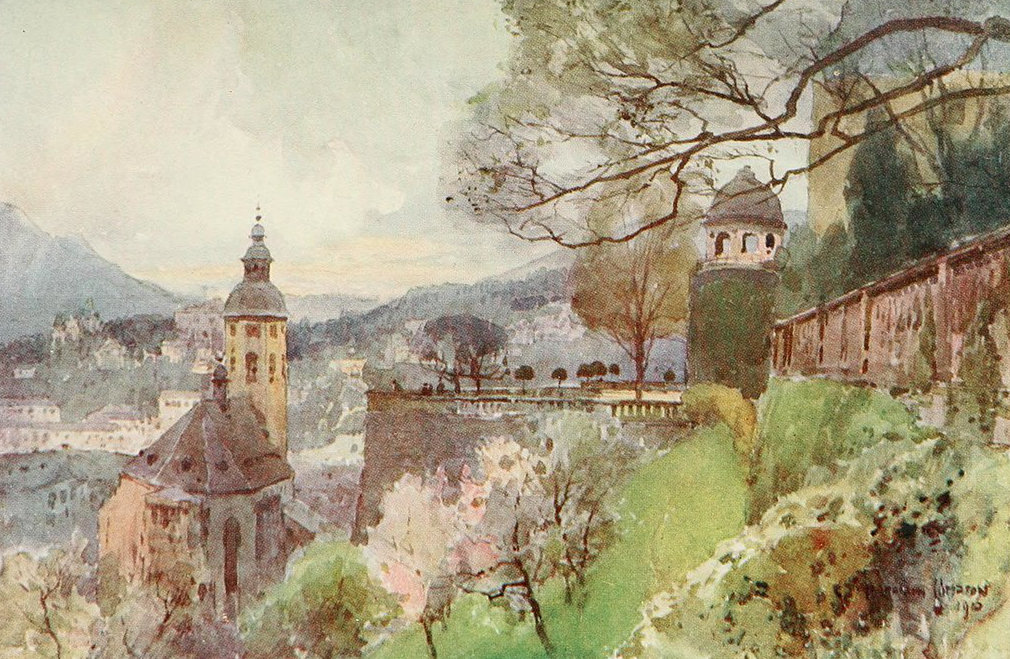
    Baden-Baden, by Edward Harrison Compton, 1912. Public domain. Source: Wikimedia Commons.

    It was after nightfall when he reached Baden-Baden too late to think of waiting upon the grand duke on that day so he sought a comfortable inn, where he was acquainted, and secured lodgings. On the following morning his first movement, after having eaten his breakfast, was to call upon the banker of the baroness, from whom he obtained all the money he required, and then he bent his steps to the ducal residence. But only disappointment awaited him. The grand duke had gone to Heidelberg, and none could tell when he would return; and he was further informed that it was seriously in contemplation to remove the seat of government to that old city. The ancient palace of the Electors Palatine was being repaired and refurnished, and in all probability Leopold would ere long make it his permanent abode.

    Residing at Baden-Baden and connected with the court, was a justice, named Arnbeck, who had in other years been Ernest’s tutor, and upon him our hero determined to call, thinking he might gain information that would be of value.

    Herr Arnbeck was an elderly man; a professor in the college in his younger days, and now a judge in the higher court of law. He had been tutor of Leopold, the present grand duke, having in that capacity accompanied him during a two or three years’ residence abroad. He received Ernest with marked kindness, glad always to meet those pupils whom he had loved and respected; and he cheerfully offered any assistance in his power to render.

    After a brief conversation upon current topics, chiefly of the grand duke and his contemplated change of residence, the young man stated the particular business that had brought him to Baden-Baden. He knew that his hearer was to be trusted, and that his sympathy would-be with him: so he told the story plainly from beginning to end; told of his love Electra von Deckendorf, of their betrothment at the baron’s own desire; told how they had grown up in love, looking upon marriage as a settled fact; and then he told of the coming of Sir Pascal Dunwolf, together with the strange plan of the grand duke for his marriage with the beautiful heiress.

    Arnbeck listened with deep interest, asking several questions for further information, and in the end he was sensibly affected.
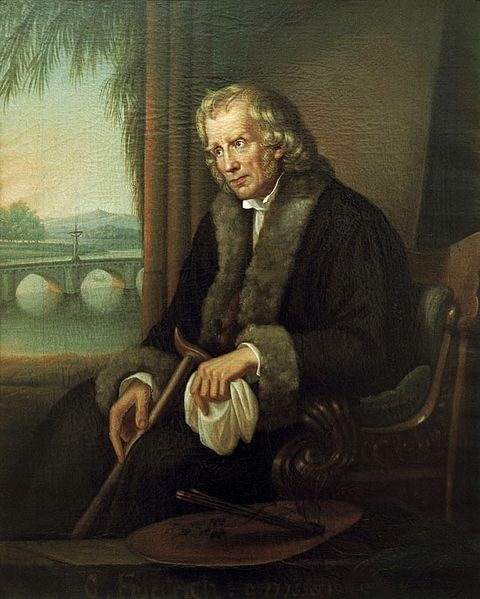
    Porträt Caspar David Friedrichs (1840) by Caroline Bardua. Public domain. Source: Wikimedia Commons

    “My dear boy,” he said, speaking with something of the old school-day familiarity, “had one whom I had not known told me your story I should have doubted its correctness, but I cannot doubt you; and moreover the whole thing bears the stamp of fact. Let me tell you one thing in the outset: Leopold was unfortunate enough to have his life saved by this Sir Pascal Dunwolf. It happened in the Bay of Naples. Sir Pascal had been appointed on Leopold’s suite by his father, the Grand Duke Rudolf. Off the island of Capri my dear pupil was knocked overboard by the jibing of a boom, and Pascal, who had been sitting by his side, leaped into the sea, and upheld him until the sailors could bring the boat around and come up with them.”

    “But surely,” said Ernest,”he would not on that account suffer

    The old justice put out his hand.

    “Listen to me, my son. Think no evil of Leopold. He is young and impulsive; his affections are strong, and his gratitude deep and abiding. He never forgets a favor. So I can see how he has hoped to bestow a benefit upon the man to whom he owes so much. You may be sure, however, that Dunwolf has misrepresented matters to the grand duke. Was he ever at the castle before? Did the baroness know him of old?”

    He was there several times, I believe, in the baron’s time. I think he was attachcd to the staff of Rudolf.”

    “Yes as due of his aides. There is no doubt in my mind that he has represented to Leopold that he would be warmly welcomed by both the baroness and her daughter. He had probably seen the young lady.”

    “Yes. He had seen her at court. She was there with her mother about two years ago.”

    After a little further discussion of the subject it was arranged that Ernest should remain and dine with his old tutor, and meantime he the tutor would go out and make enquiries. Business called him to court, and he would there investigate.

    Herr Arnbeck was gone longer than he had anticipated; and when he returned there was a cloud upon his face which he could not hide; but he would say nothing until after they had eaten their dinner; nor would there have been opportunity, for, on entering the eating-room, they met there the justice’s wife and two daughters, all of whom remembered the visitor well and kindly, and even affectionately.

    At length Herr Arnbeck and Ernest were again alone together, the latter being very anxious to know what his aged friend and counsellor had to say to him. The host did not offer his visitor a seat; but, standing before him, he laid a hand kindly and paternally upon his shoulder, saying as he did so:

    “My dear boy I have made all possible inquiry, and such information as I have is at your service. Sir Pascal did certainly represent to the grand, duke in short, he told him, in direct terms, that the Baroness von Deckendorf would gladly welcome him as a son-in-law; and that she was the more anxious since her daughter had conceived an unfortunate attachment for a vagabond hunter, who, in all probability, belonged to the band of the notorious Thorbrand. This he told her so soberly, and with so much of apparent feeling, picturing in vivid colors the grief and chagrin of the outraged mother, that Leopold believed him, and at once turned his attention to mending the matter, which he would do by exercising his regal prerogative of guardian of the orphan heiress, and bestowing her hand upon the valiant knight.

    Several times during this brief recital the youth had seemed ready to go wild in his wrathful indignation; but thought brought deeper and calmer feeling; and his first coherent speech was of what course he should pursue. Would it be well for him to push on to Heidelberg, and see the grand duke?

    “No,” said Arnbeck, with a solemn shake of the head. Though I am confident Leopold would givn you quick relief, were you to see him, yet you had better not waste time in running after him. It is his plan to visit Wurtemberg before he returns, to make investigation into the matter of an uprising a revolt led by the very Thorbrand of whom we have spoken.”

    “I have heard a whispering of something of that kind,” said Ernest, “but I gave it no credit.”

    “Nor did I, at first, returned the justice; “but I am now forced to the belief that there is much to fear, if prompt measures are not taken to nip the mischief in the bud. In the depths of the Schwarzwald, on the confines of the two principalities, there is a large number of disaffected people, with no grievance save poverty, who are ready to join the robbers, thus making a host capable of terrible work of plunder and devastation. It was to look after this rebellion, and to assist in crushing it; and, afterwards, to hold the uneasy ones in subjection, that Dunwolf was sent to Deckendorf.”

    “My dear old friend,” said our hero, with a proud flush in his face, and a kindling of his truthful eyes, “I may say to you what I would not say to another. Leopold of Baden had better trust me with that command, than trust the man he has sent thither.”

    “I believe you, my dear boy; and I will bring it to pass, if I can. Meantime, my advice to you is, Return at once to Deckendorf. Since that bad man has been so boldly wicked as to attempt your life, there is no telling what he may do next. Now that he fancies he has put you out of the way he may carry a high hand with the marriage. With the commission as given him by the grand duke, and the consent to the union therein implied, there is nothing in the world to prevent him from forcing the marriage at his will. He has only to find a priest ready and willing to do his wicked work, and they, I am sorry to say, are plenty. So, my son, back to the castle, and look to those who may need your protection.”

    For a little time the startled youth was utterly unable to speak. So confounded was he that he could scarcely think. The danger that threatened his beloved had come upon him like a thunderbolt from a clear sky. He had not dreamed of such a possibility. The idea that any living man, less than the emperor, or the grand duke himself, could do such a deed as force an unhallowed, unwelcome marriage upon the heiress of Deckendorf, would have been too wild and ridiculous for belief.

    “Herr Arnbeck!” he gasped, as soon as he could command speech, “would such a marriage as that forced upon the lady against the earnest protest of herself and her mother be valid?”

    “I am pained to say, Yes. Electra von Deckendorf is, in the eye of the law, a ward of the grand duke, and he has given his consent to her union with Pascal Dunwolf, which consent the prospective husband has in his possession in writing, in the prince’s own hand. You can see for yourself the power possessed by that dark-browed knight. But, mark you, he must act quickly if he hopes to succeed in his nefarious purpose; for, as I have promised you, the moment Leopold knows the truth, that moment Dunwolf’s power falls.”

    “O! why is not the grand duke here? Why can I not find him? Heaven have mercy!” And the quivering youth wrung his hands in the uttermost depths of anguish.

    “Hush!” said the aged justice, laying a hand upon his arm. “Be up and doing. Do you look to Deckendorf, and I will look for the grand duke. I know you will not find him if you go to Heidelberg. I shall hear from him on the arrival of his first budget, and I will not fail to notify him.”

    With a mighty effort Ernest recovered himself, and as soon as he could think consecutively, and speak coherently, he thanked the good old man for his kindness, and promised that he would return to Deckendorf as speedily as possible. It was now too late to set out that day. The weather was thick and threatening, and the night was likely to be stormy; but he would be on the road early in the morning.

    He took tea with the justice, and with him spent a portion of the evening. The conversation turned upon the trouble in the Schwarzwald, neither of them having any heart to talk further of Dunwolf and his villainy. Ernest asked if there were any men of standing and influence engaged in the insurrection.

    His host answered that there probably were, but they were not positively known. The plan, as nearly as it could be arrived at, was to form a vast and powerful organisation of freebooters. They would organize a government, and live by general plunder. Having gained possession of a few of the strongest castles in the heart of the Schwarzwald, they might bid defiance in their mountain fastnesses to the world. It was known that Thorbrand was engaged in the enterprise, and he appeared to be the ostensible head of the movement, but it was doubtful if he was the responsible head.

    “Have you any idea who is the responsible head?” asked the youth, earnestly.

    The old man returned him a sharp piercing glance, and then arose from his seat and took two or three turns around the room. By-and-by he stopped by the side of his guest, and laid a hand upon his shoulder.

    “Ernest, what I now say to you, you will sacredly keep as a trust reposed under seal of your honour. You have asked me a direct question. I will give you a direct answer: SIR PASCAL DUNWOLF!”

    The young captain started as though he had been stricken a heavy blow.

    “Hush! Not a word!” added Arnbeck. “I have never thought this until within the present hour; but now I sincerely believe it. Bury it in your bosom bury it deeply and keep your eyes open. And now I must bid you good-night. I have work to do; and you must gain sleep, if you would perform your journey on the morrow.”

    A little later our hero returned to his inn and sought his rest; and on the following morning, bright and early, he was on the road. There had been rain during the night, but the rising sun soon banished the clouds, and the day promised to be clear and pleasant.


    Notes

    • his sworn tools: his lackeys, flunkeys.
    • be the grainer: this obsolete idiom carries the sense, “be the beneficiary,” presumably after the agricultural metaphor.
    • Electors Palatine: “[A palatinate was] Either of two historical districts and former states of southern Germany. The Lower Palatinate is in southwest Germany between Luxembourg and the Rhine River; the Upper Palatinate is to the east in eastern Bavaria. They were once under the jurisdiction of the counts palatine, who became electors of the Holy Roman Empire in 1356 and were then known as electors palatine” (yourdictionary.com). Elector: “a German prince entitled to take part in the election of the Holy Roman Emperor; [E.g.], the Elector of Brandenburg’” (Oxford Languages).
    • Wurtemberg: “The Kingdom of Württembe.rg was a German state that existed from 1805 to 1918, located within the area that is now Baden-Württemberg” (Wikipedia).
    • arrival of his first budget: “budget” from OF bouge, “a bag”; so carries the sense, “immediately on his arrival.”
    • freebooter: robber, plunderer.
    • fastness: stronghold (see also Chapter 6 and n.)
    Creative Commons License
    This work is licensed under a Creative Commons Attribution-ShareAlike 4.0 International License.


  • J.F. Smith’s Mystery of the Marsh — Seventeenth Instalment

    J.F. Smith’s Mystery of the Marsh — Seventeenth Instalment

    Old newspapers are not much cared about and are often applied to undignified functions, recalling Dryden:

    From dusty shops neglected authors come,
    Martyrs of pies, and relics of the bum.

    (‘Mac Flecknoe’)

    or tossed on the rubbish heap, as in Joyce:

    About that original hen. Midwinter (fruur or kuur?) was in the offing and Premver a promise of a pril when, as kischabrigies sang life’s old sahatsong, an iceclad shiverer, merest of bantlings observed a cold fowl behaviourising strangely on that fatal midden or chip factory or comicalbottomed copsjute (dump for short) afterwards changed into the orangery […]

    (Finnegans Wake, Ch. 5)

    Biddy the hen scratches up an old letter in the rubbish heap, which stands for Finnegans Wake the novel itself, or the Bible, or even the substance of universal human history. Mere “bits and scraps” (Samuel Beckett) though they may be, they are impregnated with the world in which they were manufactured, and which decays along with them. Note that as Biddy scratches and pecks on the letter, she creates marks and holes that later exegetes interpret as part of the original message.

    This project of raising Smith’s penny novel is achievable thanks to the work accomplished by scholars and librarians such as those who established the Trove digital archives of the National Library of Australia, from where I’ve obtained the original serials of The Mystery of the Marsh.

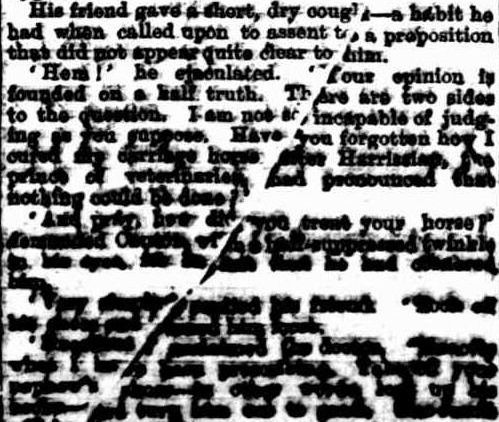
    Convenient, comprehensive and flexible a resource as Trove is, we find many instances where the text breaks down in one way or another, presenting a jigsaw puzzle. Figure 1 shows a fundamental type of this problem. Here there are two horns of the dilemma: i) the easier, where a librarian needed to piece together the paper, like an actual jigsaw; and ii) where the text, to varying degrees, becomes difficult to read, either because of damage to the original, or because of a problem in the copying process. For example:

    Figure 1. Sample of torn and blurred copy.

    Here is how the machine-reader deals with the text in Figure 1, extending from “His friend gave a short, dry cough”:

    ffi^MBnd-g8-fi^HteB^^ooBi^i-^lsfeit4«
    had ^g^. calLad..Ojp)6n ^tb jBssent tr- a proposition
    – ‘ Heidi I ‘ fie eiBonlatedl . ”Jtmx -^nidn ts
    :f&nn4id~ cmL .«.? Ealt trutlL. Tt A* ar6 m- pldea

    After “There are two sides”, it seems to give up and omit the rest as a smudge.

    Very Wake-esque but unedifying. Usually the machine-read copy is useful in piecing together a rough cut and saving a fair amount of keying-in, though every word still needs to be checked against one or both of the (digitalized) original copies.

    Thankfully there are two different copies of the serial, appearing in different publications, originally separated by about eight years, and edited by different editors. When the earlier “fair” copy is damaged (so-termed because it is closer to the author and has proven itself reliable), the later “foul” copy can provide clarification.

    At the same time, the editor of the foul copy sometimes slaps things together cavalierly. This is understandable — they’re not handling a manuscript of Shakespeare’s or the Dead Sea scrolls. Their job is to fill up available space in the most economical way. But in so doing, they often fiddle about with points of spelling, grammar and lexicon, probably aiming to make the story “more readable,” but sometimes achieving the opposite.

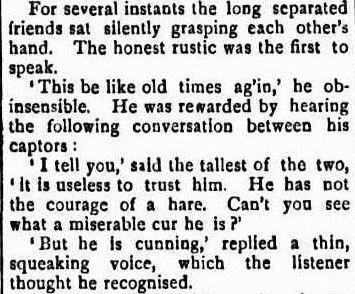
    Figure 2 demonstrates one of a couple of befuddling gaffes on the part of the foul editor this fortnight:

    Figure 2. Editorial gaffe from the foul copy.

    Perhaps you’ve spotted the problem already: there is no such word as “obinsensible”. At the end-of-line hyphen the text jumps to somewhere unrelated to the original scene: from Goliah and William’s reunion, to Benoni’s apprehension by the villains (in the previous chapter of the fair copy), where it stays for the rest of the chapter, hopelessly throwing out the entire narrative and requiring all sorts of calisthenics to get back on track. It’s interesting to observe how the editor’s fast moving eye has been deceived by an illusion of continuity created by the references in both scenes to two characters conversing, and by the formatting. The reader glides on blithely — and suddenly thinks, “What the blazes is going on?!”

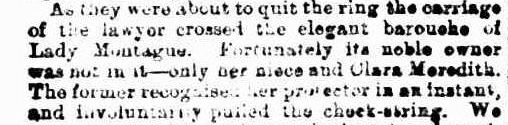
    The sample in Figure 3 presents a satisfying teaser.

    Figure 3. Sample of blurred word in fair copy.

    This is from the scene where William finally meets his love-interest Lady Kate again, when they are both being driven in carriages in London’s Hyde Park — a popular Sunday recreation of the well-to-do.  We can clearly see that Kate “involuntarily pulled” something that stops the carriage, but what? The words are not quite clear enough to be confident without further reference.

    The foul copy doesn’t help: the cavalier editor doesn’t seem to know either, or maybe thinks their readership won’t, and treats the incident thus:

    The former recognised her protector in an instant, and involuntarily, for it was the impulse of gratitude, called the driver to stop the carriage.

    However, calling the driver to stop is not really an involuntary action in the sense that physically pulling on a device that automatically stops the carriage may be considered. Such a device enables the chain of action to occur in an instant: the sighting; the recognition; and her involuntarily activating the device, which automatically stops the carriage.

    The device in question is found in Dearden’s Miscellany (1839): a “check string”, an invention that causes the reins to be pulled up automatically from inside the carriage in case of an emergency. Why on earth did the foul editor muck up Smith’s perfectly good line? The term was used in Australia, as its occurrence in Caroline Leakey’s novel Broad Arrow (1859) evidences.


    CHAPTER SEVENTEEN

    The Tables Begin to Turn — Lady Kate Meets Her Protector — A Lawyer’s Plot, but an Honest One

    It is a sad thing when parents, by dishonourable practices, give their children the right to despise them. The natural law is sure to avenge the violation of the divine one; for, with respect, filial love gradually dies — fading like some young tree planted in an ungenial soil; first indifference, then contempt usurps its place. In rough, uncultivated natures a worse tyranny is not unfrequently exercised over the erring parents who have no moral force to resist it, and they either sink into the slaves of the offspring their example has corrupted, or consent to pander to their vices.

    No doubt this is a terrible picture, but, alas! it is a true one; and may be seen, allowing for difference in tone and colour, in almost every grade of society — the highest as well as the lowest. In the former, the veil of a flimsy refinement hides the more revolting traits; but they exist. The facts are there. In the latter, they stare you in the face in all their cynical deformity.

    Viscount and Lady Allworth were beginning to feel the truth of this. The fashionable season had once more commenced in London, but Lord Bury never appeared at any of his father’s parties. He ceased to frequent the club of which they were both members, in order to avoid meeting him. Occasionally, however, it was unavoidable; but when society threw them together he treated him merely with that formal respect which, in some instances, is more cutting than downright rudeness, and far more painful to receive than positive insult. The more polished the weapon the deeper the wound.

    What made the conduct of the young nobleman still more mortifying to his father, was that he never failed to attend the receptions of Lady Montague, who had returned to town for the season. Sir George Meredith and his daughter were her ladyship’s guests; they had accepted an invitation to spend the season with her, to the great delight of Kate and Clara, who become warm friends.

    The fashionable world, which is far more observant than outsiders give it credit for, soon began to notice this polite estrangement between father and son; and the viscount, who was not wanting in tact, resolved to have an explanation with Bury. Half a dozen times he had called at his chambers, but never found him at home. ‘Absent,’ ‘On duty,’ or ‘In the country,’ were the answers he received from the obsequious porter, as he respectfully received his lordship’s card and placed it on the rack In his office. The aged roué knew that the fellow was lying, and almost respected him for the grace with which he did it.

    An actor himself, he could appreciate good acting in others.

    So he muttered, as he drove from the Albany —

    ‘Bury has taken his part and seems resolved to carry it out. Let him — cursedly ungrateful, though. I hate ingratitude. I first suggested Meredith’s girl — he ought to remember that, and not feel so resentful at the Chellston affair.’

    That any higher principle had actuated his lordship’s conduct never entered into the imagination of the worldly-minded man.

    Lady Allworth already began to discern this painful truth; in forfeiting the respect of her son she had lost all hold on his affection, which had never been very strong. From Dinant, a small town in Brittany, to which he had retired on recovering from his wound, he was continually writing for money to supply his vulgar extravagance, and yet the allowance made him was a liberal one. In answer to a letter refusing to send additional funds, he wrote back threatening to return to England and expose her share in the attempt to force Lady Kate into a clandestine marriage; if he could not rob, he would disgrace her.

    The reply of her ladyship was characteristic and laconic:

    ‘Return without my permission, and I will not only reduce the allowance I promised, but disinherit you. You cannot scare me.’

    Not a word of affection. She felt that he had none. She could not appeal to his honor; it had too long been forfeited. It was to his selfish fears that she addressed her answer, and it proved successful. Clarence Marsham knew his mother too well to doubt for an Instant that, if further provoked, she would execute her threats. He was entirely at her mercy, and he knew it. It was a bitter pill for him to swallow, but after a brief struggle with his passionate temper and sundry profane curses he did swallow it, sat down and wrote a penitential letter, declaring that he was drunk when he made his insolent demand, and asking her forgiveness, which in due time was coldly accorded.

    Lady Allworth was what the world would call a strong-minded woman; if any real strength can be found in evil, undoubtedly she merited the designation. Up to the present period her life had been a series of successes, purchased by sacrifices which will appear hereafter in all their questionable details. The crowning scheme — the marriage of her worthless son with Lady Kate Kepple — had hitherto proved a failure which discouraged without inducing her to change her purpose, which remained fixed as ever, although at times, when dwelling on the future, she began to discern faint outlines of that dark shadow which from the first step into crime follows one’s footsteps. Sometimes it appeared to be drawing nearer, frowning menacingly; then it would disappear, and courage revive again.

    We must not forget William Whiston, the hero of our tale, who had passed his first year at Cambridge, where to the great delight of his uncle, he had obtained two scholarships — one in mathematics and one in classics, and was now in London for the vacation.

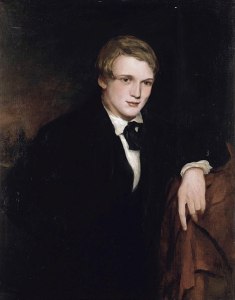
    William Powell Frith (1836-8), attrib. Douglas Cowper.

    It was not the trifling income derived from this success that gratified his guardian; that was a matter of perfect indifference to him. It was the proof that his nephew had used his time at college wisely. Tutors had written most encouragingly respecting him, predicting his future success.

    Still the old lawyer did not feel quite satisfied; the pale cheeks and certain dark circles round the eyes of the tired student alarmed him, and the first thing he did on his arrival was to send for a physician.

    ‘Overwork,’ said the man of science. ‘No organic disease.’

    The uncle breathed more freely.

    ‘We will soon remedy this,’ he observed. ‘The boy is up for the long vacation, and shall work only six hours per day.’

    Dr. Canton shook his head.

    ‘What! You think that too much? Four, then.’

    ‘Not one,’ replied the doctor emphatically.

    ‘I have frequently observed that you lawyers,’ he added, ‘astute enough in your own profession, are like children when they wander out of it — bewildered and unreliable in their judgment. I would as soon consult my tailor on a plea in chancery,’ he added, ‘as a lawyer on a point of hygiene.’

    His friend gave a short dry cough — a habit he had when called upon to assent to a proposition that did not appear quite clear to him.

    ‘Hem!’ he ejaculated. ‘Your opinion is founded on a half truth. There are two sides to the question. I am not so incapable of judging as you suppose. Have you forgotten how I cured my carriage horse after Harrassian, the prince of veterinaries, had pronounced that nothing could be done?’

    ‘And pray, how did you treat your horse?’ demanded Canton, with a half-suppressed twinkle in his eyes, for he felt that he had cornered him.

    ‘Very simply,’ replied his friend. ‘Took off his shoes and turned him loose.’

    ‘Excellent!’ exclaimed the doctor. ‘Exactly what I have been prescribing. Take off your nephew’s shoes — in other words, lock up his books — and turn him out to grass. The result will be the same.’

    With these words the friendly physician took his leave.

    ‘Canton is right!’ exclaimed the man of law, after a few minutes’ reflection. ‘I was a fool not to perceive it at first. The boy’s brain has been overtaxed. No more work till the end of the vacation. What a terrible error I was about to fall into! He shall enjoy himself. Won’t let him go to Deerhurst, though.’

    Two days afterwards our hero was delighted by the arrival of his faithful friend, Goliah. Knowing their attachment to each other, Lawyer Whiston had arranged that the two young men should spend a month together in London. There was nothing selfish in the old man’s affection for his nephew. He knew that the sympathies of youth require youth to draw them forth. The wisdom of age, however the young may venerate it, sometimes appears dry to them. Paradox as it may seem, hearts sometimes require weakness instead of strength to lean upon.

    For several instants the long separated friends sat silently grasping each other’s hand. The honest rustic was the first to speak.

    ‘This be like old times ag’in,’ he observed. ‘Deerhurst has been mortal dull without thee. Willie,’ he added, ‘thee do look pale and tired like.’

    ‘A little over-worked. Nothing more,’ replied the student. ‘I shall soon get over it.’ My uncle is very kind to me, and I have done my best to please him.’

    ‘Kind to thee?’ repeated his friend. ‘How can he help being kind to thee? Thee hast such a curious way of making a home in the hearts of all who know thee.’

    ‘Not all,’ said Willie, with something like a sigh.

    ‘All!’ added Goliah emphatically. ‘And those who don’t love thee don’t know thee. But never mind that now. I be come to spend a whole month with thee. The hay be all in, and Uncle Whiston settled it all right with mother.’

    His hearer heard the arrangement with almost as much surprise as pleasure. It was an additional proof of the place he had won in the regard of his relative.

    It was dinner-time before the lawyer made his appearance in Soho Square. He brought Bunce with him. The appearance of the poor tramp was so improved that Goliah scarcely recognised him.

    ‘Why, thee do look like a born gentleman!’ he exclaimed, at the same time shaking hands with him cordially. ‘They wouldn’t know thee at Deerhurst,’ he added.

    ‘You are as true a gentleman as I am,’ observed the wanderer. ‘Probably more so.’

    ‘I see thee be poking fun at me.’

    ‘Not so,’ replied his former acquaintance. ‘Fine clothes do not make a gentleman, or the ruffian upon whose face you left the mark of your whip would be the better gentleman of the three. It is the heart that gives the title. The rest is the mere gilding of the surface.’

    ‘There be some truth in that,’ said the honest rustic, thoughtfully.

    His hearers remarked with pleasure that considerable improvement had taken place less in the language than the manners of the speaker. He was far more quiet. His rough, boisterous fits of laughter no longer jarred upon the ears. If occasionally they broke forth, they were quickly suppressed. Mr. Whiston and Bunce felt more surprised than our hero did at the change. He thought of Susan, and understood it. His own recollections of Kate — the influence they had exercised upon his mind, although he still ignored her rank and fortune — explained it to him.

    Love is a great beautifier. The fable of Cymon and his nymph contains a delicate truth. Few of us, we suspect, but have learnt the lesson.

    ‘Not at home to any one,’ said the lawyer, as the butler placed the dessert upon the table, ‘and do not disturb me unless I ring.’

    The well-trained domestic withdrew.

    ‘And now, boys,’ continued the speaker, ‘as my nephew is enjoying his vacation, I think it only fair that I should take mine for an evening or two at least. Impossible to take more. The affairs of others might suffer.’

    ‘How stand affairs at Deerhurst?’ he added, addressing himself to Goliah. ‘Commence with Farmer Hurst, his wife and the pretty Susan.’

    At the last name his visitor coloured slightly and looked embarrassed, till a smile from Willie encouraged him to proceed.

    ‘Farmer Hurst is a changed man,’ he replied. ‘He do miss his nephew sadly. For the matter of that, so do the whole village. I don’t think,’ he added, ‘the grey mare be the best horse in the stable as it wor once. The filly ha’ taken her place. Not altogether,’ he added thoughtfully; ‘wish she had; but in a great many things.’

    ‘You mean to say that Peggy has not so much her own way as she used to have,’ observed the lawyer.

    ‘That’s it. How clever thee do put it.’

    ‘Mere practice,’ observed the man of law. ‘You, too, Goliah, are becoming a logician in your way.’

    ‘What be that?’ demanded the latter. ‘Nothing to do with law, I hope.’

    ‘More than you imagine, I expect,’ answered Mr. Whiston, with a smile. ‘But never mind that now. What is the news from Deerhurst?’

    ‘Schoolmaster Blackmore and his son Benoni ha’ left the place. Neighbours began to look coldly on them, so they started off, bag and baggage, without a word to any one; and a good riddance, too.’

    ‘And where are they gone? To London?’

    ‘Not so far as that,’ continued the lad. ‘Leastways Benoni has been seen several times in the village. He do come mostly at nights. People do say they be livin’ at their old home in the Marsh.’

    The lawyer and Bunce exchanged glances.

    ‘Mind,’ added the speaker, ‘I don’t know that it is so. At any rate he took all his books there. Breeze and Howard helped to carry them. It be a queer place to live in, fit only for wild geese and teal. Justice’s clerk told mother that schoolmaster ha’ gotten a lease of the whole place from some great lord in London.’

    The questioner brought the forefinger down to the palm of his hand — a habit he had when he wished to impress any fact or legal point upon his mind.

    Goliah looked upon all this as mere love of gossip on the part of Richard Whiston. In his simple, honest heart he never once suspected that the shrewd man of law was putting him through a regular examination.

    ‘And is this all?’ he asked.

    ‘All as I can recollect,’ was the reply.

    ‘So Benoni came merely to visit his old friends,’ observed the lawyer.

    ‘Since he went back on Willie all the boys despise him — turned him out of the cricket club, thof he wor one of the best bowlers we had. Stay, I do recollect something. The first time he came wor to get some iron bars his father had ordered of Mottram, the blacksmith.’

    A second finger was turned down.

    ‘And the next time?’ said the lawyer, insinuatingly.

    ‘He met Peggy Hurst at the Red Barn. I don’t think,’ added the speaker, ‘he will go near the farm again.’

    ‘And why not?’

    ‘I thrashed him,’ said Goliah, quietly. ‘I heard him tell Peggy that he wor in love wi’ her daughter, and I couldn’t stand that.’

    ‘Jealous,’ observed Willie.

    ‘Not a bit,’ answered his friend. ‘Susan despises him. What true-hearted girl could fancy a coward. I wor never jealous of any one but thee.’

    ‘And with quite as little reason,’ replied our hero. ‘It is quite true that Susan and I love each other; but it is only as brother and sister — nothing more.’

    ‘I know that,’ said the admirer of his cousin. ‘Thee told I so afore, and thee do allays speak the truth. It took such a lump off my heart; for what chance should I ha’ had again thee? Susan told I the same thing when I spoke my mind to her.’

    ‘And she answered —’

    ‘Nay, Willie, that beant fair,’ interrupted his friend. ‘There be two to that secret. When thee do fall in love thee will know all about it. P’raps she laughed at I — p’raps she did not; at any rate, she wor not very angry, though her mother is — she be dead set agin me. The farmer, I think, is all right, or soon will be.’

    Our hero sighed, and mentally repeated the words of the speaker, ‘When thee do fall in love.’ The poor boy was already in love. The fair girl he had rescued had left her image in his young heart. The gift of the watch — and, still more, the simple words from Kate — had confirmed the impression. The desire of pleasing his uncle was not the only motive for his hard studies at the university; a yet stronger impulse inspired him — the thought of making himself worthy of her; for, without the slightest suspicion of her real rank or fortune, he felt they were superior to his.

    ‘Now, boys,’ said the lawyer, as he bade them good night, ‘amuse yourselves in the morning as you please. The carriage and horses are at your disposal. After lunch I would advise you to take a drive in Hyde Park. The season is at its height for equipages, beautiful girls, and remarkable personages. Europe has not a scene to equal it. I can’t accompany you; neither can I spare Bunce — most important case to come off. But we shall meet at dinner.’

    ‘And my studies, sir —’ suggested Willie.

    ‘Hang your studies!’ interrupted his uncle. ‘Of course I don’t exactly mean that; but merely for the present. Recollect that for the present,’ he added, laughingly, ‘I have taken off your shoes and turned you out to grass.’

    Goliah slapped his thigh — a habit he had when greatly pleased — and exclaimed, triumphantly:

    ‘That be right, lawyer! It will soon bring back the colour to Willie’s cheeks, which those plaguey books ha’ stolen away. I opened one of ’em, and it made my eyes ache to look at the crooked lines and figgers; never seed anything like it, except in a conjuring book at fair time. Ecod!’ he added, ‘thee beest almost as sensible as a farmer.’

    Richard Whiston bowed gravely; there was an amused expression on his face.

    ‘I fear you flatter me,’ he said.

    Bunce and Willie laughed heartily.

    Poor Goliah coloured to the roots of his hair; he was quite quick enough to perceive the ridiculous side of his speech, and hastened to amend it.

    ‘I meant about horses,’ he said. ‘I didn’t think thee knowed so much. Of course, in law, book-larning, and such things, thee do know a great deal more. Why don’t thee help I, Willie?’ he exclaimed, turning to his friend. ‘I always helped thee. Thee do know what I mean.’

    ‘And so does my uncle,’ replied our hero. ‘He understands you even better than I do.’

    ‘Then he beant angry wi’ I?’ said the honest rustic.

    ‘Not in the least,’ said Mr. Whiston shaking hands with him before quitting the room. ‘We perfectly understand each other.’

    ‘Of course we does,’ observed Goliah, as the gentleman disappeared, ‘though Willie and Bunce both laughed at I.’

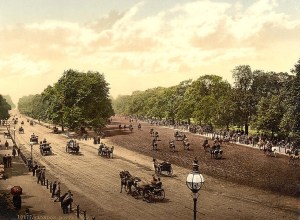
    Rotten Row and Hyde Park Corner. c.1890-1900. Photomechanical print. Source: Wikimedia Commons.

    The following day our hero and his friend did not neglect the lawyer’s advice of driving in Hyde Park at the hour he named, when the scene appears most attractive, especially to those who contemplate it for the first time. No doubt there are spots in the world equally beautiful; a few, perhaps, still more so, but none more animated. The throng of equipages in which elderly persons take their ease whilst inhaling the fresh pure air, the crowd of lovely girls, all life and animation, cantering on well-trained steeds, attended by fathers, brothers and admirers, the former proud of their charge the latter trusting to win a smile from the lips that enthralled them.

    Talk of the Isle of Calypso! The graceful fable of Fenelon never presented half its charms. His goddess and worshippers were a myth — those of Hyde Park are living realities, pure flesh and blood, fresh from the hand of nature.

    Youth! youth! such are thy glorious visions! They haunt its dreams; nor are those of age entirely free from them, dimly seen, perhaps, through the falling mists of a once happy past. So great was the excitement of Goliah that Willie had to check his outspoken bursts of admiration, which more than once attracted attention; and yet there was nothing coarse in them. The heart of the honest rustic was too well guarded for that by the recollection of the pretty Susan.

    Nothing like a pure, manly love to keep the lips and heart pure.

    As they were about to quit the ring the carriage of the lawyer crossed the elegant barouche of Lady Montague. Fortunately its noble owner was not in it — only her niece and Clara Meredith. The former recognised her protector in an instant, and involuntarily pulled the check-string. We say involuntarily, for it was the impulse of gratitude. Nothing more! Of course not! Had the high-born girl taken time to reflect, the fashionable surroundings, the familiar faces passing and repassing, might have prevented her. We do not mean to say that it would, but merely possibly.

    Mr. Whiston’s coachman — he had once been in the service of a lord chancellor — perfectly well understood what the drawing-up of Lady Montague’s equipage meant, and quietly drew up beside it. Clara Meredith looked on wonderingly. She could not understand the blushing, half-hesitating manner of her friend as she addressed our hero whose confusion equalled if it did not exceed her own.

    A very few words explained it.

    ‘I cannot,’ she said, ‘suffer the opportunity to escape me of expressing my gratitude to those who so generously protected me from a very great danger; that I have not done so personally before has not been from heartlessness, but ignorance of his name and address.’

    ‘It is the happiest recollection of my life,’ answered Willie, modestly; ‘but I fear you overrate my services.’

    ‘What!’ exclaimed Goliah, upon whose sluggish brain the truth was slowly dawning. ‘Be thee the —’

    ‘Even so,’ interrupted Lady Kate, hastily, for she had an instinctive dread of what was about to follow. ‘Do you not recollect me?’

    ‘How should I?’ replied the former. ‘Not but I ha’ often thought on thee. When I seed thee afore thee wor —’

    A violent nudge in the ribs, which, as the speaker declared, almost drove the breath out of him, gave him an unmistakable hint that he was treading on forbidden ground. Poor Willie was in agonies lest he should not take it.

    ‘So differently dressed,’ added the rustic, suppressing the allusion to her being disguised as a boy, which trembled upon his lips; ‘but that be only natteral; people don’t wear such fine clothes in the country as they do in London.’

    His friend breathed more freely, and the burning blush which had risen to the cheeks of the agitated girl gradually receded as the words were so adroitly turned.

    ‘You will find me at the residence of my aunt and guardian, Lady Montague,’ observed Lady Kate, at the same time giving him her card, and accepting the one he proffered.

    ‘I ain’t got no card,’ observed Goliah; ‘but I can write my name if Willie will lend I a pencil; that’s if’ — a second nudge, equally emphatic with the first one, cut short the rest of his speech.

    ‘Home!’ said Kate, at the same time bowing her adieu.

    The equipages separated, and for some minutes the ladies drove from the Park in silence.

    ‘O, Kate! Kate,’ said Clara Meredith, who was the first to speak.

    ‘You think I have acted wrongly?’

    ‘Incautiously, my love; wrongly, no — a hundred times no. Better, perhaps, to have let the recollection of the adventure fade from the memory of each.’

    ‘And endure the self-reproach of ingratitude?’ observed Kate.

    ‘Well, there is something in that,’ replied her companion. ‘I wonder what your dear old aunt will say — for, of course, you will tell her?’

    ‘Of course,’ was the reply.

    ‘Can you tell me, James,’ said Miss Meredith, addressing the coachman, ‘to whom the carriage in which those gentlemen were riding, belongs?’

    ‘Certainly, Miss,’ answered the man. ‘To Mr. Whiston, the great lawyer, who has the management of Lady Montague’s estates. The youngest of the gentlemen is his nephew, a great scholar, they say; and —’

    ‘Thank you, that will do.’

    Lady Kate glanced furtively at the card.

    ‘It is the same name,’ she whispered.

    ‘Thank Heaven he is a gentleman,’ exclaimed Clara.

    Her friend made no reply. She had never doubted it.

    Our hero felt too much excited by the unexpected meeting which had set his young heart dreaming to pay much attention to his companion, who sat silently by his side, turning the affair over in his mind in the hope of finding a solution.

    At last he broke into a low chuckle.

    ‘Ecod, Willie,’ he said, ‘thee beest a sly one.’

    ‘I do not understand you.’

    ‘Thee never told I about the — thee knowest who I mean. I can believe now,’ added the speaker, ‘that thee do love Susan only like a brother.’

    ‘Nonsense, Goliah! I have never seen the lady till this morning since we lost sight of her on Chandos-street. She is evidently far above me in rank as fortune. Her speaking to me was merely the result of gratitude, nothing more.’

    His friend gave a knowing wink.

    ‘No, for thee do allays speak the truth when thee do know it. I ha’ learnt many things since thee was puzzling thee brains over them dreadful books that make my eyes ache to look at, and be wiser nor thee in some things.’

    ‘Not unlikely. Susan is a very clever girl,’ observed his friend, with a smile.

    ‘Never mind Susan now,’ added Goliah. ‘I tell ’ee thee girl is in love wi’ thee.’

    ‘Ridiculous!’

    ‘’Diculous or not, be it so. Eyes don’t lie, though the tongue does.’

    Somehow our hero did not feel quite as angry at the absurdity of the speaker as he ought perhaps to have done. During the rest of their ride to Soho Square he remained silent, chewing the cud, as Shakespeare says, of sweet and bitter fancies — a weakness we are all liable to, age as well as youth.

    This edition © 2019 Furin Chime, Michael Guest


    Notes

    Finnegans Wake: For a pertinent site on the Wake, see Susie Lopez’s piece at Lithub, ‘Finnegan’s Wake at 80: In Defense of the Difficult: On the Pleasure of Annotating One of Literature’s Most Challenging Works’.

    TroveTrove, National Library of Australia

    Cymon and his Nymph: See John Dryden, ‘Cymon and Iphigenia‘, from Boccace, in Fables Ancient and Modern (1700).

    Isle of Calypso: Reference to Angelica Kauffman’s painting, Telemachus and the Nymphs of Calypso (1782), showing a scene from François Fénelon’s novel The Adventures of Telemachus (1699).

    Rotten Row and Hyde Park Corner (image): A likely site for Lady Kate and William to have crossed paths. See ‘Victorian London: Entertainment and Recreation’.  ‘Rotten Row’ is a corruption of Route du Roi, The King’s Road, which William III had built at the end of the seventeenth century as a safe route for him to travel between Kensington Palace and St. James’s Palace. In the image, Rotten Row is to the right; it was for saddle-horses only.

    Ecod: Egad.

    chewing the cud, as Shakespeare says: Common misquotation of As You Like It, 4.3: “Chewing the food of sweet and bitter fancy”.

    Dearden’s Miscellaney (1839).  Jump to page on Internet Archive for ‘check string’ entry (under “Important Invention”, p.121).