Tag: Colonial Australia

  • Ginseng Poachers

    Ginseng Poachers

    Once the blackened remains of his aerostatic globe were retrieved, Dinwiddie took to his bunk, afflicted with a profound dread usually reserved for the condemned. He shook, perspired, quivered, and palpitated; so much so that Pu-erh, apprehensive of her own fate, having been placed in charge of the Scot by the Qianlong Emperor himself, summoned a team of imperial physicians and acupuncturists. Their examination of his tongue revealed flaws in the state of his kidneys, bladder, intestines, stomach, spleen, lungs, heart, gall bladder, and liver. Moreover, its shape and colour pointed to a severe deficiency in Qi; red dots suggested heat or inflammation in his blood; and the thick coating was indicative of an allergic disorder compounded by digestive imbalance. He was dosed, moxibusted with mugwort, and cupped, scraped, tickled and pricked to the point of tears and bellows.

    He may as well have reclined sunning himself in the Imperial Garden, for Lord Macartney’s overtures to the Emperor had crashed and burned as completely as the globe, with tangible repercussions for the delegation. Macartney, preoccupied with weightier matters, had never much cared for Dinwiddie’s pet project in any case, and failed to notice its absence from the exhibition.

    Dinwiddie resurrected himself and managed to prepare for the official event. The Emperor was contemptuous, tarrying for less than five minutes before repairing to the quarters of his latest concubine. After his disdainful exit, Pu-erh conveyed his comments to the scowling Lord Macartney and deflated Dinwiddie:

    “Your air pump is of little interest, though the telescope might amuse children. He finds your planetarium infantile too – not unlike the sing-song clocks hawked in the Canton marketplaces,” she said. “The Emperor already owns a superior model, anyway, presented as a personal gift by a German delegation. It is true your giant lens can melt a copper coin, but will it melt his enemy’s city? He believes not.”

    The next day, she was summoned to the Dragon Throne. She kowtowed three times as she approached. The imperial ministers, secretaries, and scribes were in attendance, assisting the Emperor draft a reply to King George’s letter. Her attendants delivered the sketches and notes she and her agents had compiled regarding the scientific instruments.
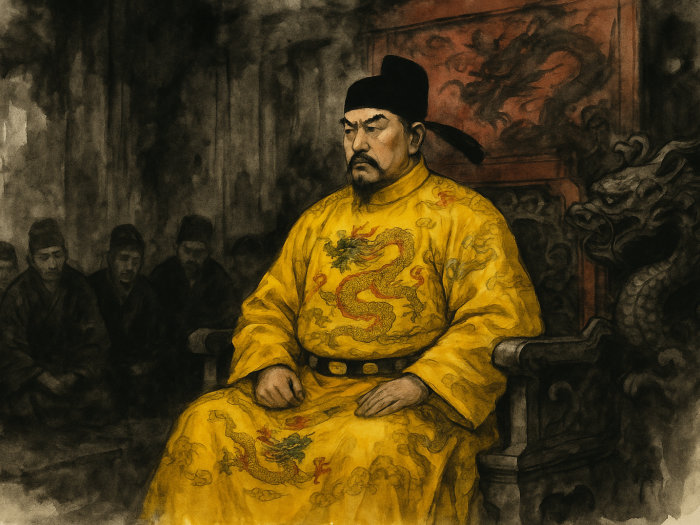
    The Qing Emperor, in his Bright Yellow court robes.

    “You have performed your duties exemplarily, our flower,” the Emperor said. “Our indulgence of the foreign delegation, exasperating though it was, has nonetheless proved edifying in certain significant respects. Their ships are capable and well-armoured, their weapons powerful beyond our anticipation. It is useful to glean these odds and ends regarding the abilities of their scientists and craftsmen. Oh, that fellow, that worm …”

    Lord Macartney,” prompted an advisor at his side.

    “That’s it – Macartney. I will never forget that spotted mulberry suit of his – the enormous diamond star, medals festooning his chest, and that hat – that ridiculous plume of feathers! The very image of presumption and self-importance. What a … peacock! But bumbling as a poacher setting snares in the Imperial Garden!” He let out a hearty laugh, provoking a ripple of hilarity among the ministers.

    “Insufferable dunce and fop. Humming and hawing about the significance of rituals and this and that, how he should bow and the rest of it. Disdains kowtowing to our Throne indeed, but performed some silly sort of jig instead. And they wouldn’t leave! They would like to have remained in Jehol the whole summer long! Those English have incurred my great displeasure – no more favours for them. Mark that, a ministerial edict for you: No more favours. Allow them two days to gather their paraphernalia, then escort them from the capital forthwith. The nonsense of this king, his wild ideas and hopes. Ah, that is apt! make a note. Come, take this down,” he said, flicking his fingers at the nearest scribe. “We shall draft the edict:

    “Your England is not the only nation trading at Canton. If other nations, following your bad example, wrongfully importune my ear with further impossible requests, how will it be possible for me to treat them with easy indulgence? Yes, good, and while I think of it, that point about letting in their proselytizers … Regarding your nation’s worship of the Lord of Heaven … Ever since the beginning of history, sage Emperors and wise rulers have bestowed on China a moral system and inculcated the code of Confucius, which from time immemorial has been religiously observed by the myriads of my subjects. There has been no hankering after heterodox doctrines.

    “Well and good,” he said, looking down at Pu-erh and granting her a broad, warm smile. It was the first smile of any sort, indeed, that she had ever received from him. “Foreign ideas and fancies can breed serious disharmony, can they not, our petal? The last thing we need is exposure to them. What was it that my father used to say? ‘Destroy the seed of evil, or it will grow into your ruin,’ or something to that effect. By the way, how is your beloved Bright Yang? Has he returned with the tiny elephant and soldiers?”

    She averted her eyes and slowly shook her head.

    “You see, I know more than I let on,” he said. “I even heard scraps of a crazy rumour that the barbarians can fly! The nonsense that gets around. Never mind, he was unworthy of you, that Bright Yang. Yet fear not, a woman as intelligent as yourself must be much sought after. Is such a brilliant flower, however plain, worth more than the prettiest concubine? No, she is worth ten of them, and not just for lacking their vacant minds. Stupidity makes a concubine restful. But you, dear petal, you keep us guessing. Oh, that is not quite well put, is it? Naturally a pretty concubine is all the better when graced with an astute mind, is she not? How old are you, our petal? When were you born?”

    She told him, and he slowly shook his head.

    “That is what I have heard tell, but would you truly have me believe in the gold elixir of immortality? Have no qualms, our enlightened one, you need not seduce me with the fairy tales of your sect. Despite my patronage of Tibetan Buddhism and my abiding friendship with the Dalai Lama, I do not entertain the slightest aversion to your affections for the Tao, though its religion and philosophy I neither believe nor understand. Alas, there are far too few of you left in the upper echelons, though I’m told that some of your rural cults are regaining popularity amongst the poorer, lower-class folk. No matter, you have earned our fond indulgence, and may rely upon it to the end of your span under Heaven.”

    Again he shed the glow of his smile upon her, or so it seemed, enhaloed as it was in the golden rays reflected from the Dragon Throne.

    If Pu-erh had never doubted the Emperor’s enduring patronage, she did now. Another warm smile deepened her unease. He dismissed her and returned to work on his epistle to the British.

    “The beginning and middle are good,” he said, “but the end needs attention. Where were we? Ah yes … I do not forget the lonely remoteness of your island, cut off from the world by intervening wastes of sea, nor do I overlook your excusable ignorance of the usages of our Celestial Empire. I have consequently commanded my Ministers to enlighten your Ambassador on the subject, and have ordered the departure of the mission. Etcetera, etcetera, etcetera … Now for a firm conclusion: Should your vessels touch the shore, your merchants will assuredly never be permitted to land or to reside there, but will be subject to instant expulsion. In that event your barbarian merchants will have had a long journey for nothing. Do not say that you were not warned in due time! Tremblingly obey and show no negligence! Yes, that should do it! Inscribe this missive on yellow silk of the finest quality, deliver it to the mulberry peacock and impose my edict upon him to begone in two days’ time, at the risk of your heads!” He uttered the final phrase in an ominous tone that echoed in the hall, then smiled broadly.

    Lord Macartney received the yellow silk epistle, mercifully unreadable to him, and departed China ignominiously, his retinue and exhibition articles hastily boxed. Aboard the Lion as she set sail from Macao, he stood on deck with her captain.

    “Are they ignorant that a couple of our English frigates would outmatch his entire antiquated fleet?” Macartney said bitterly.

    “From what I have seen,” the captain said, “it would take no more than half a summer. Half a dozen broadsides would block the so-called Tiger’s Mouth, which guards the waterway into Canton.”

    “The population would be condemned to starvation. The Empire of China is much overrated. He is a crazy old man of war, kept barely afloat these past hundred and fifty years, which through its impression of bulk has managed to overawe its neighbours. Ah, he’s rotten at the timbers …”

    “Through and through, m’lud. It won’t be long. He’ll drift as a wreck and surely be dashed asunder on the rocky shore.”

    “The tyranny of a handful of Manchu tartars over three hundred millions of Chinese, who will not endure their condition for much longer. Still, we must forbear while a ray of hope remains for the success of gentle measures. At any rate, left to its own devices, I believe the dissolution of this imperial yoke will precede my own.”

    Two British ships, the Lion and another, leaving China under full sail.

    The captain watched the lord’s back as he paced away, then turned discreetly from the breeze, to shake his head, light his pipe, and allow himself a wry face at the tales of his superior’s disastrous mission, which were attaining satirical proportions amongst members of the envoy and crew.

    • • •

    Approaching twilight, two unexceptional sojourners tramped down the dusty track that skirted the flank of Timeless Mount – a poised woman and a mustachioed youth – both clad in plain, weather-worn robes, the modest dress of those who have forsaken rank. Though travel-marked, they bore the composed, abstracted air of those returned from beyond time’s keeping.

    As they neared a fork in the path, one arm climbing higher, the other tracing a ridge eastward before dipping into dense forest, three grizzled bandits in big boots and hats came up behind them.

    “Oi! What’s your hurry, peasants?” one of the bandits growled and the two turned to face them, bowing low and repeatedly, out of old acquaintance with peril.

    The one who had spoken snorted his satisfaction at what he perceived as their humility, blind as he was to the absence of fear in it. “You can chuck down all that stuff,” he said, jerking a thumb, the other hand gripping the hilt of his goose-wing sabre, as he limped toward them. The pilgrims eased their carry-poles from their shoulders to the ground. “Toady, have a look-see what we got ’ere.”

    One of his henchmen, distinguished by the angry boils covering one side of his face, did immediately as ordered, dropping to his knees before the packages and opening them up. Periodically, he scratched at his face, his boils themselves seeming to have boils.

    “Clothes and stuff, pretty nice, silk even!” he said, holding up a deep blue scarf patterned with peonies. “Now, what have we got ’ere in this box? All this writing-stuff and little statues and books and bells and little pots, and all sorts of other useless rubbish.”

    “What about food?” said the third bandit, urgently, his eyes wide.

    “Hold on, Yongyan, give me a minute. We got some carrots, rice, and beans. Not much chop.”

    “Better than nothing,” said the third bandit, a man more corpulent than hardened. “We got more back at camp, anyway.”

    “Pack it all up, you two, and let’s be off.”

    Down from the track they stumbled with their prisoners, pushing through the bamboo until they came to a small cleared area with a fire-pit and the rough wherewithal of a bandit’s trade: a meagre stack of weapons – spear, pike, sword, and a musket – and a dismal pile of loot, which they may as well have obtained by begging: a modest heap of bronze coins, a studded leather belt, an old bamboo flute, an abacus, a compass, a wooden figurine of the Buddha, a drawstring burlap pouch, and other odds and ends.

    Pu-erh and her son sat in silence, loosely restrained by a rope, observing the men as they cooked up the food, ate, and passed around a flagon of rice-whisky. She was adorned with not one extra wrinkle since we last saw her, all that indeterminate period before, though her little boy Mow Fung was matured into an adolescent fellow of lean frame and quiet grace.

    “Better give them a bit,” the leader said through a mouthful. “Might be the last meal they ever have before getting all sliced up into bits and pieces and their heads chopped off.” His guffaws dwindled when she fixed him in her level gaze.

    “Your name, sir?” Pu-erh said politely to the one with boils, who leaned over to them with two wooden plates of beans. She and her son had already freed themselves from their restraints without any fuss. The bandit had removed his headwear, and even in the dim light one could see that the boils continued up from the side of his face and across half his cranium.

    “He’s called Ugly Toad,” the leader said. “The other one goes by Yongyan the Hungry. And me? Wang the Eviscerator.” He lifted his sabre from the ground beside him and waved it in the air. “And this ’ere’s what does the evisceratin’. So you better watch your p’s and q’s, got it? Are you from around hereabouts? We’re new ourselves, lookin’ for a good place to set up a proper hideout and all that. Heard there’s treasure up on that next mountain, Time’s Heavenly Sanctuary Blah-Blah-Something-or-Other, so we figured we might head up there a ways.”

    “That would seem an unfavourable location for those of your profession,” she said.

    “Oh it would, would it?”

    “Certainly, unless you would enter the lair to look for the tiger.”

    “Allow me to be the best judge of that,” he said. “But go on, proceed, tell us a bit about it, since you seem to know so much about everything. What is it you do around this neck of the woods, scratch the dirt, I suppose?”

    “Simple hermits. We study and improve ourselves; distill the gold elixir; wander from village to village; tend the hidden temple; heal boils; make rain; exorcise ghosts; give blessings; heal boils (it’s a recurring problem); prophesy destinies; interpret the countryside; create and burn talismans for good or ill fortune …”

    “Ar, got it,” said the leader and guzzled from the flask. “Quacks. What a coincidence. You know, before this we worked as ginseng poachers in Fusong County up at Changbai Mountain. Not much fun, I can tell you. You get those Manchus after you, because it’s their sacred place, you see; and then you get the black bears too. If it’s the Manchu, you run like the wind, for your head’s at stake. If it’s the bear, you don’t run or fight, whatever you do, but play dead and freeze, and be good at it, too, because they’ll push and prod you around to see if you’re faking, and if you are, they’ll more than likely take your head off before they gobble you up. Here, I’ll show you one of my gut-wounds, still septic it is after all that time. Pretty nice, eh? Well, I never made a peep, you better believe it, though he licked all over my face and blew his rank breath up my nostrils. The ginseng takes a lot of poaching indeed – but if you know what you’re doin’ it’s worth more’n silver. Sometimes, if you’re lucky you’ll hear a special little birdie singing, what’s telling you the ginseng is there; and if it is, it’s so fiddly to get it out you might as well not even try. The root can disappear or run away, too, because it’s magic. It’s just the exact shape of a human and it’s got the mountain spirit in it, so you have to lasso it by the sprouts with red cotton thread with the ends weighed down with two bronze coins. Then you tie it up to a sort of special trap until you dig it out without breaking any of it, which is next to impossible anyways. We’ve saved two in that little sack, which is about all we got out of the exercise. To tell the truth, we haven’t been much chop at working as bandits, either, but that’s another story.”

    “Gold elixir …” said Yongyan the Hungry. “Any alcohol in it?”

    “In the modern day, it’s generally understood as a potion of immortality formed within,” Pu-erh said. “Hence the term inner alchemy. The gold elixir is the innate knowledge and power of the mind – a fusion of vitality, energy, and spirit: the forces of creativity, motion, and consciousness – refined through rigorous observance of the Tao. By contrast, external alchemy follows the example of one of the Eight Immortals, Iron-Crutch Li. Its goal is to concoct a pill of immortality by combining ingredients like lead, mercury, cinnabar, and sulphates, then firing them in a furnace. Unfortunately, the ingestion of such pills often results in death. Some lesser practitioners attempt to raise their consciousness through crude experiments with plant extracts.”

    “Deviant practices,” Mow Fung said, with the shadow of a smile, closing his eyes. The bandits stared, then glanced at one another, slack-jawed.

    “He don’t say too much, do he?” said Wang the Eviscerator at last.

    “Those days are gone,” Pu-erh sighed, “when condemned prisoners were made available as subjects for such experiments. As for these mountains, they are favourable to our alchemical purpose: the pursuit of the elixir. For here, tucked in a valley that time forgot, lies a village where months pass as years and the people scarcely age.”

    “Heal boils, do you say?” said Ugly Toad.

    None of the bandits paid any attention as Mow Fung retrieved the bamboo flute and moved to the edge of the clearing without a word, where he sat down cross-legged again and began to play.

    The campfire crackled. He ad-libbed lento through melodic variations once taught to him by the Imperial Music Master, as a favour to Pu-erh. In theory, they formed a transcendent framework based on the King Wen sequence of I Ching hexagrams from the late Shang Dynasty, embodying a microcosm of the universe.
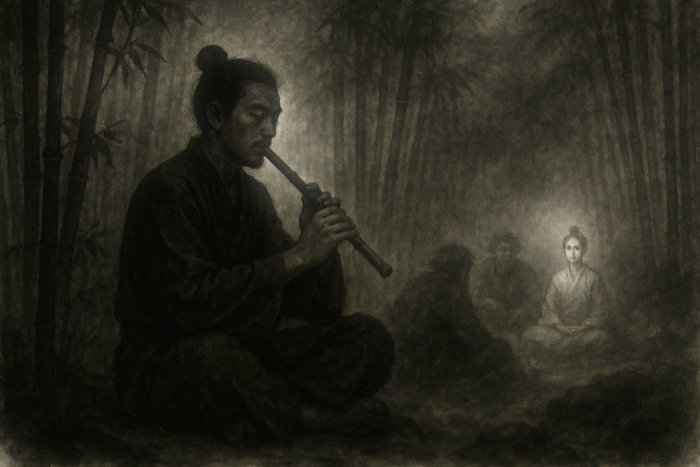
    Mow Fung playing his flute in the dark bamboo grove, with Pu-Erh and the poachers in the background

    Without effort, the young man lent the intrinsically dry exercise a style idiomatic to the flute, evoking in everyone present an impression of a lonely moon suspended in a frosty autumn night sky, though not one of them made mention of it.

    As he played, he reflected on dim memories of his infancy in the Forbidden City, and on the blurry period that followed, living their lives in hiding and reclusion among caves and forests, and in the infinite seclusion of the mountain. How the years had flown since they fled, when one looked back, while seeming, minute to minute, to progress in ordinary time – so that he, an apparent “youth” – had lived the span of perhaps two lifetimes for one of his corporeal age.

    “You might as well keep that thing,” Yongyan said. “None of us could get a note out of it.”

    “What was that you were saying about boils a while earlier?” Ugly Toad asked quietly. “I’ve been having trouble with these for years. Getting worse rather than better, I’m afraid.”

    “Those little blemishes?” Pu-erh said. “Why, you can hardly notice them. They’re really not worth bothering about too much, do you think?”

    He gave her a meek and appreciative grin. “I’ve tried all sorts of remedies from quacks all over the countryside, but they’ve only made things worse.”

    She took a dab of unguent from one of several minuscule clay pots stacked into her carry-sack and told him to apply it. Though scarcely more than a smear, it seemed to warm in his fingers and swell slightly as he rubbed it in – not diminishing, but softly renewing itself. After a long while, she told him to save what remained for daily use. There would always be enough, she said, so long as he didn’t try to measure it.

    “Feels better already,” Ugly Toad said to Wang the Eviscerator. “You should try it, you know, for your belly.”

    “Well, you do realize I was only kidding about cutting you up into bits…” Wang said to her through his toothless grin.

    “I knew your capabilities the moment we met,” she said, “and I was doubtful they include the eviscerating of unarmed victims. Unfortunately, the unguent is only a salve, a stop-gap measure. Cures for both your complaints will require substantial time and involved procedures. Take heed that if you leave your bear-wound as it is to heal, you will assuredly die. Moreover, if you lead your party to seek treasure on the upper mount as you implied was your plan, the three of you will surely perish all the sooner.”

    The following morning the five took the lower path, hiking along the ridge and descending into thick forest. They entered a narrow trail that soon forked into a dozen offshoots, each of which branched again and again into near-identical tracks, until they found themselves in a bewilderment of forks and false turnings. Only Pu-erh and Mow Fung seemed to know the way. At last, near midday, they emerged before a dilapidated temple, half-lost in the undergrowth.

    “Rest now,” said Pu-erh. “We will return before nightfall.”

    The temple and its crumbling attendant building sat on a ledge where the land dropped away into a mist-filled void. Behind it, cliffs fell sheer to silence, visited only by haughty eagles who wheeled and nested in the inaccessible crags.

    The three bandits felt a rush of exhilaration at the sight – a sensation unlike any they had ever known. They settled in to await the return of their two guides or perhaps some wandering monk. An overwhelming solemnity fell over them, as though from this high place one might commune with the Eight Immortals – whoever they were.

    “We were looking for a hideout, and we have found one,” said Wang.

    “Without knowing the way, no one could ever get in,” said Toad.

    The void was an immense auditorium of silence, from whose depths came the thin cry of a hawk.

    “… or out, for that matter, you might say,” said Yongyan.

    “You don’t think …”

    The three cast glances at each other, before settling down for a smoke.

    “How could you suggest such a thing?”


    From the draft novel Stawell Bardo © Michael Guest 2025

  • 5. Missing Persons (from the draft novel Stawell Bardo)

    5. Missing Persons (from the draft novel Stawell Bardo)

    Missing Persons

    “Here, have a go at this:

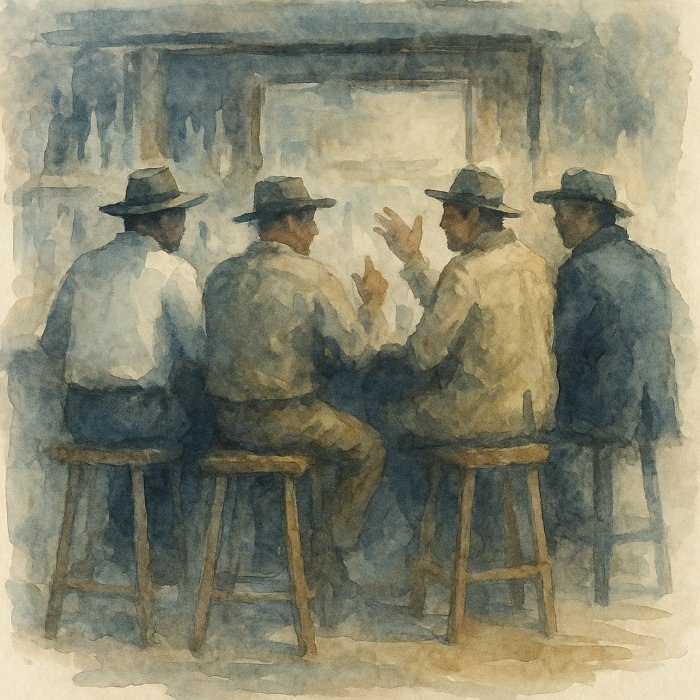
    A strange discovery was made yesterday by a miner named Wilson. While cutting props in the bush, about two miles from the Deep Lead, he found that he was at work beside the headless trunk of a human being. The remains were lying about ten feet from an abandoned shaft. The head was severed from the body, and although a careful search was made, it was nowhere to be found. The body had apparently been removed to its present spot within the last week, for there is a mark on the ground close to where the remains were. The body appeared to be that of a male, tall and slender. Not a vestige of clothing of any description was found on or near the remains.

    “Well, that is out of the ordinary, ain’t it, Wilson, what it says in this rag here?” Cleggett, the barroom wag, lowered the newspaper and gave Wilson a sidelong look over his glass.

    “Indeed, well it was exceeding strange,” Wilson said. “Eerie, horrible, and awful as well, I can assure ye. Not every day a cove turns around and cops an eyeful of sompthing like that, I mean to say, a naked corpse right there next to you where you’re workin’. Inches away. Cop that, mate! A nude, naked body of some bloke without no head and all – without a particle of clothing. Ants all over it. Crawling down his throat and everything. No private parts neither and all.”

    “Where was is clothes?” Nash muttered from along the bar.

    “No one knows for godsakes, shit! But you know, there wasn’t no stink of decomposing, having been there a while, and the skin was a kind of mystic golden colour, swear to Christ, like the Pharaoh, I reckon, like some mummy. Cor’blimey, fill this up for us, Ronald, wont’ya? I’m still a’shiverin’ and a’shakin’ from the shock. Shout me one? What about it? Calm me nerves. Who’s won the bloody cricket in Melbourne, anyhoo?”

    Cleggett set his glass down and snorted wearily.

    “No, I mean, strange you was working, like the paper says here. I ain’t never seen you doing no work never. Never heard of it neither. Yet here it is in black and white in the bloody paper. You working! How do they get them facts the sorts of which no-one’s never seen nor heard of before? Cutting props, you? God Almighty, what a farce. Love to witness that. That is an original story!”

    He paused for effect. “Oh, I see! No, the point of the story is, some bloke’s got himself murdered and ’ad his head cut ’orf and you found him.”

    A couple of grunts along the line.

    “Well anyway, who is he? Or if you like, who was he?”

    “They dunno who he was,” Wilson explained. “That’s the problem, like. How can they catch who done him in, if they don’t even know who he was, like? That’s just what I’m trying to tell the bloomin’ coppers. Detective didn’t even want to listen to me. Just kept telling me to shut up every time I opened me mouth. I was invited to the whatsit, of course – as what they call the discoverer of the cadaver. Bloody dead body layin’ there large as life. Shit. And I lost the day’s work of cuttin’ props and all.” He took a gulp of whiskey.

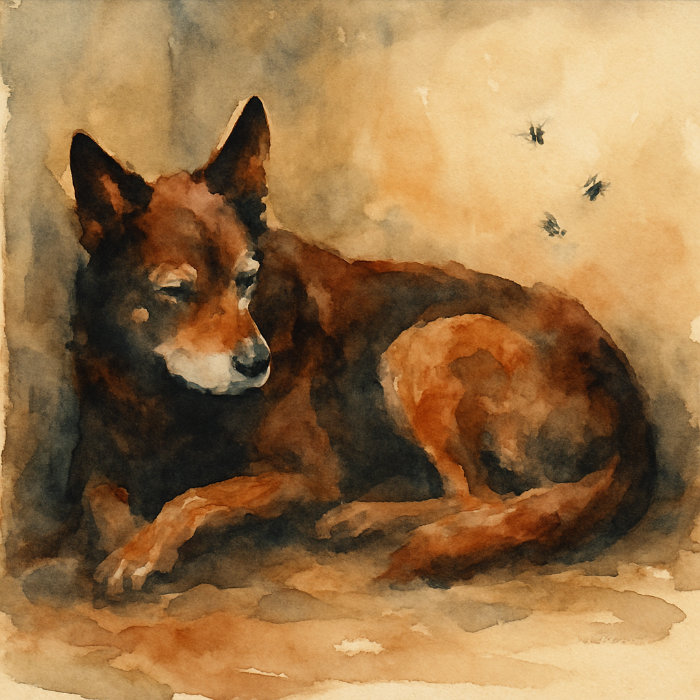
    “Oh yes, you and your props. Hi, get that dog out of ’ere!”

    “Oi, get that bloody dog out!”

    “Ah, he’s not doin’ no harm.”

    “Yeah, leave the poor bastard be.”

    “Ah, e’s bringin’ in the flies!”

    “No he ain’t. Look, he’s drawin’ ours over there into his corner! Look at that one, there you go.”

    “So he is, leave him then.”

    “Yeah, leave him be, he ain’t doin’ no harm nohow.”

    “Leave him be, you bastard!”

    The greying old red and tan kelpie settled in.

    “That is a problem, about the identity. But I overheard the coppers say some bloke was missing.”

    “Yeah, who?”

    “Bellman, I think I heard. Poor bastard. Wife and child, I think I heard. Maybe not, I dunno. She left him, I think maybe I heard.”

    “Good name,” Cleggett reflected.

    “Yeah, I know.”

    Never send to know for whom the bell tolls …” Cleggett drawled.

    “Yeah, I know.”

    It tolls for thee.”

    “Oh, for Chrissakes. Blimey, you don’t half bang on. Gad, what are they putting in this stuff?

    The mystery astonished and horrified the community, locally and across the country. At last the police had something to work upon in ferreting out what had seemed a hopeless mystery. Steadfastly, Detective Forster – dour, methodical, undistracted – set himself to the task of unravelling the details and run the murderer to ground.

    One Frank A. Bellman, a labourer, hadn’t been accounted for during the past month and seemed a likely candidate for the victim. The time frame was right, and his brother was concerned enough to notify the constabulary. Bellman was supposed to visit him at Warrnambool – but failed to show up.

    Forster was at his desk, some new leads having come in. He perused the recent details on Bellman, a page and a half. Hopefully, this was the man. Seemed a decent enough fellow, drank a bit, perhaps too much, but what was that? Didn’t gamble, hardly.

    Why was the head cut off? Obviously, to hide the identity of the deceased; so it was likely the perpetrator either had some connection to him or had been seen with him recently.

    Forster harked back to the inquiry at the pub at Deep Lead, and how the Celestial seemed to look not at the corpse, but somehow through it. That Mow Fung, weird character, Chinese or no. Forster could not get him out of his head. Perhaps call in on him in a couple of days, might know something he’s not saying.

    Frank A. Bellman.

    Frank a bellman?

    Rubbish.

    He was at his wits’ end, mind going around in circles, at the end of a track that petered out and turned into sand, just like his visit to the Junction Hotel and the crime scene. The crime scene a murderer’s paradise, if one had such an inclination. Footprints in the sand were erased in no time. Bottomless mining holes everywhere for miles around, one right near the body. Take the head and clothes, and you are away Scot free.

    Bellman was a good chance, so Forster mounted up and set off to do the rounds of Bellman’s known haunts. He rode out to Bellman’s shanty, where he found a dead dog, and a half-mad horse, and spent a while getting water into it and shifting it into the shade.

    “I’ll send someone in a little bit, you blokes, you keep tight, won’t be long.”

    He rode out through the front barbed-wire gate and dismounted to hook it up again. Clear as day, the Junction publican came to mind again. That inscrutable look still gave you the shivers somehow. He mounted, wheeled about, feeling an impulse to return to the shack.

    A shed fifty yards off stood steaming in the midday sun, so he went over. Behind the shed, a foal lay panting. He coaxed it into the shade, then went to fetch some water from Bellman’s muddy dam. When he poured it gently over the foal’s neck, the animal blinked, snorted, and took a drink. It would live.

    He paused at the gate, took a long breath, and rode to the barracks.

    Mounted-Constable Hadfield was there, chatting with a civilian. They stopped and looked up when Forster came in.

    “This is Mister Bell,” Hadfield said.

    “Bellman?”

    “Just Bell, Detective Sergeant. He’s a woodcarter, lives here in Stawell.”

    A bleached, weathered scrap of clothing lay on the desk: the torn-off half-portion of a waistcoat, violently ripped from the rest, buttons missing and lining torn askew.

    “What’s this?”

    “Mister Bell found these items in the bush, sir, a bit of a way from Deep Lead towards here, and he brought them in for us.”

    Forster checked himself – he’d been too brusque. “That’s very kind of you, sir. Do you mind telling me what took you out that way?”

    “Following my occupation. Gathering and carting wood. Sometimes I carts it, sometimes gathers, most often usually both.”

    “Might you be available to show us the spot, post haste?”

    Bell had found the waistcoat on his way to a place called the Four Posts, about eighty yards from the Old Glenorchy Road. The three fossicked through the immediate area, moving as systematically as they could outward from the spot, which Bell had thoughtfully marked with a cross of four rocks. After about an hour, Forster dispatched Bell to fetch Constable Hillard for another set of legs and eyes.

    Alone now, taking a mental break, he wandered down to a dry creek bed, fringed with scrub and tall kangaroo grass.

    A  lone bird call rang out – Four gallons of water! – and he stopped, turning towards the sound. To his left, where the call had come from, something caught his eye: a small heap half-hidden in the grass. He’d almost missed it, for the cloth had taken on a yellowish-green tinge from long exposure, nearly the same as the tussocks around it. He might have passed and re-passed forever without discovering it, but for that bird. Feathered bloody oracle.

    Three buckets of water! Fainter, receding, gone. Magnifying the heavy, empty expanse. What turns up when you are not looking.

    The coat was blood-stained, especially about the neck. One button remained on the waistcoat, the only one to withstand the violent strain by which the garment had been yanked open. It matched one found under the body. On the shirt, too, were the gaps where two buttons, also recovered under the remains, had been torn free. There could be no doubt that the clothes were those worn by the murdered man. He drew from the tangle of cloth a third of a wideawake felt hat, the rest having been cut away. A few hairs clung to the remaining rim, the same colour as those found at the base of the dead man’s neck. They were stuck to the felt by blood. The trousers were missing, and so was the dead man’s head.

    “Wideawake,” he couldn’t help saying softly aloud, as he made his notes, “no nap.”

    He’d organise another sweep in a week or so, but for now there were other fires to tend.

    Bellman’s mother had been summoned over from Horsham to examine the remains, which she was sure as sure could be were her son’s:

    “It can’t be he, oh it can’t be he! But I fear it is. I’m certain it is! His hair’s turned a little more to the reddish hue, that’s all, workin’ out here like a navvy! What a bonnie bairn he was, the wee rascal! That mole on his shoulder is sure his. Oh, he was a fine laddie, with all of his future in front of him. But will you look at him, look at his skin. It’s … radiant, the peak of health! Bless the daft lad – he couldn’t scrub up like that when he was living. Ach, ma heid’s mince!”

    Hillard fetched her again from the Commercial Hotel in Stawell, where she was being put up, having imperfect relations with her other son. This time, it was not the body she was brought in to identify, but the items of clothing recovered from the bush.

     “He was a dear laddie,” she said quavering, placing her frail hand on the waistcoat. “Och, to think this was the last thing he wore, it sends me heart racin’. Well, whit’s fur ye’ll no go by ye!” Overcome, she paled and drew the back of her hand up to her brow. Forster pulled a chair over and lowered her into it.

    There came a knock at the door, and a constable poked his head in. “There’s a bloke out here to see you, Detective.”

    “Not now.”

    “It seems important.”

    “I said not now.” The door closed.

    Mrs Bellman began to sob. The door opened again; the same constable gestured to Hillard, who looked at Forster.

    “For goodness sake, go and see what he wants.”

    The woman sobbed convulsively. Forster laid a hand lightly on her shoulder. The door opened and Hadfield came in quietly followed by a man.

    “You alright, Ma?”

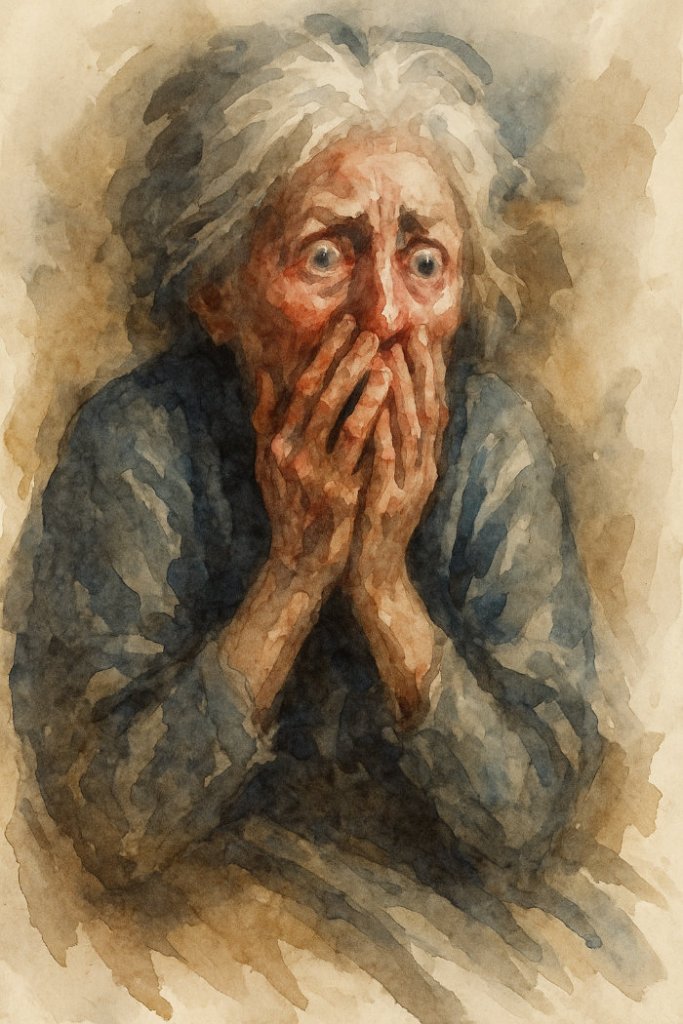
    “In the name o’ the wee man, this isnae real!” Mrs Bellman turned white as a sheet, rose shaking – “Ye’re meant to be deid!” – and abruptly dropped to the floor.

    Thus the Bellman mystery – if one can call it that – was solved. Instead of going to Warrnambool as planned, he had detoured over into New South Wales and returned the next Saturday. He’d left the animals with feed enough for a few days, thinking he’d be home on Sunday. But his horse threw a shoe past Moama and went lame, and the smith wouldn’t see him till Friday, he had to lay up at some wayside inn, only the publican’s daughter had the measles, and he ended up minding the place while the missus boiled onions. At any rate: no foul play, no mystery. Just an irritatingly loquacious fellow, who couldn’t be bothered sending a wire.

    The case of a carrier named Flannigan, though not dissimilar, was in some respects more of a nuisance. His circumstances made it likely that the remains found near Deep Lead might be his. Detective Forster left Stawell by the first train Monday morning to conduct some interviews. On Tuesday, he struck out for Woodend and went some distance into Bullarook Forest, before doubling back to Seymour. He set the telegraph wires to work, then back to Ballarat, chasing a clue. By wire, he learned that Flannigan was alive and well in Deniliquin.

    The circumstances surrounding the disappearance of all persons reported missing from the district had now been accounted for. The discovery of the clothing further assisted in establishing the identity of the murdered man and was expected to furnish evidence leading to the apprehension of the perpetrator. Another step had been taken in the matter, and it was to be hoped that justice, having misplaced its head, would soon find its footing.


    Michael Guest © 2025

    Images generated by AI

  • 4. Death Rites (from the draft novel Stawell Bardo)

    4. Death Rites (from the draft novel Stawell Bardo)

    Death Rites

    I am not the least bit afraid of you hungry ghosts, Mow Fung says silently. Not because he doubts your existence, but because he has lived too long to deny it. Still, he will not let you see his fear. A part of him is always apprehensive, and it would be foolish not to be.

    In the centre of the back room, the headless body is suspended in light as though in thin air. In the middle of all things, since everything else floats around it, cast into the eternal dimensions. He contemplates the multidimensionality of this container, of the person who once inhabited it, now perhaps having almost arrived at the infinite end of the loop, the point of closure – and escape – of a human entity.

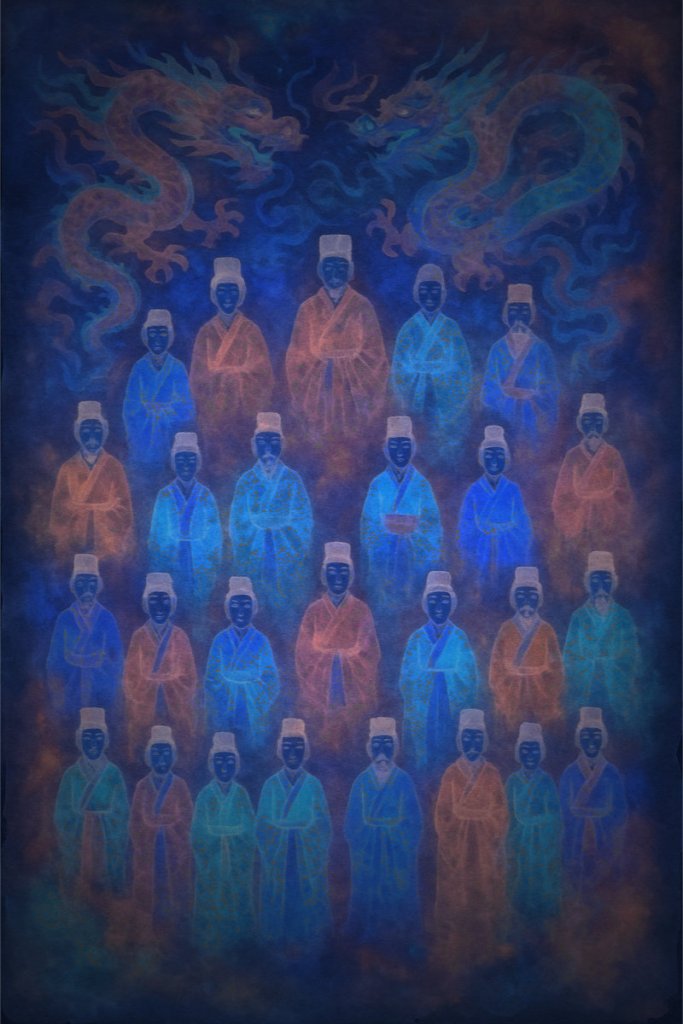
    Mow Fung sits on a wooden stool, and images of the ancestors appear to his mind’s eye. Not a grandiose company by worldly standards, not a lineage of Mandarins thirty generations deep. No, some were threadbare hermits, others alchemists in the courts of emperors. Many kept faith with the Tao; others faltered along the way, as he has. Yet all are recorded, nonetheless, in the long cosmic family archive, robed in deep blue, crimson, and jade, and encircled by golden dragons, as befits their rank in the Immortal Registers.

    The body is laid out on its back before him, upon a makeshift slab of two small tables joined and draped with a blanket. Only the remains are visible, in a sphere of candlelight. A single flame burns steadily, flickering now and again from some subtle cause, some nearby disturbance. Similarly, the ribbon of smoke from the cheap incense burner placed by the dead man’s shoulder curls and falters, though not a breath of air stirs. Spirits? A lost soul? This man died a brutal death, of a kind that lingers, and draws misery in its wake. The kind of death that attracts attention from dangerous quarters. Yet rites must still be done – from human kindness, and something higher than that. There are dangers, and it has been a long time. But the dead deserve their due.

    He sprinkles more incense onto the embers in the burner: dragon’s blood resin, frankincense, myrrh, and sea salt – the mixture taught to him long ago. The smoke rises in slow spirals, vanishing into the rafters. A garden lizard clings to the wall above the window, still as an ancient glyph.

    Mow Fung settles into meditation, imprinting the vision of the corpse onto his psyche. Ghosts may bother him tonight. But he will sit, focus his mind, and dream a little.

    For the time being, sit here and meditate on this strange and radiant being.

    Hungry ghosts may try to devour or deceive the spirit who recently inhabited this shell, may try to beguile him into straying from the true path. So Mow Fung will remain. Perhaps he may be of help to the passing spirit, which surely lingers still.

    But I am not afraid of you ghosts and phantoms and all the rest of you, though you may manifest yourselves in the hollows of my psyche and the ancient gateways at the base of my spine.

    He will lend the strength of his will and the benevolence of his heart.

    Why radiant? What may it be that it radiates? Luminous only in his own mind’s eye? He lets the thought drift past. Inwardly he perceives it again, a pale gleam, the colour of the Golden Pill and Golden Elixir of immortality, the vapour of the Tao inside the body, giving rise to the three flowers that gather at the top of the head. In the eye of ritual he was still recently dead, the spirit hovering close. But the husk declared otherwise, bearing the marks of the sun and the slow desiccation of time.

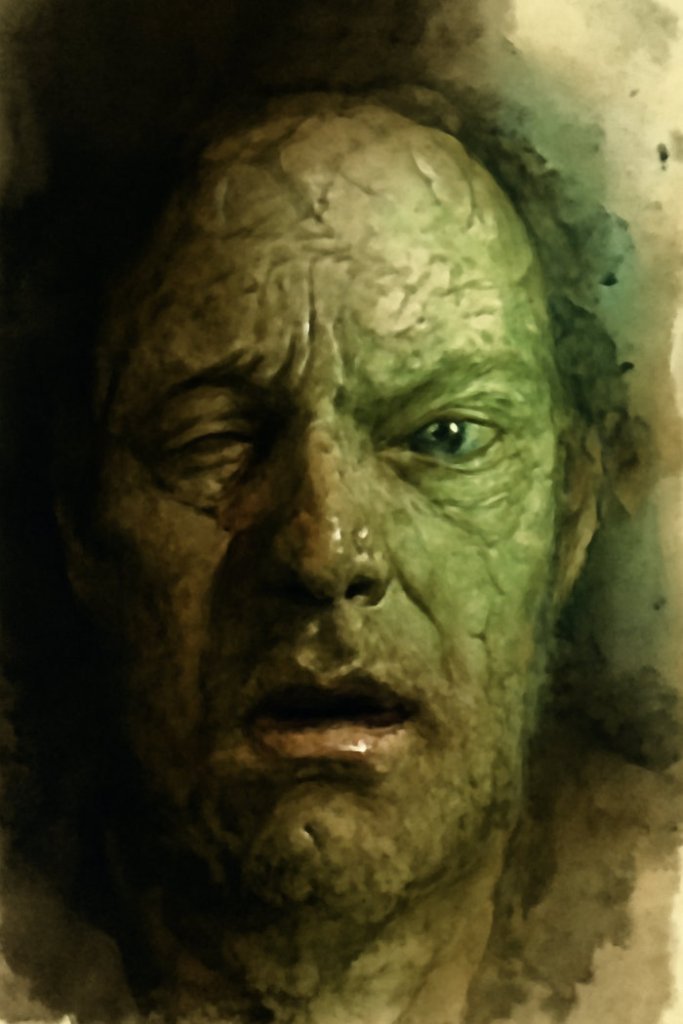
    The skin is dried and darkened to a leathery orange-brown hue, like the crust of old lacquer or parchment scorched by the sun, as though an ancient inscription had blistered and peeled from the body. He lay outdoors under the summer sun for a month to become mummified like this. Mow Fung sniffs the air. Little smell, because the flesh has dried; only a faint foulness lingers. Something has taken the generative parts. By tooth, by hand, by force of hunger or madness, there is no saying. A void where the gate of life once stood, robbed of return. The generative parts: root of essence, seed of Jing. The gate of life torn away.Without the root, the essence scatters. Jing lost, Shen adrift. A cosmological wound, rending the dead man’s passage and the karma of the living he leaves behind. Even ghosts may not find their way back to where they belong.

    Around the throat, where once rough red bristles clung, now sun-softened, the remnants of a full beard spread in a matted trail down the chest. Hair grows no further after death; this is his last signature, fading. He leans closer. At the neck: clean, decisive cuts, consistent with a heavy axe. Not just to kill (the killing blow struck the now missing head, no doubt) but to erase. To unname.

    Mow Fung stands and moves slowly around the body, passing his hands above it, sensing more than examining as such. The limbs are intact, no bones broken. The calves and thighs hollowed. Scavenged, gnawed out. In the chest, dried flecks of blood cling like pigment; where faint scratches or fragments remain embedded in the skin, their pattern uncertain, whether accidental or intentional. The ribs are bared in patches, the abdomen leached of flesh.

    There were dried-out bodies fallen by the wayside on the hot trek from the South Australian coast to the Victorian goldfields. His countrymen, whom he and his comrades would bury with some rites to speed them along their way to the afterlife.

    He had seen worse.

    One day, long ago in Canton, his feet took him along a meandering route through the city and into an alleyway, where Manchu soldiers were in the process of butchering a throng of hapless supporters of the Taiping Heavenly Kingdom of Great Peace. Already the place stank of the blood of hundreds, so many that their heads would not all fit into the chests that were to be sent to the governor general. So many heads that, after a while, many were emptied out of the chests and only the ears packed.

    One instant strikes him from the past, clear and lucid as starlight. Two Manchu soldiers bound one of the captives hand and foot and clubbed him so that he fell to his knees. One soldier grabbed hold of the pigtail and the other prepared to chop off his head. Unlike his terrified comrades, the doomed man maintained a calm demeanor. Seconds before the sword fell, he selected Mow Fung from the group of peasants, among whom he had concealed himself, and fixed him in an unearthly, unwavering gaze. It was clear to Mow Fung even then: he had been led to that place to witness this specific moment of death, for his own benefit. Such a pure death signified an enlightened life.

    Huish-Huish enters carrying a tray with tea and fruit, as though for a guest. Mow Fung sits, eyes closed, head bowed, his back showing the weight of his years. He remains absorbed in contemplation. Motionless, like a mountain, the mind rests in its place.

    “This man is calling out for help,” he says calmly, his eyes still closed. “He is stuck here in the world of the living, still clinging to his physical vessel. But there is something else, something malevolent, reaching from the far past, and out into the future, through this room, at this hour, sucking in all of us. Traces linger here, signs I was meant to see. But to read them, I must first root them in existence. And to do that, I must turn inward, though I have strayed from the path before.”

    He makes the arcane hand seal of the Patriarch of Ten Thousand Arts, upon whose benevolence his fate will depend. He doesn’t mind that Huish-Huish sees the forbidden sign.

    “Do you mean, similar omens to the ones that came to you in Canton in those lost days, those woeful days far behind you now? Do you happen to recall the ravages of the poppy?”

    “Perhaps. There were pleasant times too, you know. Neither matters anymore. But someone has arrived in our hotel needing shelter and a guide. How can we refuse him?”

    “Neither matters, according to your beliefs, so do what you feel you must,” she says. “I suppose you will anyway.”

    She smiles faintly, turns, and starts to leave the room. Then she looks back.

    “Of course,” she says, “you told me you’d fled those times forever. But you know you cannot fly from the path, since the further you fly, the closer you remain.”

    “Poppycock.”

    Suddenly the incense splutters and the fragrant smoke erupts.

    “There are some bad ghosts here now,” he says. “You had better go.” Not entirely sure they are here yet, but she is annoying him with her womanly contrariness, her profound oppositeness.

    “Well, don’t worry them,” Huish-Huish says, turning again to go. She is less afraid of ghosts than he, having had less experience. “Don’t surprise them. Don’t scare them too much.”

    But there is no surprising some of them, those whom he senses looking on from far in the future, where they have access from their lairs in eternity. Will he have descendants way down the track to help him out if needs be? To combat those vultures who lie in wait to tear out his soul?

    He recreates a temporary altar from mystical objects encountered and secreted here and there. With the Sword-Fingers Hand Seal of the right hand, he traces the character Chi or Imperial Order in the air, thereby infusing himself with celestial fire. Appealing to the Patriarch, the deity Wan Fa Zu Shi, he prepares for the journey: painting talismans on his clothes and body for protection, setting upon the altar a peach-wood sword inscribed with celestial characters, and spirit-money, paper painted with black and silver symbols, for burning. How else shall the poor fellow pay his way in the underworld?

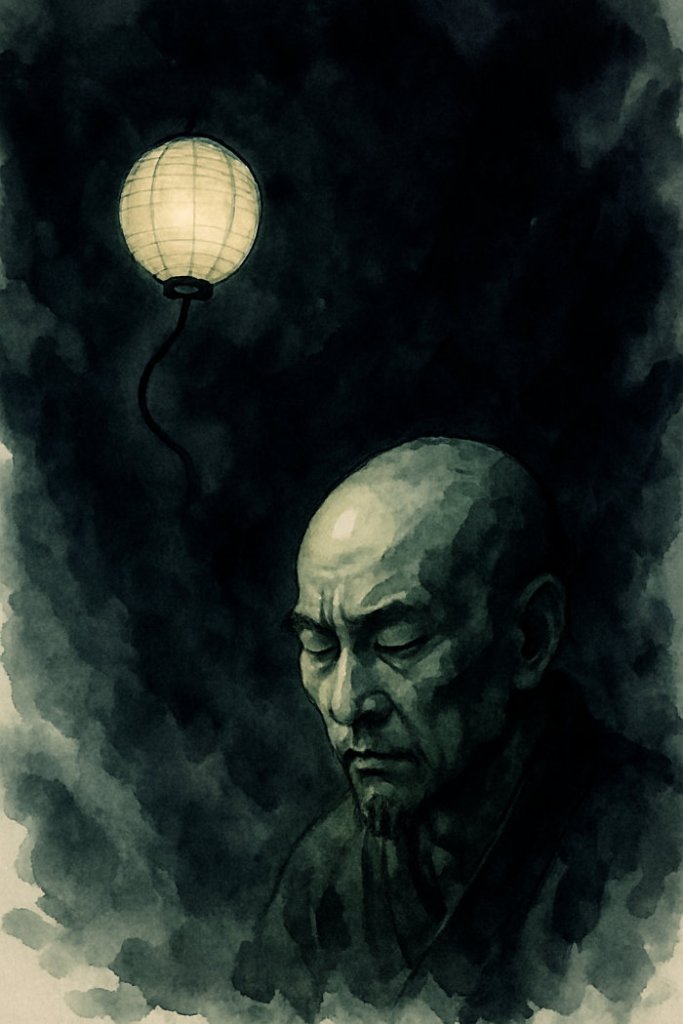
    To locate the lost soul, he inflates a consecrated paper lantern with heated air from the candle and releases it through the window, so that it drifts away into the dark. He makes the Five Thunders gesture to resist the threat he smells, from a foul presence, faint but rising. For the rest of the night, he casts spells using the symbols and talismans he has kept hidden away since … he almost forgets when. He sprinkles incense prepared from golden wattle: its essence extracted, purified, concentrated.

    He had made the incense himself, as always. The ingredients were chosen for their essences – dragon’s blood, frankincense, powdered bark of the Raspberry Jam Wattle, fragrant and subtly luminous, said to open the inner senses – dried, ground, and purified over slow charcoal in a clay cauldron, with breath and invocation. He had traced the talismanic characters in the air above the bowl: Qi, An, Ling. Then exhaled gently three times to bind them with his own spirit. The resulting powder, dark and fine, was wrapped in yellow silk and set aside to cure in the hush of moonlight. A humble alchemy, but his own.

    The ancients taught that to arrive at one’s essence, both substance and self must pass through furnace and cauldron — sacred tools of Taoist transformation, forged in both body and mind. Vessels to burn away acquired dross and reveal the hidden nature beneath.

     The incantations first trickle into memory, then the flood begins and he sinks inward, drawn down toward the realm of death. Deeper and deeper.

    For some reason this beheaded man made his way here to the Junction Hotel and set Mow Fung’s psyche in turmoil. The story of Peng Yue has haunted him from childhood.

    Once a fisherman, Peng Yue became a great general and conquered twenty cities. But the treacherous Empress Lu Zhi betrayed him, and he was beheaded. She had his body minced and salted and fed to the aristocrats who supported him. “I grant you a rare treat …”

    Now Mow Fung gazes down from the ceiling upon the headless man on the table. Palms turned down, arms spread at a forty-five degree angle – appearing relaxed, paradoxically, in their state of rigor mortis – legs extended.

    He focuses on the trunk and the space where the head once was but is no longer – a void that seems to open outward into infinite time. Even the dead man’s arms express that thought somehow, in their pathetic, unconscious gesture of resignation. He passes through the clogged throat and into the cavern of the lungs; silent chambers sealed by death, yet faintly trembling with memory.

    In his meditations, in the stillness of his body, he casts his spells, intones his incantations. No one to hear now but the spirits and ghosts.

    Even if I try to move my hand, I cannot, because I feel the pressure of time forcing me back into the reality of this place into which I was born. It is as though an inch of space through which he might move his hand is the same as the whole extent of the universe. So he cannot even lift a finger.

    But he enters a trance and moves outward in his spirit body, so that he can follow the lantern, which will lead him to the boundary realm. A dry creek with scrub that Mow Fung does not recognise. The dead man’s ghost appears in the periphery of his vision.

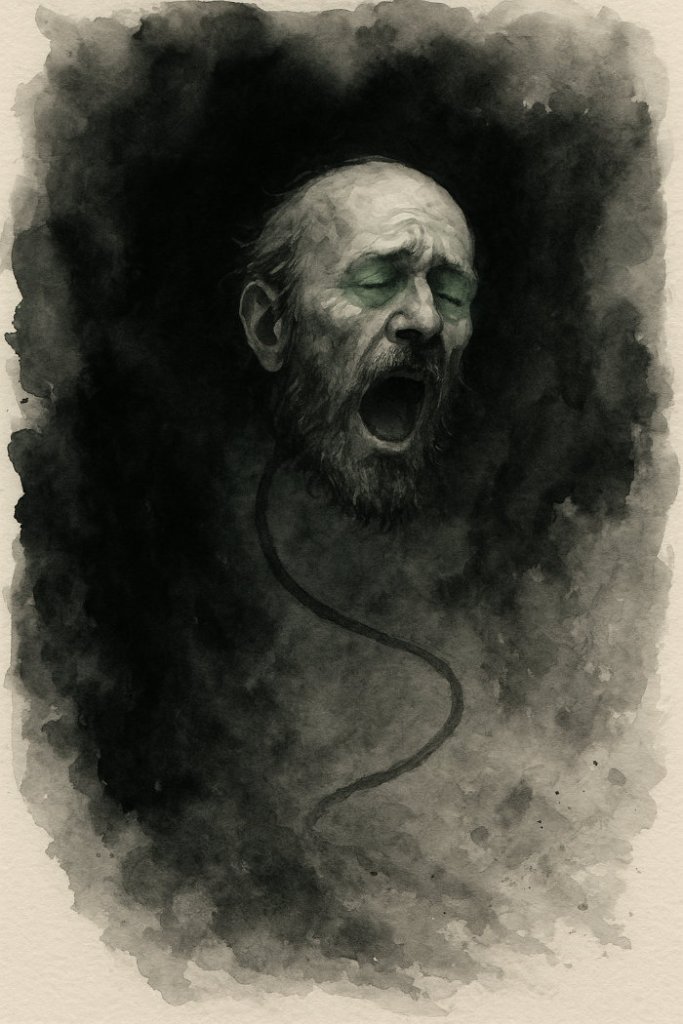
    There is the head, but floating, attached by a long cord, moaning inconsolably.

    Mow Fung wills him to come along, and so they progress, side by side towards the boundary zone, inhabited by the shadow beings and spirit-shells who prey on the newly dead. The deceased has forty-nine days to get through here, lest he himself become one of the wandering dead, to prey on others.

    Along a shimmering trail in a space of blackness beneath two purple moons, they approach the local guardian spirit. Serpents writhe about the three of them in the red dust of the outer limits, while the dark-skinned entity regards the other two askance.

    “So you’re that poor fellow with a good mate,” the guardian says to the precarious soul. “I seen what happened, don’t worry. And you, who do you think you are, yella-fella?” looking at Mow Fung. Ink-black skin, white pigment daubed roughly on the face and in lines and patches across his naked body. His eyes strike the alert look of a kangaroo, nostrils flaring.

    “You dunno him, wadda you care what appens to im?”

    “I have come down here with this bloke,” Mow Fung says, “this white fella, because he came to my place, the Junction Hotel, Deep Lead, dead and beheaded.”

    “Irish or Scottish or something. Well, I don’t care who he is,” the local guardian says. “He is where he belongs, under the dirt here. But you, you don’t belong here. You a yella man, a Chinee. You alive still, you can’t fool me, you know!”

    He cackles as if finding the situation hilarious. The laughter of spirits is never glib; it is the echo of doors closing – or opening where they should not.

    The laugh ceases abruptly, and the guardian’s visage turns to stone.

    “You smoked that stuff, them poppies. We don’t want any of them poisons here, so you begone with you!”

    “He visited my hotel before we came down here. He may be a sign of worse to come.”

    “Good point, maybe. Ha ha! You been here before too, you Chinese man of the dead. We remember you, don’t worry. Only you and that other Chinee.” He raises his arm horizontally to the right and points, without looking. ”You go that way, east, and maybe you’ll find yourself in the west after all. Maybe in the Teahouse of Awakening, where you mobs sometimes meet – if ya lucky, if ya lucky!”

    “We don’t want to loiter around here too long, anyway,” Mow Fung says sideways to his companion.

    The red-bearded head was making its way back to its place by degrees onto the broad shoulders, condensing midway into the visual field. Disconcerting. Fortunately, Mow Fung had developed his ghost-seeing eyes years before and, invoking the Ghost Eye Hand Seal, was able to discern some dim contours through ripples in the ether. The spirit’s head had descended and he stood there mute, the head bowed, the red hair falling forward to cover the face.

    The two of them set off in the direction the guardian had pointed. Mow Fung looked back once and saw a rainbow fading against the black sky.

    There are colours that infuse the beginning of things.

    There echoed a beating of wings, vast and powerful, as if from a primeval bird.

    The entity was gone.

    “I don’t know much about these local ancestor beings,” Mow Fung said, “except they are powerful spirits from what they call their Dreamtime. He has allowed us right of way, so if things work out, we might be able to get you through the border zone, out to the other side.”

    They reached a fork in the track, marked by a ruined tree. “We’ll go this way.” Taking the path to the left.

    The left-hand way follows the yielding earth; the right-hand way, the open sky.

    They descended a ridge onto a plain of white ash, streaked with tar pits. Bodies writhed in the viscous black, their groans rising on the hot wind to greet the two arrivals.


    Michael Guest © 2025

    Images generated by AI

  • 3. Glenorchy Royal (from the draft novel Stawell Bardo)

    3. Glenorchy Royal (from the draft novel Stawell Bardo)

    Glenorchy Royal

    Let us regress a few weeks, before the scene at the homely Junction Hotel. Before the discovery of the headless body. Before any names were written down, even in a dog-eared notebook. The world barely notices such half-invisible men until a cause arises to record them – for all their swagger. This was before all that, when they strode unhindered and unsought. Dust clung to them, and their deeds had not yet congealed into fates. Glenorchy manifested itself lazily as they approached: a post fence, a dozing kelpie mix, the tin flash of a roof. The Royal Hotel waited in the heat, half-slumped, only half-aware.

    “This is a hellish, God-awful, melancholy town. The miserable bloody air here alone is enough to make a cove want to get rotten,” Burns said, dispensing with his hat and scratching his head. Truth was, he was feeling tolerably well, buoyed by the promise a day held that commenced with a bout in the Glenorchy Royal Hotel, renowned as it was in the district for its unadulterated grog. No fig tobacco in the brandy casks here, cobber. And the publican’s daughters are good sorts, too – said to cut out a stubborn bullock as good as any plains stockman. The publican knows everything about anything, by all accounts, including, perhaps, the lay of the land. But it turns out he ain’t here. Joseph Jenkins, the self-styled “part proprietor,” has charge of the place today and is big-noting himself on the strength of it.

    A hollow masculine chorus echoed in the bar – voices of shearers, farmhands, bullock-drivers – out of which one solo strain or another might ascend now and then, distinct enough to catch scraps of individual wisdom: the blowflies, the heat, a dog’s virtues, or a horse’s ailment. The most vocal, a couple of ancient farmers at a table by the front window, were bemoaning rabbits.

    “Official work to do, Scotty,” Burns said. “No good to be drunk as fiddler’s bitches.”

    “Why bullock our guts out? Like my old man used to say, never put off till tomorrow what you can do the day after. A spell of easy drinking will give us zest for the task. Don’t take much, anyway, to find out where the lots are, chuck up a couple of pegs and notices.”

    “Back here by late afternoon for cards and hot whisky anyway.”

    “You’ve already got a good start on it, mate.”

    But Burns called the barman over and ordered four tots of rum for a heart-starter.

    “Me and me mate’s got a thirst on after a’rambling place to place for work, which we’ve been doing in the hearty manly fashion, in the spirit of comradeship that is the pride of the Australian bush,” he said – in a forced jocular, theatrical tone that, boorish as it proved generally to most audiences subjected to it, he knew would draw a guileless grin from Forbes.

    “Soon to be landowners,” Forbes said. “Proper cockies, us!”

    Burns inquired of the barman:

    “Would you mind fetching us some of the more recent volumes of your collected publications, my good fellow – any sorts of broadsheets, gazettes, whatever journals have informed and entertained your distinguished clientele.”

    Then turning to his companion:

    “Must keep track of world affairs, when you’ve got your head in a hole in the ground half the time, old man. See how the Australian Eleven are going over in the old Britannia, and so on and so forth.”

    “Oh yes, God almighty!” Forbes let go a cracking belch that silenced the bar for a moment, and the two roared madly, Burns holding his stomach and shaking his head.

    When the barman returned with their nobblers of rum and some newspapers, Burns raised a hand as if to prevent Forbes from paying and produced two shillings from his money purse. “It’s what a bloke does for a good cobber, who’s a half decent sort,” he said.

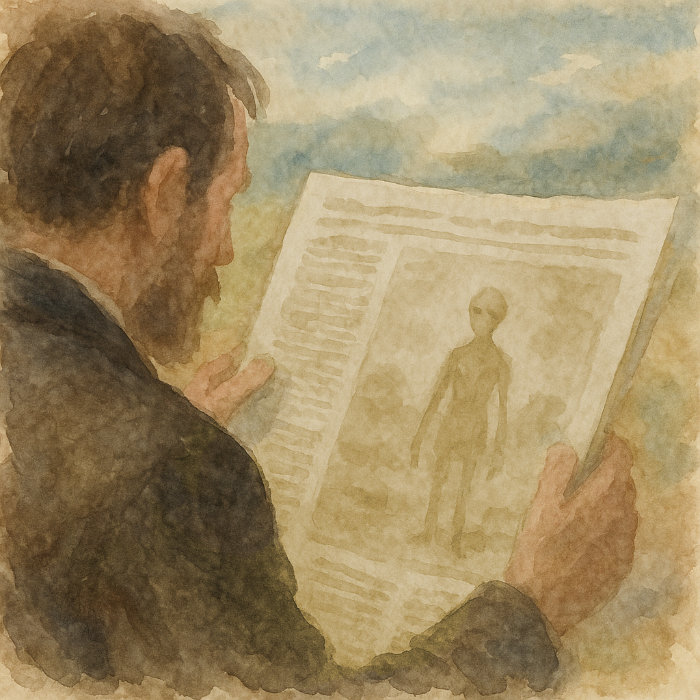
    Forbes threw his head back from his paper, then tapped it three times with his index finger to mark the rhythm of his utterance, as if to emphasise its gravity.

    “I bloody well knew it! People on Mars are no bloody different from us here on Earth.”

    “What is that nonsense?” Burns said, glancing up from a cricket report.

    “Not nonsense, mate, The Australian Town and Country Journal, scientific notes. It’s not as bright as it is down here, but their eyes are more sensitive, so they can see just as good. The polar snows extend further, so it’s colder, you know, naturally, but by no means less in proportion to the lessened power of the solar rays – so, anyway, make of that what you like.”

    “Fuck me dead,” Burns said.

    “This Professor Lockyer – or some what’s-his-name or other – has discovered several remarkable seas in the southern hemisphere, including inland seas, some of them connected and some not connected with the larger seas by straits. One of their seas looks exactly like the Baltic, and there’s an equatorial sea, a long straggling arm, twisting almost in the shape of an S laid on its back, from east to west, at least 1000 miles in length, and 100 miles in breadth.

    Forbes shook his head slowly and mused through the window towards outer space.

    “Let’s have another rum. That reminds me, we need some S-hooks from the blacksmith’s, for sinking them dams in Dunkeld.”

    When the barman served them, Burns was again magnanimous in paying.

    “Why do you say that every time?” Forbes said.

    “What?”

    “All that deal about paying for your mates. I’d take my turn just as quick, except you’re holding all my dough.”

    “What?”

    “Nothing.”

    “And why would that be, do you reckon?”

    “What?”

    “Why am I holding your dough for you, do you reckon?”

    “So as I won’t chuck it away on cards?”

    “Or pour it down your gullet, right? Look here, if you want to hold it yourself, you’ve only got to say so.”

    “Ar, it’s alright, you go on holding it.”

    “No, no, here you go, have it bloody back, because I know what’s going to happen.”

    “No, it’s alright mate, you hold it. You hold onto it for me.”

    “No,” Burns said, raising his voice as he bent down to undo his swag, lying on the floor by his boots. “If that’s how you feel about it, you take it, and we’ll wait and see what happens.”

    He fussed around, unable to lay his hand on the stash immediately, testily disembowelling the swag. The bar now quiet, furtive eyeballs over nobblers of whisky hot. Strange ones.

    “Don’t worry about it, Bobbie” – Forbes pleading – “I’m sorry. You look after it for me, please mate.”

    Burns’ back and shoulders slumped as he sighed, tut-tutted, shook his head, sat up, leaned back.

    Pause.

    “Ah, Scotty, what are we going to do with you, son? I know you’re a good’un right and proper, but god you make it hard to look after you sometimes.”

    Weary head shake.

    “Sorry mate, sorry.” Forbes placed his hand on the back of his mate’s wrist, and the two men looked each other in the face. His eyes watered, a teardrop forming at each inner corner. Conscious of it enough not to sniff, he looked into Burns. A kind man, tough but kind, good to me. His eyes, well, there was a trace of softness to them. Like his beard, bushy but soft. Burns could see right into him, too; he could see that much. They had shared tender times together, which was not the usual lot of those thrust together in railway camps. Forbes sought a salve of kindness in his eyes, the closest thing he had known to affection for a long time – who knows? – for his whole life long.

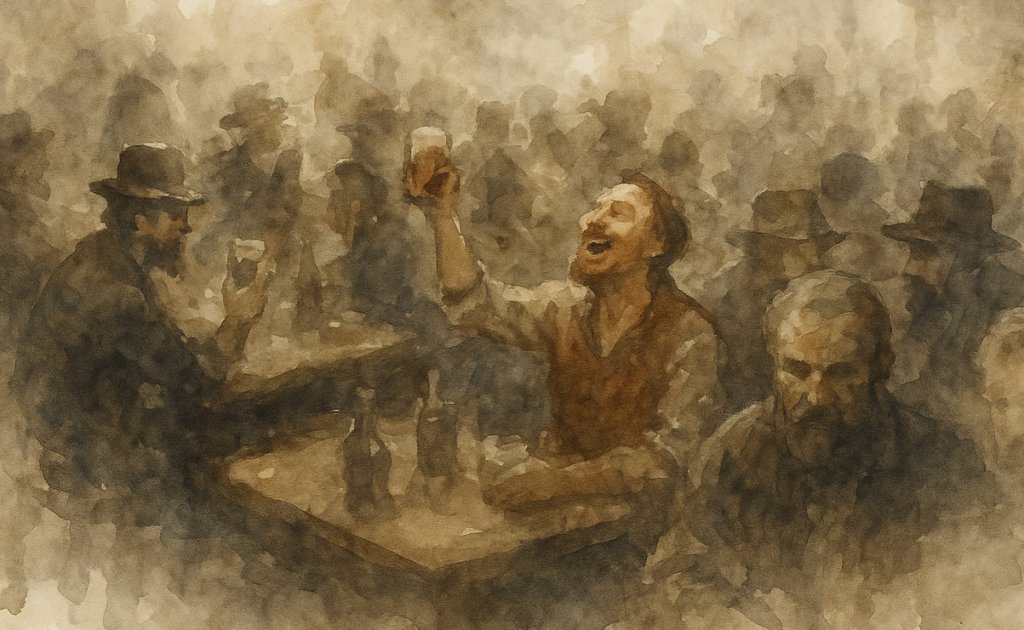
    Day moves along, and the rambunctious hour draws near. Patrons who’d started at half past ten in the morning are caught up by tardier arrivals, spurring themselves on to comparable states of elation.

    At some point, a mob of navvies crowd round the old farmers and begin to ply them with whisky for sport. Taking a barrel or chair for a seat, the hands share the one table, while one or two stand leaning against the wall engaged in their own conversations.

    “Bloomin’ city so-called ‘sport shooters’ brung ’em over from the Old Country, and the sparrows and deers and all. Said in the paper, if we got rid of the vermin, they’d get even more. Bloody Wild Rabbit Propagation Committee, would you believe?”

    “Don’t tell me!” yells a hand, hawks and hacks in his pocket-rag out of politeness.

    “I’m telling you, my son,” says the old red-haired feller, “It’s bad enough now with the rabbits, but in the sixties, them damn vermin was so many, you’d go to pull out spuds and find they was rabbit nuts instead!”

    “You don’t say!”

    Hoots and hollers. “What’d you do with the rabbit, mate?”

    “Well, you threw it out and chucked the balls in the broth for veggies. No one was in the mood for rabbits no more, in no shape or form, I’ll tell yer that much.”

    “Didn’t the government do nothin’ about it?”

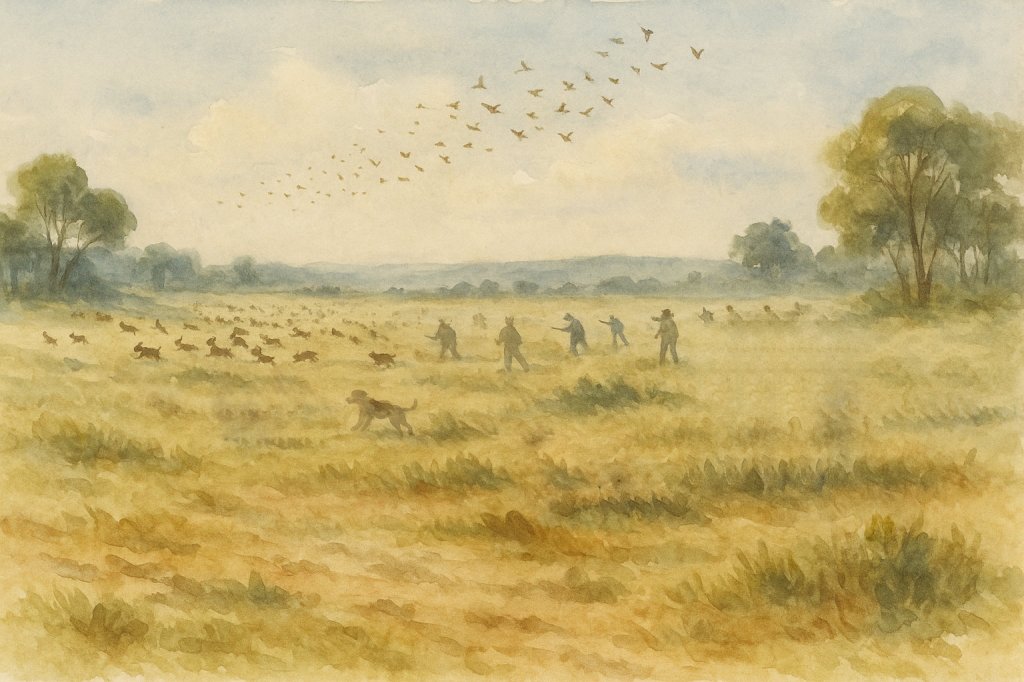
    “I tell you what,” says old red-headed bloke’s mate. “I’ll tell you right now all what the guvment’s good for. Bloody nothing. A year ago they come up here, these blokes, an army of them got sent by the guv’ment. Half a dozen Melbourne loafers and twenty-eight mongrel dogs! They went into a district so thick with pests that hundreds of men, women, and children had worked day and night for months with dogs, guns, and traps – and still made no impression. So we laughed our guts out at these poor bastards running around with their dogs. Not worth a tinker’s dam, them blokes. And sure enough, the dogs tired of huntin’ rabbits and thought they’d prefer worrying the sheep, and the local inspector took out a writ against these bastards for having unregistered dogs!”

    A gust of laughter rips through the heat – “God Almighty!” – “Don’t tell me!” – “You’re havin’ us on, y’old bugger!” – “Bloody hell, so who was the vermin after all, eh?!”

    Misshapen dwarfish gargoyle Poor Joe the Ostler is all unbridled mirth.  Lets loose an ear-splitting hoot, perching upon his stool. Leaning next to him, kindly Tom Piper, who was once a prize-fighter, stands Poor Joe another, but will keep an eye on him.

    “Goin’ to have a wee jig, Joe?” lisps a vile flea called MacDougal, peering across Tom Piper’s face, up to mischief. Poor Joe’s drunken antics are a thing to behold.

    “Do you want to find yourself out there on your face in that muck-heap, MacDougal?” Tom Piper is not one to waste words, and MacDougal slurps quietly, before seeking less perilous entertainment.

    Old red-headed bloke’s mate. “An imbecile from Warrnambool invented some kind of pills to poison them rabbits, and them pills did work to great effect for sure when a rabbit ate one, but hardly any of the rabbits did. Weren’t to their liking. God’s blood! We tried destroying them, filling their burrows with poisonous fumes, but that was damnable hard work, and we didn’t know where half their burrows was. It’s a nightmare, as you can well imagine!”

    Burns sorts the accommodation.

    Pencil poised, the barman assumes: “Two rooms?”

    “Just the one, son. He’s too far gone to warrant a room his own. I know him. I’ll have to look after him later.”

    “Who’s paying?”

    “I am, for sure as lookin’ at me, see this roll I’ve got here!”

    The barman looks him in the eye – a flicker of recognition there, and maybe a hint of suspicion.

    “Come on, cobber, I’ll see you an extra couple of bob.”

    Something in the barman’s smile twitches – almost salacious, or maybe just the beer – but not enough to call it a leer. And Burns missed it anyway.

    “If you say so, mate. Two bob, ya reckon?”

    Forbes mingles, spreading his innocent masculine charm, and generally the locals take to him. Burns has passed him enough dough to stand a few rounds, and he is liberal with it. Here is the single theatre where he can demonstrate the largesse that he aspires to be known for. In return, you have to lend him your ear to chew on for a bit.

    “Who are you, my good man, and what’s your game?” says Forbes to an amiable fellow

    “Archibald Fletcher. I work for Stawell Council as a road overseer.”

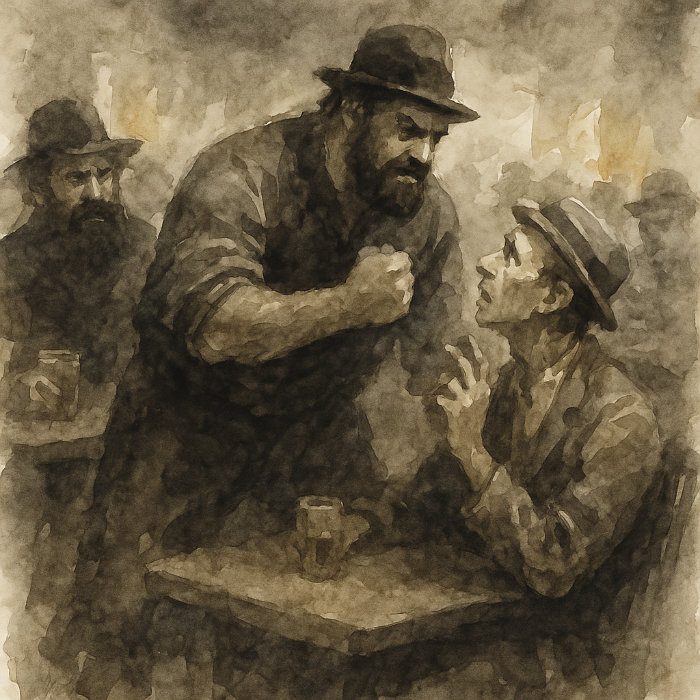
    “Well, Archy, I wish to have a word with you. Who is that gentleman over there with the long white coat? He insulted me about my church, my creed, and my coat, and I will not take that from any man! Not him nor you.”

    “I see no such chap.”

    “Do you think I’m stupid, do you? You might be surprised to hear that some fellow in England has made a remarkable invention called ‘captive daylight.’ Did you know that, smart-arse?”

    “And what might that be, Scotty?” Burns sidles up, winking a cold wink at Fletcher, the council road overseer.

    “What it sounds like, mate, just what it sounds like. I read that this chap, a Mr. Balmain, I think his name is, if memory serves, has succeeded in producing a luminous paint which can absorb light, as it were, and during darkness will suffice to illuminate an entire apartment. Very interesting article.”

    “My lord! That will be good for the outhouse!” Howls from those in earshot. “Yeah, good for readin’ the paper in the dunny without no candle!” Further rustic, scatological expressions of humour.

    Fletcher moves off, as the others incline an ear.

    “Yes, well, indeed, some might suggest there are those dimwits who can’t get their minds out of them parts! Anyways, they’re going to use it in compartments on board ironclads, probably. It’s quite intelligent, really,” Forbes says.

    “How would you turn this paint off when you wanted to go to sleep?”

    “Well, I don’t know, I suppose you don’t need to sleep in the dark, does you?”

    “A lot of blokes don’t like to sleep when the room’s all lit up, like. I’m one of them myself, in fact, so it seems to me there are apparent drawbacks with this invention.”

    “I can assure you as some folks would prefer to read late into the night, save on the price of oil at the same time, and pull the sheet up over their head later.”

    The laughter swells around them, voices breaking off into pockets of side talk. Burns drags a barrel up beside Forbes and leans close, his mouth near the other man’s ear, speaking gutturally against the racket, passing on what Jenkins the barman calls good oil on the allotments of land up for selection. There’s one or two up this way, not far from the river, which at this time of year has dried up into a line of muddy water holes, but there’s some better ones closer to Stawell, too. Blow going all the way down there today; best to catch the train there tomorrow or the day after. Cast an eye over the ones up here first. Bit of a walk this arvo. Then go down to Stawell by rail. You can meet the missus and kids.

    They down two more solid nobblers of rum apiece, before following the route Jenkins’ map takes them on, out of town and north-east towards Swede’s Creek. Forbes has procured two flasks of brandy with what is left of the money Burns has given him, and they alternate swigs, while Burns elaborates on his vision of their shared future as wheat farmers. For the most part, Burns will live with his wife and six children in Stawell, and Forbes will occupy a house on the new property. They stop at the weir for a smoke and gaze down at the muddy trickle way below. Burns lets drop the empty flask, which comes to rest with its mouth barely above the surface, such that suddenly the waters eddy in, until it emits a comic gurgle and disappears.

    Burns knows more than enough about farming, he reckons, to put Forbes on the right track. There are two classes of selectors – one goes on the land without money, and the other without knowledge; and there are some who go on the land without either. But of the first two, he would rather give credit to the man who lacked money but possessed knowledge than he would trust the man who had a limited supply of money and no knowledge at all. Did you know, mate, that sailors make the best selectors? The best of non-farmer selectors, that is. They are quick-eyed, active, strong-handed, and excellent judges of the weather. They can, he opines, almost without exception, successfully compete with old hands in fencing land.

    Four bottles of water? asks some bird invisible in the bush, the phrase clear as speech.

    “Well, I sure ain’t no sailor neither,” Forbes admits, in a tone that one would not quite call wheedling as such, though a kind of seeking for self-reassurance is evident in it, some murky undertone. “I think I might have my work cut out,” he says with a self-deprecating smile.

    “Tosh! you will do alright, son,” Burns says with a wink and a slap on his mate’s shoulder. “Well, I have to say the land’s not much good around here. Only fit for a sheep walk and a poor one at that. You’ll find a sheep every five acres around this place at best.”

    They continue their trek for a while, Burns examining a clod of the friable clay here and there, until the second flask is emptied. “Not too heavily timbered around here,” Burns observes, taking a final swig and tossing the flask. “Just a few patches of bull-oak – though that’s useful stuff for building.” Belch. “The creek’s not always like this, you know, just waterholes. It fills up alright, and I heard some talk back there about some sort of irrigation scheme that might come through in a while.” Snort, hack.

    “Listen to them birds,” Forbes says with a giggle. “They’re saying the same thing over and over and over. What sorts of birds is they?”

    They stop still and listen. A long silence. Then … CRACK! Click-click-click!

    “Out here? Must be lost,” Burns mutters of the Eastern Whipbird.

    Four bottles o’ water – watchya baaaack!

    “There he is!” laughs Forbes – a flash of sheer, foolish delight. “Four bottles of water!”

    “They’re not talkin’, just skwarkin’, son.” Burns’ patience thins. “Will you listen to what I’m saying to you, for Chrissakes?”

    Forbes is still looking up into the branches, laughing.

    Burns exhales, the sound more growl than sigh. A shadow seeps into his gaze and his jaw tightens.

    Cackling, Forbes mimics some more, then falls silent, listening. Burns spits, thinking. Here and now, God help me, I could kill him.

    As they go on, Burns lags behind, wobbling his head, sneering, and mouthing Forbes’ words in a sarcastic pantomime.

    They arrive back at the Royal. Forbes takes some brandy and old newspapers up to their room and pores over some articles of passing interest, though his brain is unable to comprehend much of what his eyes admit into it: The necessity of employing very intense temperatures in cremation, so as to convert the body into ashes, appears likely to be done away with by the experiments of M. Lissagarry. The difficulty in cremation is to decompose and reduce to ashes tissues containing 75 per cent of water; but M. Lissagarry overcomes this by exposing the body, first of all, to the action of superheated steam, which chars the tissues and enables them to burn easily in an ordinary simple furnace at a very much less cost of fuel and without the least unpleasantness . . .

    He blinks slowly, reaches for the brandy, and lets the print swim before his eyes, the words dissolving into the paper’s yellowy grain. His lips shape the words soundlessly. There are some hard ones, but Bobby will know what they mean. He always knows. Rolling onto his back, arms askew, Christlike, he drops into unconsciousness. Snores like ballast pouring into a hopper. Dreams a dream of a sky fretted with magpies, wings beating over acres of land littered with skeletons.

    Tom Piper steers Poor Joe, incoherent, out the back to his mat of hay in the stable. Off he totters, and Tom returns to the fray.

    Burns throws himself into a chaotic game of three-card loo in progress in a smoke-filled room adjoining the bar. Six men compete for tricks around a dilapidated table buried under piles of coins and damp clumps of notes, while onlookers crowd in to outshout each other’s wagers. In the main bar, an accordion strikes up an off-key melody, an Irishman belts out an amorous ditty, forcing the instrument to conform. Then a polka, and a few dance in pairs, man on man, stiffly wobbling around each other like toy peacocks, leaning away, gripping each other by the elbows. Only one woman is present, and she is too far in her cups, anyway, to be of any use, engaged in a slurring interchange with a navvy at the bar, though their topics are unrelated, and they speak past each other’s eyes.

    Burns’ cheer curdles as his luck rots. Repeatedly ‘looed,’ he feeds the pot, three at a time. Others scoop the winnings while his pile shrinks. The pool swells. Greed thickens. The drink works deeper with each loss, peeling him down – the drunken, belligerent aggrandising become brutish, to reptilian – to a being older than men. His hands move more slowly now, eyes narrowed, as though weighing the other men for more than their cards. A primitive thought coils, half-remembered, half-whispered by something older than his bones, shedding centuries like skins – as though a presence that had slithered through ages of darkness might, on a vicious whim, infect a human soul.

    After the fun, Jenkins the barman is left to sweep the refuse into piles on the floor. He leaves the doors open for the last curls of tobacco stench to drift out with the nocturnal breeze. The place is otherwise empty except for Burns – or rather, what’s left of him. The man-shape slumps in the chair, but the thing inside is pared back to its oldest layer, the cold-blooded remnant that survives when all else is stripped away. His gaze is hooded, face sliding off the skull, mouth agape and drooling. A slow flick of the tongue, lizard-like, tastes the air.

    When Jenkins has finished sweeping, he leads the creature up the stairs. By the top step, Burns is down on all fours, almost slithering. “Here you are, mate,” Jenkins says at the door. “Allow me…” He turns the master key and ushers the creature inside. From somewhere far back in his skull, Burns watches this with cold detachment. When he spits, his saliva oozes in strings to the floorboards. He tries littler ptuh! ptuh! spits to be rid of it, but it clings there.


    Michael Guest © 2025

    Images generated by AI