Tag: American popular literature

  • Cobb’s False Knight: 6. Waylaid

    Cobb’s False Knight: 6. Waylaid

    Trying to get a desperate message through to possibly avoid a looming disaster, a dangerous journey through a dark expanse. Where had I heard that before? It was also in Germany, but not in the Black Forest.

    This particular journey started from an airfield just outside Munich. The dark expanse was the North Sea, the destination Dungavel Castle in Scotland, strangely reminiscent of Dunwolf, but purely coincidentally. It was the Duke of Hamilton the desperate messenger had tried to reach, a fellow aviator, and one he had hoped could pass his message on to Churchill. Avoiding being shot down, he had to parachute into a field, unable to find his intended destination.

    The messenger was a man I had never met or had any interest whatsoever in meeting, but whose presence I had been aware of while living in West Berlin. He was the sole occupant of an entire prison built to incarcerate six hundred, kept there incommunicado, lest he told of what his errand had really been about. In later years, when his son was finally allowed to visit, guards were always present and he was not permitted to discuss anything in relation to his mission. Don’t you wonder why?

    Spandau Prison was less than twenty kilometres from where I lived, but normally, nobody was allowed to enter. An absurdly expensive, huge place to house the desperate messenger, already pushing ninety in the early 1980s, kept there under the jurisdiction of the Allied Command. These days they say it was the Soviets who held him, but when I was in West Berlin, we knew it was the British who blocked any attempts for release, even by someone as influential and definitely acting out of compassion and not because of any pro-Nazi sentiments, as former Mayor of West Berlin and Chancellor of Germany, Willy Brandt. But why?

    It was because of what Rudolf Hess knew about his mission, which was still highly embarrassing to the British. Had there been an intelligence sting to convince Hitler that Great Britain had been seeking a way out of the war? Or was Hess simply a madman? Berliners need knew of the old man, held alone in that huge and foreboding prison. Did he deserve to be there? At one time, probably. He had been Hitler’s deputy, had signed into law terrible policies that harmed and killed so many. Not an innocent, by any means.

    Why on Earth had he tried to get a message to Churchill? Because he knew that madman Hitler was about to invade the Soviet Union and thereby open a second front making the war unwinnable for Nazi Germany? Or had he been acting on the direct orders of Hitler, in response to secret British overtures? The murky world of intelligence services conceals many such plots. We will never know the details of this one, but we can be thankful that his desperate mission to find peace with the UK and avoid the defeat Nazi Germany did not succeed, whatever the circumstances.

    Hess allegedly hanged himself in 1987, at the age of 93. A messenger, whose to some still immensely embarrassing message finally “had to be stopped” from being told, because more moves were afoot to finally release the old man? Will Ernest von Linden succeed in getting his message through to King Leopold, or will he too be incarcerated or even killed?


    CHAPTER 6

    WAYLAID

    The baroness and Electra were ready to sit with Ernest at the breakfast table, so that no time might be lost in consultation. The distance to Baden-Baden was fifty miles — the road exceedingly mountainous and rough. If he could make the journey in a day he would do well. At all events, the chances were that he would be obliged to be gone three days, as he could not expect to find time for business on the day of his journeying.

    His business, however, was easily understood, most of it being left to his own judgment. Since Sir Pascal Dunwolf had made his appearance at the castle the baroness could not believe that the grand duke would insist upon his marriage with her daughter when the facts of the case had been presented to him. She knew how eager the dukes were that the great estates of the grand duchy should be possessed by their chief henchmen. She knew that during the reign of Leopold’s father three orphan daughters of wealthy baronies, representing their respective families, had been forced to wed with husbands of his choosing; and one of them, at least, she well knew had at the time a lover in the lower order of society to whom she was devotedly attached.
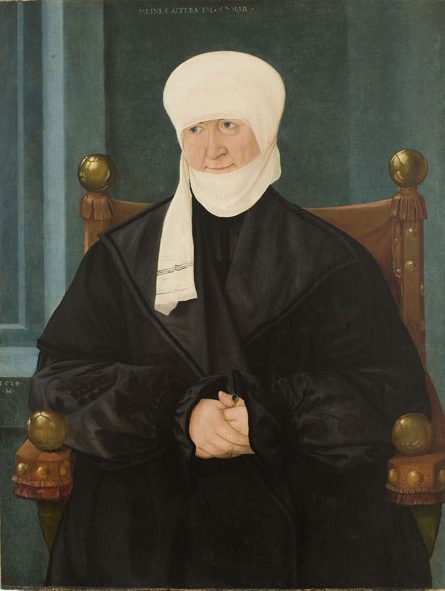
    Portrait of a Woman of 57 (1539), Hans Mielich. (MNAC, Barcelona). More information.

    Still, her case, she felt, was different. Her daughter had been long affianced — allianced, too, by a father who had given his life to the state — to a youth of noble lineage and owner of a large estate. As she arrived at this point in her statement Ernest interrupted her, saying:

    “And for that very reason, I am informed the grand duke said, he objected to our union; perhaps not in so many words, but such was doubtless his meaning. He regards the Barony of Deckendorf as already powerful enough. Let the earldom of Linden be combined therewith, as would be the case in my marriage with my darling, and Leopold thinks the lordship might, in time, over-shadow his own proud station.”

    “O! what a fool!” exclaimed Electa, impatiently. ”When Ernest and I would be to him two of the very best and truest of friends.”

    “That is what I shall try to make him understand, my own precious love,” said Ernest, as he moved back his chair from the table. There was further conversation on the all-important subject, but, as the result will be seen in the end, there is no need that we should follow it further.

    The question of companionship on the journey had been discussed, and the brave youth had decided that he would go unattended. He was not afraid of robbers, for he took with him nothing for them to steal. As for money, all he could want was in the hands of the baroness’s banker in Baden-Baden, and a simple cheque would command it. A companion of his own turn of mind and thought, one intelligent and educated, would have been pleasant; but none such was within call; so, after due consideration, he had resolved to go alone. Thus he could speed on his way as he pleased, and enjoy his own thoughts and fancies.

    The baroness had given her last words of direction and caution; both she and Electra had given him their blessing, and their parting kiss; after which he sent a servant to order his horse, while he went to his chamber to get his portmanteau and his pistols.

    The pistols, of the very latest pattern, procured of the manufacturer, at Heidelberg, less than a year ago, were the best weapons of their class to be found anywhere. The spring jaws for the flint, with the steel for the stroke directly over, and closing the pan, had been introduced; and the stock had been brought to a graceful, compact, and convenient form. In short, the pistols which our hero then handled were as nearly perfect as was possible with the flint lock.

    Those for the holsters were large and strong, carrying an ounce ball, the handles, or buts, being heavily bound with cast brass, to fit them for clubbing purposes in case of need. The smaller pistol, for the pocket, was highly ornamented. There were two barrels and two locks; the bores little more than half the diameter of the former; its sandalwood stock being richly bound and inlaid with silver and gold.

    As he took them up he instinctively opened the pans to see that the priming had not been accidently disturbed, and having found them intact, he put the smaller one into his pocket; took the others under his arm; then picked up his portmanteau and went out. In the passage he found a servant to whom he gave his key, bidding her to keep it until his return.

    As he passed through the lower hall he looked round for any friendly face that might appear; but no one did he see. He had not expected that Electra would come down; he had bidden her not to do so; but she might have sent word. None came, however, and he went his way out through the vestibule, down the broad steps, to the inner court, where he found his horse, and near by it standing Sir Pascal Dunwolf.

    For the moment his heart quickened its beatings, and his hands closed more tightly upon his luggage; but the knight gave him a smile, and offered his hand, which the youth took as soon as he had landed his portmanteau.

    “You have my letters?”

    “Yes Meinherr; and I will promptly deliver them.”

    “Thanks! I was not sure that my page had given them to you. The graceless rascal is such a liar that I know not when to believe him. But he is faithful, nevertheless, and serves me well, when it comes convenient for him to do so. I wish you a pleasant journey, Captain; and I beg you to forget our little passage of yesterday.”

    “It is already forgotten, Sir Pascal.”

    “Thanks again; and once more — success to you.” And with this the knight bowed, at the same time, raising his plumed cap, and then turned away.

    Ernest secured his portmanteau in its place, and put the pistols into the holsters; then vaulted to his saddle, and rode away. Not until he had crossed the draw-bridge, and began the descent of the deep ditch beyond, did he think of the last look he had seen upon the face of Sir Pascal Dunwolf. At that moment his thoughts chancing to turn back to his interview with the dark-browed knight, the look glared upon him. He saw it as though the face was there before him, and he could read its full diabolism. What did it mean? There had been malevolence in it, and such intense spite; but why should he have worn an expression of triumph? — for such it had surely been. Had he more promise from the grand duke than they had thought? Had he ground for the assurance that the youth’s mission would be fruitless? If not, whence his feeling of triumph? — for, the more he thought of it, the more deeply was he convinced that he had not been mistaken in his estimate of the knight’s look.

    “Bah! — I am a fool!” he told himself, after a deal of perplexing study. “The man is a natural braggart, and his look of triumph was a reflection of the wish of his heart. The grand duke will never enforce the marriage of Electra von Deckendorf with that monster! I will make him understand that he will find a safer friend in me than any man can find in Sir Pascal Dunwolf.” And he resolved that he would think no more about it.

    The sun was two hours high as Ernest crossed the stream in the valley, and shortly afterwards he began the ascent of the Schwarzwolf Mountain — or rather, of a spur thereof. It was a wild, rugged pass, but the path was clear, and he went on without difficulty, but rather slowly. At the summit of the spur the road lay through a dense growth of mountain fir — the black fir, whence the forest (wald) takes its name — and here, under the shadow of a precipitous cliff which arose on his left hand, he saw a large wolf sitting. His horse stopped suddenly and tried to turn, but the rider held him to his place; he could not hope to force him by the place, however, while the beast remained at his post; and he certainly exhibited no signs of moving out of the way.

    The captain knew that sometimes an old wolf, in his mountain fastness, would be very bold and fearless, though he did not believe the animal would attack him. He considered a few moments, and then drew one of the large pistols, meaning to give the beast a shot between the eyes, the mark being direct to his aim. At the cocking and aiming of the piece the wolf raised himself to an erect posture, but nothing more. With a sure aim our rider pulled the trigger. A flash of the powder in the pan followed, and that was all. He waited a few seconds, to make sure that the fire had hot held only temporarily, and then knew that his pistol had missed fire entirely — something he had never before known with those weapons. Never before a burning of the priming without communicating fire to the charge.

    The bright flash and the tiny wave of smoke that curled up from the pan caused the wolf to take himself off, but that mattered little to the owner of the pistol at that particular moment. He cared more to know what was the matter with his powder.

    As soon as he had made sure that the wolf had disappeared, he slipped from his saddle, and having thrown the rein over the broken stub of a stout branch, he gave his attention to his pistol. First, however, before going further, he thought he would try the other. He took it from its holster, cocked it, took aim at a small sapling fifteen to twenty yards away, and pulled the trigger. Whew! The result was as before. His next movement was to draw the double-barrelled weapon from his pocket, and try first one hammer, and then the other; and, as the reader doubtless imagines, with the same result.

    And now for the bottom facts. There must be mischief somewhere. Ernest sat down upon a stone by the wayside, and exposed the screw upon the tail of the rammer of one of the holster pistols, with which he easily drew forth the wadding of the first one he took in hand; but he quickly determined that it was not the wadding he had himself put there. It was a wad of paper, which he recognised to be a part of a leaf from one of the books that lay in his room. He went on, and drew forth another wad, but no bullet. Then another — and yet another — piece from the same book, until the barrel was empty and the vent-hole clear.

    The second holster pistol, and likewise both the barrels of the smaller pistol, were found to have been deprived of their proper charges of powder and ball, and filled with nothing but paper from his devoted book! He sat for a time and looked at the three pistols.

    And the light burst upon him. He now could translate the look he had seen upon Dunwolf’s dark visage. And he understood, also, the secret of the early visit of the hunchback page. And, of course, there was more to come, which would doubtless present itself in due time.

    Fortunately he had plenty of ammunition in his saddle-bags. He opened them, and proceeded to load his weapons with extra care. He measured the powder critically; saw that the communication with the priming was free; he fitted a tallowed patch about the bullet so that it should drive home snugly; and when the work was done, and the flints had been made sure of striking plenty of fire, he put the pistols back into their places of rest, and resumed his journey.

    At a short distance from where he had stopped he reached the brow of the spur, and looked down into the valley below. It was a vast concavity of the forest, black as night, with here and there a giant oak or pine towering above the levels of the firs, and anon a cliff of gray rock lifted its bare peak into sight. The path was lost to view not far away, but the traveller knew where it lay, and was well acquainted with its many windings and its numerous branches. It was the branching of diverging tracks that made the desolate portion of the Schwarzwald dangerous to strangers. Many a man has been lost in those endless, intricate wilds; the sun and stars shut out by the mountain mists: his instinct leading him onward — ever onward — in a fatal circle, which he pursues until fatigue and famine conquer, and he finally sinks, perhaps not an hour’s journey from the point of his departure!

    But Ernest von Linden knew every turn and every branch, and he pushed surely on. A few hours’ more would bring him to the town of Wolfach, beyond which the road was broad and mostly good.

    He had reached the foot of the mountain spur, and was striking into a broader and better path, when he distinctly heard the footfall of a horse other than his own, not far away on his left hand, and on looking in that direction, he detected an opening in the thick wood, which he soon discovered to be another path, joining that which he was following at a short distance ahead. He looked to it that the pistols were loose in their holsters, and a few moments later two horsemen appeared to view directly before him, and not more than a dozen yards away.

    As he drew rein and brought his horse to a halt, the two men turned and faced him, and he recognised at sight two of the stout men-at-arms of Sir Pascal Dunwolf’s troop. They had not taken the trouble to disguise themselves.

    “Ha, Captain! Is it really you? I’faith, you must have given Sir Pascal the slip. He declared in our hearing that you would not leave the castle. Do you journey to Baden-Baden?”

    “Such is my intention.”

    “Good! We shall have company. In these times, with Thorbrand’s infants running at will through the forest, it is just as well to travel in goodly company. But I am surprised that you should have come alone.”

    “I have traversed this section many times,” the young man returned, and have yet to encounter an enemy. Still, as you suggest, we know not when one may appear.”

    “That is even so; but against the three of us it would require a strong force to prevail.”

    While this coloquy had been going on our hero had been making a study of the two men before him, and he had been content to quietly answer them that he might gain the opportunity.

    They were men of powerful frames, with VILLAIN indelibly stamped upon both their faces. Those faces were coarse-featured and battered; heavy-lipped and low-browed; with as wicked a complement of eyes as ever looked from a human head. They wore the uniform of their troop, heavy swords hung at their sides, daggers in their girdles, and evidently pistols in their holsters.

    Ernest knew that they must have left the castle during the night, for he remembered distinctly having seen them at parade on the preceding evening. And if they had left the castle during the night, of course their chief had sent them; for they could not have passed the sentinels otherwise. And for what had they been sent? Ah! it remained for them — clumsy loons! to blunder out the truth.

    “Captain,” said the second man of the twain, with an exceedingly cunning look, “did the chief send any letters by you?”

    What did this mean? Why was the question asked? The youth determined to pursue the matter to a solution.

    “He did,” he answered, after only an instant’s hesitation.

    “Oho! Then you saw him. I s’pose he gave the letters to you with his own hands.”

    Ernest began to gain a glimmering of light.

    “No,” he said. “They were given to me by another.”

    “I wouldn’t have believed it. Generally he doesn’t trust his letters in the hands of his underlings. I s’pose he sent ’em by Lieutenant Franz?”

    “No.”

    “Eh? Who could it have been?”

    “They were brought by a humpbacked dwarf, who brought them to me in my chamber before I had completed my toilet.”

    “Well, is it possible? What d’you think of that, Roger?”

    The man thus appealed to declared, most soberly, that he wouldn’t have believed it.

    The rascals had now learned all they could hope to discover by questioning. They believed that the captain’s pistols were innocent of powder and ball; and he knew that they so believed. Further, he knew that Sir Pascal had sent them out to intercept — to waylay — him, and that he had promised them that their victim’s weapons should be rendered harmless.

    At this point Ernest gathered in his slack rein and sat erect.

    “Look, you, sirrah!” to the man who had first addressed him. “If I heard
    correctly, your name is Roger. Now, sir” — to the other — “by what name may I call you?”

    “My name is Otto, sir,” the fellow replied without hesitation

    “Will you now tell me whither you are bound?”

    “Why,” answered Roger, “we are going right along with you.”

    “To Baden-Baden?”

    “Certainly.”

    “For what purpose?”

    “Why — bless you — the governor sent us, of course.”

    “Aye, but upon what business? He did not send you without a purpose.”

    “No, certainly not. He sent us — Eh, Otto?”

    “Why — he sent us,” said Otto, “to hunt up the trail of the robbers; and that was why we started off on that side path.”

    “And now,” suggested Ernest, “you will look for them in Baden-Baden?”

    “Yes; if we take a notion so to do. We are acting on our own judgment, and we’ll have you to know that we are not responsible to you.”

    “Certainly not. I should be exceedingly sorry if you were. And now, Roger and Otto, you will turn your horses’ heads to the front, and ride on. I propose to ride in the rear.”

    At that moment the assassins were evidently not prepared to act in concert; so without hesitation, save for the simple exchanging of a glance, they turned, as they had been ordered, and rode on. For a little time they sped on at a gallop, gaining a considerable distance in advance. At length they came to an open glade through which ran a brooklet of clear, sparkling water, where they reined up and allowed their horses to drink. Their heads were close together in earnest consultation, and our hero saw one of them point over his shoulder towards himself, at the same time laying the other hand upon the hilt of his sword.

    Evidently the time of trial was at hand; but the brave youth did not shrink, nor did he fear. He felt that he had the advantage, and with a watchful, wary eye upon their every movement, he rode slowly on.


    Notes and Reference

    • barony: a baron’s domain.
    • Schwarzwolf Mountain: fictional.
    • fastness: stronghold; fortified place.
    • rammer: in a muzzle-loaded firearm, an attachment to help load the bullet.
    • tallowed: v.t. constructed from n. “tallow”: solid oil or fat of ruminant animals (Encyc. Brit. qtd. Century Dictionary).
    • anon: soon.

    Handwerk, Brian. “Will We Ever Know Why Nazi Leader Rudolf Hess Flew to Scotland in the Middle of World War II?Smithsonian Magazine (May 2016).

    Creative Commons License
    This work is licensed under a Creative Commons Attribution-ShareAlike 4.0 International License.

  • Cobb’s False Knight: 5. Plotting — Deep and Deadly

    Cobb’s False Knight: 5. Plotting — Deep and Deadly

    Inheritances. There’s an old German saying, “Wenn’s ums Erben geht, besser frueh handeln, als zu spaet…” (“When it’s a matter of inheritance, it’s better to act early, than too late …”) There’s a fairytale castle Iocked in a bitter dispute about the matter of who inherited it. A story from the middle ages? No, the dispute erupted in Lower Saxony only last year (Burghardt, “Adel vernichtet,” SZ-Magazin).

    Marienburg Palace is the home castle of the Welf family, the current head of which, Ernest August von Hannover, born on 1954, willed the castle to his son, Ernest August, born in 1983. These days, it’s not threats with soldiers, it’s legal battles.

    Schloss Marienburg bei Pattensen by Raycer (2018). CC BY-SA 4.0, Jump to panorama. Jump to snow covered.

    The head of the Welf family is suing the Prince of Liechtenstein for allegedly conspiring with his son to defraud Ernest August senior of his property, believe it or not. Ernest August Junior has, as opposed to his father, not often appeared in the Boulevarde press, while Ernest August Senior was given the nickname “Priegel Prinz” (The bashing prince) or even “Pinkel Prinz” (The peeing prince, in reference to the result of drinking binges) because of many drunken escapades resulting in court appearances.

    Unfortunately, however, he married a very beautiful Russian “commoner”, Ekaterina Malysheva, in 2017, which, in the eyes of Ernest August Senior, brought about all sorts of complications relating to the future inheritance of the family fortune. In 2005, around 20,000 art objects from the castle’s vast collection were auctioned, for 44 Million Euros.

    I remember seeing the interior decades ago: tapestries, battle standards from the Thirty Years War, Battle drums, knight armour, muskets, pikes… A fairytale hilltop castle balcony overlooking the River Leine below and the distant city of Hannover.

    Ernest August Senior is now trying to sell the castle to the State for a single Euro. A plot to disinherited his son, who married the commoner?? Ah, the problems related to owning castles. The upkeep, well, keeping up the keep. Oiling the drawbridge, that peeling wallpaper in the royal lounge, the rising damp. In the case of this particular castle, all that peeing after too many drinking binges, I wonder? Things might have been more straightforward in the Middle Ages. You marry me, I get your Castle and all the soldiers? Or else? What will the lovely Electra DO?


    CHAPTER 5

    PLOTTING — DEEP AND DEADLY

    While the scene which we have just recorded had been transpiring at the hunter’s cot, Sir Pascal Dunwolf had been making himself known and felt at the castle. During the previous evening he had done nothing more than attend to the quartering of his troop, and to making the acquaintance of the baroness and her fair daughter, with a passing salutation to Ernest von Linden. He had delivered to Lady Bertha his commission from the grand duke, by which he was empowered to possess Deckendorf Castle, and assume entire control of the fortress, together with whatever of military force there might be within its walls. She had received it and read it, and handed it over to Ernest, remarking that he was now her chief reliance, and she must refer to him the surrender of the castle. The young captain had looked the document over; had marked the salient points, and made sure that Leopold’s sign-manual was attached and then, with a low bow, passed it back to its owner, saying that he recognised the authority, and would promptly turn over the command whenever the knight was ready to assume it.

    The knight’s presence was extremely chilling and disagreeable to the ladies, and they could not hide it. Nor could Dunwolf fail to see, and he did not press his company upon them, nor did he at the time manifest to them any ill-feeling on account thereof. They retired to their own apartments, while he gathered together his chief officers in the great banqueting hall, where they held high wassail far into the night. Ernest had been invited to join them, but without hesitation, had respectfully declined.

    It was quite late in the day — past nine o’clock — when Sir Pascal made his appearance from his drunken sleep; so he was not ready for business until near noon. It was very near high twelve when Ernest von Linden, walking with Electra in the little private flower garden beneath the windows of the baroness, was saluted by an orderly, and informed that “the lord of the castle” wished to see him in the armory.

    And who is “the lord of the castle?” asked our Hero, unable to hide his deep indignation.

    “Be careful! O for my sake be careful!” whispered Electra. “That man is terribly vengeful, as his dark and forbidding face plainly shows. Do not anger him.”

    He promised her that he would exercise due caution — that he would not let his passions betray him; and then, having handed her to the foot of the stairs leading to her mother’s apartments, he turned and thanked the orderly for his information — said information being that the noble knight, Sir Pascal Dunwolf, was present lord of the castle — and having thanked him, he signified to him that he was ready to follow his lead.

    Ernest found Sir Pascal in the large armory, with a score or more of the officers and men-at-arms of the castle about him.

    We may state here that the force of the castle, under our youthful captain’s command, consisted of five-and-forty men-at arms, about equally divided into cannoneers, arquebusiers, and pikeman, the latter being trained to the use of the crossbow and the javelin, for, though firearms had come into general use, the modern cross-bow of steel, with short, steel arrows, or bolts, was still held as an effective weapon in the hands of men capable of properly using it. Then there were six corporals, three sergeants, and a lieutenant — forty-five men all told.

    Sir Pascal Dunwolf was evidently feeling far from well. His eyes were bloodshot and inflamed, and he carried his hand over and anon to his forehead, as though he had an ache there.

    “Captain von Linden,” he said, hoarsely and brusquely, “you are ordered to report to me with your command, I think you will remember.”

    “Excuse me, sir. I am ordered to turn over to you my command, which I am ready
    to do.”

    “It is one and the same thing, Captain. When your command is turned over, you will, of course, come with it to me, as you are of the military force of the castle.”

    “Not at all, Meinherr,” said Ernest, respectfully, but with emphasis. I am an officer of the Baroness von Deckendorf, by her appointed and by her commissioned.”

    “By a woman! How can a woman grant a military commission, I would like to know? Whoever heard of such a thing? Franz!” to his lieutenant, “did ever you hear of such a thing as a woman’s giving a military commission?”

    “Never, Meinherr,” was the prompt response, as in duty bound.

    “What do you think now, my youthful Captain? Where do you stand?”

    “I would refer you to Elizabeth of England, Sir Pascal.”

    “Ah!– but — ugh! — she was a queen — a queen, on the throne of a great nation.”

    “Exactly; and the Lady Bertha, was Baroness of this powerful fortress — so recognised by the Archduke Rudolph, father of our present ruler, and by the Emperor Ferdinand. If you wish for further proof, I will refer you to the grand duke himself.”

    “I will be my own judge, young sir,” retorted the knight, angrily; and, mark you; I hold you to service under me. You will disobey me at your peril!”

    Our hero bowed, but held his peace. He was too indignant to trust his tongue with speech. As briefly and quick as possible he gave the knight an inventory of the force and the arms and the ammunition of the castle, together with the horses and the forage; also he gave him the steward’s account of the provisions on hand. His heart ached as he did it — not for himself, but for the baroness. Surely the grand duke could not have known the situation. If he had, he would never have given this man such power, in such a place. And further, his heart was sore when he thought of his journey to the court of the grand duke. How could he got away if Sir Pascal should forbid him? And that thing he was certainly likely to do. He must report to the baroness, and with her confer. She could be strong and resolute upon occasion.

    He had turned to leave, when the knight again addressed him:

    “Captain, you understand that you will report to me for duty.”

    “I will confer with my lady, Meinherr, and by her orders I shall be governed. You are certainly soldier enough to see and acknowledge the propriety of that.”

    Dunwolf was upon the point of making an angry response, when his lieutenant, Franz, plucked him by the sleeve, and whispered into his ear. A little later he swallowed his wrath as best he could, and said to the stubborn youth:

    “Be it as you will for the present, but remember — the means for enforcing obedience are in my hands, and I think you will give me the credit of knowing how to use them.”

    With this Ernest left the armory, and made his way at once to the apartment of the baroness, whom he found anxious to see him.

    In as few words as possible to told the story of his late interview with Sir Pascal, at the same time assuring her that he had been respectful through the whole trial. After a few questions had been asked and answered, the lady gave herself for a little time to thought, neither Ernest not Electra disturbing her. At length she said, in a calm, resolute tone:

    “Ernest, I must send you to Baden-Baden tomorrow. I shall give you no written instructions nor messages. I shall trust you to tell the story to the grand duke, and I have faith to believe that he will do justice. Some time during the day I will see Sir Pascal, and make known my plan. Should he oppose me, I think that I can make him see that it will be for his interest to submit. Further, I shall demand that you be left entirely to me. You can be making your preparations, for I am confident that no opposition will be made to your departure.”

    Later in the day, by the baroness’s request. Sir Pascal met her in one of the salons. He was exceedingly polite, and was inclined to be effusive; but she did not unbend from her true dignity.

    “Sir Pascal,” she said, after she had waved him to a seat, and had seated herself, “it is my purpose to send Captain von Linden, on the morrow, to Baden-Baden. I give you notice of my intent, first, because you are in charge of the fortress, and second, that you may, if you desire, send by his hand any message you may have to transmit.”

    “Dear lady,” said the knight, with a perceptible quiver of the nether lip, “there is no need that you should trouble yourself. I shall be sending messengers of my own almost every day, and any message you have for the capital I will gladly forward for you.”

    “You are very kind, sir but I prefer to select my own courier. I shall despatch Ernest on the morrow. Of course, you will not prevent me from so doing.”

    “I fear I must, madam,” said the knight, with a strong effort to appear calm. “Captain von Linden is an important officer, and I cannot spare him so soon after taking command here.”

    “Whose officer do you consider Captain von Linden?” the baroness asked, with calm, unruffled dignity.

    “Of course, dear lady, we must regard him as subject to my orders. Where would be our military discipline if there could be two commanders in the fortress? He shall be at your service at all proper times, but I must consider him as owing fealty to me.”

    “Very well, sir,” said the lady, rising from her seat as she spoke and standing proudly erect. “We will not argue the matter. I will go myself to Baden-Baden; for most surely you will not claim that I am under your command.”

    “Perhaps not, madam,” the knight returned, plainly showing his temper, “but I fancy I could find means of preventing you from doing so foolish a thing as that. You will remember that the castle is under my command, and those only will pass the gate who have my permission.”

    The eyes of the baroness fairly blazed, yet she did not lose an atom of her dignity. Drawing herself up to her proudest stature she said, with her hand extended, without a finger quivering:

    “Sir Pascal Dunwolf, I shall send a message to Baden-Baden. If Ernest von Linden cannot go, I will go. If you attempt to prevent me, I will call on my tried and trusty retainers to stand by me. Of men-at-arms and officers capable of bearing arms, I have within these walls fifty-six. You will say they are now your men; but let me civil them to my aid and you will see whose men they are. You have, counting yourself, ten men less than that. Then from my battlements I will summon my true henchmen from the town. Beware, sir! If you push me to it, you will find yourself in a sorry plight! I beg you not to forget that I am, in my own right, a baroness of the empire, with all the powers and privileges of a feudal lord. Now, sir, think this matter over. Reflect upon it, and when you are ready to make known your final determination, let me know.”

    She bowed as though to dismiss him; but he did not offer to go. As she started to turn away he put out his hand and begged her to remain.

    “Dear lady,” he said, with a great gulp. “I was wrong. I see it now, and I beg you will overlook my error, an error not of the heart, but of judgment. If you will give your message to Captain von Linden, he will carry it for you. Let me hear that I am forgiven.”

    The baroness ought to have known the man better than she did. She should have known that such a man — a man with that face, and those treacherous eyes — was not to be trusted under any circumstances. But she had strained herself up to so high a pitch, and had endured so much, that the reaction was weakening; and she was so greatly relieved when he had apparently surrendered, that she felt only gratitude.

    “You are forgiven, Sir Pascal, gladly forgiven.” And with that she turned away. She wished to find a purer atmosphere, and regain her breath.

    The dark-visaged knight stood where the baroness had left him until she had disappeared from sight, and when the door had been closed behind her his countenance underwent a wondrous change. It was like the settling of a thunder-cloud over a broken landscape.

    “Aye!” he muttered, between his clenched teeth, and compressed bloodless lips, “you may send your gallant young captain, and he shall freely set forth upon his journey. But — let him look to himself on the road! By my life! I could not ask for a better opportunity to make an end of that impediment!”

    An hour later Sir Pascal was closeted with two of his stoutest and most trusty troopers — most trusty, because they were his tools — both of them culprits whom a word from his lips would consign to the rack and the wheel! — two murderers they were, whom he had saved from exposure on condition that they would give themselves to him, body and soul. And they had done it. And during the night that followed, these two men — Roger Vadas and Otto Orson were their names — fully armed, and well mounted, left the castle by a postern, the knight standing by to watch their departure and give them their final instructions.

    Haying seen his two cut-throats depart — being well-assured that no other eyes had been watching — Sir Pascal re-entered the keep, and having reached his private chamber, he summoned his page.

    The Dwarf, Sebastián de Morra, at the Court of Felipe IV (1644). Diego Velázquez (Museo del Prado)

    And this page is worth an introduction. Balthazar was his name. He was a dwarf, slightly hump-backed, not far from five-and-thirty years of age. He was from the mountains of Tyrol, as swarthy as a Moor; with features sharp and angular; a pair of eyes intensely black, that gleamed like sparks of fire; and his height not quite four feet. He was clad in a quaint garb of velvet and silk, with embroidery of gold and silver; in his bonnet, of bright crimson velvet, was a triple plume of red and white ostrich feathers; and in a crimson girdle, of knitted silk, he wore a silver-hilted dagger. Bodily he was lithe and agile, turning a summersault with entire ease, and performing tricks of legerdemain that might have astonished an Indian juggler.

    “Balthazar,” said the knight, when he had assured himself that no other ears were near, “how do you and Lieutenant Franz stand in the sum and substance of your playing? Didn’t he rather get the best of you at the dice last night?”

    “Look ’e my dear master, much revered,” piped the dwarf, with serio-comic expression, “if you mean to mend my fortunes, I can honestly assure you, there was never a more fitting occasion. My purse is as empty as is your lieutenant’s head.”

    “Well, well, we will try to mend the matter for you. But, really, my noble Festus, you should be more careful in your play with Franz. Did you use your own dice, or his?”

    “We used his, my lord; but, hark ye,” said the page, with a finger laid significantly against the side of his nose, “we will use mine on the next occasion; for he has promised me my revenge. Ho! let the doughty warrior look to himself.”

    “That is right, Balthazar. And now listen; you know the former commander here — Captain von Linden?”

    “Yes.”

    The knight cast a quick glance around the apartment, and then in a low, guarded tone, he said:

    “Captain von Linden proposes that tomorrow morning he will set out for the court of the grand duke. The proud lady of this old pile of granite has a big chapter of complaints made up lo send; and I am not ready, just yet, that our good Leopold — Heaven save him! — should receive them, to which end I have sent Vadus and Orson out upon the road to overhaul the youth and borrow his dispatches.”

    “And you want me to clip his wings,” suggested the dwarf.

    “Exactly. He has three pistols — two large ones, which he carries in his holsters, and a smaller affair, with two barrels, richly mounted with silver, which he carries in his bosom, or in a pocket of the vest. I want the charges of those playthings drawn out. Be sure and leave the priming.”

    “Aye,” cried the little rascal — “I’ll do better than that, Not only will I leave the priming intact, but I will down a charge of paper in each of the three barrels corresponding with the charges withdrawn.”

    “Good! And now for good and sufficient cause for your visit. Here are two letters, for two officers of Leopold’s court. I told the young fellow that I should have one or two messages to send by him, and these will make my promise good. The rest I must leave with you. Let me give you one caution: Von Linden is a man of keen penetration, and quick of wit. You will have to be wary. I would not have him set forth with those pistols fully charged on any account. I am told he is an unerring shot, and wonderfully quick to act.”

    “Let me alone for that, my master. But, look ye: I might work with more spirit if I knew how much you were to give me.”

    “I’ll tell you,” said the knight, after a moment’s thought, — “when you shall come to me, and assure me upon your honour, that the barrels of Captain Von Linden’s pistols are empty of powder and ball, I will give you, in shining gold, a sum just double that which you owe to Franz, let it be more or less.”

    “All right! It is a bargain. Give me the letters, and consider the work done. I shall not fail.” With that Balthazar took the two letters, carefully superscribed, bound, and sealed, and having accepted a draught of wine, he departed.

    On the following morning, while he was dressing, Ernest von Linden was interrupted in his toilet by a rap upon his door, which he had locked upon retiring. He went and opened it and gave entrance to Sir Pascal’s hunchback page.

    The fellow came in without ceremony, with the two letters in his hand.

    “A plague on all early risers, say I!” he exclaimed, rubbing his eyes, as though to get them fairly open. “Here must I, just in the very sweetest chapter of my morning’s nap, be bundled out of bed to bring your honour these two lotters, which old Evil-Eye says you have promised to deliver as directed.” A quick, furtive glance, under shadow of his overhanging brows while he spoke, revealed to him the three pistols lying upon the light stand at the head of the bed.

    Ernest could not repress a smile at the dwarf’s intensely comical and humorous manner. He took the letters, and promised that he would deliver them as addressed, and then asked if the knight had any verbal orders.

    “Nothing of importance. He isn’t out of bed yet. He bade me bring these immediately, as he thought you might be early on the road. Shall I tell him that you will see him before you go?”

    “That depends upon how much longer he remains in his bed. I am very nearly dressed as you see; and I plan to set forth as soon as I have eaten my breakfast.”

    “Then I doubt if you see his bibulous majesty today. However, I guess there’s nothing of importance. He won’t send for orders, — be, sure of that. A pleasant journey to you, fair sir; and give my love to all the pretty frauleins who inquire for me.”

    “I will not fail,” said the captain with a light laugh; and with that the dwarf made a low bow, and departed.

    Ten minutes later Earnest took up his pistols, and examined them critically. Into the pans of the larger pair he put fresh priming, the other having been primed on the previous evening. Then he went out, carefully locking the door behind him, and putting the key into his pocket; and then away to his breakfast.

    Five minutes had elapsed after the young captain’s departure, when the hunchback page glided out from a deep alcove near at hand, and crept to the door. From his pocket he took Several skeleton keys; but only one was needed. At the very first trial the bolt was thrown back, the door was noiselessly opened, and the dwarf glided into the chamber.

    He was there not many minutes; for his fingers were exceedingly nimble, and his manipulations sure. By-and-by he came forth with an evil smile lurking about his lips; he closed and relocked the door behind him; and then away to claim at the hands of his master the golden means whereby he was to be enabled to take his revenge at dice upon Lieutenant Franz.


    Notes and Reference

    • sign-manual: “a personal signature, especially that of a sovereign or official on a public document” (Dictionary.com).
    • high wassail: revelrous drinking.
    • arquebusier: Infantryman armed with an arquebus. “The arquebus (/ˈɑːrk(w)ɪbəs/ AR-k(w)ib-əs) derived from the German word Hakenbüchse (‘hook gun’), was a form of long gun that appeared in Europe and the Ottoman Empire during the 15th century.” (Wikipedia; see illustration,)
    • postern: back or side entrance (lexico.com). Example image of castle postern.
    • keep: fortified tower within a castle.
    • Balthazar: In the Bible, one of the three wise men (gave the gift of myrrh, which evidently prefigures the death of Christ).
    • dwarf: Court dwarfs were employed from early times, as early as the Egyptian empire (See for e.g, Thompson, “Dwarfs in the Old Kingdom in Egypt,” in Bulletin of the Australian Centre for Egyptology, v. 1, 1991). Sebastián de Morra, painted by Velázquez, was one of the most famous in Europe.
    • bibulous: partial to alcohol.
    • legerdemain: (/ˌlɛdʒədɪˈmeɪn/) skilful use of the hands in conjuring.
    • Felix … Festus: names of the successive Roman procurators of Judea from ca 52-58 CE, the latter of whom stands in judgement of Paul (Acts 26).
    • doughty: Brave and persistent (lexico.com).
    • chargespriming: When a flintlock pistol of the time (“first half of the seventeenth century”) is fired, a piece of flint attached to a spring-loaded hammer (or “cock”) strikes a piece of steel causing a spark that ignites an amount of priming or detonating powder, which in turn ignites the main charge of gunpowder. Thus if the charge is removed and the priming left intact, there will be a fizz but no bang.

    Burghardt, Peter. “Adel vernichtet” (“Nobility Destroyed”), SZ-Magazin, 17 Feb 2019.

    Creative Commons License
    This work is licensed under a Creative Commons Attribution-ShareAlike 4.0 International License.

  • Cobb Biosnip: Laborare est orare

    Cobb Biosnip: Laborare est orare

    Knowing nothing of Sylvanus Cobb Jr’s work, let alone the writer himself, Emerson did not realize the offense his remarks would have caused Cobb’s brother (see “Cobb Biosnip: No Yellowbacks“). In her memoir, Sylvanus’ daughter Ella Waite Cobb omits to mention which brother it was. Sylvanus Jr., the eldest, had six (one of whom had died at ten years of age) as well as two sisters.

    Cobb’s immediate family was definitely among the most righteous and upstanding in the United States, and would have taken great umbrage at the idea that Cobb’s writing was mere vulgar sensationalism.

    The novelist’s father, Reverend Sylvanus Cobb, D.D. (1799-1866), a Massachusetts clergyman, is described as “the most important Universalist reformer before the Civil War” (Harris 117). In 1839 he founded the Christian Freeman, an influential anti-slavery, pro-temperance religious publication, and was active in seeking reform.

    His wife, Eunice Hale Waite Cobb (1803-80) was a  public speaker in support of temperance and social welfare. She contributed articles and poetry to Universalist publications, and was the first woman ever to do so. In Boston, she founded the first woman’s club in America, one dedicated to health and fitness, the Ladies’ Physiological Institute (1848-1996).

    Eunice Hale Waite Cobb. Source: Wikimedia Commons

    The prodigious Cobb twins were as industrious. Cyrus Cobb was an accomplished mathematician, lawyer, writer, poet, sculptor and musician. Darius Cobb achieved fame as a painter, and was, as well, a noted “musician, singer, poet, lecturer, lithographer, and art critic” (“Darius Cobb“, Wikipedia).

    Virtual doppelgangers, the two were not only identical in appearance, but also in intellect, personality, tastes and abilities. Darius said, after Cyrus’ death that:

    No person could tell the difference between our photographs, and very few between our persons. If he were to deliver a lecture, I could step in and fill his place exactly. If I were conducting music, he could take up my baton at any point and carry it out to the end, and no one could see the difference. If either were to play the violin, the other could substitute for him absolutely.

    The Cobb Brothers,” Cambridge Tribune, 18 April, 1903

    Reverend Cobb’s adherence to Freemasonry was concomitant with his family’s extraordinary allegiance to hard work, if not fundamental to it. He was the founding chaplain of the first lodge instituted in Boston, after a period of anti-Masonic agitation, against which he worked vehemently, and of course, tirelessly. In his capacity as a member of State Legislature, he saved the Freemasons from abolition in Massachusetts.

    Of the sons who followed him into the organization, including the twins, Sylvanus Jr. is the best remembered by the fraternity:

    He served as Worshipful Master of the Lodge for five years. He was also a member of Norfolk Chapter, Royal Arch Mason and served as High Priest, a member of Hyde Park Council Royal & Select Masters serving as Thrice Illustrious Master and Cyprus Commandery Knights Templar where he was the Eminent Commander.

    Today in Masonic History: Sylvanus Cobb, Jr. passes away,” Masonrytoday.com
    Knights Templar seal. Latin motto translates to “Seal of the Soldiers of Christ” (Source: Png Guru; reproduction permitted)

    It is a tenet of Freemasonry that, in emulating the example of God as the grand architect of the universe, men are the makers of themselves, and that

    to labor well and truly, to labor honestly and persistently, is the object and chief end of all humanity.

    Mackey

    Laborare est orare. After the wisdom of the monks of the Middle Ages, Freemasons hold that labour is itself a mode of worship (Mackey).

    Cast in this mould, Cobb and his family would have considered his writing as humanitarian service, far from the low realm of the yellowback; rather, a manifestation of uplifting and formative moral values. And prime among these values, the noble aim of living by the sweat of one’s brow.

    Cobb uses Masonic symbolism overtly in some works. The Caliph of Baghdad is listed in the Encyclopedia of Freemasonry as “the most widely read of Masonic novels” and is reputedly a vault of Masonic symbolism, “all of which is instantly recognisable to Masons who have been exalted to the Royal Arch Degree.” The novels AlaricThe Mystic Tie of the Temple (evidently an earlier title of the Caliph of Baghdad) and The Keystone were published in the New York Ledger, from 1858 to 1874 (Mackey).

    Following the examples of his mother and father, Cobb actively supported social reform in the areas of slavery, suffrage and temperance. He first addressed anti-slavery meetings in 1852, and in 1864 was elected president of a Union League he had helped establish. After the commencement of the civil war, he was made Captain of a light infantry company of the Maine Volunteer Militia, but saw no active service (Ella Waite Cobb, A Memoir…).

    In the temperance publication The Rechabite, of which he was editor, he draws on his recent experience on an American man-of-war:

    The very foundation upon which rests its present mode of operation, is RUM! This may be deemed, by some, an unwarrantable assertion; but we say it calmly and understandingly — we have been there, and we know.

    Rechabite 1846-7; qtd. A Memoir…

    Cobb’s quiet subtext, by which he seems to acknowledge a demon of his own, is borne out subtly in his daughter’s memoir. She records how in 1869, he became a member of the Sons of Temperance, an organization for temperance and mutual support, for whom he lectured:

    He cherished a warm admiration for the man who could stand firm in the face of temptation and say No; and he had reason to do so; but also, from the depths of his heart, he had reason to sympathize with the man who could not always resist temptation. His own struggle extended from boyhood to death. One enemy ever hovered near him, and was ever ready for the fray. At times the battle turned against him, and a cloud, black and ominous, enshrouded him: but he never failed to rise to the light.

    A Memoir…

    Notes and References

    • Cobb’s immediate family: “The Cobb family was a large and important New England clan (see Philip Cobb’s A History of the Cobb Family, Cleveland:1907). The main branch of the Cobb family descended from Ebenezer and Elizabeth Cobb, both of whom were descended from Elder Henry Cobb who arrived in America on the second voyage of the Mayflower.” “Cobb Family Papers“. Syracuse University Libraries, Special Collections Research Center.
    • saved the Freemasons from abolition: See, for example, Cobb, Autobiography
    • Union League: “…also called Loyal League, in U.S. history, any of the associations originally organized in the North to inspire loyalty to the Union cause during the American Civil War. During Reconstruction, they spread to the South to ensure Republicans of support among newly enfranchised blacks.” Encyclopedia Britannica.
    • Rechabite: “(in the Bible) a member of an Israelite family, descended from Rechab, who refused to drink wine or live in houses (Jer. 35). /
      a member of the Independent Order of Rechabites, a benefit society of teetotallers, founded in 1835″ (Lexico.com)

    Cobb, Ella Waite. A Memoir of Sylvanus Cobb, Jr. (Boston: C.L. Peters and Son, 1891).

    Cobb, Sylvanus. Autobiography of the first forty-one years of the life of Sylvanus Cobb, D. D., to which is added a memoir, by his eldest son, Sylvanus Cobb, jr. (Boston: Universalist Publishing House, 1867). Jump to file at Internet Archive.

    Harris, Mark W. The A to Z of Unitarian Universalism (Lanham: Scarecrow Press, 2009).

    Heimbichner, C. and Adam Parfrey. Ritual America: Secret Brotherhoods and their Influence on American Society: a Visual Guide. (n.p.: Feral House, 2012). Entry on Caliph of Baghdad.

    Mackey, Albert G. The Symbolism of Freemasonry Illustrating and Explaining its Science and Philosophy, its Legends, Myths and Symbols (South Carolina: Albert G. Mackey, 1882). Available at guttenberg.org. Jump to file.

    “Encyclopedia of Freemasonry and its Kindred Sciences.” phoenixmasonry.org. Jump to page.

    Records of the Ladies’ Physiological Institute, 1848-1996.” Hollis Archives, Harvard U.

    Further reading, reference
    Creative Commons License
    This work is licensed under a Creative Commons Attribution-ShareAlike 4.0 International License.

  • Cobb’s False Knight: 3.  A Funeral — A New Arrival

    Cobb’s False Knight: 3. A Funeral — A New Arrival

    Strange, that Electra’s beloved should say of Thorbrand that he may be “evil” but not “dreadful“, and that he would “never take a penny from a man he knew to be poor”. A German Robin Hood? Some say that the before-mentioned Eppelein von Gailingen was one; however, there is little remaining evidence of this.

    Robber knights often had no choice other than to take money and riches any way they could. As opposed to today, when many impoverished castle owners open bed and breakfasts or rent out their great halls for wedding parties, these opportunities for income did not exist in the Middle Ages. So there you were, the heir to a crumbling castle, people depending on your income, a few serfs tilling soil for which they offer some of their produce to the owner. Should you take something like an unofficial tax from those rich merchants who wear grooves into the paths through your land with their heavy carts, so you can make ends meet? Many did just that.

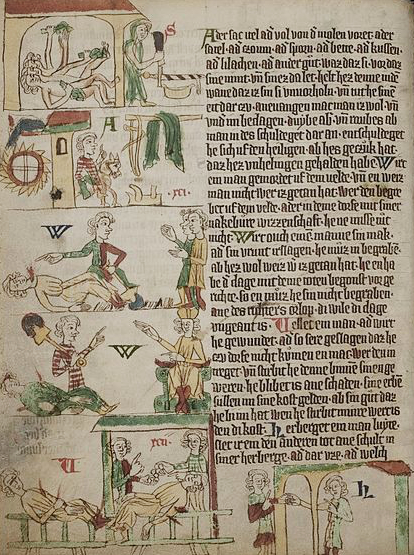
    The kings, dukes and so on did much the same, only on a grander scale. Even in the 1700s, they often demanded and went to war over ownership of assets like mines, silver or salt, etc, whether their families had ever had anything to with establishing them or not. Wasn’t that also theft? What then was legal, and what wasn’t? The only written laws appeared from 1220 to about 1235, such as the Sachsenspiegel, which remained a valid legal source in Germany until about 1900. Only seven copies of this German law book remain, all illuminated manuscripts and written in Low German.

    A page from the Heidelberg Sachsenspiegel, concerning murder and manslaughter. Source: U of Heidelberg

    It’s called Saxenspiegel (“Saxon Mirror”) because it was supposed to reflect the customary laws of the time. Of course people back then were obsessed with accusing others of witchcraft, or whatever constituted lewd behaviour in their opinions. Women could inherit, but if they married, all their possessions would become property of the male.

    Best be careful whom you might be forced to marry then. What will become of Electra if she marries her betrothed? According to the Sachsenspiegel, translated from Low German to High German, “Wenn ein Mann Eine Frau heiratet, so nimmt er all ihr Gut in sein Gewaehre zu rechter Vormundschaft” (“When a man marries a woman, he is granted all her possessions into proper trusteeship as her legal guardian”. (Because women were seen as “incapable of acting legally”, unless they happened to be queens or duchesses.) Can she really trust her suitor?


    CHAPTER 3

    A FUNERAL — A NEW ARRIVAL

    As our heroine approached the castle, she saw through the gathering gloom, the figure of a man — a man who appeared to be looking towards her — standing upon the drawbridge. The gleesome cry of her dog told her that he was a friend, and very shortly thereafter she was leaning upon the arm of her dear lover, Ernest von Linden, who had come out to meet her. He was a young man of four-and-twenty; tall and comely; with a frame of wonderful powers of endurance, lithe and sinewy; his face the mirror of truth and sincerity; his hair of a glossy brown, flowing over his well-shaped head in beautiful wavelets; his eyes of a rich gray, beaming with wit and intelligence; a man, take him all in all, as handsome as you will find in a day’s journeying through a populous district. He wore a doublet of dark green velvet, a white ostrich feather drooped over his velvet cap. and upon his hip he wore a good sword. He was a soldier, every inch of him, holding a captain’s commission from the baroness, and in command, under Sir Arthur, of the forces of the castle, and the town.

    “Darling, we had begun to worry about you, and I should have started out to meet you a long time ago, had not Sir Arthur — dear old man! — been taken with an ill turn. So ill was he that I dared not leave him.”

    “He is not dangerously ill? Do not tell me that!” cried Electra, in alarm.

    “We shall know very soon. Roland has gone on swift horse for the doctor, and it is time now that he had returned. However, there may be nothing to alarm us. He has had just such turns before.”

    “Yes,” said the loving niece, with infinite tenderness and pathos in her tone, “but they are worse and worse with every repetition. Dear old Sir Arthur! I hope God will spare him to us a little longer.”

    With this they turned to enter the main court of the castle and as they crossed the draw-bridge, Electra saw that the heavy chains were cast loose, and that the windlass of the portcullis was in readiness for use.

    “Ah!” said Ernest, in answer to her silent question. “We are making ready to close our gates. It was your mother’s desire and your uncle thought it had better be done. I suppose there can be no doubt that the noted robber chief, Thorbrand, is somewhere in the vicinity. He is no respecter of private property, and if he is accompanied by a sufficient force, he is as liable to strike at a strong castle as at a solitary wayfarer. However, he will find Deckendorf Castle a dangerous place to trifle with.”

    “Ernest, what sort of a man is this Thorbrand? Is he as dreadful as people say?”

    “If you mean to ask if he is powerful or evil, I should answer you, yes, most emphatically; but if you mean by ‘dreadful,’ is he a bloodthirsty, cruel monster, I should say, no. He never robbed a peasant’s cot, nor took a penny from a man whom he knew to be poor. Further he has been known — so I have been told — to shoot down one of his own men for offering gross insult to a peasant’s daughter; but, alas! that does not hold good, I fear, with regard to wives and daughters of castles. The man is governed by policy. While he can keep the friendship of the peasantry he finds many avenues of safety which he could not find otherwise. He has sacked whole villages, and I have no doubt but that he would attack and rob our peaceful hamlet should it come in his way. He is dangerous man, and he will be a public benefactor who shall slay him or deliver him up to justice.”

    They had now entered the broad court, and for a little time they walked on in silence. At length the young captain looked down into his companion’s face, which he could just distinguish in the deepening gloom and asked:

    “What are you thinking of, my sweet one? Has my picture of Thorbrand frightened you?”

    “No, Ernest, it was not that. A curious thought came to me, and I was trying to see through it. I was thinking: Suppose you and I were walking as we are walking now, only away in the deep forest, and should come upon a man suffering most cruelly — let us suppose him to have been wounded nigh unto death — and we should find him just when a helping, friendly hand could save his life. What should we do?”

    “Electra!”

    “Pshaw! You don’t think I am going to lead you to such an adventure, do you? Certainly not. It was only a fancy that struck me; and you will see what I mean pretty soon. What should we do to that man?”

    “Do? Why, we should put forth every effort to save him, of course.”

    “Certainly. And now suppose one thing further: Suppose after we had got the poor man up, and he had blessed us for our kindness, we should accidentally discover that we had saved the life of the Robber Chief, Thorbrand — should we seek to undo what we had done?”

    “What a question!”

    “Well — but — suppose we had known he was Thorbrand before we gave him help — when we first found his life running away through cruel wounds — would we have saved him all the same?”

    “Certainly. I would do so much for the bitterest enemy had in the world.”

    “Noble heart! I knew you would. And now answer me this: You have given the robber chief back his life, and he has asked God to bless you for your goodness; and then, after that, when he is at your mercy, are you going swiftly to the nearest barracks to call forth a host to go to the robber’s capture? That is the thought that has been puzzling me.”

    “Well, I wouldn’t let it puzzle you any more.”

    “I don’t want it to, my dear Ernest, and for that very reason I want you to tell me what you would do under such circumstances.”

    “Why, I should do as near right as I could, of course.”

    “Would you betray the man whose life you had so kindly saved to a death a thousand times more dreadful than that from which you had secured him?”

    “That is a hard question, Electra.”

    “I know it; and that is the very reason why I wish you to answer it.”

    “Well,” said the youth, after a little thought, stopping at the foot of the steps ending up to the vestibule, “if I must answer your question, I shall have to confess that, under the circumstances which you have supposed, I should not forsake the man in his great need. Betray him, I could not. The man whom I had befriended I could not, in that same hour, surrender to his enemies, let him be saint or sinner.”

    “O! I knew your heart would not let you do such a thing.”

    “But, tell me, what put that thought into your head? Electra! Have you —”

    “Hark! 0! there is dear mamma! Pooh! don’t you go to fancying that I have been doing any such wonderful things. I was thinking, that was all. You know what curious fancies sometimes possess me. — Here I am, mamma! — safe and well, with Ernest and my good Fritz for my guards.”

    With that she ran up the steps and threw her arms around the neck of her dear mother, who stood in the heavily arched doorway waiting for her.

    “Mamma! Mamma! How is Uncle Arthur?”

    “We shall know very soon, my child; for here comes the doctor.”

    Electra turned, and saw Doctor Ritter just coming through the inner gateway, with Roland in company. He was a small man, physically; but professionally he was a host. He was, in truth, a physician and surgeon of surpassing knowledge and skill; and had he not owed fealty to Deckendorf — had he not been under a promise to the last baron that he would never, willingly, forsake his old post while the Baroness Bertha lived, he might have found a more profitable location long ago.

    The Baroness Bertha von Deckendorf was of the same complexion as her daughter, but not quite so tall. She was really a short woman, and inclined to a healthful embonpoint; and though only forty years of age, the sorrow of. her great bereavement had drawn many lines of silver in her dark brown hair.

    “Electra, why did you stay so late? We had become really alarmed.”

    “Did you think I might have fallen in with the robber chieftain?”

    “Do not make light of that subject, my child. We have positive assurance that the dreadful man is somewhere in this neighborhood; and you know very well what his reputation is.”‘

    “My darling mamma, I did not think of making light of it, I assure you. Still I have no fear. But I am safe and well, as you see.”

    “For which blessing I thank Heaven devoutly,” murmured the baroness, seemingly to herself, after which she walked on with bowed head, busy with her own thoughts.

    In one of the older apartments of the castle, on the second floor, the narrow loopholes of which had been enlarged and glazed, the walls covered with arms and armour of every known description, together with trophies of the chase, lay the old knight Sir Arthur von Morin, now in his seventy-sixth year. His plentiful hair was as white, almost, as the covering of the pillow over which it floated in sinuous masses; his brow was high and full; his face of a leonine cast his frame massive, though now shrunken and shattered. For ten years, since the last going forth of the Baron Gregory, Sir Arthur had been sole master of the castle, and in that time he had endeared himself to, all with whom he had been brought in contact.

    But his days, alas! were numbered. Paralysis had followed a severe cold, taken after long and severe exposure in the mountains — a paralysis which had not marred the face, but which had been creeping nearer and nearer to the heart.

    Electra, when she entered the chamber, in company with her mother and Ernest, moved quickly to his bedside, and bent over and imprinted a kiss upon his brow.

    “Dear, dear uncle! You did not think I had forsaken you.”

    “No, sweet one. Kiss me again. Darling, you have been, very precious to me. No, no — I did not think you had run away; yet I wanted to see you — Bertha!” looking toward the baroness, “have you told her of the arrival from Baden Baden?”

    “No, dear uncle — I have had no opportunity.”

    “What is it? Who has arrived?” the girl asked eagerly.

    “It is not a person, my child — only a letter; but a letter of vast moment. It was for me,” said the old knight, “so I will explain it. A letter from the grand duke, informing me that Sir Pascal Dunwolf will soon arrive at the castle to confer with me. He had been informed of my sickness, and is pleased to add that, if it should come to pass that I be utterly incapacitated for military command, Sir Pascal will come clothed with authority to take my place, and — and —”

    “What more uncle? Do not fear to speak.”

    “Ah! Leopold does not know — he cannot know — what the situation is here. In fact, the letter itself shows that he has been misinformed. Tell me Electra — did Dunwolf ever hint to you of his love? Did he ever intimate to you that he would be happy in the possession of your hand?”

    “He! — Dunwolf! — hint to me of love! Merciful Heaven! — he dared not. Has he intimated such a thing? Does the grand Duke write to that effect?”

    “The duke writes as though he really hoped you would be happy with Sir Pascal. He says he owes the knight a heavy debt and he can think of no better way in which to pay it.”

    “The price he will pay,” said Electra with scornful bitterness, “is my castle and my hand! I wonder if he means to include my soul in the transfer”

    “The grand duke must be seen,” suggested the baroness, with calm decision. “Ernest, you are known to him.”

    “No, mother. I was well known to his father. During my stay at the ducal court Leopold was absent at the court of the emperor; and since his accession to the throne I have not been at the capital. Still, I will see him? He is reported to be a just and honourable man; and if he be that I have no fear of the result. If, after I have told him my story, as I feel I shall be able to tell it, he can turn a deaf ear to my entreaty I — shall think him neither just nor honourable.”

    The entrance of the doctor put a stop to further conversation on the subject of the grand duke’s letter, and attention was now given to Sir Arthur.

    At the end of a long and critical examination Dr. Ritter took a seat at the bedside, with one of the patient’s hands in his grasp.

    “Sir Arthur,” said he, in a frank, friendly manner, “I know you wish for the truth — the whole of it. — Certainly. Well, I have only this to say: — Put your house in order at once, after which you may quietly await the end. When it will be no man can tell. You may live for days — perhaps weeks; but, I think, not many days, if many hours. I will do what I can for you and, further, I will remain for a time with you.”

    After this the doctor prepared the simple medicines he intended to give, and took up his watch with his patient. He had explained to the baroness that the old man was liable to be taken away at any moment, and that the end might come with but little warning. He would let them know if he should detect any change for the worse.

    The evening meal was prepared, and after it had been disposed of Ernest and Electra repaired to the apartment of the baroness, where the subject of the grand duke’s project was further discussed; the conference ending with the promise that the young captain would see Leopold, and tell him the story as it was — how the Baron Gregory had planned to dispose of his daughter’s hand, and how such had been the heart’s desire of all concerned ever since, — and then he would respectfully demand that the wishes of the mother and child should be duly considered; and there was no doubt in their minds that justice would be done.

    After this Ernest went out to look to the defences of the castle, while the Baroness and Electra repaired once more to the chamber of Sir Arthur, where they found both the patient and the doctor buried in peaceful slumber; and they did not disturb them.

    Early on the morning of the following day the baroness and her daughter, who occupied apartments of the same suite, met in the passage leading to the chamber of Sir Arthur. They had but just arisen, and neither of them had yet heard from the sick one. At the old knight’s door the baroness gently knocked, and it was quickly opened by Ernest von Linden, whose cheeks were wet with tears.

    Tod (Death). 1911/13. Christian Rohlfs. Public Domain. Source: Wikimedia Commons

    No need was there to ask what had happened. Mother and daughter entered the chamber, and stood by the bedside, looking down upon the face of the dead. The good old man had passed away during the night, the doctor could not say when. He could only tell that the passage must have been peaceful and painless. He had slept lightly; at midnight he had given the patient a draught of cordial, and received in return his blessing. At four o’clock he awakened from a brief slumber, and found him sleeping the sleep that knows no earthly waking.

    They knelt in the chamber of death while Lady Bertha offered up a fervent prayer to the Throne of Grace, after which the household servants were notified of the solemn event, and those who desired were permitted to come and gaze upon the still, calm face of him whom, in life, they had so truly and devotedly loved.

    Then the death-flag was raised upon the main tower of the castle, and a gun was fired upon the western bastion, towards the settlement.

    Sir Arthur von Morin had died on Tuesday morning, and it was arranged that the funeral should take place on Thursday, at noon.

    Thursday morning dawned, and at an early hour all was in readiness for the solemn ceremonies. A rich casket had been brought from Zell, and the people had come in from far and near to pay their tribute of respect to the memory of the deceased.

    Irene Oberwald came over from her cot in the opposite mountain side; but she was forced to come alone, saving the company of one of her father’s dogs. When asked by the warder, at the gate, where old Martin was, she replied that sickness kept him confined within doors. She did not hesitate to go that far in the way of deceiving, since a good and sufficient excuse of some kind was absolutely necessary, seeing that her father had been one of Sir Arthur’s oldest and dearest friends. In answer to the baroness she was more frank. She said that her father was kept at home in attendance upon a sick guest, — an unfortunate traveller who had received a severe hurt in the forest, and whom he felt called upon to kindly nurse.

    “Dear Irene, tell me, how is it with my hero?” eagerly asked Electra, as soon as she could get the hunter’s daughter to herself.

    “I have not seen him since you left,” the girl replied; “but papa says he is doing well. He has a powerful frame, and most excellent health, and his recovery is likely to be rapid.”

    The last note of the solemn service had sounded; the mortal remains of the brave old knight had been consigned to their resting-place in the vaults beneath the chapel, and most of the people had departed for their homes, when, towards the middle of the afternoon, the warder of the castle, Herbert, came in from his post at the great gate, with the intelligence that a large troop of cavalry was approaching.

    Electra, upon the spur of the moment, thought of raising the drawbridge and letting fall the portcullis; but even she, upon more sober thought, was forced to the conclusion that such a course would not be advisable.

    Fifteen minutes later the head of the column crossed the drawbridge and entered the court. There were five-and-forty well-armed troopers of the Ducal Guard, with a richly-clad knight in command. When the whole force had entered, it was brought to a proper alignment, after which the knight turned over the command to a subaltern, and turned himself towards the vestibule, an orderly and a herald bearing him company.

    As the chieftain slipped from his saddle, and gave his horse to the servant, he displayed a thick-set, powerful frame, rather below the medium stature, but making up in breadth what it lacked in height. He was of dark complexion; his hair and beard as black as the raven’s plumage, with a pair of heavily-arched eyes to match. His features were regular, and by many might certainly have been thought handsome. He was a bold man, and reckless of physical danger, but hardly brave; for true bravery presupposes truth and honor, and these were not the characteristics of the man whose face and figure we are now contemplating.

    When he had given his horse to his orderly, he started up the broad steps towards the deep arch of the vestibule, sending his herald on in advance; and shortly thereafter the notes of a brazen trumpet smote the ears of the inmates, and the herald proclaimed:

    “SIR PASCAL DUNWOLF!”


    Notes and References

    • portcullis: Heavy gate, such as a metal grill, that can be lowered vertically to close off a gateway.
    • vestibule: “An antechamber, hall, or lobby next to the outer door of a building” (lexico.com).
    • embonpoint: The plump or fleshy part of a person’s body, in particular a woman’s bosom. E.g., ‘I have lost my embonpoint, and become quite thin.’ Late 17th century from French en bon point ‘in good condition’ (lexico.com).
    • subaltern: Officer below the rank of a captain (lexico.com).

    “The Heidelberg Saxon Mirror (Heidelberger Sachsenspiegel)“.  Heidelberg University. Jump to page.

    This work CC BY-SA 4.0

  • Cobb Biosnip: No Yellowbacks

    Cobb Biosnip: No Yellowbacks

    Some years after Cobb began writing for the New York Ledger, Ralph Waldo Emerson delivered a public lecture in East Boston. The honour of introducing him happened to fall to one of Cobb’s brothers. On the subject of modern literature, Emerson made a contemptuous mention of “yellow-covered literature of the Sylvanus Cobb, Jr. stamp.”

    He was referring to so-called “sensational literature,” as opposed to substantial matter. “To what base uses we put this ineffable intellect! To reading all day murders & railroad accidents, & choosing patterns for waistcoats & scarves,” he wrote in his journal of May 1852. The social critic Charles Eliot Norton voiced his similar dismay a few years later in reference to popular publications, which he considered to be consumed by

    a horde of readers who seek in them […] the gratification of a vicious taste for strong sensations; who enjoy the coarse stimulants of personalities and scandal, and have no appetite for any sort of proper intellectual nourishment.

    “The Intellectual Life of America” (1888)

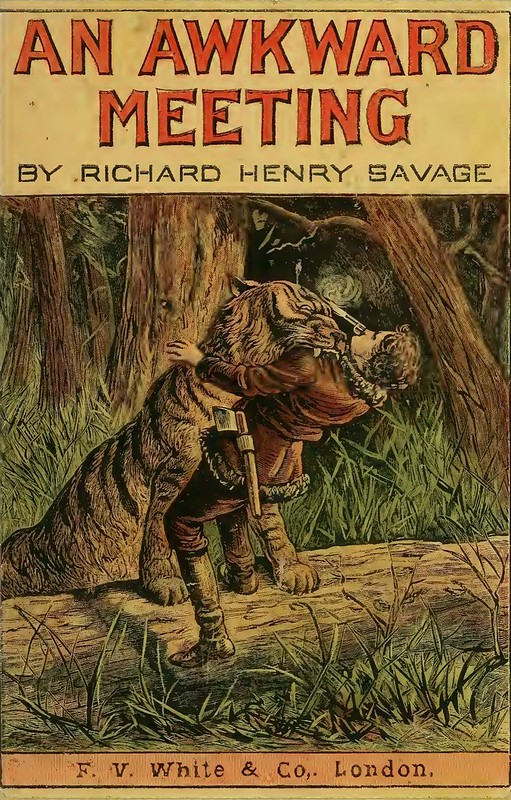
    The term “yellowback” was imported from Britain, where it was used to denote cheap, sensational railway novels; these appeared as a result of reciprocal developments in mass printing technology and the evolution of a reading public. In 1840s America, speculative “yellowback publishers” arose who, unrestricted by international copyright law, were able to pirate the British works. Cutthroat operators, these companies managed to put each other out of business before long, in a melee of price-cutting. Subsequent publishers, however, continued to produce cheap, paperbound editions, such as paperbacks and dime novels (West, 788-9).

    Typical yellowback cover image (1899). Source: Yellowback Cover Art, Flickr

    But back to East Boston, where at the end of the meeting, Cobb’s brother approached the lecturer. Cobb’s daughter resumes the narrative in her memoir:

    ‘Mister Emerson, did you ever read one of Mr. Cobb’s stories?’

    ‘No, sir!’ with a tone and look that implied that such a question was almost an insult.

    ‘And do you think it just and honest to hold up one of the most popular writers of the day as a representative of a certain class of objectionable literature, when, as you confess, you have never read a line of his work?’

    After some further conversation, Mr. Emerson said:–

    ‘Well, I confess that I may have erred in this matter in relying too much upon impressions, and I promise that the remark to which you object shall not be repeated until I am able to judge for myself whether or not it is just. I will read one of Mr. Cobb’s stories at my earliest opportunity. What one shall I read?’

    ‘It makes no difference,’ said Mr. Cobb; ‘select any of them and read.’

    About three months after this the two gentlemen met in the little den of Mr. James T. Fields, in the famous Old Corner Bookstore. After a mutually cordial greeting, and a few general words, Mr. Emerson looked Mr. Cobb in the face with a frank smile, and said:–

    ‘By the way, Mr. Cobb, according to promise I have read one of your brother’s novels, and I have ascertained that it is a fair representative of all his stories. While it is not in my line of reading, I confess that when once I had begun it I could not leave it unfinished. And it will be sufficient for me to say to you that I have never, since that East Boston lecture, nor can I ever again, hold up the stories of Mr. Cobb as an illustration of yellow-covered or merely sensational literature. In sentiment and language that story was not only unobjectionable, but elevating.’

    Ella Waite Cobb, A Memoir…

    High praise from a luminary of American letters, the man whom Nietzsche called “the most fertile author of this century” (qtd. Ratner-Rosenhagen, 5).

    One could quibble with Emerson over his use of “yellow-covered,” given that even at this quite established stage in Cobb’s career, with scores of serialized novels behind him, he had actually published barely any books as such. From the pen of the most prolific novelist in history, his daughter tells us, issued just one single book, which was “a memoir of his father, a duodecimo of four hundred and fifty pages, written in 1866” (A Memoir).

    The reason underlying this ironical circumstance is that Robert Bonner, his New York Ledger publisher, strictly maintained the rights to all Cobb’s work, for subsequent republication in the serial format. Cobb saw none of his novels in book form until late in life. His best known work, The Gunmaker of Moscow, his first contribution to the Ledger, serialized in 1856 — a novel that became almost as popular as Harriet Beecher Stowe’s Uncle Tom’s Cabin — did not appear in book form till 1888 (Hart, 99, 809).

    Apart from the obstacle to his “pet scheme” of publishing an actual book (see A Memoir 261), Cobb had no reason to complain, perfectly satisfied as he was with his agreement with Bonner. The contract required him to produce a “novelette every eight weeks and a minimum of two short pieces in a week”, and provided him with $50 per week for the next thirty years. A most satisfactory and indeed lucrative arrangement for “the first American one-man fiction factory” (Ljungquist 83).


    References

    Cobb, Ella Waite. A Memoir of Sylvanus Cobb, Jr. Boston, 1891.

    Hart, J.D. The Popular Book: A History of America’s Literary Taste (NY: 1950, OUP).

    Ljungquist, K.P. ed. Bibliography of American Fiction Through 1865 (NY: Facts on File, 1994).

    Norton, C. E. “The Intellectual Life of America”, The New Princeton Review 6 (1888) 312–324 (318). Available here on the Internet Archive.

    Ratner-Rosenhagen. J. American Nietzsche: A History of an Icon and His Ideas (Chicago: U of Chicago P, 2012).

    West, J. “Twentieth-century publishing and the rise of the paperback,” in Cambridge History of the American Novel, Vol. 3, 1860-1920, ed. Leonard Cassuto et al. (Cambridge: CUP, 2011).

    This work CC BY-SA 4.0