Category: Contemporary Fiction

  • Long Death Last Breath

    Long Death Last Breath

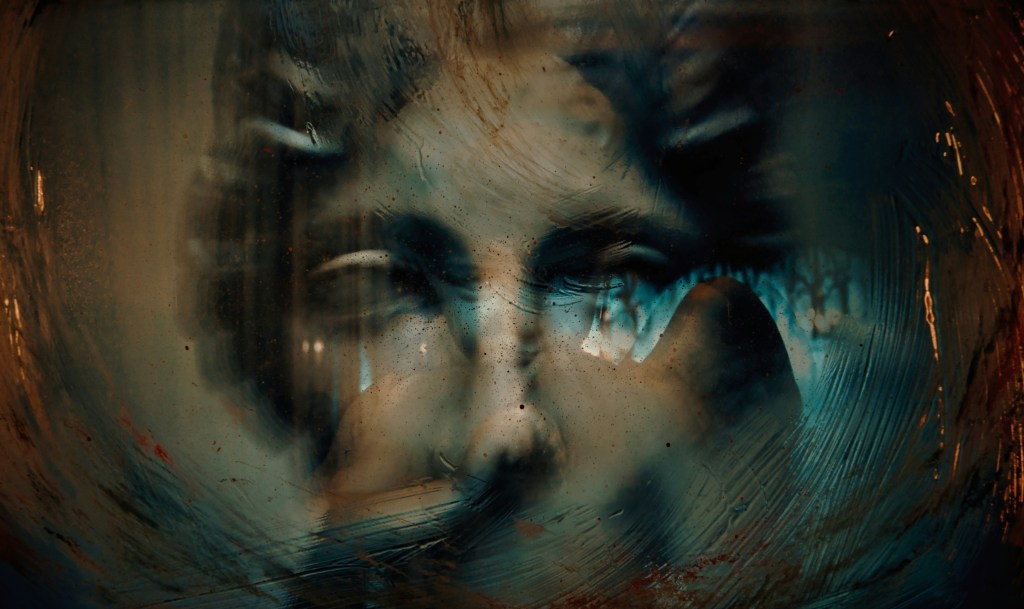
    Tony Reck’s Long Death Last Breath is a work of intense psychological fiction, written in a fevered, stream-of-consciousness style. It traces a man’s descent into obsession, self-harm, and moral disintegration, interwoven with moments of tenderness, delusion, and deferred violence. In support of its themes, the language itself destabilises: syntax stretches, referents blur. Some readers may find the story disturbing.

    ⁓ MG


    Long Death Last Breath

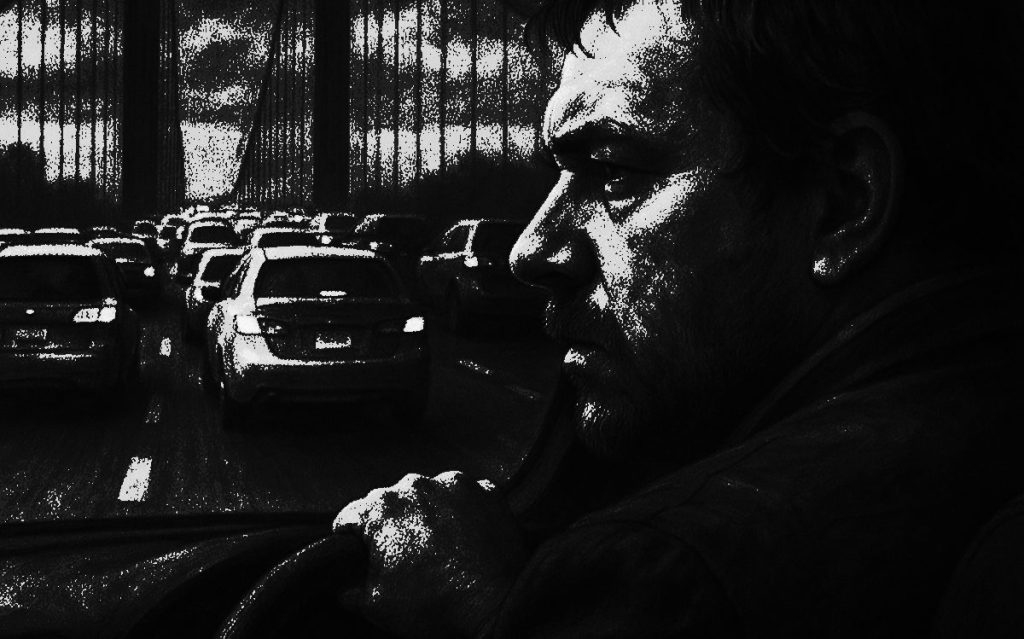
    Light reflected off the surface of the river and caused him to reflect; yes, memories of that house. But traffic on the bridge was thick and he forced himself to concentrate. Little Cindy and Loopy Sally were strapped into the rear seat. Little Cindy smiled and sighed; she was born with wisdom. Loopy Sally waited for her next opportunity. And if that meant waiting for her sister to fall asleep so she might dribble into Little Cindy’s ear, then so be it. He had driven across the bridge many times. One day he would stop. On that day, they would remember him forever.
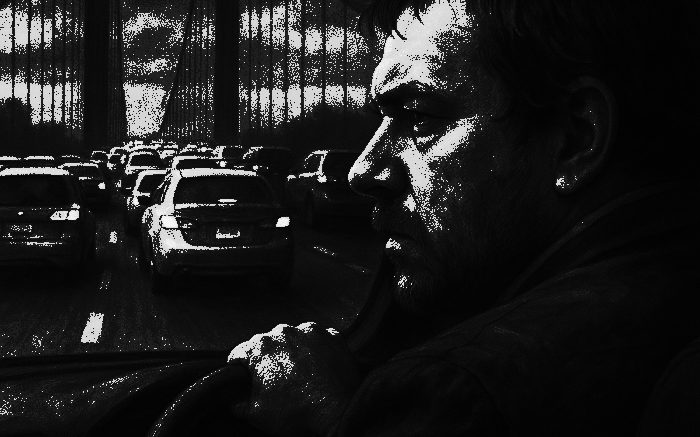
    The western suburbs of Melbourne sapped the required determination. He would speak with her and she with him. They would smile at one another, and the daggers would rise between them. The traffic cleared and he planted his foot as bitumen receded and an exit loomed. He turned left: a pizza joint: a pub: a supermarket: a dealer in antiques. Each establishment displaced by a windscreen that deferred his eventual destination.  

    The house that once belonged to both of them malingered half-way down the street. There she was, arms folded across her breasts. That shock of peroxide hair fractured at its ends, splitting every soul that sought entry to her home, and the home that Little Cindy and Loopy Sally lived in. Five minutes may as well have been five years. She would have her revenge simply because she could. That’s what love was: an acrobat fallen the wrong side of the net; a failed possession.

    ‘You’re late.’

    The children tumbled out of the car.

    ‘Inside.’

    The girls were gone.

    ‘This won’t go down well with the magistrate.’

    ‘You’re joking.’

    ‘No joke,’ She said.

    ‘Next week …?’

    ‘Not if I can help it.’

    He removed his daughters’ possessions from the vehicle: clothes, smart devices, a Monkey doll. It had three hands, twelve fingers and three thumbs. Each appendage excluded its other, but the formality of love betrayed was conspicuous between parents who hated one another. The front door followed the gate slammed shut. The moon was up and lunacy illuminated a wall.

    He slammed the door of his vehicle. A driver manic with fear – tyres whistled, an intersection loomed. He did not drive, he careered: experienced the lubricated shift of transmission; appreciated cylinders displaced, pistons tuned, and brake fluid mediated by the irascible edge of steel. He steered the vehicle beyond the shopping strip. A hard right onto the freeway, unnecessary speed, and he was back on the bridge. The city skyline strained a ventricle in his chest. Concrete, electricity, and pollution masquerading as cloud, distilled in his brain.

    He liked murder and murder liked him.

    Several days passed during which he performed the functions required of him. He answered the phone, ate his meals, attended work, and laughed with colleagues during designated breaks. But his laughter belonged to another and a voice infiltrated his ear. Later, he walked home and was obsessed by streetlight and a disturbance he believed was about to occur inside his unit on the 25th floor of the Brunswick St. commission flats. His unremarkable suit shone in the moonlight. He walked, smiled, and deliberated. He sang:

    Turn your mobile phone on.
    Your ID consists of sand.
    Feel the pulse of phallic-matrix
    vibrate in your hand.

    He had seen the light, and momentarily he was an angel. A Crown of Thorns encrusted around his head leeched blood from wounds that tasted like wine. But this inspiration was a flicker and he remained the creature he had always been: obese, effeminate, selfish, and inconsiderate. He sought retribution for the sin he believed had been committed against him. And as a sinner sinned against, the commission flat he occupied became a sign. Once inside, his desire for retribution would begin.

    Screaming was common on the 25th floor of the Brunswick St. commission flats. A cut-throat razor and an awl required sterilisation, while cotton thread might incite infection. But pain procured by a ten-centimetre incision inflicted upon his right hip was suppressed by a sock inserted between his teeth and a mega-dose of paracetamol. The day then passed in deference to the sin committed. That afternoon, Mary Kyrikilli called and questioned his commitment. He placated Mary’s presence and terminated her call. But Mary Kyrikilli was most insistent. She demanded he drive his vehicle across the bridge. Approximation would not suffice; the exact distance had to be ascertained. By evening, Mary Kyrikilli had persuaded him that he must complete this mission.

    Divinity accumulated within traffic lines that receded on the bitumen.  He braked: a car horn complained, patience was obliterated, and a driver abused him. But sufferance was to be expected from those critical of the divine, and he was saved from a broken nose by selflessness. (Give a sinner what he desired, and transcendence was his forever.) He alighted from his vehicle. An infusion of brilliance followed him to a safety platform. Disbeliever aside, no truth was more telling than that which emanated from within.

    He estimated the distance between bridge and river. (A document retrieved from his smart device had proposed fifty metres). But he remained sceptical of the digital realm because he believed it was populated by pedophiles, washed-up rock stars and other degenerates. The divine light would ascertain that which the digital realm failed to quantify; it accumulated in his oesophagus and descended toward the river. Fifty metres exactly, and never mind a document obtained online and tyrannised by an algorithm. The intelligence was artificial, but the bias was human.

    Exact distance obtained, he steered his vehicle toward an off-ramp. His left hand was on the steering wheel while his right hand caressed the suture on his hip. He suspected an oscillation had invaded his thoughts. But failed to recognise he was alone in this perception. Mary Kyrikilli had spoken: words: viscera: muscle: bone: marrow; each throbbed in time with his predicament. (His doctor was ambivalent when prescribing fentanyl; a dilemma resolved by a gathering of clinicians who, post-consideration of the patient and the wound inflicted, concluded he be certified then discharged him into the community.)

    Driving through the streets of Altona at night, he was once again obsessed by light. On this occasion, however, the luminosity resided beneath the waistline of his shirt. He muttered the word ‘Child’, but was immediately saddened by how the word presented itself. The vehicle dashboard was luminous, as was his crude incision. Two weeks old, tender and putrid, the suture vibrated. His vehicle sped past the previously mentioned pizza joint and its shopfront was made disingenuous by an extrusion of unlit neon.

    The antique dealership was also closed. (Nobody, not least his desecrated self, expected an antique dealership be opened at that time of night.) His car crooned, as would any vehicle emaciate before that which was inevitable. A hard left onto a minor arterial and there: his domain. Little Cindy and Loopy Sally were not simply his children: they were his ‘Child’. He had not liked the way in which the word had presented itself. But he muttered it again, until the offending noun was flushed beyond the driver’s-side window.  

    He parked his vehicle as did his vehicle park him: an organism comprised of flesh, blood, and viscera. Considered in reverse, he was a machine; or, perversely, tumescent flesh, iron-ore, and a crucible containing both, designed for the manufacture of neither. He sat there, headlights diminished, motor cooled, and listened to music – Stravinsky, although he could not say which work. He waited patiently, aware of that which he most desired. And when the opportune moment arrived, he capitalised.

    Immersion within the divine had damaged the wound on his hip and information assembled there became algorithmic. He stared through the windscreen and ruminated upon his children. Intelligence was autonomous: numbers calculated: code written: commands received. He had been unhappy with the word ‘Child’ as this had escaped his lips. But his suture concealed a radiance that only he could interpret; or, his tongue, a rendition of lithium, cobalt, carbon fibre and diode, unravelled from his mouth and sought release from his vehicle.

    He released the door-handle. The night was warm, and cloud carried precipitation from the west. A globule of rain found his nose. Madness was a tropic of the mind; a mind in Tropicana, so to speak. And if the suture on his hip existed, then reality was made, not procured. He scaled the high fence. The veranda was a minefield of bicycles, pot plants, a brutal mezzanine, and domestic despair. He was surprised that domestic despair persisted, for he mistakenly believed that despair, domestic or otherwise, belonged to him alone.

    Powered by the moon, he imagined he was a feline apparition and it occurred to him that entrance could be achieved in multiples: a door, a window, a floor, a ceiling. Ferocious, he crawled beneath the front doorstep. The underside of her home was not defined by cockroaches and beetles and, as precision was life, he crawled with ruthless efficiency. At 3.23 am he was capable of committing the atrocity required by the creature he had become and the phantasmagoria that consumed him.

    But he returned to his vehicle.

    The night had contracted to a greasy humidity. He had crawled beneath the floorboards of his ex-wife’s home and an excommunication was in order. The arterial was separated by a nature strip. He removed his clothes, hastened toward a sprinkler, and danced within the repeated thrusts emitted from an automated mechanism that cleansed perspiration from his arms, chest, legs, face and neck. Liberated, he returned to his vehicle, patted himself down with a dirty handkerchief, declined within the driver’s seat, and caressed the accelerator toward a poorly-lit intersection.  

    The next day came and went, as did the day that followed; an excess of light does that to a person. Ensconced within the kitchenette of his commission flat, he might have performed tricks: a deck of cards snapped to a flourish and a palmed ace apparently discovered behind his left ear; a card trick discouraged by his mother, but taught to him by his father. He might have performed tricks and thereby desecrated the memory of one parent but satisfied the demands of another. Rather, he sat, waited and ruminated. Five days later, Mary Kyrikilli had not called and his paralysis remained unresolved.

    He gazed beyond the kitchenette window as the sun disappeared behind a nearby apartment. The night progressed; he slept, and dreamed a candle luminescent ignited the entrails of a curtain. His dream erupted in flame. A window exploded outward and the offending protagonist was transported by ambulance to a hospital burns unit.

    His childhood had been spoiled by his parents’, but he was not a supernaturalist. He woke, and interpreted the dream as a sign.

    He was ready to kill; now, he would spread the word.

    Mary Kyrikilli pinged on his smart device. She did not crackle and click or advise him to commit atrocities. And she did not appear as a nightmare he had experienced fifty years earlier. Mary had become a slick communicator, a politician, and she made him fly upon dissertations of her disfigured shaman’s dreams.

    He was that flicker of light: the same flicker he had studied weeks earlier, when he had stopped his vehicle on the bridge and ascertained the exact distance between safety railing and river.

    And he considered himself a civic individual, even if he was about to murder his children.

    His vehicle ran a red light at St. Kilda Junction and Mary Kyrikilli communicated with him via the luminance within his right hip. He floored the accelerator. Perforated white lines disappeared into the darkness and the inner suburbs of the north east soon became the outer suburbs of the south west. An off-ramp; a pizza joint, a supermarket, an antique dealership. A right; a left, a right. He was the pathetic individual he had always been but the luminous voice that belonged to Mary Kyrikilli disavowed empathy. A poorly lit street faded to its inevitable conclusion, as he did to his.

    He alighted from his vehicle and it expired before his eyes. But he remained convinced its algorithm would crystallize and transport Little Cindy and Loopy Sally to their final destination.
    He threw himself over the high fence, crashed through a branch of Ti-Tree, and feared he may have woken Lucifer himself. He held his breath, and pressed his hands together in prayer. No alarm was forthcoming and the house remained dark. A side-entrance had been reinforced so as to prevent unauthorised access. But tools secured in a satchel were procured, and he flipped the latch with a tyre lever. Several years had expired since his failure to complete external renovations. But he interpreted the incomplete side-entrance as a sign that he remained welcome in the home he had destroyed.

    Little Cindy and Loopy Sally slept in the Little Room. He removed a screwdriver from his satchel and inserted its tip beneath a window. The window screeched. He retrieved a jar of petroleum jelly and lubricated the offending surface. Loopy Sally’s face upon a pillow was made luminous by moonlight, and Little Cindy’s breath exited her lips amidst a radiance that illuminated the Little Room.

    He woke Little Cindy.

    ‘Daddy.’

    A kiss on the cheek.

    ‘Get dressed.’

    She did.

    Eternity was anticipated.

    If we were meant to live forever this night would never end.

    Long death. Last breath. Expire.

    A dressing table installed within the room was a teak contraption. Two angular mirrors positioned left and right of a sheet of reflective glass revealed a triptych of the person he had never intended to be: a monster once a father who had since become a human being.

    Little Cindy returned to sleep.

    Loopy Sally was a light sleeper.

    She glared at her father.

    The new moon descended into the Little Room, aspiration was elevated, and malevolence diminished.

    He climbed out the window and returned to his vehicle.  

    Mary Kyrikilli was silent.  

    The dashboard radiated across his face.

    An algorithm calculated kilometres travelled and fuel consumed.

    His vehicle ascended an on-ramp.

    The skyline of the city of Melbourne was a Mohawk beneath the cavernous sky.

    The distance between safety-railing and the river had been ratified. The radiance he believed illuminated his right hip was nestled between flesh and bone. Traffic accumulated, but he was headed in the opposite direction. He stared beyond the Yarra River and across Port Phillip Bay. Maritime light flickered in time with his pulse. He looked out, and he looked down. He saw the faces of Little Cindy and Loopy Sally splayed across the surface of the river.

    Fifty metres.

    He looked out, and down, and in. To an observer standing on the deck of a boat, or the planet Venus, he was a man who scaled a protective railing; the father of two daughters who had taught him that the person he might have been no longer existed.

    A foghorn bellowed in the distance, and he was gone.  


    Tony Reck © 2025

    Images generated by AI

  • Nightshift

    Nightshift

    Driving through the streets of Fitzroy at night you become obsessed with streetlight and the sound of an imagined disturbance occurring in flat thirteen on the twenty-fifth floor of the Brunswick St. commission flats. In daylight, there is little to see but a urine stain on a tram shelter seat. An old stiff with a grey beard named Jimmy calls to you unintelligibly from the other side of the street. You wish you were somewhere else; perhaps wandering along a path beneath a mountain in the bush…

    But no.


    You are up against a brick wall. Forever waiting to be released from the pain that is synonymous with the stiff named Jimmy who sits the day out on Death Row while trams travel along gentrified Gertrude St.

    Jimmy isn’t a bad man, but he’d snip you for twenty dollars if he could. He sits in his tram shelter, one foot across a thigh, digging splinters of glass out of the soles of his bare feet. The memories emanating from the grey hair covering his scalp are all he has for company. Nobody bothers about old Jimmy, so he creates imaginary friends in order to deflect the pain circulating in his head.

    Jimmy once drove a cab at night. One morning, when the encroaching daylight had washed another junkie’s brains into the gutter, he drove home and had breakfast. While sitting at the kitchen table he saw what he believed was a worm wriggling in his buttered toast. He placed a finger in the marmalade jar and dabbed a touch of ginger in the direction of the worm’s mouth. It promptly slurped the marmalade off his finger, smiled, and in Jimmy’s mind, thanked him for the secretion. The worm then crawled beneath his fingernail and entered his bloodstream through a crack in his skin. Jimmy quietly explained this to his mother; she blessed herself, kissed her son between the eyes, then made him a dish of pear and pineapple pieces hoping that something fruity would prepare her son for the nightshift.

    After breakfast Jimmy read the Neos Kosmos. As the heat of the afternoon drew near he retired to his bedroom and studied an old high school history report. He dropped off to sleep riding the gratification obtained from reading a comment his teacher had made:

    ‘Jimmy is a very bright boy who does no work.’

    As he dozed the worm that he believed had earlier entered his bloodstream fused with the memory of Mrs. Logan’s words until a further sentence was tacked onto the end of the history report:

    ‘Jimmy is a very bright boy who does no work. For punishment, he must clean up the streets.’

    His mother woke him at 4.00 pm. She knocked on his bedroom door then marched into his room and checked him for dysentery. (Her husband had been killed fighting the fascists in the mountains of Northern Greece. He had been a Greek resistance fighter, who, when captured by the Italians, had been forced to sit unchecked in a cell for nine months until an Italian soldier had walked in one morning unannounced and asphyxiated the prisoner using Jimmy’s father’s own excrement. Since the knowledge of that foul act had reached Jimmy’s mother she had remained petrified by the presence of faecal matter. She sensed it everywhere: under the stairs, in the refrigerator, hiding out surreptitiously under the model bridge Jimmy had constructed in the backyard of their home and which acted as a monument over the fish pond he had built in memory of his dead father). Jimmy was free of dysentery, but the worm that he believed had burrowed beneath his fingernail earlier that day had increased in size during the five hours he had been asleep. He now heard and felt Mrs Logan’s command circulating in his arteries and forcing its message through veins, onto blood vessels; which then pumped her command into each muscle of Jimmy’s body until his arms, legs, head, toes and feet were ready to put this command to work and quote:

    ‘…clean up the streets.’ Unquote.

    Later, Jimmy sat at the kitchen table, breadcrumbs clinging to the sleeve of his shirt, gazing at his features in a handheld mirror his menopausal mother had once used when plucking her eyebrows and waxing her bikini line.

    His mother entered the kitchen through a rear door with orange worry beads clasped in her left hand and muttering ‘Hail Mary’ in unorthodox Greek; this was Jimmy’s cue to hit the street. He placed the mirror on the kitchen table and dismissed the furrowed brow that now followed him through the flywire door — Jimmy unaware of its presence between his black Kalamata eyes — and into Vere St.

    Outside, a local street urchin dangled the entrails of a ginger tom cat on a bamboo stick, saw Jimmy, twirled the mess several times, and released it. The entrails slapped on the driver’s side windscreen of Jimmy’s Silver Top Holden Kingswood.

    Jimmy could have murdered the child; indeed, should have murdered the child. This kid, along with all the other kids that played in Jimmy’s region, who refused to play anywhere else, was a constant reminder of his semiconscious desire to kill off ‘The Child’. If Jimmy wanted to achieve this ambition he would have to transcend himself and become a red-eyed battalion of tungsten, human protein, and simple stainless steel, put together and integrated with various weaponry, some obvious, some not so, into a two tone, white hot, come as you are to the party killing machine.

    The sun slithered across the roofs of houses and all its grace and splendour was lost in sawtooth alcoves and sheets of rusty corrugated iron. Jimmy held the ginger tom’s entrails in one hand while its pancreas remained lodged between the taxi’s wiper blade and windscreen. He hurled the entrails after the retreating child then lunged for the pancreas with the intention of removing it. Unluckily for Jim his intellectual faculty kicked in and he was quietly impressed by the proud pancreas’ emanating theoretical value. As the saying goes, and this is not one I would use in any other context I assure you, Jimmy was about to ‘Bust his Pooper’.

    The worm, which that morning had slipped beneath Jimmy’s chipped fingernail and manoeuvred its way into his bloodstream, penetrated his mind. He now believed it had receded, recidivist worm that it was, into the compartment in his brain that contained traces of zinc, iron oxide, lead, sulphur and bauxite, and which had been secreted there by the monumental amount of illicitly made amphetamine Jimmy had injected in a previous attempt at killing off ‘The Child’. With worm and heavy metals in tow — and an undissolved preservative attached to a jelly crystal he had eaten as a child — Jimmy was ready to inflict harm upon the nearest pederast he could find.

    The sun was completely hidden in alcoves and side streets as the nightshift began with ginger tom’s pancreas flapping insistently on the windscreen; a constant reminder to Jimmy of the fun filled days he had been forced to spend with his mother. All of which culminated in a desire to whip the blade of his paint scraper across the carotid artery of ‘The Child’.

    A voice cackled into life on the two-way radio. It was Mary Kyrikilli, the depot manager’s wife. The job involved picking up an elderly couple in Surrey Hills wanting a lift to the over seventy five’s dance in Canterbury. What Jimmy heard was this:

    ‘You have a function to fulfil at 666 Fitzroy St. St. Kilda. Be quick, for the scum is sliding off the street and receding into drains then catching the first train to outer Elsternwick. We applaud your meticulous preparations for performing the task of killing ‘The Child’. We respect your commitment to cleaning up the streets and replacing unredeemed low life with flesh powered by pink spark plugs. We recognise your brain’s ability to assimilate organic material, heavy metal, and static electricity. We admire the organism you have become Jimmy: your quilled fingers, tungsten breastplate, metal teeth, and plumber’s worm for a tongue. We implore you to unleash this flexible spike from your mouth and reach into the decadent minds of the scum who surf Fitzroy St. You are the future Jimmy… Do you read me?’

    Mary’s voice fractured into an orangutan’s outraged scream that pierced Jimmy’s skull, ramming the shears into the soft skin beside his forehead. His eyes crackled with green intensity. He pressed the cab’s accelerator to the floor, picked up the receiver, and responded to Mary’s call:

    ‘Clear as the night sky seen from the planet Venus.’

    
His cab rocketed past a sex shop in Smith St. just as its pot-bellied, red moustached proprietor stepped out for a breather.

    ‘That’s odd.’ The proprietor lit a cigarette and inhaled deeply. ‘There’s a cab without its lights on.’


    Excessive exposure to the Kama Sutra, jet-propelled semen, and pink pelvic interiors pierced by nuts and bolts, wooden pegs, and surgical steel curtain rings eventually overwhelm the most sophisticated thinkers. The proprietor stepped back inside, but not before carelessly flicking his half-finished cigarette into the sky — and there it remained, frozen. The city skyline wheezed while in St. Kilda, Fitzroy St. seethed with discontinuity and shallow breathing as Jimmy’s murderous thoughts sharpened the shears.

    Number six hundred and sixty-six Fitzroy St. was a Malaysian Hawker’s joint. The restaurateur and a Labrador-Deerhound cross he kept in a kennel in the kitchen studied Jimmy with similar expressions when he walked into the restaurant and proclaimed he was on a mission from Mary. The restaurateur shrugged:

    ‘Sorry. Not on the menu here.’

    Then resumed tossing squealing noodles, broccoli, and tofu in a wok. In his left ear Jimmy heard the depot manager’s wife and temporary radio operator Mary Kyrikilli. She sang a song he remembered singing in primary school. The words were unfamiliar: a jumble of disconnected nouns, verbs and present tenses, but Jimmy recognised the tune. His mother had hummed the same tune while sitting in a chair as she tried to conceal from her infant son the homesickness and accompanying despair she felt for the mountains of Northern Greece.

    Jimmy’s vision of the Labrador-Deerhound’s curling upper lip, revealing pink gristle and canines capable of inflicting a serious incision, was blurred by melancholic feelings rising through his gullet and intersecting with Mary Kyrikilli’s pursed lips whispering in his ear. The restauranteur slipped his hand beneath the dog’s frothing muzzle, grabbed its leather collar, and demanded Jimmy exit the premises post haste. Instead of ramming the shears as he had planned, Jimmy turned and stepped onto Fitzroy St.

    Next door, a fight erupted in the bar of the Prince of Wales Hotel, and spilled out over cascading chairs and tables onto the footpath.

    Jimmy became involved in the fracas.

    The bouncer, a bald-headed gorilla, stomped up and down on Jimmy’s head until a member of the Scottish clan celebrating St. Andrew’s Day in the bar intervened, and hit the bouncer with a Bolo combination that cracked the bouncer’s rib and broke his nose.

    The other Jocks drinking portergaffs at the bar broke into a chant for Glasgow singing:

    ‘Here we go… Here we go… Here we go…’

    But their striker’s score on the bouncer was soon equalised by a door bitch well versed in Zen Do Kai, sadism, and the cultivation of azaleas.

    In retaliation, she KO’d Jimmy with a Liverpool Kiss.

    Jimmy sat cross-legged amid the chaos, losing blood from his right ear, and pleading for help to find his glasses. He was unable to do so, and feeling rather discontent, until one of the Scottish revellers finally bought him a beer.

    ‘There you are my good man…’, said Jock to the unremitting Jimmy. ‘Drink up, for you are about to meet your maker.’

    He walked down Fitzroy St. dressed in his stove pipe suit. When he reached The Esplanade the sound of waves breaking on St. Kilda beach accumulated in his mind. He sat down on the dirty sand, stared across Port Phillip Bay, and saw a silhouette of the You Yang Range in the night sky. He pulled his beanie over his eyes and saw an image in his mind of a man not unlike himself. That man wore a tungsten breastplate emblazoned with a moving image of the Serengeti Plain. Jimmy now believed that he was wearing a tungsten breastplate that contained a moving image of the Serengeti Plain. Then, in spite of the worm beneath his fingernail, and the cat entrails on the windscreen, Jimmy murdered ‘The Child’.

    He had wanted to go to the milk bar and buy another ice cream, but his mother had disallowed it, so he had placed a chair beside the window in his bedroom, stood on the chair, and beat his little fists upon the pane of glass until it smashed. He had seen the ice cream stick in his mind, sailing through the sewer beneath the suburb he had grown up in, while hiding under the bed and staring at his mother’s bare legs as she tried to coax him into the open. But Jimmy had refused to come out from under the bed under any circumstance for he knew this meant a beating, so his mother had sent the straw broom under the bed in an attempt to dislodge him. He felt the scratch and tickle, the rip and sickle like feature of sharp straw upon his bare thigh. He squeezed further into a hole between the bed and the wall and slashed his elbow open on a protruding bed spring. He cried and his mother screamed, while the real culprit leant against the wall. The straw broom, diffident, composed, quietly calculating the amount of blood the boy’s wound had sprayed upon its handle.

    On the night of his breakdown, Jimmy struck fourteen people on the head with an engineer’s hammer. When his cab sideswiped a telephone pole in Richmond he ripped a piece of metal from the cab’s rear door and tried to dig that worm out of his ear. A gardener found him in the Botanic Gardens at 8.30 am with the metal shard protruding from the wound in his head. The worm was nowhere to be seen, but Jimmy had mumbled something about a bloated maggot wriggling down Batman Ave. toward Flinders St. According to Jimmy, his extraterrestrial partner had boarded a train, gained six kilograms on the trip by eating leftover packets of potato chips, then got out in Ringwood.

    Jimmy was sentenced to three and a half years in jail, during which he was raped by one inmate, beaten by two, and poleaxed by a screw. Upon his release into the community he lived with a fervour only countered by the ecstasy derived from watching an Old English Sheepdog urinate against a pole. Yet Jimmy did not complain, or if he did, then it was a complaint directed inward — to that black hole he has remained in for the past twenty years.

    Jimmy sucks hard on a cigarette butt. A tram stops alongside his shelter in Gertrude St. He is preoccupied with swatting flies in and around his beard, but the combined stare of the tram cuts him to the quick and he is invigorated.

    ‘Come ’ere…’, Jimmy says.

    He waves an alighting passenger in his direction, hoping to score a fag or some coins for a bottle of turps, but the elderly woman blows disgust at him then disappears into a Voluntary Helpers shop to do her bit for charity. Jimmy’s moment of clarity dissipates in his air of lost connections.

    I watch Jimmy from across the street, sitting in his tram shelter, one foot across a thigh. I am aware of a certain similarity that exists between us.

    Turpentine is not my poison, but living is.

    His mother is asleep in the bedroom of her commission flat. She dreams of water sliding over rocks that cascades into a silent pool. Alongside one another Jimmy and his mother sit waiting for the Achilles Laura to sail back home to Greece. Outside, she can hear Jimmy’s voice, or another voice belonging to one of the hundreds of stiffs on Death Row, sitting in tram shelters on cold nights, sleeping beneath the All Ordinaries Index printed on daily newspapers, or simply fighting off the demon that is Mary Kyrikilli emanating from a microchip Jimmy believes has been implanted in his cerebellum.

    From the twenty-fifth floor of the Brunswick St. commission flats there is only the night sky. The stars try to force the clouds apart, but it is the clouds that contain the pain scintillating in Jimmy’s mother’s mind. She lies on her back in the dark, listening to the tick of an alarm clock, along with her son, sitting in a tram shelter in Gertrude St. He shouts obscenities directed at nobody in particular, yet which she feels are reserved for her. She cannot go out and embrace him or bring him in for moussaka; he is lost to her. He screams:

    ‘Come ’ere gamisou…. La, la, la…’

    His mother takes earplugs from the drawer beside her bed and inserts these into her ears to deaden the obscenities.

    All is quiet at 3.53 am.

    This is the son she was unable to love who has returned to torment her.

    When the early birds rise the squeak they make is an expression of ornithological glee at the penetration of a starling’s beak into the green heart of a cicada. Jimmy’s mother wakes, hurries to the kitchen, and prepares a Turkish coffee.


    NIGHTSHIFT by Tony Reck © 2025

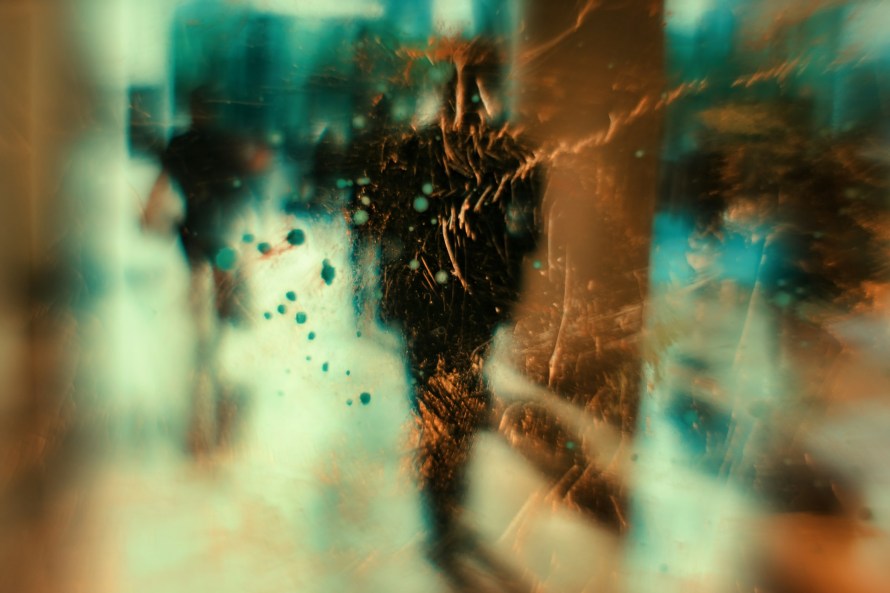
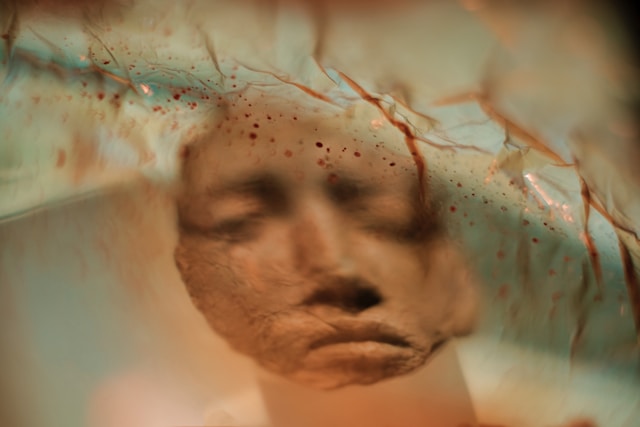
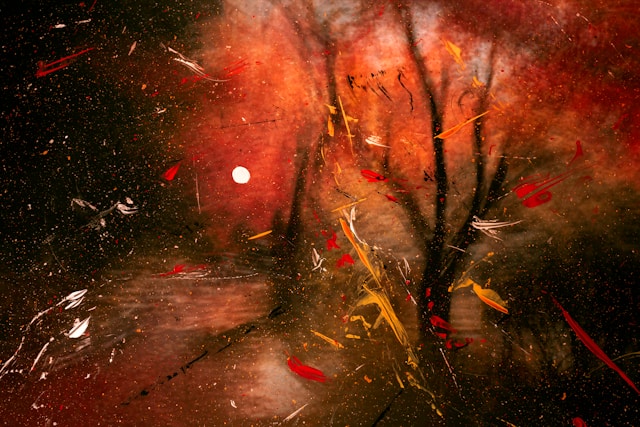
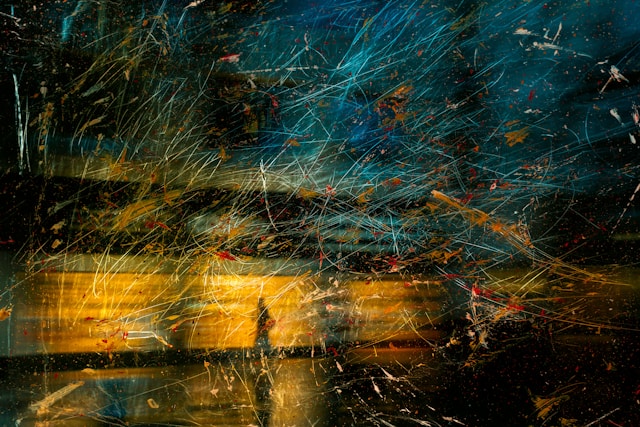
    Selected photographic art is by Jr Korpa, a prominent photographer based in Spain, at Unsplash | @jrkorpa. His surrealistic vision echoes the fractured streets and restless minds within Tony Reck’s narrative. See more of Jr Korpa’s work at jrkorpa.com