Category: Cobb Biosnips

  • Cobb Biosnip: Laborare est orare

    Cobb Biosnip: Laborare est orare

    Knowing nothing of Sylvanus Cobb Jr’s work, let alone the writer himself, Emerson did not realize the offense his remarks would have caused Cobb’s brother (see “Cobb Biosnip: No Yellowbacks“). In her memoir, Sylvanus’ daughter Ella Waite Cobb omits to mention which brother it was. Sylvanus Jr., the eldest, had six (one of whom had died at ten years of age) as well as two sisters.

    Cobb’s immediate family was definitely among the most righteous and upstanding in the United States, and would have taken great umbrage at the idea that Cobb’s writing was mere vulgar sensationalism.

    The novelist’s father, Reverend Sylvanus Cobb, D.D. (1799-1866), a Massachusetts clergyman, is described as “the most important Universalist reformer before the Civil War” (Harris 117). In 1839 he founded the Christian Freeman, an influential anti-slavery, pro-temperance religious publication, and was active in seeking reform.

    His wife, Eunice Hale Waite Cobb (1803-80) was a  public speaker in support of temperance and social welfare. She contributed articles and poetry to Universalist publications, and was the first woman ever to do so. In Boston, she founded the first woman’s club in America, one dedicated to health and fitness, the Ladies’ Physiological Institute (1848-1996).

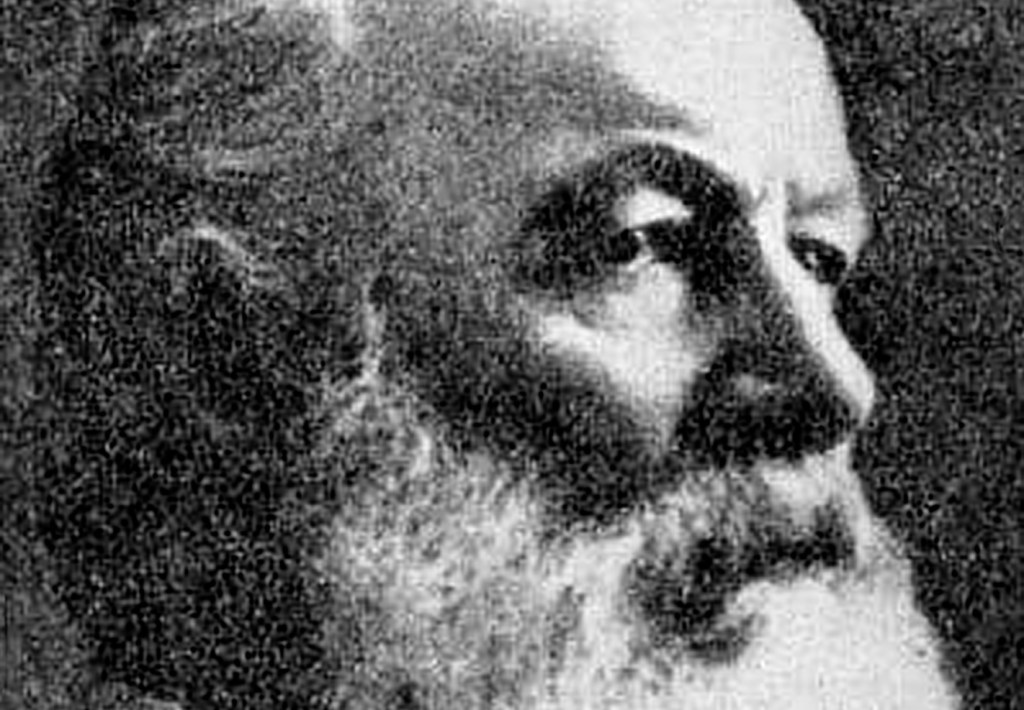
    Eunice Hale Waite Cobb. Source: Wikimedia Commons

    The prodigious Cobb twins were as industrious. Cyrus Cobb was an accomplished mathematician, lawyer, writer, poet, sculptor and musician. Darius Cobb achieved fame as a painter, and was, as well, a noted “musician, singer, poet, lecturer, lithographer, and art critic” (“Darius Cobb“, Wikipedia).

    Virtual doppelgangers, the two were not only identical in appearance, but also in intellect, personality, tastes and abilities. Darius said, after Cyrus’ death that:

    No person could tell the difference between our photographs, and very few between our persons. If he were to deliver a lecture, I could step in and fill his place exactly. If I were conducting music, he could take up my baton at any point and carry it out to the end, and no one could see the difference. If either were to play the violin, the other could substitute for him absolutely.

    The Cobb Brothers,” Cambridge Tribune, 18 April, 1903

    Reverend Cobb’s adherence to Freemasonry was concomitant with his family’s extraordinary allegiance to hard work, if not fundamental to it. He was the founding chaplain of the first lodge instituted in Boston, after a period of anti-Masonic agitation, against which he worked vehemently, and of course, tirelessly. In his capacity as a member of State Legislature, he saved the Freemasons from abolition in Massachusetts.

    Of the sons who followed him into the organization, including the twins, Sylvanus Jr. is the best remembered by the fraternity:

    He served as Worshipful Master of the Lodge for five years. He was also a member of Norfolk Chapter, Royal Arch Mason and served as High Priest, a member of Hyde Park Council Royal & Select Masters serving as Thrice Illustrious Master and Cyprus Commandery Knights Templar where he was the Eminent Commander.

    Today in Masonic History: Sylvanus Cobb, Jr. passes away,” Masonrytoday.com
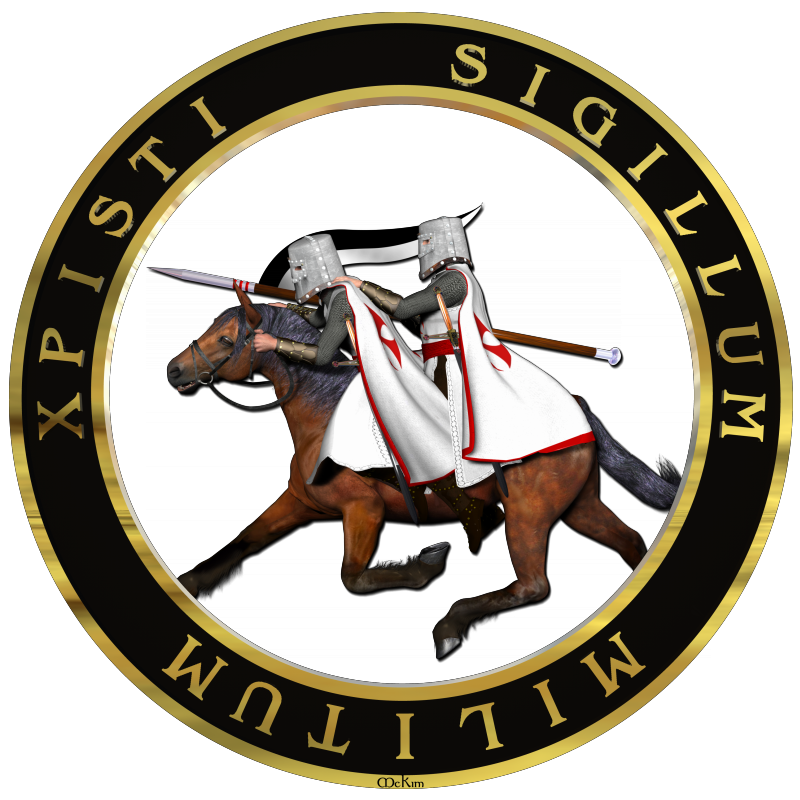
    Knights Templar seal. Latin motto translates to “Seal of the Soldiers of Christ” (Source: Png Guru; reproduction permitted)

    It is a tenet of Freemasonry that, in emulating the example of God as the grand architect of the universe, men are the makers of themselves, and that

    to labor well and truly, to labor honestly and persistently, is the object and chief end of all humanity.

    Mackey

    Laborare est orare. After the wisdom of the monks of the Middle Ages, Freemasons hold that labour is itself a mode of worship (Mackey).

    Cast in this mould, Cobb and his family would have considered his writing as humanitarian service, far from the low realm of the yellowback; rather, a manifestation of uplifting and formative moral values. And prime among these values, the noble aim of living by the sweat of one’s brow.

    Cobb uses Masonic symbolism overtly in some works. The Caliph of Baghdad is listed in the Encyclopedia of Freemasonry as “the most widely read of Masonic novels” and is reputedly a vault of Masonic symbolism, “all of which is instantly recognisable to Masons who have been exalted to the Royal Arch Degree.” The novels AlaricThe Mystic Tie of the Temple (evidently an earlier title of the Caliph of Baghdad) and The Keystone were published in the New York Ledger, from 1858 to 1874 (Mackey).

    Following the examples of his mother and father, Cobb actively supported social reform in the areas of slavery, suffrage and temperance. He first addressed anti-slavery meetings in 1852, and in 1864 was elected president of a Union League he had helped establish. After the commencement of the civil war, he was made Captain of a light infantry company of the Maine Volunteer Militia, but saw no active service (Ella Waite Cobb, A Memoir…).

    In the temperance publication The Rechabite, of which he was editor, he draws on his recent experience on an American man-of-war:

    The very foundation upon which rests its present mode of operation, is RUM! This may be deemed, by some, an unwarrantable assertion; but we say it calmly and understandingly — we have been there, and we know.

    Rechabite 1846-7; qtd. A Memoir…

    Cobb’s quiet subtext, by which he seems to acknowledge a demon of his own, is borne out subtly in his daughter’s memoir. She records how in 1869, he became a member of the Sons of Temperance, an organization for temperance and mutual support, for whom he lectured:

    He cherished a warm admiration for the man who could stand firm in the face of temptation and say No; and he had reason to do so; but also, from the depths of his heart, he had reason to sympathize with the man who could not always resist temptation. His own struggle extended from boyhood to death. One enemy ever hovered near him, and was ever ready for the fray. At times the battle turned against him, and a cloud, black and ominous, enshrouded him: but he never failed to rise to the light.

    A Memoir…

    Notes and References

    • Cobb’s immediate family: “The Cobb family was a large and important New England clan (see Philip Cobb’s A History of the Cobb Family, Cleveland:1907). The main branch of the Cobb family descended from Ebenezer and Elizabeth Cobb, both of whom were descended from Elder Henry Cobb who arrived in America on the second voyage of the Mayflower.” “Cobb Family Papers“. Syracuse University Libraries, Special Collections Research Center.
    • saved the Freemasons from abolition: See, for example, Cobb, Autobiography
    • Union League: “…also called Loyal League, in U.S. history, any of the associations originally organized in the North to inspire loyalty to the Union cause during the American Civil War. During Reconstruction, they spread to the South to ensure Republicans of support among newly enfranchised blacks.” Encyclopedia Britannica.
    • Rechabite: “(in the Bible) a member of an Israelite family, descended from Rechab, who refused to drink wine or live in houses (Jer. 35). /
      a member of the Independent Order of Rechabites, a benefit society of teetotallers, founded in 1835″ (Lexico.com)

    Cobb, Ella Waite. A Memoir of Sylvanus Cobb, Jr. (Boston: C.L. Peters and Son, 1891).

    Cobb, Sylvanus. Autobiography of the first forty-one years of the life of Sylvanus Cobb, D. D., to which is added a memoir, by his eldest son, Sylvanus Cobb, jr. (Boston: Universalist Publishing House, 1867). Jump to file at Internet Archive.

    Harris, Mark W. The A to Z of Unitarian Universalism (Lanham: Scarecrow Press, 2009).

    Heimbichner, C. and Adam Parfrey. Ritual America: Secret Brotherhoods and their Influence on American Society: a Visual Guide. (n.p.: Feral House, 2012). Entry on Caliph of Baghdad.

    Mackey, Albert G. The Symbolism of Freemasonry Illustrating and Explaining its Science and Philosophy, its Legends, Myths and Symbols (South Carolina: Albert G. Mackey, 1882). Available at guttenberg.org. Jump to file.

    “Encyclopedia of Freemasonry and its Kindred Sciences.” phoenixmasonry.org. Jump to page.

    Records of the Ladies’ Physiological Institute, 1848-1996.” Hollis Archives, Harvard U.

    Further reading, reference
    Creative Commons License
    This work is licensed under a Creative Commons Attribution-ShareAlike 4.0 International License.

  • Cobb Biosnip: No Yellowbacks

    Cobb Biosnip: No Yellowbacks

    Some years after Cobb began writing for the New York Ledger, Ralph Waldo Emerson delivered a public lecture in East Boston. The honour of introducing him happened to fall to one of Cobb’s brothers. On the subject of modern literature, Emerson made a contemptuous mention of “yellow-covered literature of the Sylvanus Cobb, Jr. stamp.”

    He was referring to so-called “sensational literature,” as opposed to substantial matter. “To what base uses we put this ineffable intellect! To reading all day murders & railroad accidents, & choosing patterns for waistcoats & scarves,” he wrote in his journal of May 1852. The social critic Charles Eliot Norton voiced his similar dismay a few years later in reference to popular publications, which he considered to be consumed by

    a horde of readers who seek in them […] the gratification of a vicious taste for strong sensations; who enjoy the coarse stimulants of personalities and scandal, and have no appetite for any sort of proper intellectual nourishment.

    “The Intellectual Life of America” (1888)

    The term “yellowback” was imported from Britain, where it was used to denote cheap, sensational railway novels; these appeared as a result of reciprocal developments in mass printing technology and the evolution of a reading public. In 1840s America, speculative “yellowback publishers” arose who, unrestricted by international copyright law, were able to pirate the British works. Cutthroat operators, these companies managed to put each other out of business before long, in a melee of price-cutting. Subsequent publishers, however, continued to produce cheap, paperbound editions, such as paperbacks and dime novels (West, 788-9).

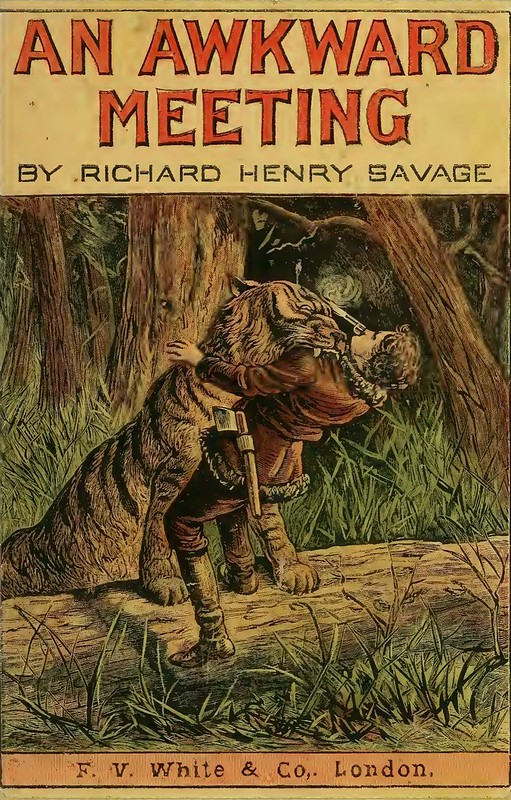
    Typical yellowback cover image (1899). Source: Yellowback Cover Art, Flickr

    But back to East Boston, where at the end of the meeting, Cobb’s brother approached the lecturer. Cobb’s daughter resumes the narrative in her memoir:

    ‘Mister Emerson, did you ever read one of Mr. Cobb’s stories?’

    ‘No, sir!’ with a tone and look that implied that such a question was almost an insult.

    ‘And do you think it just and honest to hold up one of the most popular writers of the day as a representative of a certain class of objectionable literature, when, as you confess, you have never read a line of his work?’

    After some further conversation, Mr. Emerson said:–

    ‘Well, I confess that I may have erred in this matter in relying too much upon impressions, and I promise that the remark to which you object shall not be repeated until I am able to judge for myself whether or not it is just. I will read one of Mr. Cobb’s stories at my earliest opportunity. What one shall I read?’

    ‘It makes no difference,’ said Mr. Cobb; ‘select any of them and read.’

    About three months after this the two gentlemen met in the little den of Mr. James T. Fields, in the famous Old Corner Bookstore. After a mutually cordial greeting, and a few general words, Mr. Emerson looked Mr. Cobb in the face with a frank smile, and said:–

    ‘By the way, Mr. Cobb, according to promise I have read one of your brother’s novels, and I have ascertained that it is a fair representative of all his stories. While it is not in my line of reading, I confess that when once I had begun it I could not leave it unfinished. And it will be sufficient for me to say to you that I have never, since that East Boston lecture, nor can I ever again, hold up the stories of Mr. Cobb as an illustration of yellow-covered or merely sensational literature. In sentiment and language that story was not only unobjectionable, but elevating.’

    Ella Waite Cobb, A Memoir…

    High praise from a luminary of American letters, the man whom Nietzsche called “the most fertile author of this century” (qtd. Ratner-Rosenhagen, 5).

    One could quibble with Emerson over his use of “yellow-covered,” given that even at this quite established stage in Cobb’s career, with scores of serialized novels behind him, he had actually published barely any books as such. From the pen of the most prolific novelist in history, his daughter tells us, issued just one single book, which was “a memoir of his father, a duodecimo of four hundred and fifty pages, written in 1866” (A Memoir).

    The reason underlying this ironical circumstance is that Robert Bonner, his New York Ledger publisher, strictly maintained the rights to all Cobb’s work, for subsequent republication in the serial format. Cobb saw none of his novels in book form until late in life. His best known work, The Gunmaker of Moscow, his first contribution to the Ledger, serialized in 1856 — a novel that became almost as popular as Harriet Beecher Stowe’s Uncle Tom’s Cabin — did not appear in book form till 1888 (Hart, 99, 809).

    Apart from the obstacle to his “pet scheme” of publishing an actual book (see A Memoir 261), Cobb had no reason to complain, perfectly satisfied as he was with his agreement with Bonner. The contract required him to produce a “novelette every eight weeks and a minimum of two short pieces in a week”, and provided him with $50 per week for the next thirty years. A most satisfactory and indeed lucrative arrangement for “the first American one-man fiction factory” (Ljungquist 83).


    References

    Cobb, Ella Waite. A Memoir of Sylvanus Cobb, Jr. Boston, 1891.

    Hart, J.D. The Popular Book: A History of America’s Literary Taste (NY: 1950, OUP).

    Ljungquist, K.P. ed. Bibliography of American Fiction Through 1865 (NY: Facts on File, 1994).

    Norton, C. E. “The Intellectual Life of America”, The New Princeton Review 6 (1888) 312–324 (318). Available here on the Internet Archive.

    Ratner-Rosenhagen. J. American Nietzsche: A History of an Icon and His Ideas (Chicago: U of Chicago P, 2012).

    West, J. “Twentieth-century publishing and the rise of the paperback,” in Cambridge History of the American Novel, Vol. 3, 1860-1920, ed. Leonard Cassuto et al. (Cambridge: CUP, 2011).

    This work CC BY-SA 4.0

  • Cobb Biosnip: Naval Stint

    Cobb Biosnip: Naval Stint

    In 1841 Sylvanus Cobb, Jr. left his job running the printing office for his father’s denominational newspaper, the Christian Freeman, to sign up with the US Navy. Seventeen years of age, he passed himself off as twenty-one, to join the crew of the USS Brandywine on May 31 as a “ship’s guard.” Cobb senior was clearly acquiescent, meeting his son on board two weeks later, with a warm greeting and “all the affection of a fond parent” (Cobb’s diary, qtd. in A Memoir of Sylvanus Cobb, Jr.)

    Brandywine, a 44-gun, three-masted, wooden-hulled frigate, previously named Susquehanna, had the honour in 1825 of returning the Marquis de Lafayette, fighter for the American revolution, to France. She was renamed to commemorate the September 1777 Battle of Brandywine, in which Lafayette sustained a gunshot wound to the leg.

    In June the Brandywine sailed for the Mediterranean, arriving a month later:

    On the morning of the 24th of July we saw the coast of Portugal, and about noon entered the river Tagus, and after passing numerous beautiful villas and vineyards, and ‘Old Bellum Castle’ which is a specimen of the old fortifications of the Spanish and Portugese […] we came to anchor off the city of Lisbon…

    Upon our left lies the city of New Lisbon. On our right rises a high, perpendicular precipice, capped by a few old ruins, the only vestige which remains of the ill-fated city of Old Lisbon; and right beneath us, at the depth of about thirty fathoms, lie the ruins of the city, which was destroyed in 1755, by a tremendous earthquake … (qtd. A Memoir…)

    After his transfer to the sloop-of-war USS Fairfield in 1842, the young Cobb’s diary entries continue to express his enchantment with Europe.

    Ha! ha! What a glorious cruise have we before us! Now in Mahon, from here to Marseilles, Leghorn, Naples, Toulon, Trieste, Venice, Athens, Tunis, Tripoli, Algiers, touching at all the intermediate places. Ah! I forgot Corfu and Palermo. Ah! And also Civita Vecchia and Messina.

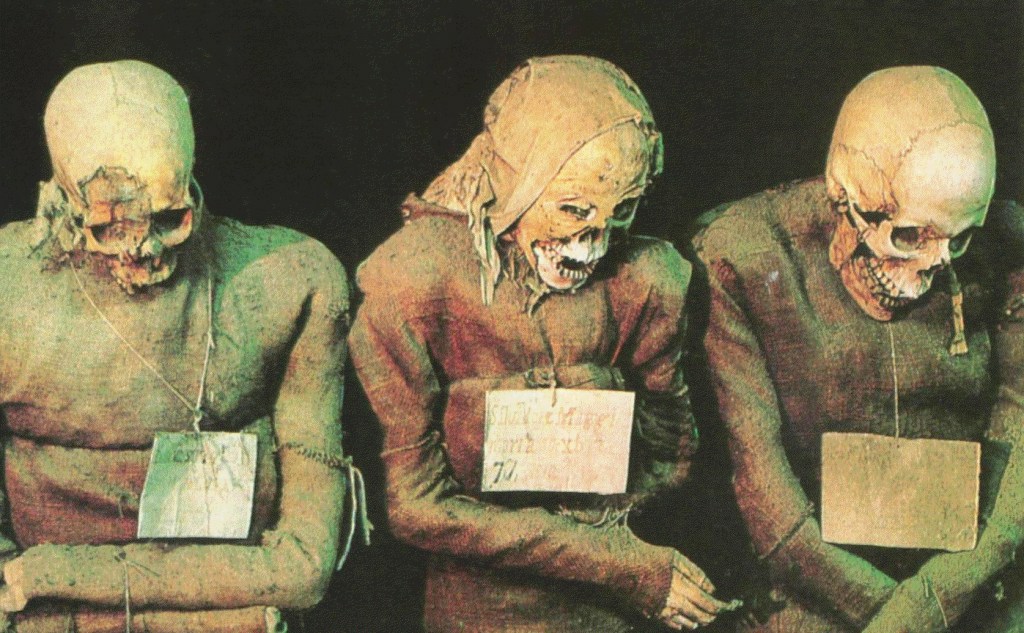
    There are evocative moments, redolent with the imagination and literary facility of the great popular writer he is to become. In the burial catacombs of Palermo’s Capuchin Monastery, with its thousands of corpses and mummies:

    The bodies undergo some chemical process which destroys the flesh and makes the skin resemble thin burnt leather. They are ranged along the walls in rows three or four tiers high, and stand upon a narrow board, upright, with nothing to keep them in their place but a cord which runs around their waists and is fastened to the wall.

    They are thus thrown into the most grotesque and ludicrous postures imaginable. Their waists being confined to the wall, throws the upper part of the body forward, and their heads incline downward, which, as you are below them, makes them appear as though they were all gazing directly upon you.

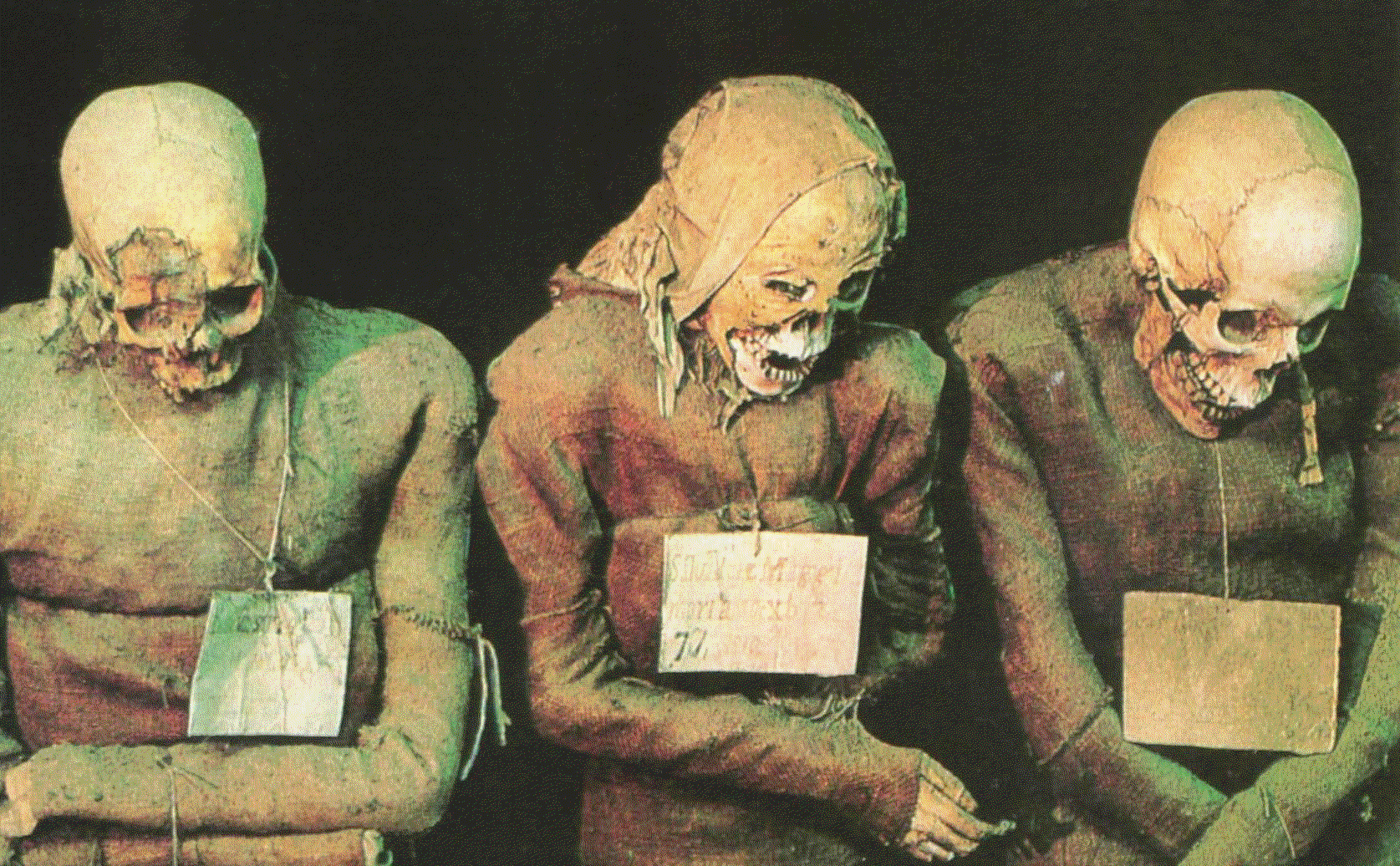
    Monks’ Corridor, Catacombe dei Cappuccini, Palermo (2008). Public Domain, Link

    They are placed without any distinction of age, for you will behold an old man with his white locks still remaining, placed beside a boy whose bright flaxen ringlets retain their lustre, and flow over that neck and forehead which once, perhaps, were so beautiful, but which now are horrible to look upon. The old man will be looking down upon the child with a most horrid grin, and so it is all along; the under jaws being in all sorts of positions; and the feelings which are generally excited upon the sight of death are wholly destroyed; and were it not for the knowledge that you are in the chamber of death, it would be almost impossible to restrain laughter…

    One day the Fairfield was sailing along the Atlantic coast of Africa, when her captain observed Cobb idling on deck, toying with a steel printer’s composing-rule, which he had brought with him from home. Establishing that the young man had worked as a printer before joining up, he made him his personal secretary, preparing and revising clerical materials for printing, such as travel memoranda.

    The position afforded Cobb greater liberties and shore-leave, and he spent more time with his diary. He studied “the beauties and characteristics of the countries, and the manners and customs of their various peoples” (A Memoir…).

    Cobb continued similar duties under the subsequent chief, including revising the new captain’s own naval memoir. After three years, despite the adventure of a nautical life, he became restless and homesick:

    [T]he life that I lead is one of constant excitement; every day brings something new. Today, perhaps calm and pleasant; tomorrow, tossed about in a gale of wind, and wet to the skin; Continually running from one port to the other. One night I behold the golden tints of an Italian sunset among a beautiful and Christian people, and in two or three days, under the hot sun of Africa, and amid a set of Moors and Turks and wild Arabs. I hope I shall soon change such scenes as these for those of ‘Sweet Home’.

    In 1842 Cobb’s father petitioned the Secretary of the Navy for a discharge for his son. He was successful a year later, and Cobb returned to his home in Waltham, Massachusetts. He married Mary Jane Mead there in 1845; their union would last until his death in 1887.


    Notes and References

    • See entry on Cobb’s father “Cobb, Sylvanus: (1798 – 1866)” at Harvard Square Library. Jump to page.
    • “Old Bellum Castle”: The Belém Tower (Torre de Belém), a famous Lisbon landmark.
    • Civita Vecchia: Civitavecchia in Lazio, Italy.
    • Palermo’s Capuchin monastery: Incidentally, the top of a “Capuccino” coffee resembles the colour of the Capuchin friars’ robes, whence the name.

    Cobb, Ella Waite. (1891) A Memoir of Sylvanus Cobb, Jr. Boston. Available at Internet Archive. Jump to file.

    This work CC BY-SA 4.0

  • Cobb’s The False Knight

    Cobb’s The False Knight

    Give me them good ol’ days of guns, of snakes, an’ gapin’ jaws
    Of wolves an’ ragin’ catamounts, with blood upon their paws;
    W’en six-foot heroes courted girls that they had snatched away
    From out a bloody bandit’s clasp, an’ tramped him into clay.

    I wish we had some writers now who understand the job,
    Some writers who can sling themselves like ol’ Sylvanus Cobb!

    Sam Walter Foss, “Uncle Seth on the Modern Novel”

    Outstanding popular novelist of nineteenth century America, Sylvanus Cobb Jr (1823-87) was famous for contributions to the New York Ledger. From 1856 until his death in 1887 the Ledger published his short stories and serialised novels, adding up to 89,544 pages of manuscript. During his whole career he produced 120 novels, over 800 short stories, and over 90,000 manuscript pages of short pieces for weeklies.

    Sylvanus Cobb Jr.
    Sylvanus Cobb Jr.

    Cobb was a scrupulous researcher, and three years’ experience as a seafarer in the United States Navy provided him with plenty of material. But in addition to his own name, he found it advantageous to employ several pseudonyms. Under “Colonel Walter B. Dunlap,” he cultivated notoriety as an adventurer and expert on the East.

    “Colonel Dunlap,” wrote his publisher:

    has travelled through Asia and Africa, and has had considerable experience in fighting elephants, lions, tigers, boa constrictors, cannibals and other tough customers …

    At the same time that Cobb’s own novels were appearing in the Ledger, so did seventy-two of the Colonel’s “Forest Adventures” and several “Sketches of Adventure.” His publisher spruiked one of the Colonel’s serialised novels, Lorinda the Princess; or, The Sultana’s Diadem as

    a new story of Eastern life, with which Colonel Dunlap is so familiar. He has travelled a great deal, and, judging from his thrilling sketches in the Ledger, he has had more adventures than almost any other living man.

    The Colonel grew into such a vivid figure that the Ledger received countless inquiries about him, and one man claimed to have met him out West.

    Cobb’s brilliant writing reached Australian shores in the 1880s. The False Knight appeared serialized far and wide, creating a sensation from the Nepean, through Horsham, to out beyond the black stump. It is to this medieval story of love, mystery, and adventure set in the Black Forest of Germany that we now turn in our quest for gems of penny and dime novels that would otherwise remain buried. The serial begins next week.

    Context and commentary by Oliver Raven will accompany each instalment. An acute observer and entertaining writer, Oliver is expert in German history, culture and language, and has trodden among some of the very scenes and castles where the adventure takes place.

    Perhaps he will be able to keep Cobb honest. I doubt it.