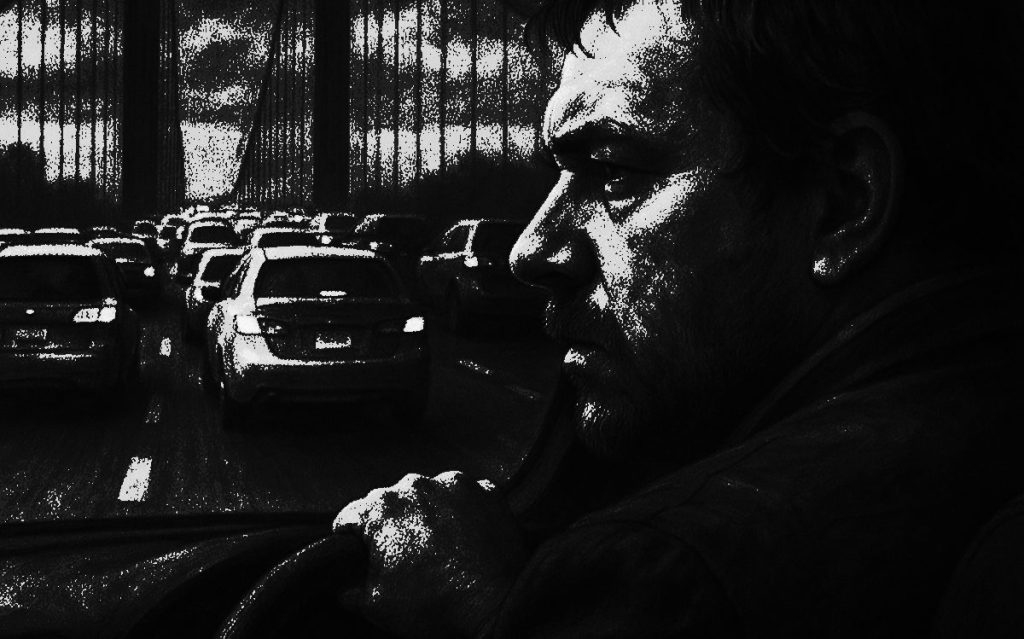
Tony Reck’s Long Death Last Breath is a work of intense psychological fiction, written in a fevered, stream-of-consciousness style. It traces a man’s descent into obsession, self-harm, and moral disintegration, interwoven with moments of tenderness, delusion, and deferred violence. In support of its themes, the language itself destabilises: syntax stretches, referents blur. Some readers may find the story disturbing.
⁓ MG
Long Death Last Breath
Light reflected off the surface of the river and caused him to reflect; yes, memories of that house. But traffic on the bridge was thick and he forced himself to concentrate. Little Cindy and Loopy Sally were strapped into the rear seat. Little Cindy smiled and sighed; she was born with wisdom. Loopy Sally waited for her next opportunity. And if that meant waiting for her sister to fall asleep so she might dribble into Little Cindy’s ear, then so be it. He had driven across the bridge many times. One day he would stop. On that day, they would remember him forever.
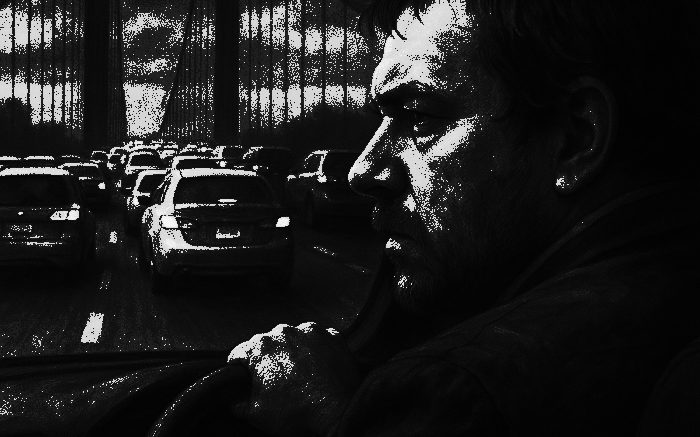
The western suburbs of Melbourne sapped the required determination. He would speak with her and she with him. They would smile at one another, and the daggers would rise between them. The traffic cleared and he planted his foot as bitumen receded and an exit loomed. He turned left: a pizza joint: a pub: a supermarket: a dealer in antiques. Each establishment displaced by a windscreen that deferred his eventual destination.
The house that once belonged to both of them malingered half-way down the street. There she was, arms folded across her breasts. That shock of peroxide hair fractured at its ends, splitting every soul that sought entry to her home, and the home that Little Cindy and Loopy Sally lived in. Five minutes may as well have been five years. She would have her revenge simply because she could. That’s what love was: an acrobat fallen the wrong side of the net; a failed possession.
‘You’re late.’
The children tumbled out of the car.
‘Inside.’
The girls were gone.

‘This won’t go down well with the magistrate.’
‘You’re joking.’
‘No joke,’ She said.
‘Next week …?’
‘Not if I can help it.’
He removed his daughters’ possessions from the vehicle: clothes, smart devices, a Monkey doll. It had three hands, twelve fingers and three thumbs. Each appendage excluded its other, but the formality of love betrayed was conspicuous between parents who hated one another. The front door followed the gate slammed shut. The moon was up and lunacy illuminated a wall.
He slammed the door of his vehicle. A driver manic with fear – tyres whistled, an intersection loomed. He did not drive, he careered: experienced the lubricated shift of transmission; appreciated cylinders displaced, pistons tuned, and brake fluid mediated by the irascible edge of steel. He steered the vehicle beyond the shopping strip. A hard right onto the freeway, unnecessary speed, and he was back on the bridge. The city skyline strained a ventricle in his chest. Concrete, electricity, and pollution masquerading as cloud, distilled in his brain.
He liked murder and murder liked him.
Several days passed during which he performed the functions required of him. He answered the phone, ate his meals, attended work, and laughed with colleagues during designated breaks. But his laughter belonged to another and a voice infiltrated his ear. Later, he walked home and was obsessed by streetlight and a disturbance he believed was about to occur inside his unit on the 25th floor of the Brunswick St. commission flats. His unremarkable suit shone in the moonlight. He walked, smiled, and deliberated. He sang:
Turn your mobile phone on.
Your ID consists of sand.
Feel the pulse of phallic-matrix
vibrate in your hand.
He had seen the light, and momentarily he was an angel. A Crown of Thorns encrusted around his head leeched blood from wounds that tasted like wine. But this inspiration was a flicker and he remained the creature he had always been: obese, effeminate, selfish, and inconsiderate. He sought retribution for the sin he believed had been committed against him. And as a sinner sinned against, the commission flat he occupied became a sign. Once inside, his desire for retribution would begin.

Screaming was common on the 25th floor of the Brunswick St. commission flats. A cut-throat razor and an awl required sterilisation, while cotton thread might incite infection. But pain procured by a ten-centimetre incision inflicted upon his right hip was suppressed by a sock inserted between his teeth and a mega-dose of paracetamol. The day then passed in deference to the sin committed. That afternoon, Mary Kyrikilli called and questioned his commitment. He placated Mary’s presence and terminated her call. But Mary Kyrikilli was most insistent. She demanded he drive his vehicle across the bridge. Approximation would not suffice; the exact distance had to be ascertained. By evening, Mary Kyrikilli had persuaded him that he must complete this mission.
Divinity accumulated within traffic lines that receded on the bitumen. He braked: a car horn complained, patience was obliterated, and a driver abused him. But sufferance was to be expected from those critical of the divine, and he was saved from a broken nose by selflessness. (Give a sinner what he desired, and transcendence was his forever.) He alighted from his vehicle. An infusion of brilliance followed him to a safety platform. Disbeliever aside, no truth was more telling than that which emanated from within.
He estimated the distance between bridge and river. (A document retrieved from his smart device had proposed fifty metres). But he remained sceptical of the digital realm because he believed it was populated by pedophiles, washed-up rock stars and other degenerates. The divine light would ascertain that which the digital realm failed to quantify; it accumulated in his oesophagus and descended toward the river. Fifty metres exactly, and never mind a document obtained online and tyrannised by an algorithm. The intelligence was artificial, but the bias was human.
Exact distance obtained, he steered his vehicle toward an off-ramp. His left hand was on the steering wheel while his right hand caressed the suture on his hip. He suspected an oscillation had invaded his thoughts. But failed to recognise he was alone in this perception. Mary Kyrikilli had spoken: words: viscera: muscle: bone: marrow; each throbbed in time with his predicament. (His doctor was ambivalent when prescribing fentanyl; a dilemma resolved by a gathering of clinicians who, post-consideration of the patient and the wound inflicted, concluded he be certified then discharged him into the community.)
Driving through the streets of Altona at night, he was once again obsessed by light. On this occasion, however, the luminosity resided beneath the waistline of his shirt. He muttered the word ‘Child’, but was immediately saddened by how the word presented itself. The vehicle dashboard was luminous, as was his crude incision. Two weeks old, tender and putrid, the suture vibrated. His vehicle sped past the previously mentioned pizza joint and its shopfront was made disingenuous by an extrusion of unlit neon.
The antique dealership was also closed. (Nobody, not least his desecrated self, expected an antique dealership be opened at that time of night.) His car crooned, as would any vehicle emaciate before that which was inevitable. A hard left onto a minor arterial and there: his domain. Little Cindy and Loopy Sally were not simply his children: they were his ‘Child’. He had not liked the way in which the word had presented itself. But he muttered it again, until the offending noun was flushed beyond the driver’s-side window.
He parked his vehicle as did his vehicle park him: an organism comprised of flesh, blood, and viscera. Considered in reverse, he was a machine; or, perversely, tumescent flesh, iron-ore, and a crucible containing both, designed for the manufacture of neither. He sat there, headlights diminished, motor cooled, and listened to music – Stravinsky, although he could not say which work. He waited patiently, aware of that which he most desired. And when the opportune moment arrived, he capitalised.
Immersion within the divine had damaged the wound on his hip and information assembled there became algorithmic. He stared through the windscreen and ruminated upon his children. Intelligence was autonomous: numbers calculated: code written: commands received. He had been unhappy with the word ‘Child’ as this had escaped his lips. But his suture concealed a radiance that only he could interpret; or, his tongue, a rendition of lithium, cobalt, carbon fibre and diode, unravelled from his mouth and sought release from his vehicle.

He released the door-handle. The night was warm, and cloud carried precipitation from the west. A globule of rain found his nose. Madness was a tropic of the mind; a mind in Tropicana, so to speak. And if the suture on his hip existed, then reality was made, not procured. He scaled the high fence. The veranda was a minefield of bicycles, pot plants, a brutal mezzanine, and domestic despair. He was surprised that domestic despair persisted, for he mistakenly believed that despair, domestic or otherwise, belonged to him alone.
Powered by the moon, he imagined he was a feline apparition and it occurred to him that entrance could be achieved in multiples: a door, a window, a floor, a ceiling. Ferocious, he crawled beneath the front doorstep. The underside of her home was not defined by cockroaches and beetles and, as precision was life, he crawled with ruthless efficiency. At 3.23 am he was capable of committing the atrocity required by the creature he had become and the phantasmagoria that consumed him.
But he returned to his vehicle.
The night had contracted to a greasy humidity. He had crawled beneath the floorboards of his ex-wife’s home and an excommunication was in order. The arterial was separated by a nature strip. He removed his clothes, hastened toward a sprinkler, and danced within the repeated thrusts emitted from an automated mechanism that cleansed perspiration from his arms, chest, legs, face and neck. Liberated, he returned to his vehicle, patted himself down with a dirty handkerchief, declined within the driver’s seat, and caressed the accelerator toward a poorly-lit intersection.
The next day came and went, as did the day that followed; an excess of light does that to a person. Ensconced within the kitchenette of his commission flat, he might have performed tricks: a deck of cards snapped to a flourish and a palmed ace apparently discovered behind his left ear; a card trick discouraged by his mother, but taught to him by his father. He might have performed tricks and thereby desecrated the memory of one parent but satisfied the demands of another. Rather, he sat, waited and ruminated. Five days later, Mary Kyrikilli had not called and his paralysis remained unresolved.
He gazed beyond the kitchenette window as the sun disappeared behind a nearby apartment. The night progressed; he slept, and dreamed a candle luminescent ignited the entrails of a curtain. His dream erupted in flame. A window exploded outward and the offending protagonist was transported by ambulance to a hospital burns unit.
His childhood had been spoiled by his parents’, but he was not a supernaturalist. He woke, and interpreted the dream as a sign.
He was ready to kill; now, he would spread the word.
Mary Kyrikilli pinged on his smart device. She did not crackle and click or advise him to commit atrocities. And she did not appear as a nightmare he had experienced fifty years earlier. Mary had become a slick communicator, a politician, and she made him fly upon dissertations of her disfigured shaman’s dreams.
He was that flicker of light: the same flicker he had studied weeks earlier, when he had stopped his vehicle on the bridge and ascertained the exact distance between safety railing and river.
And he considered himself a civic individual, even if he was about to murder his children.
His vehicle ran a red light at St. Kilda Junction and Mary Kyrikilli communicated with him via the luminance within his right hip. He floored the accelerator. Perforated white lines disappeared into the darkness and the inner suburbs of the north east soon became the outer suburbs of the south west. An off-ramp; a pizza joint, a supermarket, an antique dealership. A right; a left, a right. He was the pathetic individual he had always been but the luminous voice that belonged to Mary Kyrikilli disavowed empathy. A poorly lit street faded to its inevitable conclusion, as he did to his.
He alighted from his vehicle and it expired before his eyes. But he remained convinced its algorithm would crystallize and transport Little Cindy and Loopy Sally to their final destination.
He threw himself over the high fence, crashed through a branch of Ti-Tree, and feared he may have woken Lucifer himself. He held his breath, and pressed his hands together in prayer. No alarm was forthcoming and the house remained dark. A side-entrance had been reinforced so as to prevent unauthorised access. But tools secured in a satchel were procured, and he flipped the latch with a tyre lever. Several years had expired since his failure to complete external renovations. But he interpreted the incomplete side-entrance as a sign that he remained welcome in the home he had destroyed.
Little Cindy and Loopy Sally slept in the Little Room. He removed a screwdriver from his satchel and inserted its tip beneath a window. The window screeched. He retrieved a jar of petroleum jelly and lubricated the offending surface. Loopy Sally’s face upon a pillow was made luminous by moonlight, and Little Cindy’s breath exited her lips amidst a radiance that illuminated the Little Room.
He woke Little Cindy.
‘Daddy.’
A kiss on the cheek.
‘Get dressed.’
She did.
Eternity was anticipated.
If we were meant to live forever this night would never end.
Long death. Last breath. Expire.
A dressing table installed within the room was a teak contraption. Two angular mirrors positioned left and right of a sheet of reflective glass revealed a triptych of the person he had never intended to be: a monster once a father who had since become a human being.
Little Cindy returned to sleep.
Loopy Sally was a light sleeper.
She glared at her father.
The new moon descended into the Little Room, aspiration was elevated, and malevolence diminished.
He climbed out the window and returned to his vehicle.
Mary Kyrikilli was silent.
The dashboard radiated across his face.
An algorithm calculated kilometres travelled and fuel consumed.
His vehicle ascended an on-ramp.
The skyline of the city of Melbourne was a Mohawk beneath the cavernous sky.

The distance between safety-railing and the river had been ratified. The radiance he believed illuminated his right hip was nestled between flesh and bone. Traffic accumulated, but he was headed in the opposite direction. He stared beyond the Yarra River and across Port Phillip Bay. Maritime light flickered in time with his pulse. He looked out, and he looked down. He saw the faces of Little Cindy and Loopy Sally splayed across the surface of the river.
Fifty metres.
He looked out, and down, and in. To an observer standing on the deck of a boat, or the planet Venus, he was a man who scaled a protective railing; the father of two daughters who had taught him that the person he might have been no longer existed.
A foghorn bellowed in the distance, and he was gone.
Tony Reck © 2025
Images generated by AI
 Furin Chime Press™
Leave a comment