Mushanokoji Saneatsu’s novella The Innocent (1911) incorporates an anecdote that, at first glance, might seem eccentric. Chapter 7 offers a poignant portrait of Jibun’s uncle, prompted by the uncle’s cancer diagnosis and Jibun’s complex emotional response, including reflections on their relationship. Among a few stories expressing the uncle’s colorful character and past, Jibun tells how on one occasion his uncle, who held the title of Viscount, signed an inn’s guest register with the term “Shinheimin” – a label then used to designate members of Japan’s former outcaste communities.
One day, my uncle went to Kōfu. It was before the steam train was in service, and he stayed at an inn along the way. He was unhappy with the way he was treated there, so he signed “Shinheimin” – “New Commoner” – in the register.
He was welcomed in Kōfu warmly as a viscount. When for some reason the police saw the derogatory name “New Commoner” written in the inn’s register, they were astonished and reprimanded the innkeeper for his poor service. My uncle said he was sorry to hear that, and went back and stayed at the inn again.
The Innocent, Chapter 7
The incident is loaded with symbolic meaning, warranting some closer attention. In this post I will briefly explain it in light of the historical and philosophical context that surrounds it. Jibun’s anecdote, in fact, opens a window onto certain aspects and contradictions at the heart of Japan’s modernization project, especially the tension between state-driven reforms and the emergence of an autonomous individual self.
As one of the earliest and most representative works of the I-novel (shishosetsu) tradition, The Innocent reflects a moment when Japan’s writers were grappling with the formation of an autonomous, individual self – a project intimately tied to the nation’s broader transformation into a modern state. It dramatizes these psychological dynamics in a highly original and creative way. This literary focus aligned with a political aim: to cultivate disciplined, self-aware citizens who could help Japan compete with Western powers. Under the preceding feudal regimes (late 12th to late 19th century), the concept of an autonomous self had been largely sublimated. The modern self needed to be forged in tension with long-standing structures of hierarchy and familial authority. The Innocent embodies this contradiction, situating personal feeling and selfhood within the currents of modernization and social reform.
A Nation Under Pressure
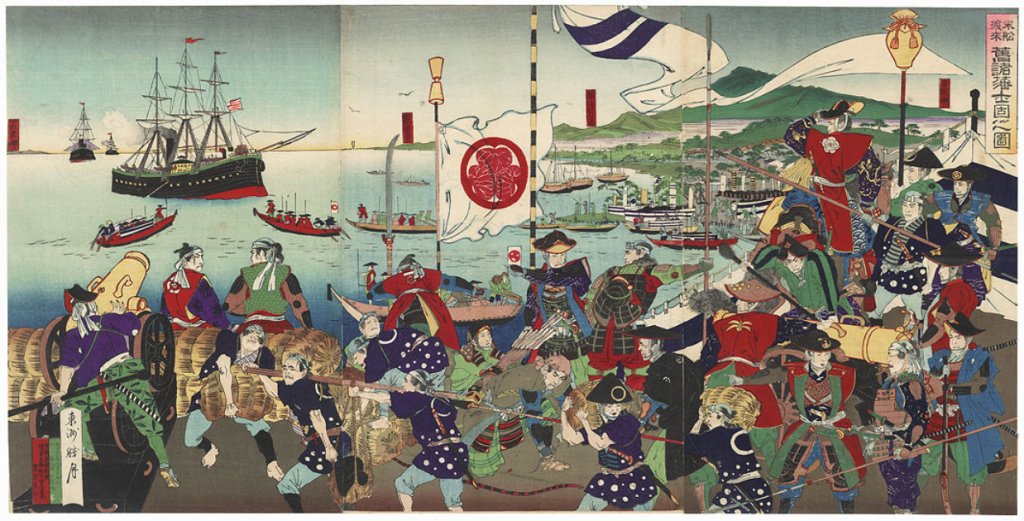
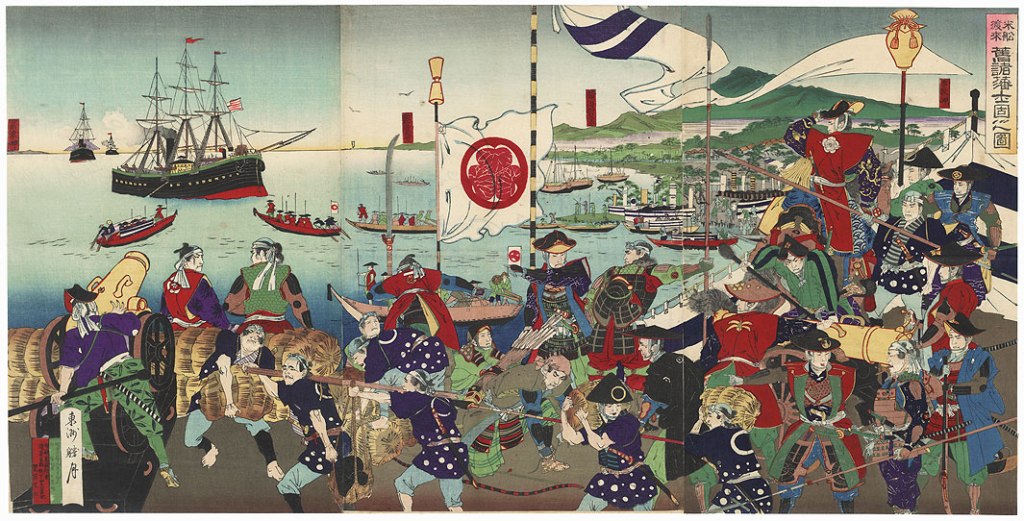
The push toward modernization was not born of internal reform alone. In 1853, Commodore Matthew Perry arrived in Tokyo Bay (at the time, Edo Bay) with a fleet of American warships: the infamous “Black Ships.” The military imbalance and resulting treaties exposed the Tokugawa Shogunate’s vulnerability and shocked the country into action. Reformers feared Japan would share the fate of colonized nations like China, which had been exploited by Western powers.
In response, the Meiji Restoration from 1868 marked a deliberate and sweeping effort to transform Japan into a modern nation-state. Leaders pursued a course of “defensive modernization” (e.g., Trevor Getz, “Meiji Restoration: Japan’s Industrial Revolution“): building a conscript army, overhauling the tax system, and reforming education. But modernization also required a new kind of citizen, an individual who was literate, obedient, and nationally conscious. The redefinition of the self was thus as much a political imperative as a philosophical project.
The Viscount and the Inn Register
The anecdote in question involves the narrator’s uncle, an aristocrat bearing the title of Viscount (shishaku). Upon feeling slighted at an inn, he signs the guest register using the term shinheimin, which translates as “new commoner.”
While humorous on the surface, the act amounts to a trenchant piece of social commentary. The term shinheimin referred to the reclassified descendants of outcast groups (“eta” and “hinin”) who had occupied the lowest rungs of Tokugawa Japan’s rigid social order. Although these designations were officially abolished in 1871 during the Meiji government’s efforts to modernize and unify Japan, the new classification of shinheimin continued to stigmatize and segregate. (See James Miura, “Birth of the Outcaste in Tokugawa Japan“, PDF.)
Despite its aim to enhance the status of previous outcastes, the Meiji government’s revision of the koseki household registration system preserved certain pejorative distinctions. In practice, the term shinheimin (“new commoner”) marked someone as a former outcaste, preserving their underclass status despite formal reform. By signing himself as he does, the uncle accuses the inn of having treated him with extreme disrespect.
For a Viscount to claim this status was to invert the hierarchy, not as satire, but as a statement of protest. He was using the most pejorative term available to underscore his indignation and to show that, in his view, the inn’s treatment had violated not just his personal dignity but the social order itself.
The Koseki and the Codification of Status
This brings us to one of the key bureaucratic tools of Meiji modernity: the koseki (family register). Following the 1871 Kaihorei (Emancipation Edict), former outcast groups were reclassified as shinheimin (“new commoners”). Yet in practice, the new label was frequently used in ways that preserved discrimination, and the 1872 koseki system often recorded social origins in forms that enabled continued exclusion. (See Chapman, “Geographies of Self and Other”).
- Definition: The koseki is a national family registration system instituted in 1872. It was designed to record the names, birthplaces, and familial relationships of every Japanese citizen.
- Purpose:
- To centralize population data for taxation, conscription, and education
- To unify a fragmented society under a common administrative structure
- To serve as legal proof of identity, family relations, and nationality
- Problems:
- Despite its claim to abolish class distinctions, the koseki often preserved old hierarchies
- Shinheimin and former outcastes were labelled in ways that perpetuated discrimination
- Individual identity was defined by the ie (patrilineal household), subordinating autonomy to familial and patriarchal control
The koseki thus represents a paradox: it was a modernizing force that enabled the Meiji state to govern effectively, but it also codified social exclusions that persisted well into the twentieth century and, in some cases, have left lasting effects on social mobility and discrimination that contradicted the very ideals of equality and unity it claimed to promote. Mushanokoji’s anecdote in The Innocent underscores this inherent contradiction.
The Kazoku: A New Aristocracy
Jibun’s Viscount uncle belongs to the kazoku, a hereditary peerage class established after the Meiji Restoration. Mushanokoji’s uncle and his father were, indeed, members of this nobility in real life, their father having been a senior court noble (Kugyo) under the Tokugawa regime. Formed by merging the former court nobility (kuge) and feudal lords (daimyo), the kazoku had five ranks: Prince, Marquess, Count, Viscount, and Baron. Its creation was meant to:
- Reward loyalty to the imperial cause
- Provide a political elite for the new constitutional order
- Recast old power holders as allies of the modern state

Takahashi Yuichi (1828-1894)
Yet, like the koseki, the kazoku system reveals the contradictions of Meiji modernization. In place of dismantling hierarchy, it replaced old feudal titles with Western-style aristocratic ones, perpetuating privilege under a new guise.
The Reorganization of Self
One of the less immediately visible aims of Meiji reform was to cultivate a new kind of subject: the autonomous, responsible individual citizen (kokumin).
This was not merely a philosophical goal. It was instrumental:
- A modern nation-state needed disciplined soldiers, literate taxpayers, and educated workers
- Citizens had to think of themselves as individuals tied to the state, rather than vassals tied to a lord
Yet this ideal of individuality clashed with the reality of the ie system, in which the household head had legal authority over all family members, and personal identity was defined relationally rather than independently.
This contradiction is central to The Innocent, which uses its confessional, first-person narrative form to dramatize, in a sense, the emergence of a modern, autonomous self. As an I-novel (shishosetsu), it is uniquely suited to explore the tensions between inherited social obligations and the evolving demand for individual subjectivity in a rapidly modernizing society. The novel probes conscience, personal love, and emotional conflict in ways that challenge traditional roles. In doing so, it participates in the birth of the I-novel: a literary form devoted to introspection and self-expression. By 1910, this broader project had become an aesthetic and ideological aim of the “White Birch” literary society (Shirakaba-ha), a humanist-leaning group co-founded by Saneatsu Mushanokoji that championed individualism, ethical idealism, and Western liberal thought.
Conclusion: Literature as Reflection and Critique
The uncle’s sardonic use of shinheimin may seem like a personal joke, but it encapsulates much more than social wit. It crystallizes the paradoxes of Meiji-era social engineering, serving as a literary flashpoint for the contradictions at the heart of Japan’s modernization. As a pivotal moment in an early I-novel, it not only signals protest against entrenched hierarchies but also foregrounds the emergent self-consciousness central to the genre’s role in articulating an autonomous individual subjectivity.
The Innocent is not a political tract, yet it is deeply political. Its quiet tone belies the depth of its insight into the nature of modern Japanese identity. As an early I-novel, it stands at the threshold of a new literary and philosophical era, one where the personal was never merely personal, but bound up with the transformation of Japanese society itself. By examining a single symbolic moment, we gain access to the larger forces that shaped modern Japan – and its “modern self.”
References, Further Reading

Saneatsu Mushanokoji, The Innocent (1911), trans. Michael Guest, (Sydney: Furin Chime Press, 2024).
David Chapman. (2011) Geographies of Self and Other: Mapping Japan through the Koseki. Asia-Pacific Journal Vol. 2, Iss. 29, No. 2.
Trevor Getz. “Meiji Restoration: Japan’s Industrial Revolution.”
James Miura, (2019) “Birth of the Outcaste in Tokugawa Japan“, PDF., in Hohonu 17, University of Hawai‵i
Karl Jakob Krobness, (2014) “Jus Koseki: Household registration and Japanese citizenship,” Asia-Pacific Journal: Japan Focus Vol. 12, Iss. 35, No. 1.
 Furin Chime Press™
Leave a comment