Author
Saneatsu Mushanokoji (1885-1976) was one of the first great Japanese modernist writers. He may lay claim to have founded the I-novel (shishosetsu), a specifically Japanese confessional genre in which the author speaks directly and colloquially to the reader (e.g., Lippit 28). Mushanokoji was also a painter of still lifes, a poet and playwright, and a unique but influential philosopher. Inspired by the writings of Tolstoy, he established a utopian village, Atarashiki-mura (“New Village”), which continues to operate, and which a young Mao Zedong himself attempted to replicate.
Mushanokoji (aka Mushakoji) first published Omedetaki Hito (1910) in a journal of the Shirakaba (White Birch) society, a group of aristocratic writers from Tokyo Imperial University, of whom he was the leader. Shirakaba led a humanitarian movement in Japan during the Taisho era of 1912-1926.
Novella
Elements of Mushanokoji’s later style, and of the I-novel, are distinctly present in this his first novel, and the narrator may be to an extent identified with the author. Written in the form of a diary, the novel draws on personal experiences from his youth, and from his own philosophy of happiness and transcendence (Okazaki 310; Mochizuki).
The novel’s psychological and philosophical depths are already evident in this initial chapter. On the one hand, the story of the narrator’s infatuation with a schoolgirl named Tsuru consists of straightforward incidents, candidly expressed. Notice in the beginning, the spontaneity of the character (“I”) when he turns towards the two geishas. It sems as though his feet veer in their direction on their own, propelled by his internal “hunger” (starving/longing) for a woman, which he mentions several times.
As the story proceeds, however, it becomes evident that he has never actually spoken to Tsuru. As he reflects about her, he starts to appear unhealthily obsessive to an extent—to us, who have become familiar with the socio-psychological phenomenon of “stalking.” He appears to admire her fairly creepily from afar. Indeed, some modern young Japanese reporting on the Web, tend to see the book either as a “stalker novel” or as the story of a person so hopelessy naive as to be unbelievable. (I have come across one or two who confess to identifying with him in his standoffishness.)
The character’s utter detachment from the object of his love is, at the same time, equivalent to his complete absorbtion in the self. Hence, he positively affirms his unwillingness to sacrifice his “own self” for the sake of his idealized love-object, Tsuru. Somewhat reminiscent of Nietzsche, Mushanokoji expresses his ideal of a transcendent self that refuses to defer to societal norms, but will conduct life on its own terms.
Mushanokoji uses a device of ambiguity to help depict the “I” character’s absolute detachment from exterior reality, and his centering upon the self. That is why he refuses to speak of “watching” or “observing” Tsuru. Instead he expresses the action euphemistically as “seeing” her, which carries a an incorrect connotation of their having “met.”
Frontispiece
Max Klinger’s image suggests the psychic and animal aspects of human being. With the “higher” elements needing to control the “baser.” Darwin is implicit, but a salient cruelty is apparent on the psychical or human side. Still, the bear is after the elf, presumably wanting to gobble her up!

The results of reading Darwin and viewing exhibited nature can be judged by Klinger’s thematic preoccupation with scenes of elemental nature (centaurs in Intermezzi and satyrs in Rettungen Ovidischer Opfer), primitive man, prehistoric creatures (dinosaurs in sketches and a pterosaur in Ein Handschuh), and women with animals. These appear not only in the central images, but in numerous details, botanical and biological, sprinkled like coded clues throughout the pictures. In all cases, science is merged with imagination, and primal states are considered with an eye to their impact on modern man.
Marsha Morton, “Art on the Edge: Klinger at the Threshold of Modernism”, in Max Klinger Le Théâter de L’Étrange: Les Suites Gravées 1879-1915 (Strasbourg: Musées de la Ville de Strasbourg, 2012)
Stroll through the heart of Meiji Tokyo
“On the morning of January 29, I went to Maruzen bookshop to look for some books and left after buying one titled Civilization and Education, written by someone named Münch.”
This fitting opening reference carries an almost metafictional significance to readers of today, for Maruzen became the primary conduit for Western thought into Japan, subsequent to the Meiji Restoration. It is particularly appropriate, given Mushanokoji’s further significance as a leading figure in the evolution of Japanese modernism.
Consider the following, written by Katai Tayama, whose 1907 novel Futon, may also lay fair claim to being, along with Saneatsu Mushanokoji’s The Innocent, an early instance of the I-novel:
It was thanks to the upstairs section of Maruzen that the surging currents of thought of nineteenth [and early twentieth] century continental Europe broke relentlessly through onto the shores of this remote Far Eastern island.
It was a small and gloomy section. The attendant, who had a limp and was very pale, had a ready smile. The shelves were thick with dust, and the literature books were put away behind the glass with a mixture of science books and guide-books. Nonetheless it was here that one came across the masterpieces that shook Europe.
… You’d encounter some young man walking along the streets of Marunouchi in the vicinity of the Palace, clutching a copy of [Turgenyev’s] Fathers and Sons that he’d ordered some time before and looking as it he’d just met his sweetheart. You’d see some other young man spotting a copy of [Tolstoy’s] Anna Karenina on the second-floor shelves at Maruzen and emptying his month’s allowance from his purse to buy it with a look of delight on his face.
In those days I often went searching for such books with Yanagita Kunio. With great excitement we searched out advertisements appended to magazines, and catalogues appended to books. And then, with money we could scarce afford, we ordered these rare books from Maruzen.
“The Second Floor of Maruzen”, by Tayama Katai, Thirty Years in Tokyo (1917) (translated by Kenneth G. Henshall, 1987). oldtokyo.com

This young man of Tayama’s, strolling through Maranouchi could well be Mushanokoji himself, particularly the one carrying the novel by Tolstoy, who was a major influence on Saneatsu, giving way to his later interest in the Belgian writer Maurice Maeterlinck. (See my opening comments on Maeterlinck’s play The Blind in a recent post.)
But Jibun has other things on his mind as well as literature.

“I assumed the women were geisha. When I see a woman in a flowery kimono, with a round face, heavily powdered, I naturally think of her as a geisha.”
Various images jostle for the foreground of his mind, for association with his thoughts on morals and aesthetics. Inevitably, they lead to images and thoughts of the girl Tsuru, his desire for whom dominates his existence.
The dark blue dotted route shows Jibun’s twenty-minute or so walk from Maruzen bookstore in Nihonbashi via the corner of the moat at the boundary of Kokyo Gaien National Garden, and down through Hibiya Park, the green rectangle at the bottom:

“Walking quickly I reached the moat and, instead of catching an electric tram, turned left to follow the tracks to Hibiya and go through Hibiya Park to my house”

Since 1868, the Imperial Palace has occupied the site of Edo Castle, originally built in 1457 by the Edo Clan, the samurai family who first fortified the town of Edo. Between 1603 and 1868, the Tokugawa shogunate, who were the feudal rulers up until the Meiji Revolution, developed the castle into the largest ever constructed in Japan.
The Kokyo Gaien National Gardens encircle the palace, in Chiyoda City, a special ward of Tokyo. As well as being the economic and political hub of Japan, Chiyoda contains the most affluent residential neighborhoods in Tokyo, towards the west, in the Yamanote area.
The Mushanokojis were among the most aristocratic families in Japan. Their home was located at what is now Saneatsu Park, adjacent to the Saneatsu Mushanokoji Memorial Museum, in Chofu, Tokyo, to the west. It seems odd, then, that Jibun would forgo the electric tram ride for Shank’s Pony, since the journey on foot would take around four and a half hours, and we learn at the opening of Chapter 2 that he arrives home in time for lunch.
Jibun doesn’t strike us as the athletic type. Perhaps it is an instance of the divergence from biographical fact that the I-novel can exhibit generically. For instance, his father makes some appearances in the novella, whereas Mushanokoji’s own father, Viscount Saneyo Mushanokoji, a court noble, actually died when his son Saneatsu was two.
Anyway Hibiya Park is a pretty spot for Jibun to enjoy his homeward stroll. Note that the first-person narrator is unnamed in the story. Jibun is actually a Japanese pronoun equivalent to “myself/oneself/me,” and how he is conventionally referred to in literary criticism.
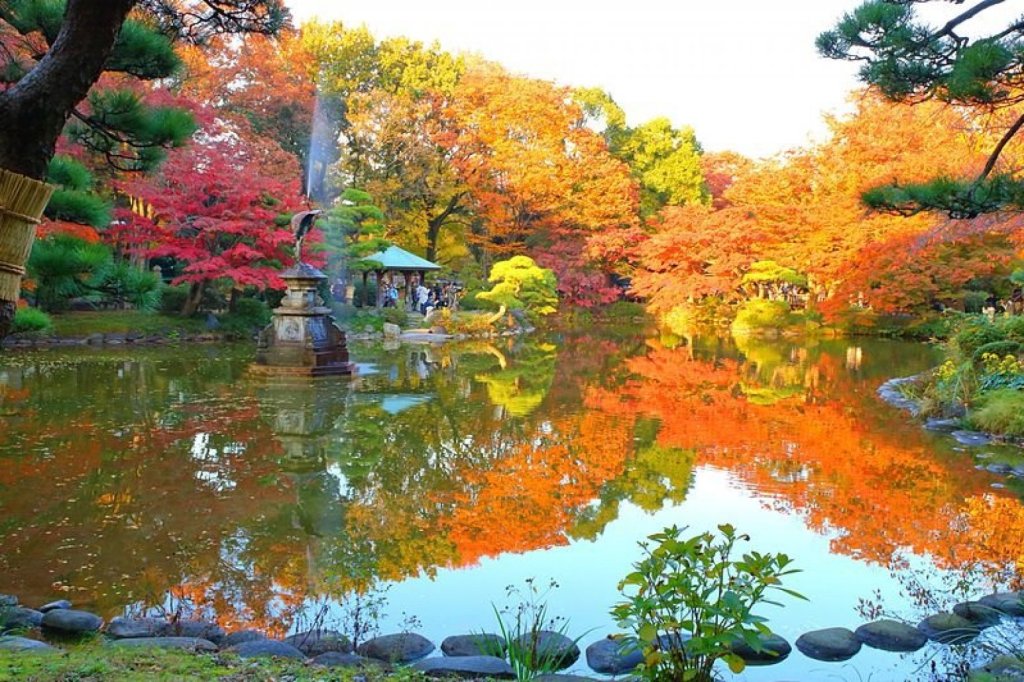
This time he is distracted by two lovers, and he can’t decide whether to rejoice for them in their happiness, or curse them for reminding him of his unfulfilled longing for Tsuru.
Notes and References

Saneatsu Mushanokoji, The Innocent (1911), trans. Michael Guest, Sydney: Furin Chime Press, 2024.
Lippit, Seiji, M. Topographies of Japanese Modernism. (NY: Columbia U, 2002).
Mochizuki, Yoshihiro. Rediscovering Musha-ism: The Theory of Happiness in the Early Works), of Mushakoji Saneatsu (Master of Arts thesis, Univ. Hawai’i, 2005).
Okazaki, Yoshie, Japanese Literature in the Meiji Era. Vol. 1 of Japanese Culture in the Meiji Era. Trans. V.H. Vigliemo (Tokyo: Toyo Bunko, 1955).
Suzuki, Tomi. Narrating the Self: Fictions of Japanese Modernity (Stanford: Stanford UP, 2000) ,
Treat, John Whittier. The Rise and Fall of Japanese Literature (Chicago: U of Chicago P, 2018).
Tyler, William J. Review of Suzuki, Narrating the Self, in Harvard Journal of Asiatic Studies Vol. 60, No. 2 (Dec., 2000), pp. 661-670.
 Furin Chime Press™
Leave a comment