Reading Maeterlinck’s The Blind, we become aware of a continuous, brilliant process of transposition and streamlining into Waiting for Godot. Here’s an instance from Part One of the previous post:
THIRD BLIND MAN.
Is the sun still shining?
[*74]SIXTH BLIND MAN.
I think not: it seems very late.SECOND BLIND MAN.
What time is it?THE OTHERS.
I do not know. — Nobody knows.SECOND BLIND MAN.
Is it light still? [To the sixth blind man.] — Where are you? — How is it, you who can see a little, how is it?SIXTH BLIND MAN.
I think it is very dark; when there is sunlight, I see a blue line under my eyelids. I did see one, a long while ago; but now, I no longer perceive anything.FIRST BLIND MAN.
For my part, I know it is late when I am hungry: and I am hungry.
In Waiting for Godot, Pozzo is of course the archetypal blind man, with his definitive fatalistic proclamation on time, and its reduction to a metaphysical eternal instant:
POZZO (suddenly furious).
Have you not done tormenting me with your accursed time! It’s abominable! When! When! One day, is that not enough for you, one day he went dumb, one day I went blind, one day we’ll go deaf, one day we were born, one day we shall die, the same day, the same second, is that not enough for you? (Calmer.) They give birth astride of a grave, the light gleams an instant, then it’s night once more. (He jerks the rope.) On!
And testily, when pressed about when it was he had become blind: “Don’t question me! The blind have no notion of time.”
Beckett’s self-parodic humour, we detect, lies partly in the knowledge of the appropriative act. It is like a sly confessional acknowledgement. Notice what becomes of Maeterlinck’s gothic setting:
Tall funereal trees, — yews, weeping willows, cypresses, — cover them with their faithful shadows. A cluster of long, sickly asphodels is in bloom, not far from the priest, in the night. It is unusually oppressive, despite the moonlight that here and there struggles to pierce for an instant the glooms of the foliage.
Of course: “A country road. A tree. Evening.” From which Beckett draws comic business in a sly acknowledgement:
Estragon (despairingly). Ah! (Pause.) You’re sure it was here?
Vladimir. What?
Estragon. That we were to wait.
Vladimir. He said by the tree. (They look at the tree.) Do you see any others?
Estragon. What is it?
Vladimir. I don’t know. A willow.
Estragon. Where are the leaves?
Vladimir. It must be dead.
Estragon. No more weeping.
Vladimir. Or perhaps it’s not the season.
Estragon. Looks to me more like a bush.
Vladimir. A shrub.
Estragon. A bush.
Hence there is, for us readers of 2025, endless existential marvel to be derived from Maeterlinck’sThe Dead. The play could be given spectacular minimalistic realization in the post-Beckett era, using sound and lighting effects. It absolutely warrants production. Without further ado, let’s turn to the second part.
- In the text below , *** indicates some select “Beckettian” touches, among copious others.
The Blind (continued)
[*86]
THE YOUNG BLIND GIRL.
My lids are shut, but I feel that my eyes are alive.…
FIRST BLIND MAN.
Mine are open.
SECOND BLIND MAN.
I sleep with my eyes open.
THIRD BLIND MAN.
Let us not talk of our eyes!
SECOND BLIND MAN.
It is not long since you came, is it?
THE VERY OLD BLIND MAN.
One evening at prayers I heard a voice on the women’s side that I did not recognize; and I knew by your voice that you were very young…. I would have liked to see you, to hear you.…
FIRST BLIND MAN.
I didn’t perceive anything.
SECOND BLIND MAN.
He gave us no warning.
SIXTH BLIND MAN.
They say you are beautiful as a woman who comes from very far.
[*87]
THE YOUNG BLIND GIRL
I have never seen myself.

THE VERY OLD BLIND MAN.
We have never seen each other. We ask and we reply; we live together, we are always together, but we know not what we are! … In vain we touch each other with both hands; the eyes learn more than the hands.…
SIXTH BLIND MAN.
I see your shadows sometimes, when you are in the sun.
THE VERY OLD BLIND MAN.
We have never seen the house in which we live; in vain we feel the walls and the windows; we do not know where we live!…
THE VERY OLD BLIND WOMAN.
They say it is an old château, very gloomy and very wretched, where no light is ever seen except in the tower where the priest has his room.
FIRST BLIND MAN.
There is no need of light for those who do not see.
SIXTH BLIND MAN.
When I tend the flock, in the neighborhood of the Asylum, the sheep return of themselves when they see at nightfall that light in the tower.… They have never misled me.
[*88]
THE VERY OLD BLIND MAN.
Years and years we have been together, and we have never seen each other! You would say we were forever alone! … To love, one must see.
THE VERY OLD BLIND WOMAN.
I dream sometimes that I see …
THE VERY OLD BLIND MAN.
I see only in my dreams…
FIRST BLIND MAN.
I do not dream, usually, except at midnight.
SECOND BLIND MAN.
Of what can one dream where the hands are motionless?
[A flurry of wind shakes the forest, and the leaves fall, thick and gloomily.]
FIFTH BLIND MAN.
Who touched my hands?
FIRST BLIND MAN.
Something is falling about us!
THE VERY OLD BLIND MAN.
That comes from above; I don’t know what it is…
[*89]
FIFTH BLIND MAN.
Who touched my hands? — I was asleep; let me sleep!
THE VERY OLD BLIND MAN.
Nobody touched your hands.
FIFTH BLIND MAN.
Who took my hands? Answer loudly; l am a little hard of hearing …
THE VERY OLD BLIND MAN.
We do not know ourselves.
FIFTH BLIND MAN.
Has someone come to give us warning?
FIRST BLIND MAN.
It is useless to reply; he hears nothing.
THIRD BLIND MAN.
It must be admitted, the deaf are very unfortunate.
THE VERY OLD BLIND MAN.
I am weary of staying seated.
SIXTH BLIND MAN.
I am weary of staying here.
[*90]
SECOND BLIND MAN.
It seems to me we are so far from one another.… Let us try to get a little nearer together, — it is beginning to get cold.…
THIRD BLIND MAN.
I dare not rise! We had better stay where we are.
THE VERY OLD BLIND MAN.
We do not know what there may be among us.
SIXTH BLIND MAN.
I think both my hands are in blood; I would like to stand up.
THIRD BLIND MAN.
You are leaning toward me, — I hear you.
[The blind madwoman rubs her eyes violently, groaning and turning obstinately toward the motionless priest.]
FIRST BLIND MAN.
I hear still another noise.…
THE VERY OLD BLIND WOMAN.
I think it is our unfortunate sister rubbing her eyes.
SECOND BLIND MAN.
She is never doing anything else; I hear her every night.
[*91]
THIRD BLIND MAN.
She is mad; she never speaks.
THE VERY OLD BLIND WOMAN.
She has never spoken since she had her child.… She seems always to be afraid.…
THE VERY OLD BLIND MAN
You are not afraid here then?
FIRST BLIND MAN.
Who?
THE VERY OLD BLIND MAN.
All the rest of us.
THE VERY OLD BLIND WOMAN.
Yes, yes; we are afraid.
THE YOUNG BLIND GIRL.
We have been afraid for a long time.
FIRST BLIND MAN.
Why did you ask that?
THE VERY OLD BLIND MAN.
I do not know why I asked it.… There is something here I do not understand…. It seems to me I hear weeping all at once among us.…
FIRST BLIND MAN.
There is no need to fear; I think it is the madwoman.
[*92]
THE VERY OLD BLIND MAN.
There is something else beside … I am sure there is something else beside…. It is not that alone that makes me afraid.
THE VERY OLD BLIND WOMAN.
She always weeps when she is going to give suck to her child. ***
FIRST BLIND MAN.
She is the only one that weeps so.
THE VERY OLD BLIND WOMAN.
They say she sees still at times.
FIRST BLIND MAN.
You do not hear the others weep.
THE VERY OLD BLIND MAN.
To weep, one must see. ***
THE YOUNG BLIND GIRL.
I smell an odor of flowers about us.
FIRST BLIND MAN.
I smell only the smell of the earth.
THE YOUNG BLIND GIRL.
There are flowers, — there are flowers about us.
[*93]
SECOND BLIND MAN.
I smell only the smell of the earth.
THE VERY OLD BLIND WOMAN
I caught the perfume of flowers in the wind….
THIRD BLIND MAN.
I smell only the smell of the earth.
THE VERY OLD BLIND MAN.
I believe the women are right.
SIXTH BLIND MAN.
Where are they?’ — I will go pluck them.
THE YOUNG BLIND GIRL.
At your right. Rise!
[The sixth blind man rises slowly and advances groping, and stumbling against the bushes and trees, toward the asphodels, which he breaks and crushes on his way.]
THE YOUNG BLIND GIRL.
I hear you breaking the green stalks. Stop! stop!
FIRST BLIND MAN.
Don’t worry yourselves about flowers, but think of getting home.
SIXTH BLIND MAN.
I no longer dare return on my steps.
[*94]
THE YOUNG BLIND GIRL.
You need not return. — Wait. — [She rises.] Oh, how cold the earth is! It is going to freeze. — [She advances without hesitation toward the strange pale asphodels; but she is stopped in the neighborhood of the flowers by the uprooted tree and the fragments of rock] They are here. — I cannot reach them; they are on your side.
SIXTH BLIND MAN.
I believe I am plucking them.
[He plucks the scattered flowers, gropingly, and offers them to her; the night birds fly away.]
THE YOUNG BLIND GIRL.
It seems to me I saw these flowers in the old days…. I no longer know their name.… Alas, how sickly they are, and how soft the stems are! I hardly recognize them. … I think it is the flower of the dead. [She twines the asphodels in her hair.]
THE VERY OLD BLIND MAN.
I hear the noise of your hair.
THE YOUNG BLIND GIRL.
It is the flowers.…
THE VERY OLD BLIND MAN.
We shall not see you.…
[*95]
THE YOUNG BLIND GIRL.
I shall not see myself, anymore.… I am cold.
[At this moment the wind rises in the forest, and the sea roars suddenly and with violence against cliffs very near.]
FIRST BLIND MAN.
It thunders!
SECOND BLIND MAN.
I think there is a storm rising.
THE VERY OLD BLIND WOMAN.
I think it is the sea.
THIRD BLIND MAN.
The sea? — Is it the sea? — But it is hardly two steps from us! — It is at our feet! I hear it all about me! — It must be something else!
THE YOUNG BLIND GIRL.
I hear the noise of breakers at my feet.
FIRST BLIND MAN.
I think it is the wind in the dead leaves. ***
THE VERY OLD BLIND MAN.
I think the women are right.
THIRD BLIND MAN.
It will come here!
[*96]
FIRST BLIND MAN.
What direction does the wind come from?
SECOND BLIND MAN.
It comes from the sea.
THE VERY OLD BLIND MAN.
It always comes from the sea. The sea surrounds us on all sides. It cannot come from anywhere else.…
FIRST BLIND MAN.
Let us not keep on thinking of the sea!
SECOND BLIND MAN.
We must think of it. It will reach us soon.
FIRST BLIND MAN.
You do not know if it be the sea.
SECOND BLIND MAN.
I hear its surges as if I could dip both hands in them. We cannot stay here! It is perhaps all about us.
THE VERY OLD BLIND MAN.
Where would you go?
SECOND BLIND MAN.
No matter where! no matter where! I will not hear this noise of waters any longer! Let us go! Let us go!
[*97]
THIRD BLIND MAN.
I think I hear something else. — Listen!
[A sound of footfalls is heard, hurried and far away, in the dead leaves.]
FIRST BLIND MAN.
There is something coming this way.
SECOND BLIND MAN.
He is coming! He is coming! He is coming back!
THIRD BLIND MAN.
He is coming with little quick steps, like a little child.
SECOND BLIND MAN.
Let us make no complaints to him today.
THE VERY OLD BLIND WOMAN.
I believe that is not the step of a man!
[A great dog enters in the forest, and passes in front of the blind folk. — Silence.]
FIRST BLIND MAN.
Who’s there? — Who are you? — Have pity on us, we have been waiting so long! …[The dog stops and coming to the blind man, puts his fore paws on his knees] Oh, oh, what have you put on my knees? What is it? … Is it an animal? — I believe it is a dog.… Oh, oh, it is the dog, it is the Asylum dog! Come here, sir, come here! He comes to save us! Come here! come here, sir!

[*98]
THE OTHERS. Come here, sir! come here!
FIRST BLIND MAN.
He has come to save us! He has followed our tracks all the way! He is licking my hands as if he had just found me after centuries! He howls for joy! He is going to die for joy! Listen, listen!
THE OTHERS
Come here! Come here!
THE VERY OLD BLIND MAN.
Perhaps he is running ahead of somebody…
FIRST BLIND MAN.
No, no, he is alone. — I hear nothing coming. — We need no other guide; there is none better. He will lead us wherever we want to go; he will obey us …
THE VERY OLD BLIND WOMAN.
I dare not follow him…
THE YOUNG BLIND GIRL.
Nor I.
FIRST BLIND MAN.
Why not? His sight is better than ours.
[*99]
SECOND BLIND MAN.
Don’t listen to the women!
THIRD BLIND MAN.
I believe there is a change in the sky. I breathe freely. The air is pure now …
THE VERY OLD BLIND WOMAN.
It is the sea wind passing about us.
SIXTH BLIND MAN.
It seems to me it is getting lighter; I believe the sun is rising …
THE VERY OLD BLIND WOMAN.
I believe it is getting colder
FIRST BLIND MAN.
We are going to find our way again. He is dragging me! … he is dragging me. He is drunk with joy! — I can no longer hold him back! .… Follow me, follow me. We are going back to the house! …
[He rises, dragged by the dog, who leads him to the motionless priest, and stops.]
THE OTHERS.
Where are you? Where are you? — Where are you going? — Take care!
[*100]
FIRST BLIND MAN.
Wait, wait! Do not follow me yet; I will come back … He is stopping. — What is the matter with him? — Oh, oh, I touched something very cold!
SECOND BLIND MAN.
What are you saying? — We can hardly hear your voice any longer.
FIRST BLIND MAN.
I have touched — I believe I am touching a face!
THIRD BLIND MAN.
What are you saying? — We hardly understand you any longer. What is the matter with you? — Where are you? — Are you already so far away?
FIRST BLIND MAN.
Oh, oh, oh! — I do not know yet what it is. — There is a dead man in the midst of us.
THE OTHERS.
A dead man in the midst of us? — Where are you? Where are you?
FIRST BLIND MAN.
There is a dead man among us, I tell you! Oh, oh, I touched a dead man’s face! — You are sitting beside a dead man! [*101] One of us must have died suddenly. Why don’t you speak, so that I may know who are still alive? Where are you? — Answer! answer, all of you!
[The blind folk reply in turn, with the exception of the madwoman and the deaf man. The three old women have ceased their prayers.]
FIRST BLIND MAN.
I no longer distinguish your voices … You all speak alike! …Your voices are all trembling.
THIRD BLIND MAN.
There are two that have not answered… Where are they? [He touches with his stick the fifth blind man.]
FIFTH BLIND MAN.
Oh! oh! I was asleep; let me sleep!
SIXTH BLIND MAN.
It is not he. — Is it the madwoman?
THE VERY OLD BLIND WOMAN.
She is sitting beside me; I can hear that she is alive …
FIRST BLIND MAN.
I believe … I believe it is the priest! — He is standing up! Come, come, come!
[*102]
SECOND BLIND MAN.
He is standing up?
THIRD BLIND MAN
Then he is not dead!
THE VERY OLD BLIND MAN.
Where is he?
SIXTH BLIND MAN.
Let us go see!
[They all rise, with the exception of the mad- woman and the fifth blind man, and advance, groping, toward the dead.]
SECOND BLIND MAN.
Is he here? — Is it he?
THIRD BLIND MAN.
Yes, yes, I recognize him
FIRST BLIND MAN.
My God! my God! what will become of us?
THE VERY OLD BLIND WOMAN.
Father! father! — Is it you? Father, what has happened? — What is the matter? — Answer us! — We are all about you. Oh! oh! oh!
THE VERY OLD BLIND MAN.
Bring some water; perhaps he still lives.
[*103]
SECOND BLIND MAN.
Let us try … He might perhaps be able to take us back to the Asylum …

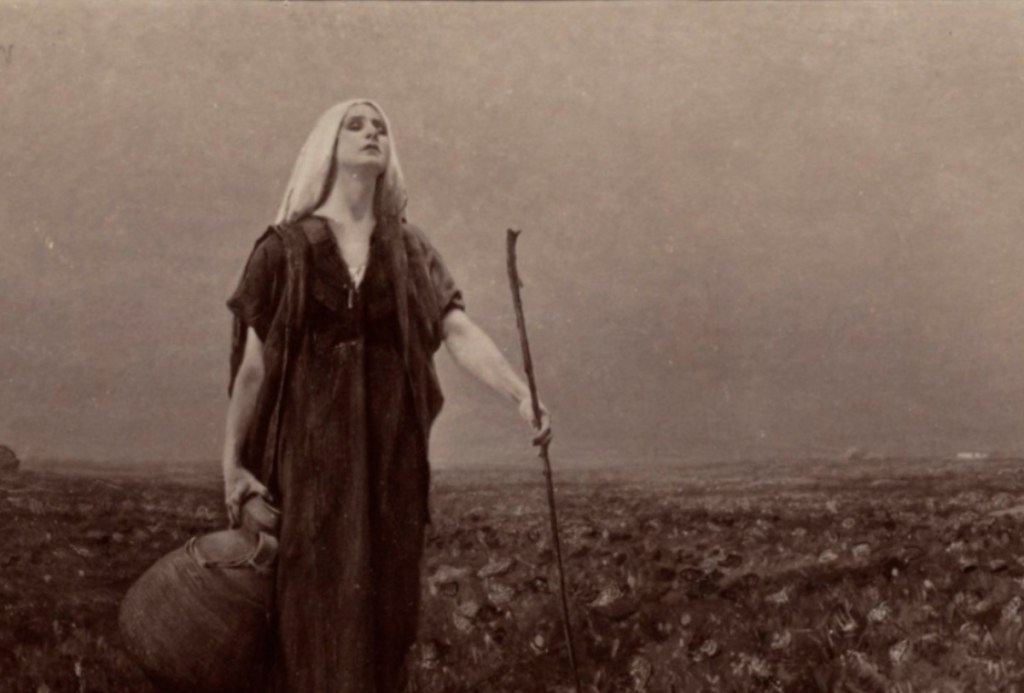
Anthon Gerhard Alexander van Rappard, 1868 – 1892 (rijksmuseum.nl)
THIRD BLIND. MAN.
It is useless; I no longer hear his heart. — He is cold.
FIRST BLIND MAN.
He died without speaking a word.
THIRD BLIND MAN.
He ought to have forewarned us.
SECOND BLIND MAN.
Oh! how old he was!… This is the first time I ever touched his face …
THIRD BLIND MAN.
[Feeling the corpse.] He is taller than we.
SECOND BLIND MAN.
His eyes are wide open. He died with his hands clasped.***
FIRST BLIND MAN.
It was unreasonable to die so …
SECOND BLIND MAN.
He is not standing up, he is sitting on a stone.
[*104]
THE VERY OLD BLIND WOMAN.
My God! my God! I did not dream of such a thing! … such a thing! … He has been sick such a long time … He must have suffered today … Oh, oh, oh! — He never complained; he only pressed our hands … One does not always understand … One never understands! … Let us go pray about him; go down on your knees …
[The women kneel, moaning.]
FIRST BLIND MAN.
I dare not go down on my knees.
SECOND BLIND MAN.
You cannot tell what you might kneel on here.
THIRD BLIND MAN.
Was he ill? … He did not tell us …
SECOND BLIND MAN.
I heard him muttering in a low voice as he went away. I think he was speaking to our young sister. What did he say?
FIRST BLIND MAN.
She will not answer.
SECOND BLIND MAN.
Wai you no longer answer us? — Where are you, I say? — Speak.
[*105]
THE VERY OLD BLIND WOMAN.
You made him suffer too much; you have made him die.… You would not go on; you would sit down on the stones of the road to eat; you have grumbled all day … I heard him sigh … He lost heart…
FIRST BLIND MAN.
Was he ill? Did you know it?
THE VERY OLD BLIND MAN.
We knew nothing … We never saw him.… When did we ever know anything behind our poor dead eyes? … He never complained. Now it is too late … I have seen three die … but never in this way! … Now it is our turn.
FIRST BLIND MAN.
It was not I that made him suffer. — I said nothing.
SECOND BLIND MAN.
No more did I. We followed him without saying anything.
THIRD BLIND MAN.
He died going after water for the madwoman.
FIRST BLIND MAN.
What are we going to do now? Where shall we go?
[*106]
THIRD BLIND MAN.
Where is the dog?
FIRST BLIND MAN.
Here; he will not go away from the dead man.
THIRD BLIND MAN.
Drag him away! Take him off, take him off!
FIRST BLIND MAN.
He will not leave the dead man.
SECOND BLIND MAN.
We cannot wait beside a dead man. We cannot die here in the dark.
THIRD BLIND MAN.
Let us remain together; let us not scatter; let us hold one another by the hand; let us all sit on this stone … Where are the others? … Come here, come, come!
THE VERY OLD BLIND MAN.
Where are you?
THIRD BLIND MAN.
Here; I am here. Are we all together? — Come nearer me. — Where are your hands? — It is very cold.
[*107]
THE YOUNG BLIND GIRL.
Oh, how cold your hands are!
THIRD BLIND MAN.
What are you doing?
THE YOUNG BLIND GIRL.
I was putting my hands on my eyes; I thought I was going to see all at once …
FIRST BLIND MAN.
Who is weeping so?
THE VERY OLD BLIND WOMAN.
It is the madwoman sobbing.
FIRST BLIND MAN.
And yet she does not know the truth.
THE VERY OLD BLIND MAN.
I think we are going to die here.
THE VERY OLD BLIND WOMAN.
Perhaps someone will come …
THE VERY OLD BLIND MAN.
Who else would come? …
THE VERY OLD BLIND WOMAN.
I do not know.
[*108]
FIRST BLIND MAN.
I think the nuns will come out from the Asylum …
THE VERY OLD BLIND WOMAN.
They do not go out after dark.
THE YOUNG BLIND GIRL.
They never go out.
SECOND BLIND MAN.
I think the men at the great lighthouse will perceive us …
THE VERY OLD BLIND MAN.
They never come down from their tower.
THIRD BLIND MAN.
They will see us, perhaps.…
THE VERY OLD BLIND WOMAN.
They look always out to sea.
THIRD BLIND MAN.
It is cold.
THE VERY OLD BLIND MAN.
Listen to the dead leaves. I believe it is freezing. ***
THE YOUNG BLIND GIRL.
Oh! how hard the earth is!
[*109]
THIRD BLIND MAN.
I hear on my left a sound I do not understand.
THE VERY OLD BLIND MAN.
It is the sea moaning against the rocks.
THIRD BLIND MAN.
I thought it was the women.
THE VERY OLD BLIND WOMAN.
I hear the ice breaking under the surf.
FIRST BLIND MAN.
Who is shivering so? It shakes everybody on the stone.
SECOND BLIND MAN.
I can no longer open my hands.
THE VERY OLD BLIND MAN.
I hear again a sound I do not understand.
FIRST BLIND MAN.
Who is shivering so among us? It shakes the stone.
THE VERY OLD BLIND MAN.
I think it is a woman.
THE VERY OLD BLIND WOMAN.
I think the madwoman is shivering the hardest.

[*110
THIRD BLIND MAN.
We do not hear her child.
THE VERY OLD BLIND WOMAN.
I think he is still nursing.
THE VERY OLD BLIND MAN.
He is the only one who can see where we are!
FIRST BLIND MAN.
I hear the north wind.
SIXTH BLIND MAN.
I think there are no more stars; it is going to snow.
SECOND BLIND MAN.
Then we are lost!
THIRD BLIND MAN.
If anyone sleeps, he must be aroused.
THE VERY OLD BLIND MAN.
Nevertheless, I am sleepy.
[A sudden gust sweeps the dead leaves around in a whirlwind.]
THE YOUNG BLIND GIRL.
Do you hear the dead leaves? — I believe someone is coming toward us.
[*111]
SECOND BLIND MAN.
It is the wind; listen!
THIRD BLIND MAN.
No one will ever come.
THE VERY OLD BLIND MAN.
The great cold will come …
THE YOUNG BLIND GIRL.
I hear walking far off.
FIRST BLIND MAN.
I hear only the dead leaves. ***
THE YOUNG BLIND GIRL.
I hear walking far away from us.
SECOND BLIND MAN.
I hear only the north wind.
THE YOUNG BLIND GIRL.
I tell you someone is coming toward us.
THE VERY OLD BLIND WOMAN.
I hear a sound of very slow footsteps.
THE VERY OLD BLIND MAN.
I believe the women are right.
[It begins to snow in great flakes.]
[*112]
FIRST BLIND MAN.
Oh! oh! what is it falling so cold upon my hands?
SIXTH BLIND BIAN.
It is snowing.
FIRST BLIND MAN.
Let us press close to one another.
THE YOUNG BLIND GIRL.
No, but listen! The sound of footsteps!
THE VERY OLD BLIND WOMAN.
For God’s sake, keep still an instant.
THE YOUNG BLIND GIRL.
They come nearer! they come nearer! listen!
[Here the child of the blind madwoman begins suddenly to wail in the darkness.]
THE VERY OLD BLIND MAN.
The child is crying.
THE YOUNG BLIND GIRL.
He sees! he sees! He must see something if he cries. [She seizes the child in her arms and advances in the direction from which the sound of footsteps seems to come. The other women follow her anxiously and surround her.] I am going to meet him.
[*113]
THE VERY OLD BLIND MAN.
Take care.
THE YOUNG BLIND GIRL.
Oh, how he cries! — What is the matter with him? — Don’t cry. — Don’t be afraid; there is nothing to frighten you, we are here; we are all about you. — What do you see? — Don’t be afraid at all. — Don’t cry so! — What do you see? — Tell me, what do you see?
THE VERY OLD BLIND WOMAN.
The sound of footsteps draws nearer and nearer: listen, listen!
THE VERY OLD BLIND MAN.
I hear the rustling of a gown against the dead leaves. ***
SIXTH BLIND MAN.
Is it a woman?
THE VERY OLD BLIND MAN.
Is it a noise of footsteps?
FIRST BLIND MAN.
Can it be perhaps the sea in the dead leaves?
THE YOUNG BLIND GIRL.
No, no! They are footsteps, they are footsteps, they are footsteps!
[*114]
THE VERY OLD BLIND WOBIAN.
We shall know soon. Listen to the dead leaves.
THE YOUNG BLIND GIRL.
I hear them, I hear them almost beside us; listen, listen! — What do you see? What do you see?
THE VERY OLD BLIND WOMAN.
Which way is he looking?
THE YOUNG BLIND GIRL.
He keeps following the sound of the steps. — Look, look! When I turn him away, he turns back to see … He sees, he sees, he sees I — He must see something strange!
THE VERY OLD BLIND WOMAN [stepping forward].
Lift him above us, so that he may see better.
THE YOUNG BLIND GIRL.
Stand back, stand back. [She raises the child above the group of blind folk.] — The footsteps have stopped amongst us.
THE VERY OLD BLIND WOMAN.
They are here! They are in the midst of usl …
[*115]
THE YOUNG BLIND GIRL.
Who are you? [Silence.]
THE VERY OLD BLIND WOMAN.
Have pity on us!
[Silence. — The child weeps more desperately.] ***
[Curtain.]
- In Maurice Maeterlinck, The Intruder: The Blind; The Seven Princesses; The Death of Tintagiles, translated by Richard Hovey, NY: Dodd, Mead, and Company, 1911. Page numbers in the text (*) are from this edition.
- *** indicates some select “Beckettian” touches, among copious others.


 Furin Chime Press™
Leave a comment