Month: July 2019

  • J.F. Smith’s Mystery of the Marsh — Eleventh Instalment

    J.F. Smith’s Mystery of the Marsh — Eleventh Instalment

    This chapter presents insights into the motivations and machinations in play at the ‘higher end’ of society. A far cry from Mrs. Hurst’s scheme to have William and Goliah banged up for the ‘theft’ of the horse and wagon, motivated partially by her rivalry with Mrs. Gob over her excellent butter.

    Nevertheless, the differences appear to be more in terms of their degrees of subtlety and complexity rather than in essence. Smith presents the moral attributes of the characters in a system of defined binary oppositions, which work at times to undercut each other in the same character. Someone who wears a ‘black hat’ in the first instance may be shown subsequently to have redeeming qualities to some extent. (Cinema quite commonly applies similar techniques.)

    It seems on cue to turn, as we do in the present chapter, to a deeper context of meaning for his play of morality and human nobility. The scene in the regimental headquarters of the Royal Life Guards and Horse Guards (also known as The Blues) serves to diminish the importance of the social hierarchy per se, with this proximity to royalty and empire.

    These are the two most senior regiments of the Royal Household Cavalry, dating to the restoration of Charles II in 1660. They boasted an illustrious record of service at home and abroad in any number of theatres of war over the subsequent centuries, including Waterloo.

    In the Victorian era, the British Empire had become one upon which ‘the sun never set’. A certain mode of history — ‘Whig historiography’ — assumed popularity, one that viewed this position of world leadership as a logical and inevitable development, a march towards global enlightenment based on the principles enshrined in British governance.

    Lord Macaulay’s (1800–1859) five-volume History of England (1848) is considered the archetype of Whig history. But guess in whose history we can discern shades? Correct: in John Frederick Smith’s own volume of the nine-volume Cassell’s lIlustrated History of England (1874):

    The slow building of a constitution which finds no parallel in the world is the most distinctive, as it is the largest feature in English history … If we do not profit in heart and head by the experience which the ages have gathered for us — if we do not grow, as they would have us, not only in wisdom but in humility, in moderation, in humanity — we have to blame, not these unerring teachers, but ourselves.

    Preface to Volume 1

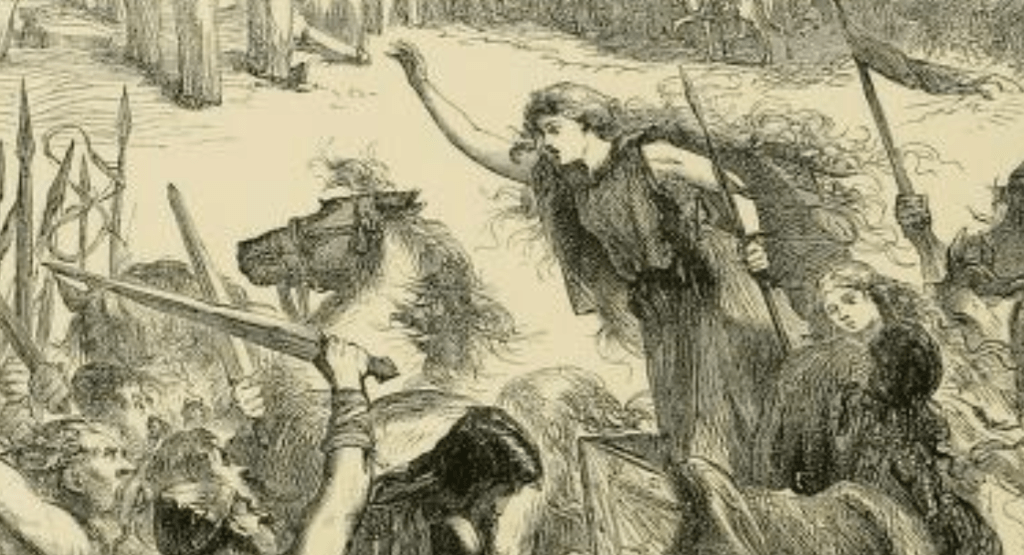
    The Celtic queen Boadicea leading the British revolt against the Romans, 60/61 CE. Frontispiece to Cassell’s Illustrated History of England Vol. 1 (cropped).

    CHAPTER ELEVEN

    Clara Meredith Does not Feel Quite Satisfied with Herself — The Sketch — Return of her Cousin to London

    Clara was seated in the library, thinking over the events of the last few days, and taking herself to task for her conduct to her cousin. To be sure, his neglecting to make her acquaintance in London — her first season, too — was unkind, to say the least of it; but had she the right to resent it, and turn him into ridicule on his arrival in the country? After turning the circumstances over in her mind she came to the conclusion that she had not. It was undignified, to say the least of it; and she felt dissatisfied with herself, and all the more so that he had endured her sarcasm with such polished good humour.

    That her cousin was ultra-fashionable, and not a little fastidious, she did not doubt; but that he merited the title some of her dear friends in London had given him of a “cynical, heartless man,” she could not believe. Had he not danced with the May Queen at her request; defended her from the insulting familiarity of Burcham? Shaken hands with Tom Randal as he reluctantly yielded to his right to protect his rustic sweetheart?

    What better proofs of manhood could he have given?

    ‘Clara,’ said his lordship, as he entered the library, ‘I am come to fulfil my promise. I told you when I made it that I was not much of an artist; but I have done my best.’

    He placed the sketch in her hand.

    The young lady coloured slightly as she received it. She had secretly hoped he had forgotten it; but Bury was a man of his word. Despite the seriousness of her late thoughts she could not help laughing gaily as she contemplated the drawing. It was really exceedingly well done for an amateur, and he had carried out her description to the letter. There stood the old mansion in the distance; Clara, in a short frock and blue sash, screaming on the bank of the pond; his lordship floundering in the water. One of the famous red morocco shoes floating on the surface, and a goose swimming after it.

    The last, by-the-by, was an introduction of the artist’s own, intended, probably, as a slight epigram on the playful malice which had recalled the incidents.

    ‘I am glad,’ observed Clara, recovering her seriousness, ‘that you have recollected your promise, and yet it scarcely amounted to one. But why represent me twice?’

    ‘I scarcely understand you, cousin.’

    His cousin pointed to the goose sailing after the shoe. His lordship smiled.

    ‘I am ever so much obliged to you,’ resumed the fair girl, after a pause. Is it really mine?’

    ‘Undoubtedly, since you have honored me by accepting it. Shall the drawing find a place in your album, or be sent as a contribution to the next fancy fair?’

    ‘Neither one nor the other,’ answered his cousin, with a show of feeling at which she felt provoked with herself. ‘I can dispose of it in a far more fitting way. And yet it is a almost a pity,’ she added, as she crushed the sketch in her little hand, dropped it into the fire, stood watching it until it was consumed, and then, with a quiet courtesy, quitted the room.

    Lord Bury stood for some little time gazing after her in silence. Possibly the problem was becoming interesting to him.

    ‘Pshaw!’ he muttered, as he took up a newspaper to while away the time till luncheon. ‘Why should I feel surprised? Good blood will tell.’

    Had he said good principles, the observation, we suspect, would have been more germane to the matter, as our friend, Shakespeare, says.

    Three days after the interview in the library, which neither of the cousins thought fit to allude to again, Lord Bury, who had just received his letters, informed Sir George that he was obliged to start the following morning, on particular business, for London.

    ‘Nothing unpleasant, I trust. Can I be of any use?’

    ‘Exceedingly unpleasant, uncle, for it concerns the honor of one who ought to be very dear to me. Unfortunately,’ he added, ‘you cannot be of the slightest assistance to me.’

    ‘That scamp of a father, I suppose,’ thought his host, who had noticed the word “ought.” ‘He is always getting himself into some infernal scrape or another. Older, too, than I am.’

    Of course he kept these reflections to himself.

    ‘Possibly I may be able to renew my visit,’ said his lordship, ‘in the shooting season. That is, if I have not worn out my welcome.’

    ‘We are homespun, Egbert,’ observed his relative, ‘and can stand a vast amount of wear and tear. Come when you will, always glad to see you, Make it a promise, and I will keep the home cover for you. Make it your home if you like.

    ‘That is,’ he added, noticing the blush upon his daughter’s cheek, ‘as long as I live, Of course I cannot answer for my successor.’

    ‘That would be unreasonable, Sir George,’ observed the nephew, who had noticed the blush and the correction of the speaker’s offer. ‘Thanks, I will not abuse your hospitality.’

    The next day Lord Bury started for London.

    ‘Well, Sparks,’ said his lordship, when the sergeant-major entered the room the morning after his arrival at headquarters, to report on the condition of his company, ‘anything important?’

    ‘Not very,’ answered the old soldier. ‘There has been a fine young fellow here from the country, who wants to enlist, but won’t engage in any company but yours. Such a chest! Stands six feet two; straight as a pike-staff. Knows the points of a horse as well as the regimental vet, himself. Hope we shan’t lose him.’

    ‘But why in my company?’ demanded Lord Bury.

    ‘Heard that you were a kind officer, most likely.’

    ‘No flattery, Sparks. Did the young fellow you were speaking of give his name?’

    ‘Tom Randal, my lord.’

    ‘Find him; bring him to me instantly,’ exclaimed the officer, greatly interested. ‘You said truly, he is a fine fellow — a man every inch of him.’

    In a few minutes the lover of the pretty Phœbe entered the luxuriously-furnished room of the officer, who frankly held out his hand to him.

    Although the countenance of the new recruit flushed with a momentary satisfaction, he did not accept it.

    ‘You forget,’ he observed, ‘that I am about to become a private soldier.’

    ‘No, I do not,’ replied his lordship; ’till you are enlisted, you are a free man, and a prince might shake hands with you. Once in the ranks,’ he added, ‘it would be different; but that will be neither your fault nor mine.’

    The hand was again extended, and this time cordially shaken. The sergeant discreetly withdrew. He thought it best to leave the officer and his rustic friend together.

    Tom Randal, after the quarrel with his father, had made the best of his way to London on foot; for he had very little money, and proceeded at once to the barracks of the Guards. Our readers know the rest. Vainly did his aristocratic friend try to argue him out of his intention to enlist, pointing out the difficulty of obtaining his discharge when once he had taken the fatal shilling.

    ‘The colonel,’ he added, is a good man — a kind man — but will never consent to let a fine young fellow like you leave the regiment when once engaged in it,’ and advised him to take a few days to consider of it.

    ‘Not an hour, my lord,’ replied the lover of Phœbe. ‘I have lost the only girl I can ever love, and all through my father’s prejudice, pride, and obstinacy. It has cost him his son,’ he added. ‘He shall find I can be as resolute as he is. My mind is made up.’
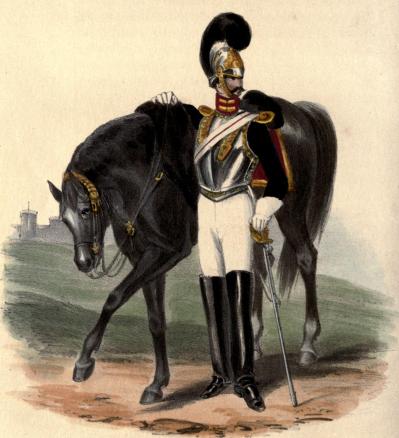
    Trooper of the Royal Horse Guards, 1828. (Created 1847) Public Domain. Source: Wikipedia

    Lord Bury sent for Sergeant Sparks, and Tom Randal quitted the room, duly enlisted into his majesty’s first regiment of Life Guards.

    The poor fellow, we suspect, had inherited some of the old farmer’s temper; if so, the army was, perhaps, the best school to work it out of him.

    The expiration of his leave of absence was not the only motive which brought his lordship to London. He could easily have obtained a prolongation of it. He had received a letter from one of his most intimate friends, informing him of certain ugly rumours that were whispered in society of an attempt to force his cousin, Lady Kate Kepple, into an unequal marriage with Clarence Marsham, and that Lord Allworth’s name was unpleasantly mixed up with the transaction. ‘Of course,’ added the writer, ‘I do not vouch for the correctness of these reports; but as they are levelled at the honor of your family, I felt it my duty to inform you of them. All I really know is that the chancellor has deprived your father of the guardianship of Lady Kate’s person, and that his step-son has sold out of the army. The last two facts I affirm on my knowledge. There the duty of friendship ends. It is for you to act as you think best.’

    On his way to town, the young guardsman had perused the letter at least a dozen times, and each reading added to his mortification. As we before observed, he was both proud and honorable, weak in some things and extremely sensitive; but, then, we are not drawing a perfect character; absolute perfection, we fear, would be just a little insipid.

    His first visit was to Montague House. There, at least, he expected to learn the truth. Its owner, with whom he was a favorite, received him nervously. Our readers have not forgotten her intense dread of scandal, and the feeling increased tenfold when he had explained the object of his visit.

    ‘It it possible!’ she exclaimed, ‘that, despite my precautions, the unfortunate story has leaked out?’

    ‘It is true, then?’

    ‘I cannot deny it.’

    Lord Bury rose to take his leave.’

    ‘Egbert! Egbert! cannot the affair be hushed up?’

    ‘Impossible!’ was the reply. ‘At present it is only whispered; in a week’s time it will be a common topic of conversation in half the drawing-rooms in London. It is my duty,’ he added, firmly, ‘to see that your conduct and Kate’s should be unquestioned.’

    Again he moved towards the door.

    ‘Stay,’ said her ladyship, lowering her voice to a whisper. ‘You do not know all.’

    ‘For Heaven’s sake, let me hear it, aunt!’

    ‘Kate escaped from Allworth Park in boy’s clothes; walked all one night in them, and slept the next in a barn.’

    ‘Is that the worst?’

    ‘What could be worse?’ replied the aristocratic old maid, blushing deeply as the veiled meaning of his question dawned upon her mind. ‘Is not Kate living — slowly recovering her health and spirits?’

    A terrible suspicion passed from the heart of Lord Bury. He knew the speaker too well to doubt her word for an instant. A third time he was about to depart.

    ‘Stay,’ said Lady Montague, ‘Do tell me where you are going.’

    ‘To see my father,’ answered her visitor, gloomily. ‘I have a hard task before me, but will not shrink from it.’

    This time he succeeded in quitting the room.

    ‘Poor Egbert!’ sighed Lady Montague, as he disappeared. ‘He is very much to be pitied. Why did my sister marry Allworth? I told her he was a roue, repeated all the evil reports I ever heard of him, warned her every way; but it was of no use — seemed to increase her infatuation. If she had accepted some plain country gentleman, or even a bishop’s son I should not so much have minded, although, of course, it would have been a misalliance. But no, she would have a peer. Poor girl; she paid dearly enough for her folly. And yet,’ she added, thoughtfully, ‘I do not think it was all ambition. At the worst,’ continued her ladyship, ‘Kate and I can return to Montague Castle, live like nuns, and when we die, leave our fortunes to found a hospital for old maids.’

    However improbable, the project certainly was not an impossible one, although somehow we have an idea that Lady Kate will feel but little disposed to join in it.

    Viscount Allworth never believed it would be possible to keep the disgraceful escapade of his stepson from the knowledge of society — he knew the world too well for that — so he prudently resolved to make his own share in the transaction appear as harmless as possible. What he most feared was the indignation of his own son, who had lately shown a spirit which startled him.

    ‘Bury behaved exceedingly well in the Chellston affair,’ he muttered to himself, as he turned the incidents over in his scheming brain. ‘Must keep friends with him if possible.’

    Having traced a line of conduct for himself, Lord Allworth was not the man to be easily moved to depart from it; and the less so, that for the first time for years he found himself — thanks to the Chellston trickery — tolerably at ease in his pecuniary affairs; hence the firmness with which he insisted on Clarence Marcham’s retirement from the army.

    ‘Absurd!’ exclaimed his wife, when he informed her of his determination. ‘A mere boyish folly; the world soon forgets such things.’

    ‘In some persons, perhaps, but not in others,’ remarked the husband, gravely. ‘You made no objection when I stated my intention to Lady Montague.’

    ‘Because I did not believe you to be serious. In fact I never know when you. are serious. I considered it merely a sop thrown to the old Cerberus.’

    His lordship appeared greatly shocked.

    ‘I wish, Lady Allworth,’ he observed, but without losing his temper, ‘that you would be a little more refined in your expressions. I am aware that the defects of early education and associations are hard to overcome. Still it may be done. You will oblige greatly by striving to recollect this the next time you speak of my first wife’s sister, a woman of high birth, large fortune, and spotless reputation.’

    There was a momentary lull in the stormy conversation. The viscountess bit her lips to avoid giving expression to her rage at his provoking coolness.

    The husband — and we feel there are but too many like him in the world — enjoyed his wife’s mortification exceedingly.

    ‘I perceive what you are driving at,’ observed the angry woman. ‘You require money?’

    ‘No.’

    The lady gazed at him with astonishment. It was the first time in her married life she had received such an answer to a similar question.

    ‘Money,’ continued the speaker, ‘is an excellent thing in its way. I can’t imagine how some people contrive to exist without it; but it is not everything. Listen to me — my conduct is not so unkind as you suspect. You are far from being a fool, Lady Allworth. I know that you can control your temper on some occasions, and act with prudence.’

    The wife could scarcely repress a smile; she recollected how cleverly she had contrived to outwit him in the settlement of her fortune.

    ‘I have seen the commander-in-chief,’ added the speaker; ‘the affair has got wind through the rascally lawyers. I suspect Clarence is in bad odor at the Horse Guards — very bad. His royal highness is decidedly of opinion that he ought to sell out; and you know what such an opinion from such a quarter means. The price of his commission I am told, will barely pay his debts.’

    ‘Debts!’ gasped the astonished mother; ‘why, his allowance has been most liberal!’

    ‘Not feeling the slightest interest in the subject,’ said his lordship, ‘I made no inquiry as to their amount. You perceive the step is inevitable. Clarence had better return to France; living is cheap there; great resort for half-pay people. But he must decide quickly; in three days he will be arrested.’

    It is quite true that Viscountess Allworth loved her son, but, then, she loved herself a great deal more, and did not care to impoverish herself to pay off his liabilities. He must do that, she thought, by a wealthy marriage. So far from having abandoned the project, she clung to it more tenaciously than ever. Two days afterwards the unmanly scapegrace landed in France.

    We scarcely need to remind our readers that these last arrangements were made during Lord Bury’s visit to the country.

    This edition © 2019 Furin Chime, Michael Guest


    Notes and References

    ‘as our friend, Shakespeare, says’: ‘The phrase would be more germane to the matter if we could carry cannon by our sides’ (Hamlet, V, 2).

    ‘[to take] the fatal shilling’: sign up as a soldier, ‘from the former practice of giving a shilling to a recruit when he enlisted’, wordhistories.net

    Macaulay, Thomas Babington, Baron, 1800-1859, History of England from the Accession of James the Second (1901). Digital facsimile available at the Internet Archive. Link opens Vol. 1.

    Smith, John Frederick, Cassell’s Illustrated History of England (1874). Beautifully illustrated digital facsimile available at the Internet Archive. Link opens Vol. 1.

    While all nine volumes of Cassell’s Illustrated History are sometimes attributed to Smith, Andrew King and John Plunkett reveal that he actually only wrote the first. Subsequently Cassell ‘realized that Smith was less concerned with facts than narrative drive’ and handed the rest of the work over to William Howitt (1792–1879) (King and Plunkett, Victorian Print Media, OUP, 2005, p. 415).

  • J.F. Smith’s Mystery of the Marsh — Recap

    J.F. Smith’s Mystery of the Marsh — Recap

    I’ll keep good the promise made by the 1883 newspaper sources for this reconstructed penny blood mystery, by providing their mid-way summary. The author of the novel is the Englishman John Frederick Smith, the most popular writer of the mid-nineteenth century — but in later years all but forgotten. The annotated instalments include contextual notes along with glimpses of the life of this intriguing writer.


    In order that new readers may begin with the following installment of this story, and understand it just the same as though they had read it all from the beginning, we here give a synopsis of that portion of it which has already been published:

    Two girls, clad in male attire, one evening appealed for help to William Whiston, nephew of Farmer Hurst, of Deerhurst. William — who was accompanied by two friends, Goliah Gob and Benoni Blackmore — gave the fugitives refuge in his uncle’s red barn. Soon afterwards a tramp, named Bunce, took refuge in the barn, and two ruffians came there also, in pursuit of the girls. Bunce defended the girls against the ruffians, till Goliah Gob, a young fellow of gigantic size and strength, came to his assistance. The ruffians were overpowered and bound.

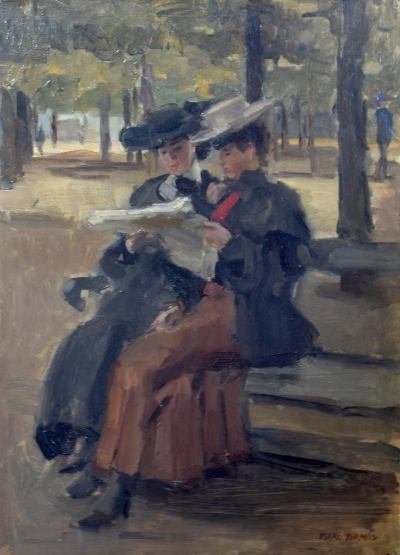
    Isaac Israëls (1865-1934), Bois de Boulogne (1904). Public Domain. Source: 1stdibs.com

    Goliah then summoned William and Benoni, and after consultation William and Goliah set out in a waggon for London with the girls, who proved to be Lady Kate Kepple, an heiress, and her maid Martha. Lady Kate was fleeing from Clarence Marsham, an officer in the Guards, who attempted to force her to marry him. They arrived safely in London, where Kate went to the protection of her aunt, Lady Montague.

    William called on his uncle, Lawyer Whiston, and told him the story. The old lawyer was Lady Montague’s legal adviser, and was delighted to find what part his nephew had played in Lady Kate’s escape.

    Benoni had been left in charge of the bound ruffians in the red barn, with directions to hand them over to the authorities in the morning, but he set them free, and told such a story to Farmer Hurst that Mrs. Hurst insisted on having William and Goliah arrested for stealing the farmer’s horse and waggon. This was done, but Lawyer Whiston came down from London, rescued them, and overwhelmed the Hursts and Benoni with exposure and shame.

    William, who was half-owner of the Hurst farm, then went to London with his uncle.

    Goliah loved Susan Hurst (William’s cousin), and Mrs. Hurst hated him for it. Lawyer Whiston, to whom Bunce showed some old family papers, provided handsomely for the wanderer, and Lady Kate Kepple sent William and Goliah each a handsome watch as a token of her gratitude.

    Clarence Marsham, the persecutor of Lady Kate, was a step-son of an unprincipled nobleman, Lord Allworth, who, after the death of his wife, married Clarence’s mother for her money. Lord Allworth had a son of his own — Egbert, Lord Bury — whom he had swindled out of an estate called Chellston, that Egbert had inherited from his mother. Sir George Meredith, Egbert’s uncle, had bought Chellston.

    Clara Meredith, sole child of Sir George Meredith was a beauty and an heiress. Egbert — Lord Bury — was on a visit to Chellston. Clara felt piqued at Lord Bury, who was an officer of the Guards and noted for his exclusiveness, because when she was on her first visit to London the season before, he did not call upon her. For this reason she snubbed him, reminded him how he had fallen into the duck pond when he was a boy, and requested him to make her a drawing of the scene.

    At the May Day festival Lord Bury defended the May Queen, Phœbe Burr, from a ruffian named Burcham, until her lover, Tom Randal, came upon the scene, and claimed the right to act as her champion. Farmer Randal, Tom’s father, was so incensed at his son for avowing his love for Phoebe that a quarrel ensued and Tom ran away. Clara was a friend of Phœbe’s and resolved to help her to marry Tom despite his father’s opposition.

    This is the state of affairs at Chellston when the following chapter opens …

    This edition © 2019 Furin Chime, Michael Guest


    Next instalment will be Chapter Eleven. All the previous chapters are available at Furin Chime website. 

  • J.F. Smith’s Mystery of the Marsh — Tenth Instalment

    J.F. Smith’s Mystery of the Marsh — Tenth Instalment

    Smith lingers over May Day while introducing a new source of conflict. The early twenty-first century reader may wince at the themes of gender and morality so firmly foregrounded. In our era we have the advent of LGBT rights, and concurrent with them, the destabilization, at least, of traditional gender identifications; such that perhaps the only truly defining characteristic remains the (optional) ability of a woman to bear offspring.

    Women’s rights and equality, moreover, have been hard fought for and to an extent achieved, and we have come to expect the equivalent participation of women across the gamut of human endeavour, from politics and world leadership to sport. At the same time, the advance of a particular set of human rights collides with others and frictions arise with traditional religious ideas.

    From the modern perspective, the Victorian ethos is beheld as the epitome of repression against which the progressive West measures its freedom of thought and existential identity. Though John Ruskin himself has been the butt of many jokes, there are few better spokespeople for the ideology of a culture that fundamentally prefigures our own.

    His lecture ‘Of Queens’ Gardens’, published as one half of Sesame and Lilies (1865), outlines his ideals of femininity, defining the woman’s sphere as passive in relation to the man’s, and in the private domain of the home. At the same time, he ‘urges women to abandon trivial feminine pursuits in order to act as a moral force in countering the ills of society’ (Norton Anthology of English Literature).

    Here are some quotations from Ruskin’s lecture, referring to the ‘place’ (the home) and ‘power’ of women, which echo in the instalment to follow:

    We are foolish … in speaking of the ‘superiority’ of one sex to the other, as if they could be compared in similar things. Each has what the other has not: each completes the other and is completed by the other: they are nothing alike, and the happiness and perfection of both depends on each asking and receiving from the other what the other only can give …

    The man’s power is active, progressive, defensive. He is eminently the doer, the creator, the discoverer, the defender …

    But the woman’s power is for rule, not for battle, — and her intellect is not for invention or creation, but for sweet ordering, arrangement, and decision. She sees the qualities of things, their claims and their places …

    This is the true nature of home — it is the place of Peace; the shelter, not only from all injury, but from all terror, doubt, and division … And wherever a true wife comes, this home is always round her.

    Of Queens’ Gardens (p. 20 ff.)


    CHAPTER TEN

    The May Day Sports Interrupted — The Bully and the Gentleman — A Manly Lover — A Poor Girl’s Resolution

    ‘What is the meaning of this disgraceful scene?’ demanded the baronet, walking in the midst of the crowd, composed mostly of his old and new tenants. ‘Nephew, will you explain?’

    ‘Better, ask some one else, uncle,’ replied the guardsman, laughingly. ‘You forget that I am a particeps criminis in the affair.’

    This was the first intimation of the relation between their landlord and the unknown gentleman.

    The bully began to feel cowed.

    ‘I need not ask,’ added Sir George, ‘since I see Mr. Burcham present. It is time these public outrages were put a stop to.’

    ‘High time,’ said the rector.

    ‘Leave him to me,’ exclaimed the lover of the pretty May Queen, ‘and I will answer for it he will not be in a hurry to recommence.’

    ‘And what have you to do with it?’ inquired the baronet mildly, for the speaker was rather a favorite with the old gentleman from his sporting accomplishments.

    ‘That is what I should like to know,’ muttered Farmer Randal.

    ‘Sir George,’ replied the young man, respectfully, ‘Phœbe is my betrothed wife. I love her very dearly, and she loves me. It is my right to defend her. Don’t cry, Phœbe,’ he added, ‘there is nothing to be ashamed of in an honest affection, although it is rather tough to be forced to speak of such things. When that thing, who calls himself a gentleman, tried to force her to dance with him — no modest girl could do so — your nephew stood forward like a man to protect her. God bless him! If ever he wants a true heart and a tolerably strong arm to defend him, he knows where to find them.’

    The glowing countenance of the speaker, his untaught natural eloquence, and manly avowal of his love produced a favorable effect upon his hearers.

    ‘I was at a distant part of the green,’ continued Tom Randal, ‘when the row commenced. Burcham — Squire, as he calls himself — had already received some punishment. I claimed the right to finish him, which my lord here — I recollect him now — reluctantly consented to. It was my right to defend her, and I would have pounded the rascal to a jelly, if your honour and your friends had not interfered; but I only put off paying my debts: the first time we meet I intend to take a receipt in full.’

    ‘Very proper,’ said the baronet. ‘How very natural, I meant to say,’ he added, correcting himself; ‘but unfortunately, it would be illegal. Mr. Burcham you had better retire.’

    ‘I shall do nothing of the kind,’ replied the cowardly ruffian, sullenly. Conscious that in the presence of so many magistrates, no further contest would be permitted, he resolved to brave it out. ‘This is May Day, and though you are lord of the manor, the green is free to all.’

    ‘Who conduct themselves respectably,’ observed Sir George; ‘but vagrants, disorderly characters, and disturbers of the peace, I am fully authorised to remove. I shall commit you.’

    ‘I can give bail,’ observed Burcham with a sneer.

    ‘Or place you in the stocks,’ added Sir George, thoroughly roused.

    At this there was a general shout of laughter.

    ‘And any magistrate present, I feel certain, will sign the warrant. Call the constables.’

    As the bully said, he could easily have found bail, and lawyers to defend him, for he had plenty of money; but the stocks! Nothing could ever efface the ridicule of such an exposition. With an oath of future vengeance he broke through the crowd, and ran with the fleetness of a hound till he had cleared the village green. There was a general hiss on his flight.

    During the rest of the day the sports were languidly carried out. Tom Randal never for an instant quitted the side of Phœbe. Vainly did his father call to him, his mother and sisters beckoned to him; summons and signs were alike unheeded. He knew his place, and stuck to it.

    For several years the young farmer, who with Lord Bury had fairly divided the honours of the day, had been an object of speculation amongst those of his own class, who had daughters to dispose of in marriage. Mothers, of course, condoled with Mrs. Randal on her son’s having been so easily entrapped; the girls pouted and tossed their heads indignantly.

    ‘Phœbe Burr indeed!’ observed one.

    ‘Hasn’t an acre of land in the parish!’

    ‘Nor in any other parish,’ added a third. ‘The old organist can’t have saved much.’

    The last observation, unfortunately, was strictly true, the old man’s salary being only forty pounds a year, and for that he had to train the choir, as well as attend two weekly services.

    ‘Tom was always a soft-hearted fool,’ said one of his sisters, spitefully. She was not only jealous of her brother, but detested the object of his choice.

    ‘Hold thee tongue, Bess!’ exclaimed her father, angrily. Not that he did not feel quite as much displeased at his son’s choice as the rest of the family, or had not come to a conclusion to break it off; but the old man was quite shrewd enough to perceive that abusing Phœbe was not the way to do it. ‘Thee was always envious of the gal because she has a prettier face than thine. It be only calf-love,’ he added, ‘and will die off of itself, if let alone.’

    We question if the speaker felt much confidence in his own prediction. Still he was resolved to give the boy a chance. If Tom listened to reason, well and good; if not, then he would see.

    If it were possible to tempt us to bet, we rather think we should feel inclined to back the son. How frequently have we seen prudent resolutions made, and fail from lack of temper in carrying them out. We suspect it will prove so with the farmer.

    How frequently can one coarse mind destroy the enjoyment of many. To the May Day Queen her ephemeral dignity had proved anything but a source of pleasure; her name had been made the theme of village gossip, the sport of every tongue — and we know how charitable they are, especially in rustic communities. As soon as Sir George and his guests returned to the Hall, poor Phœbe retired to her father’s cottage. Her lover accompanied her. It had been by her own repeated requests that Tom had abstained from paying her any marked attentions, and kept at a distance from her mimic court. Not that he felt ashamed of his choice; on the contrary, he felt proud of it, and proved the depth as well as manlinesss of his attachment by proclaiming it openly to the world.

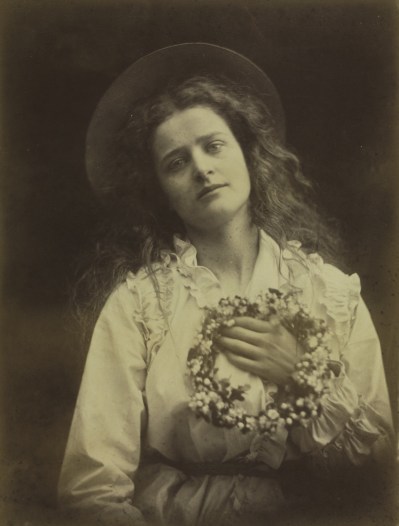
    Queen of the May, 1875. Julia Margaret Cameron (British, 1815-1879). Albumen print from wet collodion negative. Public Domain. Source: Internet Archive (Cleveland Museum of Art)

    With tender, truthful words, such as dwell on memory’s page long after they are uttered, he sought to soothe her delicacy and wounded pride, till he had the satisfaction of seeing something like a smile on her pale face. The shades of evening had fallen when he rose to depart. At the request of her lover, Phœbe consented to accompany him as far as the garden gate. Perhaps he thought to steal a kiss; if so, who shall blame him?

    On reaching the limit of the enclosure the lovers paused; neither of them liked to say the word ‘good-night,’ and yet each felt that it was time to speak it.

    ‘I fear, Tom,’ said the fair girl, breaking their mutual silence, ‘that I can never be your wife.’

    ‘You will! You must!’ exclaimed the young farmer, impetuously.’What would life be without you?’

    ‘You forget that you have a father,’ the maiden hesitatingly replied; ‘and that without his consent I never will be yours.’

    ‘Phœbe! Phœbe!’ ejaculated her lover, imploringly.

    ‘I will bring discord into no family,’ continued the former; ‘happiness would fail to follow it. Remember how angry your father looked; how repeatedly he called you when you proclaimed the right to protect me.’

    ‘You do not know how well he loves me,’ replied her suitor, trustfully. ‘ He will fret and fume and rage at first — for I cannot conceal from myself that he has other views respecting me — but when he finds my happiness is really at stake, he will yield at last.’

    ‘Never!’ exclaimed a harsh voice near them.

    The next instant Farmer Randal broke through the hedge, where he had been a concealed listener to their conversation.

    ‘I did not think, father,’ observed Tom, greatly hurt, ‘that you would play the spy upon me.’

    ‘Aye, thee father; and thee will find that his heart baint half so soft as thee do think. Leave that artful minx, and come home with me.’

    The countenance of his son flushed, and then became pale. He had never disobeyed a command of his parent yet.

    ‘I will follow you in a few minutes,’ he replied. ‘I cannot accompany you now.’

    ‘Come home, I say,’ repeated the angry man.

    ‘For Heaven’s sake! go with him,’ whispered the terrified girl.

    ‘I will not!’ said her lover, firmly. ‘I am glad the discovery has been made, although it has not occurred in the manner I could have wished. I love her, father. You must have some memories in your heart to tell you what a first love means. You know that I am industrious. I will work harder than ever to please you. We are both young — willing to wait, if you exact the sacrifice; but one thing is certain: if Phœbe consents, she shall be my wife.’

    ‘Wife?’ repeated the old man, scornfully. ‘Why she hasn’t a penny! Knowing what a soft-hearted fool thee art, her mother has trained the artful hussy to catch thee.’

    In his wrath the speaker would have struck his son a blow; but Tom caught his wrist in an iron grasp, and held it firmly till his father’s eyes quailed beneath his reproachful gaze.

    ‘Do not disgrace my manhood by an outrage it would be sacrilege to resent by a blow that must separate us for ever,’ replied his son, disengaging his wrist.

    ‘Thee has driven me half mad!’ was the reply.

    Phœbe felt that it was time to interfere. The slanderous accusation against the mother she so dearly loved had aroused her indignation, and she confronted the speaker with eyes lit up by scorn at the outrage.

    ‘Mr. Randal,’ she said, ‘it is quite true that Tom and I love each other dearly — very dearly; equally true that I am poor. I do not deny it, Poorer, perhaps, than you suspect. But it is a wicked falsehood to accuse my mother of plotting to entrap your son.’

    ‘Maybe I was wrong there,’ growled the farmer.

    ‘You have a right to object to our marriage. I also have the right, to respect myself. Never will I consent to become the wife of your son till his father asks me.’

    The old man gave a low, chuckling laugh.

    ‘Phœbe!’ exclaimed her lover, greatly agitated.

    ‘I have said it, and you know that I can keep my word, And now, Tom,’ she added, blushingly, ‘take the kiss you asked for — in this world probably the last; for rest assured of this, the lips you have once pressed shall never be pressed by another.’

    The kiss was given and received. The lovers lingered over that parting embrace as if their heartstrings were twined together. Phœbe was the first to recover from the conflicting emotions which agitated both, and tearing herself from the arms of the young farmer, tottered rather than walked into her father’s humble cottage.

    The poor fellow stood gazing after her, the image of mute despair.

    ‘Come home, Tom,’ said the old man, mildly, for he, too, felt touched by the sorrow of his son. ‘She be a good gal, after all,’ he added.

    ‘God forgive you, father; you have broken my heart,’ murmured the poor fellow.

    The next instant he bounded over the hedge and disappeared. The farmer tried to follow him, thinking to soothe him with soft promises of future indulgence, but soon gave up the chase for want of breath.

    ‘Ah, well,’ he muttered, as he sank panting on one of the benches prepared for the May Day visitors — ‘I beant as spry as I once wor. Ugh! Tom can outrun me. Then what a grip he has! I am glad I didn’t strike him — not that he would have hit back again; too manly for that.

    ‘It be all calf love,’ he continued, ‘felt it once myself. Father wouldn’t hear of it, so I sulked for three days; refused my food; but, then, I milked the cows in the barn, and that kept me up like. I wonder if the boy will think of that. He will be back in three days, or four at the furthermost, and then I’ll buy him the colt that he took a fancy to. That will make it all right.’

    Here we must anticipate the progress of events and inform our readers that not only did the four days but as many weeks, nay, months, elapse before Farmer Randal received the least intelligence of his son.

    Although Sir George Meredith, on hospitable cares intent, did his best to entertain his guests, the dinner somehow passed heavily. He told his best stories, and scarcely elicited a smile. His daughter too, appeared dull and dispirited; her cousin calm as usual, as might have been expected, for his lordship rarely indulged in sentiment. Being in the Guards, of course he had a horror of gushing.

    The rector and his lady were the first to move; the worthy man had his sermon to write.

    ‘Hang the sermon!’ exclaimed his host. Struck by the impropriety of the expression, he instantly added: ‘I don’t mean that; excellent things in their way. I thought to make a night of it. Preach one of your old ones; that about the Pelagians. Like to hear it again; never understood it.’

    ‘Nor any one else,’ the speaker might have added.

    The suggestion was artfully made, but failed in its intended effect, although the subject was a favorite one with the learned churchman, who looked upon the denial of original sin with orthodox horror. Possibly the last observation of the baronet — that he never understood, the sermon — had something to do with the reverend gentleman’s refusal to remain.

    The Nevilles went next — that is to say, all but Rose. She and Clara Meredith had long been intimate friends. They compared observations, criticised men creatures together, and had no secrets from each other. Girls are something like boys in one respect — they must have a confidant till they win a lover, and then their confessions become more guarded; not that friendship has grown cold — it has only become discreet.

    Older readers can easily understand why Rose Neville remained at the Hall for a few days.

    Captain Waterpark and Lord Wiltshire and the rest of the guests soon followed. And the owner of the Hall began to feel in an irritable humor.

    ‘Well, Bury,’ he observed, ‘I suppose you find yourself considerably bored by your visit. Had you written to inform me of’ your intention, I would have asked some of your set down to meet you.’

    ‘Not at all necessary, my dear uncle,’ replied his lordship. ‘So far from feeling bored, I have been highly amused. Fond of studying character.’

    ‘Pretty specimen, that fellow Burcham,’ said the baronet. ‘Glad you thrashed him. Would have done it myself had I been ten years younger. Believe I can do it now. Great mind to try it.’

    ‘Oh, papa! papa!’ exclaimed Clara.

    ‘Don’t look frightened, pet,’ said her father. ‘I am not going to make myself so ridiculous as that.

    His nephew felt delighted to hear there is a limit; if rather a wide one, to the eccentricities of his relative.

    ‘Mr. Burcham in society?’ he asked.

    ‘No,’ answered Sir George pettishly; ‘admitted to the hunt; a mere outsider. Can’t avoid that; he owns the best cover in the country.’

    ‘But not to the county balls,’ observed Rose Neville.

    ‘Or at any house where there are ladies in the family,’ added Clara.

    ‘I see; a native of the debatable land,’ said her cousin.

    The ladies retired; they had their own little confidences to make and compare notes on the events of the day.

    Albert Anker (1831 — 1910). Still Life with two glasses of red wine, a bottle of wine, a corkscrew and a plate of biscuits on a tray. Public Domain. Source: Wikimedia Commons

    ‘You have made out anything but a pleasant time,’ observed the uncle to his nephew; ‘do better, I trust, tomorrow. Touch the bell — thank you.’

    The summons was answered by the butler, whom his master ordered to bring up a bottle of choice Burgundy.

    ‘No such wine to be had in the market now,’ observed the old gentleman, complacently eyeing the sparkling nectar. ‘Don’t often produce it. Stock getting low. We will finish it together.’

    ‘One glass, with pleasure,’ replied Lord Bury, ‘and then good night. I have a drawing to make for my cousin in the morning.’

    ‘O, nonsense! Put it off.’

    ‘Impossible; I have given a promise.’

    The glass was taken, and his lordship withdrew to his own room.

    ‘Milksop!’ growled his relative, distastefully. ‘Not a headache in a hogshead of the wine. No, he is not,’ he added, as kindlier thoughts and recollections stole over him; ‘and hang me if I don’t call out the first man who utters a word against him; could not have done it better myself in my best days; perhaps not quite so well.’

    This was rather a remarkable admission for the speaker to make, who, like most old men, prided himself on what he had been.

    ‘How well he has behaved,’ he continued, pursuing his reflections, ‘to that old scamp, his father. It was a cruel trick he played him. The loss of Chellston must have galled him. Wish I had not bought it now. Not that I suspected foul play till the lawyer told me all about it in confidence. If the boy is not a fool, the estate may be his again. But mum — must not breathe that thought, even to myself. Clara would never forgive me. I wonder if she likes the fellow.’

    The baronet pursued his reflections till the Burgundy was exhausted, and then, with the assistance of his valet and the butler, retired to bed, to awake in the morning with all the premonitory symptoms of a violent attack of gout.

    The fit proved an unusually severe one. Whilst it lasted Clara and Rose were his constant attendants. At the end of ten days the violence of the attack had considerably abated, and the patient, who had been anything but patient, insisted, on the twelfth, that his daughter and her friend should take a canter to recover the roses they had lost.

    Their first visit was to the cottage of the old organist. They found poor Phœbe greatly changed. Her eyes had lost their lustre; the innocent mirth which once sparkled in them was gone; and the two dark circles which grief had drawn around them showed too plainly the effects of sorrow. As they noticed the change the indignation of her visitors at the cruelty of Farmer Randal became roused, and the heiress then and there made a vow not to rest till she had brought the old man to his senses.

    ‘You are very kind,’ said the ex-May Queen, ‘and I feel so grateful. I am sure Tom would. I am quite hopeless. When his father told me that I had ensnared his son by arts and wiles, I bore it patiently; but when he accused my dear, good mother of plotting with me to entrap him, I felt so angry and unforgiving that I declared I would never be his son’s wife unless his father came to our cottage to ask me.’

    ‘Very proper,’ exclaimed Rose Neville.

    ‘The farmer is a slandering, wicked, unreasonable monster. I see I must take him into my own hands. Entrap, indeed! As if any modest girl would lay herself out to entrap any man. How little does he know our sex,’ she added.

    Hem! We are not quite certain that we can honestly endorse the last observation, but we believe the speaker was sincere in making it.

    ‘Have you heard from Tom?’ asked the young lady.

    ‘No,’ replied the poor girl, yielding to her tears. ‘I know that everything is at an end between us; still he might have written or sent a message that he was safe, just in a friendly way. Dear, dear, I shall never see him again.’

    ‘You shall!’ exclaimed Clara Meredith, pained by the sorrow of her former playmate. ‘More, you shall be his wife, and I will give you your wedding dress. I have not the slightest idea how I shall bring it about. You know I never yet set my mind on anything that I did not, accomplish. Don’t fret; make haste to recover your good looks; that is a duty every girl owes herself. Tom must not find you changed when he comes back.’

    The two visitors quitted the cottage to resume their ride, leaving hope and consolation behind them.

    ‘O, if he should soon return. I only want to know that he is safe.’

    Probably she thought so. The heart dissembles even to itself.

    It was not without design, or rather the hope of meeting the old man, that the fair equestrians returned to the Hall by way of the Randal farm. They were not disappointed, but came upon the occupant walking moodily along the shady land connecting it with the high road.

    The ladies checked their horses.

    Some are born with tact, others never can acquire it. The first lead gently and almost imperceptibly to the point they seek; the latter jump at it, and frequently miss it.

    ‘Well, farmer,’ said the heiress, as her father’s richest tenant stood bareheaded before her, ‘how is the good dame?’

    ‘Not very well, my lady; trouble has come upon us. Tom has run away.’

    ‘Sorry to hear it. I thought he was such a good son.’

    ‘He beant a bad one,’ replied the father, quickly; ‘he be only a fool; gone off because I would not listen to his marrying Burr the organist’s daughter. I ha’ been to Ipswich, Yarmouth, and even as far as Norwich, to find him, but can’t hear naught of him. I fear he’s gone and listed.’

    ‘I regret to hear it,’ repeated Clara, with difficulty repressing her satisfaction, for she began to read the speaker rightly; ‘but you have some consolation.’

    ‘Have I, my lady?’

    ‘Two excellent daughters.’

    ‘Yes, to be sure; the gals are well enough!’

    ‘Bess, I hear, is to marry young Watson.’

    ‘Some talk on it, my lady.’

    ‘So that if Tom should get shot, drowned at sea, or never come back, there will be no danger of the farm going out of the family. To be sure,’ she added, carelessly, ‘it will not be a Randal. Good-day.’

    ‘I fear, Clara,’ observed her friend, after they had resumed their ride, ‘that our sex are naturally inclined to be a little cruel. Did you notice how the old man winced when you alluded to the possibility of his son’s being shot or drowned?’

    ‘I did notice it replied the heiress; ‘but I thought of Phœbe, and conscience told me I was right. The farmer has a hard nature. It is only by constantly hammering one can produce the least impression.’

    I must be cruel only to be kind.

    ‘I have resolved,’ added the speaker, ‘to see my old playmate happy with her lover, who really deserves her, and begin to think I perceive the way.’

    ‘It will not be a Randal,’ repeated the farmer, several times to himself. The words had stung him deeply. ‘It shan’t be a Watson, anyway. I’ll shut my gals up fust — make nuns of ’em. I ha’ heard that nuns don’t marry. Tom be a bad boy, though I wouldn’t own to it, to cross his old father. Why, I always let him have his own way.’

    The speaker should have added, when it happened to be his own as well. Clara Meredith was right. Some men have hard natures and require a deal of hammering.

    This edition © 2019 Furin Chime, Michael Guest


    Notes and Further Reading

    I’ll keep good the promise made by one of my 1883 newspaper sources:

    In tomorrow’s issue a synopsis will be given of that portion of The Mystery of the Marsh which has already been published, in order that new readers may be enabled to take up the following chapters with a knowledge of what has preceded.

    Perhaps not tomorrow as such, but before the next instalment, anyway.

    ‘on hospitable cares intent’: Generic misquotation from Milton’s Paradise Lost, ‘on hospitable thoughts intent’ (5.332). Sir Walter Scott (Redgauntlet, Ch. 11, 1824) and Anthony Trollope’s brother Tom Trollope (A Summer in Brittany, 1840) also use the misquoted phrase.

    ‘the Pelagians’: Followers of Pelagius (c. 354 — post-418), a monk and theologian, probably born in Britain, who espoused a belief in the freedom of human will, especially concerning the question of spiritual salvation, as opposed to inherent dependency upon Adam’s original sin.

    ‘native of the debatable land’: Originally a specific politico-geographical reference, as in Walter Scott’s Introduction to Minstrelsy of the Scottish Border (1802 — 03): “At this time [mid-16th C], also, the Debateable Land, a tract of country, situated betwixt the Esk and Sarke, claimed by both kingdoms, was divided by royal commissioners, appointed by the two crowns.” By the nineteenth century, the term had been extended to apply to other, comparable regions. (See Claire Lamont and Michael Rossington, Romanticism’s Debatable Lands [Macmillan, 2007]).

    Hence Burcham, while considered persona non grata and not invited to respectable affairs, has no problem posting bail, and though ‘a mere outsider’, owns ‘the best cover in the country’ and must therefore be admitted to the hunt.

    I must be cruel only to be kind: Italics added to the quotation from Hamlet, Act 3, scene 4, 173-9, which is differentiated typographically in the newspaper copies.

    Holly Furneaux, ‘Victorian Sexualities’, online at the British Library website.

    John Ruskin, ‘Of Queens’ Gardens‘, Ballantyne Press (1902). Beautiful digital facsimile available free online at Internet Archive (see above link).