Category: Gunter Biosnips

  • Gunter Biosnip: Trade in Desires

    Gunter Biosnip: Trade in Desires

    Archibald Clavering Gunter’s life exhibits the marks of a new breed of author – one that in turn exemplifies an emerging species of individual. Homo Economicus, or ‘economic man’: a term coined initially in reaction to John Stuart Mill’s utilitarianist theory and the eminently sensible-sounding principle that “actions are right in the proportion as they tend to promote happiness, wrong as they tend to produce the reverse of happiness” (qtd. Cohen, p. 330).

    Gunter too was a child of his time, and subject to global forces: notably the technologies that powered American growth and integration as a nation. The nineteenth century saw migration from all over Europe to the United States, in a massive wave accelerated by developments in shipping, in terms of steam propulsion and steel manufacture. Gunter’s family set off from England and joined the human tide sailing to the States in quest of the American Dream, which itself assumed imponderable dimensions as the Frontier was overcome.

    ‘SS Amerika’ (1894), Artist Antonio Jacobsen

    The year was 1853, five years after the discovery of gold in California, four years after the completion of the Panama railroad in 1849, seventeen years before the completion of the first transcontinental railroad in 1869. When the Gunters moved to San Francisco after a short while in New York City, they probably travelled via the Panama Railroad – the trip took some forty days. Otherwise, apart from an arduous four to six months on the Oregon Trail (but they were certainly cut from a finer fabric), the only route was by sea right around the Cape of Good Hope, taking up to four times as long as going via the Isthmus.

    They went to California not in quest for gold, but for a new life in a city starting to boom. Archie Gunter was afforded an idyllic childhood in the magnificent house on the hill, overlooking “Taylor Street, all of the bay and Marin and Alameda counties for that matter” (The Insider), and attending public school (Kunitz). As a teenager, he worked “in a variety of technical theater positions” (Fisher, p. 201) and studied at university, graduating with a degree in mining engineering, before “eking out a fair subsistence in California doing odd jobs at assaying minerals” (San Jose Daily Mercury, Dec. 11, 1892).

    Despite being so emphatically kick-started prosperous aims clearly the focus (he even worked as a minerals stockbroker), his career foundered:

    At one time the prime worry of the family of Archibald Clavering Gunter was concerning what would become of the boy. He had attended the University of California, where he had studied in the engineering college, but he didn’t make a go of his profession. He was too restless. What to make of Archie was the Gunter family problem… (The Insider).

    We know already what happened: “…Then he wrote a novel and the question was answered. Before long he was driving four-in-hands at Newport” (The Insider). His books made it, bigtime, and he was carousing in grand style with the wealthy.

    For he was as gifted an entrepreneur as a writer, these two capacities profoundly infusing each other. His first novel having been roundly rejected, he organizes his own company to publish it, and then establishes Gunter’s Magazine, to meet a rapidly rising popular demand. We might say in business terminology, he engages a strategy of “downstream vertical integration,” expanding through the links down the literary supply chain. Those transatlantic liners had established well-stocked passenger libraries. And far more than that: a flourishing readers’ market founded on the hopes of sixty million European emigres, there for the taking (Frost, p. 3).
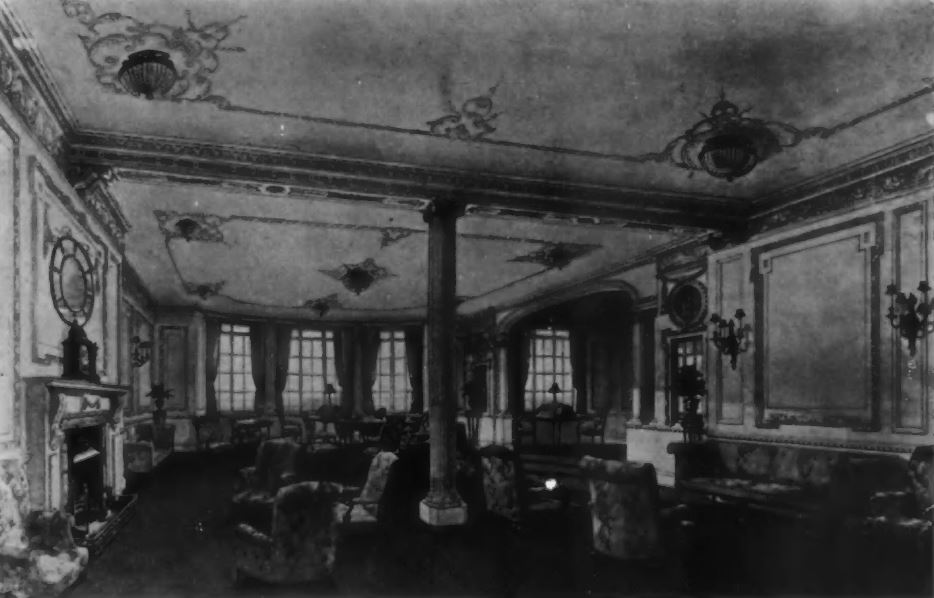
    Library of the ‘Olympic’, Winter, p. 372

    The public, it turns out, especially the seagoing public, overwhelmingly preferred light reading. A group of passengers, members of the literary fraternity, once addressed this very issue, conducting some impromptu research in order to decide it:

    …they spent a few hours in wandering up and down the ship and taking sly glimpses of the books actually being read by their fellow-travellers. A rather careful canvass of the entire ship resulted in the discovery that the book which easily carried off the prize was one of those familiar yellow covered novels by Archibald Clavering Gunter, at that time at the height of his popularity.

    Winter, p. 373
    Library of the ‘George Washington’, Winter, p. 373

    And onward, to the sources of migration, where Gunter had his books translated to be sold in numerous European countries. Those teeming masses in quest of dreams, dreams commodified in systems of movement and exchange, actual and symbolic, a veritable “trade in desires” (Frost).

    Library of the ‘Kronprinzessin Cecilie’ (Winter, p. 369)

    Thus the pieces of the jigsaw ultimately fell into place for Gunter: the fragments of careers, the transatlantic, transcontinental trajectories of his childhood so imaginatively combined.  We can see even at this early stage in Baron Montez of Panama and Paris, expressions of overarching themes that, in fact, encompassed Gunter’s being. Montez is like a reverse Yankee, tracing his desire in a reverse direction, from the Isthmus to Europe. Hence, a striking image of commodified desire:

    Upon this yellow dross [gold dust], Fernando’s eyes linger lovingly, and from it roam gloatingly to the heavy ironbound trunk of the Californian, and turning from this to the beautiful Americana, who had thrown her pearls in a string of white radiance around her fair white neck, his glance becomes more longing than ever.

    Chapter 3, “The Railroad Station at Panama”

    Notes and References

    • SS Amerika: “This steamship was built in 1872 by Harland & Wolff as the Celtic. It served in the White Star Line 1872-1893, and was then sold to the Danish Thingvalla Steamship Company. That employment lasted until the fall of 1897. Broken up in 1898.” Wikimedia Commons.
    • “organizes his own company to publish it”: Frost has a slightly different account; however, the version cited here is that given in a number of contemporary newspapers.

    Cohen, Marshal. The philosophy of John Stuart Mill: ethical, political, and religious (NY: Modern Library, 1961). Available at Internet Archive.

    Fisher, J. Historical Dictionary of American Theater (Lanham: Rowman and Littlefield, 2015).

    Frost, S. “A trade in desires: Emigration, A. C. Gunter and the Home Publishing Company.” Chapter 3 in The Book World, Selling and Distributing British Literature, 1900-1940, edited by Nicola Louise Wilson (Johns Hopkins UP, 2017). I have used the pre-peer-reviewed version of Frost’s paper.

    The Insider. San Francisco Call, Volume 101, Number 90, 28 February 1907.

    Kunitz, S. American authors, 1600 – 1900 a biographical dictionary of American literature (NY: Wilson, 1938).

    Winter, C. “The Libraries on the Transatlantic Liners”, The Bookman, 33.4, June 1911, 368-76


    Creative Commons License

    This work is licensed under a Creative Commons Attribution-ShareAlike 4.0 International License.
  • Gunter Biosnip: Seeds of Brilliance

    Gunter Biosnip: Seeds of Brilliance

    A brief reflection on the theme of eugenics that Brian Armour identifies in Baron Montez, in his preface to Chapter One. Gunter was himself probably of “mixed race” to a modest degree. Legacies of British Slave-ownership, a web site of University College London, reports that his father, Henry Gunter (1813–1856), was born in Jamaica to a one-quarter African woman.

    Archibald Clavering Gunter would have been, if their research is correct, at least one-sixteenth African. I venture to suggest that such a “quantum” of blood might tend towards a sense of identification with – indeed, a celebration of – the minority cultural, and racial, heritage.

    With this in mind, Gunter’s reference to the polyracial “polyhaema drops” in the blood of Montez becomes a tantalizing issue; as does the nature of his identification with his anti-hero. Gunter is fond of Montez even while the narrator reviles him. Of course, as we know, Lucifer is far more appealing as a character than God in Milton’s Paradise Lost. How fitting Gunter’s phrase, “This little disciple of Satan” in the opening to Chapter Two, “A Toboga Breakfast in56!

    The UCL web-page agrees with the short supply of biographical data in the literary overviews. Using New York and New Orleans passenger lists, it traces Henry Gunter three times across the Atlantic between 1838 and 1844, which evidences his alacrity as a merchant at the time.

    Henry Gunter married Elizabeth Agnes Sharples in Liverpool in 1839, and they had two sons, William Henry and Archibald Clavering. The family moved from Liverpool, first to New York in c. 1853, and soon after to San Francisco, where Henry became proprietor-manager of the “first conventional theater” to be built there, called the National. Archibald Clavering Gunter moved back to New York in 1879, after his variegated career (See Gunter Biosnip: Curse of Popularity).

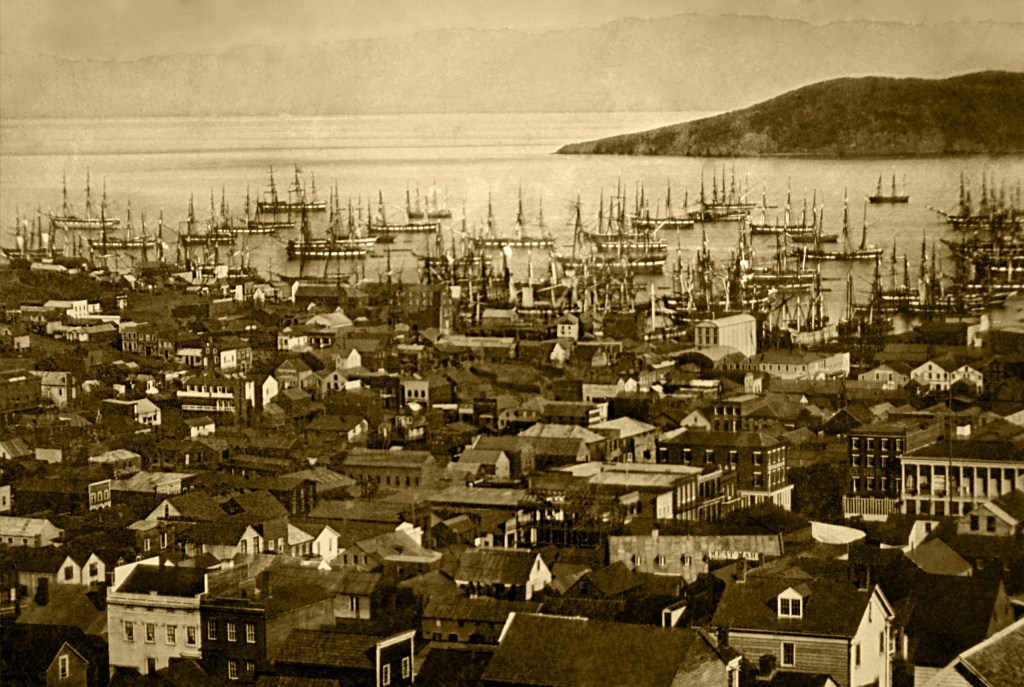
    As with J.F. Smith in England, whose father also owned a theatre company, Gunter first wrote plays. When he was a child, his home in San Francisco boasted “an unusually large living room built expressly for the purpose of giving young Archie a theatre in which to produce his youthful dramas.” It was a stately residence, attesting to the entrepreneurial success his father enjoyed with the National Theater. The house had an entrance on Washington Street and at the back overlooked the lower, adjacent Taylor Street. From the porch of this house, the oldest on the hill, was “one of the finest vistas in San Francisco” (The Insider).

    San Francisco harbor c.1851

    Ella Sterling Mighels considers the first two of Gunter’s dramatic successes as too high up on the “literary plane” for popular success, though she and her milieu were impressed that a San Franciscan was able to produce writing of such a high tone. He soon realized that the “high plane goes a-begging” and retuned it to appeal for public tastes (p. 338).

    The sensation caused by his first novel, Mr Barnes of New York, gave him an inkling he might be able to make a go of it on the printed page. Following the trail of other Californian writers before him, he moved East in 1879 and achieved just that, making enough to set up his own Gunter’s Magazine and The Home Publishing Company. He produced a string of thirty-nine novels and “one of the most remunerative careers ever lived by a man who lived by his typewriter” (The Insider). Gunter’s contemporary, the Californian author Gertrude Atherton (1857–1948) writes in Cosmopolitan that:

    His books have been on every stand in three continents where our language is read, and by a large proportion of the reading public abroad he is regarded as the representative American author.

    Cited in Mighels, p. 339

    … his international popularity being facilitated by a busy industry of book pirating.

    Baron Montez (1893) comes at the height of Gunter’s momentum. It is not one of his most cited works, but was decently reviewed when it appeared, with particular reference to Gunter’s skill, and to his  polyhaemic anti-hero.

    Here are some excerpts:

    The work exhibits the wonderful resources of the author’s mind and the richness of his imaginative powers. The characters are forcibly drawn, the details worked up with surprising exactness, and the plot unraveled with scrupulous care

    Although entirely a piece of fiction – good fiction, still under the surface may be found many direct hits at some of the social and political fads of the present day…

    His portrayal of the hero, Harry Larchmont, is excellent and will not only win the admiration of the fair sex, but also that of the men who admire a good athletic figure and a will power over which the Anglomaniac craze has no control.

    In the heroine, Miss Louise Ripley Minturn, we have one of those strong, sensitive characters, of the typical American girl – the girl to whom we raise our hat in honor, to her pluck, refinement and modesty; the girl who in the face of poverty and temptation will educate herself to meet the battle of life with a smile, and even though [sic] a typewriter, will assert her independence and uphold the greatest of all characters – the American woman.

    The central figure of the novel, however, is the all-nation prince of villains, Fernando Gomez Montez, mule boy of Cruces, self-ennobled to “Baron” Montez. As a villain he will challenge the admiration of all the readers. The conventional smooth, oily villain has been succeeded by an educated one, full of fascination, a good conversationalist, cunning and almost brave, a clear, quick-witted brain, working like fast revolving machinery, accurate in calculation, precise in detail, with a strong will and commanding power which fascinates all weaker natures first, and then causes them to obey…

    The scenes are panoramic in their changes, and carry the reader rapidly from the rushing restless, bustling city of New York to the drudgery and turmoil of the miasmic, fever-laden tropic isthmus, and thence to pleasure-loving, scheming Paris, the center of intrigue, gay life, inflated stocks, bonds, and feverish existence. The situations are very sensational and dramatic showing the author’s dramatic vein in the background of the novelistic landscape…

    Behymer, “Among the Authors” (1893)

    Chapter Three coming next week, edited and introduced by Brian Armour.


    Notes and References

    Behymer, H. “Among the Authors,” Los Angeles Herald, Volume 40, Number 40, 21 May 1893.

    Mighels, Ella Sterling, The Story of the Files: California Writers and Literature (Boston: Harvard U, 1893).

    The Insider. San Francisco Call, Volume 101, Number 90, 28 February 1907.

    Creative Commons License
    This work is licensed under a Creative Commons Attribution-ShareAlike 4.0 International License.
  • Gunter Biosnip: Curse of Popularity

    Gunter Biosnip: Curse of Popularity

    The word “unenthusiastic” well encapsulates Gunter’s critical reception. Observe his appearance in a number of overviews of the history of American letters and theatre. In his Dictionary of American Authors (1899), Adams pronounces Gunter’s “popular sensational romances” as “quite destitute of literary merit” (161). In American Authors, 1600-1900 a Biographical Dictionary of American Literature; complete in one volume with 1300 biographies and 400 portraits (1938) Kunitz grudgingly acknowledges Gunter as the “most widely read American novelist” for a few years, before concluding that “[h]is work had little merit and is almost completely forgotten today” (323).

    We find with Gunter the same theme that comes up with J.F. Smith and Sylvanus Cobb, Jr.: how often preeminently successful writers in their own day – when viewed through the lens of their popularity – were pilloried critically. Indeed, specifically for an author to make a considerable income from his or her work, generally attracted derisive opinions about their literary value. In the shorter term, they were prejudged (as Emerson prejudged Cobb, Jr., without having read him.) In the longer, their perceived shortcomings magnified, they were no longer read, for their unjustly disvalued reputations preceded them.

    This effect is particularly pronounced in encyclopedic coverages of the kind I mentioned in opening, because the compilers and editors have no opportunity to read the corpora of every single author they cover. Rather, they must distil the critical accounts of popular authors such as Gunter. Even though literally masses of readers celebrated him, what mostly remains is the critical taint.

    Hence, far more recently than the overviews I mentioned, in their Oxford Companion to American Theatre (2004), Bordman and Hischak find that

    [Gunter‘s] two dozen produced plays were generally perceived as lacking in real merit, but theatrically effective.

    p. 280

    Traditionally – and to some extent in the present day –theatre was considered a “lower” artistic form than literature. Only by extracting the words from the dramatic context, the theatrical occasion, can they attain to transcendence and timelessness. One truly appreciates Shakespeare, not by seeing a play, but by reading him on the page. Gunter’s play is merely “theatrically effective.” I don’t know quite how, but somehow Gunter must produce his play’s theatrical effectiveness from out of thin air rather than from his writing, which is obviously very poor, according to the remnants of critical account.

    Consider Bordman and Hischak’s verdict on Gunter’s early box office success, Fresh, the American (1881): a “loosely contrived farce” that nevertheless “provided [its leading man] with a major hit for two years” (245). And again, their description of another of Gunter’s successful plays, Two Nights in Rome (1872), as “a crude but powerful drama” (280). Note yet again the persistence of the dual description, and how “crude” tends to outweigh “powerful” in the impression it leaves regarding his literary talent — and a reader’s orientation towards his books..

    Their ambivalence betrays their instinct to avoid the taint of a literary elitism that bolsters the structures of the traditional canon. One mainstay is a perceived opposition between “merit” and “popularity.” Hence this “crude but powerful” each-way bet. The play lacks some ephemeral quality that marks true literature, despite, or because of its “vulgar” mass appeal. On the other hand, Adams, writing more than a century before them viewed a “popular sensational romance” as crossing a line drawn in filth.

    Archibald Clavering Gunter, in King, Notable New Yorkers of 1896–1899

    Understandably, canonical-critical preconceptions pervade the institution of publishing. Gunter wrote his first novel, Mr. Barnes of New York (1887), in response to a dare by a friend: “I bet you couldn’t put me into a book and make me interesting” (San Francisco Call, Volume 101, Number 90, 28 February 1907). Hart, in his The Popular Book: a History of America’s Literary Taste (1950), describes the novel as “awkwardly written.” This implies he has read it; but of course, it could only have been awkwardly written to have been so roundly rejected for publication.

    I don’t mean to suggest that the book may not in one way or another be considered awkwardly written—many are. Its awkwardness was clearly not, however, a defining characteristic that prevented the novel from providing immense pleasure for millions of people who actually did read it.

    According to a celebratory account in the San Franciso Call, written the week after Gunter died in Chicago in 1907:

    [Mr. Barnes of New York] was offered to most of the publishers in the country, and not one would consider it, so the author finally decided to publish it himself. It came out in 1886, and was not a best seller at once. Indeed, it fell as flat as the proverbial pancake, but one copy being sold on the first day of publication. Within seven months, however, it was selling at the rate of nearly 3500 a day,

    … ultimately to the tune of three million copies (Burt, p. 271).

    The astute obituarist views the issue of Gunter’s “literary merit”:

    Archibald Clavering Gunter’s works will never be considered literature. He lived a generation too soon; he never became one of the “six best sellers” because his books always sold in greater numbers than the “Six Best” ever dared to.

    It would have been laughable for Gunter’s cheap yellowbacks ever to make it into the Bookman’s bestseller list. The “Six Best” would have found it equally ludicrous to leap from literary grace in pursuit of such spectacular popular acclaim, even if they were able to.


    Notes and References

    Adams, Oscar F. A Dictionary of American Authors (Boston: Houghton & MIfflin, 1899).

    Burt, Daniel S (ed.) The Chronology of American Literature: America’s Literary Achievements from the Colonial Era to Modern Times (Boston: Houghton Mifflin, 2004).

    Bordman, G. and Hischak, T.S, Oxford Companion to American Theatre (2004). 3d ed. (NY: OUP, 2004)

    Hart, J.D, The Popular Book: a History of America’s Literary Taste (NY: OUP, 1950).

    King, Moses. Notable New Yorkers of 1896–1899, NY: King, 1899.

    Kunitz, American Authors, 1600-1900: A Biographical Dictionary of American Literature; complete in one volume with 1300 biographies and 400 portraits (1938).

    Sorenson, Alan T., “Bestseller Lists and Product Variety,” Journal of Industrial Economics, 55.4, Dec. 2007 (pp. 715–38).

    “The Insider”, San Francisco Call, Volume 101, Number 90, 28 February 1907.

    © 2020 Furin Chime, Michael Guest

  • A.C. Gunter’s Baron Montez of Panama and Paris

    A.C. Gunter’s Baron Montez of Panama and Paris

    Prepare to embark on an idiosyncratic taste thrill, another foray into the paradoxically expanding universe of vanishing literature. This bestselling author-playwright, said to have been better known in his day than his contemporary, Mark Twain (1835-1910), is now reduced to fragments, trivial contributions to popular culture: Played middle-man in the rise of the great American baseball poem “Casey at the Bat” – sometimes referred to as the best known poem in the United States. Authored a novel on which A Florida Enchantment (1914) was based, ancestor of lesbian-transgender films.

    Archibald Clavering Gunter (1847-1907) was born in Liverpool, England, taken by his parents to San Francisco when he was six, and grew up there, before moving to New York to become a playwright, after building careers in rail and mining engineering, chemistry and stockbroking. Something of the thrill and spectacle of that six-year-old Liverpudlian’s trans-Atlantic voyage surely took permanent root in his imagination, given the extensive output he managed to generate even after such patently anti-literary occupations. Actually, he wrote his first play, Found a True Vein (1872), about life in a mining camp, while still working as an engineer.

    Baron Montez of Panama and Paris (1893) is a rags-to-riches story, like other of Gunter’s novels propelled by a dynamic of character and place. We can compare with titles of his such as  Mr. Barnes of New York (1888), Mr. Potter of Texas (1891), Don Balasco of Key West (1897), and the intriguing Miss Nobody of Nowhere (1890). Intriguing indeed, as Harlequin Romance author Elizabeth Ashton must have thought in 1933 when writing her novel Miss Nobody from Nowhere.

    But where are places as plentiful in such possibilities of drama and exotica as Panama and Paris – especially in that exciting era of massive change and aspiration, of explorers, prospectors, swindlers and tycoons? We wonder already about Gunter’s representation of the burgeoning Americas and Americana upon a global stage.

    Panama Dancers (1910-11), Ernst Ludwig Kirchner. (North Carolina Musuem of Art)

    Shady Señor Fernando Montez starts out as a seedy muchacho in a bamboo shack on Toboga Island. These are portentous times, however, preceding the building of a great canal to link the Atlantic and Pacific Oceans, and hence the two hemispheres of the globe, a dream only intensified by the discovery of Californian gold. Montez’ ascent can be limited only by his own hubris, and Gunter’s imagination.

    The French diplomat Ferdinand de Lesseps, who had developed the Suez Canal in 1869, attempted a repeat performance in Panama during the years 1881-89 but went bankrupt. The Compagnie Nouvelle du Canal de Panama again tried unsuccessfully in 1894. Gunter’s novel is, therefore, quite contemporaneous with the world depicted in it. One anticipates a taste of the authentic flavour of the times—the authentic zeitgeist, good and ill.

    In Gunter’s own estimation, his were “the most successful novels ever published” (Hart 189). Well, we’ve heard that sort of thing before, and it depends which way you’re looking at it. Nevertheless, if not for literary brilliance or a polished style, he is acknowledged for bringing American and European attitudes into a comparative focus and for the immense popularity of his

    …long line of yellow-backed novels, soon to be seen in innumerable hammocks, summer resorts, excursion boats, Pullman Palace cars, or wherever else Americans moved for dreams and escape.

    Hart 188

    Brian Armour will edit the chapters and provide reflective, contextual prefaces. Brian is the author of a stunningly good science fiction novel, Future Crime (2015), with a further brilliant novel and book of short stories coming out soon.


    Reference

    Hart, J.D.,The Popular Book: a History of America’s Literary Taste (NY: OUP, 1950).